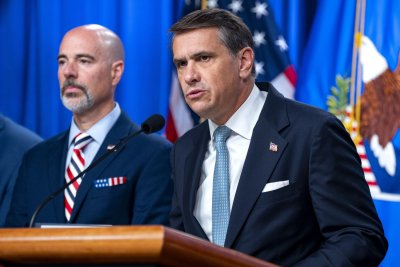
Aug. 10 (UPI) — Todd Blanche, President Donald Trump‘s former personal attorney, was sworn in as U.S. attorney general on Monday, making the role he’s held for several months official.
“I am deeply honored by the trust and confidence President Trump has placed in me to lead the Department of Justice as our great nation’s 88th attorney general,” Blanche wrote on social media Saturday after the vote. “I am grateful to the Senate for staying late to finish the process.”
The vote was largely along party lines, with Sen. Lisa Murkowski, R-Alaska, and Sen. Susan Collins, R-Maine, voting with every Democrat against Blanche. While other Republicans, including Sens. Thom Tillis, R-N.C.; John Cornyn, R-Texas; and Bill Cassidy, R-La., had expressed concerns about Blanche’s independence and earlier actions, they voted for him anyway.
Blanche was Trump’s personal defense lawyer and represented him in a New York hush-money case and other criminal matters, The Guardian reported. He became a deputy attorney general in early 2025.
As acting attorney general, Blanche approved Trump’s $1,776 billion “anti-weaponization fund” and a deal that promises the Internal Revenue Service will not investigate Trump’s tax returns or those of his family members. Blanche rescinded the order establishing the fund last week.
As acting attorney general, he has overseen the departure of more than 200 prosecutors and agents who worked on Trump-related investigations and dealt with controversy from the handling of the Epstein files, The Guardian reported. Lawmakers continue to seek the full release of the records.
New president, who replaces leftist Gustavo Petro, continues rightward political shift in Latin America.
Published On 8 Aug 20268 Aug 2026
Right-wing lawyer Abelardo de la Espriella has been sworn in as Colombia‘s president after winning a run-off election on promises to crack down on the armed groups, cut government spending by as much as 40 percent, and revive the South American country’s oil and gas industry.
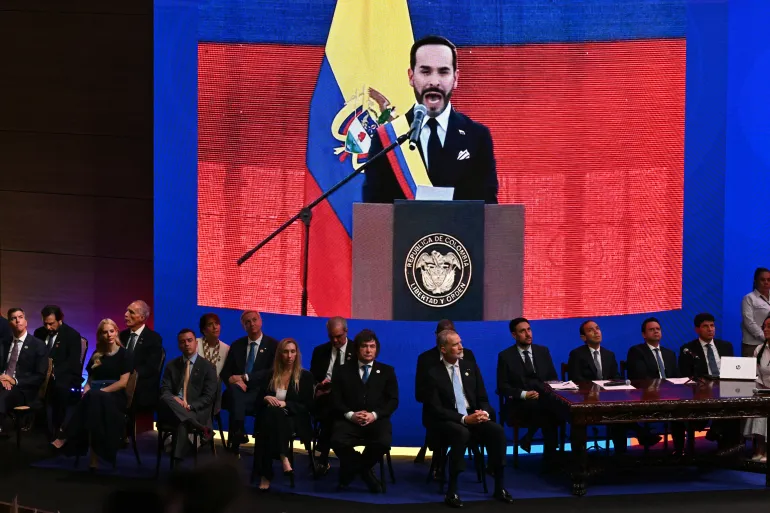
De la Espriella, 48, took the oath of office on Friday, breaking with tradition by holding the ceremony not in the capital, Bogota, but in Cali, a city in Colombia’s volatile southwest that has long borne the brunt of the government’s conflict with armed groups.
Recommended Stories
list of 3 itemsend of list
The choice signaled a decisive break from the strategy of negotiated peace with those groups pursued by outgoing leftist leader Gustavo Petro, whom de la Espriella defeated in June’s runoff. De La Espriella has dismissed Petro’s policy as a failure.
“There will be no room for maneuvers that undermine the stability of the nation,” de la Espriella said on Friday, as he pledged to “relentlessly defeat narco-terrorism”.
He added that “the option of dialogue is completely exhausted”.
A political newcomer known to supporters as “El Tigre”, The Tiger, de la Espriella built his fortune and public profile as a lawyer and businessman rather than through elected office, largely self-financing his campaign as an outsider candidate.
His arrival in power marks a sharp ideological reversal for a country that, for the past four years, was led by a former rebel fighter who was frequently critical of the drug and immigration policies of United States President Donald Trump.
De la Espriella has, in contrast, hewed closed to Trump and his militaristic approach to drug crime in Latin America.
Security dominated Friday’s ceremony, which was held at a university auditorium before Congress. Soldiers and armoured vehicles lined roads near the venue, and police manned checkpoints screening vehicles for explosives in the preceding days.
Guests at Universidad Santiago de Cali watch Colombia’s new President Abelardo de la Espriella deliver a speech from the Pichincha Battalion on a giant screen during his inauguration ceremony in Cali. [AFP/Luis Acosta]
After the ceremony, de la Espriella travelled to a nearby military battalion to address troops directly, framing the visit as both a morale boost for the armed forces and a signal to the country’s armed groups of the approach he plans to take.
Colombia’s southwest remains contested territory for dissident factions of the demobilised FARC rebel movement who rejected the peace deal signed a decade ago. The Clan del Golfo drug cartel, and the National Liberation Army, or ELN guerrilla group are also active in the area.
The new president has also pledged to join the so-called “Shield of the Americas”, a US-backed regional coalition against drug trafficking that grew out of a summit hosted by the Trump administration in March. He has vowed to restored diplomatic relations with Israel and sever ties with Cuba and Nicaragua, branding them “tyrannies”.
Petro had initially refused to accept the election result, alleging that vote tallies had been manipulated. The claim was dismissed by international observers and Colombia’s own electoral authorities. Petro ultimately conceded he would respect the outcome.
Still protests broke out in Cali, Bogota and Barranquilla on inauguration day.
In Cali’s Puerto Resistencia neighbourhood, once the epicentre of mass anti-government demonstrations in 2021, 25-year-old protester Sebastian Ocampo said residents were “defending dignity” against a president he said had not won their support.
De la Espriella’s win extends a run of electoral victories by conservatives across Latin America, with seven elected since Trump returned to the White House in January 2025. That includes Peru’s Keiko Fujimori, Jose Antonio Kast in Chile, and Argentina’s Javier Milei.
Trump personally endorsed de la Espriella’s campaign.
Leaders in attendance at Friday’s event included Spain’s King Felipe VI, acting US Attorney General Todd Blanche, FIFA president Gianni Infantino, and several of Latin America’s other conservative leaders, including Milei and Kast.