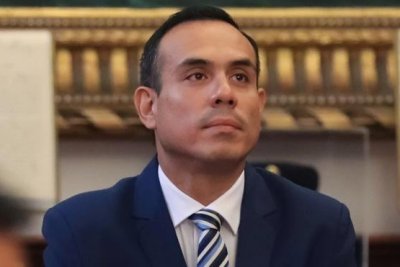

Peru’s interim president, Jose Jeri, appears before the Congressional Oversight and Accountability Committee in Lima, Peru, in January. Jeri denounced a plot against him and a clear intention to destabilize the country, after a series of videos were revealed showing semi-clandestine meetings and encounters he had with a Chinese businessman, as well as visits to the Government Palace by another businessman of the same nationality who was under house arrest. Photo by Paolo Aguilar/EPA
Feb. 17 (UPI) — Peru’s Congress convened Tuesday in an extraordinary session to debate seven censure motions against interim President Jose Jeri — a move that could remove him from office less than two months before general elections and deepen the country’s ongoing political instability.
Jeri, who also serves as head of Congress, would automatically lose the presidency if lawmakers vote to oust him from that parliamentary post. He has denounced what he calls a plot against him and an intention by enemies to destabilize the country.
Jeri assumed the presidency in October after the removal of Dina Boluarte. However, investigations into Jeri’s conduct and declining public support have weakened his political standing, according to local newspaper La Republica.
According to local media reports, the current crisis escalated after reports that the president held unregistered meetings, not listed on his official agenda, with two controversial Chinese businessmen.
One reportedly holds multimillion-dollar state contracts and has been linked to construction firms accused of securing public works through bribes. The other has faced legal proceedings for trafficking illegal timber from the Amazon region.
Prosecutors have also opened a preliminary investigation into alleged influence peddling involving the hiring of nine young women in public institutions after meetings with Jeri at the presidential palace.
Those allegations enabled opposition lawmakers to gather 78 signatures to present a censure motion against him as congressional president — a step that would automatically remove him from the presidency.
Under congressional rules, a simple majority is required to approve the censure motion, RPP Noticias reported.
Peru has experienced marked political volatility over the past decade. Six recent presidents have faced removal proceedings or imprisonment, reflecting a pattern of institutional instability.
Analysts often cite the repeated use of constitutional mechanisms such as presidential vacancy on grounds of “moral incapacity” and censure votes against congressional leadership, factors that have made the presidency unusually fragile.
Political calculations ahead of Tuesday’s vote suggest limited support for the 39-year-old president. Most political blocs have expressed opposition to him continuing in office, with the exception of Fuerza Popular, the party associated with right-wing presidential candidate Keiko Fujimori.
Peru’s fragmented Congress includes about a dozen political blocs whose members frequently split during votes, leading analysts to caution that the outcome remains uncertain.
Jeri’s party, Somos Peru, is expected to attempt a procedural delay by requesting a constitutional review on whether a censure motion applies to an interim president. According to El Comercio newspaper, the Constitutional Commission could take about two weeks to issue an opinion, which might give Jeri time to secure additional political backing.
If Jeri is removed, Congress would elect a successor from among its members. That person would become Peru’s eighth president in a decade and oversee the transition toward general elections scheduled for April.