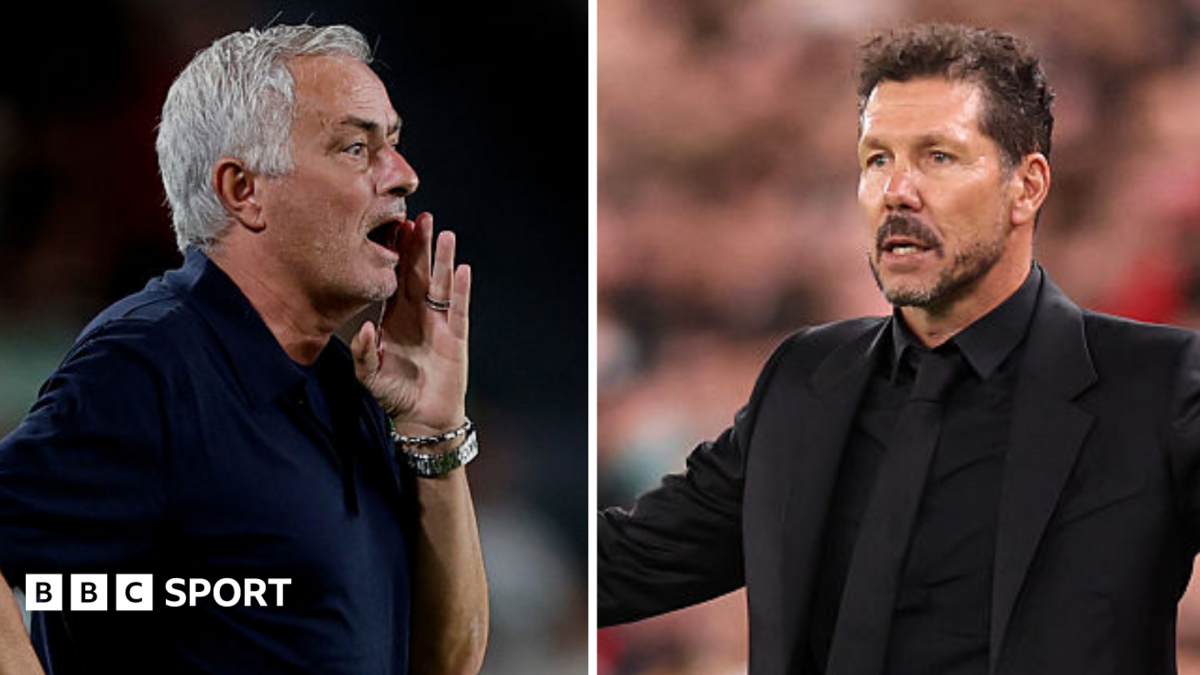
After years of speculation, Jose Mourinho has confirmed that he agreed to replace Sir Alex Ferguson at Manchester United in 2013, before changing his mind and re-joining Chelsea instead.
“When I left Real Madrid, I signed to go to Manchester United after Sir Alex,” the 63-year-old coach – now back at Real for a second spell – said in a new Netflix documentary series about his career.
“He was offered the job, yes,” confirmed Ferguson, who won 13 Premier League titles over 26 years at Old Trafford before retiring in 2013.
“I sat him down and explained the situation,” he added: “As far as I was concerned, he was accepting. And then, within hours, it changed.”
What changed was that Mourinho felt he could not turn down a return to Chelsea, where he had won consecutive Premier League titles in 2005 and 2006.
“One night, he phoned me and he was crying and he says, ‘Alex, I can’t take it. I’ve given my word to Chelsea and I’m not going to break my word’,” said the former United boss.
“The reason he gave to me, I could understand, but I was disappointed.”
Mourinho said he was “very flattered” to be offered the job of replacing Ferguson “because Manchester United has an incredible appeal”.
“But one thing is love for football, another thing is love for a certain club,” he explained.
“I think this is more powerful than love for football and fundamentally, after Real Madrid, I needed to feel that I’m loved.
“For me to lose the chance to be the coach to succeed Sir Alex Ferguson was dramatic, but I don’t regret (it) because it was a decision that I made with my heart.”
After returning to Stamford Bridge in 2013, Mourinho went on to win his third Premier League title as well as the League Cup.
In May 2016, he got a second chance to take over at United, succeeding Louis van Gaal.
Over a two-and-a-half year spell at Old Trafford, Mourinho won League Cup and Europa League titles before being sacked in December 2018 following a slump in results.
He returned to another of his old clubs, Real Madrid, in May this year. Mourinho’s last spell there ended in acrimony as he fell out with club captain Iker Casillas and other players.
On the eve of his Real reunion, the combative manager and former Spain goalkeeper Casillas spoke candidly about the reasons behind those differences.
Mourinho also spoke about difficulties he has faced with former Chelsea owner Roman Abramovich, who hired him twice and sacked him both times.
Rengel stressed the importance of completing seismic microzoning studies in La Guaira. (Venezuelanalysis)
José Gregorio Rengel is a civil engineer with a master’s degree in seismic-resistant engineering from the Central University of Venezuela (UCV), where he presently teaches, and specialization studies in geological risks at the University of Geneva, Switzerland. Rengel is a member of the government commission tasked with assessing the structural damage from the June 24 double earthquake.
In this interview, he discusses the effects of the tremors, Venezuela’s building codes, and the steps toward reconstruction.
Why did the double earthquake on June 24 have such devastating effects on La Guaira?
Every seismic event is caused by a rupture along geological faults, and in this case, the rupture –which began in Yaracuy State –follows a distinct east-west direction along the San Sebastián fault. The coastal strip that is La Guaira lies directly on that rupture plane. In fact, the distance from La Guaira to the fault –specifically, the fault’s rupture plane –is 0 kilometers in some areas; in other words, the state lies directly on the rupture. This is made clear in all the reports released by various agencies, from [Venezuela Seismological Research Foundation] FUNVISIS to the US Geological Survey.
In an earthquake, the effects are maximized the closer cities are to these rupture planes. Furthermore, the earthquake was a very shallow event. In other words, it occurred at a small depth, which also leads to stronger effects. Thus, La Guaira meets these two specific conditions: first, it is practically located on the rupture plane, and second, the earthquake was a shallow event.
From a structural standpoint, with thousands of buildings affected, what are the priorities right now?
For now, our task is to inspect the buildings that were affected. Four weeks after the earthquake, we have conducted more than 32,000 inspections using the traffic-light system. Buildings that have not been damaged in any relevant way receive a green label; those that have been moderately affected, a yellow label; and those with significant damage, where people should not remain, a red label.
Next will come a reconstruction phase, which must be carried out in accordance with Venezuela’s seismic codes, most recently updated in 2019. In the case of La Guaira, additional studies are needed, such as developing a seismic microzoning analysis that already exists for Caracas. Although several studies are well underway, this classification has not yet been completed in La Guaira.
Can you explain a bit further what these building inspections consist of?
The current inspections are rapid assessments designed to enable an immediate decision regarding the occupants: whether they can stay, use the building under restricted conditions, or whether they must evacuate. Our job is to categorize the level of damage to the building.
This is followed by a second phase, during which a more detailed inspection will be conducted on structures that received yellow or red labels to determine which of these could proceed to the repair stage. This, in turn, requires a more detailed assessment by structural experts to determine what type of repair work can be performed and how it would be carried out. In cases where it is not possible to restore the structure, for those that are too severely damaged, protocols for safe, controlled demolition must be established.
Rengel talking to local residents and issuing a “green” label after a building inspection. (Ángel Márquez)
The corporate media has tried to push the narrative that buildings constructed as part of the Great Venezuela Housing Mission (GMVV) were particularly hard hit in La Guaira. Is there any truth to it or is it a myth?
We have witnessed the collapse of various types of buildings, ranging from those built by the private sector, which account for the majority of the destroyed buildings observed, to those built by the public sector. Some of them were part of the Great Venezuela Housing Mission.
In some cases, the flattened buildings were very old. In other cases, they had structures that were supposed to be built in accordance with the latest codes. We will need to assess whether they failed to meet the standards, and that must be investigated. We cannot jump to conclusions.
However, it is also possible that the buildings did meet the standards, but the seismic event exceeded them. So far, everything seems to indicate that this was an extraordinary geological event and may have surpassed the country’s existing codes, especially in La Guaira.
As far as we understand, in Venezuela the building codes are primarily governed by the standards of the Ministry of Habitat and Housing and the COVENIN industrial norms system. What do these standards establish?
Basically, there are two types of standards: seismic standards, which specify the level of acceleration for which a building is designed to withstand, in terms of ground acceleration. In other words, this relates to the force that an earthquake exerts on structures. Therefore, the structural setup of buildings is designed to withstand these lateral forces caused by earthquakes through a calculation of acceleration at the base. This is something the standards define very clearly. Our most recent seismic standards were updated in 2019.
And then there are the building codes. These are essentially regulations governing how to construct with reinforced concrete, steel, and other materials. But fundamentally, in Venezuela, we build with concrete and steel. Currently, both types of codes are up to date and comply with international standards. Furthermore, Venezuela has a long tradition of good engineering practices in earthquake-resistant construction and structural engineering.
Rengel stressed that every collapsed building warrants a thorough investigation. (Rome Arrieche)
If the investigations ultimately reveal that those standards were not met, should penalties be imposed?
Certainly, yes. It is necessary to conduct an investigation into each collapsed building, or at least a sample of these buildings. This is the ideal approach. Of course, we must also take into account that the earthquake was an event with characteristics that we might call extreme or extraordinary.
In the case of La Guaira, given that the geological fault is very close to the affected areas, this generated what in science jargon are called near-field effects, which subject structures to extreme stress. That is why even buildings that were well-constructed and very robust sustained significant damage.
However, all cases of total collapse must be investigated to understand the causes: whether the earthquake exceeded the standards under which they were built, or whether there were construction defects or regulatory violations. The goal is to determine the predominant cause of the collapse. In La Guaira, we are working with the hypothesis that the seismic event exceeded regulatory parameters.
Looking now toward reconstruction, what are the next steps, particularly in La Guaira?
The first step is to continue developing seismic microzoning studies. This is what will allow us to understand in which areas of La Guaira there is an amplification of accelerations, an amplification of the effects of earthquakes, so that we can impose the strictest design and construction requirements precisely in those areas. Therefore, these rigorous microzoning studies must be conducted, completed, and translated into a map that complements the other regulations.
Jose Siri hit a game-winning single in the 10th inning, Mike Trout and Logan O’Hoppe homered, and the Angels beat the Houston Astros 3-2 on Wednesday night.
Angels starter Reid Detmers retired his first 15 batters before Shay Whitcomb homered leading off the sixth. Chase Silseth replaced Detmers to begin the eighth and gave up a leadoff homer to Cam Smith that tied it 2-all.
Houston nearly took the lead in the ninth. Yordan Alvarez singled with two out and Christian Walker followed with a double that appeared to score Alvarez. But the Angels challenged the safe call at home plate and it was overturned following a replay review.
Bryan Abreu (2-3) came on for the Astros in the 10th and pinch-hitter Donovan Walton hit a leadoff single that moved automatic runner Nick Madrigal from second to third. Siri, facing one of his former teams, then hit an 0-2 pitch to left field to drive in Madrigal.
Ryan Zeferjahn (3-3) worked a scoreless inning for the win.
Trout launched his 15th homer to open the scoring in the first, and O’Hoppe’s drive with two out in the fifth made it 2-0.
Peter Lambert gave up two runs and five hits with six strikeouts in 6 1/3 innings for Houston.
Detmers permitted only one hit over seven innings. He struck out nine and walked none. The left-hander is third in the American League with 97 strikeouts and has given up three or fewer earned runs in eight of his last nine starts.
Benfica said they had “reached an agreement” with Silva who is set to sign a contract until the end of the 2027-28 season which can be extended to 2028-29.
Fulham were Silva’s fourth English club after spells in charge of Hull City, Watford and Everton.
Mourinho’s exit from Estadio da Luz was also announced, with Benfica saying Real Madrid will pay them £13m (15m euros) in compensation to bring the 63-year-old back to the Bernabeu.
“The coach [Mourinho] has given his agreement to this hiring,” added a Benfica statement.
“Thus ended Jose Mourinho’s second spell as manager of Benfica’s professional football team.”
Mourinho took charge of Benfica in September and led them to third place in the Primeira Liga this season as they went through the league campaign unbeaten.
In his previous spell in charge of Real Madrid between 2010 and 2013, the Portuguese won La Liga, the Copa del Rey and the Spanish Super Cup.
Nothing could possibly generate a headline Tuesday night when the worst American League team — the Angels — played host to the perhaps the worst National League team — the Colorado Rockies.
Except. . .
This.
A fly ball conked Angels right fielder Jo Adell on the head and bounced over the fence for a home run, reminding fans of José Canseco’s similar gaffe 33 years ago.
The ball caromed back into the outfield and Rumfield momentarily stopped at second base. But the umpires confirmed the home run, coupling Adell with Canseco in numerous social media posts.
Canseco, the steroids-fueled, defensively challenged left fielder of the Texas Rangers, made a similar blunder on May 26, 1993, when a ball hit by Cleveland’s Carlos Martínez bounced off his head and over the wall.
Mike Trout presumably has witnessed every possible blooper, blunder and boo-boo in 16 seasons with the woeful Angels. The center fielder stood only a few feet from Adell when this one occurred and did not make himself available for comment afterward.
To his credit, Adell faced reporters.
“It looks like I’ve never played in the field before, which is disappointing, because it’s beyond the truth,” he said. “I’m the only one that really knows what happened. I was out there, and it happened to me, so it is what it is.
“It was kind of the icing on the cake, because I was [expletive] all the way around the whole day today.”
Adell was hitless in four at-bats, striking out twice, in the 8-2 loss that dropped the Angels to 23-39, the worst record in the AL.
The play was emblematic of Adell’s seven-year career with the Angels, who made him a first-round draft pick in 2017. At first blush, his lifetime Wins Above Replacement of 0.3 would indicate that he’s little better than the fictional minor league “replacement player” to which MLB players are compared in calculating the statistic.
Yet Adell’s physical tools and occasional highlights scream stardom. He shouldn’t be an ordinary Jo. The antithesis of the embarrassing episode Tuesday night came less than two months ago when he robbed the Seattle Mariners of three home runs in one game.
“It was the Jo Show,” Angels manager Kurt Suzuki said at the time. “This guy works as hard as anybody I’ve ever been around. His work ethic, attention to detail, his desire to improve every single day. To see him do that, I don’t believe you’ll see that again.”
Suzuki, who was Adell’s teammate in 2021 and 2022, likely never thought he would see a fly ball bounce off the outfielder’s head and into the stands, the Jo Show shifting to Oh, No!
“I saw the play, but for me, Jo’s made great strides defensively from when I played with him,” Suzuki said Tuesday. “And obviously, he had the night he robbed three home runs. It was a tough play tonight, but at the same time, the strides that he’s made defensively have been great.”
Adell was considered a defensive liability early in his career and was saddled with a four-base error in 2020 when a fly ball hit his glove and went over the fence. But he steadily improved and became a Gold Glove Award finalist in 2024.
That didn’t stop the “Tarps Off” throng of shirtless fans at Angel Stadium from chanting Adell’s name after the gaffe against the Rockies. For his sake, they likely will revert to imploring Angels owner Arte Moreno to “sell the team” soon enough.
Adell might have to stay away from social media forever, but he would like to forget the ball bouncing off his head as soon as possible.
“That’s what we have to do,” he said. “I mean, there’s really no other way around it. Let it fester and tumble over, but these are plays I’ve made hundreds and thousands of times. I’ve got to just keep going, and as a team, we’ve got to keep going.”
Mourinho was seen speaking with Vinicius after he walked off the pitch following the interaction with Prestianni.
But it was Mourinho’s post-match comments that were the most shocking.
While publicly backing his player Prestianni, Mourinho suggested Vinicius had incited tensions through his celebration in front of the home support.
“You score a goal from another world, why celebrate like that?” Mourinho said.
“The same thing always happens in so many stadiums. In how many states has this happened? In how many stadiums? How many? How many?
“He’s an out of this world player, I love him. Vinicius tells me one thing and Prestianni tells me another. I want to be balanced.”
The remarks sparked widespread criticism, with many accusing Mourinho of shifting attention away from the racism allegations and placing responsibility on the victim instead.
In addition to expressing his belief that Vinicius had been disrespectful with his goal celebration, he pointed to the club’s legendary striker Eusebio as proof that Benfica are not a racist club.
Asked if he felt Vinicius incited the crowd, Mourinho said: “Yes. I believe so.
“It should be the crazy moment of the game, an amazing goal. Unfortunately [he was] not just happy to score that astonishing goal. When you score a goal like that, you celebrate in a respectful way.”
He added: “When he was arguing about racism, I told him the biggest person in the history of this club [Eusebio] was black.
“This club, the last thing that it is, is racist. They [Vinicius and Prestianni] told me different things. But I don’t believe in one or another. I want to be an independent.”
Jose Mourinho completed an unbeaten league season with Benfica but had to settle for third place in the Portuguese top-flight.
Benfica beat Estoril 3-1 in their final match of the campaign as they ended their undefeated Primeira Liga campaign with 23 wins, 11 draws and no defeats.
However, they finished on 80 points – eight behind champions Porto and two behind second-placed Sporting.
The victory against Estoril could be Mourinho’s final game in charge of Benfica as he is in final negotiations to become Real Madrid manager, 13 years after his first spell at the Bernabeu.
The 63-year-old joined Portuguese side Benfica as manager on a two-year contract last September, but is wanted by Real president Florentino Perez.
This is not the first time Benfica have gone a league season unbeaten and ended up trophyless.
In 1977-78, Porto drew two games fewer and pipped them to the league title on goal difference.
Mourinho’s Benfica have join FC Sheriff in Moldova (2024-25) and Serbian side Red Star Belgrade (2007-08) as the only European sides this century to miss out on a league title despite going an entire season without losing.
Arbeloa has also faced criticism from France striker Kylian Mbappe after he was left out of the starting line-up for Los Blancos’ 2-0 win over Real Oviedo.
Mbappe had missed his side’s two previous games, including last weekend’s El Clasico which Barcelona won to secure the league title, with a thigh injury and was whistled by his own fans when he came on.
The World Cup winner has faced scrutiny over his commitment to the club in recent weeks while an online petition calling for ‘Mbappe Out’ attracted tens of millions of signatures.
But the manager played down the incident on Saturday.
“I’ve just bumped into him, I told him to stay calm. I understand that these kinds of things make headlines, but it’s something much more normal than you think,” Arbeloa said.
“I used to be a player, I know what they can feel in these situations – playing every day, then playing less or not at all.
“I totally understand that Kylian wasn’t happy about not playing on Thursday, and I like that.
“I wouldn’t understand it if he didn’t want to play. My relationship with him remains the same.”