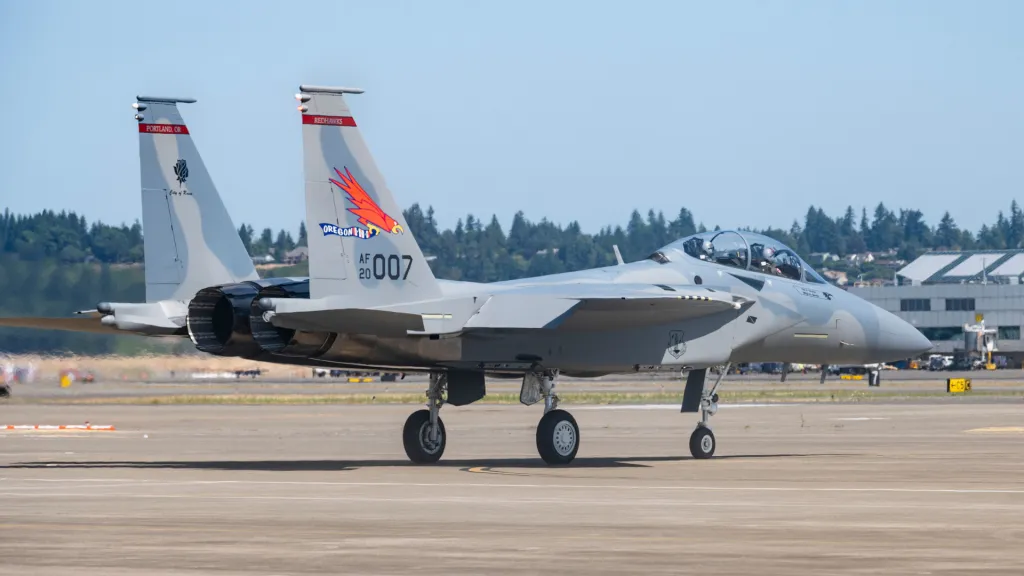
A pair of operational F-15EX Eagle II fighters assigned to the Oregon Air National Guard’s 142nd Wing are now flying with conformal fuel tanks (CFT). While F-15EX test jets have been flying with surplus CFTs for years, the U.S. Air Force did not originally feel that combat-coded jets needed them to perform their primary air-to-air missions. For the Eagle II, CFTs offer boosts in range and capacity to carry stores, especially air-to-ground munitions, and are another sign of how the jet’s mission requirements are evolving.
Photographer Bill Shemley brought the CFT-equipped F-15EX Eagle IIs to our attention after spotting them operating recently at Portland International Airport. The airport is collocated with Portland Air National Guard Base, the home of the 142nd Wing. One of the jets in question is serial number 20-0012, part of the first batch of production Eagle IIs, which started being delivered to the 142nd in 2024. As of September, the Air Force had received 22 F-15EXs, including test jets, out of a planned fleet of 267 Eagle IIs. The service revealed earlier this year that the target fleet size had roughly doubled, up from the previously stated program of record of 129 aircraft.

“We are currently using conformals that we received from ACC [Air Combat Command] on two F-15EX Eagle IIs,” SMSgt. Steve Conklin, a public affairs officer with the Oregon Air National Guard, told TWZ when asked for more information. “We were given the opportunity from ACC and have flown the approved configuration for the last two weeks.”
We are still seeking additional details. The CFT that is visible in Shemley’s picture notably has the insignia of the 366th Fighter Wing, which flies F-15E Strike Eagles from Mountain Home Air Force Base in Idaho. In the past year or so, the 142nd has been sending Eagle IIs, pilots, and ground personnel to Mountain Home to conduct air-to-ground mission training.

The F-15EX is designed to use the same CFTs that are standard on the F-15E, as well as all other members of the extended Strike Eagle family. This includes the F-15QA for Qatar, on which the Eagle II was directly based. Each CFT can hold some 750 gallons of fuel and adds six additional pylons.


As mentioned, the Air Force did not originally plan to equip operational F-15EXs with CFTs. This decision was made despite the aircraft having the necessary provisions and initial testing having been done using jets fitted with them. Instead, the Eagle IIs were expected to fly with external drop tanks under their wings, just like the F-15C/D Eagles they were slated to replace.

“The F-15EX program as funded from FY20-FY23 is a direct replacement for the F-15C/D in the air-to-air and homeland defense role,” an Air Force spokesperson explained to TWZ back in 2023. “The F-15C/D does not typically operate with CFTs, and the first operational F-15EX aircraft do not have CFTs funded.”
A number of Air Force F-15C/Ds did fly with CFTs, also known as “FAST Packs,” during the twilight of the Cold War and its immediate aftermath. Those aircraft operated primarily from bases in Alaska and Iceland where long-range patrols and quick-reaction alert (QRA) missions were the norm.

“The DAF [Department of the Air Force] is exploring options to resource a number of advanced capabilities for the F-15EX fleet, including both new and refurbished CFTs, in current and future budget submissions,” the spokesperson added at that time.
Where things currently stand when it comes to equipping all operational F-15EXs with CFTs, including on Eagle IIs destined for forward-deployment in Japan, is still not entirely clear. The service’s Fiscal Year 2027 budget proposal, released earlier this year, did include an explicit request for funding for CFTs to go with all 24 Eagle IIs in the eighth production batch, or Lot 8.

Back in 2023, TWZ did acknowledge the logic, at least up front, of eschewing CFTs on the F-15EX given the air-to-air mission focus for those jets. At the same time, we pointed out then that the omission of conformal tanks could still impact Eagle IIs operating in those roles. A 600-gallon underwing drop tank holds 150 gallons less fuel than a CFT and takes up a hardpoint that could be used to carry other stores. Drop tanks also impart far greater drag, reducing fuel economy and range in certain flight profiles.
CFTs do still have their own effects on speed and maneuverability. Unlike drop tanks, they cannot be jettisoned in flight, either. F-15C/D pilots that TWZ has spoken with in the past have talked about the benefits of being able to get an immediate boost in performance and instantly optimize their jets for air-to-air combat by dropping their underwing tanks.

A CFT-equipped F-15EX would still be able to carry underwing drop tanks, as well, if desired. Doing so would give the jets an impressive loadout of weapons and other stores while even further increasing their unrefueled reach.
Even just within the context of air-to-air missions, CFT-equipped F-15EXs would be particularly beneficial for supporting future operations in the Pacific. The inherent geography of the region means access to bases on the ground and tanker support could easily be limited. With CFTs, Eagle IIs would be able to operate further forward of tankers and be able to do so for longer periods of time, helping to extend patrol distances and total on-station time. Not having to carry drop tanks would also translate to more ordnance capacity on those sorties.
Since 2023, the operational landscape for the F-15EX has changed even further as the air-to-ground mission set has started creeping more and more into the jet’s repertoire. As noted earlier, the CFT seen on 20-0012 itself has a clear link to Mountain Home Air Force Base, where the 142nd has been honing its air-to-ground skills. In July, the Oregon Air National Guard announced that one of its F-15EXs had dropped training bombs for the first time ever while operating from Mountain Home. The first release of a live bomb from one of the 142nd’s Eagle IIs came during training out of Nellis Air Force Base in Nevada in September.

This has all been entirely unsurprising given the F-15EX’s inherently large payload capacity and ability to carry it over very long distances, all of which is only increased by the use of CFTs. The Eagle II, like the other members of the extended Strike Eagle family, can also accommodate outsized stores that it is simply not feasible for many other tactical jets to lug around. Prime contractor Boeing and the Air Force have been touting these capabilities as core features of the F-15EX for years now. These are the same attributes that make the F-15E one of the Air Force’s most heavily in-demand platforms today.
CFTs are not the only way in which the F-15EX design continues to evolve, either. The Air Force is also now moving toward adding a missile approach warning system (MAWS) to the Eagle IIs. This is another feature the aircraft was designed to accommodate from the outset, but that was skimped on. Its absence, however, has been more and more glaring, especially in light of recent combat experiences over Iran.
Furthermore, the future of the Air Force’s Strike Eagle fleet is only becoming more and more inseparable from plans for the Eagle II. The service has said explicitly that the doubling of the planned F-15EX fleet size is intended to help “begin to recapitalize the aging F-15E fleet.”

In recent years, the Air Force has moved to retire all of the older F-100-PW-220-powered Strike Eagles, which represent roughly half of F-15Es currently in inventory. The service has argued this will also help free up resources for new and improved capabilities as part of larger modernization efforts.
For the Air Force’s F-15EX fleets, the two 142nd Wing jets flying now with CFTs underscore the continued evolution of these aircraft and their expected roles.
Special thanks again to Bill Shemley for sharing his picture of F-15EX 20-0012 equipped with CFTs.
Contact the author: joe@twz.com