F15EXs

First F-15EXs Arrive At Kadena Air Base In Japan, 25 Now Delivered To The USAF

The U.S. Air Force now has two F-15EX Eagle II fighters permanently forward-deployed at Kadena Air Base on the Japanese island of Okinawa. The 18th Wing has been awaiting the arrival of F-15EXs as replacements for its retired F-15C/D Eagles for years now. This milestone also highlights the continued expansion of the overall Air Force Eagle II fleet, which has now grown to 25 jets.

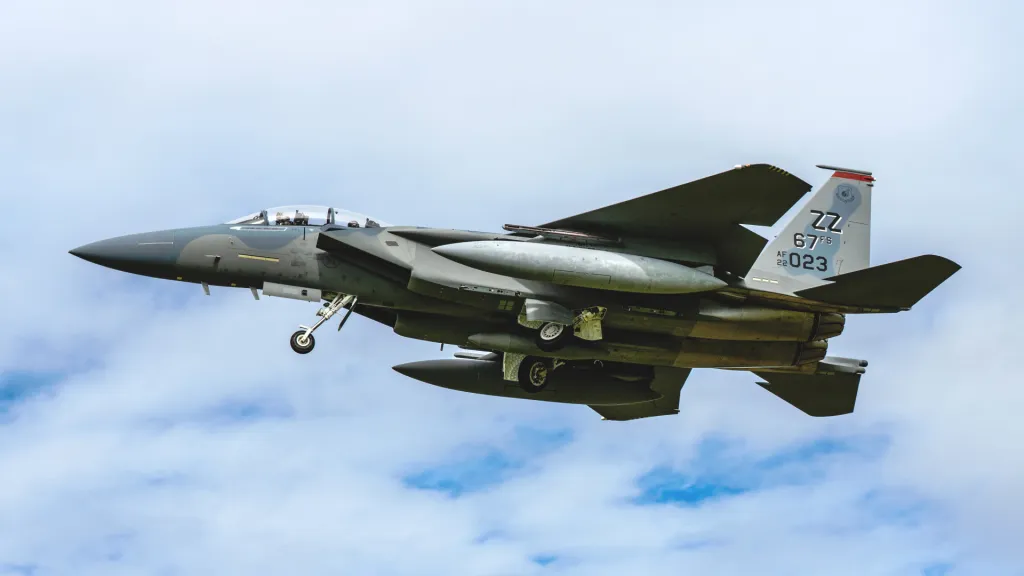
The 18th Wing announced that its first F-15EXs had touched down at Kadena yesterday. Prime contractor Boeing confirmed today that those jets were the 22nd and 23rd Eagle IIs produced (EX22 and EX23) in posts across its social media accounts. The expectation is that 36 F-15EXs will eventually be based in Japan, with 18 each assigned to the 44th and 67th Fighter Squadrons.

An F-15EX Eagle II seen about to land at Kadena Air Base on November 15, 2026. USAF

Boeing also confirmed to TWZ directly today that 25 F-15EXs have been delivered to the Air Force. This includes all of the jets in the first and second production lots. Lot 3 deliveries are now underway. The total Air Force Eagle IIs fleet is now set to reach 267 airframes, roughly double what the program of record was in 2025.

EX22, the first Japan-bound Eagle II, had left Boeing’s plant in St. Louis in September and traveled first to Portland Air National Guard Base in Oregon. The base is collocated with Portland International Airport and is home to the Oregon Air National Guard’s 142nd Wing, the first unit to fly combat-coded F-15EXs. The 142nd has been central to coordinating and preparing the way for the deployment of Eagle IIs to Kadena.

The first two F-15EX fighter jets — EX-22 and EX-23 — arrived at Kadena Air Base in Japan, marking the first time an F-15EX has been stationed outside the United States. pic.twitter.com/31JjAymX6E

— Boeing Defense (@BoeingDefense) November 16, 2026

In the lead up to this weekend’s deployment, “operators from the 67th Fighter Squadron traveled to Eglin Air Force Base, Florida, and Portland Air National Guard Base, Oregon, to maintain flying proficiency and complete aircraft qualification training in preparation for the aircraft’s arrival,” according to the 18th Wing’s press release. “Maintenance personnel from the 18th Aircraft Maintenance Squadron also spent years preparing for the transition, coordinating with Boeing and Air Force teams at Eglin and Portland to develop and maintain technical proficiency. They additionally supported F-15E operations at Seymour-Johnson Air Force Base, North Carolina, and Mountain Home Air Force Base, Idaho, gaining valuable experience while supporting the broader fighter enterprise.”

An airman directs an F-15EX at Kadena Air Base on November 15, 2026. USAF

The Air Force began a phased withdrawal of F-15C/Ds from Kadena in November 2022, but did not initially confirm what those aircraft would be replaced by. TWZ was the first to report in 2024 that the decision had officially been made to forward-base F-15EXs in Japan permanently through an interview with Col. Michael Kosderka, then commander of the 142nd Wing.

In the interim, the Air Force had been making rotational deployments of F-16C/D Vipers, F-15E Strike Eagles, F-22 Raptors, and F-35 Joint Strike Fighters to the base in Japan to fill the resulting gaps in operational capacity left by the departed F-15C/Ds. Eagle II test jets had also previously traveled to Kadena on temporary deployments as part of exercises.

An F-15EX assigned to the 85th Test and Evaluation Squadron (TES) seen at Andersen Air Force Base on Guam in 2025. The jet had stopped over there on its way to Kadena for Exercise Resolute Force Pacific 2025. USAF

“Getting the F-15EX to Kadena is just the beginning,” Air Force Lt. Col. Ajay Dua, head of the 67th Fighter Squadron, said in a statement this weekend. “Now our focus shifts to integrating the aircraft into our flying operations, building experience as a squadron, and learning how to get the most out of its capabilities. It’s an exciting time to be part of the 67th Fighter Squadron.”

As we have previously written:

“The F-15EX will give U.S. forces in the Indo-Pacific a high-capacity platform that complements the fifth-generation F-22 and F-35. With its ability to carry large air-to-air and air-to-surface payloads, the Eagle II can serve as a long-range ‘missile truck,’ extending the reach and firepower of stealth aircraft operating closer to contested airspace. Its open-architecture systems also allow it to incorporate new sensors, weapons, and electronic warfare capabilities more readily than the aging F-15C/D fleet.”

“The aircraft’s value is also tied to its role in networked operations. Exercises such as Valiant Shield have demonstrated how the F-15EX can work with uncrewed aircraft like the MQ-28 Ghost Bat, pointing toward mixed formations in which crewed fighters provide weapons, sensing, and command-and-control capacity for autonomous wingmen. Operating from strategic locations such as Kadena, the Eagle II could help the Air Force generate more combat power across the vast Pacific while reducing the burden on its limited number of stealth fighters.”

A U.S. Air Force F-15EX Eagle II accompanies an MQ-28 Ghost Bat drone during the U.S.-led Valiant Shield 26 military exercise. USAF

The deployment of the first F-15EXs to Kadena also follows the appearance of conformal fuel tanks (CFT) on operational Eagle IIs assigned to the 142nd earlier this month. The F-15EX is designed to use the same CFTs as the F-15E, which can also be fitted to other jets in the extended Strike Eagle family. However, the Air Force initially decided against acquiring the tanks for use on combat-coded F-15EXs, ostensibly because of the focus on air-to-air combat applications for these jets.

An F-15EX Eagle II assigned to the Oregon Air National Guard’s 142nd Wing seen fitted with conformal fuel tanks (CFT). Bill Shemley

Since then, the Eagle II’s mission requirements have continued to evolve, especially in the air-to-ground arena. The benefits CFTs offer can also be relevant during air-to-air combat missions. TWZ recently explored all of this in greater depth, writing, in part:

“Even just within the context of air-to-air missions, CFT-equipped F-15EXs would be particularly beneficial for supporting future operations in the Pacific. The inherent geography of the region means access to bases on the ground and tanker support could easily be limited. With CFTs, Eagle IIs would be able to operate further forward of tankers and be able to do so for longer periods of time, helping to extend patrol distances and total on-station time. Not having to carry drop tanks would also translate to more ordnance capacity on those sorties.”

The plan now for expanding the fielding of CFTs across the F-15EX fleet, including jets now being forward-deployed to Japan, is still not entirely clear.

Otherwise, “the arrival of the F-15EX at Kadena marks a significant milestone for American airpower in the Pacific,” Air Force Brig. Gen. John Gallemore, head of the 18th Wing, said in a statement yesterday. “These aircraft strengthen our ability to deter aggression, respond to emerging threats and defend Japan alongside our allies and partners. Their permanent presence at Kadena reinforces our commitment to the U.S.-Japan alliance and ensures we continue to bring advanced combat capabilities to one of the most strategically important regions in the world.”

Another look at one of the first F-15EXs permanently forward deployed at Kadena. USAF

While the start of permanent deployments of F-15EXs to Kadena is certainly a milestone, it does also highlight certain production and sustainment concerns. Boeing was originally supposed to have completed delivery of Lot 3 by early 2026, but experienced delays largely stemming from a labor strike in 2025. That, in turn, caused the schedule for sending jets to the 18th Wing to shift to the right.

Internal Pentagon reports have also warned about the growing need for the F-15EX program to address issues related to diminishing manufacturing sources and material shortages. All of this has raised questions about whether or not the Air Force will be able to keep to its longer-term schedules for fielding Eagle IIs to other units.

Still, with the first two F-15EXs now based at Kadena, combat-coded Eagle IIs now look set to increasingly leave their mark on the Western Pacific.

Contact the author: joe@twz.com
Joseph is TWZ’s Deputy Editor, helping to oversee the site’s highly experienced and dedicated team, while also writing informative and impactful defense and national security content. He lives right in the thick of it in the Washington, D.C. area.


Source link

Operational F-15EXs Have Started Flying With Conformal Fuel Tanks

A pair of operational F-15EX Eagle II fighters assigned to the Oregon Air National Guard’s 142nd Wing are now flying with conformal fuel tanks (CFT). While F-15EX test jets have been flying with surplus CFTs for years, the U.S. Air Force did not originally feel that combat-coded jets needed them to perform their primary air-to-air missions. For the Eagle II, CFTs offer boosts in range and capacity to carry stores, especially air-to-ground munitions, and are another sign of how the jet’s mission requirements are evolving.

Photographer Bill Shemley brought the CFT-equipped F-15EX Eagle IIs to our attention after spotting them operating recently at Portland International Airport. The airport is collocated with Portland Air National Guard Base, the home of the 142nd Wing. One of the jets in question is serial number 20-0012, part of the first batch of production Eagle IIs, which started being delivered to the 142nd in 2024. As of September, the Air Force had received 22 F-15EXs, including test jets, out of a planned fleet of 267 Eagle IIs. The service revealed earlier this year that the target fleet size had roughly doubled, up from the previously stated program of record of 129 aircraft.

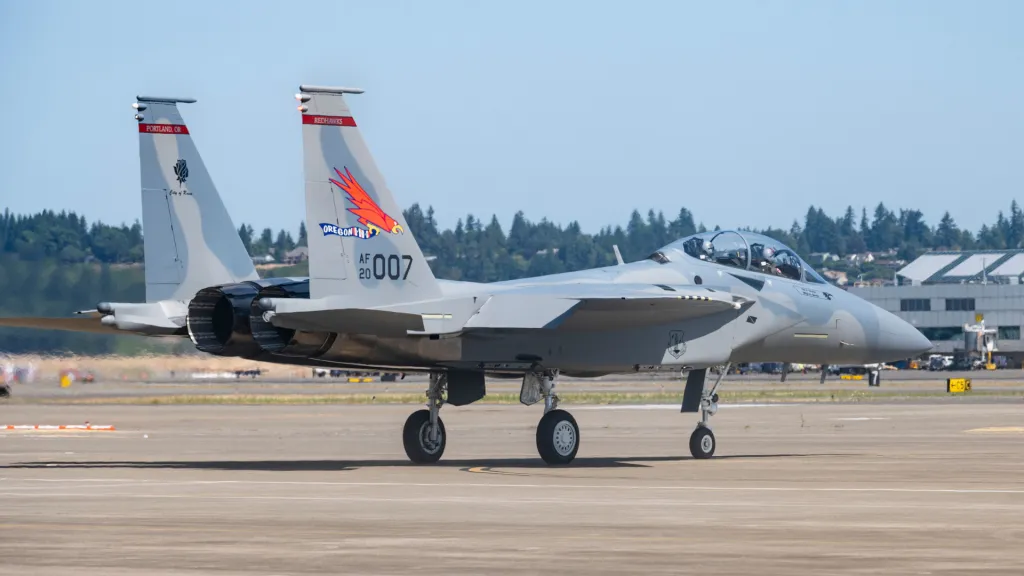
A stock picture of another F-15EX from the first production batch, serial number 20-0007, delivered to the 142nd Wing. Note the lack of conformal fuel tanks (CFTs) on this aircraft. USAF

“We are currently using conformals that we received from ACC [Air Combat Command] on two F-15EX Eagle IIs,” SMSgt. Steve Conklin, a public affairs officer with the Oregon Air National Guard, told TWZ when asked for more information. “We were given the opportunity from ACC and have flown the approved configuration for the last two weeks.”

We are still seeking additional details. The CFT that is visible in Shemley’s picture notably has the insignia of the 366th Fighter Wing, which flies F-15E Strike Eagles from Mountain Home Air Force Base in Idaho. In the past year or so, the 142nd has been sending Eagle IIs, pilots, and ground personnel to Mountain Home to conduct air-to-ground mission training.

A close-up look at the 366th Fighter Wing insignia on the CFT, at left, and a full-color version of the insignia, at right. Bill Shemley/USAF

The F-15EX is designed to use the same CFTs that are standard on the F-15E, as well as all other members of the extended Strike Eagle family. This includes the F-15QA for Qatar, on which the Eagle II was directly based. Each CFT can hold some 750 gallons of fuel and adds six additional pylons.

Air Force personnel install a conformal fuel tank (CFT) onto an F-15E Strike Eagle. USAF
A pair of CFT-equipped Qatari F-15QAs. USAF

As mentioned, the Air Force did not originally plan to equip operational F-15EXs with CFTs. This decision was made despite the aircraft having the necessary provisions and initial testing having been done using jets fitted with them. Instead, the Eagle IIs were expected to fly with external drop tanks under their wings, just like the F-15C/D Eagles they were slated to replace.

An F-15EX test jet with CFTs. USAF

“The F-15EX program as funded from FY20-FY23 is a direct replacement for the F-15C/D in the air-to-air and homeland defense role,” an Air Force spokesperson explained to TWZ back in 2023. “The F-15C/D does not typically operate with CFTs, and the first operational F-15EX aircraft do not have CFTs funded.”

A number of Air Force F-15C/Ds did fly with CFTs, also known as “FAST Packs,” during the twilight of the Cold War and its immediate aftermath. Those aircraft operated primarily from bases in Alaska and Iceland where long-range patrols and quick-reaction alert (QRA) missions were the norm.

A late Cold War-era picture of an Iceland-based F-15C equipped with “FAST Packs.” USAF

“The DAF [Department of the Air Force] is exploring options to resource a number of advanced capabilities for the F-15EX fleet, including both new and refurbished CFTs, in current and future budget submissions,” the spokesperson added at that time.

Where things currently stand when it comes to equipping all operational F-15EXs with CFTs, including on Eagle IIs destined for forward-deployment in Japan, is still not entirely clear. The service’s Fiscal Year 2027 budget proposal, released earlier this year, did include an explicit request for funding for CFTs to go with all 24 Eagle IIs in the eighth production batch, or Lot 8.

A “ZZ” tail-coded F-15EX destined to eventually be forward-deployed in Japan. USAF

Back in 2023, TWZ did acknowledge the logic, at least up front, of eschewing CFTs on the F-15EX given the air-to-air mission focus for those jets. At the same time, we pointed out then that the omission of conformal tanks could still impact Eagle IIs operating in those roles. A 600-gallon underwing drop tank holds 150 gallons less fuel than a CFT and takes up a hardpoint that could be used to carry other stores. Drop tanks also impart far greater drag, reducing fuel economy and range in certain flight profiles.

CFTs do still have their own effects on speed and maneuverability. Unlike drop tanks, they cannot be jettisoned in flight, either. F-15C/D pilots that TWZ has spoken with in the past have talked about the benefits of being able to get an immediate boost in performance and instantly optimize their jets for air-to-air combat by dropping their underwing tanks.

An F-15C carrying two underwing drop tanks. USAF

A CFT-equipped F-15EX would still be able to carry underwing drop tanks, as well, if desired. Doing so would give the jets an impressive loadout of weapons and other stores while even further increasing their unrefueled reach.

Even just within the context of air-to-air missions, CFT-equipped F-15EXs would be particularly beneficial for supporting future operations in the Pacific. The inherent geography of the region means access to bases on the ground and tanker support could easily be limited. With CFTs, Eagle IIs would be able to operate further forward of tankers and be able to do so for longer periods of time, helping to extend patrol distances and total on-station time. Not having to carry drop tanks would also translate to more ordnance capacity on those sorties.

Since 2023, the operational landscape for the F-15EX has changed even further as the air-to-ground mission set has started creeping more and more into the jet’s repertoire. As noted earlier, the CFT seen on 20-0012 itself has a clear link to Mountain Home Air Force Base, where the 142nd has been honing its air-to-ground skills. In July, the Oregon Air National Guard announced that one of its F-15EXs had dropped training bombs for the first time ever while operating from Mountain Home. The first release of a live bomb from one of the 142nd’s Eagle IIs came during training out of Nellis Air Force Base in Nevada in September.

One of the 142nd’s F-15EXs with a live bomb on its centerline station seen at Nellis Air Force Base earlier this year ahead of a training sortie. USAF

This has all been entirely unsurprising given the F-15EX’s inherently large payload capacity and ability to carry it over very long distances, all of which is only increased by the use of CFTs. The Eagle II, like the other members of the extended Strike Eagle family, can also accommodate outsized stores that it is simply not feasible for many other tactical jets to lug around. Prime contractor Boeing and the Air Force have been touting these capabilities as core features of the F-15EX for years now. These are the same attributes that make the F-15E one of the Air Force’s most heavily in-demand platforms today.

CFTs are not the only way in which the F-15EX design continues to evolve, either. The Air Force is also now moving toward adding a missile approach warning system (MAWS) to the Eagle IIs. This is another feature the aircraft was designed to accommodate from the outset, but that was skimped on. Its absence, however, has been more and more glaring, especially in light of recent combat experiences over Iran.

Furthermore, the future of the Air Force’s Strike Eagle fleet is only becoming more and more inseparable from plans for the Eagle II. The service has said explicitly that the doubling of the planned F-15EX fleet size is intended to help “begin to recapitalize the aging F-15E fleet.”

A heavily armed F-15E Strike Eagle on a combat sortie. USAF

In recent years, the Air Force has moved to retire all of the older F-100-PW-220-powered Strike Eagles, which represent roughly half of F-15Es currently in inventory. The service has argued this will also help free up resources for new and improved capabilities as part of larger modernization efforts.

For the Air Force’s F-15EX fleets, the two 142nd Wing jets flying now with CFTs underscore the continued evolution of these aircraft and their expected roles.

Special thanks again to Bill Shemley for sharing his picture of F-15EX 20-0012 equipped with CFTs.

Contact the author: joe@twz.com

Joseph is TWZ’s Deputy Editor, helping to oversee the site’s highly experienced and dedicated team, while also writing informative and impactful defense and national security content. He lives right in the thick of it in the Washington, D.C. area.


Source link