operational

Turkish Kizilelma Fighter Drone Declared Operational

Turkish drone manufacturer Baykar says it has made aviation history, announcing that the first three of its Bayraktar Kizilelma uncrewed combat aircraft have entered the inventory of the Turkish security forces following the completion of acceptance testing. The company describes the development as the first operational induction of an uncrewed ‘fighter jet’ anywhere in the world.

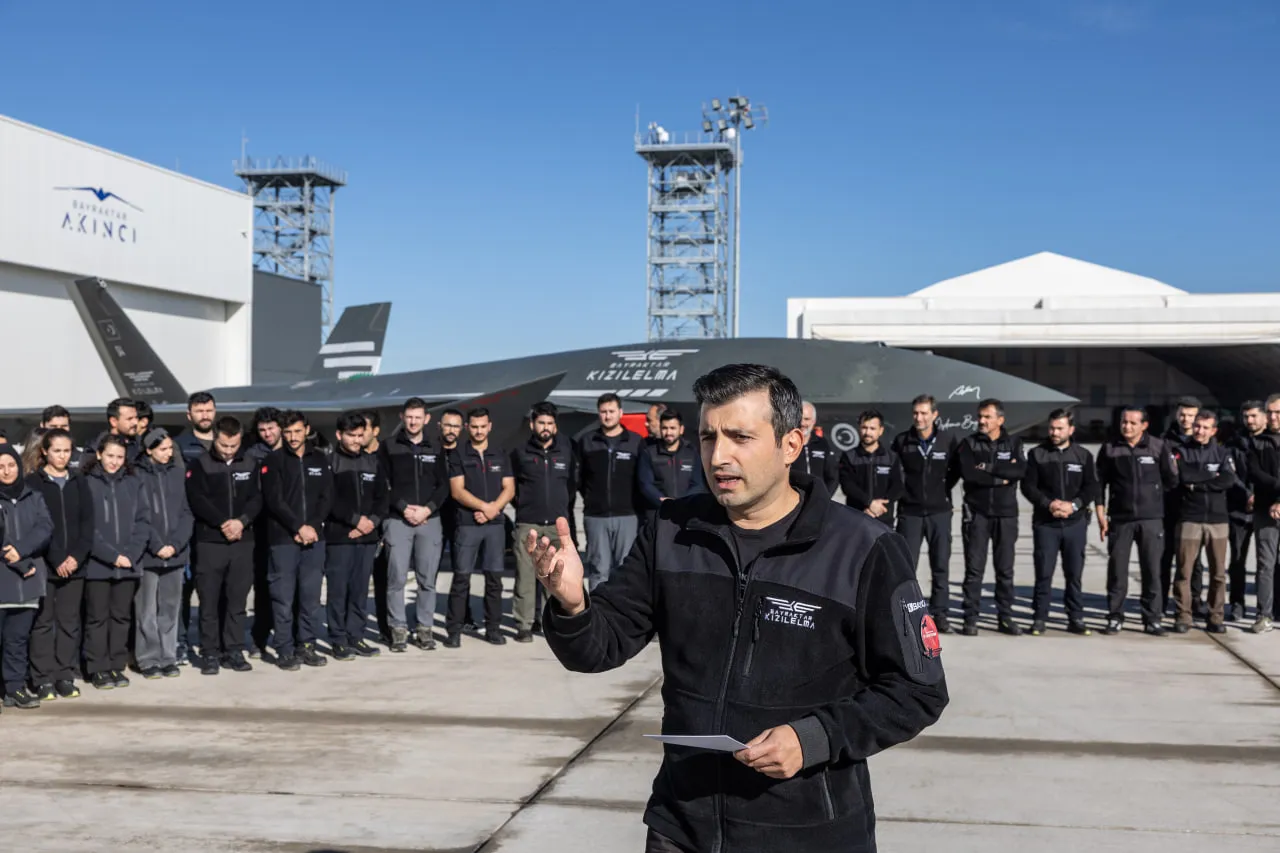
Handover ceremony for the first three Bayraktar Kizilelma uncrewed combat aircraft to the Turkish security forces. Baykar

It is a significant milestone for a program that has progressed from its initial unveiling in 2021 to flight testing, weapons integration, and now military acceptance. Baykar says the program has accumulated approximately 600 test and training sorties.

But the significance of Kizilelma goes beyond the question of whether it represents a world first. The aircraft belongs to an emerging category of uncrewed combat aircraft that is increasingly difficult to describe using the traditional Uncrewed Combat Air Vehicle (UCAV) label. Unlike conventional armed drones, Kizilelma was designed for fighter-type missions, including air-to-air combat.

It arrives on the scene as the United States, China, Australia and European countries pursue their own concepts for fighter-like uncrewed aircraft intended to operate in increasingly demanding combat environments, especially alongside crewed fighters.

Beyond the traditional UCAV

The term UCAV encompasses a broad range of aircraft, but is typically applied to more sophisticated, stealthy, jet-powered aircraft intended to penetrate defended airspace and to conduct air-to-ground attack, as well as electronic attack and surveillance and reconnaissance (it is worth noting that some still refer to any weaponized complex drone system capable of sizable endurance and delivery of ordnance as UCAVs). Regardless, the ability of many UCAV concepts to carry guided bombs and missiles does not necessarily make them fighter drones in the conventional sense.

A different concept is now emerging: uncrewed aircraft specifically designed to undertake fighter missions, and especially air-to-air combat.

Profile view of the Bayraktar Kizilelma uncrewed combat aircraft. Baykar

Within this narrower category, another important distinction is the Collaborative Combat Aircraft (CCA). These are designed to operate alongside crewed combat aircraft, extending their sensor coverage, weapons capacity, and tactical flexibility. Their employment involves considerable autonomy, but they are generally conceived as part of a wider crewed-uncrewed combat formation.

Kizilelma sits somewhere between these concepts. It is intended to undertake fighter-type missions, including air-to-air combat, but is also expected to perform air-to-ground missions and eventually operate as part of a wider crewed-uncrewed team.

Its design and intended employment make it particularly fighter-like among the emerging generation of advanced uncrewed combat aircraft.

Kizilelma’s fighter credentials

Kizilelma was conceived with a rather different premise from most UCAVs. It is claimed the aircraft will be capable of supersonic performance in later versions and is tailored for missions typically undertaken by crewed fighter jets.

In particular, it is intended to complement Turkey’s next-generation TF Kaan crewed fighter. While it incorporates a degree of reduced observability, stealth was not the overriding design driver. Baykar is also pursuing a naval variant capable of operating from ships with short flight decks.

Turkish drone manufacturer Baykar says it has made aviation history, announcing that the first three of its Bayraktar Kizilelma uncrewed combat aircraft have entered the inventory of Turkish security forces following the completion of acceptance testing. The company describes the development as the first operational induction of an unmanned fighter jet anywhere in the world. It’s a bold claim and one that all comes down to definitions.
A Kizilelma UCAV taxis out. Baykar Baykar

The basic aircraft has a reported maximum speed of Mach 0.9, a cruise speed of Mach 0.6, and a payload capacity of approximately 3,000 pounds. Other specifications include a maximum endurance exceeding three hours, a typical mission radius of 500 nautical miles, a service ceiling of 40,000 feet, and an operational altitude of 25,000 feet.

These characteristics place it closer to a light fighter than to the majority of UCAVs developed to date, which tend to prioritize endurance, payload capacity, and reduced observability over fighter-like performance.

One of the program’s most significant milestones came in November 2025, when a Kizilelma used a domestically developed Gökdoğan air-to-air missile to strike a jet-powered aerial target.

Bayraktar #KIZILELMA | GÖKDOĞAN Füzesi Atış Testi thumbnail

Bayraktar #KIZILELMA | GÖKDOĞAN Füzesi Atış Testi

The target was designated using Aselsan’s Murad active electronically scanned array (AESA) radar. The engagement demonstrated the integration of an uncrewed aircraft, onboard radar, and beyond-visual-range missile in an air-to-air engagement.

The aircraft has also demonstrated autonomous formation flight. In December 2025, two Kizilelma prototypes reportedly flew in close formation using intelligent fleet autonomy. A subsequent formation flight alongside Italian M-346 aircraft in May 2026 represented another step toward crewed-uncrewed teaming.

Nevertheless, the extent to which the aircraft can independently detect, identify, track, and engage hostile aircraft remains unclear.

The international race to develop uncrewed fighters

Kizilelma is not emerging in isolation. Several countries are now pursuing related concepts, although their designs, operational philosophies and levels of maturity differ.

The United States is pursuing its uncrewed fighter concept through the Air Force’s Collaborative Combat Aircraft program.

In March 2025, the U.S. Air Force formally designated General Atomics’ YFQ-42A and Anduril’s YFQ-44A as uncrewed fighters.

YFQ-42A. General Atomics

Both aircraft are intended to operate alongside crewed fighters, with the aim of extending their combat effectiveness through additional sensors, weapons and autonomous capabilities.

The program has progressed considerably. In June 2026, the Air Force awarded production contracts for both designs, while the YFQ-44A conducted an AIM-120 AMRAAM firing test against a target in July.

New test footage: first missile shot from YFQ-44A.

YFQ-44A executed an end-to-end, beyond-line-of-sight strike against a simulated target.

The test, executed out of @EdwardsAFB, represents an important step in turning CCA into an operational capability. pic.twitter.com/70cRIs6uXJ

— Anduril Industries (@anduriltech) July 15, 2026

The first aircraft were subsequently delivered to the service’s Experimental Operations Unit in September, where they are being used to develop operating concepts, tactics, and procedures.

The American approach differs somewhat from Kizilelma. The CCA aircraft are being developed entirely around collaborative operations with crewed platforms, rather than as independent uncrewed fighters with collaborative capabilities.

Nevertheless, they are part of the same broader shift toward aircraft capable of undertaking increasingly demanding fighter missions without an onboard pilot.

Meanwhile, China has made considerable progress with its stealthy GJ-11 Mysterious Dragon UCAV.

The People’s Liberation Army Air Force announced that the GJ-11 had entered service in November 2025, predating Kizilelma’s delivery by approximately a year.

GJ-11 Mysterious Dragon. PLA screencap

Recent Chinese state media coverage has provided additional insight into the GJ-11’s intended operational role, including air-to-ground strikes, suppression of enemy air defenses, and operations alongside crewed J-16 and J-20 fighters.

However, the publicly disclosed mission set remains primarily focused on air-to-surface operations. There has been no comparable public demonstration of the GJ-11 conducting an air-to-air missile engagement against an aerial target.

That does not establish that the aircraft lacks such a capability. Its precise performance and operational role remain difficult to determine given the limited transparency surrounding China’s uncrewed combat aviation programs. Still, this is a more traditional UCAV, built around low observability, range, and payload, not fighter-like performance.

China is developing a broader family of CCAs, reflecting an approach that extends beyond the GJ-11 and increasingly emphasizes the integration of uncrewed systems into fighter formations with higher-performance designs. We have seen China testing these daily in satellite images. They are larger uncrewed aircraft and much more like Turkey’s offering than America’s CCAs or traditional UCAVs.

China’s stealthy fighter CCA designs took center stage in a parade in 2024. Chinese internet

European manufacturers are also pursuing the next generation of uncrewed combat aircraft, some of which are similar to Kizilelma in basic concept.

Sweden’s Saab, for instance, is exploring autonomous combat aircraft and crewed-uncrewed teaming as part of its longer-term combat aviation development, including a large fighter-like uncrewed design. Airbus’ Wingman drone is also of the same fighter-like general design family.

Saab has unveiled the roadmap for its Autonomous Collaborative Platform (ACP) program, including this mockup of a stealthy, supersonic ‘fighter drone.’ Thomas Newdick

Meanwhile, in Australia, Boeing’s MQ-28 Ghost Bat CCA is also making strides. Only weeks after the Kizilelma test-fired an air-to-air missile, Boeing made a first live-fire weapons shot from a Ghost Bat drone, with an AIM-120 Advanced Medium-Range Air-to-Air Missile (AMRAAM) launched over the sprawling Woomera Range Complex (WRC) in southern Australia. The milestone event comes as the Australian government committed further to the Ghost Bat program and collaborative air capabilities in general. Although dropped from German plans for now, Boeing has reported strong export interest in the drone.

An AIM-120 is launched from an MQ-28A Ghost Bat during Trial Kareela at RAAF Base Woomera, South Australia. Australian Department of Defense

So clearly, these larger, fighter-like, higher-performance UAV designs are of increasing interest globally, and Kizilelma was really the first to emerge, establishing this unique segment of the drone space.

What does being operational actually mean?

Baykar’s announcement confirms that the first three Kizilelma aircraft completed acceptance testing and entered the inventory of Turkish security forces.

However, several important questions remain unanswered.

The company has not publicly identified the receiving military branch. Janes reported that imagery of the occasion showed an officer believed to belong to the Turkish Land Forces Command.

Turkish industry and media alike have heralded the recent live-fire test in which a Kizilelma uncrewed combat air vehicle (UCAV) used a Turkish-made air-to-air missile to destroy a target drone. Turkey claims the test marks the first occasion a UCAV has launched a radar-guided air-to-air missile. But, while undoubtedly impressive, there are unanswered questions about how the engagement actually played out, especially to what degree the UCAV was being controlled by crewed fighter jets.
Kizilelma launches an air-to-air missile. Turkish Defense Industry screencap Turkish Defense Industry screencap

More importantly, delivery and acceptance do not necessarily mean that Kizilelma has achieved full operational capability.

Its readiness for combat, initial operational mission set, and the extent to which its air-to-air weapons capabilities have been cleared for operational use remain unclear.

The autonomy question is equally important. Autonomous formation flight and a successful radar-guided missile engagement are significant achievements, but neither establishes that the aircraft can independently, or even semi-autonomously, conduct the complete fighter engagement process in a real combat environment. The aircraft can rely on man-in-the-loop control (where a pilot is physically flying it like an MQ-9 Reaper) and still carry out various missions, but a larger degree of autonomy would unlock greater flexibility, resilience due to less reliance on high-bandwidth datalinks, and far more efficient pairing with crewed assets.

A new category of combat aircraft

Regardless of whether Baykar’s world-first assertion withstands closer scrutiny, Kizilelma’s entry into Turkish military inventory is an important development in the evolution of uncrewed combat aviation.

The aircraft represents a move away from the traditional model of uncrewed aircraft as primarily persistent surveillance and strike platforms, toward systems intended to undertake some of the most demanding missions in modern air warfare.

The United States, China, Turkey, Australia and several European countries are pursuing their own approaches to this challenge.

Whether it becomes a true independent uncrewed fighter, a collaborative wingman to the TF Kaan or a platform capable of fulfilling both roles remains to be seen, but efforts to realize those aspirations will certainly accelerate over the coming years. This is especially the case now that the program can build operational experience with the active Turkish armed forces.

Contact the author: thomas@thewarone.com
Thomas Newdick is a staff writer at TWZ, where he covers military aviation, defense technology, weapons systems, and international security. Based in Berlin, Germany, he reports on conflicts, military modernization efforts, and emerging aerospace technologies around the world, with a particular interest in airpower and its role in contemporary warfare. His reporting is informed by deep expertise in modern and historical airpower, particularly in Europe, with a focus on military aviation, air campaigns, and aerospace developments across the continent and beyond.


Source link

Operational F-15EXs Have Started Flying With Conformal Fuel Tanks

A pair of operational F-15EX Eagle II fighters assigned to the Oregon Air National Guard’s 142nd Wing are now flying with conformal fuel tanks (CFT). While F-15EX test jets have been flying with surplus CFTs for years, the U.S. Air Force did not originally feel that combat-coded jets needed them to perform their primary air-to-air missions. For the Eagle II, CFTs offer boosts in range and capacity to carry stores, especially air-to-ground munitions, and are another sign of how the jet’s mission requirements are evolving.

Photographer Bill Shemley brought the CFT-equipped F-15EX Eagle IIs to our attention after spotting them operating recently at Portland International Airport. The airport is collocated with Portland Air National Guard Base, the home of the 142nd Wing. One of the jets in question is serial number 20-0012, part of the first batch of production Eagle IIs, which started being delivered to the 142nd in 2024. As of September, the Air Force had received 22 F-15EXs, including test jets, out of a planned fleet of 267 Eagle IIs. The service revealed earlier this year that the target fleet size had roughly doubled, up from the previously stated program of record of 129 aircraft.

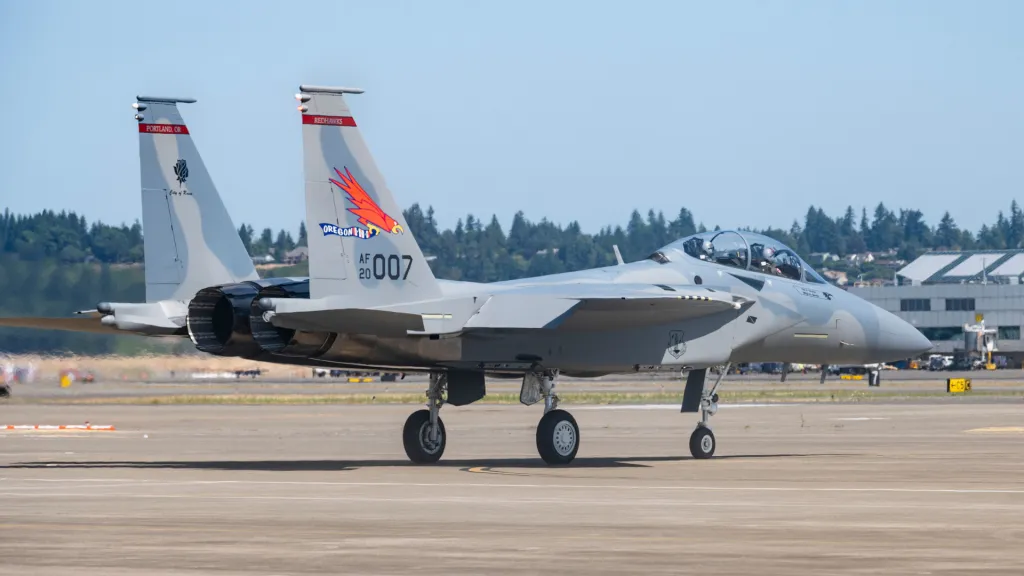
A stock picture of another F-15EX from the first production batch, serial number 20-0007, delivered to the 142nd Wing. Note the lack of conformal fuel tanks (CFTs) on this aircraft. USAF

“We are currently using conformals that we received from ACC [Air Combat Command] on two F-15EX Eagle IIs,” SMSgt. Steve Conklin, a public affairs officer with the Oregon Air National Guard, told TWZ when asked for more information. “We were given the opportunity from ACC and have flown the approved configuration for the last two weeks.”

We are still seeking additional details. The CFT that is visible in Shemley’s picture notably has the insignia of the 366th Fighter Wing, which flies F-15E Strike Eagles from Mountain Home Air Force Base in Idaho. In the past year or so, the 142nd has been sending Eagle IIs, pilots, and ground personnel to Mountain Home to conduct air-to-ground mission training.

A close-up look at the 366th Fighter Wing insignia on the CFT, at left, and a full-color version of the insignia, at right. Bill Shemley/USAF

The F-15EX is designed to use the same CFTs that are standard on the F-15E, as well as all other members of the extended Strike Eagle family. This includes the F-15QA for Qatar, on which the Eagle II was directly based. Each CFT can hold some 750 gallons of fuel and adds six additional pylons.

Air Force personnel install a conformal fuel tank (CFT) onto an F-15E Strike Eagle. USAF
A pair of CFT-equipped Qatari F-15QAs. USAF

As mentioned, the Air Force did not originally plan to equip operational F-15EXs with CFTs. This decision was made despite the aircraft having the necessary provisions and initial testing having been done using jets fitted with them. Instead, the Eagle IIs were expected to fly with external drop tanks under their wings, just like the F-15C/D Eagles they were slated to replace.

An F-15EX test jet with CFTs. USAF

“The F-15EX program as funded from FY20-FY23 is a direct replacement for the F-15C/D in the air-to-air and homeland defense role,” an Air Force spokesperson explained to TWZ back in 2023. “The F-15C/D does not typically operate with CFTs, and the first operational F-15EX aircraft do not have CFTs funded.”

A number of Air Force F-15C/Ds did fly with CFTs, also known as “FAST Packs,” during the twilight of the Cold War and its immediate aftermath. Those aircraft operated primarily from bases in Alaska and Iceland where long-range patrols and quick-reaction alert (QRA) missions were the norm.

A late Cold War-era picture of an Iceland-based F-15C equipped with “FAST Packs.” USAF

“The DAF [Department of the Air Force] is exploring options to resource a number of advanced capabilities for the F-15EX fleet, including both new and refurbished CFTs, in current and future budget submissions,” the spokesperson added at that time.

Where things currently stand when it comes to equipping all operational F-15EXs with CFTs, including on Eagle IIs destined for forward-deployment in Japan, is still not entirely clear. The service’s Fiscal Year 2027 budget proposal, released earlier this year, did include an explicit request for funding for CFTs to go with all 24 Eagle IIs in the eighth production batch, or Lot 8.

A “ZZ” tail-coded F-15EX destined to eventually be forward-deployed in Japan. USAF

Back in 2023, TWZ did acknowledge the logic, at least up front, of eschewing CFTs on the F-15EX given the air-to-air mission focus for those jets. At the same time, we pointed out then that the omission of conformal tanks could still impact Eagle IIs operating in those roles. A 600-gallon underwing drop tank holds 150 gallons less fuel than a CFT and takes up a hardpoint that could be used to carry other stores. Drop tanks also impart far greater drag, reducing fuel economy and range in certain flight profiles.

CFTs do still have their own effects on speed and maneuverability. Unlike drop tanks, they cannot be jettisoned in flight, either. F-15C/D pilots that TWZ has spoken with in the past have talked about the benefits of being able to get an immediate boost in performance and instantly optimize their jets for air-to-air combat by dropping their underwing tanks.

An F-15C carrying two underwing drop tanks. USAF

A CFT-equipped F-15EX would still be able to carry underwing drop tanks, as well, if desired. Doing so would give the jets an impressive loadout of weapons and other stores while even further increasing their unrefueled reach.

Even just within the context of air-to-air missions, CFT-equipped F-15EXs would be particularly beneficial for supporting future operations in the Pacific. The inherent geography of the region means access to bases on the ground and tanker support could easily be limited. With CFTs, Eagle IIs would be able to operate further forward of tankers and be able to do so for longer periods of time, helping to extend patrol distances and total on-station time. Not having to carry drop tanks would also translate to more ordnance capacity on those sorties.

Since 2023, the operational landscape for the F-15EX has changed even further as the air-to-ground mission set has started creeping more and more into the jet’s repertoire. As noted earlier, the CFT seen on 20-0012 itself has a clear link to Mountain Home Air Force Base, where the 142nd has been honing its air-to-ground skills. In July, the Oregon Air National Guard announced that one of its F-15EXs had dropped training bombs for the first time ever while operating from Mountain Home. The first release of a live bomb from one of the 142nd’s Eagle IIs came during training out of Nellis Air Force Base in Nevada in September.

One of the 142nd’s F-15EXs with a live bomb on its centerline station seen at Nellis Air Force Base earlier this year ahead of a training sortie. USAF

This has all been entirely unsurprising given the F-15EX’s inherently large payload capacity and ability to carry it over very long distances, all of which is only increased by the use of CFTs. The Eagle II, like the other members of the extended Strike Eagle family, can also accommodate outsized stores that it is simply not feasible for many other tactical jets to lug around. Prime contractor Boeing and the Air Force have been touting these capabilities as core features of the F-15EX for years now. These are the same attributes that make the F-15E one of the Air Force’s most heavily in-demand platforms today.

CFTs are not the only way in which the F-15EX design continues to evolve, either. The Air Force is also now moving toward adding a missile approach warning system (MAWS) to the Eagle IIs. This is another feature the aircraft was designed to accommodate from the outset, but that was skimped on. Its absence, however, has been more and more glaring, especially in light of recent combat experiences over Iran.

Furthermore, the future of the Air Force’s Strike Eagle fleet is only becoming more and more inseparable from plans for the Eagle II. The service has said explicitly that the doubling of the planned F-15EX fleet size is intended to help “begin to recapitalize the aging F-15E fleet.”

A heavily armed F-15E Strike Eagle on a combat sortie. USAF

In recent years, the Air Force has moved to retire all of the older F-100-PW-220-powered Strike Eagles, which represent roughly half of F-15Es currently in inventory. The service has argued this will also help free up resources for new and improved capabilities as part of larger modernization efforts.

For the Air Force’s F-15EX fleets, the two 142nd Wing jets flying now with CFTs underscore the continued evolution of these aircraft and their expected roles.

Special thanks again to Bill Shemley for sharing his picture of F-15EX 20-0012 equipped with CFTs.

Contact the author: joe@twz.com

Joseph is TWZ’s Deputy Editor, helping to oversee the site’s highly experienced and dedicated team, while also writing informative and impactful defense and national security content. He lives right in the thick of it in the Washington, D.C. area.


Source link