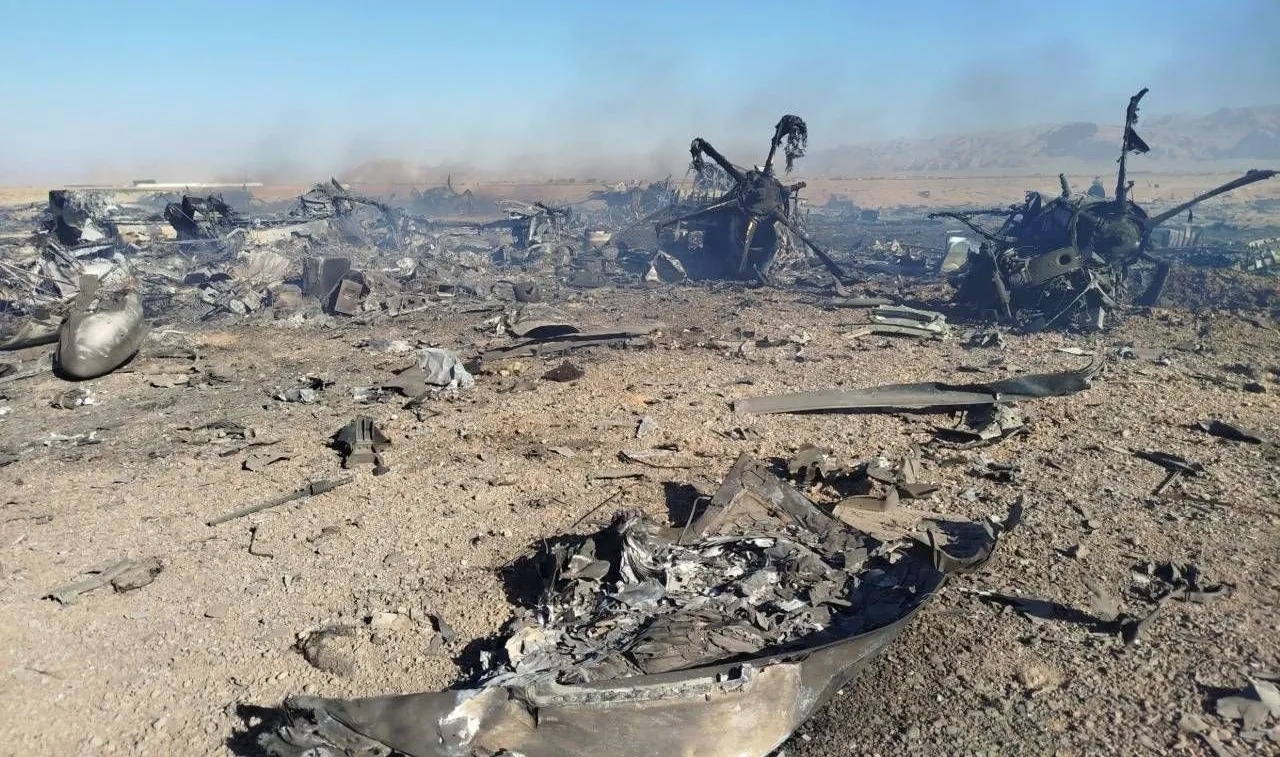
New images have emerged that appear to show the destroyed special operations C-130s (MC-130Js Commando IIs) at the forward improvised airfield in Iran. The austere operating location acted as a hub (and forward arming and refueling point or FARP) for the rescue mission of the downed F-15E Weapon System Officer. You can read our latest coverage on the rescue here. It has been reported that the two C-130s were demolished in place as they were incapable of departing, with three more aircraft coming in and extracting the special operations force. Amongst this wreckage appears to be two burned-out wrecks of MH-6/AH-6 Little Birds of the 160th Special Operations Aviation Regiment, better known as the Night Stalkers.
As is typically the case, the images of the crash site look authentic after a cursory examination, but that could change in the future.


These helicopters, if in AH-6 configuration, were likely delivered to the landing site to provide close air support and force protection for the larger force deployed there. Reports now state that there may not have been a major firefight on the ground as originally reported, but Iranians were fired upon from the air when trying to approach the base. Video supposedly showing one of these engagements does look like the firing aircraft could be an AH-6.

The Little Birds could have also been used to help find and support the extraction of the pilot if in MH-6 configuration. Little Birds can be configured in the AH-6 attack and MH-6 assault configurations.

The force protection role for exactly this kind of mission is a key one for the AH-6. Night Stalker AH-6 crews train heavily for it. The Little Birds can be rapidly delivered to forward locations aboard aircraft as small as a C-130, but it’s their ability to be rolled out and flying in mere minutes that suits them so well for this mission set. The MC-130 can act as transport, weapons hauler and a gas station on the ground for the Little Birds.
You can read all about the Little Bird’s ability to be rapidly deployed virtually anywhere in our past feature linked here.

The Little Birds could possibly have flown directly to the site, and then refueled from MC-130J on the ground and operated out of the makeshift base, although the range on these aircraft is limited, even with auxiliary fuel tanks. Even flying from Kuwait or a commercial ship in the northern Persian Gulf, a direct flight over Iranian airspace would have been very risky and required much of the Little Bird’s range. Overall, this option seems very likely.

As to why the Little Birds were destroyed in place, that isn’t clear. Extracting the force was likely done in a big hurry, especially due to the immobilization of two C-130s. If the Little Birds flew in aboard them, there may have been no time (or room) to load them onto the replacement aircraft. They could have also been damaged by enemy fire. If they flew in directly themselves, the mission may not have gone as planned and they could not be fueled while on the ground by the stricken MC-130s. There are many possibilities.
Destroying stranded special operations aircraft is absolutely critical as they are packed with sensitive sensors, communications, defensive systems and more.
Regardless, the inclusion of the Little Birds is another indication of just how complex this mission, which was thrown together in just a matter of hours, was. It’s also a reminder of just how versatile and forward deployable the MH/AH-6s truly are.
UPDATE: 6:02 AM PDT—
The landing zone has been geolocated to just south of Isfahan. This puts it about 200 miles from the Iranian coastline and roughly 230 miles from a land border. It is very unlikely the Little Birds made this trip on their own (can rule it out almost entirely) beyond the tactical issues with doing so.
Contact the author: Tyler@twz.com