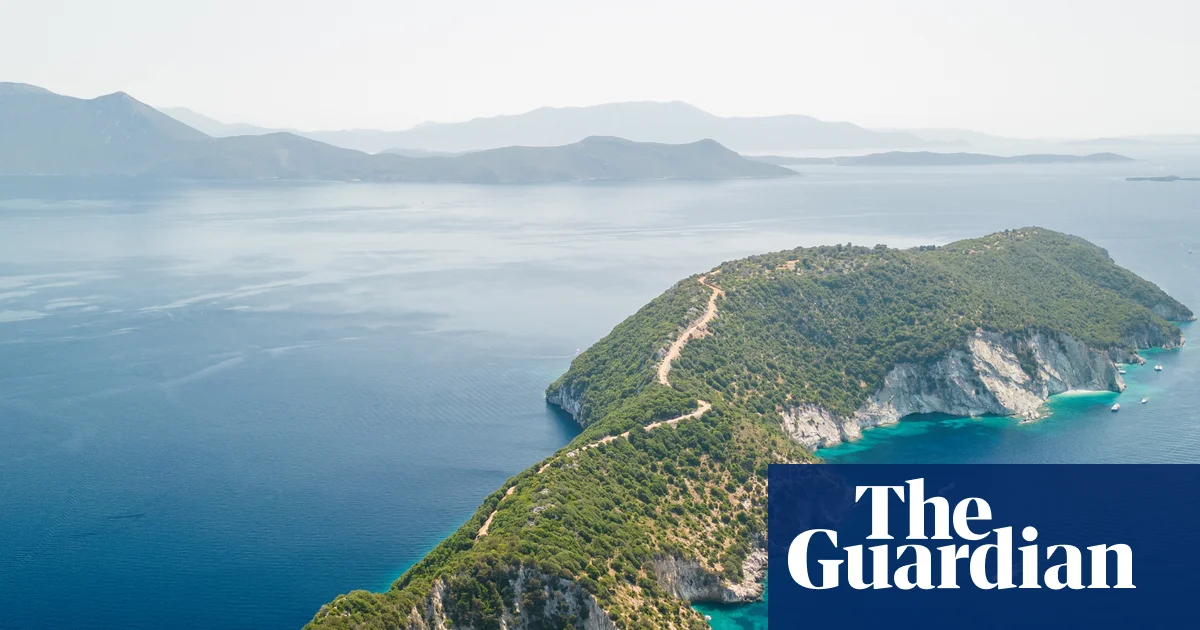
Swimming ashore from the boat I can see a narrow shingle beach covered in driftwood. There are logs, bamboo canes and the sundried planks of an old shipwreck. The steep climb up the hill behind is not easy. I skirt thick clumps of thorn and abandoned ancient olive trees, scrambling over jagged outcrops of limestone. Every time I curl my fingers into a rocky niche I think about snakes. The only residents, however, are spiders. Their webs are strung between the trees, and so thick and strong that I grab a stick to slash through them. No one has been here for a long time.
Near the hilltop I stumble on a ruined stone building. Who lived here, I wonder? And where have they gone? A few steps further and the land abruptly ends in a vertical white cliff that plummets into an improbably blue sea. Far away, in the haze, there is a stack of Ionian islands and one of them, I know, must be Ithaca.
At that moment I feel footsteps running across my forehead and let out an involuntary scream. An arachnid Achilles has come to take revenge. I leap up, arms flailing. The eight-legged hero heads for the underworld of my left armpit.
In the original epic tales of human adventure, the action starts in the middle of the story, a rule first identified by the Roman poet Horace. At that central moment our protagonist is in a terrible state: probably lost at sea, often naked, and always alone. We want to know: how did things get to this nadir, and where will they go now? It’s a pattern repeated over and over. Take, for example, that ancient classic The Bourne Identity, a 2002 film starring Matt Damon, who appears in the opening sequences floating in the Med like a stunned octopus. He doesn’t even know who he is, but with the hospitality of strangers and cathartic bouts of extreme violence, he inches towards his happy place.
Now Matt gets to do it all again, in a pleated skirt and bronze helmet, appearing as Odysseus in Christopher Nolan’s The Odyssey, a $250m blockbuster due for release on 17 July in the UK and US and starring almost every deity in the Hollywood heavens. Go back to the literary Odysseus, however (with Emily Wilson’s brilliant recent translation), and he is much more than a Hollywood action hero. This home-loving husband is also a pathological liar, serial philanderer, murderer, carpenter and, most famously, a traveller. And like all travellers, sitting around the campfire at some later date with listeners agog, he is forced to confront the thorny problem of how to convey the full visceral impact of what happened on his journey and hold his audience. Traditionally, there are two options: the full truth, or the fuller truth.
Back on the clifftop, tickled to death by Achilles, I dive into the improbably blue sea only to find that my assailant has become a six-headed monster that’s dragging me towards a giant whirlpool. And I’ve lost my glasses.
I had come a few days earlier to the Greek mainland and set sail for Ithaca. This is actually easier than it might seem. First, track down a friend with the correct sailing credentials (or get them yourself at the Royal Yachting Association), then gather a crew and search out a boat. Alternatively, pay the extra and hire a skipper. We sailed with Neilson Holidays, which has a mainland base near Palairos on the Ionian Sea. Depending on experience and qualifications, you can either follow a flotilla or go it alone. We arrive and find our boat, Cafard, which my multilingual skipper friend, Fabian, translates as Depressed Cockroach. I wonder if it’s a misspelling of Cavafy (Constantine P), the Greek poet who wrote:
When you set out for Ithaca
Ask that your way be long,
Full of adventure, full of instruction
We stock up and set sail. Adventure and instruction is our hope. My wife, Sophie, has never sailed before and is scoffing seasickness tablets faster than Odysseus’s men gobbled down the sun god’s cattle, and that did not end well. Can we discover a Homeric sense of wonder and novelty on our voyage to Ithaca? And report back truthfully?
Despite the yacht name, the beginning is auspicious. Leaving Palairos we sail into a pod of dolphins, swarming around the bows, close enough to make eye contact. That night is spent on Kalamos, a steep-sided wooded island with a tiny port. In the taverna, cats stretch out under chairs where old men are making a glass of ouzo stretch out too. There is talk of a crashed military drone found by fishermen in a sea cave north of here. The engine was still running and there were 100kg of explosives on board. Is this story also getting stretched a little, I wonder? Or is it connected to the presence of unfriendly Russians on some islands, hiding behind warning signs for savage dogs? Odysseus would not like that. He was fine-tuned to any abuse of hospitality, and perhaps a tad oversensitive when it came to other men flirting with his wife.
The next morning we sail out, stopping at Porto Leone, a village on Kalamos abandoned after the 1953 earthquake. The plan is to stop again at the island of Atokos, where wild pigs reputedly swim off the beach, but the wind picks up and we are properly smashing through the waves. Fabian is loving it. Sophie, amazed not to feel seasick, is letting out shrieks of joy.
We head for Kioni on Ithaca, little more than a scattering of old houses around an exquisite harbour. In August, I’m told, the berths are all taken before lunchtime. The waterfront is a lovely mix: a corner shop that stocks everything, a top-notch bakery, tavernas and some swish boutiques all tied together with colourful plumes of bougainvillaea. In one arty studio, a yachtie with auburn hair and a regal manner is demanding the price of a swordfish sculpture.
“It’s €15,000,” purrs the assistant.
Not everything is so pricey: we find that a good dinner with wine can be had for less than €25 each.
The next day, I walk some of the island’s footpaths, a network that badly needs a strimmer. In the town of Stavros, the tiny museum holds an astonishing array of Homeric treasure that was found in a nearby cave: a second-century BC shard of pottery bearing the inscription “pray to Odysseus” and several pieces of bronze tripod cauldron dated to the ninth century BC. In local minds these are some of the Phaeacian gifts mentioned in The Odyssey.
A mile further up the trail, at a site known as the School of Homer, are the ruins of what may have been a palace – sufficient evidence for locals to build a model in Stavros town square and confidently identify the bedroom of Odysseus. Listen closely and you can almost hear him: “Honestly Penelope, they both bewitched me. I was a sex slave. I couldn’t wait to get home.” The tradition of Odyssean tall tale-telling is in robust good health.
In the highly recommended Margarita Cafe there is another fine tradition on display: cakes. The local speciality is rovani, a delicious spicy concoction served with ice-cream.
Our voyage takes in Kefalonia and the noisy mainland port of Sivota, but the highlight comes with that lonely anchorage off the mysterious island of Meganisi. Parts of the Ionian coast are undergoing a building boom – glass and concrete palaces spreading across the hillsides like a nasty rash. But here we find tranquillity: snorkelling through shoals of fish, exploring vast sea caves and raising a toast to that magnificent poet Homer, and the inspiration he has given to so many for almost three millennia. After a week on the water, we sail back to Palairos. We have all had a great time, even the nervous first-time mariner. I leave with vivid memories, not least that desperate underwater struggle with the deadly spider woman who stole my glasses.
The trip was provided by Neilson Holidays: a seven-day South Ionian flotilla cruise from £595pp (for four adults) including flights from Gatwick; skippered boat from £1,145pp. Travel to London was provided by LNER and accommodation for a trip to the British Museum’s Ancient Greece section by Radisson Blu Bloomsbury