MACUNGIE, Pa. — President Trump visited a Mack Trucks facility in battleground Pennsylvania on Tuesday, attempting to shift attention to the U.S. economy in his first major public event outside the nation’s capital since he signed an interim agreement to end the Iran war.
The trip to Macungie, in the Allentown suburbs, came as Trump works to put the conflict — and the higher gasoline prices it caused — in the rearview mirror as the November midterm elections draw closer.
Trump had a private tour of the facility, but his speech often felt more like a reelection rally from two years ago than an effort to promote his second-term accomplishments.
The president listed longstanding political grievances, and made only passing mentions of promoting Republicans ahead of Election Day — while spending more time bragging about the UFC fight he staged on the White House lawn in honor of his own 80th birthday than he did the economy.
At one point, Trump even called UFC fighters Bo Nickal and Anthony Cassar to the stage and mused about whether he could beat either one of them in a wrestling match if he were to “work out for the next couple of months.”
It was Trump’s fifth second-term visit to Pennsylvania, a state whose support in 2016 and 2024 helped him to win the White House. The truck factory is in a district where incumbent Republican Rep. Ryan Mackenzie faces Democratic challenger Bob Brooks in November.
“For more than 100 years, this legendary company has been making trucks right here in eastern Pennsylvania,” Trump said, “building the heavy duty machinery that keeps our economy rolling, our factories moving, and our industries roaring all across the nation.”
His visit coincided with rising prices that could color the verdict voters render on Trump’s stewardship in the fall. About one-third of U.S. adults approved of Trump’s approach to the economy, according to a June Associated Press-NORC Center for Public Affairs Research poll. That’s in line with last month for Trump on the issue.
The Iran war, which began Feb. 28, has also been a politically difficult issue for the president. Most Americans continued to disapprove of his handling of Iran, according to the June AP-NORC poll, which was being fielded as Trump announced a tentative deal with Iran and concluded just before the interim agreement was signed last week. It found that 65% of U.S. adults disapprove of how the president is handling issues with Iran, unchanged from May.
Still, while most Democrats and independents view Trump’s actions negatively, only about 3 in 10 Republicans are unhappy.
This is the kind of district that matters in November elections
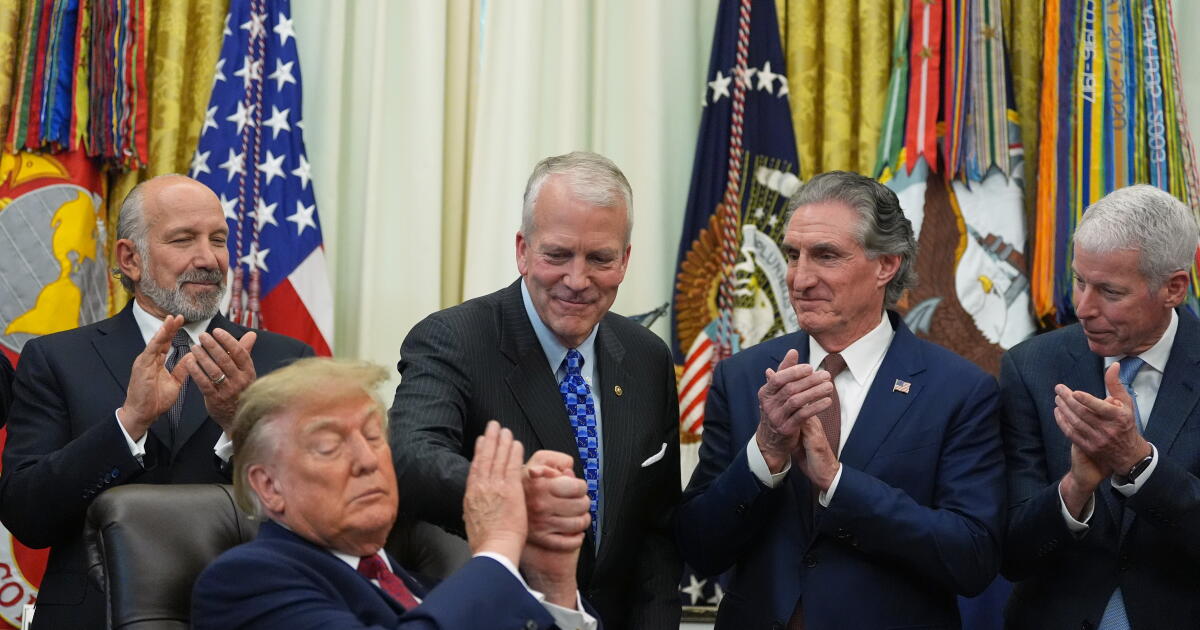
Trump addressed a cheering crowd from a stage erected on the factory floor, flanked by two red, white and blue trucks and rows of workers in fluorescent safety vests under a large “American Workers First” banner.
It’s the kind of district that may prove pivotal to Republicans holding narrow control of the House, where a loss could hobble the president’s final two years in office.
Mackenzie, a freshman lawmaker, is looking to hold on to a district Democrats have targeted to flip. Brooks, president of the state firefighters’ union, has support from Democratic Gov. Josh Shapiro, who’s also seeking reelection this year.
Trump urged the crowd to support Mackenzie, saying of his trip, “I’m not doing this for my health.” But he devoted more energy to issues such as the U.S.-Mexico border, opposing transgender rights and decrying “Marxist” judges, while also referencing his administration’s efforts to lower prescription drug prices.
“We gotta win the midterms,” Trump said, in one of the few references he made to the midterms. Later, however, he suggested it wasn’t actually a “political season,” perhaps because he himself won’t be on the ballot in November.
On Iran, Trump suggested that the country would be smart and keep negotiating during the ceasefire. “Otherwise we’ll have to finish the job, which will take about, maybe less than a week,” he said.
An odd moment came when the president offered, “The ideology of the Muslims is slightly different than the ideology of the Catholics. We have the Catholics and the Muslims slightly different.” He didn’t elaborate.
Biden came to the same plant previously
Trump’s predecessor, Democrat Joe Biden, visited the same Mack Trucks facility in 2021 to highlight regulations aimed at promoting manufacturing jobs. Manufacturing employment peaked in 1979 at nearly 19.6 million jobs. It trended downward after the 2001 recession and the 2007-9 Great Recession. The figure now stands at 12.6 million as of May, according to the Bureau of Labor Statistics.
In 2025, the truck facility got hit by market uncertainty, including sweeping tariffs that Trump’s administration imposed, and about 170 people were laid off, according to Mack spokesperson Kimberly Pupillo. She added that by the end of last year, almost 150 people were recalled to work and anyone laid off last year was given the chance to return.
There are about 2,800 workers at Mack, Pupillo said.
At a pizzeria down the road from the truck facility, workers and diners said they’d heard about the president’s visit and recalled Biden’s trip to the plant.
George Carver, a retired elementary school principal, said he wasn’t a fan of Trump’s. “I’m looking for a president who’ll clean up this mess,” he said, meaning improve the economy and better handle the war in Iran and immigration.
“I’m looking for someone who’s gonna tell the truth — that could be a Democrat or Republican,” Carver said.
Trump’s visit underscores Pennsylvania’s status as a crucial swing state.
Trump made a trip to Mount Pocono in December 2025 to road test messages that he’s addressing affordability; in July 2025, he was in Pittsburgh to tout tens of billions of dollars of recent energy and technology investments in the state; in June 2025, he was in West Mifflin to tell steelworkers he was doubling the tariff on steel imports to protect the industry; and in March 2025, he attended the NCAA wrestling championship in Philadelphia.
Denise Green, a retired software trainer, was among a handful of people protesting the visit outside a McDonald’s across the street from the plant.
Green said she was a former Republican who became a Democrat in 2007 because her original party backed policies where “all the money” was going to the rich.
Green said her key issue was Social Security funding, which she said she’ll need but is worried could run out.
The Italian prime minister has accused Trump of making up a story that she ‘begged’ him for a photo at the G7 summit in France.
Published On 19 Jun 202619 Jun 2026
A diplomatic row between United States President Donald Trump and Italian Prime Minister Giorgia Meloni has escalated, with Italy’s top diplomat cancelling an upcoming visit to the US.
At issue is Trump’s claim that Meloni “begged” him for a photograph during the Group of Seven (G7) meeting in France earlier in the week.
Recommended Stories
list of 3 itemsend of list
“She’s probably happy I talked to her. I didn’t have to talk to her,” Trump reportedly told the Italian La7 network. The broadcaster only published a dubbed Italian version of the interview, not the original English version.
“She begged me to take a picture with her. She wanted a picture with me so badly. I wouldn’t have taken it, but I felt sorry for her.”
On Friday, Meloni posted a video answering Trump’s statement, saying that “certain things deserve an immediate response”.
“Donald Trump’s statements are completely fabricated. I am frankly stunned,” she said. “I don’t know why the president of the United States behaves this way toward his own allies. After all, this isn’t the first time this has happened.”
The head of a far-right party who campaigned on an anti-immigrant platform, Meloni had long been seen as one of Trump’s most supportive counterparts in Europe.
She had met with Trump at his Mar-a-Lago estate following his 2024 election victory and attended his inauguration in January 2025.
However, the pair have diverged during Trump’s second term over several issues, including support for Ukraine amid Russia’s invasion, the US-Israeli war with Iran, Trump’s threats to seize the Danish territory of Greenland and his criticism of Pope Leo.
In her video, Meloni said it was a “shame” Trump did not show “the same resolve toward the enemies of the West, toward the enemies of the United States” as he did in his statements against her.
She accused the US president of being “much more accommodating” to foes than allies.
“But there’s one thing he must remember: Italy and I do not beg,” she said.
Shortly after Meloni posted the video, Italian Foreign Minister Antonio Tajani said he was cancelling a weekend trip to the US, where he was scheduled to attend a business forum in Miami, Florida and meet with US Secretary of State Marco Rubio.
He called Trump’s reported statements “serious and offensive”. Several other government officials also weighed in.
Justice Minister Carlo Nordio suggested Trump’s remarks besmirched the legacy of the US soldiers who died during World War II.
“The thousands of crosses marking the graves of American soldiers who died to free us from Nazi-Fascist dictatorship did not deserve such a painful blow to our fraternal ties,” Nordio posted on X.
Defence Minister Guido Crosetto said he did not believe Meloni would ever beg for a photo, “not even under threat”.
“Jokes of this kind do no good to anyone: neither to the USA, nor to Italy, nor to the alliance,” he said.
The White House did not immediately respond to Meloni’s comments.
One of my favourite recent photographs is of me (unusually), perched on the bonnet of our car, about to set off on a solo, two-week road trip from our Sussex home to the wilds of Scotland, taking in Eryri (Snowdonia), Lancashire, the Lake District and Yorkshire. I had no idea that the research trip I was about to embark on – for my book, which traces the story of British holidays over 400 years – was going to reveal my homeland as somewhere I barely knew.
As a southerner, it was the northern half of Britain that I needed to discover. I’d stitched together my route with visits to museums, archives and classic seaside resorts that had once blazed so brightly. I’d visited Cumbria before, but the Conwy coast, the Lancashire countryside, Blackpool, Morecambe, Scarborough? All these were unknowns.
My first stop was Eryri, where it turned out my hotel, the Royal Oak in Betws-y-Coed, had been welcoming artists such as JMW Turner since the late 18th century. Fifty years later, it became the hub of the country’s first artists’ colony, drawn here by the dramatic beauty of the dense, bottle-green swathes of the Gwydir Forest and the spectacular peaks of the Glyderau range and Moel Siabod.
Llandudno has one of the most complete Victorian promenades in the UK. Photograph: James Clarke/Alamy
Over coffee, hotel manager Katie Valentine told me about the artists who called the area home – David Cox, Henry Clarence Whaite and Thomas Collier among others – at least until Betws railway station opened in 1868. “At that point,” she said, “many moved to houses further up the valley, grumbling that the place was becoming flooded with tourists.” As I would discover on this journey, it seems overtourism is far from a contemporary travel trend.
From Eryri, it was a short hop to Llandudno, a beach town so pristine it felt a little like a Victorian theme park resort. “In some ways it is,” Judith Phillips, trustee of the Llandudno Museum, told me. “The family who built Llandudno in the mid-19th century – the Mostyns – still own much of it now, and control everything from what colours people can paint their hotels to what businesses are allowed on the promenade.”
The Llandudno Museum made plain that much of our history is not in the great city museums, but in libraries, archives and small museums on quiet high streets, often run by passionate volunteers with an encyclopaedic knowledge of their local heritage.
Driving from Llandudno up to Lancashire along the North Wales Expressway, I whipped in and out of tunnels, emerging to see great swathes of the cobalt-blue Irish Sea stretching to the horizon.
Further into my journey, I was pointed towards early editions of the very first guidebooks to the Lake District, written by Thomas West and William Wordsworth, at the Armitt Library in Ambleside; shown handwritten letters by Queen Victoria at Blair Castle (including her personal recipe for potato salad); and told wonderful stories of Wakes Week holidays in Blackpool by the dapper Richard Croisdale at Blackburn Museum – their longest-serving volunteer, at a sprightly 90 years old.
Annabelle Thorpe drove up from Sussex to the Highlands via north Wales and Lancashire. Photograph: Annabelle Thorpe
Blackburn’s grandiose Victorian museum and Bolton’s neoclassical town hall stand as legacies of the era when Lancashire towns were affluent manufacturing bases home to tens of thousands of factory workers. The Georgian streets of Richmond are like a mini Bath, but steeped in Yorkshire heritage. But perhaps nowhere confounded my expectations more than Blackpool.
Arriving on a Friday night, the promenade buzzed with lights and life; the illuminations blazing all the way to the tower, kids skipping along the seafront entirely unaware they had been brought to one of the most deprived towns in the country. “We are a town of extremes,” said Claire Smith, co-owner of the chic Number One South Beach B&B. “We have pockets of absolute joy next to complete caverns of woe. There’s no blending. It’s either amazing or awful.”
Claire and husband Mark shared stories of Blackpool in the 1970s, not least his coming back from the pub as a teenager to find his parents had let his bedroom – along with their own – to guests, leaving them to sleep in the lounge. This was the era when guests queued in their dressing gowns to use the bathrooms, landladies locked the doors between mealtimes, and peach Melba was the height of culinary flair.
“They were simpler times, people expected much less,” Claire told me, a little wistfully. “But I do think people were happier.” There’s still plenty of joy to be found, though. When I visit the Pleasure Beach as it opens on a Sunday morning, families are streaming in; the first coasters rattling skywards; a general air of giddy excitement that is a stark counterpoint to the rundown streets elsewhere in the town.
So many of my preconceptions were corrected or reversed: the elegant St George’s Hotel in Llandudno showed me that not all grand dame seaside hotels are faded or old-fashioned. And while we do love to run down our own seaside resorts, I saw beaches to rival anything the Med has to offer, from Scarborough’s South Bay to Morecambe’s vast, empty sandscapes.
Nowhere confounded Annabelle’s expectations more than Blackpool. Photograph: Alex West/Getty Images
Beyond the seaside, it was Scotland that really blew my mind. Following in the footsteps of William and Dorothy Wordsworth, who toured the Highlands and Lowlands for six weeks in 1803, I headed up the western flank of Loch Lomond, entirely unprepared for what I was about to discover. Dusk was falling as I drove across Rannoch Moor – a silent, pockmarked moonscape that seemed entirely bereft of life, save for a lone pair of car headlights, somewhere up ahead. And then, in the distance, great, hulking mountains began to rise up, guarding the entrance to Glen Coe. It is a landscape so forbidding that when I pulled up at the Three Sisters viewpoint, I was genuinely relieved to see another couple, so I didn’t have to stand alone among the ominous peaks.
Scotland had stories, too: from the spruce and redwood trees planted in Glen Coe by Lord Strathcona in the 1890s to make his Canadian wife feel at home, to Queen Victoria taking the first ever fly-and-flop (train-and-flop, perhaps more accurately) at Blair Castle in 1844. Her visit was hosted by the 6th Duke of Atholl, who promised the security of his own private army (and who had to move out of his own castle during the royal stay). It was the beginning of a royal love affair with Scotland that led to the purchase of Balmoral in 1852.
When I got home from the long road trip – 13 days and 1,600 miles later – my husband took the same photograph of me perched on the car. It had been more of an adventure than I could have ever imagined – to lands unknown on the island I call home.
The Great Escape: Britain’s 400-Year Love Affair with Holidays by Annabelle Thorpe (£18.99, DK Red) is available now. To support the Guardian, buy a copy from guardianbookshop.com for £17.09
Nvidia chief executive officer Jensen Huang, left, and Naver Chairman Lee Hae-jin appear at Naver’s Vision Studio at its 1784 headquarters in Seongnam, south of Seoul, on Monday. Photo courtesy of Naver
June 12 (Asia Today) — OpenAI chief executive officer Sam Altman is expected to visit Naver on Monday, a week after Nvidia chief executive officer Jensen Huang met with the South Korean technology company’s leadership.
Industry sources said Altman plans to visit South Korea during a two-day trip beginning Sunday and meet officials from major Korean companies, including Naver, Kakao and Samsung Electronics, to discuss artificial intelligence cooperation.
The expected Naver visit comes shortly after Huang visited Naver’s 1784 headquarters in Seongnam, south of Seoul, on Monday and met with Lee Hae-jin, Naver’s founder and chairman.
The back-to-back visits by two of the most influential figures in the global AI industry are drawing renewed attention to Naver’s role in the sector. Industry officials said OpenAI may be interested in Naver’s data, service ecosystem and experience operating consumer platforms at scale.
Naver has built large user data assets through search, shopping, content, community, mapping and reservation services. As competition in generative AI increasingly depends on access to high-quality data, those assets are viewed as one of Naver’s main strengths.
Naver recently outlined what it calls a “product-native LLM” strategy, saying it will optimize AI for specific services such as search, shopping, maps and reservations rather than rely only on a single general-purpose model.
The company develops its own AI models and also operates a creator ecosystem of about 20 million people, with more than 630 million pieces of content produced annually. It also owns large-scale data center infrastructure and runs the services where AI can be applied directly to users.
A Naver official said competition in AI is changing quickly.
“In the past, the key was developing a better model,” the official said. “Now, the ability to secure high-quality data, service experience and the infrastructure to support them is emerging as a decisive factor.”
Naver is also seeking to expand AI search into agentic AI services, in which AI does not simply answer a user’s question but can help complete tasks such as reservations and purchases.
Global interest in Naver also grew after Huang’s visit this week. During his meeting with Lee, the Nvidia chief described Naver as a “world-class AI company.”
Huang cited possible cooperation with Naver in several areas, including participation in Nvidia’s Nemotron Alliance, the development of AI factories and robotics. He said Naver was selected because it has world-class cloud technology and AI talent.
Industry officials said Nvidia appears to view Naver as an AI infrastructure partner, while OpenAI may see potential in Naver’s data and service ecosystem.
“Naver’s combined strength in AI models, data, services and infrastructure is attracting attention from global AI companies,” one industry official said.
It’s midnight, in June. Powder pink and dark grey clouds drift across a pallid sky, the palette reflecting in the motionless water of Lake Inari. Islets of pine and just-budding birch create pools of distorted shade close to the horizon of this 420 sq mile (1,080 sq km) lake in Lapland, northern Finland. There is not a sound. It’s so silent, I barely breathe to avoid disturbance. Only me, the lake and a moonbeam-coloured moth, whose wingbeat is inaudible.
I am sat beside my car-sized campervan, with mesmerised reverence for the rose-tinged panorama. I do not wish to go to bed and miss this moment. And I am loving the wild freedom and deliciousness of being entirely alone, with nobody in the world knowing my exact whereabouts. Ordinarily, I would be long asleep by midnight, exhausted after a day of work and family life. But I have left my husband and (adult) children at home in England for an eight-week solo camping adventure through Denmark, Sweden, Finland and Norway, with the singular aim of reaching Nordkapp (North Cape) and Knivskjellodden, Europe’s northernmost point at the top of Norway, in time for midsummer.
Earlier in the day, I’d met Father Christmas. “If you’re driving north, be careful of the reindeer,” the costumed gentleman said as I sat beside him at Santa Claus’s Main Post Office in Rovaniemi, the capital of Finnish Lapland, a place considered over-touristy in winter, but certainly not during my summer visit.
“We have 230,000 reindeer here in Finland, but only one of them has a red nose.” As it happens, I see countless reindeer, in Finland, as well as Norway and Sweden, creeping through forests and grazing at the coast. Not Rudolph to my knowledge, but many females with calves, all legs and ears.
A pitstop along the way – off-grid camping is legal in Norway.
My meetings with reindeer and the night beside Lake Inari are two of many memorable experiences on my road trip through the Land of the Midnight Sun, so called because north of the Arctic Circle the sun doesn’t set below the horizon during the summer months. It doesn’t set for long south of it either, including in Denmark, where (after I’d driven my campervan from the UK via Germany) my Nordic adventure started in Rødby, on the island of Lolland.
Other than reaching Nordkapp, I have no plan; no accommodation booked either. Instead, I am utilising the popular practice of Allemansretten (everybody’s right, as it’s known in Norway), which is also legal in Finland and Sweden: the right to stop off-grid overnight on uncultivated land, leaving without a trace. On my journey I’m able to park up and stay overlooking fjords, beside mountain passes, with lake or coastal views.
From the flat plains of Lolland, Denmark’s fourth-largest island, my route north takes me to Helsingør for the ferry across the Øresund to Helsingborg in Sweden, leaving a rear-view image of Kronborg Slot – “Hamlet’s Castle” – at dawn.
Luminous lupins and puce pinks litter the roadsides of my 370-mile cross-country route to Sigtuna, 30 miles north-west of Stockholm. The lakeside settlement of colourful timber houses is Sweden’s oldest town. Half an hour’s drive north is Linnaeus’ Hammarby, a pretty 18th-century farm that once belonged to Carl Linnaeus, the botanist who developed the binomial system of naming species we use today.
Watching the midnight sun from Nordkapp.
Hammarby is wonderfully representative of this Uppland region of Sweden. I walk 10 miles through the cultivated countryside along the Dannmark Trail between Linnaeus’s farm and Uppsala, a route he would walk with his biology students for nature studies. Students at Uppsala University (where Linnaeus was a professor) are celebrating finals when I arrive, mingling around ice-cream cafes and in floral parks and botanical gardens. Nearby, the vast twin spires of the city’s rust-red cathedral protrude above blossoming rowan trees.
From Uppsala, I follow the E4, a road that reaches the border with Finland, covering more than 600 miles over six days. Along the way I cross Scandinavia’s longest suspension bridge, the Högakustenbron, at the Höga Kusten, or High Coast, a Unesco world heritage site.
Vast stretches of empty road lined with little but pine trees provide a chance for contemplation. But it’s not until I arrive in the colourful town of Karasjok days later, having crossed from Finland into Norway, that I truly understand the scale of the Nordics. For Karasjok feels very far north, yet it is still a four-hour drive to Nordkapp.
Karasjok is the Norwegian administrative centre for the indigenous Sámi population of Sápmi, the cross-border cultural region that includes parts of Norway, Sweden, Finland and Russia. The parliament building resembles a traditional lavvu tent and, nearby, Sápmi Park offers an introduction to Sámi traditions.
Leaving Karasjok, the road winds its way alongside Porsangerfjorden, passing fishing hamlets, waterfalls, shaly mountain cliffs and tremendous viewpoints before dipping beneath the Arctic Ocean by tunnel to reach Magerøya, the island upon which Nordkapp sits. I chance upon fine weather as I climb beyond Honningsvåg, one of Norway’s northernmost towns, over snowy mountain plateaux to reach Nordkapp. A tear forms in the corner of my eye. I am alone, about 2,500 miles from home by the quickest route, and I wish my family could see what I can. But this is a solo adventure, and I have reached my goal, staying up all night to watch as the midnight sun sends orange beams across the Arctic Ocean. Captivating.
The writer on a windswept plateau near Nordkapp.
It is not by the quickest route that I return home, though. My journey back south through Norway (and ultimately Sweden and Denmark, too) is contorted, meandering west and east. Picnics beside turquoise sea coves on the Lofoten Islands, watching pods of dolphins in the Norwegian Sea. Bulging rivers and thundering waterfalls in Saltfjellet national park. Then small farms and meadows with emerald stripes of hay, amassed buttercups, and long lakes through the region of Trøndelag. It is Norway bursting into colour after the bleached landscapes of the north. Occasionally I’ll put in a long stretch in one day – 200 miles or so. Other days, I simply stay put, enjoying the view or stepping out for long walks.
Atlanterhavsvegen – a 22-mile national scenic route across skerries and strung together by bridges – is captivating. Then Runde, one of Norway’s westernmost islands, renowned for a colony of puffins that breed on the cliffs here. A steep mountain walk across the island reveals clusters of people perching on cliff edges in the hope of witnessing the spectacle of birds coming in to roost.
But it is the east of the island where I park up and sit alone for days, watching an otter swimming among the lichen-speckled black rocks, alerted by a clatter of ducks and ducklings, shelducks, wigeon and oystercatchers. Keeping my distance, I observe parent gulls sheltering fluffed-up chicks as curlew call overhead. Orchids, sea campion, clover and a host of other flowers smother the coastal ground. A memorable time.
View from the campervan while overnighting on Norway’s Atlanterhavsvegen scenic route.
So, too, my wild camp at the summit of Sognefjellet mountain pass, the highest road in Scandinavia. I set out from Lom, an attractive town that sits between three national parks and possesses a famous stave church and the fascinating Norwegian Mountain Centre. The road, also a designated national scenic route, runs alongside the pretty Bovra River initially, then climbs into some of Norway’s wildest scenery. My overnight is cold, with huge frozen lakes of glacial blue and roadside snow above the height of the campervan. In the morning, as Nordic skiers and a pack of snowmobiles head out to nearby glaciers, I brush snowflakes from my windscreen to begin the descent to the green and luscious Sognefjord. It’s as if I have stepped through a wardrobe and imagined the wintry summer scene.
I appreciate that being alone by choice is entirely different to loneliness. I am often asked of my solo travels, “Don’t you ever get lonely?” I can feel lonelier, I explain, in a crowded room than camping in the wild. Yes, leaving family behind creates a sense of “wish you were here”; special moments I’d like to share. Then again, this adventure is understanding that the memory is mine alone. The thrill, the excitement, the calm and occasionally the trepidation. I’d do it all again tomorrow.
The writer travelled in her own campervan, using Scandlinesferries between Puttgarden, Germany, and Rødby, Denmark.In the UK and Europe, hire of Roadsurfer’s smaller vehicles starts at £49 a night
A MUM was forced to cancel her flight after discovering her son doodled a dinosaur in her passport just hours before a work trip abroad.
The distraught parent shared the stressful experience online, along with photos of the ballpoint scribbles, captioned: “I hate dinosaurs!”
Sign up for the Travel newsletter
Thank you!
A mum in Malaysia was forced to change her flight after her son drew dinosaurs in her passportCredit: Jam PressOfficials declared the passport damaged and not valid for travelCredit: Jam Press
“I feel like crying. My flight is tonight,” she said.
“I was packing, and my little one was busy scribbling on my passport. I didn’t notice when he got hold of it.
“This morning I was running around queuing at immigration.
“I’m hoping I don’t have to declare the passport as damaged.”
The woman then went to the Immigration Department in Kajang, Malaysia before being sent to Putrajaya.
Unfortunately, her worst fears were realised.
Officials told her her passport was damaged and not valid for travel.
To make matters worse, as it was a weekend, she could not get a replacement until Monday.
She said: “I’m now on the way to Kuala Lumpur International Airport to ask Qatar Airways if I can change my ticket to Monday night.
“Please pray that everything is made easier.”
Fortunately, she was able to change her flight to Monday – though at a not insignificant price of £114.
Accepting the outcome, she wrote: “To those asking about the little one who scribbled on the passport, he’s still smiling without any sense of guilt and still saying, ‘Let’s go to the airport!’
“Please pray that our affairs are made easier as we continue our 11,977km journey soon… amen.
“Also, thank you to the immigration officer in Putrajaya who was on duty this morning and helped us accept fate with more calmness.
“God willing, there is a blessing in it.”
This is not the first time passport issues have caused last-minute travel chaos.
Imagine the Swedish landscape and a stereotypical scene of idyllic red cottages with white trim, foregrounded by a lake of glimmering blue, might spring to mind. Beyond perhaps, adding depth, lies a band of birch and spruce, and a midsummer view of wooded islands.
Now, add to this image the sight of two half-naked men lunging from a tiny sauna cabin into the cold shock of a lake. One screams. The other ducks his head under, pops up, shivers, then does it again. His skin has the pinkish tinge of salmon, but he’s smiling.
Those swimmers are my friend John and me (I’m the one grinning), and we’re quickly learning that the subversive joy of cold-water swimming – and stripping off in nature – are Swedish obsessions.
We’re on the first day on the Lelångenleden, a 112-mile (180km) cycle route of newly linked trails, which takes riders from the Bohuslän coast, north of Gothenburg, through the lakes of Dalsland and deep into the coniferous forests of Värmland, where the country is wilder still. The promise is traffic-free gravel roads and a segment that runs along the embankment of the discontinued Lelången railway, as well as a journey punctuated by stops in lake towns so charming they could easily be creations of Pippi Longstocking author Astrid Lindgren.
The scenery is dominated by forest and water. Photograph: Mike Maceacheran
But we’re up for a sterner challenge than the recommended four-day itinerary. Our plan, researched and booked online using West Sweden Trails’ helpful planning tool, is to split the route into three sections of about 40 miles each and cycle for up to five hours a day. Along the way, we’ll be staying in quiet hotels and a campsite where the food is as important as the lake setting.
“You won’t be alone,” says Erik Josefsson, founder of the Dalsland Experience, the tour organiser and bike shop that rents us our gravel bikes and bikepacking gear – for the next three days, we’ll be living out of frame and saddle bags. “Why not?” I ask Josefsson, a little disgruntled. “Sorry, I meant to say there’s plenty of wildlife in the forests!” comes the reply.
West Sweden’s burgeoning cycling scene is largely thanks to the ambition of the regional tourist boards. Now in development, the Västkustleden will be a new national cycle path between Gothenburg and the Norwegian-Swedish border, while the 105-mile Ljungleden opens this month and links together two of Sweden’s most popular trails (the Kattegattleden in Gothenburg and the Ätradalsleden in Falköping). More and more Swedes want to spend their summers cycling, and the Lelångenleden – affordable, family-friendly and largely flat – is tipped to become the next top-tier trail.
We start in the coastal village of Uddevalla, overlooking the beaten metal blue of the Byfjorden, setting off from the Strandpromenaden, a beautiful seaside boardwalk below granite cliffs – a few years ago, it was named Sweden’s most beautiful road. Then, before we head north, a 15-minute detour takes us to Gustafsberg, Sweden’s oldest seaside resort, with a beach, a jetty, a colony of crimson-tinted bathhouses and a historic lido converted into a hostel.
After four hours in the saddle, the fully serviced eco-campsite at Ragnerud Lake, at the foot of the Kroppefjäll plateau in Färgelanda, is a welcome stop for our first night. We check in to a cosy red cabin, then take canoes out on the lake and enjoy a restorative sauna, before watching the sun’s glorious rays cresting the treetops as the light fades. There is a very special quiet and otherworldliness to Sweden in the late summer.
The cycle route runs for 112 miles and includes several towns and villages. Photograph: Amplifyphoto/Markus Holm
Overseeing this wilderness are campsite owners Linus Bergström and Marielle Örtengren, who grew up on the lake, and the location offers access to one of southern Sweden’s largest hiking destinations. On their doorstep is 200m years of geology and 80 miles of trails.
The campsite’s sustainable restaurant Ragnerud Kök showcases the gifts of the forest – mushrooms, lingonberries, dill flowers. We share plates of kroppkaka (boiled potato dumplings) with chanterelles and brown hazelnut butter, and beef with beetroot and mushroom cream. Then it’s lingonberry-poached pears with forest marmalade. “We hike, we pick mushrooms. Then there is the pure thrill of jumping into the cold lake,” says Linus. “We love the simplicity of the forest and the slow pace of life.”
On untamed gravel roads the next day, red waymarkers guide us to the Dalsland Canal, a system of natural lakes and locks connecting 157 miles of waterways, where cold water swimmers regularly strip off, leaving John looking sheepish. Our cycle route soon morphs into the canal towpath, and we pass a lock house turned summer cafe that’s selling waffles and ice-cream, and lock keeper’s cabins of stone, wood and iron, which can now be booked for overnight stays.
At the end of the 19th century, the variety of terrain – bristling forests, silent mountains, quivering lakes, almost alpine landscapes – prompted Prince Eugen of Sweden and Norway to describe Dalsland as a microcosm of his homeland. As a prominent landscape painter, the prince captured the soul of the place better than most, and his description fits the Sweden we wheel through. With more lakes than anywhere else in the country, our map shows hundreds of spreading fingers, with depths of inky blue.
We stop for the night in the former lumber town of Bengtsfors, checking in at First Hotel Bengtsfors before heading for dinner at Storgatan 19, a cocktail bar with a menu fit for a Tour de France winner. “Seasonality is vital,” co-owner Oliver Tveter tells us, and I order a lifetime-best skagen (prawn salad, but served on a potato pancake) and fallow deer with pickled pumpkin.
The woods around the town are so vast, breathing and beckoning that they can fool you into believing you are being followed, especially in the slanting, shifting early morning light. For all that, it’s not frightening, but a landscape that enlivens the senses. Often, there are roe deer running earnestly across the road – once, I brake hard to avoid a collision.
Delightful cafes offer ample opportunities to refuel. Photograph: Amplifyphoto/Markus Holm
What’s more, there is a sense that time is not linear in Dalsland. When we cycle deeper into the dense coniferous forests on our last day, it is as if the clock has been wound back. The red barns and lonely church on Lake Västra Silen look like period pieces. When we surface again from the woods to arrive in a blaze of Lycra in the little mill town of Gustavsfors, we have to push onwards for our fika (social coffee break) as it’s Sunday and all the cafes are shut. Any thought of modern-day Sweden has largely been erased.
On our last afternoon, near journey’s end in Värmland, the gravel slowly welcomes us back into the 21st century. I had worried there wouldn’t be enough to do on our trip, but in the end there are so many interruptions – lakes that quiver like jelly, photo stops for elk signs, cold swims everywhere – that we have to clock-watch until the end.
As we reach the road to Årjäng, where our trip finishes, I gaze back and strange half-certainty comes to me. That I’ll return to west Sweden as soon as I can – maybe even on a bike.
The trip was provided by West Sweden tourist board. The Dalsland Experience organises guided and self-guided itineraries and rents gravel bikes and bikepacking gear. Itinerary planning information can be found at Lelångenleden. Ragnerud camping pitches from £20; cabins from £75. Doubles at First Hotel Bengtsfors from £96 B&B. Lock keepers’ cottages from £200
Delcy Rodríguez was hosted by Narendra Modi in New Delhi. (EFE)
Mérida, June 8, 2026 (venezuelanalysis.com) – Venezuelan Acting President Delcy Rodríguez concluded a four-day high-profile diplomatic tour of India on Sunday, having held meetings with Prime Minister Narendra Modi, Indian cabinet members, and major business conglomerates.
Rodríguez, who assumed the acting presidency after the kidnapping of President Nicolás Maduro in a US military operation on January 3, led a large ministerial delegation including the foreign affairs, science, and transport ministers. The visit was Rodríguez’s sixth trip to India.
Caracas’ main stated goal was to deepen long-term energy ties with the Asian giant and expand crude exports. The Trump administration has publicly backed India to increase purchases of Venezuelan crude as part of efforts to move its Asian partner away from Russian energy imports.
One of Rodríguez’s first meetings was with Petroleum and Natural Gas Minister Hardeep Singh Puri, who stated that Indian companies are looking to “build upon” existing investments in the Caribbean nation.
“Indian companies are additionally looking for newer opportunities for fruitful collaborations which will provide momentum to our quest towards energy security,” Singh Puri wrote on social media.
For her part, Venezuela’s acting president described India as a “reliable partner” and invited Indian corporations to explore new investment opportunities in the country’s energy sector. Rodríguez highlighted the “energy complementarities” between the two nations.
Venezuela’s oil exports reached 1.25 million barrels per day (bpd) in May, with India reportedly receiving 427,000 bpd, making it the second-largest destination after the US. In recent years, under wide-reaching US sanctions, Venezuela had repeatedly sought to increase exports to India, only to see efforts blocked by US threats of secondary sanctions.
The meeting with Singh Puri likewise featured executives from several Indian public energy companies, including ONGC, Indian Oil Corporation (IOLC), Oil India, and ONGC Videsh (OVL). The companies own multiple minority stakes in the San Cristóbal and Petrocarabobo heavy crude projects in the Orinoco Oil Belt.
Indian authorities stressed addressing an outstanding US $500 million debt in unpaid dividends to ONGC Videsh as a priority before new investments are to be considered.
Rodríguez went on to tour the Jamnagar refinery complex, owned by Reliance Industries, in Gujarat state. The refinery is the world’s largest, with a daily capacity to process 1.4 million bpd. In recent months, Reliance has emerged as a top buyer of Venezuelan crude, purchasing cargoes directly from state-owned PDVSA as well as from traders Vitol and Trafigura.
The Venezuelan delegation held further meetings with top Indian business conglomerates. On June 6, it toured Tata Group facilities in Mumbai. According to Venezuela’s embassy in India, the discussions centered on renewable energy, ecological projects, and urban transport. Venezuelan Transport Minister Jacqueline Faría highlighted Tata’s cutting-edge electric public transportation vehicles.
Rodríguez’s agenda also included talks with Indian dairy giant Amul. Venezuelan state media emphasized interest in Amul’s massive production of buffalo milk. Venezuela currently holds the largest buffalo herd in South America and officials have touted buffalo dairy as a priority export venture.
Likewise in Mumbai, the Venezuelan officials visited multinational conglomerate Essar, with discussions reportedly focusing on infrastructure and electricity. Venezuela’s National Assembly is presently advancing legislation to open electricity, from generation to distribution, to private sector investment and participation.
Rodríguez’s visit featured a meeting with Indian Prime Minister Narendra Modi in New Delhi. In a social media message, Modi praised Venezuela as a “valued partner” and disclosed that discussions had centered on “expanding cooperation in energy, critical minerals, technology, agriculture, health, and people-to-people ties.”
The Venezuelan delegation was also hosted by External Affairs Minister Subrahmanyam Jaishankar, who praised Rodríguez’s “longstanding commitment” to deepening Venezuela-India ties.
In a press briefing, Rudrendran Tandon, Secretary (East) in the Ministry of External Affairs, emphasized discussions on pharmaceutical cooperation and increasing supplies of low-cost generic drugs for Venezuela’s public healthcare system. Tandon also brought up a $700-800 million debt to Indian pharmaceutical manufacturers but said the Venezuelan side was “very sensitive” to the issue.
While no formal agreements were announced, Venezuela’s acting president offered a positive balance of a visit that “consolidated the friendship and cooperation between the two nations.” She went on to thank Modi for the hospitality.
Rodríguez’s last day in India included a visit to the Prasanthi Nilayam ashram in Andhra Pradesh, a spiritual center founded by Indian religious guru Sathya Sai Baba (1926-2011). In a social media message, Rodríguez expressed her “deep belief” in Sai Baba’s “love all, serve all” motto.
The Venezuelan leader’s tour featured a stop in Istanbul on Tuesday before the return to Caracas. Rodríguez met with Turkish President Recep Tayyip Erdoğan to discuss bilateral trade and diplomacy between Venezuela and Türkiye.
This location is the perfect day trip from London as you can enjoy the colourful coastline, admire the turquoise waters and hop on board a chairlift with the most breathtaking views
You’ll want to visit this gorgeous pier(Image: Getty Images)
But now if you’re tempted to head down south, there’s the “most breathtaking” ride in England that promises absolutely spectacular scenery. This destination truly has everything – from turquoise waters to a vibrant coastline which feels completely “unreal”. One content creator recently documented his day trip to the Isle of Wight, which is surprisingly straightforward to reach from London.
Samual told his TikTok followers: “I think I’ve found the most breathtaking ride in England.”
In his caption, he continued: “The chair lift at The Needles on the Isle of Wight is honestly one of the most breathtaking rides I’ve experienced.
“Gliding down the cliffs at Alum Bay with views of the famous Needles cliffs, turquoise water and colourful coastline feels unreal. This is the perfect day trip from London.”
Content cannot be displayed without consent
How to get to the Isle of Wight:
If you’re travelling from London, you’ll have to take a South Western Railway train to Portsmouth Harbour, which takes around 2 hours. Next you’ll need to hop on board the ferry to Ryde Pier Head, a journey of roughly 22 minutes.
Any other areas of the UK will require you to drive down to Portsmouth before you can take the ferry. Meanwhile, a journey in the car might take a little longer, in some cases around 3-4 hours depending on what area you’re leaving from.
What to do in the Isle of Wight:
The island boasts a wealth of attractions, including iconic landmarks such as Alum Bay and The Needles. You can also travel back in time at Carlsbrooke Castle, where King Charles I was held prisoner, or hop aboard the Isle of Wight Steam Railway.
For family entertainment, marvel at 300,000 specimens at the Dinosaur Isle Museum in Sandown, or let the kids run wild at the UK’s oldest theme park at Blackgang Chine.
Round off your visit by tackling the breathtaking coastal trails, wandering through the lush surroundings of Ventnor Botanic Garden, or simply soaking up the sun at Compton Beach.
Chinese President Xi Jinping (R) will visit North Korea next week, state media from both countries reported Friday. This photo shows North Korean leader Kim Jong Un and Xi shaking hands during a meeting at the Great Hall of the People in Beijing in September 2025. File Photo by KNCA/EPA
SEOUL, June 5 (UPI) — Chinese President Xi Jinping will visit North Korea next week, state media in both countries reported Friday, marking his first trip to the isolated state since 2019.
Xi will make the visit on June 8-9 at the invitation of North Korean leader Kim Jong Un, China’s official Xinhua News Agency reported. North Korea’s Korean Central News Agency also reported the upcoming trip, but neither outlet provided further details.
The trip will be Xi’s second to North Korea. He last made a two-day state visit in June 2019.
It comes amid a stretch of renewed high-level engagement between the longtime allies. Kim traveled to Beijing in September for a military parade marking the 80th anniversary of the end of World War II, where he held summit talks with Xi.
China has long been North Korea’s largest trading partner, and international observers say it continues to help Pyongyang skirt punishing economic sanctions. Ties had appeared to cool in recent years, however, as North Korea deepened military cooperation with Russia following Moscow’s invasion of Ukraine.
In exchange for providing troops and munitions to Russia, North Korea is believed to be receiving economic support and advanced military technology for its weapons programs, reducing its dependence on China and giving Kim greater leverage in dealings with Beijing.
The announcement of Xi’s visit comes one day after North Korea unveiled a new uranium enrichment facility used to produce fissile material for nuclear weapons, with Kim calling for an “exponential” increase in the country’s nuclear arsenal.
The visit also comes amid growing uncertainty over Beijing’s approach to North Korea’s nuclear ambitions.
After Xi met with U.S. President Donald Trump last month, the White House said the two leaders had reaffirmed their shared commitment to the denuclearization of North Korea. China’s Foreign Ministry, however, said only that the leaders had “exchanged views” on the Korean Peninsula.
Some analysts have suggested that China increasingly views North Korea’s nuclear capabilities as a “geopolitical asset” that helps constrain Washington as competition between the two powers intensifies.
The visit will be closely watched in Seoul, where President Lee Jae Myung has sought to ease tensions with Pyongyang since taking office last year.
Unification Minister Chung Dong-young on Thursday proposed a four-way dialogue involving the two Koreas, the United States and China aimed at establishing a peace regime on the peninsula.
South Korea’s Foreign Ministry said Friday that it hopes Xi’s visit will “play a constructive role in addressing issues related to the Korean Peninsula,” according to Yonhap News Agency.
KYLIE Jenner has shown off her stunning figure as she enjoyed a night out during a luxury holiday to Turks and Caicos.
The TV star posed up a storm for a slew of snaps from the trip, which saw her donning a skintight cream dress – ditching her underwear for the ensemble.
Sign up for the Showbiz newsletter
Thank you!
Kylie Jenner looked stunning in a slew of new beach snaps from her luxury getawayCredit: Instagram/KylieJennerThe star ditched her underwear and donned a skintight white dress for a sunset dinner outingCredit: Instagram/KylieJenner
Kylie’s dress had a large cut-out down the side, with the brunette pulling her locks into a slicked back braid and adding statement silver earrings.
Posing on the beach, she looked sensational in a carousel of Instagram snaps.
Kylie even got into the sea in her dress for some pictures, seemingly unfazed about getting her ensemble wet.
“Loves a sunset day,” captioned Kylie underneath the pictures.
She shared numerous snaps to Instagram in the gorgeous ensemble and even had a dip in the seaCredit: Instagram/KylieJennerThe trip is to promote her makeup brand, Kylie CosmeticsCredit: InstagramShe travelled to the spot earlier this week via private jetCredit: InstagramIt comes after fans were convinced she is set to marry boyfriend Timothee Chalamet after spotting she was wearing a diamond ringCredit: Getty
The star is enjoying the fun-filled trip with a group of her pals, with the holiday to promote her brand, Kylie Cosmetics.
In a recent TikTok video, she was spotted sporting a diamond ring on her little finger, which several fans were convinced was actually an engagement ring.
One user wrote: “It HAS to be an engagement ring because it’s too big to be fitted for her pinky.”
“Mrs. Chalamet has never looked this beautiful. A touch of happiness made her glow,” noted a second.
The couple have been dating since 2023 and she’s showed up as the proud girlfriend as she accompanied him to the various award shows during award season.
Tina O’Brian has shown off her stunning figure in new snaps from her holiday to ItalyCredit: InstagramThe actress is currently soaking up the sun a solo holidayCredit: Instagram
Taking to Instagram, Tina shared a slew of pictures from her solo trip to Italy this week as she soaked up the sun.
She donned a patterned pink bikini in one with a matching cover-up, showing off her slim physique while posing in the mirror.
Other snaps showed Tina sipping cocktails by the pool, enjoying lavish meals and exploring the area.
She captioned the post: “I had the most incredible solo travel experience exploring Ischia and Capri 🇮🇹 🛵 ❤️ Can’t wait to plan the next one 💫
It comes months after Tina’s split from Adam FableCredit: instagramThe actress described her trip as the ‘most incredible solo travel experience’Credit: InstagramShe sipped cocktails by the pool during the tripCredit: InstagramShe showed off her tan in the slew of snapsCredit: Instagram
‘Tell me, what is it you plan to do with your one wild and precious life?’ – Mary Oliver”.
Tina’s co-stars such as Lucy Fallon, Samia Longchambon and Sally Carman all took to the comment section of the post to send their love to Tina.
The solo trip comes months after Tina split from her boyfriend Adam in November after four months together.
The Coronation Street star, 42, went official with the millionaire businessman in the summer last year and they both made their first public outing at her co-star Jack P. Shepherd’s wedding in July.
Insiders said that the Sarah Platt actress called time on the relationship after she felt it “wasn’t going anywhere” and she didn’t think it was “going to last”.
Tina’s outcome is said to have shocked Adam, 38, who believed they had a real future.
Jensen Huang, CEO of U.S. chip giant Nvidia Corp., will visit South Korea later this week, industry sources said Thursday. Huang is seen here speaking at conference in Taipei on June 1. Photo by Yonhap
Jensen Huang, chief executive officer (CEO) of U.S. chip giant Nvidia Corp., will visit South Korea later this week for a series of meetings with the heads of major conglomerates and researchers that could pave the way for broader cooperation in artificial intelligence (AI) and robotics, industry sources said Thursday.
Huang is scheduled to arrive at Gimpo International Airport in western Seoul aboard his private jet on Friday afternoon for a four-day visit, following his appearance at the Computex trade show in Taipei, the sources said.
During his stay, Huang is expected to meet with leading business figures, as well as executives from the gaming industry, AI and robotics startups, university researchers and students.
On Friday evening, he is expected to visit a Korean barbecue restaurant in Seoul’s Seongsu neighborhood for a gathering with SK Group Chairman Chey Tae-won, Hyundai Motor Group Executive Chair Euisun Chung, LG Group Chairman Koo Kwang-mo and Naver Chairman Lee Hae-jin.
Industry observers expect the participants to discuss a wide range of potential cooperation areas between Nvidia and South Korean companies, including high-bandwidth memory (HBM), AI data centers, autonomous driving, robotics and physical AI.
During his previous visit to South Korea in October, which coincided with the Asia-Pacific Economic Cooperation (APEC) CEO Summit in the southeastern city of Gyeongju, Huang drew widespread attention when he joined Samsung Electronics Chairman Lee Jae-yong and Chung for a late-night meal of Korean fried chicken and beer, commonly known as “chimaek.”
On Sunday, Huang is expected to meet with Kim Taek-jin, CEO of NC Corp., a South Korean gaming company, they said.
While the agenda has not been disclosed, discussions are expected to focus on cooperation in gaming and AI.
On Monday, Huang is also expected to hold a closed-door meeting with executives from South Korean AI and robotics startups in Seoul.
The meeting would mark the first known occasion on which Huang has met with robotics startup founders in South Korea.
The Nvidia chief is also coordinating plans to visit the country’s top-notch Seoul National University’s AI institute and robotics research center.
Separate from the visits, Huang has reportedly expressed interest in meeting directly with university students.
Huang is reportedly meeting Krafton’s Executive Director Chang Byung-gyu, and other senior managers from the company, though the exact dates have yet to be confirmed, the sources said.
The two companies are likely to discuss gaming partnerships related to Nvidia’s RTX Spark, a type of semiconductor designed for premium Windows laptops, as well as physical AI.
Krafton has founded a robotics company called Ludo Robotics early this year.
Copyright (c) Yonhap News Agency prohibits its content from being redistributed or reprinted without consent, and forbids the content from being learned and used by artificial intelligence systems.
The children were asleep in the little tent behind us, wrapped in two sleeping bags, each with an extra helping of wool blankets. Earlier, all I could see were their little faces half-lit by torchlight as I read them a book about rivers to the sound of rain on canvas. They fell asleep as fast and thick as the fog pooling in the valley below.
My partner and I sat outside, huddled together under a waterproof coat, cheek to cheek, perched on our daughters’ foam swim vests because the ground was saturated. We were laughing. As parents, absurdity and beauty make for familiar bedfellows.
Just a few days earlier, it had seemed impossible we would go anywhere;every affordable campsite, yurt and cottage was booked up for the Easter holidays. Then I remembered how last year, tagging along with the Right to Roamcrew, I ended up sleeping on the floor of the Beeches, a former Quaker residential community house in the village of Bamford, on the edge of Derbyshire’s upper Derwent valley. Its new stewards had amazing plans – a space for community health, social justice and ecological regeneration, all in collaboration with local people and grassroots groups.
I pinged them an email – “Can we stay on your land for one night?” – and, feeling inspired, contacted a few other initiatives, too.
We were in luck. Our hosts, Vanessa and Max, welcomed us into the Beeches, which was just as beautiful as I remembered. At the end of a wildflower path, past allotments and woodland, are two outbuildings: sheds on the outside, cosy cabins on the inside. “A family of deer lives here,” Vanessa said to my daughters, five and three, holding one hand each.
By the firepit, we unloaded still-hot pizzas, still-cold beers and marshmallows for roasting. As the dark set in, the children set the ends of sticks on fire, drawing shapes in the air.
In our cabin, candles, fairy lights and a wood-burning stove cast flickering shadows. The sofa beds were pushed together to make one giant bed. As I told the kids a story beneath the covers, I felt I was in a story myself.
By morning, we were a tangle of limbs. Light filtered through egg-patterned curtains. A train rumbled past and the sound summoned adventure. I opened the doors to birdsong while my partner prepared instant coffee and porridge. “I wish today would never end, Mama,” said my eldest.
Coco Lane Neal’s daughters at Bamford Mill. Photograph: Coco Lone Neal
We ate lunch at the nearby Anglers Rest, Bamford’s community-owned pub, with a cafe and post office in the same building. I dropped my sacred local texts, Wild Swimming Walks Peak District and The Upper Derwent: 10,000 Years in a Peak District Valley by Bill Bevan, on to the table. There was so much to explore – reservoir, ruin, gritstone edge – but the sun was calling.
The River Derwent was just down the road, its banks dotted with bluebells, cow parsley, clover and stitchwort. A mandarin duck watched from a patch of brambles as we quickly changed into our swimming costumes. Wading in upstream from the stepping stones at Bamford Mill, I was instantly ecstatic, while the children sat in the shallows, covering themselves in river mud.
That evening, we followed a winding road up into the hills above Ladybower reservoir. Lockerbrook Farm Outdoor Centre is a hill farm now run as a residential education centre by Woodcraft Folk, a national youth charity promoting education for social change. “We will make an exception,” they explained in their email, “because the camping field is empty.” They don’t usually rent camping pitches to individuals who are not on their courses, but have a cottage on the site available for rentals.
The friendly warden showed us around: field, sink, toilet, the most stupendous view of the high moorlands and deep cut of Derwent valley. The field was on an incline and, while we set up camp, the children bickered over which molehill was theirs. A group of cyclists passed above: “You’re very brave!” shouted one, and I thought he meant the children until my partner pointed out the dark clouds bruising the horizon.
The cosy cabins at the Beeches, a former Quaker residential community house in the village of Bamford. Photograph: Coco Lone Neal
“I’m hungry, Mama!” I went to light the camp stove. It didn’t work. Drizzle turned to rain. The packet of macaroni cheese said it would be edible with cold water. It wasn’t. I ran to beg the warden for boiled water and found a scene of pure bliss – young people cooking together in a warm cottage. One hot flask, two pots of apology-porridge and countless-kisses later, the children were asleep.
And so, this is how my partner and I found ourselves pressed together outside the tent in the dark, in the rain. “Next time we must bring a waterproof blanket to sit on,” he said.
“And an umbrella,” I said.
“And test the stove,” he laughed. “And then maybe we’ll be ready for a wild camp!”
We were giggling, shushing one another, when a female tawny owl screeched, quickly answered by the male, echoing from what seemed to be all the trees: ke-wick hoo-hoo, ke-wick hoo-hoo.
The next morning, we packed up early and drove down to Fairholmes car park, where the Refreshment Kiosk was waiting with hot drinks and pasties. From here, there’s a family-friendly trail featuring carved wooden creatures on the shores of Ladybower reservoir. I told the children about the lost villages beneath its waters. They were already there, one foot always in the imaginary.
We smelt of mildew, wildflower, woodsmoke, river water and sweat. Dandelion seeds were caught in my daughter’s curls. I blew the wishes free.
The Beeches has cabins sleeping four from £125 a night; camping £10pp per night. Lockerbrook Farm is predominantly for large groups, but the Warden’s Cottage sleeps six from £33pp per night. The weekend is accessible from Bamford train station for those who love hiking: the Beeches is a 15-minute walk; pub and wild swimming 20 minutes; Fairholmes is two hours; and Lockerbrook Farm a further 30-minute uphill hike from there.
Wales’ preparations for Friday’s Women’s World Cup qualifier in Montenegro have been badly disrupted after the team flight was forced to divert to Italy due to bad weather.
Rhian Wilkinson’s squad took off from Cardiff at 16:30 BST on Wednesday and had been due to arrive in Montenegro around three hours later.
However, they were unable to land in Podgorica due to electrical storms around the Montenegrin capital and eventually diverted to the Italian port city of Brindisi.
After more than three hours on the tarmac in southern Italy, during which Wales had hoped weather conditions would ease, the decision was taken to stay in Brindisi on Wednesday night.
That left Football Association of Wales (FAW) officials scrambling to secure hotel rooms for the travelling party, as well as trying to arrange travel plans for Thursday.
“Due to storms in Podgorica, the Cymru women’s national team flight was diverted this evening, landing safely in Brindisi airport in south Italy,” the FAW said on social media.
“The team will stay overnight in Italy and will arrange alternative travel to Montenegro ahead of Friday evening’s match.”
Wales take on Montenegro in Podgorica in their penultimate Group B1 fixture at 17:00 BST on Friday.
They then host Czech Republic, their rivals to finish top of the group, in their final fixture in Cardiff on Tuesday.
THE sun is still rising as we trot on horseback across acres of a wild and untouched landscape.
The only sign of human life is a stream of smoke in the distance billowing into the sky.
Sign up for the Travel newsletter
Thank you!
A cowboy ropes a calf with a lasso in ‘big-sky country’Credit: GettyEnjoy the culture on Main Street in BoerneCredit: Getty
It isn’t until we get closer that I notice the group of cowboys busying themselves around a fire, cooking us up a mighty breakfast of smoky bacon, grits, eggs and refried beans.
The smell is incredible, the view is magical and even my kids seem awestruck.
For the past few days I’d been getting a true taste of Texas on the family-run Mayan Dude Ranch in the city of Bandera, a couple of hours or so from Austin.
And the crowd I was travelling with — my 13-year-old daughter Belle and eight-year-old son Harry — is usually tough to please.
But judging by my daughter’s grin as she dismounted and hugged her huge white horse Cash, this holiday had already got a big thumbs up.
She was so hooked on the adventure that she’d even left her phone back at the ranch, which makes me wonder why on Earth we didn’t do this sooner.
Normally, as a family we join thousands of other Brits splashing out a small fortune on a beach resort in Europe to soak up the rays while the kids force Dad to get in the pool for the 97th time.
But when our son announced a few months back that he’d “quite like to be a cowboy”, we decided to take the plunge and instead head to the Lone Star State, where we’d never stepped foot before.
Our epic road trip kicked off with a bang as we pulled into Buc-ee’s, the world’s biggest gas station, before arriving at Boerne (lovingly pronounced Bernie by the locals) right in the heart of cowboy country.
This city is extremely walkable, with lots to admire on the way.
Streets are lined with architecture that blends classic Texas with European designs due to an influx of Germans settling here in the mid-1800s.
When we weren’t admiring the buildings, we took on some fiery hot Texan wings — I wouldn’t recommend giving them to your eight-year-old! — and hiked the family-friendly Cibolo Trail that follows a nature-filled creek.
With tired legs, we were more than ready for a spot of luxury.
And that’s exactly what The Kendall, one of America’s oldest country inns, offers.
The hotel is a national landmark that has been welcoming guests, including Presidents, since 1859, with 34 unique rooms, including some cute log cabins.
We stayed in the converted chapel suite which blew our socks off, with original features, the biggest bed we’ve ever slept in and a wide veranda complete with rocking chairs.
Harry at a shop in BanderaBig breakfast at a campfire cookout
This place was worth the trip alone but, little did we know, the best was yet to come.
Around a 30-minute drive west of here is the Mayan Dude Ranch and it is one of the most welcoming places I’ve ever stayed. From the moment we arrived we were made to feel part of the family.
Everyone you meet — at check-in, dinner or running the never-ending activities — is a part of the Hicks Family, who have run the ranch for three generations. In fact, if you go during school holidays you’ll see five generations working here.
The rustic cabins offer plenty of space but there are no frills, which only adds to the charm and authentic feel.
Breakfasts are laid on in different parts of the 348-acre ranch and there are only two ways to get there.
Ride out on horseback (it is walking pace so even total amateurs like me can manage it) or jump on “The Haybale Trailer” and trundle down.
Everyone gets two horse rides a day but be warned, by day three you may be walking like John Wayne.
With a maximum of 90 guests at any one time we quickly got to know our fellow ranchers and the kids were soon off making friends, playing corn hole and shuffleboard or horseshoe pitching.
These smoked chicken wings are a Western treatCredit: GettyBelle with horse CashCredit: Unknown
And when the Texan sun got too much, the outdoor pool offered the perfect escape. Everything is included in your stay at the ranch.
So this means all activities from exotic animal visits to impromptu kids’ foam parties, as well as ice cold beers and wine to help you unwind.
As for the food, it’s delicious and never-ending — much of it plucked from their own land. Make sure to try their campfire-cooked steak, it’s the best you’ll ever taste.
After dinner each night the Texan hospitality really heats up.
Cracking the whip at a lessonMovie icon John WayneCredit: Getty
One night we were learning to crack a whip with the local whipping champion — ear defenders at the ready — and the next, everyone was learning to line dance.
We started out nervous and awkward as we tried to master the Texan Two Step but by the end of the evening the whole group was pulling off a full Square Dance.
Well, at least we thought we were. Upon check out, my son was surgically attached to his cowboy hat, my daughter wanted a horse and my wife was thinking of moving to Texas.
Hopefully she’ll take us with her . . .
GO: TEXAS
GETTING THERE: British Airways flies from Heathrow to Austin from £676 return.
STAYING THERE: Family rooms at the Mayan Dude Ranch cost £117 per person per night, based on four sharing and on an all-inclusive basis (minimum two-night stay required).
Olivia Attwood and Pete Wicks said KISS Radio snubbed them from the Ibiza party this yearCredit: GettyThe pair partied together last year and were caught looking rather cosy on a yachtCredit: Not known, clear with picture desk
At the time, uproar arose because Olivia was still married to former flame Bradley Dack.
Though the TV presenter Olivia and ex-Towie’s Pete are now dating, after being seen kissing in a bar in March.
Speaking about the snub on their Sunday Roast podcast, Olivia and Pete addressed the “elephant in the room”.
Olivia began: “Pete I can’t believe we haven’t actually addressed the elephant in the room.
Olivia hinted that she’s dating Pete, saying on Loose Women that she “loves love”Credit: GettyPete also appeared flustered when asked about Olivia on Sam Thompson’s podcastCredit: GettyThe pair clearly enjoyed their time abroad last yearCredit: Not known, clear with picture deskOlivia came under scrutiny for her cosy display with Pete while she was still marriedCredit: Instagram
“I wasn’t sure how to address it but basically… this year we haven’t been invited back to Ibiza Pete…’
Pete then chimed in, saying: ‘I’m disappointed to be honest with you. I don’t know if it was our performance last year or what we did but we have been put on the bench. We’ve been replaced actually.
“This week KISS has been out in Ibiza for the opening parties and last year we got an invite but this year Tyler (West) and Chloe Burrows are going.”
Olivia quipped back: “Yeah I can’t imagine why we weren’t invited…”
It comes after Olivia and Pete have been hinting that they are an item after being friends for over a decade.
Sam asked: “Do you like to go to the airport frequently when you’re not flying?”
Pete replied: “Yeah when I’m around. I bumped into a few people I know and that. It’s just one of those things sometimes I like to go to the airport to get my coffee, there’s a really good Cafe Nero there.”
Former I’m A Celeb star Sam argued that Heathrow was quite a way from Pete’s home but appearing to use a clever euphemism forOliviahe said the “coffee is worth it.”
Talking of Olivia and Pete’s pap pictures, Sam joked: “You looked really happy to be there.”
You don’t have to be a van-lifer to enjoy a good road trip. Whether it was a dramatic route delivering epic mountain views, a coast-hugging road linking coves, bays and seaside villages, or a cinematic sweep of lowland plains, we’d like to hear about your best experiences on the roads of Europe.
The best tip of the week, chosen by Tom Hall of Lonely Planetwins a £200 voucher to stay at a Coolstays property – the company has more than 3,000 worldwide. The best tips will appear in the Guardian Travel section and website.
Keep your tip to about 100 words
If you have a relevant photo, do send it in – but it’s your words we will be judgingfor the competition.
We’re sorry, but for legal reasons you must be a UK resident to enter this competition.
The competition closes on Monday 1 June at 10am BST
THE American city of Philadelphia may be known as the home of brotherly love – but loves a good fight.
Its name combines the ancient Greek words philos, which translates as love or friendship, and adelphos, meaning brother, because founding father William Penn envisaged it as a haven of tolerance and peace.
Sign up for the Travel newsletter
Thank you!
The American city of Philadelphia is where the American Declaration of Independence was signed in 1776Credit: Sean PavoneAs you step inside Independence Hall you are transported back 250 yearsCredit: Lucio Rossi
But the US state of Pennsylvania’s largest city is also, of course, where the Rocky movies were filmed — and everywhere homage is paid to cinema’s most famous boxer.
Philly also has another claim to fame, though, as the place where the American Declaration of Independence was signed in 1776 — and this year marks the 250th anniversary of that treaty. So there is plenty to explore.
Our base was the Loews Philadelphia hotel, a 20-minuite drive from the airport and just yards from the City Hall — topped by a 37ft statue of William Penn.
The hotel is also handy for many a fine restaurant and bar — including the historic McGillin’s Old Ale House bar and restaurant.
The beer taps here have been pumping out ale since 1860 and the kitchen cooks up the city’s most famous dish — Philly cheesesteak.
This feast was the perfect introduction to my stay in town — layers of finely cut beef and sauteed onions shaped into a long roll and drenched in melted cheese.
Just forget that your arteries are closing as you eat it — and enjoy.
We did.
The Philly cheesesteak is the city’s most famous dishCredit: Refer to sourceThe historic McGillin’s Old Ale House bar and restaurantCredit: Photo by K. Huff for PHLCVB
Less than a 20-minute walk from here is Independence Hall, where that treaty was born.
Before entering, do swing by the Liberty Bell, just opposite, which rang out as America’s founding fathers, also including George Washington, finalised America’s break from mother country Great Britain.
Sadly, the 3ft-high bronze bell, which weighs nearly a ton, no longer rings out due to a crack that opened up in the 19th Century.
But on special occasions, it is tapped with a mallet.
Bell ticked off, as you step inside Independence Hall you are transported back 250 years, with history all around you.
It is free to enter but tickets at busy hours are limited so make sure you book your time slot well in advance.
Number one attraction is the room where the Declaration of Independence was signed, as well as the US Constitution 11 years later.
For a spot of culture, not far from Independence Hall is the Barnes Foundation — possibly the greatest art museum that, er, no one has ever heard of.
The Liberty Bell, which rang out as America’s founding fathers finalised America’s break from mother country Great BritainCredit: SeanPavonePhoto – stock.adobe.comPennsylvania’s largest city is where the Rocky movies were filmed, featuring Sylvester StalloneCredit: Rex
And then just a 15-minute walk up the road is the place for your must-have Philly holiday snap — next to the Rocky statue.
This 8ft 6in bronze tribute of Rocky Balbao stands at the foot of the 72 steps up to the Museum of Art which the underdog slugger played by Sylvester Stallone famously ran up as part of his gruelling big-fight training.
If all the sightseeing leaves you working up an appetite, there are plenty of fabulous eating places to choose from.
One such is the Reading Terminal Market, which is home to more than 75 stalls selling every food delicacy you can possibly imagine — and then some.
Or, for a proper sit-down feast, the Gran Caffe L’Aquila is a good bet — and particularly renowned for its award-winning gelatos.
I called it posh ice cream — and got a glare.
If, on the other hand, you want to find out what the locals really eat, book on to a Streats of Philly Food Tour and open your eyes, and mouth, to no end of tasty treats.
There are several tours to choose from, many led by chef Jacquie who grew up in the area and seemingly knows everyone in town.
I opted for the Italian Market tour and, over the course of two and a half hours, sampled fare including pork sandwiches, local cheeses and cannolis.
But do just remember not to eat anything before you go — the helpings were so generous that, after I later made for the airport to return home, I had to practically roll on to the plane.
GO: PHILADELPHIA
GETTING THERE: British Airways flies from London Heathrow to Philadelphia, with fares from £648 return. See britishairways.com.
OUT & ABOUT: Admission to Independence Hall is free but tickets must be booked in advance, from the National Parks Service. Check out nps.gov.
Entry to the Barnes Foundation art museum (barnesfoundation.org) is 30 dollars per adult, five dollars for under- 18s. Chef Jacquie’s food tour is 99 dollars (streatsofphillyfoodtours.com).
WASHINGTON — Seeking to reassure U.S. allies, a bipartisan group of senators is departing for a tour of Arctic nations. And this time they’re leaving the men behind.
From the eight senators to their staff and military liaison officers, the all-female group will pay diplomatic visits to government officials in four Arctic nations, witness the challenges for militaries in the region and visit a Norwegian archipelago so remote they will need escorts to avoid run-ins with polar bears.
“I want them to experience, first of all, the awesomeness of the Arctic,” said Republican Sen. Lisa Murkowski of Alaska, who is leading the trip alongside Democratic Sen. Jeanne Shaheen of New Hampshire, the top Democrat on the Senate Foreign Relations Committee.
The trip was born out of both senators’ work to stabilize relations with U.S. allies in North America and northern Europe at a time when President Trump has taken an aggressive, go-it-alone stance in the region. Just this week, the Pentagon announced that the U.S. would pause participation on a joint board with Canada for continental defense that dates back to World War II.
Murkowski and Shaheen said that is the wrong approach in an Arctic region that has increasing strategic value and unique challenges.
“We will reassure our allies that we recognize and appreciate the importance of our allies and partners in the Arctic as in so many other areas,” Shaheen told the Associated Press, adding that she expected the group to discuss “what more we can do as members of Congress to support those relationships.”
The group is split evenly between Democrats and Republicans, with Sens. Cindy Hyde Smith, Katie Britt and Cynthia Lummis making up the Republican side, and Sens. Maggie Hassan, Kirsten Gillibrand and Catherine Cortez Masto from the Democrats. Departing Friday, they will visit Arctic or sub-Arctic regions in Canada; Greenland, which is an autonomous territory of Denmark; Svalbard, a Norwegian archipelago that is one of the northernmost inhabited areas on Earth; and Iceland.
Understanding the Arctic
Murkowski and Shaheen said they want the group to come away with a deeper understanding and appreciation for Arctic communities that are experiencing the effects of climate change, as well as the unique challenges of conducting military operations in the region.
“It’s to understand what it means to go into a remote, isolated community that has no access by road,” Murkowski said, adding that the group would see how military sites need airplane hangars because aircraft cannot be kept outside overnight in the Arctic cold.
NATO has recently tried to foster cooperation in the High North through a series of joint military exercises, especially as nations like China and Russia increase their activities there.
As climate change thins the Arctic ice, it could potentially create a northwest passage for international trade as well as reignite competition with Russia, China and other countries over access to the region’s mineral resources. The region is also host to a number of undersea cable projects that hold strategic value.
The group will also visit Indigenous communities that have lived in the region for generations and understand the environment. Murkowski said she hopes the senators come away from the trip “excited and intrigued and hopefully inspired.”
As Trump threatened to take Greenland earlier this year, Shaheen and Murkowski also teamed up to push for legislation that would prevent the U.S. from attacking any fellow NATO member. They are among the lawmakers pushing to include language in this year’s defense legislation that would prevent the Trump administration from withdrawing military commitments to NATO allies.
Shaheen said, “I also want to know if there are policy directives that we should be thinking about. And it will be great to have a strong bipartisan group there to discuss what we might want to do when we get back.”
How an all-female trip will be different
For some of the nations the group will be visiting, a high representation of women is nothing new. Iceland’s parliamentary body is comprised of roughly 46% women, one of the top ranking countries globally for female political representation.
Shaheen said that research suggests that “when women are the negotiating table, that agreements that are made have a much better chance of lasting for a longer period of time.”
She added that data show that representation of women in government leads to more stable societies, as well as investments back into their communities.
“There are very real reasons why we need to make sure that women are at the table,” she added.
HONG KONG — As President Trump left Beijing on Friday, Chinese social media resurfaced a familiar nickname for the president — flattering at first glance — declaring that Chuan Jianguo, the “Nation Builder,” had returned.
It was not meant as a compliment. The nation he is building, according to the Chinese, is not the United States but their own, through a series of inadvertent yet costly mistakes inflicted by Trump at home and abroad.
Share via
If the Chinese government was self-assured entering Trump’s summit with Xi Jinping, then the results of the state visit, in which Beijing refused to offer Trump any meaningful deals or concessions, signal their unmistakable confidence in American decline.
Chinese government statements in local media stating as much made their way back to Trump as he was departing, aggravating the president, a U.S. official said. But the White House secured a clarification from the Chinese that seemed to placate Trump. America was only declining under President Biden, they said — not anymore.
President Trump and President Xi Jinping tour Zhongnanhai Garden on Friday in Beijing.
(Evan Vucci / Pool via Getty Images)
The Trump administration argues the trip was a success, having secured the display of conciliation and partnership the president had sought after years of increasingly dangerous acrimony.
Foreign policy hawks on China will be displeased with his new direction of friendship and cooperation with a government they view as openly hostile to the United States. But Trump seems to have reached a similar conclusion as past administrations, that China might require a relationship in pursuit of, as Xi put it, “constructive strategic stability.”
Trump was notably out of character throughout his stay here, deferential to his host, marveling at displays of Chinese power and reticent to speak with the press.
Five times over two days, Trump referred to Xi as his friend, taking every public opportunity to offer his compliments and pats on the back. None of it was reciprocated. The Chinese leader, Trump told Fox News in an interview, was “all business” in private, as well, apparently uninterested in his overtures of personal goodwill.
Presidents Xi and Trump tour Zhongnanhai Garden on Friday.
(Evan Vucci—Pool/Getty Images)
The summit may ultimately be remembered as the moment when Trump recognized a shifting power dynamic, where an American president had the rare and uncomfortable experience of entering a meeting clearly overmatched.
“I think the most important thing is relationship,” Trump said in the interview, describing the summit as “historic.”
“It’s all about relationship,” he added. “I have a very good relationship with President Xi.”
Taiwan was discussed ‘the whole night’
Little of substance was accomplished over two days of talks. But Chinese officials expected no less after warning Trump’s team before the summit that its minimal preparation had failed to lay the groundwork for diplomatic agreements.
Still, the lack of breakthroughs may come as a relief to some in Washington. Trump appears to have held to a long-standing U.S. line on Taiwan, for now, refusing to provide Xi with clarity on whether the United States would defend the self-ruled island if China tries to reclaim it by force.
The two men discussed the matter “the whole night,” Trump told Fox.
If China attacked, “they would be met harshly, and bad things will happen,” Trump said. Yet within the same answer, he questioned Taiwan’s “odds” against China if war were to break out, even with U.S. help, noting its proximity to the Chinese mainland and its vast distance away from the United States.
Whether Trump will proceed with arms sales to Taiwan — passed by Congress and obligated by law under the Taiwan Relations Act — is still an open question.
“If you kept it the way it is, I think China is going to be OK with that,” Trump said, referencing an ambiguous status quo around Taiwan’s status, “but we’re not looking to have somebody say, ‘Let’s go independent because the United States is backing us.’ ”
“Taiwan would be very smart to cool it a little bit,” he added. “China would be smart to cool it a little bit. They ought to both cool it.”
President Trump departs as President Xi looks on after a visit to Zhongnanhai Garden on Friday.
(Evan Vucci/ Pool via Getty Images)
Curious company
Trump’s choice of company in the U.S. delegation left the Chinese with questions over the purpose of the trip.
Lara Trump, a Fox News host and the president’s daughter-in-law, attended alongside her husband, Eric Trump, whose presence as a private citizen running the Trump Organization was a direct appeal to Beijing to treat the administration like a family business. Brett Ratner, director of the “Rush Hour” series and a documentary on the first lady that bombed at the box office, was given prime placement along with America’s top business leaders.
The last time a secretary of Defense attended a presidential state visit to China was on Richard Nixon’s famous trip in 1972. Chinese officials were unsure what to make of Pete Hegseth’s presence — whether it was meant to convey a softer stance, a hardening one, or simply an ignorance of basic diplomatic protocol.
Trump said he felt personally honored by the lavish welcome he received on the edge of Tiananmen Square, outside the Great Hall of the People, where China hosts all visiting dignitaries.
Before a lunch at Zhongnanhai, the secretive headquarters of the Chinese Communist Party, Trump asked Xi if he was special for getting to visit the compound. He was the fourth U.S. president to do so.
While the Trump administration offered itself glowing reviews of the outcome of the summit, the Chinese government offered little to say as he departed. And Chinese media highlighted Beijing’s resolute stance on American priorities — from trade to the Iran war — as evidence of Chinese confidence and American decline.
But all that business wasn’t the point of the trip, Trump told Fox’s Bret Baier. For the president, it was all personal.
“I want to thank President Xi, my friend, for this magnificent welcome,” Trump said in his toast at the state banquet, repeating the personal overture. “The American and Chinese people share much in common. We value hard work. We value courage and achievement. We love our families and we love our countries.
“Together, we have the chance to draw on these values to create a future of greater prosperity, cooperation and happiness and peace for our children,” Trump added. “We love our children. This region and the world — it’s a special world, with the two of us united and together.”