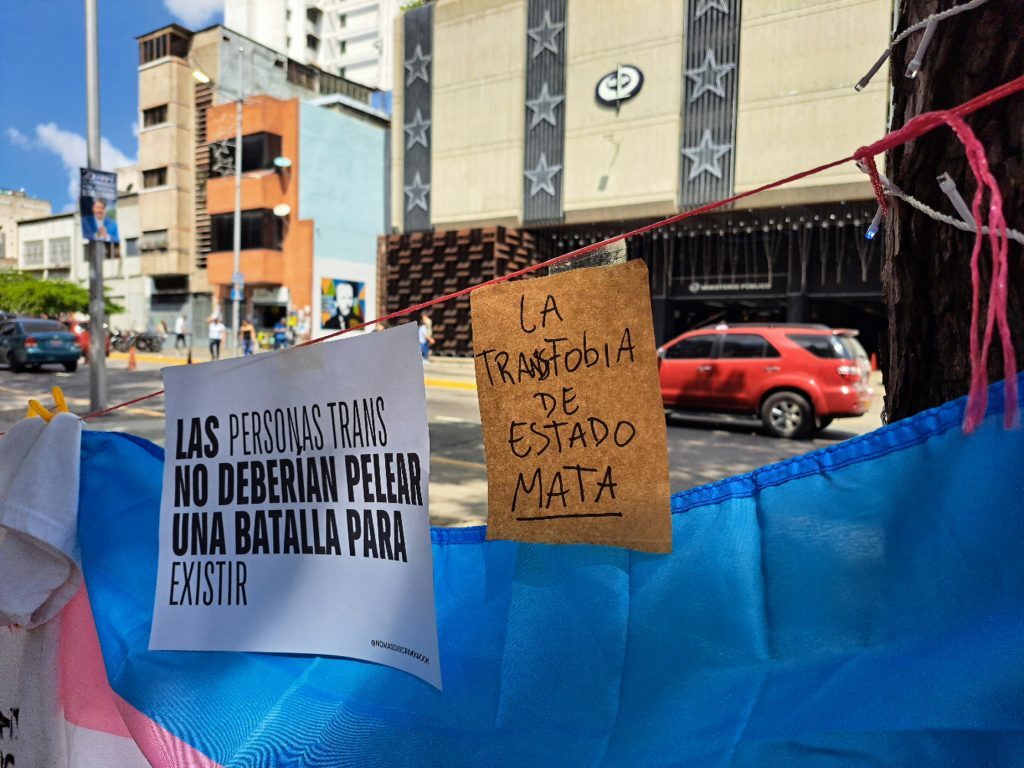
Soto is a co-founder of the Transgresores collective. (Venezuelanalysis)
Joseph Soto is an activist and co-founder of the Transgresores collective. This 34-year-old, who holds a degree in performing arts, has emerged as a leading figure in the defense of the rights of the sexual and gender diversity community in Venezuela, with a particular focus on raising awareness about trans men.
How was the transition process to a trans man in Venezuela amid a full-blown crisis?
It was undeniably very complex. The years 2016–2017 saw a worsening of the socioeconomic crisis in Venezuela as a result of the US blockade and sanctions, which had a drastic impact on day-to-day life, public services, and the population’s living standards. Everything pointed to the fact that, in order to transition, I would have to leave the country, but I decided not to. There had to be some way to be a trans man in Venezuela.
It was difficult, not only because of the material and socioeconomic conditions, but above all because of the lack of information and the void of references surrounding the issue of trans masculinity. Historically, trans women have shouldered the burden of visibility within the struggles for sexual diversity. When we talk, for example, about the 1969 Stonewall riots, trans women played a leading role. Trans men, on the other hand, have not taken on that protagonism. It caused me a great deal of anxiety to not know what to do, where to start, or where to go. I figured it out by researching, studying, seeing how things were done in other countries, reading medical protocols, analyzing different perspectives, and acquiring theoretical tools to develop my own process. But also by making connections and building networks here. That’s what saved me.
In the end, it was challenging but not impossible. And that’s exactly how I began to make connections with activists and advocates in the field of sexual and gender diversity, who in turn put me in touch with trans peers who were here in Venezuela. That allowed me to navigate the initial challenges of my gender identity transition, which involved building a collective of trans men called Transgresores.
In general terms, how would you describe the access to healthcare and medical treatment for trans people in Venezuela?
I believe there is a great need for discussion, training, and awareness-raising among healthcare workers regarding the care of our population. In addition to the inherent weaknesses of the public healthcare system, resulting from the US blockade and internal mismanagement, which create endless hurdles for receiving care at a hospital or affording treatment at a clinic, there is also the anxiety stemming from the possibility that a medical professional might be prejudiced or lack knowledge about trans issues.
The trans community doesn’t just go to healthcare centers for issues related to their gender transition, such as hormone replacement therapy or surgery. We may also experience general illness or suffer an accident, and prejudice stemming from ignorance can affect the quality of care we receive. It’s happened to me. Once I went to the hospital in Lidice (Caracas) for a swollen lymph node in my armpit, but when I mentioned that I was trans, the doctor refused to treat me, telling me to go to my primary care physician or an endocrinologist. He couldn’t even prescribe some ibuprofen. Prejudice won out.
Worse still is the treatment of transgender women. Discrimination persists, and the medical field is no exception. But we exist, and we have the right to healthcare. It seems like something very basic, but it’s work that still needs to be done. In the current context, with the Coexistence Program and the call made by the acting president herself for the recognition of sexual diversity, there is an opportunity for the Ombudsman’s Office, which has been facilitating this debate, to collaborate with the governing bodies in the healthcare sector to develop a training and awareness-raising process.
In other Latin American countries such as Cuba, or certain provinces in Argentina and Uruguay, there are established protocols and transition processes. This is provided through the public healthcare system, including access to hormones and surgical procedures if that is what the person desires. However, in Venezuela, there is no public health policy established and regulated by the state geared toward the care of transgender people. Before that can happen, there must be a rigorous debate since, in addition to transgender people, gay men and lesbians also suffer this type of discrimination.

Two issues stand out on the gender and sexual diversity agenda: marriage equality and legal name and gender changes for transgender people. Can you explain why these two issues are so central? And what other demands does the movement have?
In what concerns marriage equality, the Venezuelan sexual and gender diversity movement submitted a bill to the National Assembly in 2014. In other words, work has already been done on this issue, including going through the various legal steps required by the Venezuelan legal framework to present a bill of this magnitude to the legislature. But in the end, that debate did not proceed. It was shelved despite having met all the requirements. That is why we still demand a debate, to overcome the fear of recognizing other forms of family and to integrate ourselves as subjects of equal rights within our legal framework. That would allow, for example, our partners to have inheritance rights.
Regarding the issue of legal name and gender changes for transgender people, there are two key points. The first is that for trans people, when the name registered on legal documents does not match how we see ourselves, it can often expose us to situations of violence and discrimination in administrative procedures or when dealing with law enforcement. There have been instances of discrimination, violence, and abuse by the police when they identify a person as trans.
The second reason is that there is no need to create a new right. What is needed is to enforce and implement an existing one. The Organic Law on the Civil Registry establishes that every citizen of this country has the right to change their name at least once if it is humiliating or does not correspond to their gender. That is why the Venezuelan sexual and gender diversity movement has been so vocal in demanding this provision. As for other demands, there is the issue of the right to a life free from violence and discrimination, because discrimination based on gender identity, gender expression, or sexual orientation is still very much alive in Venezuela. Certain municipalities have proposed decrees on this matter, but I believe that is insufficient. We need a legal framework that establishes penalties and, above all, addresses all the various forms of discrimination faced by our community.
In other interviews and articles, you have talked about the harm suffered from studying in religious schools, despite the law establishing that education should be secular. As we witness a major offensive from evangelical groups in national politics, what is your perspective?
Indeed, the rise of conservative religious thought is a threat to sexual and gender diversity. But at the end of the day, this is nothing new. We are the cultural product of [Spanish] conquest and colonization, and from that point on, the Catholic religion was imposed.
Now, [Protestant] fundamentalist groups are definitely on the rise both nationally and regionally. But I believe the threat does not lie in religious thought itself, because this country is not inhabited solely by Christians. It is a melting pot of religions, beliefs, and faiths. I believe that our commitment must be precisely to celebrate, through sexual and gender diversity, that religious pluralism, so long as it does not infringe upon the rights of any group. My call is for sexual diversity to provide the country with a roadmap, a vision of a truly diverse, respectful society that aims for recognition and is free from violence and discrimination. We must engage in a meaningful debate about the kind of society we want to build. This involves addressing educational, cultural, and media issues.

Most of the country is focused on socioeconomic issues, and this is pushing other important questions to the backburner. What does the sexual and gender diversity movement propose in these circumstances?
I believe that the diversity movement owes a debt to the country because it has often limited itself to merely making demands and pointing out the shortcomings of the Venezuelan state and the Venezuelan people, but it has also failed to develop a strategic, programmatic vision to offer the country a vision of governance and an institutional framework.
My view is that we need to open up a broader debate and reestablish spaces for discussion within collectives, organizations, and platforms. Migration has also disrupted spaces for activism, because many sexual, gender, and diversity activists left the country. But it’s time to regroup and rise to the challenge of the times. What do we propose for the country in the present context? How do we see it? That is the debate we are called upon to have. I cannot definitively say what the sexual and gender diversity movement proposes because it is a debate that has yet to take place. But our approach cannot be limited to marriage equality and sexual identity.
You have also expressed concerns about a sector of the LGBTIQ+ community subordinating its agenda to the dynamics of foreign funding. Can you elaborate on this?
On this topic, I am referring to the fact that many of the sexual and gender diversity initiatives or forms of activism have been limited by NGOs since the international humanitarian system entered the country, as a result of sanctions, the crisis, and so on. In this kind of activism, political action has fallen short because it has been restricted solely to activities outlined within a given project sponsored by a specific funder, and it has lost its own organic character. It cannot be that the only spaces for us to meet and discuss are fully determined by the timelines, categories, and demands of a specific NGO project.
We must have our own agenda, with our own perspective and objectives. One that, above all, is guided by sexual and gender diversity activism and struggle. We have the responsibility and the challenge of overcoming this logic to reclaim an organic structure linked to concrete spaces of work and transformation, to a community, to a specific educational institution, to our territories, with our own agendas, categories, and timelines, not those predefined by an external organization.
The idea is not to demonize external funding, but our actions cannot be completely determined by it. Furthermore, these project activities fall short of the transformation we owe to our society. This is a personal perspective, and I’m sure I’ll get a lot of hate for it, but painting a bike lane with a rainbow flag in wealthy parts of eastern Caracas doesn’t bring about real change, even if resources, information, media coverage, and human effort are devoted to it. In terms of social and structural transformation, it achieves nothing; it leaves no lasting impact. We need a deeper, more strategic vision that harnesses the transformative potential we possess as a collective, as organized actors in society. That is why we must rebuild the movement.
