Human Rights

Israel kills at least 12 Palestinians in Gaza amid ‘ceasefire’ | Israel-Palestine conflict News

Hamas says the Israeli escalation represents the failure of the international community to uphold the truce in Gaza.

Israeli forces have killed 12 Palestinians in attacks throughout Gaza, medical sources in the enclave tell Al Jazeera, as Israel continues its daily violations of the ceasefire struck last year.

An Israeli attack on a police vehicle on Friday killed at least eight people, including three civilian bystanders, in Khan Younis. A separate attack in Gaza City also killed two police officers.

Recommended Stories

list of 3 itemsend of list

Two other people were killed in the bombing of a house in Beit Lahiya in northern Gaza.

Gaza’s Ministry of Interior called on the international community on Friday to intervene and end the Israeli targeting of local police forces working to restore security in civilian areas.

It said the attack in Khan Younis came after security forces intervened to break up a fight in the area.

“The continued silence of international organisations … regarding the targeting of civilian police officers constitutes complicity with the Israeli occupation, encouraging it to commit further crimes against a civilian institution protected under international law,” the ministry said.

“We emphasise that the police force provides services to citizens in the Gaza Strip across various aspects of daily life. There is absolutely no justification for targeting it or killing its personnel.”

Israel has been systemically killing police officers in Gaza, as it allies itself with criminal gangs in the occupied territory.

During its genocidal war on Gaza, which started in October 2023, the Israeli military regularly targeted officers securing aid convoys, which led to intensified looting. That, in turn, deepened the hunger crisis that Israel imposed on the territory.

A ceasefire, brokered by United States President Donald Trump, came into effect in October of last year. That decreased the intensity of the Israeli bombardment.

But Israel has nevertheless continued its attacks on the territory, killing at least 984 people and injuring 2,235 others since the truce was announced, according to health authorities.

Just this week, Israeli strikes killed five people, including three children, on Wednesday.

The overall death toll in the war has surpassed 72,500, with more than 172,000 others injured. Thousands of missing people are believed to be dead and buried under the destroyed buildings.

The number of confirmed casualties represents more than 7 percent of the enclave’s population of two million people. The Israeli assault also turned most of Gaza’s structures into piles of rubble.

Leading rights groups and United Nations investigators have concluded that the Israeli military campaign amounts to genocide: an effort to destroy the Palestinian people.

Under the far-right government of Prime Minister Benjamin Netanyahu, Israel has continued to bomb Gaza as it simultaneously attacks south Lebanon, in violation of a separate truce with Hezbollah.

Hamas on Friday called the deadly attacks in Gaza part of the Israeli government’s “unprecedented bloody, fascist approach”.

“This escalation … by the government of the war criminal Netanyahu represents a clear failure of the role of the mediators and guarantors [of the ceasefire] and the international community to quell the barbaric Zionist killing machine,” it said.

More than six months into the ceasefire, Trump has struggled to implement the 12-point plan on which the truce was based.

Israel continues to occupy most of Gaza. Reconstruction in the territory has not begun. An international security force envisioned by the agreement has not been formed.

In February, Trump convened his so-called Board of Peace that is supposed to govern Gaza through a council of Palestinian technocrats, but it is not clear when or how these forces will take over government agencies in the territory.

Source link

Trump to again end legal status of people who entered US with CBP One app | Donald Trump News

Judge had previously blocked move to end temporary legal status for those who entered US via Biden-era application.

The administration of President Donald Trump plans to again end the temporary legal status of hundreds of thousands of people who applied for asylum in the United States via the CBP One app.

The plan was detailed in a court filing in Boston, Massachusetts, and comes after a judge ruled that Trump’s earlier effort to terminate the legal status of those individuals was unlawful.

Recommended Stories

list of 3 itemsend of list

Under US President Joe Biden, individuals who registered for an appointment with US Customs and Border Protection (CBP) were preliminarily vetted and granted temporary legal status in the US as their asylum cases were adjudicated.

About 900,000 people were granted so-called humanitarian parole under the programme.

But in April of last year, just months after Trump took office for a second term, many of those individuals received emails saying their status had been terminated.

The message told its recipients it was “time for you to leave the United States”.

Federal Judge Allison Burroughs subsequently ruled that the Department of Homeland Security did not follow the proper procedures in terminating the legal status immigration status of CBP One users.

The US Department of Justice, in the new filings, told Burroughs that the Trump administration was complying with ⁠her order.

However, the department said the administration would begin issuing new parole termination notices, pursuant to a Tuesday memo from CBP’s head, Rodney Scott.

The memo is not public, but according to the Justice Department, Scott provided ‌an explanation for why, in his opinion, “parole is no longer appropriate for those aliens”.

Lawyers for Democracy Forward and Massachusetts Law Reform Institute, which represent the individuals whose status faces termination, urged Burroughs in a subsequent filing to prevent what they called a “deliberate attempt to evade compliance with the court’s order”.

The next hearing was set for May 6.

During his second term, Trump has pursued a hardline immigration policy that has included staunching nearly all asylum claims at the southern border.

Shortly after taking office, Trump’s officials also dissolved the CBP One app and relaunched it as CBP Home, a tool for self-deportation.

His administration has claimed there was an “invasion” at the border that constituted a “national emergency”, thereby allowing Trump to bypass legal requirements to allow individuals seeking asylum into the country.

Asylum, however, is a right enshrined both in domestic and international law, to protect people fleeing persecution on the basis of race, religion, nationality, political opinion or membership in a particular social group.

Separately, on Friday, a federal appeals court ruled against the Trump administration’s ban on asylum at the southern US border, potentially clearing the way for applications to once again be processed.

The administration is expected to appeal the decision.

Source link

US appeals court rejects Trump’s ban on asylum seekers, teeing up appeal | Migration News

Judges say Trump’s order for swift removal at the border ‘cast aside federal laws affording’ right to seek asylum.

An appeals court has ruled that President Donald Trump’s ban on asylum applications in the United States is unlawful, dealing a setback to the administration’s immigration crackdown.

In a decision released on Friday, a three-judge panel from the US Court of Appeals in Washington, DC, found that existing laws — namely the Immigration and Nationality Act (INA) — give people the right to apply for asylum at the border.

Recommended Stories

list of 3 itemsend of list

Trump had issued the asylum ban in a proclamation on January 20, 2025, on the first day of his second term.

But the appeals court questioned whether suspending asylum unilaterally was within the president’s power.

“Congress did not intend to grant the Executive the expansive removal authority it asserts,” the ruling said.

“The Proclamation and Guidance are thus unlawful to the extent that they circumvent the INA’s removal procedures and cast aside federal laws affording individuals the right to apply and be considered for asylum or withholding of removal protections.”

The decision validated a ruling by a lower court. While the judges blocked Trump’s order, it is unclear what its immediate impact will be. Already, the White House has signalled it plans to appeal.

Trump made immigration a major pillar of his 2024 re-election campaign, pledging to repel what he describes as an “invasion” of migrants by shutting down the southern border of the US.

Asylum in the US can be granted to people facing “persecution based on race, religion, nationality, political opinion, or membership in a particular social group”. Such protections have been recognised as a fundamental human right under international law.

But unauthorised border crossings reached record levels during the administration of President Joe Biden, which had itself imposed asylum restrictions.

Millions of migrants — many suffering from gang violence and political persecution in Central and South America — have claimed asylum upon reaching the US.

Nearly 945,000 filed for asylum in 2023, according to the Department of Homeland Security.

In his January 2025 decree, Trump suspended “the physical entry of aliens involved in an invasion into the United States across the southern border”.

The proclamation was quickly challenged in court, as other measures in Trump’s immigration crackdown have been.

But the appeals court panel concluded that the INA does not authorise the president to remove the plaintiffs under “procedures of his own making”.

Nor does it allow him to suspend the plaintiffs’ right to apply for asylum or curtail procedures for adjudicating claims of torture and persecution.

“The power by proclamation to temporarily suspend the entry of specified foreign individuals into the United States does not contain implicit authority to override the INA’s mandatory process to summarily remove foreign individuals,” wrote Judge J Michelle Childs, a Biden appointee.

The Trump administration will likely appeal the ruling to the full appellate court and subsequently to the Supreme Court.

The White House stressed after the court’s decision that banning asylum is part of Trump’s constitutional powers as commander-in-chief.

“We have liberal judges across the country who are acting against this president for political purposes. They are not acting as true litigators of the law. They are looking at these cases from a political lens,” White House spokesperson Karoline Leavitt told reporters.

Source link

Milei administration in Argentina blocks journalist access to Casa Rosada | Freedom of the Press News

Press freedom advocates have warned of hostile rhetoric towards journalists and increasingly restrictive policies under Milei.

The administration of Argentina’s Javier Milei has restricted access to the presidential palace, the Casa Rosada, as part of an escalating feud with the country’s journalists.

Accredited journalists reportedly arrived at the Casa Rosada on Thursday and attempted to enter the building through fingerprint scanning, as they usually would.

Recommended Stories

list of 3 itemsend of list

But they were unable to pass the scan. As confusion hit the news corps, the head of Argentina’s Secretariat of Communication and Press issued a clarification that their press accreditation had not been revoked.

“The decision to remove the fingerprints of journalists accredited to the Casa Rosada was taken as a preventive measure in response to a complaint filed by the Military Household regarding illegal espionage,” Secretary Javier Lanari wrote on social media.

“The sole objective is to guarantee national security.”

Lanari’s post cites an incident wherein two journalists from the Argentinian channel TN were accused of secretly filming inside the government palace.

After their report was broadcast, the Milei administration accused the journalists of endangering government security by showing parts of the Casa Rosada that were reportedly off limits.

On Wednesday, Milei himself took to social media to call the journalists “repugnant trash”. He then challenged other members of the news media to justify their actions.

“I would love to see that filthy scum — the 95% who carry press credentials — come out and defend what these two criminals did,” Milei wrote on X.

Since then, the president has repeatedly reposted messages critical of the news media, often accompanied by the acronym “NOLSALP” or “NOL$ALP”. It stands for: “We don’t hate journalists enough.”

“Someday, that filthy journalistic scum (95%) will have to understand that they are not above the law. They abused legal precedent. It does not come without a price,” Milei added in one of his posts on Thursday, as he continued to slam the news media.

This week’s actions are the latest in a series of policy changes under Milei designed to tighten restrictions on journalists.

Last year, for instance, his government capped entry to certain rooms in the Casa Rosada and placed other areas out of bounds.

Critics say the policies are part of a wider broadside against journalism in Argentina. The media advocacy group Reporters Without Borders (RSF) has said that, since Milei took office in 2023, the country has seen “a sharp decline in press freedom”.

And PEN International, an organisation for writers, warned last year of a “serious deterioration” in free-speech rights.

It pointed to legislation that further restricted which government documents could be made public and to Milei’s dismantling of public media, as well as the installation of a “mute” button to silence journalists during news conferences.

Already, the decision to bar journalists from entry into the Casa Rosada has faced pushback, including from Argentinian lawmakers.

Marcela Pagano, a former journalist turned deputy in Argentina’s legislature, announced on Thursday that she had filed a criminal complaint against Milei.

“The Casa Rosada is not private property,” Pagano wrote in a statement.

“Still less does a head of state — or his henchmen officials — have the authority to decide whether the press may access the building.”

She called Thursday’s incident “an unprecedented occurrence since the return of democracy” in Argentina in 1983.

“Prohibiting journalists from exercising their freedom of expression is the first step toward silencing any dissenting voice — a situation that we in Argentina have experienced during our country’s darkest moments,” she added. “THEY WILL NOT SILENCE US.”

Source link

South American migrants deported to DRC say facing pressure to return home | Migration News

Rights advocates have accused the Trump administration of using third-country deportations to intimidate asylum seekers and migrants.

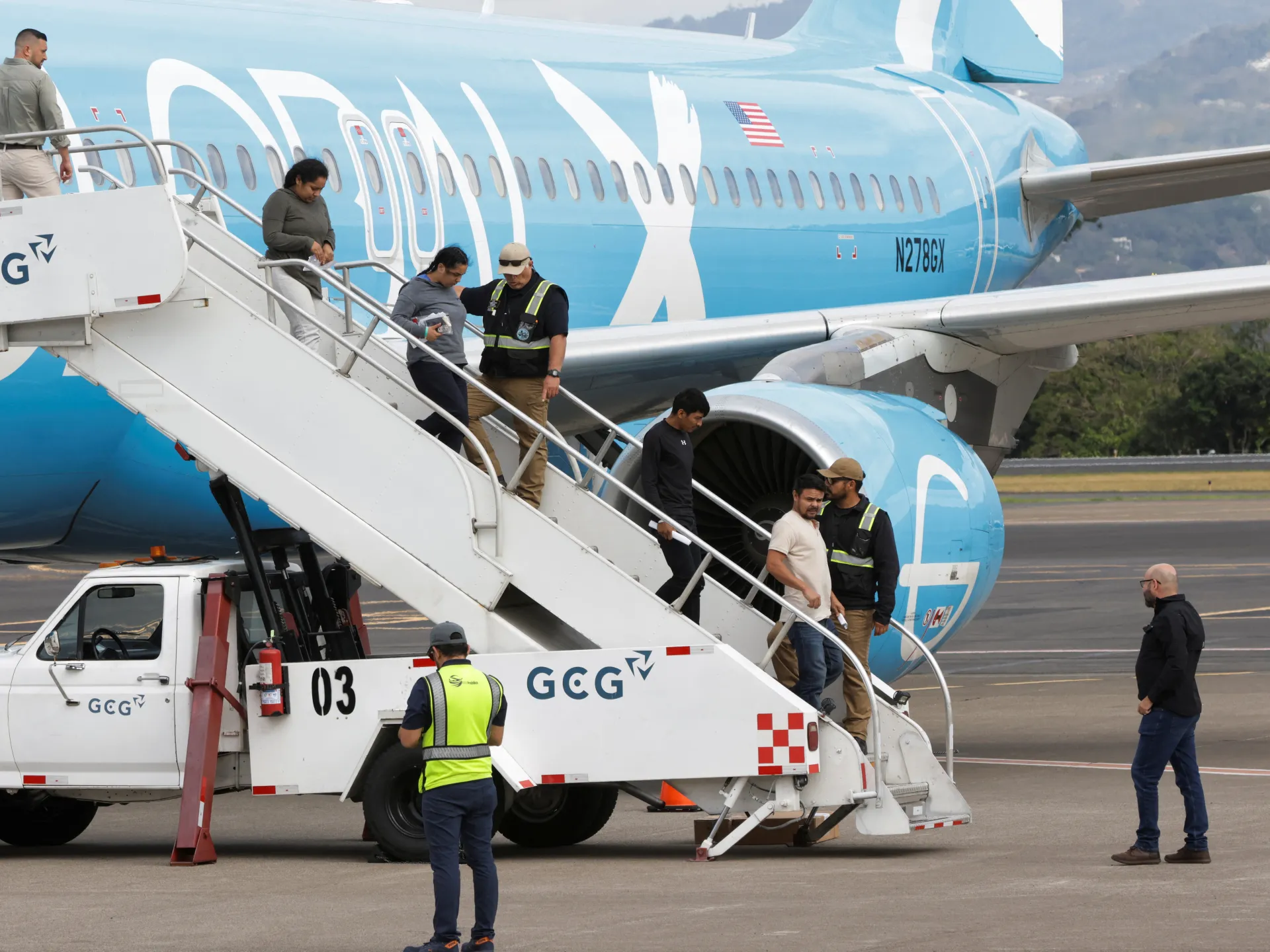
Fifteen South American migrants and asylum seekers recently deported from the United States to the Democratic Republic of the Congo (DRC) say they are facing pressure to return to their countries of origin, despite concerns for their safety.

Women from Colombia, Peru and Ecuador told the Reuters news agency that, since being deported to the Central African nation last week, they have been given no credible options other than going back to their home countries.

Recommended Stories

list of 3 itemsend of list

“We feel pressured to agree to go back to our country, regardless of the risks,” a 29-year-old Colombian woman, who asked to remain anonymous out of fear of reprisals, told Reuters.

The group arrived in the DRC last week as part of a controversial third-country agreement with the administration of US President Donald Trump.

Since returning to the presidency for a second term, Trump has implemented hardline measures to restrict immigration to the US and expel immigrants already in the country, some of whom have legal status.

Among the 15 South Americans who were deported to the DRC, some say they had sought asylum — a legal immigration process — in the US after fleeing persecution in their home countries.

The 29-year-old woman, for example, wrote in her asylum application in January 2024 that she left Colombia after being kidnapped and tortured by an armed group, as well as suffering abuse at the hands of her ex-husband, who was a police officer.

A US immigration judge ruled in May 2025 that she was more likely than not to be tortured if she was sent home, according to court records reviewed by Reuters.

The AFP news agency also reported that a 30-year-old Colombian woman named Gabriela only learned that she was being sent to the DRC a day before last week’s flight. During a 27-hour trip, the hands and feet of the deportees were shackled.

“I didn’t want to go to Congo,” she told AFP. “I’m scared; I don’t know the language.”

Immigration advocates have said that third-country deportations are an effort to intimidate migrants and asylum seekers into agreeing to leave the US.

Such removals involve sending immigrants to places with which they have no familiarity. Many, including the DRC, are known for human rights concerns or are sites of active conflict.

“The goal is clear: Put people in a place so unfamiliar that they give up and agree to return home, despite the immense risk they face there,” said Alma David, a US-based lawyer representing one of the asylum seekers in the DRC.

Source link

Pro-Palestine legal aid requests stay high in 2025 amid US campus pressure | Donald Trump News

Washington, DC – Requests for legal support related to pro-Palestine advocacy remained high in the United States last year, as President Donald Trump threatened activists and universities with penalties.

In an annual report released on Tuesday, Palestine Legal, an organisation that “supports the movement for Palestinian freedom in the US”, said it received 1,131 queries for legal support in 2025.

Recommended Stories

list of 3 itemsend of list

The figure is below the record 2,184 requests the group received in 2024, when pro-Palestine protests swept US campuses — and were regularly met with crackdowns from both school administrators and law enforcement.

Despite universities enacting new restrictions on protests across the country, the figures from 2025 show that pro-Palestine advocacy has persisted, according to Dima Khalidi, the executive director of Palestine Legal.

“Our 2025 year-end report shows that while universities have largely cowered and caved to coercive pressure from the Trump administration and its pro-Israel supporters, student activists for Palestinian and collective freedom remain a model of moral conviction and courage,” Khalidi said.

“Even when facing punitive consequences for speaking out, they are holding the line of dissent against injustice from the US to Palestine, because they understand the cost of surrender for all of us.”

Palestine Legal said that the “overwhelming majority of requests” for legal support came from university students and faculty in 2025, but a growing number, 122, were categorised as “immigration and border-related”.

The group received 851 requests from people or organisations targeted for their Palestine-related advocacy, as well as 280 more asking for legal guidance on conducting advocacy.

Despite the drop from 2024, the rate of complaints last year remained 300 percent higher than in 2022, the year before Israel began its genocidal war in Gaza on October 7, 2023.

Since then, at least 72,560 Palestinians have been killed in Gaza.

Pressure campaigns

In 2024, Trump campaigned for a second term in the White House in part on a pledge to crack down on the pro-Palestinian protest movement, which sought to shine a light on the human rights abuses unfolding during the war.

He has framed such protests as anti-Semitic, and since his inauguration in 2025, he has led a campaign to penalise schools that played host to pro-Palestinian activism.

To date, five universities have struck deals with Trump after he threatened to withhold billions in federal funding. They include Columbia University, where a pro-Palestine encampment and resulting police crackdown drew international attention.

Columbia eventually reached a $200m settlement with the Trump administration and moved to make several policy changes it said were aimed at combatting anti-Semitism.

Rights groups have condemned such policies as conflating pro-Palestine advocacy with anti-Jewish sentiment. They also warn that Trump’s actions risk dampening free speech, a protected right under the First Amendment of the US Constitution.

All told, nearly 80 of the students who took part in Columbia’s protests faced serious academic discipline, including expulsions, suspensions, and degree revocations, as of July 2025.

Meanwhile, the Trump administration used immigration enforcement to target pro-Palestine protesters and advocates, including scholars like Rumeysa Ozturk, Mohsen Mahdawi, Badar Khan Suri and Mahmoud Khalil.

To date, the deportation proceedings against Ozturk, who was in the US on a student visa, and Mahdawi, a US permanent resident detained at his citizenship hearing, have been abandoned.

Ozturk has since voluntarily returned to her native Turkiye after completing her doctoral studies at Tufts University.

The government is still proceeding with deportation efforts against Khan Suri, a Georgetown University researcher, and Mahmoud Khalil, a Columbia University graduate and permanent US resident.

Separately, the Federal Bureau of Investigation (FBI) raided five homes connected to pro-Palestine activists at the University of Michigan in April 2025, sparking outrage. Federal authorities seized properties, but no arrests were made.

Despite the restrictive climate across the country, Palestine Legal hailed a string of legal victories in 2025 that upheld the right to pro-Palestinian protest.

Last August, for instance, a federal court dismissed a complaint that sought to penalise UNRWA USA, a non-profit that supports the United Nations Relief and Works Agency for Palestine Refugees (UNRWA), under the Antiterrorism Act of 1990.

A separate lawsuit launched by Palestine Legal and the Council on American-Islamic Relations (CAIR) charged that the University of Maryland had tread on the free speech rights of students by banning Students for Justice in Palestine (UMD SJP). That case resulted in a $100,000 settlement.

Meanwhile, federal judges have sided with Harvard University and the University of California, Los Angeles (UCLA), in their challenges to the Trump administration’s defunding efforts.

“The fights that Palestine Legal and our partners have waged affirm that the Trump administration, universities, and Israel advocacy groups cannot, without consequence, run roughshod over growing demands to respect and protect Palestinian rights,” Palestine Legal said at the conclusion of its report.

“The developments throughout 2025 made crystal clear that if we allow our right to stand for Palestinian freedom to be trampled, all of our fundamental rights will be in jeopardy in the face of an authoritarian slide.”

Source link

Spain, Slovenia, Ireland push EU to debate Israel pact suspension | Gaza News

In a letter to EU foreign policy chief Kaja Kallas, the three governments say Israel is violating ‘human rights’.

Spain, Slovenia and Ireland have urged the European Union to debate suspending its association agreement with Israel, saying the bloc can no longer remain “on the sidelines” as conditions worsen in Gaza, the occupied West Bank and Lebanon.

Speaking before a meeting of EU foreign ministers in Luxembourg on Tuesday, Spanish Foreign Minister Jose Manuel Albares said the three countries had formally requested that the issue be placed on the agenda.

Recommended Stories

list of 4 itemsend of list

“Spain, along with Slovenia and Ireland, has requested that the suspension of the Association Agreement between the European Union and Israel be discussed and debated today,” Albares said.

“I expect every European country to uphold what the International Court of Justice and the UN say on human rights and the defence of international law. Anything different would be a defeat for the European Union,” he added.

In a joint letter sent last week to EU foreign policy chief Kaja Kallas, the three governments said Israel had taken a series of measures that “contravene human rights and violate international law and international humanitarian law”, adding that it breached the 1995 agreement that outlines political, economic and trade relations between the EU and Israel.

They said repeated appeals to Israel to reverse course had been ignored. The ministers pointed to a proposed Israeli law that would impose the death penalty by hanging on Palestinians convicted in military courts, describing it as “a grave violation of fundamental human rights” and a further step in the “systematic persecution, oppression, violence and discrimination” faced by Palestinians.

They also cited the humanitarian crisis in Gaza, saying conditions there were “unbearable”, with continuing violations of the ceasefire agreement and insufficient aid entering the territory.

The letter warned that violence in the occupied West Bank was also intensifying, with settlers acting “with absolute impunity” alongside ongoing Israeli military operations, causing civilian deaths.

“The European Union can no longer remain on the sidelines,” the ministers wrote, calling for “bold and immediate action” and saying all options should remain on the table.

The three countries argued Israel was in breach of Article 2 of the EU-Israel Association Agreement, which ties relations to respect for human rights. An earlier EU review had already found Israel was failing to meet those obligations, they said, adding that the situation had deteriorated further since then.

During a donor conference in Brussels, Kallas said the estimated cost of rebuilding Gaza had risen to $71bn.

Ireland and Spain first pushed for a review of the agreement in 2024, but the effort failed to win enough backing from member states supportive of Israel. A later Dutch-led initiative succeeded in triggering an EU assessment, which concluded Israel had “likely” breached its obligations under the pact.

Possible trade measures, including suspending parts of the relationship, were later discussed but not implemented after Israel pledged to significantly increase humanitarian aid entering Gaza.

Occupied Territories Bill

Ireland is also seeking to revive its Occupied Territories Bill, first introduced in 2018, which would ban trade in goods and services from illegal settlements in the occupied Palestinian territory, including the West Bank. Progress has stalled despite unanimous backing in the lower house of parliament, the Dail.

Meanwhile, Spain and Slovenia have moved to curb trade with illegal Israeli settlements in the occupied West Bank following sustained public protests and growing political pressure. In August last year, Slovenia banned imports of goods produced in Israeli-occupied territories, becoming one of the first European states to take such a step.

Spain followed later that year with a decree banning imports from illegal Israeli settlements, with the measure coming into force at the start of 2026.

All three countries formally recognised the State of Palestine in May 2024, in what was widely seen as a coordinated diplomatic move aimed at increasing pressure for a two-state solution.

Source link

‘Sent to be killed’: How Russia forces migrants to fight in Ukraine | Russia-Ukraine war News

Kharkiv, Ukraine – Hushruzjon Salohidinov, 26, was working as a courier in Saint Petersburg, Russia’s second-largest city and President Vladimir Putin’s hometown.

But last year, the Tajik man and practising Muslim says he was arrested while picking up a parcel which police claimed contained money stolen from elderly women.

Salohidinov says he never interacted with the alleged criminals, but nevertheless spent nine months in the Kresty-2 pre-trial detention centre about 32km (20 miles) from the city, while a judge refused to start his trial because of the “weak evidence” against him.

But instead of releasing him after that, prison wardens threatened to place him in a cell with HIV-infected inmates who, they said, would gang-rape him – unless he “volunteered” to fight in Ukraine.

“They said, ‘Oh, you’ll put on a skirt now, you’ll be raped,’” Salohidinov, who has raven black hair and a messy full beard, told Al Jazeera at a centre for war prisoners in northeastern Ukraine, where he is now being held, having been captured in January this year by Ukrainian forces.

Using a carrot-and-stick tactic, the wardens also promised him a sign-up bonus of 2 million rubles ($26,200), a monthly salary of 200,000 rubles ($2,620) and an amnesty from all convictions.

So, in the autumn of 2025, Salohidinov signed up as he “saw no other way out”.

Officials in Kresty-2, St Petersburg’s prosecutors’ office and Russia’s Ministry of Defence did not respond to any of Al Jazeera’s requests for comment.

Russia migrants
Hushruzjon Salohidinov, 26, a Tajik man forced to fight for Russia, at a prisoner of war facility [Mansur Mirovalev/ Al Jazeera]

‘Catching migrants’

Salohidinov is just one of tens of thousands of labour migrants from Central Asia coerced by Russia to become soldiers as part of the Kremlin’s nationwide campaign, according to human rights groups, media reports and Russian officials.

Hochu Jit, a Ukrainian group that helps Russian soldiers surrender, has published verified lists of thousands of Central Asian soldiers like Salohidinov.

“They are literally sent to be killed, no one considers them soldiers that need to be saved,” the group wrote in a 2025 post on Telegram. These soldiers’ life expectancy on the front line is about four months. “Losses among them are catastrophic,” the group reported.

With its low birthrate and large oil wealth, Russia has for years been a magnet for millions of labour migrants from ex-Soviet Central Asia, especially Tajikistan, Uzbekistan and Kyrgyzstan.

The campaign by the Kremlin to force Central Asians to fight in Ukraine dates back to 2023 – the year after Russia’s invasion of Ukraine – when police began rounding up anyone who didn’t look Slavic and charging them with real or imagined transgressions such as a lack of registration, expired or “fake” permits or blurred stamps on their documents. Sometimes, migrants are simply bused straight to conscription offices.

In 2025, Al Jazeera interviewed another Tajik man who said he had been detained with an expired work permit and was then tortured into “volunteering” while being subjected to countless xenophobic and Islamophobic slurs from his officers.

Migrants say they are abused, tortured and threatened with jail or having their entire families deported.

“The main way of recruiting as many migrants as possible is pressure on them with threats of deportation,” Alisher Ilkhamov, the Uzbekistan-born head of the London-based Central Asia Due Diligence think tank, told Al Jazeera.

Sometimes, migrants are simply duped.

Salohidinov said one serviceman in his squad was an Uzbek who “didn’t speak a word of Russian” and was fooled into “volunteering” while signing papers at a migration centre.

In their reports about “catching” migrants, officials frequently use derogatory terms about them, and also when they describe men who have obtained Russian passports but skipped registration at conscription offices. Since the Soviet era, such registration has been obligatory for all men and, since 2024, a newly naturalised Russian national can lose his citizenship if he fails to do it.

“We’ve caught 80,000 such Russian citizens, who don’t just want to go to the front line, they don’t even want to go to a conscription office,” chief prosecutor Alexander Bastrykin said in May 2025, referring to the migrants’ alleged patriotic sentiments.

He boasted that 20,000 Central Asians with Russian passports were herded to the front line in 2025.

The year before, he said 10,000 Central Asians had been sent to Ukraine.

Such remarks resonate with the Russian public that lives with “a high level of xenophobia in the stage of fear and helplessness,” Sergey Biziyukin, an exiled opposition activist from the western city of Ryazan, told Al Jazeera.

“For them, such phrases from Bastrykin are a form of sedative.”

What makes Central Asians easy targets is that they hail from police states, which depend on Moscow politically and economically, observers say.

“While the migrants are frightened into signing contracts, their motherland doesn’t really pay any attention,” Galiya Ibragimova, an Uzbekistan-born, Moldova-based regional expert, told Al Jazeera.

Despite hefty signup bonuses and relentless propaganda, the number of Russians who want to fight in Ukraine fell by at least one-fifth this year, and Moscow will strive to recruit more Central Asians, she said.

Russia conscripts
Russian conscripts called up for military service attend a ceremony marking their departure for garrisons from a recruitment centre in Saint Petersburg, Russia, on October 15, 2025 [Anton Vaganov/Reuters]

‘We’ll have our fingers broken’

After signing the contract and leaving his debit card with his sign-up bonus with his parents, Salohidinov was sent to the western city of Voronezh for three weeks of training that did little to prepare him for the war.

“We just kept running back and forth with guns,” he said.

Their drill sergeants, he says, told the conscripts that the standard-issue flak jackets, helmets, boots and flashlights were of subpar quality and urged them to pitch in a million rubles ($13,100) each for “better” gear.

The incident corroborates reports on dozens of similar cases in Russian military units.

Salohidinov was ordered to work in a kitchen – and was verbally abused and beaten for the slightest transgression.

Of 28 men in his unit, 21 were Muslims – but their ethnic Russian officers ignored their pleas not to have pork in meals, repeating a decades-old practice of ignoring religion-related dietary restrictions dating back to the Soviet army.

The commanders demonised Ukrainians, telling them “that if we surrender, we’d be tortured, have our fingers broken, maimed, get [construction] foam up our a**, have our teeth yanked out one by one, have our arms broken”, Salohidinov says.

In early January this year, the conscripts were bused to the Russia-occupied Ukrainian region of Luhansk.

Salohidinov says he was tired, frightened and disoriented – Ukrainian drones were “always” above them and a grenade explosion nearby damaged his left eardrum.

Ukraine prisoner swap
A woman waits for news about a missing loved one as some Ukrainian soldiers return during a prisoner of war (POW) swap, amid Russia’s attacks on Ukraine, in an undisclosed location in Ukraine, on April 11, 2026 [Thomas Peter/Reuters]

‘Glad I got captured’

On the fourth day of his service, Salohidinov was ordered to run beyond Ukrainian positions as part of Russia’s new tactic to send two or three servicemen to infiltrate the porous front line.

The mission was suicidal because the terrain was open, dotted with landmines and the bodies of dead Russian soldiers, while Ukrainians were firing machineguns and flew drones above them.

“I ran and ran and saw we were being shot at,” he said. “Me and my commander decided to surrender voluntarily instead of dying for nothing.”

They detached their assault rifles’ magazines, raised their hands and yelled they were surrendering.

What followed was “a calm feeling, beautiful”, he said. “They fed us, let us have a smoke, gave us food and water and even cake.”

Now, Salohidinov hopes to return to Tajikistan and panics at the thought of being made part of a prisoner swap – these have taken place several times each year – and returning to Russia because he would be sent back to the front line.

Tajikistan and other Central Asian nations have never endorsed Russia’s war in Ukraine, but nor have they openly criticised it.

In August 2025, Tajikistan’s Prosecutor General Habibullo Vohidzoda declared that no Tajik national would be charged for fighting in Ukraine.

So, what Salohidinov needs right now is an extradition request.

“I’m even glad that I got captured, because I’m not fighting anyone now, not risking anything,” he said. “I’ll even say thanks to Ukraine for taking me prisoner.”

The Tajik embassy in Kyiv did not respond to Al Jazeera’s request for comment.

Source link

As world focuses on Iran, Israel ‘engineering starvation policy’ in Gaza | Gaza News

With the global attention fixated on the diplomatic efforts to end the war on Iran, Israel has systematically escalated its attacks on Gaza and choked off vital aid, plunging the besieged enclave into what economic experts are now calling an “engineered, compounded famine”.

The number of aid trucks entering Gaza has dropped drastically in violation of the October 2025 ceasefire with Hamas. Since then, the Government Media Office in Gaza has recorded 2,400 military violations by Israeli forces, resulting in the killing of more than 700 Palestinians.

Recommended Stories

list of 4 itemsend of list

On Tuesday, Israel’s military killed at least 11 Palestinians, including two children, in separate attacks across the war-torn Strip.

The intensity of these attacks spiked during peak regional tensions. Between February 28 and April 8, while Israel and the US were engaged in a bombing campaign against Iran, Israeli forces bombed Gaza on 36 out of those 40 days.

In the last five weeks alone, more than 100 people have been killed, including Al Jazeera journalist Mohammed Wishah. Israel has killed more than 72,336 people since launching the brutal military offensive on October 7, 2023.

Interactive_40Days_Gaza_US-ISRAEL-WAR-APRIL8_2026-FOOD_SECURITY

The ‘truck deception’

While Israel frequently claims it is allowing hundreds of aid trucks into Gaza, Palestinian officials and economic experts argue these figures are a deliberate mathematical deception.

According to the Government Media Office, only 41,714 aid and commercial trucks have entered Gaza over the past six months. This represents a mere 37 percent of the 110,400 trucks stipulated under the ceasefire agreement. The fuel situation is even more critical, with only 1,366 fuel trucks entering out of a promised 9,200 – an abysmal 14 percent compliance rate.

Recent daily logs highlight the severity of the bottleneck. On April 13, a total of only 102 aid trucks and 7 fuel trucks were allowed into the entire Strip, alongside 216 commercial trucks – a fraction of the more than 600 total trucks required daily under the “ceasefire” deal. By April 14, the numbers remained critically low with 122 aid trucks and 12 fuel trucks entering.

Crucially, Israeli authorities entirely shut down additional entry points like the Zikim and Kissufim crossings, which had processed dozens of commercial and aid trucks just a day prior, bottlenecking all limited traffic exclusively through Karem Abu Salem.

Mohammed Abu Jayyab, a Palestinian economic expert based in Gaza, told Al Jazeera that Israel utilises a “technical and commercial deception” to inflate these numbers.

“An Israeli truck carries up to 32 or 34 pallets… which are then unloaded into two or three smaller, dilapidated Palestinian trucks on the Gaza side,” Abu Jayyab explained. “Consequently, the UN and Israel count double or triple the actual number of Israeli trucks entering.” One pallet holds roughly 1 tonne of goods or food items.

Furthermore, Israel recently banned mixed-load shipments. If a merchant brings in 20 pallets of sugar, the remaining 12 pallet spaces on the truck must remain empty, yet it is still registered as a full commercial truck.

“The political agreement stipulated a ‘truck’ but did not specify quantities, weights, or the number of pallets,” Abu Jayyab noted, allowing Israel to weaponise logistics to restrict aid while appearing compliant.

Engineering starvation

This logistical strangulation is part of a broader strategy. Hassan Abu Riyala, undersecretary of the Ministry of National Economy in Gaza, stated in a meeting published on the ministry’s official Telegram channel that Israel is “engineering a policy of starvation”.

To ensure chaos in the local markets and sky-high prices, Israel has deliberately dismantled civil regulatory bodies. “The occupation targeted the majority of the crews that monitored prices, and assassinated the [former] undersecretary of the Ministry of Economy and five directors general during the war,” Abu Riyala said.

The results have been devastating, basic commodities have become scarce, and bread production has plummeted to 200 tonnes daily, far below the 450 tonnes required to feed the population.

“We manage this structural deficit under exceptional and coercive conditions,” Ismail Al-Thawabteh, director general of the Government Media Office, told Al Jazeera.

He described the ongoing reduction of supplies despite the truce as a “systematic restriction of basic supplies” that pushes the population towards dangerous levels of food insecurity. Fresh produce has skyrocketed, with 1kg (2.2lb) of tomatoes jumping from $1.50 to nearly $4 in a matter of weeks.

Moreover, the humanitarian catastrophe is being accelerated by the withdrawal of major aid groups. Al-Thawabteh noted that the scaling back or suspension of operations by key international institutions, most notably the World Food Programme (WFP), due to Israeli restrictions, represents a “highly dangerous development” that threatens the complete collapse of Gaza’s relief system.

“We issue an urgent appeal to the international community and the guarantors of the agreement to immediately pressure Israel to open the crossings… before reaching a point of no return and an imminent human explosion,” he said.

A ‘compounded famine’

The crisis has evolved beyond a simple lack of food; it is now a complete collapse of the Palestinian economy.

Abu Jayyab described the current situation as a “compounded famine”. With unemployment soaring to 80 percent and the destruction of more than 160,000 jobs across industrial, agricultural, and commercial sectors, the population has entirely lost its purchasing power.

“It has become illogical to link the entry of food supplies from the crossings to their availability to Palestinian citizens,” Abu Jayyab told Al Jazeera. Even when goods reach the market, between 70 to 80 percent of families simply cannot afford to buy them due to the total absence of income.

This extreme deprivation is forcing civilians into life-threatening alternatives. “The return of long queues for bakeries, and citizens resorting to burning plastic and waste in the absence of cooking gas, are dangerous field indicators of an unprecedented deterioration,” Al-Thawabteh warned, noting that government health facilities are currently struggling to treat respiratory and skin diseases resulting from this toxic pollution.

The medical blockade

Meanwhile, the stranglehold extends to Gaza’s most vulnerable patients. While the ceasefire agreement mandated the opening of the Rafah crossing for medical evacuations, Israel has kept the borders tightly restricted.

Over the past six months, only 2,703 people have been allowed to cross through Rafah out of an expected 36,800 – a compliance rate of just 7 percent. Consequently, only 8 percent of the severely wounded and chronically ill patients slated for urgent medical evacuation have been permitted to leave. According to the World Health Organization, roughly 18,000 people are still trapped in Gaza waiting for life-saving treatment abroad.

INTERACTIVE - Israel’s closure of the Rafah crossing - OCT 15, 2025 copy 2-1775738950
(Al Jazeera)

Source link

The New Prosecutor General is a Professional Denialist of Chavista Atrocities

A day after the chavista-controlled National Assembly gave the cold shoulder to Magaly Vásquez, and confirmed Larry Devoe as Attorney General, I spent the day going through the latter’s public record as a “Venezuela agent” in multilateral spaces.

It was a shocking way to spend a Friday afternoon. What was I expecting? Back in 2014, Devoe was handed the so-called Human Rights Council just as Venezuela was about to spiral into a multi-dimensional crisis. Súper Bigote seemingly set three tasks in the international arena:

Find excuses and someone to blame for the disaster that was about to unfold, by casting the chavista government as the victim.

No matter how bad the humanitarian situation can get and the extent to which social indicators were reversed, insist that Chávez lifted millions out of poverty forever. 

Every time other diplomats, foreign officials or humanitarian personnel showed details and data that showed a dire country, answering that Venezuela was sovereign and democratic and no one needed to meddle with our own mess.

    Devoe was one of the three main bureaucrats that defined such diplomatic chavista wisdom in those days. These three had fancy degrees from European schools, and were clever enough to fabricate a good headline amidst pervasive criticism. Besides Devoe, there was a lady called Delcy Rodríguez, disgraced in the late-Chávez years but handed the Information Ministry soon after el comandante passed, with studies from London’s Birkbeck University and Paris Nanterre University. There was also Bernardo Álvarez, Maduro’s representative in the OAS who had been the man in Washington when Chavez’s beef with Bush reached peak levels.

    Soon after they started to defend Maduro in Venezuela and abroad, the international perception about his regime suffered a deep setback. In July 2016, dozens of Venezuelan NGOs addressed Ban Ki-moon complaining about the behavior of UN agencies in reaction to the country’s humanitarian situation. The letter was based on a report that covered plummeting indicators in the previous four years (measuring institutional quality, human rights and the conditions of vulnerable groups). On August 10, the South Korean secretary general said Venezuela was undergoing a humanitarian emergency, quoting that very report.

    In 2016, Devoe said an opposition-drafted amnesty law was a “serious threat” to human rights.

    Rodríguez, Álvarez and Devoe had work to do. Footage of Delcy denying the humanitarian crisis in June 2016 (did so again in 2018 before the UNHCR) has circulated in recent days, but it was actually Álvarez who first established the regime’s position. In an IACHR human rights hearing that featured the likes of Alfredo Romero, Carlos Correa, Rafael Uzcategui, Liliana Ortega and other prominent human rights defenders—many of which the newly minted prosecutor will have to deal with— , Álvarez said: “It’s not a humanitarian crisis, that has a political intentionality.”

    A 43-year-old UCAB lawyer, with human rights studies from the iconic Alcalá de Henares University, sat next to Álvarez and in front of Romero et al. He was Larry Devoe, and came with the goods in his turn to speak, praising the “23,146 health centers across the territory, a 333% in terms of infrastructure” that Maduro had inherited by 2015.

    He made another remark that day that now sounds like a prescient spell. Back then, the opposition-led parliament approved an amnesty bill aimed at 82 political prisoners held in Venezuela. Devoe said its contents were a “serious threat” to human rights with the allegation that the bill pardoned international crimes like the use of minors to commit crimes, drug trafficking, terrorism and corruption.

    Whataboutism at its best

    Devoe would use that technique several times after. In October 2018, he was invited as a conference speaker in the Autonomous University of Santo Domingo to discuss OAS’ record in defending human rights in the region. His lecture’s talking points: Venezuela became “the theater of operations of OAS and US actions” and the OAS whitewashed the pre-Chávez regime. Before that, he showed up in a local TV program, El Matinal, where interviewer Pablo McKinney tried to make him feel at ease by introducing the brotherly ties between Dominicans and Venezuelans. Devoe started speaking of Venezuela’s all-round, positive transformation since 1999 in terms of human rights. When McKinney raised his eyebrows, Devoe claimed Venezuela had one of the best social security programs in the Americas, but the nation was under MECANISMOS DE AGRESIÓN since 2013.

    Devoe kept going. Chavez had ended illiteracy and handed out two million homes, and so goes that famous song. Unconvinced by the explanation, McKinney said he couldn’t bear Venezuelans wandering the streets of his city. Es demasiado grave, to which Devoe replied that Maduro was getting the Allende treatment, and that Venezuelan migrants were returning home from Colombia and the DR because of the treatment they got in those countries.

    Is this surprising?

    Not really. That was the standard rhetoric wielded by chavista diplomats, or Cuban officials since the 1960s, which Devoe also liked to quote. That doesn’t exempt Devoe from being a cold liar that now heads one of Venezuela’s most important institutions. He’s still good for Delcy, as he was good for the three tasks that I listed several paragraphs ago. 

    Devoe could not acknowledge the humanitarian crisis in public. It was too embarrassing. It would give credibility to widespread reports about malnutrition, tropical diseases and growing maternal mortality rates.

    The videos show how Devoe reacts to well-documented accusations to “defend the country” and conceal responsibility. Take for instance this occasion in 2018, two years after Ban Ki Moon’s now-historic statement, where Devoe addressed Venezuelan experts in the Inter American Commission on Human Rights. He admits the scarcity of medical supplies, but attributes its cause to “sanctions and economic blockades” (sectoral sanctions then in place affected Venezuelan credit). When asked about Maduro’s public refusal to accept humanitarian assistance, Devoe said:

    “Commissioner, Venezuela has the capacity to buy and provide the resources to guarantee the rights of its population.”

    A kidney transplant patient, Francisco Valencia, interrupted Devoe to tell him he had not received medical treatment for six months. “I am dying.” Devoe replied: “Well Francisco, I ask you to leave this room and ask Euroclear to unfreeze the 1,650 million dollars that would let us buy your treatment.”

    The problem with that statement is not only Devoe’s audacity in talking back to a helpless patient. Venezuelan humanitarian organizations were, at that point, getting resources because of international cooperation. That cooperation was, to an extent, greenlighted by the Venezuelan State. ECHO, Caritas International, the Red Cross, the International Rescue Committee and others were already in the country, liaising with local groups.

    Like Maduro and Delcy, Devoe could not acknowledge it. It was too embarrassing. It would give credibility to reports that maternal mortality grew 90% between 2016 and 2017, of 11.4% of acute malnutrition among kids under 5 years old, and claims that the government was hiding data on spikes of tuberculosis, diphtheria and malaria.

    Hard Left roots?

    It recently emerged that Larry Devoe is the maternal grandson of Pompeyo Márquez, who had been a communist militant during Betancourt and Leoni’s war against Cuba-funded guerrillas. Márquez later joined the party system with Movimiento Al Socialismo (MAS) through Caldera’s pacification process. He broke with Chávez when MAS endorsed his 1998 candidacy, and spent his final years opposing chavismo from within the Left.

    On that shocking Friday afternoon, I also came upon a book about Venezuelan universities in the second half of the 20th century. One chapter speaks about the political climate in Caracas’ Universidad Central in the 1970s. It mentions a Larry Devoe in the youth ranks of MAS, which clashed with the Leftwing Revolutionary Movement (MIR)—where Jorge Antonio Rodríguez, father of Jorge and Delcy, was a student leader—on campus and in student council elections. (At this point, everyone knows the fate of Jorge Rodríguez padre, murdered in the custody of DISIP in 1976 after the kidnapping of William Niehous).

    Albeit rivals in the halls of UCV, it seems like the fathers of Larry Devoe and the Rodríguez siblings were part of the same political community 50 years ago. There’s a chance the new prosecutor general, born after the killing of Rodriguez padre, has known Delcy and Jorge for quite a while. Devoe Sr. was a MAS member along with Jorge Valero, a former Venezuelan ambassador to the UN and OAS this century, whom Devoe defended in his Santo Domingo speech.

    Delcy, Ernesto Villegas and Larry Devoe presented a 2017 report denying the State’s responsibility for the great majority of deaths during that year’s protests.

    Part of what people like Devoe and the Rodríguez siblings likely absorbed early on were accounts of the extrajudicial killings and torture Venezuelan communists endured in the 1960s. Then came the 1976 case of Rodríguez. And later, when Devoe was 11, the Caracazo—preceded by massacres like Cantaura and El Amparo, carried out by state officials, often with impunity.

    These events are not just real; they must be remembered as part of the bloodier side of our recent history, one that did not begin in 1999. What is striking is that Devoe, now prosecutor in this “new political moment”, has repeatedly covered up similar crimes, the very kind the Rodríguez siblings have long grieved over.

    In 2023, Devoe dismissed the ongoing investigation in the International Criminal Court as a political ploy, said Caracas proved crimes against humanity were never committed, and echoed Tarek William Saab’s claims that Venezuelan courts were doing their job in dealing with the bad apples. That now contradicts the discourse of the Rodríguez siblings, who got rid of Saab to appoint him. Six years before that, Delcy, Ernesto Villegas and Larry Devoe presented a report denying the State’s responsibility for the great majority of deaths during the 2017 protest cycle. This denialism has been a recurring pattern in his career as a Venezuelan State agent, and remains a part of chavismo’s rhetoric about “political violence since 1999.”

    Someone told me that Devoe was respectful and decent in one-on-one interactions, even after heated debates over the causes and scale of the Venezuelan crisis. That perhaps he was caged by his own surroundings. Let’s see if Devoe can somehow turn that record around.

    After all these years, we have reasonable doubts he’ll do so.

Source link

US forces kill 4 people in latest strike on vessels in eastern Pacific | Donald Trump News

The killings mark the fourth US deadly strike in the past four days on vessels in the eastern Pacific Ocean.

The US military has killed four more people in its fourth deadly attack on vessels in the eastern Pacific Ocean over the past four days.

US Southern Command (SOUTHCOM) announced the attack in a social media post on Tuesday, alongside a video that showed a stationary boat with outboard engines being hit by a missile and exploding into a huge ball of flames.

Recommended Stories

list of 4 itemsend of list

SOUTHCOM, which is responsible for US military operations in Latin America and the Caribbean, claimed that the four people killed were “narco-terrorists”, but provided no evidence to support its claims.

Justification for the lethal attack, according to SOUTHCOM, was due to intelligence – details of which were not provided – that confirmed that “the vessel was transiting along known narco-trafficking routes in the eastern Pacific and was engaged in narco-trafficking operations”.

The latest killing of people on board vessels in international waters in the eastern Pacific Ocean and Caribbean brings the overall death toll to at least 175 since early September, when US President Donald Trump ordered the attacks to stop what the White House claims are Latin American cartels transporting drugs to the US.

Tuesday’s killings came after two people were killed in a US strike on Monday, and five people were killed in two separate strikes on Saturday, also in the eastern Pacific.

The Associated Press news agency reported that the US coastguard has suspended a search for one survivor from the two attacks reported on Saturday.

International legal experts and rights groups say the US military campaign amounts to “extrajudicial killings” in international waters and that the attacks have targeted civilian fishing boats.

Legal experts have said that if some vessels were involved in drug trafficking, those on board should face the law, rather than deadly attacks.

Critics have also questioned the effectiveness of the US military operation in part because the fentanyl behind many fatal overdoses in the US, which Trump has used to justify his campaign, is typically trafficked to the US over land from Mexico, where it is produced with chemicals imported from China and India.

Source link

Maradona’s childhood home becomes soup kitchen for those in need | Football News

The late Argentinian football legend’s childhood home has been converted into a soup kitchen serving those affected by President Javier Milei’s austerity measures.

At 523 Amazor street in Fiorito, a Buenos Aires suburb where the “Golden Boy” experienced extreme poverty growing up, locals can now receive meals and clothing assistance.

This neighbourhood of about 50,000 residents living in modest brick homes features numerous murals commemorating the career of the iconic number 10, who passed away in 2020 at the age of 60.

As a criminal negligence trial begins on Tuesday against the seven-member medical team responsible for Maradona’s final care following brain surgery, his childhood community continues his legacy of compassion.

Neighbours visit “Diego’s house” carrying containers that volunteers fill with chicken stew and other meals prepared in large cauldrons in the yard, while cumbia music – Maradona’s preferred genre – plays in the background.

“Diego would say there is a lot of hunger and we have to help, because the need is so great,” explained Diego Gavilan, who benefits from the kitchen’s services.

Gavilan, who collects cardboard and scrap metal, began visiting the soup kitchen after Milei implemented radical free-market reforms following his December 2023 election.

“You can’t make ends meet,” Gavilan noted.

Despite statistics showing poverty reduction under Milei, primarily due to decreasing inflation, family finances remain in crisis, according to Central Bank reports. Increased imports and plummeting consumption have resulted in more than 20,000 business closures.

Gavilan appreciates receiving assistance from Maradona’s former home: “He suffered so much hunger here as a child. For the people of the neighbourhood to receive a plate of food is special.”

The facility operates without dining accommodations. Volunteers prepare food over open fires in the yard, distributing it in bags to those waiting at the entrance.

Maradona frequently referenced his humble origins in an area without running water or paved streets. Sixty-six years after his birth, hardship remains visible on the faces of those queueing for food.

“People are going hungry,” said Maria Torres, one of the centre’s cooks, who believes Maradona would approve of his childhood home’s charitable repurposing.

Source link

US military kills two men in new strike on vessel in eastern Pacific | Crimes Against Humanity News

Latest attack brings death toll from US strikes on vessels in the Pacific and Caribbean to at least 170 since September.

The ⁠United States military has ⁠carried out another attack on a vessel in the eastern Pacific, killing two people, in the latest deadly strike by US forces on boats that Washington alleges have links to Latin American drug trafficking cartels.

US Southern Command (SOUTHCOM), which is responsible for Washington’s military operations in Latin America and the Caribbean, confirmed the attack in a post on social media late on Monday, claiming to have killed two “male narco-terrorists”, without providing any evidence.

Recommended Stories

list of 4 itemsend of list

SOUTHCOM claimed that, based on intelligence reports, the boat was “⁠transiting along known narco-trafficking routes ⁠in the ⁠Eastern Pacific” and was targeted with “a lethal kinetic strike” on the orders of US Commander General Francis L Donovan.

A grainy video clip released with the statement shows a stationary boat with outboard engines and what appear to be floats from fishing nets nearby. The boat comes under attack from the air and explodes into flames.

The attack marked the second day in a row that SOUTHCOM announced a deadly strike on boats in the Pacific. On Sunday, the US military said it blew up two boats in the eastern Pacific a day earlier, killing five people and leaving one survivor. It was not immediately clear what happened to the person who survived the attack, though SOUTHCOM said the US coastguard was notified.

With the attack on Monday, the US military has now killed at least 170 people in dozens of strikes on vessels in the eastern Pacific and Caribbean Ocean since September.

International law experts, human rights groups and regional governments have accused the administration of US President Donald Trump of carrying out extrajudicial killings in international waters, which have likely targeted civilians, often fishing crews, who do not pose an immediate threat to the US.

The Trump administration claims that such attacks are part of its war on drug trafficking cartels in Latin America, but has provided no solid evidence that any of the vessels targeted since last year have been involved in drug trafficking.

Source link

At least seven Palestinians killed in Israeli attacks on Gaza | Israel-Palestine conflict News

An early-morning strike hits a group of civilians in ​​Bureij camp as drones attack a tent in Khan Younis displacement site.

At least seven Palestinians have been killed, and others wounded, in Israeli strikes across the central and southern Gaza Strip.

An Israeli drone fired two missiles close to a police post in Bureij refugee camp in central Gaza, Mahmoud Bassal, a spokesman for Gaza’s civil defence rescue service told the AFP news agency on Saturday.

Recommended Stories

list of 3 itemsend of list

Medical sources confirmed the early morning attack to Al Jazeera, saying the strike hit a group of civilians in the “Block 9” area of Bureij. Several people were killed and seriously wounded, they said.

Ambulance crews faced difficult conditions as they worked to transport the bodies and those injured to nearby hospitals, the sources added.

The al-Aqsa hospital in central Gaza told AFP it had received six bodies and seven wounded people, including four in critical condition. The nearby al-Awda hospital said it received one fatality and two wounded people.

Separately, in the southern Gaza Strip, Nasser Medical Complex said it received three wounded people following an Israeli drone strike against a tent of displaced people in the town of Bani Suheila, located east of Khan Younis.

Al Jazeera’s correspondent on the ground also reported Israeli artillery shelling and heavy tank fire near Bani Suheila and east of Gaza City.

Israel’s genocidal war on Gaza has killed more than 72,300 people since it began in October 2023, according to the Gaza Ministry of Health, including at least 738 since the so-called ceasefire went into effect last October.

The tally includes at least 32 deaths since the start of April alone – among them Al Jazeera journalist Mohammed Wishah, who was killed in an attack west of Gaza City earlier this week.

United Nations human rights chief Volker Turk on Friday condemned Israel’s recent violence in the Gaza Strip, saying that “the unrelenting pattern of killings” reflects Israel’s “sweeping impunity”.

“For the past 10 days, Palestinians are still being killed and injured in what is left of their homes, shelters and tents of displaced families, on the streets, in vehicles, at a medical facility and a classroom,” Turk said.

Israeli settlers stand at a water slide in the Israeli-occupied West Bank village of Ras Ein al-Auja on April on April 9, 2026. Israel vowed more strikes against Hezbollah on April 9, dismissing mounting international demands that the fragile truce between the United States and Iran in the Gulf be expanded to cover the war in Lebanon. (Photo by Ilia YEFIMOVICH / AFP)
Israeli settlers stand at a water slide in the Israeli-occupied West Bank village of Ras Ein al-Auja on April 9, 2026 [Ilia Yefimovich/AFP]

West Bank raids, arrests continue

Meanwhile, in the occupied West Bank, Israeli settlers and forces stormed homes and villages throughout the morning, continuing an escalating campaign to expand their illegal settlements.

The Palestinian Wafa news agency reported that Israeli forces arrested seven people east of Qalqilya and separately descended upon Bir al-Basha, near the city of Jenin, where they detained various residents and interrogated them.

In al-Maniya, southeast of Bethlehem, Israeli settlers fanned out across the streets, shone spotlights inside homes and provoked residents.

Another group of settlers set fire to a house in the village of Duma in the Nablus governorate, according to village council head Suleiman Dawabsheh.

Residents managed to control the fire and prevent it from spreading, Dawabsheh said.

Israeli media outlets have reported the recent secret approval of 34 new illegal West Bank settlements, adding to 68 that have been endorsed since Israeli Prime Minister Benjamin Netanyahu’s government rose to power in 2022.

Various foreign governments and organisations, including the European Union, Turkiye, Sweden and the Organisation of Islamic Cooperation, have condemned the move as a flagrant violation of international law.

Source link

What’s at stake in Benin’s presidential election? | Elections News

Benin will elect a new president on Sunday in a race that is shaping up to favour the chosen successor of the governing party, which has been in power for the past decade.

Outgoing President Patrice Talon, 67, is barred under the constitution from running again after two terms in power, and will step down with a legacy of mixed results: economic growth, but also a clampdown on the opposition and critics.

Recommended Stories

list of 3 itemsend of list

The small West African nation with a population of 14 million has also seen increasing numbers of attacks in its north as Sahel-based armed groups expand their territories towards the Atlantic coast.

Benin is sandwiched between its bigger neighbour, Nigeria, to the east and Togo to the west. The coastal country has increasingly gained attention as a tourist destination as more people from the African diaspora flock to its windy beach towns.

A former French colony, Benin retains French as its official language. Fon, Yoruba, Bariba, and Fulfulde are among the largest local languages spoken in the country.

Here’s what to know about Sunday’s election:

What’s happening?

About eight million eligible voters will choose a president for the next seven years.

Candidates will need to secure at least 50 percent of the votes; otherwise, a run-off will be called on May 10 between the top two candidates.

There are only two candidates, however.

The main opposition party, the Democrats, failed to get enough lawmakers to sponsor a candidate, so it is not on the presidential ballot. It earlier failed to win any seats in legislative elections in January.

Reporting from a governing party campaign event in the commercial capital, Cotonou, this week, Al Jazeera’s Ahmed Idris said the mood there was lively, but that it did not represent feelings in all of Benin after the main opposition party was sidelined.

“Most supporters of President Talon feel that this is a walkover …The only question will be whether the voting population will turn out in huge numbers. The last election we had only 50 percent,” he said.

Wadagni
Romuald Wadagni, Benin’s finance minister and the governing party’s candidate for the presidential election, speaks during the presentation of his platform in Cotonou, Benin, on March 21, 2026 [Charles Placide Tossou/Reuters]

Who is running?

Romuald Wadagni: The 49-year-old is presently the country’s finance minister and is the candidate of the governing alliance between the Progressive Union Renewal (UPR) and the Republican Bloc (BR).

A former Deloitte executive, he is expected to take a comfortable lead on Sunday, having been endorsed by current leader Talon, with whom he says he has a “father-and-son” relationship.

Wadagni, in his campaign, has touted the benefits of continuity that would come with his win. He has highlighted achievements under Talon, like tripling the national budget and posting the cotton-exporting country’s highest GDP growth rates in more than two decades.

He is also proposing new development hubs and expanding healthcare access.

Under Talon, “I had the honour of managing one of your most precious assets: your money,” Wadagni told supporters on the campaign trail in March. “I will do the job with the same seriousness and dedication,” he said.

On Friday, the final day of campaigning, he told supporters in Cotonou: “We are going to move forward, go even further with what began before your very eyes,” referring to a decade of economic transformation in the country.

Benin
People ride past an electoral campaign billboard of Presidential candidate Paul Hounkpe of FCBE (Force Cauris pour un Benin Emergent) ahead of the presidential election scheduled for April 12, in Cotonou, Benin, on April 2, 2026 [Charles Placide Tossou/Reuters]


Paul Hounkpe: The 56-year-old is the only opposing candidate.

A former teacher, he represents the Cowry Forces for ⁠an Emerging Benin party (FCBE).

He was formerly the culture minister under the government of ex-leader Thomas Boni Yayi of The Democrats. He also ran as a vice presidential candidate in the 2021 elections.

He is seen as a moderate, and has pledged to reduce the price of basic products and to secure the release of opponents imprisoned under Talon’s administration.

Hounkpe has campaigned on the perceived sidelining of citizens despite economic growth and flashy tourism projects under the current government.

What are the key issues?

Continuing Talon’s economic legacy

Economic growth sustained for a decade has been among Talon’s strongest achievements, and Beninese will be looking for a president who can sustain or improve on that.

Benin’s economy grew 7 percent in 2025 according to the International Monetary Fund, making it one of the region’s steadiest economies.

That’s driven by investments in trade, agriculture and infrastructure, including port expansions in Cotonou.

On the other hand, benefits have not been equally distributed across the country as poverty remains widespread in rural areas, especially in the poorer north.

Rising insecurity and political stability

Benin made headlines in December after a group of military officers attempted but failed to seize power. About 100 alleged coup planners are still in jail awaiting trial.

The coup leaders’ key complaints were the deterioration of security in northern Benin, where al-Qaeda and ISIL(ISIS)-affiliated armed groups from neighbouring Sahelian countries have increasingly launched attacks on communities. They said soldiers were “neglected” on the front lines.

Benin’s north is close to the tri-border area, a hotbed for armed violence. Lack of security cooperation with Niger and Burkina Faso, both now led by military leaders, has worsened the situation.

An attack by the al-Qaeda-backed Jama’at Nusrat al‑Islam wal‑Muslimin (JNIM) on Benin military posts last year killed 54 soldiers. Last month, another 15 were killed.

Candidate Wadagni has promised to defend the north by creating municipal police forces to guard border towns.

Shrinking democratic space

Talon has also been accused of dragging the country back into an era of autocracy, especially after authorities shut down cost-of-living protests in April 2024.

Beninese treasure the country’s reputation as one of West Africa’s most stable democracies in recent times, but critics say that has changed under Talon, and opposition groups accuse him of using the justice system to undermine other parties.

A constitutional reform in November extended presidential terms from five to seven years. It also established grounds for the president to nominate candidates to the Senate, which further raised the bar for opposition parties to enter parliament.

In January’s parliamentary election, Talon’s two allied parties controlled all 109 seats in the National Assembly.

Rights groups like Human Rights Watch and Amnesty International have meanwhile accused Talon’s government of cracking down on dissent through arbitrary detentions, restrictions on demonstrations, and pressure on independent media.

Source link

Nobel Prize Committee condemns Russian move to criminalise rights group | Human Rights News

Memorial was co-winner of 2022 Peace Prize for its work in documenting human rights abuses in Russia.

The committee that awards the Nobel Peace Prize has condemned attempts by Moscow to designate the human rights group and Peace Prize laureate Memorial as an “extremist organisation”.

The chairman of the Norwegian Nobel Committee, Jorgen Watne Frydnes, said in a statement on Wednesday that it was “deeply alarmed by the Russian authorities’ latest attempts to destroy Memorial – a co-recipient of the 2022 Nobel Peace Prize – by seeking to designate [it] as an extremist organisation”.

Recommended Stories

list of 3 itemsend of list

The statement was issued as Russia’s Supreme Court is expected to examine a petition from the Ministry of Justice on Thursday to add Memorial to Russia’s list of “undesirable” entities.

The designation would ban the organisation from operating in Russia, with those affiliated with it could face up to four years in prison and fines.

Memorial has already been declared a “foreign agent”, and the Supreme Court ordered it dissolved in Russia at the end of 2021.

Frydnes stressed that if the latest petition by the Justice Ministry is upheld, “all activities of Memorial will be criminalised. Anyone taking part in, or funding, Memorial’s work – or even sharing its published materials – will risk imprisonment.”

“To designate such an organisation as extremist is an affront to the fundamental values of human dignity and freedom of expression,” he added.

The committee called “on the Russian authorities to immediately withdraw this claim and to cease all harassment of Memorial and its members”.

Memorial won the Nobel Peace Prize with the Ukrainian human rights organisation Centre for Civil Liberties and Ales Bialiatski, who has worked to promote democracy and human rights in Belarus. Memorial, established in 1987, focuses on documenting human rights abuses in Russia.

Before it was banned in Russia, Memorial formed a network of about 50 organisations across Russia and outside its borders. Some of its constituents based in Germany, France and Italy continue to operate.

Several Russian Memorial leaders have been subjected to criminal proceedings – including Oleg Orlov, who was freed in a prisoner exchange in 2024 after being imprisoned for speaking out against the Ukraine war – are now working outside Russia to continue documenting human rights abuses.

Source link

Australia arrests ex-soldier Roberts-Smith over alleged Afghan war crimes | Human Rights News

Arrest comes after Roberts-Smith lost case against journalists who said he was involved in murders of unarmed Afghan men.

Former Australian special forces soldier Ben Roberts-Smith has been arrested at Sydney airport and is expected to face charges for alleged war crimes committed in Afghanistan, according to the Australian Broadcasting Corporation (ABC).

The 47-year-old was expected to appear in a court in New South Wales later on Tuesday over five counts of the war crime of murder, related to unarmed Afghan nationals who “were not taking part in hostilities at the time of their alleged murder”, Australian Federal Police Commissioner Krissy Barrett told reporters in Sydney on Tuesday, according to the ABC.

Recommended Stories

list of 4 itemsend of list

Barrett said the charges followed a “complex” investigation by the AFP news agency and the Office of the Special Investigator (OSI) dating back to 2021.

The arrest comes after Roberts-Smith lost defamation proceedings he brought against journalists who had reported he was “complicit in and responsible for the murder” of three Afghan men.

An Australian judge found in 2023 that those journalists had not defamed Roberts-Smith, a ruling that was upheld by the Full Court of the Federal Court of Australia in May last year.

Rawan Arraf, the executive director of the Australian Centre for International Justice, said the arrest was a “significant and long-awaited step for victims and affected communities” in Afghanistan, where Roberts-Smith was deployed multiple times.

“The proper investigation and prosecution of alleged war crimes by members of the Australian special forces in Afghanistan are essential to ensuring justice for Afghan victims and to Australia meeting its obligations under international law,” Arraf said in a statement.

About 39,000 Australian soldiers were deployed to Afghanistan as part of the United States and NATO-led operations against the Taliban and other armed groups over two decades.

Roberts-Smith’s case has drawn considerable scrutiny in Australia, including because prior to the charges, he had received the Victoria Cross medal for his fifth tour of Afghanistan, and was reportedly the most-decorated living Australian war veteran.

Meanwhile, former Australian army lawyer David McBride remains imprisoned in Australia over his role in revealing information about alleged Australian war crimes in Afghanistan.

Australian Senator David Shoebridge responded to the news of Roberts-Smith’s arrest by saying “Release David McBride” in a short post on X.

Source link

Who Speaks for Palestinian Women? Unmasking the Politics of ‘Saving’ in Gaza”

In the midst of the escalation of the Gaza conflict that has been going on since 2023, the world is once again witnessing the heartbreaking reality of women crying among the ruins of their homes and the burning of property, mothers who have lost children, and families separated by military attacks. Global media were quick to point to this event as a symbol of the suffering of civil society. But behind the empathy shown, there is also a question that is rarely asked: how exactly can Palestinian women be represented, and who can shape that narrative?

For decades, women in conflict zones, such as the Middle East, have often been portrayed in the same framework, as passive victims who need to be rescued and protected. In the context of Gaza, this pattern has resurfaced. Global media coverage often only highlights women’s plight without giving enough space for their voices, perspectives, and agency in conflict. This narrative does look humanistic, but it also contains an element of simplification that makes the world unaware of the more complex reality behind it.

This is where postcolonial feminism offers a sharper critique and helps us to look further at this issue as a form of epistemic violence. This perspective emphasizes that in understanding women’s experiences, it cannot be separated from considerations about the history of colonialism and global power relations. In the context of the Gaza conflict, this means that violence is experienced by women. Not only a patriarchal problem but also supported by aspects of colonialism, militarization, and inequality politics (Enloe, 2014).

This phenomenon cannot be separated from the thoughts of Lila Abu-Lughod, who mentioned “politics of saving” in her work entitled Do Muslim Women Need Saving? Abu-Lughod (2013) criticized how the Western world portrays Muslim women as an oppressed group in need of rescue. This narrative is not only a form of simplifying women’s representation but can also be used as a legitimacy for political, cultural, and even military intervention from external actors. Such as the concept of militarization of daily life raised by Enloe (2014), who explains that militarization does not only occur on the battlefield but also enters into the reality of daily life, including in how the media frames conflicts. Where in this context the representation of Palestinian women as passive victims is used to affirm certain narratives about war, security, and the legitimacy of power.

The term “security politics” in the Gaza conflict appears in a more subtle form. Palestinian women are positioned as a universal form of suffering but are rarely seen as political subjects with diverse experiences and aspirations. The suffering they experience in conflict becomes a global consumption, while structural contexts, such as colonialism and power inequality, are often ignored.

An important question then arises: who really has the right to speak on behalf of Palestinian women? This is where Spivak’s (2009) thoughts on the concept of the subaltern become relevant. Spivak himself argues that the subaltern group is a group that is in a marginalized position so that its voice is not heard in the dominant discourse. Even when they are “represented,” their voices are often mediated or even filtered by stronger actors.

In many news narratives about Gaza, Palestinian women rarely appear as the main narrator of their own experiences. Brand awareness is often told by foreign journalists and international organizations. Or humanitarian institutions as “representatives.” As a result, the narrative that is born is not a complete reflection of the reality they face, but rather a form of representation that has been framed according to the logic and direction of global media reporting.

This issue becomes more complex when we look at how the media tends to ignore the agency dimension. Palestinian women not only live in the shadow of conflict but also have active agency in various forms of resistance, both as activists, journalists, medical personnel, and community leaders. They have the capacity to build solidarity and even contribute to political struggles as well as peace. However, aspect II rarely gets the same spotlight as the narrative of suffering.

This disregard of agency can create an imbalance of representation. Palestinian women are only seen as passive victims, which makes them look like they also have no capacity as active actors. This inequality is not only a question of representation but also a question of power regarding who has the right to define reality for a particular purpose.

In the digital era, this is certainly starting to change. Social media provides a space for Palestinian women to be able to speak directly to a global audience. Through various social media platforms, they can share experiences and aspirations that are often not featured in the mainstream media. This ultimately opens up the possibility of a more authentic and diverse counternarrative.

However, the digital space is still full of limitations. Certain narratives can easily go viral, while others sink and disappear without a trace. In other words, while social media can offer opportunities, the space is not completely free from the influence of broader power structures.

Rereading the narrative of Palestinian women in the era of the Gaza conflict is a form of recognition that representation is not neutral. It is always related to interests, ideologies, and power relations. The narrative of “rescue” may seem like a form of concern from the surface, but if you look further, it can also be a form of control over the other party’s representation. Looking at the Gaza conflict through the lens of feminism is to question basic assumptions in global reporting. Do we really see them as individuals? Do we really hear their voices, or just voices about them?

Therefore, it is important to change our perspective. Instead of seeing Palestinian women as victims who need to be saved, we need to recognize them as subjects who have the capacity to speak, form agencies, and share their experiences in the form of real reality. This is not to ignore the real suffering but to place Palestinian women’s experiences in armed conflict in a broader, fairer, and closer context to reality. As Abu-Lughod (2013) reminds us, the more important question that arises is not how to save Muslim women, but how to understand the conditions and realities that shape their life experiences.

Ultimately, the lens of feminism, particularly postcolonial feminism, invites us to not only have empathy but also to be more critical. By looking further at how the narrative is formed, who can benefit, and which voices are ignored.

Perhaps the more relevant question is not whether Palestinian women need protection and rescue, but whether the world is ready to hear and see them as subjects who have the capacity to speak and move. Because what needs to change is not them, but the way we understand them.

Source link

Amnesty International Defends US Regime-change NGOs in Venezuela, Nicaragua, and Cuba

Analysts have long documented Amnesty International’s bias against leftist governments in Latin America. (Archive)

Why are many Latin American countries shutting down nonprofit organizations? Amnesty International claims it has the answer: in every case, it’s part of a drive to restrict human rights and “tear up the social fabric.”

Amnesty’s new 95-page report (in Spanish, with an English summary), criticizes governments across the political spectrum for attacking what it calls “civil society organizations.” But Amnesty ignores the history of many such organizations and therefore why governments might be justified in closing them.

Here we focus on the report’s deficiencies in relation to Nicaragua, Venezuela (two NGOs interviewed in each) and Cuba (none).

Data-light analysis supports preconceived conclusions

Amnesty’s report is strikingly thin. Unlike many other Amnesty investigations, this one provides scarce case studies or incidents, almost no statistics, few named victims or affected organizations, and little discussion of specific crackdowns. In most cases, substantive content about a particular country is assumed to apply to all countries.

Amnesty conducted interviews with only 15 non-governmental organizations (NGOs) across six countries: Nicaragua, Venezuela, Paraguay, Peru, El Salvador and Ecuador. Its analysis extended to two more, Guatemala and Cuba, where no interviews took place. Yet the six countries alone have around 40,000 NGOs between them, making Amnesty’s sample minuscule. In none of the countries did Amnesty do any direct fieldwork.

Amnesty did not consult with any government sources or individuals close to governments, resulting in a one-sided narrative. According to Amnesty, the issues “should not be interpreted as… differentiation between the countries analyzed.” Thus, countries as politically different as Ecuador and Nicaragua are painted with the same brush.

While claiming to expose the real purpose of these laws, Amnesty fails to explain their political context, despite the widespread and documented use made of NGOs by the US to destabilize countries.

The authors emailed Amnesty with our key criticisms. In a lengthy response, Mariana Marques, Amnesty’s South America Researcher & Advisor, claimed that “the report intentionally prioritizes depth and comparability [between the chosen countries].” However, this is difficult to accept given that the report’s sweeping generalizations are mechanically applied to all six.

The authors also asked Amnesty if they had considered evidence that NGOs in Venezuela, Nicaragua and Cuba have indeed engaged in political activities – that would very likely be illegal in Western countries such as the US? Did they consider whether allegations that NGOs provoked political violence or other criminal activities might be true? In response, Ms. Marques wrote: “The report does not adjudicate case‑by‑case allegations about individual organizations.”

Nevertheless, the report apparently identified “selective enforcement” and “sanctions” that were “disproportionate.” But how could they reach an impartial judgment on the fairness of a government’s actions without considering whether the alleged infractions might have actually occurred?

Destabilization claims go unexamined

If governments justify their laws as efforts to halt foreign-funded destabilization, surely Amnesty should ask whether such claims have merit. Here are some examples that Amnesty might have considered:

  • In Cuba, the U.S. Agency for International Development (USAID) spent $15.5 million from 2009 through 2012 running “civil society” programs aimed at secretly stirring up anti-government activism. Then in just one year (2020), the National Endowment for Democracy (NED) – a reported CIA cutout itself masquerading as an NGO even though it is largely funded by the US government – financed 40 civil-society projects in Cuba with sums up to $650,000. According to the Cuban government, these groups were directly involved in violent demonstrations that affected Cuba in July 2021.
  • In Nicaragua, which suffered a major coup attempt in 2018, Global Americans reported that the NED was “laying the groundwork for insurrection” even as the violence was taking place. NED and other bodies bragged to Congress about their regime-change efforts, and the Council on Hemispheric Affairs described in detail how NGOs indoctrinated young Nicaraguans.
  • In Venezuela, USAID corroborated the use of NGOs to further US regime-change activities; since 2017 it provided “more than $158 million in humanitarian aid in Venezuela” through questionably “impartial” organizations.

Well-substantiated examples of Washington’s huge investment, extending over many years, to create or infiltrate NGOs in the three countries and use them to provoke anti-government violence, were of no interest to Amnesty researchers.

Rather, the report focuses on restrictions on access to foreign funding, which allegedly have “chilling effects on legitimate human‑rights work.” Amnesty’s refusal to “map individual donors” prevents scrutiny about the purpose of Washington’s funding for NGOs, which are often framed in vague terms such as “promoting democracy” or “strengthening civic society.”

Had the researchers talked to actual NGOs doing humanitarian work, they might have heard testimony such as this one from Rita Di Matiatt with Master Mama, a Venezuelan NGO dedicated to offering support to breastfeeding mothers: “NGOs that conspire against the stability and rights of a nation or its citizens, as well as everything that does not comply with the norms and laws of a country must be held accountable.” Venezuelan National Assembly deputy Julio Chávez expressed concern about such NGO’s working “to generate destabilization.”

And, indeed, the current NED president, Damon Wilson, recently confirmed that Nicaragua, Cuba and Venezuela are his highest priorities in the region.

Comparison with other countries

Amnesty claims a “global” trend toward laws resembling Russia’s “foreign agents” legislation. However, a more relevant comparison is the US Foreign Agents Registration Act (FARA) which is really the model.

The US has some of the world’s strongest and most detailed regulatory powers governing NGOs. Indeed, the US typically closes around 44,000 nonprofits annually that fail to comply. This is not unusual. The Charity Commission in Britain closes around 4,000 nonprofits each year. New regulations have led to large-scale closures in India, Turkey, South Africa and elsewhere.

Washington’s foreign agents act is not unique: The Library of Congress has examples of 13 countries with similar legislation. In Britain, the government has consulted on the introduction of a “Foreign Influence Registration Scheme,” which is similar to FARA, as are regulations which apply in the European Union.

However, it does not suit Amnesty’s narrative to make comparisons with Western countries that might caste the laws in Cuba, Nicaragua and Venezuela in a different light.

Amnesty’s longstanding bias

Amnesty has a long history of bias against countries such as Venezuela, Cuba, and Nicaragua. Ecuadorian-Canadian journalist Joe Emersberger documents how Amnesty minimizes the impact of US sanctions – illegal under international law – which target all three countries.

While Amnesty refused to recognize Nelson Mandella as a prisoner of conscious, because he failed to renounce violence in self-defense against the South African apartheid regime, Amnesty readily bestowed the honor on Leopoldo López, who fomented a number of violent coup attempts in Venezuela.

María Corina Machado is arguably Amnesty’s most lauded Venezuelan. Her legitimacy is based largely on her victory in an opposition primary. However, the contest was conducted by her personal NGO, Súmate, rather than the official Venezuelan electoral authority as is customary. This is relevant to NGO law, because Súmate received NED funds. Machado won that privately run primary by an incredible 92% landslide in a crowded field of eight candidates. When the runner-up, Carlos Prosperi, cried fraud, the ballots were destroyed to prevent an audit of the vote.

Camilo Mejia, a US military resistor and an Amnesty “prisoner of conscience,” published an open letter expressing his “unequivocal condemnation of Amnesty International with regards to the destabilizing role it has played in Nicaragua, my country of birth.”

Amnesty has long been accused of bias on an international scale. Journalist Alexander Rubinstein documented Amnesty’s collaboration with US and UK intelligence agencies dating back to the 1960s. Francis A. Boyle, human rights law professor and founding Amnesty board member, observed: “You will find a self-perpetuating clique of co-opted Elites who deliberately shape and direct the work of AI and AIUSA so as to either affirmatively support, or else not seriously undercut, the imperial, colonial, and genocidal policies of the United States, Britain, and Israel.

NGOs and the “human rights industry”

Alfred de Zayas, former UN independent human rights expert, argues in The Human Rights Industry that there are few fields that are “as penetrated and corrupted by intelligence services” as NGOs. “The level of NGO interference in the internal affairs of states and their destabilizing impact on the constitutional order has become so prevalent that more and more countries have adopted… legislation to control this ‘invasion’ of foreign interests, or simply to ban them.”

While de Zayas recognizes Amnesty International when it does good work, he points out that in Latin America it ignores the struggle of sovereign nations “to shake off the yoke of US domination.” In a general comment that might apply specifically to Amnesty’s Tearing Up the Social Fabric, de Zayas condemns “entire reports… compiled from accounts of US-backed opposition groups.”

Nicaragua-based writer John Perry publishes in the London Review of Books, FAIR, CovertAction and elsewhere. Roger D. Harrisis with the Task Force on the Americas and the Venezuela Solidarity Network. Both authors are active with the Nicaragua Solidarity Coalition.

The views expressed in this article are the authors’ own and do not necessarily reflect those of the Venezuelanalysis editorial staff.

Source link

Rights groups, Milwaukee leaders slam ICE’s arrest of Palestinian advocate | Donald Trump News

Ten Muslim civil rights groups have issued a joint letter denouncing the arrest of a Palestinian American community leader in Wisconsin, Salah Sarsour.

The president of the Islamic Society of Milwaukee and a vocal Palestinian advocate, Sarsour was reportedly pulled over by 10 federal agents from Immigration and Customs Enforcement (ICE) while driving on March 30.

Recommended Stories

list of 3 itemsend of list

The joint letter explains that Sarsour was transferred to a detention facility in Illinois, then to Indiana, leaving his family “scrambling to determine his whereabouts”.

A lawful permanent resident, he had lived in the US for 32 years, according to the letter, and his wife and children are all US citizens. Sarsour has been in immigration detention ever since his arrest.

“We must be clear that Salah is being targeted on the basis of his Palestinian and Muslim background,” the letter, issued Thursday, said.

It was co-signed by organisations including the Council on American-Islamic Relations (CAIR), the Muslim Legal Fund of America, and the US Council of Muslim Organizations.

The groups noted that, under President Donald Trump, a number of immigrant activists, scholars and foreign students had been targeted for deportation based on their pro-Palestinian solidarity.

“His detention reflects a troubling trend we’ve seen with Mahmoud Khalil, Leqaa Kordia, Mohsen Mahdawi and other voices critical of Israeli oppression,” the groups wrote.

“This administration is weaponizing the U.S. justice system to advance the interests of a foreign state, Israel, at a time when it is carrying out a genocide in Gaza.”

The groups have launched an online campaign for Sarsour’s legal defence. By Thursday afternoon, it had earned over $35,500 in donations.

While the Trump administration has yet to issue a statement about Sarsour’s arrest, it has taken a hardline approach to pro-Palestinian activism.

When running for re-election in 2024, Trump pledged to crack down on protesters denouncing human rights abuses during Israel’s genocidal war on Gaza.

According to statements obtained by the Washington Post in May 2024, Trump reportedly called the protest movement a “radical revolution” and said that, if he were elected, he planned “to set that movement back 25 or 30 years”.

Within months of taking office in January 2025, Trump proceeded to take action.

Starting in March 2025, his administration moved to strip hundreds of millions of dollars in federal funds from universities that saw protests unfold on their campuses, citing claims of anti-Semitism.

Federal agents also arrested legal permanent residents like Mahmoud Khalil, a Palestinian student leader, stripping him of his green card.

One scholar, Rumeysa Ozturk of Turkiye, saw her student visa revoked for co-signing a pro-Palestinian opinion piece in her school’s student newspaper.

The arrests and subsequent efforts to rapidly deport the activists and scholars have prompted widespread condemnation as a violation of the Constitution’s First Amendment right to free speech and protest.

Officials in Wisconsin have been among the leaders to denounce Sarsour’s arrest as the latest in a series of efforts to stifle free speech. Two local alderpersons, JoCasta Zamarripa and Alex Bower, called the situation a “nightmare”.

“This is an illegal detention of a longtime permanent U.S. resident, as Mr Sarsour is a Milwaukeean who is lawfully present in our community,” they wrote in a joint statement on Thursday.

“The unacceptable activities by ICE — and especially illegally detaining citizens without due process — must stop immediately. How dare federal ICE agents come into our community and unlawfully detain a grandfather, a faith leader, a Wisconsinite!”

State Senator Chris Larson, meanwhile, underscored that the federal government has yet to offer any reasons publicly for Sarsour’s arrest.

“We have already seen numerous Muslim activists unfairly and unlawfully targeted by the Trump Administration for their beliefs and their speech,” Larson wrote.

“These Unconstitutional assaults on our freedoms should alarm all of us. When any individual or group is targeted by the government for their speech, all of our freedoms are threatened.”

Source link

Legal groups condemn arrival of a dozen deportees from US to Uganda | Donald Trump News

Legal groups in Uganda have announced that a dozen deportees from the United States are expected to land in the country, following a deal with President Donald Trump.

On Thursday, the Uganda Law Society and the East Africa Law Society announced they had gone to court to challenge the deportation, which they called “an undignified, harrowing and dehumanising process”.

Recommended Stories

list of 3 itemsend of list

“We have approached the Courts of Law in Uganda and the region, seeking bespoke reliefs designed to arrest this patent international illegality,” Asiimwe Anthony, the vice president of the Uganda Law Society, wrote in a statement.

“Our perspective of the matter is broader than a single act of deportation. We view it as but one gust from the ill winds of transnational repression that are blowing across our world.”

Thursday’s deportation marks the first confirmed instance of deportees being transferred from the US to Uganda.

The 12 people reportedly landed at the Entebbe International Airport, some 40 kilometres (25 miles) from Kampala, by private aircraft. No identifying information was provided about the deportees.

But the deportation is the latest example of Trump’s far-reaching efforts to offload immigrants to “third countries”, where they have no personal connections — and may not even know the language.

Scrutiny of third country deportations

So far, Trump has struck deals with a number of countries to accept deported foreigners. They include at least six African countries, among them Equatorial Guinea, Ghana, Rwanda, Eswatini and South Sudan.

The deal with Uganda came to light last August. The country’s Ministry of Foreign Affairs confirmed that the agreement was a “temporary arrangement” and that priority would be given to deportees from other African countries.

Unaccompanied children and people with criminal records would not be allowed under the deal, according to the ministry’s statement at the time.

It is unclear whether Uganda received payment for its decision to accept third-country deportations.

Other countries, though, have signed multimillion-dollar deals. El Salvador was given nearly $6m to imprison deportees from the US, Equatorial Guinea got $7.5m, and Eswatini nabbed $5.1m.

There is no official estimate about the total cost of these third-country deals, but Senate Democrats in the US have estimated that at least $40m in funding has been given as incentives for countries to accept deportations.

Most of those funds, the Democrats added, were disbursed in lump sums before any deportees arrived. They also note that those funds are separate from the additional costs of the deportation flights: US military aircraft can cost $32,000 per hour to operate.

“Through its third country deportation deals, the Trump Administration is putting millions of taxpayer dollars into the hands of foreign governments, while turning a blind eye to the human costs,” Democratic Senator Jeanne Shaheen said in a February statement.

“For an Administration that claims to be reigning in fraud, waste and abuse, this policy is the epitome of all three.”

Critics have also questioned whether the countries receiving US deportees are adequately safe.

In the past, the US has criticised Uganda for “significant human rights abuses”, citing reports of extrajudicial killings, life-threatening prison conditions, and torture and other degrading treatment from government agencies.

It also noted that Uganda had government restrictions against human rights and civil society organisations, and that consensual same-sex conduct was outlawed.

According to the United Nations, Uganda already plays host to nearly 1.7 million refugees and asylum seekers, as people flee violence in neighbouring countries like the Democratic Republic of Congo (DRC) and South Sudan.

An ‘authoritarian project’?

In his letter on Thursday, Anthony, the vice president of the Uganda Law Society, called the US deportations part of a “broader authoritarian project” that his group felt compelled to oppose.

“This development and the attendant illegalities that accompany it are reminiscent of a dark past that the global family of humanity supposedly put behind itself in the pursuit of the ideal that every human being is born equal,” Anthony wrote.

He added that US actions under Trump were paving the way for similar policies elsewhere.

“In the United States, the militarisation of society has given carte blanche to captured democracies in Africa to carry on with despotism unchecked,” he said.

Still, the Trump administration has defended the deportations as legal under the US Immigration and Nationality Act, which has loopholes for removals to “safe third countries”.

The Trump administration has also pointed to diplomatic assurances from the “third countries” in question that US deportees would not face persecution.

The “third-country” policy has, however, faced numerous legal challenges. While the US Supreme Court has largely let such removals proceed, a lower court once again ruled in February that the policy could infringe upon immigrants’ due process rights.

In the case of Salvadoran immigrant Kilmar Abrego Garcia, lawyers have even argued that his deportation to a country far from home was evidence of “vindictiveness” on the part of the Trump administration.

Uganda has been floated as one of the destinations for Garcia, who was wrongfully deported in March 2025 and then returned to the US in June, only to face deportation proceedings once more.

Trump has pushed an aggressive programme of mass deportation since returning to the White House for a second term in 2025.

At least 675,000 people have been removed under his administration as of January, according to US government statistics.

Source link

UN experts urge investigation into Israel’s killing of Lebanese journalists | Israel attacks Lebanon News

UN experts say Israel ’emboldened by impunity’ for previous journalist killings in Lebanon, Gaza and the West Bank.

Three United Nations experts have called for an independent and thorough investigation into Israel’s recent killing of three journalists in Lebanon, denouncing the deadly incident as “another egregious attack on press freedom by Israeli forces”.

UN special rapporteurs Irene Khan, Morris Tidball-Binz and Ben Saul on Thursday noted that “journalists carrying out their professional duties in armed conflict are civilians and must not be targeted or made the object of attack”.

Recommended Stories

list of 3 itemsend of list

“The deliberate killing of journalists not directly participating in hostilities constitutes a serious violation of international human rights and humanitarian law and a war crime,” they said in a statement.

The Israeli military killed Al Mayadeen journalist Fatima Ftouni, her brother, freelance photojournalist Mohamad Ftouni, and Al-Manar’s Ali Shoaib in a targeted strike on their car in southern Lebanon on March 28.

Al Mayadeen and Al-Manar are pro-Hezbollah media outlets, and Israel accused Shoaib – without presenting any evidence – of being a fighter with the Lebanese armed group.

That claim was rejected by Shoaib’s colleagues as well as by the UN experts, who on Thursday also stressed that working for media outlets affiliated with an armed group does not mean journalists are directly participating in hostilities under international law.

“Israeli officials know this, yet they choose to ignore it – emboldened by impunity for their previous killings of journalists in Lebanon, Gaza and the West Bank,” they said.

In February, the Committee to Protect Journalists (CPJ) reported that Israel was responsible for two-thirds of all killings of journalists in 2024 and 2025.

More than 60 percent of the 86 members of the press killed by Israeli fire last year were Palestinian journalists reporting from the Gaza Strip amid Israel’s genocidal war in the coastal enclave, the advocacy group found.

After the killings in southern Lebanon last week, CPJ’s Middle East director Sara Qudah also warned that Lebanon is becoming “an increasingly deadly zone for journalists, despite their status as civilians who must not be targeted”.

“We have seen a disturbing pattern in this war and in the decades prior of Israel accusing journalists of being active combatants and terrorists without providing credible evidence,” Qudah said in a statement.

“Journalists are not legitimate targets, regardless of the outlet they work for.”

The UN experts also warned that Israel’s killing of Lebanese journalists is part of “an abominable push … to silence reporting on Israel’s current military action in Lebanon, and shut down news coverage of war crimes committed, just as it did in Gaza”.

At least 1,345 people have been killed and 4,040 wounded in intensified Israeli attacks across Lebanon since early March, according to the Lebanese Ministry of Health.

Source link