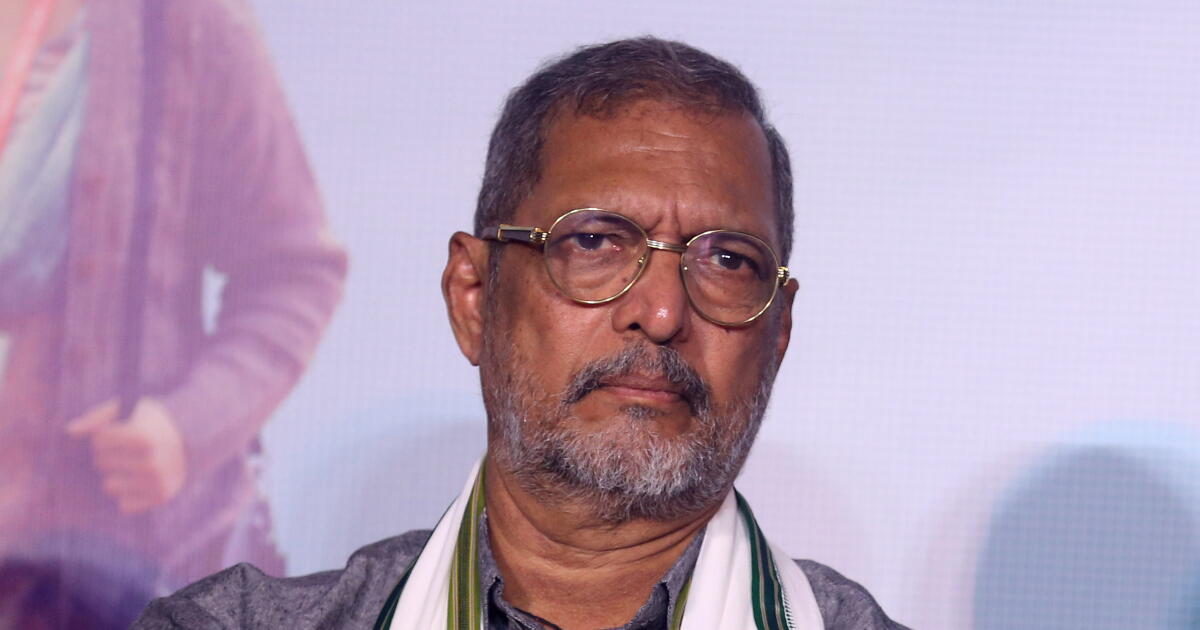
NEW DELHI — Nana Patekar, an acclaimed Indian actor and filmmaker, died Thursday at his home in the western state of Goa. He was 75.
Patekar died of a suspected cardiac arrest, the Press Trust of India news agency reported, citing a doctor at the hospital where he was pronounced dead.
Born in 1951 in India’s western state of Maharashtra, Patekar built a career spanning nearly five decades in Hindi- and Marathi-language cinema. He was known for intense performances and roles that often portrayed complex or unconventional characters.
Patekar made his film debut in the 1978 Hindi film “Gaman” and later earned acclaim for “Parinda” and “Krantiveer.” Patekar became popular in mainstream Bollywood films, while also working in India’s “parallel cinema” movement, known for its focus on realism and social issues. He gained wider international recognition with filmmaker Mira Nair’s Oscar-nominated “Salaam Bombay!”
He won three National Film Awards, India’s highest film honors, and received the Padma Shri, one of the country’s highest civilian honors.
In 2018, during India’s #MeToo movement, a Bollywood actress accused Patekar of sexual harassment on a film set. Patekar denied the allegation. The case was among several that drew attention as women publicly spoke about sexual misconduct in India’s film industry.
Prime Minister Narendra Modi mourned Patekar’s death, praising his “intensity, individuality and unmistakable presence” as an actor.
“He brought remarkable versatility and creativity to every role and gave us characters that will be remembered for generations,” Modi wrote on X.
London, United Kingdom – Claire, 52, lives in the Scottish countryside, not far from Edinburgh.
She describes her work as “low-level administration” and does not use social media. She lives a quiet life with her dog, reading and baking in her spare time. Until three years ago, she did not consider herself political.
Recommended Stories
list of 4 itemsend of list
Now, she faces 14 years in prison for her suspected show of support for Palestine Action.
Claire, who requested Al Jazeera withhold her surname, is one of the many people in the United Kingdom who, until three years ago, did not consider themselves activists.
But as the genocide in Gaza was livestreamed, many have rallied around the cause of Palestinian solidarity.
Organisations like Defend Our Juries, Artists for Free Palestine, Workers for Free Palestine, and virtually every other insert-profession-here for Palestine have cropped up across the UK.
In the summer of 2023, Claire read I Shall Not Hate by Dr Izzeldin Abuelaish, a Palestinian physician in Gaza who lost his three daughters to Israeli tank fire. Not long after finishing the book, Claire watched the aftermath of October 7 unfold online.
“For me, there wasn’t a delay between ‘Israel has a right to defend itself’ and then lies,” she told Al Jazeera.
She went to a pro-Palestine rally on Armistice Day, calling for a ceasefire, and “was horrified” by then Home Secretary Suella Braverman, who called the protests “hate marches”.
“I was determined not to ignore [Palestine],” she says.
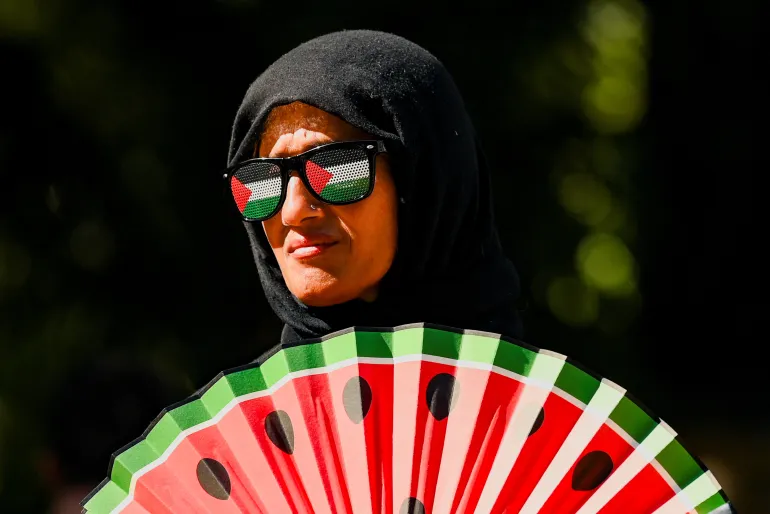
A protester wears eyewear in the colours of the Palestinian flag and holds a fan featuring a watermelon design during a rally organised by Defend Our Juries in Parliament Square, London, Britain, August 9, 2025 [Jaimi Joy/Reuters]
She continued to march, writing letters to lawmakers and fundraising for various Palestinian aid programmes.
In August 2025, she began publicly protesting against the proscription of Palestine Action with Defend Our Juries, the group behind a campaign of civil disobedience aimed at lifting the ban. To date, more than 3,000 people have been arrested for showing support for the pressure group that was banned in 2025.
Earlier this year, police arrived at her door to arrest Claire under Sections 11 and 12 of the Terrorism Act: “Being a member of a proscribed organisation and encouraging others to join a proscribed organisation.”
“I’ve never been in trouble before,” she says. “I’m not backing down.”
A police officer holds a pro-Palestinian protester during a demonstration outside the Parliament, organised by campaign groups including Palestine Solidarity Campaign, Avaaz and Parents for Palestine, calling for sanctions on Israel over ongoing hunger among Gaza’s war-struck population, in London, Britain, June 4, 2025 [Isabel Infantes/Reuters]
Marji, 70, lives in Colchester and had a similar feeling after hearing Braverman’s words.
“I had never been to a protest in my life,” she says, until she carried a “Ceasefire Now” sign at an Armistice Day march in 2023.
“I knew it wasn’t a ‘hate march’.”
Marji’s father served in the British Army, and her father-in-law was in the Royal Air Force and taken as a prisoner-of-war in Japan during World War II.
“Our parents’ generation fought fascism,” she says. “Now Britain is breaking British law.”
Marji, who also requested to be identified only by her first name, had a successful career in financial services, while her husband held an executive-level role.
They are now retired grandparents.
In July, they were arrested in Westminster under Section 12 of the Terrorism Act and are now waiting to see if charges will be laid.
“We’ve had to decide … is it safe to have grandchildren here? When the police could come to the door?”
Her children remain supportive.
“I think they’re proud of us, even if there’s been fear on their part.”
People protest on Vauxhall Bridge during a march in solidarity with Palestinians in Gaza in London, Britain, November 11, 2023 [Kevin Coombs/Reuters]
Across sectors, from the arts to railways, financial services and administration, Britons have risked professional and legal repercussions for the sake of Palestinian solidarity.
Hundreds of thousands have taken to the streets to protest against Israel’s genocidal campaign in Gaza and what they see as the UK’s role in the conflict. They have urged the UK government to cease all arms sales to Israel and cut diplomatic and trade ties as the genocide goes on in Gaza and violence escalates in the occupied West Bank.
This week, tensions have flared again as the Metropolitan Police warned pro-Palestine protesters against rallying on the three-year anniversary of October 7. The force said on Wednesday that five people were arrested outside the Board of Deputies of British Jews in north London for “inciting racial hatred, involving allegedly shouting or chanting slogans calling for Intifada”.
Israel’s latest war on the Gaza Strip – it has waged several since 1948 – began after Hamas, the group that governs Gaza, attacked southern Israel. About 1,200 people were killed that day, while more than 240 were taken captive, including Israeli soldiers, citizens and some foreign nationals.
Since October 7, 2023, Israel’s relentless bombardment has killed more than 74,000 people and devastated Gaza, making life for survivors nearly impossible. The small territory is now home to the largest group of child amputees in modern history.
“The narrative that we had grown up with was wrong – that the people who were there and living peacefully have been cast as ‘terrorists’, when they have suffered terrorism,” Marji says.
A demonstrator argues with the police as students take part in an inter-university march organised by the University of London Coalition in support of Palestinians, on the third anniversary of October 7, 2023 in London, Britain [Carlos Jasso/Reuters]
“The government participation, complicity, and their lies. Their gaslighting makes people more determined,” says Claire.
As the legal dangers and rhetorical backlash mount against pro-Palestine protesters, Marji, whose maternal grandmother was Jewish, is only more resolved: “We knew that saying ‘stop the genocide’ doesn’t mean you’re an anti-Semite. We’re not stupid, we can differentiate between Jewish people and people who support illegal occupation.”
Workers for Free Palestine, which includes a range of trade unions, formed in late 2023 and soon began holding protests.
“Many people oppose how their labour is used to prop up an apartheid state, but have been told there is nothing they can do as individuals,” a spokesperson told Al Jazeera.
Many workers are nervous to speak out against their workplace’s role in producing weapons, their investments in Israel, or other ways of enabling Israel’s war.
“Many are unfamiliar with their rights as workers and are afraid of the repercussions of speaking up – and these repercussions can be very real,” the spokesperson said.
Still, for some, there is not just resolve but optimism.
“Doing nothing makes us feel sick, angry and powerless,” says Marji. “I hope people will wake up and see how our own civil liberties … are being eroded to protect the interests of Israel.”
India’s youth-led Cockroach Janta Party has joined opposition calls for election chief Gyanesh Kumar to resign, giving him 48 hours before it launches nationwide protests. The pressure follows reports of internal objections over changes to voter lists.
Youth group threatens return to mass protests, sets deadline for Gyanesh Kumar to quit due to reports of meddling with voter lists.
By Al Jazeera Staff and Reuters
Published On 25 Sep 202625 Sep 2026
India’s ‘cockroach’ party youth movement has threatened to launch nationwide protests unless the country’s chief election officer does not resign by Saturday.
Founder of the Cockroach Janta Party (CJP), Abhijeet Dipke, announced on Friday that protests would begin in Mumbai on October 2 – if Gyanesh Kumar does not step down.
Recommended Stories
list of 4 itemsend of list
The CJP, a satirical outfit born on Instagram in May after India’s chief justice compared unemployed young Indians to “cockroaches” and “parasites”, has shaken the staunchly conservative government of Prime Minister Narendra Modi.
On Thursday, the group demanded that Kumar quit within 48 hours, following a newspaper report linking him to altered voter lists. Opposition parties say the lists have been manipulated to benefit Modi’s Bharatiya Janata Party (BJP).
“If Gyanesh Kumar does not resign by tomorrow, CJP will begin its nationwide protest from Mumbai on 2 October, and take it to cities across India,” Dipke posted on X.
“This Gandhi Jayanti let’s pledge to save democracy,” he added, referring to the October 2 holiday marking independence leader Mahatma Gandhi’s birthday.
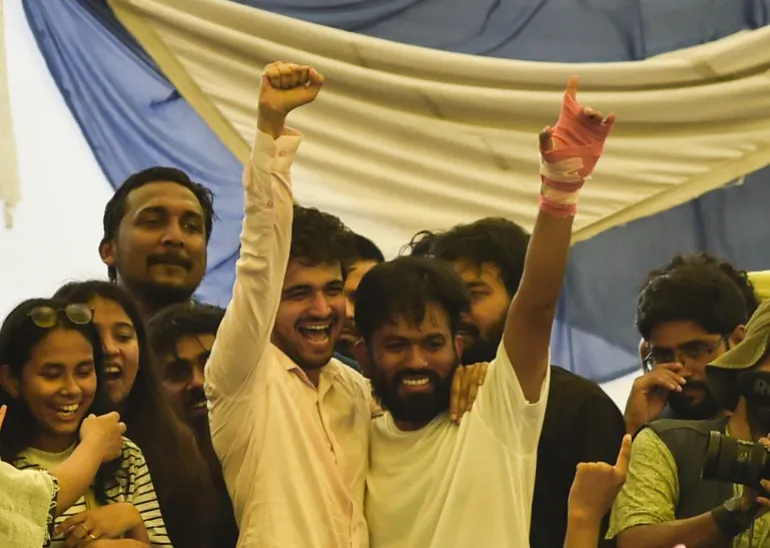
CJP founder Abhijeet Dipke celebrates with supporters in New Delhi after the resignation of India’s Education Minister Dharmendra Pradhan, July 25, 2026 [Ritesh Shukla/Getty]
Report provokes political storm
On Wednesday, the Indian Express newspaper reported that two election commissioners had raised questions or voiced concern with Kumar at least 14 times in 10 months, mostly over the process of updating voter lists that began last year.
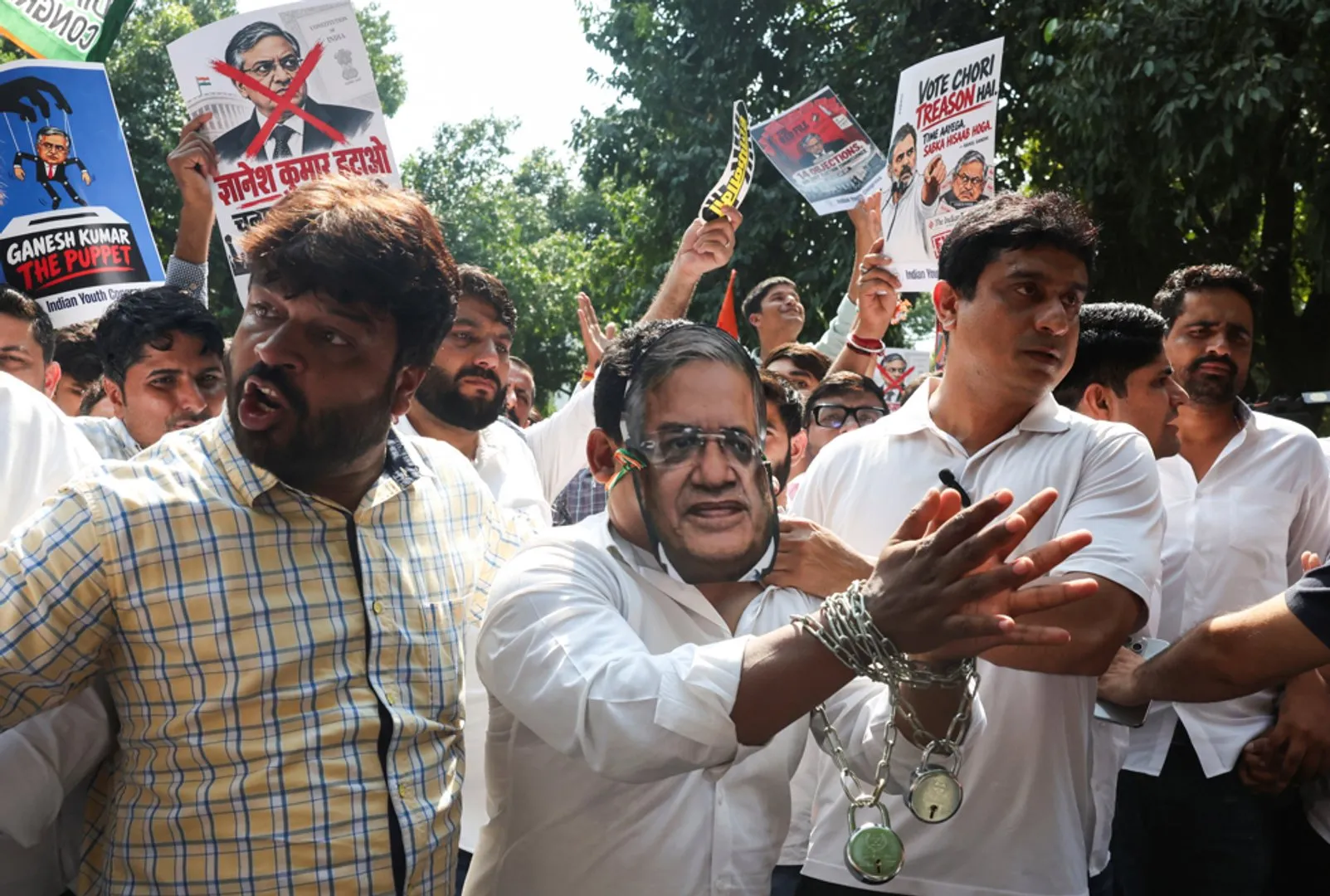
The main opposition Congress party announced protest marches on state election offices across India on Friday, demanding Kumar’s arrest, his removal and an independent review of decisions and voter-list changes made under him.
Opposition parties have long accused the commission of deleting the names of millions of voters without warning and adding new voters without verification to favour the BJP.
BJP leaders and supporters at a ‘Drug-Free Punjab’ march in Amritsar [File: Narinder Nanu/AFP]
Election panel rejects claims
The Election Commission of India said that “differing views and observations are a normal part of deliberation in any institution” and that all its actions were lawful.
The BJP has defended the commission, accusing the opposition of a smear campaign because it keeps losing elections.
“Neither the Election Commission of India nor any constitutional body in India is under dictatorial rule,” BJP spokesperson Sambit Patra said on Wednesday.
CJP-led protests in July forced the resignation of Modi’s education minister over exam-paper leaks, one of the prime minister’s biggest political setbacks since coming to power in 2014.