If you’re reading this review of Gore Verbinski’s maniacal farce “Good Luck, Have Fun, Don’t Die” in newsprint, congratulations on being a Luddite.
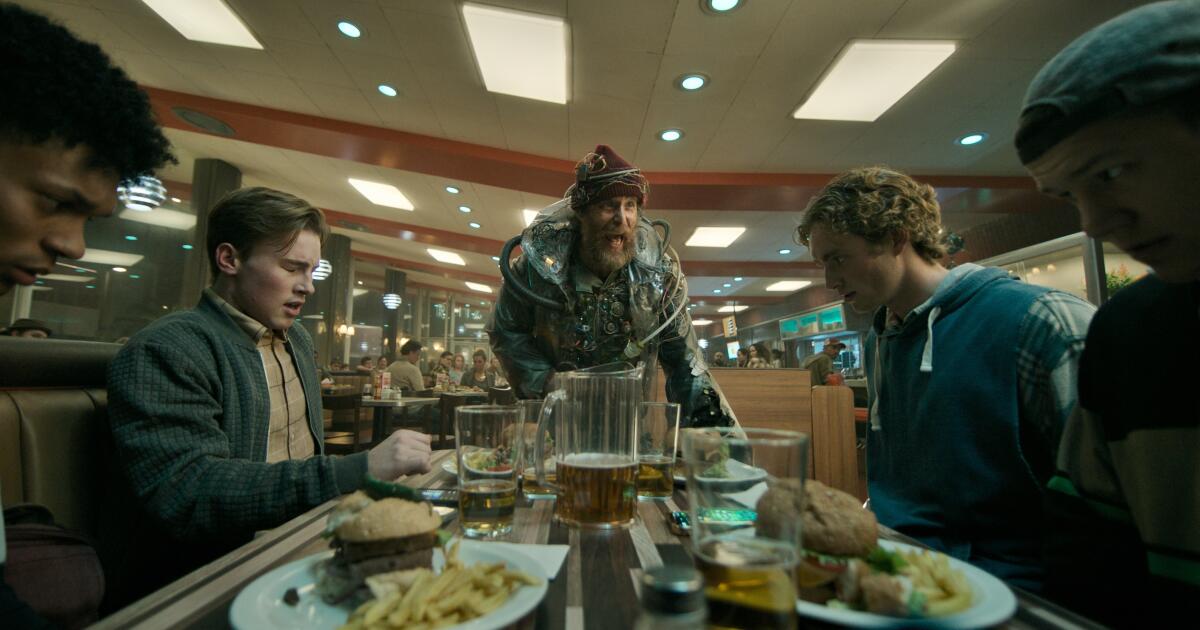
But if you’re reading it on a smartphone, then you’re one of the suckers that Sam Rockwell is hoping to reach when his unnamed time traveler barges into a late-night Los Angeles diner screaming, “I am from the future and all of this goes horribly wrong!” The patrons pause scrolling to glance at this unhinged, unwashed man wearing a crown of computer wires wrapped around his head like an IT messiah. Then they get a good look at his shoes when he stomps on their tables, kicking cheeseburgers as he tries to make these regular folks engage with the tech-pocalypse he swears is coming.
It’s a sermon we’ve heard plenty of times before and possibly even delivered ourselves. Coming from the ever-charismatic Rockwell, a lecture to stop wasting our lives online sounds no more insurmountable, only more immediate.
Half of the world will die, he foretells. The other half will be too distracted to notice. That is, unless a handful of strangers join him right now, right this moment, to fight for humanity’s cerebral freedom. Unsurprisingly, volunteers don’t raise their hands. (The one eager guy who does has failed him too often in other scenarios.) But Rockwell’s time traveler — he really is one — is used to a firewall of resistance. He’s given this speech at this diner 117 times. Some combination of the 47 people in it is fated to succeed.
That opening scene sounds as if an AI merged “The Terminator” with “Groundhog Day.” True, Matthew Robinson’s funny, savage and surprising script doesn’t downplay its inspirations. (He even lets Rockwell rip off Indiana Jones’ line about snakes.) But the screenplay gets so intricate and angry — and so shamelessly ambitious — you can’t believe someone in today’s Hollywood was willing to put up the money to get it made. Even helmed by proven hitmaker Verbinski of the “Pirates of the Caribbean” franchise, it’s a feat akin to convincing someone to fund a skyscraper-sized cuckoo clock that has a bird that pops out and heckles the crowd.
Eventually, a dubious crew enlists: public school teachers Mark and Janet (Michael Peña and Zazie Beetz), grouchy ride-share driver Scott (Asim Chaudhry), assistant Boy Scout leader Bob (Daniel Barnett), jittery mom Susan (Juno Temple) and forlorn Maria (Georgia Goodman), who keeps sighing that all she wanted was a slice of pie. Rockwell also impulsively yokes in Ingrid (Haley Lu Richardson), a grungy girl in a princess dress, who seems to be on her own suicide mission. The actors are mostly just pegs in a complicated plot, but they snap into place well.
The man from the future doesn’t have a plan — and worse, he considers himself the only person who isn’t expendable. The others can die (and do). As the group shuffles toward catastrophe, Verbinski intercuts their mission with flashbacks to their civilian lives. Their ordinary days, the digital indignities they’ve borne, that’s where Verbinski really gets mean.
The film’s feints and twists are fabulous as they explore how the internet’s promise has soured. One plotline involves a corporate brainstorm to make people love and nurture their own talking adbot, essentially a human-sized Tamagotchi. In another, school shootings have become such an epidemic that when Temple’s Susan gets summoned to identify her ninth-grader’s corpse, the other grieving mothers at the station calmly chitchat about traffic until one glances over at her nonchalantly and says, “First time?”
At first, the not-so-original idea that phones have turned children into zombies is a Romero-style parody of brain rot. (The young actor Cassiel Eatock-Winnik has a great scene as a vicious teen who stares down one of her elders and says, “You’re 35? That’s, like, older than most trees.”) But Verbinski reveals an unexpected angle of attack: Here, society has groomed the next generation to behave like machines. We don’t know why, exactly, but we can imagine a few reasons.
Even coping mechanisms take fire. Susan meets more parents who’ve snapped under the strain and become nihilistic trolls raising their daughter to be toxic so it won’t matter as much if she dies. Another character is quick to insist that everything he’s looking at — the walls, the people — is a facade. A 20-something gig worker named Tim (Tom Taylor) wants to permanently live in a VR simulation. His story is a little rushed but we get the idea that Tim’s not a jerk, just an idealist who can’t handle the tawdriness of the 21st century. As he puts it, “Why would I choose this world over that one?”
Verbinski doesn’t say much outright about the creeping concern that we’re living in a highly surveilled, aggressive and unpredictable police state. He’s able to make that point without words when cops arrive and our heroes-slash-hostages, none of whom have yet done anything worse than skip out on their bill, all assume the itchy trigger finger of the law will shoot them on sight. (And they’re right.) He also makes an ominous refrain of “Thank you for your service.”
It’s easier to howl at a classic like “Dr. Strangelove,” which mocked the leaders giddyuping the planet’s destruction, than at a present-day satire where we ourselves are the joke. As with “Idiocracy” (and eventually “Eddington”), our ability to fully appreciate this merciless, furious comedy might take a decade of remove. Even then, though, I won’t like James Whitaker’s cinematography, which goes for a deliberate ugliness but just looks dishwater drab.
“Good Luck, Have Fun, Don’t Die” anticipates the audience’s resistance. We do think for ourselves and so we scour the movie for flaws that will justify the urge to roll our eyes. For example: Why does Rockwell let some characters die and not others? Is the movie just as shallow as its j’accuse of us? Some quibbles get answered. Larger questions are left coyly unresolved so that we leave the theater uneasy.
There are so many overwhelming ideas in “Good Luck, Have Fun, Don’t Die” that, at over two hours, it does have the sense of a dissociative doomscroll. There’s even a plot point involving an algorithmic overlord that creates randomly generated armies: “Ghostbusters” with AI slop. The normie survivors try to convince themselves it might send something good, like they’re thumbing TikTok hoping for a treasure worth the time. Rockwell assures them it won’t. Nothing good will ever come. And what does arrive is so hellacious that it makes the Stay Puft Marshmallow Man look sweet.
The film is too cynical to take itself that seriously; Verbinski would roll his eyes at any thoughts and prayers it could do much good. Yet, anyone born with “19” at the start of their birthyear still remembers how it felt to leave the house without a black rectangle in their hands. That makes us all time travelers of a sort, too, beacons of an increasingly distant era in which it was possible to be unplugged.
But it’s OK if you’re on your screen right now. Just sit before a bigger one to see this film.
‘Good Luck, Have Fun, Don’t Die’
Rated: Rated R, for pervasive language, violence, some grisly images and brief sexual content
Running time: 2 hours, 14 minutes
Playing: Opens Friday, Feb. 13 in wide release