good luck

‘Don’t Say Good Luck’ review: Sunny Sandler and Melanie Lynskey shine

The importance of parental support goes meta in Julia Hart’s “Don’t Say Good Luck.” The YA musical drama, which premieres Friday, pays homage to musical theater, unconditional maternal love and the family-hour TV, er, Netflix movie. In a landscape littered with teenage dysfunction, “Don’t Say Good Luck” is a moving argument for aspirational television.

And with a star whose famous father serves as producer, it‘s an admonition to the term “nepo baby.”

We meet normal kid Sophie Birenbaum (Sunny Sandler) as she anxiously prepares for a day that will include auditioning for her high school’s production of “Waitress.” While her father, Ted (Max Greenfield, marvelously transformed by a beard), wrangles her rambunctious younger twin brothers, her mother, Elizabeth (Melanie Lynskey), assures her that she is talented and beautiful and will do just great. These sentiments are echoed by Sophie’s best friend, Carolyn (Scarlett Estevez), who joins her at the audition where the director is the super-cool Ms. Parker (“Brooklyn Nine-Nine’s” Stephanie Beatriz) and even theater department queen bee Mallory (Elyse Bell), who everyone knows is going to get the lead, is pretty nice.

It’s a high school experience that’s about as far from “Euphoria” or even “Glee” as one can get while still being situated on Earth. Still, all is not perfect in Sophie’s world. When Elizabeth learns that her cancer has returned, Sophie overhears her parents’ subsequent conversation via a butt-dial from her father’s phone. Her first impulse is to flee the audition; instead her emotional turmoil fuels a powerful performance that (spoiler alert?) lands her the lead role.

Determined to downplay the seriousness of her illness, Elizabeth insists that life continue on as normal — she and Ted own a local deli, which offers some nice bagel versus wrap shade and a Jon Lovitz cameo. Though Sophie is worried, she believes her mother who says she will beat cancer again. So she throws herself into the stomach-churning rigor of being the star of the show, which includes a painful separation from her bestie, a crush on her co-star and a struggle to find the confidence to let her obvious talent shine.

“Don’t Say Good Luck” is, obviously, a showcase for Sandler, whose parents, Adam and Jackie Sandler, serve as producers (which may have had something to do with the extraordinary supporting cast, which also includes Bebe Neuwirth and Steve Buscemi as Elizabeth’s parents). Adam Sandler and his Happy Madison Productions have a long and lucrative partnership with Netflix, which recently debuted “Happy Gilmore 2” and announced “Grown Ups 3” as part of their deal. One could see this as yet another case of nepo-baby triumph — streaming is currently littered with the progeny of famous parents — or simply a living example of the film’s theme. Like the Birenbaum parents, the Sandlers want to help their daughter shine in her chosen career and that she certainly does.

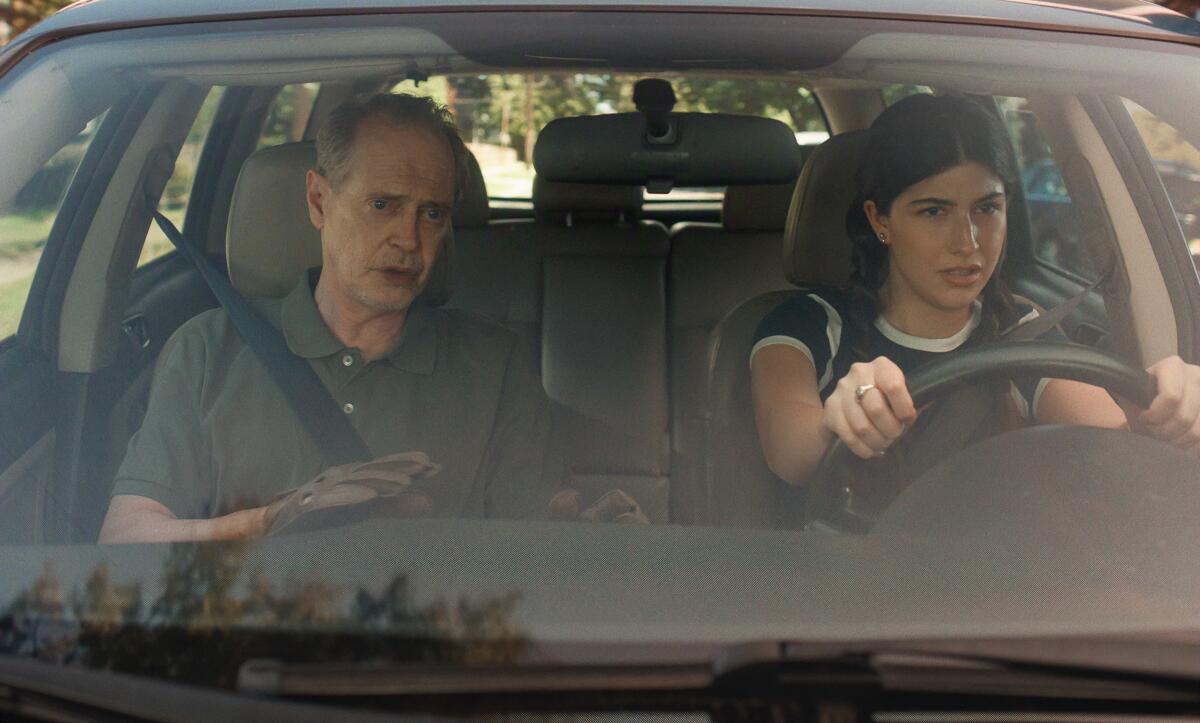
Steve Buscemi sits in the passenger seat as Sunny Sandler drives in "Don't Say Good Luck."

Adam Sandler serves as a producer, which may have had something to do with the extraordinary supporting cast, which also includes Steve Buscemi as Sophie’s grandfather.

(Netflix)

Though Sophie is the only older daughter ever to escape the task of caring for her younger brothers (or doing any chores at all), Sandler makes her completely believable as a nice, self-conscious kid who just needs a push to trust her talent. If the tone of the film is 1970s-family-comedy aspirational (particularly in the mother-daughter scenes), that shouldn’t be construed as a low level of difficulty.

Indeed, it is almost revolutionary to see emotionally resonant teenage characters who aren’t mired in abuse, addiction or some kind of horror; leveraging dysfunction has become shorthand for “drama.” “Don’t Say Good Luck” is based on the real-life experience of co-writer Laura Hankin (collaborating here with Hart and Jordan Horowitz), and though the stakes are emotionally high, portraying a loving family doing their best to get through a devastating situation with minimal meltdowns is its own act of bravery.

It certainly helps that this family is firmly anchored by Lynskey, who proves, yet again, that she can do anything. Her Elizabeth is neither martyr nor saint, just a woman who wants to live as she’s always lived for as long as she can. Lynskey lifts what could have been a sappy (or even worse, guilt-inducing) cancer-mom tale into a quietly transcendent contemplation of motherhood. (A scene in which she flips through the calendar trying to figure out when to let the kids know what’s really going on drove the breath from this mother’s body.)

Does “Don’t Say Good Luck” skirt around the grim realities of cancer as cavalierly as it paints a Pinterest mood-board vision of high school? Absolutely. But that doesn’t mean the message and the feelings (yes, you absolutely will cry) are not just as authentic. Love is the root of much pain, but it’s also what conquers it in the end.

Melanie Lynskey, Max Greenfield and Jon Lovitz, all wearing aprons, stand in a deli.

Melanie Lynskey as Elizabeth, Max Greenfield as Ted and Jon Lovitz as Lenny in “Don’t Say Good Luck.”

(Netflix)
Source link

CBS News Radio signs off after nearly 100 years

As a radio professional who grew up aspiring to work at CBS News Radio, anchor Steve Kathan understood the weight of the words he wrote and recorded Friday on the final broadcast of “World News Roundup.”

“America’s longest running newscast signs off for the last time,” Kathan said in the small dimly lighted studio in the CBS Broadcast Center on Manhattan’s West Side. “It all began on March 13, 1938,” he said, referring to the iconic news program.

Kathan played a recording of Edward R. Morrow, the legendary CBS News journalist who delivered his first report on the debut of the program, saying “the best in radio reporting is yet to be — good night and good luck.”

“And goodbye,” Kathan added, ending the run of around 23,000 editions of the 10-minute signature broadcast, delivered from CBS’ radio network . A final news update was scheduled to run later Friday night.

CBS News Radio and its 26 employees became a victim of budget cuts across parent-company Paramount’s news division announced in March.

“A shift in radio station programming strategies, coupled with challenging economic realities, has made it impossible to continue the service,” the company said.

Privately, longtime insiders at CBS News say the division has struggled for years to find ways to financially turn around its radio business.

The unit was operating at a loss with monthly revenues recently falling as low as $67,000, according to a network executive not authorized to discuss the matter publicly. The service held on because it still had value in promoting CBS News and its journalism, reaching 20 million listeners a week.

Leadership over the years have put off the messy task of winding the radio business down due to its iconic status at the company. CBS News editor-in-chief Bari Weiss was reluctant to make the cuts as well, according to people inside the company familiar with her thinking. But with Paramount taking on substantial debt to acquire Warner Bros. Discovery, considerations of the division’s legacy are likely to matter less in ongoing efforts to reduce costs.

Kathan had heard rumblings about CBS getting out of radio going all the way back to its first ownership change in the 1980s when Larry Tisch acquired the company.

“Even though I’ve been here 39 years, the thought was someone’s going to decide to do it,” he said.

As television dominated the media landscape, CBS News Radio retained its role as what Kathan called “the background track of American history.”

As a child growing up in Connecticut, Kathan recalls watching Douglas Edwards, the “World News Roundup” evening anchor for two decades, doing TV news updates in between the soap operas his mother watched on CBS. After Kathan joined the network in 1987 as a writer and producer, he would see Edwards and other famous names from the division walking through the hallways of the broadcast center before doing his afternoon newscasts.

“Just the fact that you were working with them made you think and realize you had to up your game,” Kathan said. “You wanted the audience to trust you as much as it trusted them.”

“World News Roundup” rose to prominence during World War II, when Murrow and other CBS News correspondents delivered live reports from Europe.

Once TV supplanted radio as a source for scripted entertainment, news and information became the primary mission of CBS’ radio division that began in 1927. In 1967, the company converted its owned AM radio stations — including its Los Angeles outlet KNX — to an all-news format.

While the stations focused on local news, traffic, weather and sports, they also prominently featured CBS News Radio reports at the top of the hour and other features throughout the day.

Longtime listeners became familiar with Edwards, Dallas Townsend, Reid Collins, Richard C. Hottelet, Christopher Glenn and other CBS News veterans who brought national and world stories to listeners throughout the day, introduced by a five-note sounder that simulated a telegraph. Dan Rather and Walter Cronkite were heard daily with analysis.

The radio network developed a major star in Charles Osgood, who joined WCBS in New York as anchor. He went national in 1971 with a twice-daily segment called “The Osgood File.”

Osgood wrote two-minute reports in succinct prose delivered in his mellifluous tones. He occasionally offered commentary in verse, which earned him the title of poet-in-residence at CBS News.

Osgood’s popularity was rivaled only by ABC Radio personality Paul Harvey. CBS News even allowed him to read commercial copy to satisfy eager advertisers who wanted their product messages presented in his comforting voice. When Osgood became a host on the TV side in the 1990s on “CBS News Sunday Morning,” his sign-off remained “I’ll see you on the radio.” He filed his final “Osgood File” report in 2017.

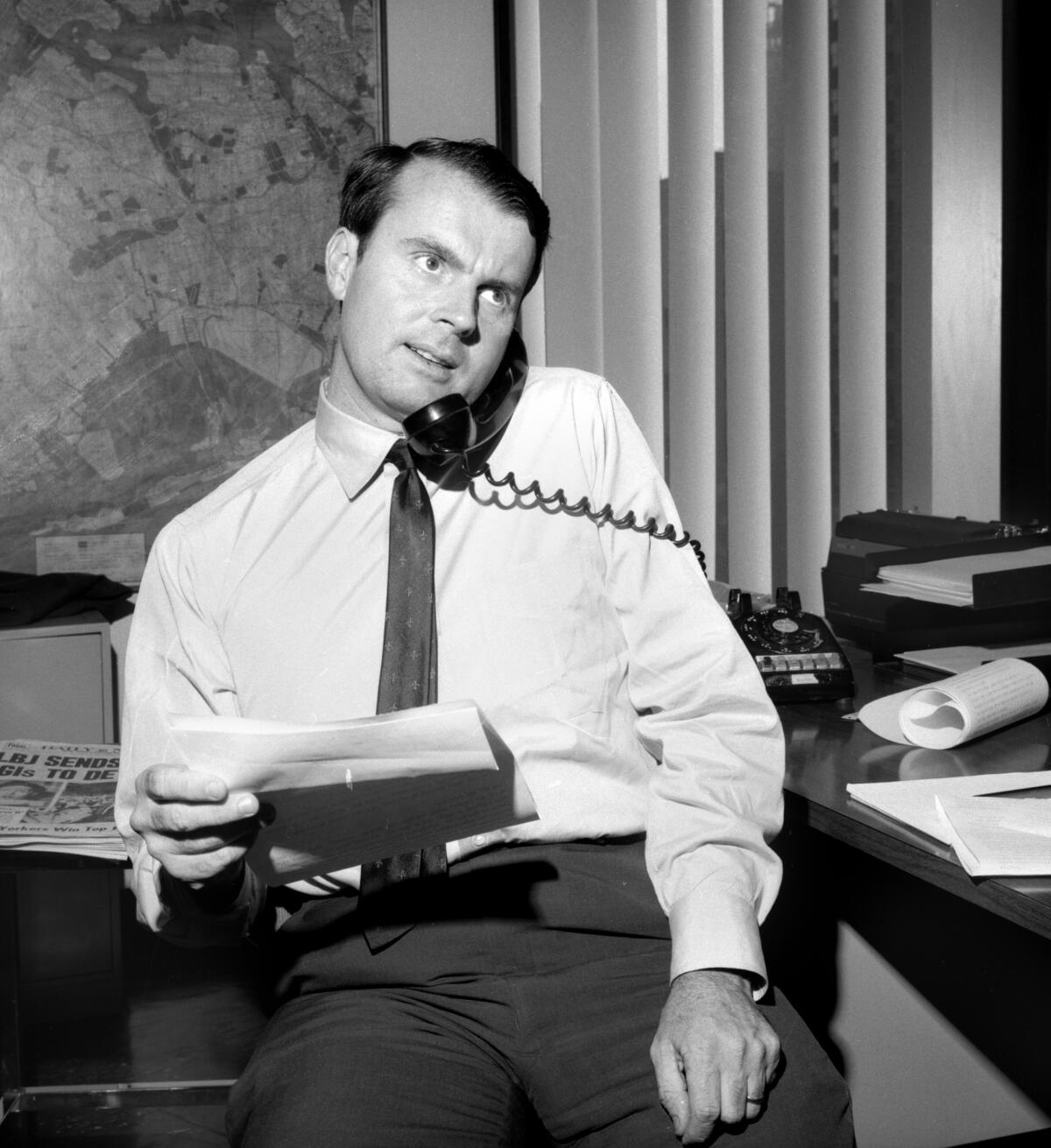
Charles Osgood in the WCBS radio studio in New York on July 25, 1967.

Charles Osgood in the WCBS radio studio in New York on July 25, 1967.

(CBS Photo Archive/CBS)

CBS sold off its radio stations in 2017, but continued to produce and distribute its network programs as the business faced competition from digital media.

Dustin Gervais, technical operations manager for the network, said CBS News Radio struggled as more audio advertisers prefer digital content because of its effectiveness at targeting specific demographic groups. The shift is reflected in radio ad revenue, which dipped about 2% to $14.37 billion, according to media research firm Kagan. But the digital ad revenue portion of that pie continued to grow, topping $1.75 billion.

Charles Forelle, managing editor for CBS News, said the company plans to remain in the audio journalism business through podcasting and not straight newscasts.

“We have a whole bunch of different things in development that are less news reading and more other things,” he told The Times.

Not all of radio’s problems are related to digital.

Michael Socolow, a professor of communication and journalism at the University of Maine, notes that the industry troubles began in 1996 when deregulation loosened the limit on the number of stations a single entity can own. Buying sprees of outlets led to owners who became highly leveraged and less able to invest in programming, which put the squeeze on suppliers such as CBS News Radio.

“Radio was hollowed out by the corporations, before its utility to the American citizen ended,” Socolow said. “You can trace it to the Telecom Act of 1996.”

Some of the 26 employees at CBS News Radio who were severed from the company have found work at Worldwide News Network, a service launched by John Catsimatidis, the owner of New York’s top-rated talk station WABC. The company said the service, which begins Saturday, will deliver “hard news, breaking headlines, and fact-driven reporting to affiliates across the country.”

CBS News Radio’s biggest customer — the all-news stations owned by Audacy, including KNX — have already switched their network service to ABC News Audio.

Source link