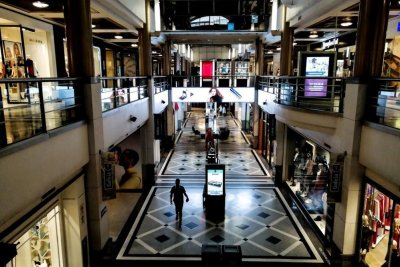

Many of Argentina’s country’s leading shopping mall operators to expand capacity to meet growing demand for retail space. File Photo by Juan Ignacio Roncoroni/EPA
BUENOS AIRES, June 9 (UPI) — International fashion, luxury and sports brands are accelerating expansion into Argentina after years of absence, driving multimillion-dollar investments and prompting the country’s leading shopping mall operators to expand capacity to meet growing demand for retail space.
The renewed interest from foreign companies reflects Argentina’s changing economic environment since President Javier Milei took office.
Looser import restrictions and other market-opening measures have revived the appeal of a market that for years had been left out of the expansion plans of many international firms.
The expansion comes despite a challenging consumer environment. According to consulting firm Scentia, sales of mass-market consumer goods fell 3.8% year over year in April 2026 and were down 3.3% during the first four months of the year.
Federico Vaccarezza, an economist and professor in Austral University’s Faculty of Business Sciences, told UPI that international brands closely monitor sales data from Argentina’s leading shopping malls because they reflect the behavior of the consumers targeted by their products.
He noted that many of these brands are not seeking to reach the broader population, but rather higher-income consumers — a segment that has shown greater resilience in maintaining spending levels despite economic difficulties.
Vaccarezza said those groups represent roughly the top 10% to 20% of income earners in Argentina.
The international chains that have announced plans to enter Argentina are focusing their projects on Buenos Aires’ most exclusive shopping centers and key cities across the country. The trend includes companies entering the market for the first time, brands returning after years away and firms expanding existing operations.
International companies view Argentina as a long-term opportunity because of its market size, with more than 45 million residents, and expectations surrounding recent economic changes.
The influx of brands is already affecting the commercial real estate sector. Shopping mall operators report growing demand for retail space from foreign companies.
To meet that demand, several groups have accelerated expansion and construction projects. Chilean retailer Cencosud, one of Latin America’s largest retail groups, will invest $60 million to expand Unicenter, Argentina’s largest shopping mall, betting on rising demand for commercial space from international brands.
The project will add more than 215,000 square feet of space and 85 new stores by 2027.
“This expansion represents a concrete long-term commitment to Argentina,” Dolores Fernández Lobbe, country manager of Cencosud Argentina, told La Nación.
Meanwhile, IRSA, Argentina’s largest shopping mall operator and owner of some of the country’s most valuable retail assets, including Alto Palermo, Patio Bullrich, Alcorta Shopping and DOT, is moving forward with three new developments in the Buenos Aires area and the cities of La Plata and Mar del Plata. The company has not opened a new shopping center since 2015, when it inaugurated a project in the Patagonian province of Neuquén.
“Shopping mall customers are still there. What has changed is that competition on prices is now more intense,” IRSA President Eduardo Elsztain told La Nación.
According to business news outlet iProfesional, the expansion spans multiple sectors. Fashion, beauty, sports equipment, accessories and luxury goods are among the industries seeking to capitalize on Argentina’s new economic environment.
June is expected to be one of the busiest months for store openings. U.S.-based Skechers will open a new location, while Dolce & Gabbana will launch its first store in Argentina.
In July, Bullpadel, a company specializing in padel equipment, will enter the market. Padel has experienced rapid growth across Latin America in recent years.
U.S. apparel company Lucky Brand will enter Argentina through a partnership with local group Oxford. According to La Nación, the company plans an initial $1 million investment, will open its first store in July and aims to develop a network of 30 standalone stores across the country.
The company also plans to align prices with those in the U.S. market to compete with other brands in the segment.
Spanish fashion retailer Mango confirmed its return to Argentina through a franchise agreement with local group Grimoldi. The company plans to open five stores over the next five years, including a first location at Alto Palermo scheduled for September.
Vaccarezza said 2025 was a favorable year for Argentina’s shopping malls, although the trend began to weaken in 2026, with sales declining about 5% in the first quarter compared with the same period a year earlier.
The economist said looser import regulations and previously unmet demand help explain foreign companies’ interest in Argentina. He added that investment decisions by international brands are driven primarily by market-specific studies rather than broader economic indicators.
“It is a calculated risk. Companies have a clear understanding of the consumers they want to reach. The results will become evident later,” he said.
Economist and consultant Néstor Requelme expressed a similar view, saying the arrival of new international brands reflects recent economic changes and the presence of consumers with strong purchasing power.
Martín Burgos, an economist and researcher at the Latin American Faculty of Social Sciences, or Flacso, said the arrival of new companies could increase competition and help lower clothing prices in Argentina, a market that has historically been more expensive than many others.
“There is a policy aimed at reducing clothing prices. For years, apparel prices in Argentina were above international levels, and the easing of import restrictions is facilitating the arrival of these brands,” he told UPI.
However, Burgos agreed that many of the companies entering the country are primarily targeting higher-income consumers, one of the segments that has best withstood recent economic changes.
“The data show that overall consumption remains weak, but these brands are targeting consumers with greater purchasing power. For that reason, their expansion does not necessarily reflect a broad recovery in consumer spending,” he said.