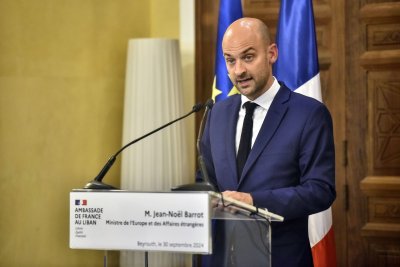

BEIRUT, Lebanon, Feb. 6 (UPI) — French Foreign Minister Jean-Noël Barrot said on Friday that a military escalation in the Middle East must be avoided, urging Iran-backed groups to show restraint and Lebanon to stay out of any war between Iran and the United States.
Speaking during a news conference after meeting Lebanon’s top officials in Beirut, Barrot said that a military escalation in the region “is a risk we must avoid by all means,” calling on Iran to prepare “to make major concessions and to radically change its posture.”
He added that Iran, which held a first round of talks with the United States in Oman on Friday, must renounce its role as “a destabilizing power,” citing its nuclear program, its missile and ballistic programs, and its support for “terrorist groups” in the region, which he said “pose threats to countries in the Near and Middle East as well as to European countries.”
The Oman talks came as the United States reinforced its military presence in the Middle East following Iran’s violent suppression of anti-government protests last month, which rights groups say killed thousands. President Donald Trump has warned of military action if no agreement is reached, while Iran has threatened retaliation against U.S. forces in the region and Israel.
“If we were to witness a regional escalation, Iran-backed groups throughout the region would need to exercise the utmost restraint, so as not to worsen a situation that would profoundly destabilize the Near and Middle East,” Barrot said.
He also said that Lebanon must “at all costs” avoid being drawn into the escalating tensions between the U.S. and Iran, similar to the war that erupted with Israel after Hezbollah opened a support front for Gaza on October 8, 2023.
“Dissociation is a condition for Lebanon’s security,” he said.
Hezbollah leader Sheikh Naim Qassem said last week that his group would not remain “neutral” if Iran were attacked and its Supreme Leader, Ayatollah Ali Khamenei, were threatened by Trump-comments that were strongly rejected by Lebanese officials, who refused to let Lebanon be drawn into the conflict.
The militant group was severely weakened during the war with Israel but has quietly been attempting to reorganize its ranks and secure new channels for rearming and funding. It has refused to fully disarm under the November 27 cease-fire agreement, as long as Israel continues strikes in southern and eastern Lebanon and refuses to abide by the truce.
The French Foreign Minister said that the regional equation has changed due to recent conflicts and that “everyone must draw the appropriate conclusions.”
Barrot said his talks with Lebanese President Joseph Aoun, Prime Minister Nawaf Salam and House Speaker Nabih Berri also addressed preparations for an international conference in Paris on March 5, aimed at supporting the Lebanese Army and assisting it in completing Hezbollah’s disarmament.