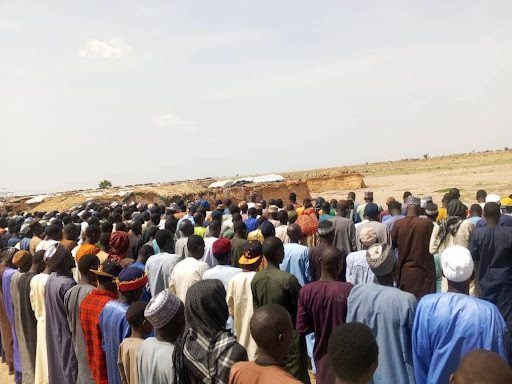
Muhammed Kaumi had just stepped out of the mosque when his phone rang on the evening of Friday, May 29. He had recently returned from Dikwa, a town in Borno State, northeastern Nigeria, and assumed the call was from a relative checking on his journey home. Instead, the voice on the other end delivered news that left him numb.
“Bulama has been killed,” the caller said. “They have killed Bulama.” Muhammed felt his chest tighten. “I instantly felt a sharp pain in my heart,” he recalled.
Bulama Ali was his cousin, a farmer, a father of five, and one of thousands, like him, who have been displaced by the Boko Haram insurgency that has scarred the region for more than a decade.
Within minutes, Muhammed was on his way to the Custom House Internally Displaced Persons’ Camp in Muna, on the outskirts of Maiduguri, where Bulama had lived with his family for nearly a decade.
As he rushed there, questions flooded his mind: “What had happened? Who had killed him? Why?”
When he arrived, residents told him that Bulama had allegedly been beaten by men they identified as “repentant Boko Haram fighters”, locally known as “Hybrids”.
For many residents of Maiduguri, the allegation struck a painful nerve.
For years, former insurgents who surrendered to authorities have passed through government rehabilitation and reintegration programmes such as Operation Safe Corridor and the Borno Model, before returning to civilian communities. However, some have bypassed both interventions completely.
The Nigerian authorities have involved some of these deserters in security operations, where they help troops with intelligence gathering, their knowledge of terrorist-held terrain, and even operational activities. The arrangement has remained controversial among many survivors of the conflict and among security analysts.
Now, residents in these communities say their fears have been justified.
They brought him back dead
Bulama’s final hours began shortly before the Friday Muslim congregational prayers.
Muhammed was told by relatives and eyewitnesses that “[Bulama] was on his way to the mosque on his bicycle when he received a phone call. He stopped by the roadside [close to Muna, on the Maiduguri-Gamboru highway] to answer it.” Behind him was a vehicle carrying armed men dressed in black uniforms. “They honked at him to move,” Muhammed said. “But he was speaking on the phone and did not hear them.”
Abbas Shettima, who witnessed the incident, said the confrontation, which occurred between 1:15 p.m. and 1:30 p.m., quickly escalated.
“We were all heading to the mosque when we saw them beating him,” Abbas recounted. According to him, the group consisted of about ten men carrying guns and sticks. “They said he was blocking their way,” he said.
Bulama tried to explain. He apologised repeatedly, but his pleas fell on deaf ears.
“He kept begging them to spare him,” Abbas said. “He crouched down and covered his head with his hands while they beat him.” When bystanders attempted to intervene, the armed men threatened them. Residents watched helplessly. Eventually, the men forced Bulama into their vehicle and drove away.
No one knew where he had been taken.
At the time, witnesses said they believed the group were members of the Civilian Joint Task Force (CJTF) because of their uniforms.
Hours later, shortly after 3 p.m., the vehicle returned. “They brought him back severely wounded,” Abbas recounted. “He could barely move.”
Residents rushed toward him to help, but within ten minutes, he died.
The incident was immediately reported to the soldiers stationed at the camp’s entrance. According to Muhammed, the soldiers said they had seen the vehicle dropping Bulama but did not know what had transpired. “They were the ones who told us the men were Hybrids and that they had come from the Maiwa axis,” he said.
Residents later learned that Bulama had allegedly been taken to Maiwa Kura, a remote village in Mafa Local Government Area, Borno State, where the group was reportedly stationed.
Although “Hybrids” are often perceived as operating independently, they are typically attached to military formations and work alongside security forces, according to a member of a local volunteer security outfit involved in counterterrorism operations who spoke to HumAngle.
“The commanding officer of the military base gives instructions to the ‘Hybrid’ commander attached to that formation, who then relays orders to his men,” the source explained. “During broader operations involving multiple locations, they also have a state commander from whom they receive directives.”
However, this does not necessarily imply military involvement in the attack that claimed Bulama’s life, as Hybrid patrols sometimes operate independently.
Bulama’s family subsequently reported the matter to the police.
Muhammed said that soldiers, police officers, and members of the CJTF later travelled to Maiwa, where they arrested three suspects, including a commander. “They told us the others had travelled to Mafa for an operation,” he said.
The suspects were taken into custody and transferred to the Borno State Criminal Investigation Department for further investigation.
According to family members, the suspects claimed Bulama died after jumping from the back of a moving Hilux vehicle. But the relatives remain unconvinced. “The doctors told us he had been severely beaten,” Muhammed said. “His hands were tied, and he had internal bleeding.”
The family retrieved the body on Saturday morning and buried him later that afternoon. When the body was prepared for burial, he said, blood continued to seep from his eyes, ears, and nose. “It stained the white shroud.”

When HumAngle contacted the Borno State Police Public Relations Officer, Nahum Kenneth Daso, he said he was not aware of the case and would make inquiries. As of publication, no official update had been provided.
The men known as ‘Hybrids’
In many communities across Borno State, the word “Hybrid” carries different meanings depending on who defines it.
To security officials, they are a practical asset in a war that has stretched for more than 15 years. For many residents, they are former terrorists trying to rebuild their lives. To others, especially those who lost relatives, homes, farms, and livelihoods during the conflict, they are a constant reminder of wounds that have never fully healed.
The term is commonly used to describe some former Boko Haram members who surrendered and passed through official rehabilitation and deradicalisation programmes, and later became attached to security operations in various capacities.
Since they possess intimate knowledge of terrorist operations and hierarchy, security agencies have increasingly relied on some of them to help in identifying former colleagues, navigating difficult terrain, and providing information that security forces may otherwise struggle to obtain.
For authorities, the arrangement is often viewed as a necessary component of the counterterrorism campaign. However, many civilians find it deeply unsettling.

That is why, for some residents, the sight of former terrorists carrying weapons or working alongside security forces can be difficult to accept.
Bulama’s death has reopened those anxieties. Yet, the resentment many residents express today did not begin with his killing. It has been building for years.
In August 2021, as thousands of terrorist deserters began surrendering from the Sambisa Forest and the Lake Chad region, the Borno State Government convened a high-level stakeholders’ meeting at the Government House in Maiduguri. Government officials, security agencies, traditional rulers, religious leaders, civil society organisations, journalists, and community representatives gathered to discuss the reintegration of former insurgents into society.
At the end of the meeting, participants agreed in principle to forgive and accept these deserters back into their communities. Their acceptance, however, was not unconditional. The stakeholders insisted that surrendered terrorists must be thoroughly screened before reintegration. They also warned against the release of hardened extremists into the communities. They further called for meaningful reconciliation between victims and former terrorists.
The gathering was widely presented as a collective endorsement of reconciliation.
But beyond the conference hall, acceptance has proved far more complicated.
Many residents who had survived the violence felt they had not been part of that conversation. Some had lost parents, spouses, siblings, and/or children. Others had spent years moving between displacement camps, uncertain whether they would ever return home. For them, forgiveness was not a policy decision that could be reached through consensus among stakeholders. It was an intensely personal choice shaped by trauma, memory, and loss.
“The people making these decisions are not always the people who suffered directly,” Abba Gana told HumAngle.
Over the years, some residents have complained of harassment and intimidation by former terrorists and their families. Others say they simply feel the reintegration process has moved faster than community healing.
The debate became even more sensitive as some former terrorists began assisting security operations. To many survivors, the transformation can be difficult to reconcile: people who once arrived as attackers returning as neighbours and protectors, and in some cases, as men carrying authority.
Some government officials have repeatedly defended the reintegration policy. Recently, General Olufemi Oluyede, the Chief of Defence Staff and chairperson of the Operation Safe Corridor National Steering Committee, likened terrorist deserters to the biblical Prodigal Son, arguing that they deserve rehabilitation because they remain Nigerian citizens.
Those concerns were further amplified by reports that not all former terrorists were passing through official rehabilitation channels. In 2025, a HumAngle investigation documented allegations that some defectors were quietly leaving the forest and reintegrating into communities without participating in formal deradicalisation programmes, raising questions about screening, accountability, and oversight.
Over the years, several incidents involving terrorist deserters have also contributed to public unease. In April, a former Boko Haram member allegedly shot and killed a CJTF member during an argument in the Mafa LGA. According to reports, the victim was rushed to the hospital but was confirmed dead on arrival, while the suspect was later arrested and handed over to the police.

Two years earlier, some deserters reportedly stormed a police station in Maiduguri in an attempt to secure the release of their colleagues arrested over alleged drug-related offences. In another case that generated public outrage in 2023, a deserter was accused of killing his wife at the outskirts of Maiduguri.
Concerns about the reintegration programme are not new. As far back as 2020, Ali Ndume, the senator representing Borno South Senatorial District, publicly criticised aspects of the government’s amnesty efforts, recounting the case of a deserter whom he alleged killed his father and later absconded with his property. The senator argued that the victims and survivors’ concerns were not receiving the same level of attention as the rehabilitation of the deserters.
Taken individually, the circumstances surrounding these incidents differ significantly from Bulama’s case. Collectively, however, they have helped shape public perceptions of the reintegration programmes and deepened anxieties among some residents about the monitoring, supervision, and accountability of deserters, particularly those involved in security-related activities.
For many survivors of the conflict, such incidents reinforce a lingering fear that rehabilitation alone may not be enough. Bulama’s death has now brought those long-simmering concerns into sharper focus.
“The community is deciding on an action,” Abbas said.
Residents gathered after Bulama’s burial to discuss possible legal steps. Some suggested pooling money to hire a lawyer. Others proposed approaching human rights organisations.
“We are thinking of contributing money and hiring a lawyer,” Abbas said.
Justice and unfinished wounds
For Muhammed, grief and anger now coexist. His cousin survived displacement and years of uncertainty. He, however, did not survive a short journey to the mosque.
When asked what justice would look like for his family and the displaced community, Muhammed replied, “The law does not play by sentiments; it follows laid-down rules. I hope they will do what is right. If it is by my sentiments, I would not want them to be free. I would want them imprisoned for life.”
He paused.
“I don’t care about compensation. I don’t care about apologies. Justice for me is their imprisonment.”
A family left devastated
Bulama was only 30 years old. He left behind two wives and five children.
He earned a living as a farmer. And before displacement forced the family from Boboshe in 2016, his father was killed. His elderly mother remains alive and still lives with them at the displacement camp.
The survival of his family, which was Bulama’s responsibility as the breadwinner, hangs uncertainly over relatives, who are also struggling to survive. “We are not rich people,” Muhammed said. “Caring for five children in addition to our own children will be difficult.”
Around the camp where he lived for over a decade, residents gather beneath makeshift shelters to rest, but the conversations about Bulama’s death remain on their lips.
What remains immediate is his nuclear family, and the space left by a man who left home for Friday prayers and never returned.