displaced

After a deadly raid, a displaced Nigerian mother finds a lifeline in sewing | News

Jibia, Katsina State, Nigeria – Safiya Musa’s sewing machine has given her something violence had taken away: a way to provide for her children.

But the livelihood she built after losing her husband and two of her children has left her facing a painful choice: whether to return home or risk losing the fragile independence she has created after being forced to flee.

Safiya cannot remember which month it was, only that it was 2023, when armed bandits raided the town of Kankara in Katsina State, where she and her husband had built their life after moving from their hometown of Batsari. Kankara is a small rural community where farms sit close to homes, and her husband worked as a farmer and foodstuffs trader. They lived there with their two youngest children, Umar (4) and Maryam (6), while their three older children, Sani (12), Hajara (10) and Zubaida (8), were staying with relatives in Batsari.

The attackers had come to kidnap the town head, but the attempt failed. As gunfire spread through the community, Safiya locked herself inside her room while Umar and Maryam were outside playing with other children. Her husband had left for the farm when the attack happened. The bandits killed about 20 people as they left the town.

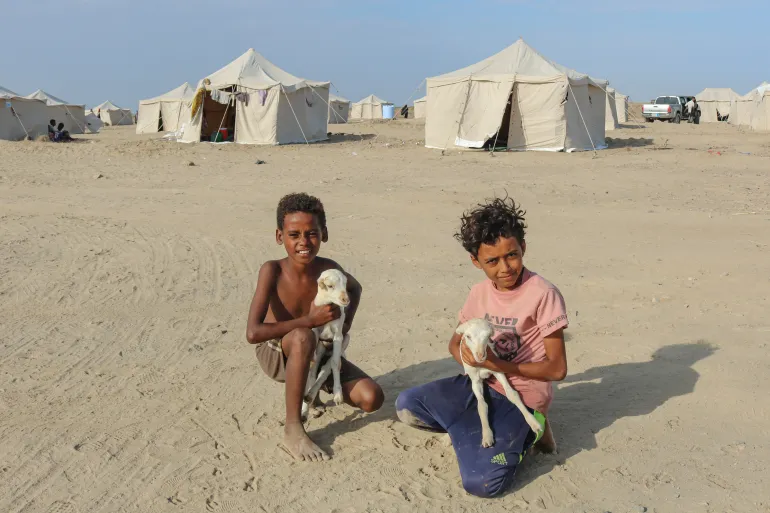
Three days later, after she had learned that her husband had also been killed during the attack, she fled to Batsari, where she was reunited with Sani, Hajara and Zubaida. When another bandit attack reached Batsari, she fled again with her three surviving children – now aged (15), (13) and (11) – to Jibia, where they eventually settled in a camp for displaced people.

She still remembers the night she lost much of her family.

“Minutes later, silence overwhelmed the atmosphere,” she recalled. “Then I started thinking about my husband, who had left for the farm, and my children, who were outside playing with other kids.”

The thought of them pushed her out of hiding.

But she was too late.

“They were all killed,” she told Al Jazeera.

Safiya’s experience reflects a wider crisis affecting communities across northwest Nigeria. For more than a decade, the region has faced attacks, kidnappings and village raids by armed groups commonly called bandits.

The violence has forced thousands of families from their homes, disrupted farming and trade, and left many people struggling to rebuild their lives.

Katsina State, which borders Niger, has been among the areas hardest hit.

After arriving in Jibia, Safiya survived by taking whatever work she could find. She ground grain for local residents and relied on temporary jobs to support her children.

She was then selected for a handbag-making training programme organised by the United Nations Development Programme (UNDP) through its Climate Security Project.

The initiative provides women affected by conflict with vocational training and equipment to help them start small businesses.

Months later, the programme gave her a source of income. The work brought stability, but it also created a new uncertainty: whether she could continue the business if she returned home.

“The essence is to give them an opportunity to become self-reliant,” said Muhammad Hamisu, the project coordinator in Jibia.

A skill that changed her circumstances

After completing the training, Safiya turned handbag-making into a source of income for her family.

With sewing materials and new skills, she began cutting fabric, stitching designs and producing handbags she could sell to support her children.

The work did not erase the pain of what she had lost, but it gave her something she had struggled to regain since fleeing: the ability to provide for herself.

“I used to wake up with nothing to offer my children,” she said. “There were days I sent my boys out with bowls to beg for food because I had nothing to give them. Now I can feed them myself.”

In March 2024, the Climate Security Project trained 20 women in Jibia in handbag production and provided sewing machines and materials to help them begin working.

Jibia’s location near the border with Niger also gives traders access to cross-border markets, including those in the Maradi region, one of Niger’s major commercial areas.

For some women, the business has become an important source of income.

“I make approximately $50 a month,” said 30-year-old Karima Sule, who has lived in Jibia since fleeing violence four years ago. “When demand is high, I earn even more. I help my husband and pay the school fees for my two older children from this business.”

A business shaped by insecurity

But building a business in a conflict-affected area remains difficult.

Safiya said her biggest challenge is finding enough money to buy materials.

“Sometimes I run out of stock and don’t have the funds to buy more,” she said. “When that happens, I lose customers.”

Karima said violence continues to affect sales.

“Whenever violence happens, market activities slow down for days,” she said. “People stop buying, and we lose income.”

Their growing economic activity may also expose them to new risks, according to Abdussamad Ahmad Yusuf, a human security researcher at HumAngle, a Nigerian newsroom that reports on conflict.

“Kidnapping for ransom in that region is becoming more targeted,” he said. “Authorities should conduct regular conflict and security risk assessments to identify high-risk trading routes, markets and emerging threats before expanding commercial activities.”

The Katsina government established the Community Watch Corps in 2023, a local security initiative that uses community members to gather intelligence and support responses to attacks.

Officials said security has improved in some communities, but many families who fled violence remain uncertain about returning home.

An uncertain future

Safiya hopes to return home one day and reunite her children with their relatives.

But the livelihood she has built in Jibia has become a reason to hesitate.

The handbag business has allowed her to buy food, support her children and depend less on unstable work. Leaving it behind could mean losing the independence she has worked hard to build.

She has been told that conditions in her hometown are improving, but she remains unsure whether she could rebuild the same source of income there.

For Safiya, returning home is not only about finding safety again. It is also about whether she can continue providing for her family.

“I want to go back home because my children need their relatives,” she said. “But I am afraid of losing this business. If I cannot continue it there, how will we survive?”

Source link

Venezuela: Earthquake Relief Efforts Continue, Thousands of Families Displaced

The earthquake flattened more than 100 buildings in La Guaira. (Agencia Zero)

Mérida, June 29, 2026 (venezuelanalysis.com) – Venezuelan and international rescue teams continue to search for survivors under collapsed buildings following last Wednesday’s back-to-back earthquakes.

The 7.2- and 7.5-magnitude tremors caused widespread destruction, primarily in the coastal state of La Guaira, which has been described as “ground zero.” Geological services have registered more than 500 aftershocks since the original earthquakes.

On Monday, Venezuelan officials reported that there have been 1,719 people killed, 5,034 injured, and more than 15 thousand displaced. According to the country’s authorities, 855 buildings have been damaged, including 189 totally collapsed, along with damage to 38 hospitals and 1,645 road structures.

“We are in critical and crucial hours to continue saving lives,” National Assembly President Jorge Rodríguez stated during a Monday press conference. He confirmed that over 25,000 rescue workers, including military personnel, police, firefighters, and civil protection units, are currently deployed, supported by 3,319 international rescuers from 25 nations and 137 specialized canines.

Rodríguez added that 90% of electricity service has been restored in La Guaira State, and that a special hotline remains active to provide psychological support to relatives of the victims, displaced people, and those suffering from post-traumatic stress following the earthquakes.

Earlier on Monday, Acting President Delcy Rodríguez celebrated the rescue of 21-year-old Aaron Levi Cantillo, who was pulled alive from the rubble in La Guaira after being trapped for 106 hours. The rescue was the result of 43 hours of intense, coordinated work by Venezuelan Civil Protection and brigades from Mexico, Chile, and Argentina. Emergency workers have warned that, as time passes, the probability of still finding survivors drastically decreases.

Over the weekend, the Venezuelan government has likewise ramped up efforts to tend to displaced families, with 15 temporary shelters set up in La Guaira and a further 50 in Caracas.

Other areas beyond La Guaira have also been severely impacted. Local residents reported structural damage and service failures in Morón, Carabobo state, close to the earthquakes’ epicenters. Similarly, in Tucacas, Falcón state, residents called for assistance from authorities as they face interrupted electricity or water services.

As part of its response to the crisis, the acting Rodríguez government restricted access to the state of La Guaira, the hardest-hit area. The measure aims to prevent traffic congestion and prioritize the movement of emergency vehicles and heavy machinery. Venezuelan officials have urged the public to avoid traveling to the area to ensure that rescue efforts are not impeded.

At the same time, authorities have sought to organize volunteer brigades, both for search and rescue operations and to tend to temporary shelters, via a registration center at the Poliedro complex in Caracas. 

As of June 29, 10,834 volunteers had registered, and they have been categorized according to their area of expertise: survivor rescue, medical care, logistics at temporary camps, and other essential tasks.

Following the double earthquake, the United States government has ramped up its presence in the Caribbean nation. The US Department of State has deployed a Disaster Assistance Response Team (DART) and specialized urban search and rescue units.

The Department of War has sent an expeditionary airfield management team to repair and reopen the damaged Simón Bolívar International Airport, which is now serving as the primary hub for international relief flights. The US Southern Command (SOUTHCOM) has stated that it is currently “managing tower and ground operations” at the country’s most important airport.

SOUTHCOM is also assessing conditions at the port of La Guaira and has docked the USS Fort Lauderdale warship to coordinate maritime deliveries. Various aircraft, including C-17 Globemaster, C-130 Hercules, MV-22 Ospreys, and helicopters, have conducted aerial surveys and transported rescue teams and supplies. 

Acting President Delcy Rodríguez personally thanked President Trump and Secretary of State Marco Rubio for US support following the natural disaster. In a social media message, the acting president said she was “deeply grateful for this gesture of friendship and cooperation.”

The Trump administration announced that humanitarian assistance to Venezuela has been increased to over $300 million. However, Washington has not offered any relief from widespread economic sanctions, only issuing a time-limited license allowing earthquake relief-related transactions.

The White House also retains control over Venezuelan oil export revenues, with the disbursement timings and amounts left at US officials’ discretion.

Edited by Ricardo Vaz in Caracas.

Source link

Gaza’s displaced families face worsening living conditions | Gaza

NewsFeed

Rats are invading displacement camps across Gaza, where piles of garbage, overflowing sewage and overcrowded shelters are worsening a public health crisis. Doctors report more severe skin diseases as families struggle without proper sanitation or adequate medical care.

Source link

Zamfara Farmers Displaced Despite Paying Millions to Terrorists in ‘Farming Tax’

Muhammadu Mahe wasn’t at home when terrorists came for him one rainy night. It was during the rainy season in 2023. He had travelled to sell livestock and spent the night in the Shinkafi area of Zamfara, North West Nigeria.

The following morning, his brother, Alhaji Usman, rang his phone.

Dan Hajiya, Yan Bindiga came looking for you last night,” Usman said over the phone. The term, Yan Bindiga, is what most rural residents call terrorists in the area. Muhammadu, who is known as Dan Hajiya in his Ruwan Bado village in the Maradun Local Government Area (LGA), did not fully grasp the message, so he asked, and his brother explained succinctly.

Six armed men on three motorcycles had stormed the village and gone straight to Muhammadu’s house. When they were told he was not around, the terrorists asked one of his children to let them know when he returned. They neither fired a single shot nor abducted any of his three wives and 13 children.

“Normally, they would have abducted a family member to force me to look for them, but they didn’t. It was very surprising,” Muhammadu told HumAngle on the afternoon of June 4 in a town in Zamfara, where he now lives with his family.

Hearing about the terrorists’ visit, he wanted to rush home to check if any of his children had been hurt. He had thought the terrorists were targeting him for more extortion. However, his brother advised him to stay in Shinkafi for at least two more days until they could determine the reason the terrorists were looking for him.

A dry, barren landscape with scattered green shrubs under a clear blue sky.
Muhammadu now works as a labourer on other people’s farms. Photo: Muhammad Babangida Mafara/HumAngle.

Muhammadu had paid a ₦1.5 million “farming tax” to a terrorist group led by Jamilu, a loyalist of the notorious criminal mastermind, Halilu Sububu, who was killed by the military in 2024. Halilu, originally from Maradun, maintained several camps in the forest reserves in the Sububu/Tubali, Bakura, and Kaya axes. One of such camps is now controlled by Jamilu. Ruwan Bado, Muhammadu’s village, sits not far from Janbako and Faru, two bigger villages in the Talata Mafara town. Terrorist groups routinely attack communities and motorists on the road, a situation that forced several farmers to abandon their farms. 

The lingering crisis engulfing northwestern Nigeria began as a farmer-herder clash in Zamfara over a decade ago. Thousands of people have since been killed, with over a million displaced. Motorcycle-riding terrorists invade communities, schools, farmlands, and roads to abduct people for ransom. Terrorist attacks have persisted in the region despite kinetic and non-kinetic approaches. 

Amid the ongoing armed violence, farmers are severely affected as terrorist attacks disrupt their agricultural activities. Each year, with the onset of the rainy season, terrorists intensify their attacks on rural communities to intimidate farmers, ultimately seeking agreements that often lead to residents paying millions as taxes. Funds collected from farmers help finance their terrorist activities. Farmers who fail to pay are forced to flee their communities for fear of being attacked by the terrorists. However, even paying the tax does not guarantee safety, as seen in several cases, especially in Zamfara State. 

Of recurring attacks and farming taxes

Before the violence escalated in his community, Muhammadu said he had always wondered what he would do without his farms. He is a farmer like his father and grandfather. Everyone in his family is a farmer, including those who have taken government jobs or other businesses. Everyone had a farm before terrorists began to invade their communities. 

The day the terrorists came looking for him was not their first time in the village. Before the rainy season in 2023, Muhammadu said, terrorists attacked the village in broad daylight. “I’ll never forget that attack,” he says as he unravels how the ugly event unfolded. And even before then, there were about three attacks.

A little before 3 p.m. on a Friday, he was sitting down outside the mosque with friends and relatives when terrorists barged into the community, shooting sporadically. He didn’t remember much of what happened immediately after he heard the gunshots, but he ran outside the village. “I ran for several minutes and decided to lie down on my stomach,” he says. His wives and some of his children who were at home also ran out.

The attack didn’t last long. When he returned, people had converged on the village square close to the mosque, with three dead bodies lying on the ground. “It was one of the saddest days of my life. My nephew, Haladu, was one of those killed. His mother is my elder sister. Malam Abubakar Jijji and Malam Usman were also killed in that attack.”

The violent incident changed Muhammadu’s life and that of several others in the community. “Our vigilante members said they got information that the terrorists vowed to turn our community upside down if we didn’t cooperate with them. They said what they did was a warning attack,” he says. Cooperating with the terrorists literally means paying taxes to them before farming. 

The community leaders would later meet to discuss how to negotiate with the terrorists for peace to reign. “We decided to pay the money. We had no option,” Muhammadu says. The terrorists said anyone with more than one farm must pay ₦1.5 million. 

Elderly man approaches armed figures with an offering, another man observes, in a grassy landscape.
Illustration: Akila Jibrin/HumAngle.

Payment for one farm ranged from ₦400,000 to ₦600,000, depending on the number of acres. His brother, Usman, paid for one farm. The terrorists said the community should not pay the money in a lump sum, but whoever was ready should go and pay their own. 

Muhammadu said he sold some of his livestock to raise the “farming tax”. He had volunteered to take the money to the terrorists in the forest. He took his money and that of another villager, Alhaji Sani, who contributed ₦2 million, resulting in a total of ₦3.5 million. The terrorists asked him to wait on the main road after the Faru community. A few minutes after he arrived, two terrorists on a motorcycle emerged from the shrubs, collected the money, and sped off. 

That same night, Jamilu, the leader of the terrorists, called to inform them that the money had been collected. He instructed them not to go to their farms and to wait for further instructions. While the residents awaited the next directive, the terrorists arrived looking for Muhammadu.

On the run

Muhammadu didn’t wait in Shinakafi for two days, as his brother suggested.

The following morning, he took the first car from Shinkafi to Boko, and from there, another car to Talata Mafara. He disembarked in Janbako, a community neighbouring his village. He said he was being careful because of informants lurking nearby. While waiting for someone to pick him up, his brother called again, asking him to head to Maradun instead because “they got information that the terrorists would kill me”.

He spent three days in Maradun and later sneaked back into his village, Ruwan Bado. At home, he gathered his family members, including his daughters, who were already married, and told them about the situation he had found himself in. 

“They all agreed that I should leave,” Muhammadu says. “One of my daughters thought it was suicidal to return to the community. So, I left for Talata Mafara in the morning.”

The choice of Talata Mafara was intentional as the town sits on the edge of the Bakalori dam with sprawling farmlands where residents engage in year-round farming. From Colony via Rini down to Gora on one side and River Bobo inside Mafara town down to Tumfafiya to the boundaries of Danbaza, stretches of water lie abundant for irrigation farming. 

“I was wrong. I didn’t know that farmers were also fleeing the Rini (in Bakura) and Gora (in Maradun) axis due to incessant attacks. Most of the farms are now abandoned,” he recalls. He moved farther down to the other side of Mafara town, this time to Tsakuwa, a suburb on the road to the communities of Sauna, Garbadu, Morai, and Kagara in southern Mafara. 

However, these communities also face terrorist attacks, making the roads and the farms on both sides of the road very vulnerable. This situation compounds Muhammadu’s problems.

“Since then, I’ve not gone back to Ruwan Bado. My family joined me here after three months.”

Even after three years, Muhammadu says he has not looked back because several people he knows have left the community. His elder brother, Usman, has also left for Maradun town with his family because Ruwan Bado and the communities around it have continued to witness terror attacks. 

“Even some months back, people were killed in our community as the attacks continued,” Muhammadu says. “I don’t know whether the Yan Bindiga (bandits) are still looking for me, but I think it’s unsafe to go home.” Only a few families remain in Ruwan Bado. 

Sani, the person whose farming tax Muhammadu took to the terrorists alongside his, has also left the community for Mafara town. “Even after collecting our money, the terrorists kept returning. There was a time they attacked the community and stole our livestock. I lost more than 10 cows to that attack,” the 63-year-old man told HumAngle. 

Muhammadu said he heard about the attack last year and advised Sani to leave the community. Sani was one of the three well-to-do people in the area. Life was good to him; he had three wives and 17 children, some of whom were already married. Aside from owning five farm fields, he was a trader and livestock merchant before the violence consumed his property. He sold some of his livestock out of fear of cattle-rustling terrorists and retained only the animals he used for ploughing on his farms.

“I encouraged our people to accept the terrorists’ demand for farming tax, believing that we would be allowed to go to the farm. But after we paid, the terrorists allowed us to start working, after which they continued attacking us. It was very unsafe for me to continue living in the community,” Sani, who now lives with his family in a rented apartment in Mafara, said. He has tried, to no avail, to gather the remnants of his wealth to start a business in the town but he said “it’s frustrating because the capital is too small and I don’t even know where to start from.”

As Muhammadu continues to flee, many farmers in the region are suffering from terrorist attacks, especially with the onset of the rainy season in the core northern states. The situation in communities like Ruwan Bado is worsened by a lack of adequate security agents to protect residents. Since there is an absence of conventional security forces in most of the communities, residents pay a farming or protection tax as requested by terrorists to avoid being attacked.

‘There was only a road checkpoint for soldiers on the Colony – Boko road, which is even farther away from us. Without adequate security agents, it’ll be difficult for us to go to farms or markets. When the terrorists attack, it’s only the vigilante group members who fight them back,” Muhammadu said. HumAngle learnt that the Zamfara State government recruited operatives for its Community Protection Guards (also known as Askarawa) and posted them to all communities facing security challenges in the state. But Muhammadu, who left Ruwan Bado in 2023, couldn’t confirm if there are Askarawa in his community now. 

James Barnett, a conflict researcher at Hudson Institute, believes terrorists are using the vacuum created by the absence of governance in some of the rural communities in North West Nigeria. The terrorists believe it’s easier and more profitable to enforce levies than to attack communities. “Communities that have no protection from the state often have no choice but to submit to bandit demands in order to be allowed to farm—and survive,” he said. 

“The regions where bandits are strongest are the sorts of areas where there has been almost no meaningful state presence in years—roads, schools, clinics and the like. Bandits have essentially filled a vacuum in those parts of rural Nigeria that the state has neglected,” Barnett, who has written extensively on the banditry conflict in the North West, added. 

The consequences of this reality are evident in communities, where residents say concerns about survival and security now overshadow everyday economic worries.

“Many villages in Tsafe are no longer thinking about where to get the cheapest fertiliser; instead, they are worried about how to access their farms safely. In some communities, despite paying ransoms and levies to the terrorists, locals are still not confident that their lives will be spared,” Abubakar Bala, a resident of Tsafe in Zamfara, told HumAngle.

Source link

Former Boko Haram Terrorists Accused of Killing Displaced Farmer in Borno

Muhammed Kaumi had just stepped out of the mosque when his phone rang on the evening of Friday, May 29. He had recently returned from Dikwa, a town in Borno State, northeastern Nigeria, and assumed the call was from a relative checking on his journey home. Instead, the voice on the other end delivered news that left him numb.

“Bulama has been killed,” the caller said. “They have killed Bulama.” Muhammed felt his chest tighten. “I instantly felt a sharp pain in my heart,” he recalled.

Bulama Ali was his cousin, a farmer, a father of five, and one of thousands, like him, who have been displaced by the Boko Haram insurgency that has scarred the region for more than a decade.

Within minutes, Muhammed was on his way to the Custom House Internally Displaced Persons’ Camp in Muna, on the outskirts of Maiduguri, where Bulama had lived with his family for nearly a decade.

As he rushed there, questions flooded his mind: “What had happened? Who had killed him? Why?”

When he arrived, residents told him that Bulama had allegedly been beaten by men they identified as “repentant Boko Haram fighters”, locally known as “Hybrids”.

For many residents of Maiduguri, the allegation struck a painful nerve.

For years, former insurgents who surrendered to authorities have passed through government rehabilitation and reintegration programmes such as Operation Safe Corridor and the Borno Model, before returning to civilian communities. However, some have bypassed both interventions completely. 

The Nigerian authorities have involved some of these deserters in security operations, where they help troops with intelligence gathering, their knowledge of terrorist-held terrain, and even operational activities. The arrangement has remained controversial among many survivors of the conflict and among security analysts. 

Now, residents in these communities say their fears have been justified. 

They brought him back dead

Bulama’s final hours began shortly before the Friday Muslim congregational prayers.

Muhammed was told by relatives and eyewitnesses that “[Bulama] was on his way to the mosque on his bicycle when he received a phone call. He stopped by the roadside [close to Muna, on the Maiduguri-Gamboru highway] to answer it.” Behind him was a vehicle carrying armed men dressed in black uniforms. “They honked at him to move,” Muhammed said. “But he was speaking on the phone and did not hear them.”

Abbas Shettima, who witnessed the incident, said the confrontation, which occurred between 1:15 p.m. and 1:30 p.m., quickly escalated. 

“We were all heading to the mosque when we saw them beating him,” Abbas recounted. According to him, the group consisted of about ten men carrying guns and sticks. “They said he was blocking their way,” he said.

Bulama tried to explain. He apologised repeatedly, but his pleas fell on deaf ears. 

“He kept begging them to spare him,” Abbas said. “He crouched down and covered his head with his hands while they beat him.” When bystanders attempted to intervene, the armed men threatened them. Residents watched helplessly. Eventually, the men forced Bulama into their vehicle and drove away.

No one knew where he had been taken.

At the time, witnesses said they believed the group were members of the Civilian Joint Task Force (CJTF) because of their uniforms.

Hours later, shortly after 3 p.m., the vehicle returned. “They brought him back severely wounded,” Abbas recounted. “He could barely move.”

Residents rushed toward him to help, but within ten minutes, he died.

The incident was immediately reported to the soldiers stationed at the camp’s entrance. According to Muhammed, the soldiers said they had seen the vehicle dropping Bulama but did not know what had transpired. “They were the ones who told us the men were Hybrids and that they had come from the Maiwa axis,” he said.

Residents later learned that Bulama had allegedly been taken to Maiwa Kura, a remote village in Mafa Local Government Area, Borno State, where the group was reportedly stationed. 

Although “Hybrids” are often perceived as operating independently, they are typically attached to military formations and work alongside security forces, according to a member of a local volunteer security outfit involved in counterterrorism operations who spoke to HumAngle.

“The commanding officer of the military base gives instructions to the ‘Hybrid’ commander attached to that formation, who then relays orders to his men,” the source explained. “During broader operations involving multiple locations, they also have a state commander from whom they receive directives.”

However, this does not necessarily imply military involvement in the attack that claimed Bulama’s life, as Hybrid patrols sometimes operate independently.

Bulama’s family subsequently reported the matter to the police. 

Muhammed said that soldiers, police officers, and members of the CJTF later travelled to Maiwa, where they arrested three suspects, including a commander. “They told us the others had travelled to Mafa for an operation,” he said.

The suspects were taken into custody and transferred to the Borno State Criminal Investigation Department for further investigation.

According to family members, the suspects claimed Bulama died after jumping from the back of a moving Hilux vehicle. But the relatives remain unconvinced. “The doctors told us he had been severely beaten,” Muhammed said. “His hands were tied, and he had internal bleeding.”

The family retrieved the body on Saturday morning and buried him later that afternoon. When the body was prepared for burial, he said, blood continued to seep from his eyes, ears, and nose. “It stained the white shroud.”

A large group of people stand in rows outdoors, appearing to observe or participate in an event under a clear sky.
Mourners at Bulama’s interment at the Custom House IDP camp. Photo: Abbas Shettima.

When HumAngle contacted the Borno State Police Public Relations Officer, Nahum Kenneth Daso, he said he was not aware of the case and would make inquiries. As of publication, no official update had been provided.

The men known as ‘Hybrids’

In many communities across Borno State, the word “Hybrid” carries different meanings depending on who defines it. 

To security officials, they are a practical asset in a war that has stretched for more than 15 years. For many residents, they are former terrorists trying to rebuild their lives. To others, especially those who lost relatives, homes, farms, and livelihoods during the conflict, they are a constant reminder of wounds that have never fully healed.

The term is commonly used to describe some former Boko Haram members who surrendered and passed through official rehabilitation and deradicalisation programmes, and later became attached to security operations in various capacities.

Since they possess intimate knowledge of terrorist operations and hierarchy, security agencies have increasingly relied on some of them to help in identifying former colleagues, navigating difficult terrain, and providing information that security forces may otherwise struggle to obtain.

For authorities, the arrangement is often viewed as a necessary component of the counterterrorism campaign. However, many civilians find it deeply unsettling.

A group of men in numbered uniforms sit on the ground, facing military personnel on an airstrip.
File: A group of former Boko Haram terrorists who were rehabilitated by Nigeria’s Operation Safe Corridor programme in northeastern Nigeria.

That is why, for some residents, the sight of former terrorists carrying weapons or working alongside security forces can be difficult to accept.

Bulama’s death has reopened those anxieties. Yet, the resentment many residents express today did not begin with his killing. It has been building for years.

In August 2021, as thousands of terrorist deserters began surrendering from the Sambisa Forest and the Lake Chad region, the Borno State Government convened a high-level stakeholders’ meeting at the Government House in Maiduguri. Government officials, security agencies, traditional rulers, religious leaders, civil society organisations, journalists, and community representatives gathered to discuss the reintegration of former insurgents into society.

At the end of the meeting, participants agreed in principle to forgive and accept these deserters back into their communities. Their acceptance, however, was not unconditional. The stakeholders insisted that surrendered terrorists must be thoroughly screened before reintegration. They also warned against the release of hardened extremists into the communities. They further called for meaningful reconciliation between victims and former terrorists.

The gathering was widely presented as a collective endorsement of reconciliation.

But beyond the conference hall, acceptance has proved far more complicated.

Many residents who had survived the violence felt they had not been part of that conversation. Some had lost parents, spouses, siblings, and/or children. Others had spent years moving between displacement camps, uncertain whether they would ever return home. For them, forgiveness was not a policy decision that could be reached through consensus among stakeholders. It was an intensely personal choice shaped by trauma, memory, and loss.

“The people making these decisions are not always the people who suffered directly,” Abba Gana told HumAngle.

Over the years, some residents have complained of harassment and intimidation by former terrorists and their families. Others say they simply feel the reintegration process has moved faster than community healing.

The debate became even more sensitive as some former terrorists began assisting security operations. To many survivors, the transformation can be difficult to reconcile: people who once arrived as attackers returning as neighbours and protectors, and in some cases, as men carrying authority.

Some government officials have repeatedly defended the reintegration policy. Recently, General Olufemi Oluyede, the Chief of Defence Staff and chairperson of the Operation Safe Corridor National Steering Committee, likened terrorist deserters to the biblical Prodigal Son, arguing that they deserve rehabilitation because they remain Nigerian citizens. 

Those concerns were further amplified by reports that not all former terrorists were passing through official rehabilitation channels. In 2025, a HumAngle investigation documented allegations that some defectors were quietly leaving the forest and reintegrating into communities without participating in formal deradicalisation programmes, raising questions about screening, accountability, and oversight.

Over the years, several incidents involving terrorist deserters have also contributed to public unease. In April, a former Boko Haram member allegedly shot and killed a CJTF member during an argument in the Mafa LGA. According to reports, the victim was rushed to the hospital but was confirmed dead on arrival, while the suspect was later arrested and handed over to the police.

People in uniforms and civilians gather on a street, with yellow tape indicating a restricted area.
File: Police officers at the scene of an explosion at the Maiduguri Monday Market in March 2026. Photo: Al’amin Umar/HumAngle. 

Two years earlier, some deserters reportedly stormed a police station in Maiduguri in an attempt to secure the release of their colleagues arrested over alleged drug-related offences. In another case that generated public outrage in 2023, a deserter was accused of killing his wife at the outskirts of Maiduguri.

Concerns about the reintegration programme are not new. As far back as 2020, Ali Ndume, the senator representing Borno South Senatorial District, publicly criticised aspects of the government’s amnesty efforts, recounting the case of a deserter whom he alleged killed his father and later absconded with his property. The senator argued that the victims and survivors’ concerns were not receiving the same level of attention as the rehabilitation of the deserters.

Taken individually, the circumstances surrounding these incidents differ significantly from Bulama’s case. Collectively, however, they have helped shape public perceptions of the reintegration programmes and deepened anxieties among some residents about the monitoring, supervision, and accountability of deserters, particularly those involved in security-related activities.

For many survivors of the conflict, such incidents reinforce a lingering fear that rehabilitation alone may not be enough. Bulama’s death has now brought those long-simmering concerns into sharper focus. 

“The community is deciding on an action,” Abbas said.

Residents gathered after Bulama’s burial to discuss possible legal steps. Some suggested pooling money to hire a lawyer. Others proposed approaching human rights organisations.

“We are thinking of contributing money and hiring a lawyer,” Abbas said.

Justice and unfinished wounds

For Muhammed, grief and anger now coexist. His cousin survived displacement and years of uncertainty. He, however, did not survive a short journey to the mosque.

When asked what justice would look like for his family and the displaced community, Muhammed replied, “The law does not play by sentiments; it follows laid-down rules. I hope they will do what is right. If it is by my sentiments, I would not want them to be free. I would want them imprisoned for life.”

He paused.

“I don’t care about compensation. I don’t care about apologies. Justice for me is their imprisonment.”

A family left devastated 

Bulama was only 30 years old. He left behind two wives and five children.

He earned a living as a farmer. And before displacement forced the family from Boboshe in 2016, his father was killed. His elderly mother remains alive and still lives with them at the displacement camp.

The survival of his family, which was Bulama’s responsibility as the breadwinner, hangs uncertainly over relatives, who are also struggling to survive. “We are not rich people,” Muhammed said. “Caring for five children in addition to our own children will be difficult.”

Around the camp where he lived for over a decade, residents gather beneath makeshift shelters to rest, but the conversations about Bulama’s death remain on their lips. 

What remains immediate is his nuclear family, and the space left by a man who left home for Friday prayers and never returned.

Source link