Haram

‘We were herded like animals’: Freed from Boko Haram captivity | Boko Haram News

More than 360 people abducted by Boko Haram have been rescued in northeastern Nigeria. Former captives recount months of hardship, while families of those still missing say they are running out of answers for children waiting for their parents to return.

Source link

Seeking Redemption, Spurring Terror: The Curious Lives of Former Boko Haram Fighters in Nigeria

As a pariah child in search of Islamic knowledge, Goni Abubakar has no clue what it means to hold a gun and pull the trigger. He is just an almajiri who runs errands for his cleric master in Bama, a town in Borno State, northeastern Nigeria. He learns to recite Quran verses by heart; he is one of the brightest pupils under the cleric’s tutelage. In the beginning, the messages are clear: have faith in Allah, the Prophet Muhammad, and the Day of Judgement. Every pupil carries these heavy words around and keenly believes in them. They say the Quranic verses that match those words by heart: “O you who have believed, fear Allah and believe in His Messenger; He will [then] give you a double portion of His mercy and make for you a light by which you will walk and forgive you; and Allah is Forgiving and Merciful.”

The preaching is pious until peril pierces the heart of the preacher. 

The teacher sells groceries, and Goni doubles as his shop assistant. Detached from his parents as a child, he was now a teen, tending only to the bidding of his mentor. Dozens of children are on this path to seek knowledge, but Goni is the teacher’s delight: fierce, smart, and completely loyal. Their earliest form of education is the Tsangaya, a traditional Quranic education in northern Nigeria, and most of them have not attended any formal secular school before they are thrown under the control of a man they all call “mallam”. The morning and evening classes are held in the shade of a tree and are led by the teacher, who preaches to them the ways of Islam.

Kids like Goni know what it means to grow up in a local community. A child can sing through the neighbourhood, begging anyone there for food and water. Local farmers prosper in peace after months of tilling and cultivating the land. People sleep at night without fear of being raided by assailants or militants. Fear and terror consumed the town when Boko Haram’s strange ideologies spread like wildfire into the communities. Goni’s teacher is among the first to embrace the ideologies propagated by Boko Haram’s founder, Mohammed Yusuf. As his preaching changed, his way of life changed too, beaming terror and extremism infused into the hearts of children under his mentorship.

In 2009, when Boko Haram went underground before re-emerging in 2010, Goni was already a 12-year-old. Too young and naive to ask questions, he and dozens of children followed their tutor to join the insurgent group that would later destabilise Nigeria. Now, in the northeastern region, the Boko Haram insurgency has uprooted over three million people and killed over 350,000, with government authorities failing to rein in the deadly scourge. Armed violence has spread beyond the region’s borders into parts of the northwestern and north-central regions.

Goni would become a grown man, swallowing the rulings of terrorists until he could no longer bear them. He now seeks redemption and reintegration through the state-backed deradicalisation programme. While it appears he has left a life of violence and attacks for good, it’s not that simple. For him and many other men in his shoes, post-Boko Haram life presents some puzzles that test the true efficacy of the deradicalisation scheme.

Are the terrorist deserters genuinely seeking redemption or only trying to survive? For months – between November 2025 and May 2026 – HumAngle probed the complexities of the former insurgents’ lives, documenting their journeys from the past to the present, their struggles to become civilians again, their secret frontline deals with the military, and the fragile peace their reintegration poses to the civilian population.

Close-up of a person's arm with a noticeable scar or raised mark on the skin, outdoors.
Another defector shows the scars he carries around. Photo: Ibrahim Adeyemi/HumAngle.

Snaring the cat

When Goni joined Boko Haram as a teen, his master’s preachings had switched from admonishing children under his watch to have strong faith in their religion to brainwashing them into a life of violence. They embraced it, truly believing that spilling the blood of people who don’t believe in their ideology was the clearest pathway to paradise. Elsewhere in Borno, in the Malam Fatori area, Ali Bukhar also listened to the sermons of Boko Haram’s jihadists. Those sermons summoned the beast in him and took away the best of his humanity. He joined them convinced that true salvation was immersed in the ideology of killing and maiming.

“In the preachings, they’d emphasise that if you died in the cause, you are a martyr. That you are going to paradise straight,” Ali recalls. He joined as an adult in 2014 during the peak of the Boko Haram emergence. About five months after joining the group, he was asked to attend training. His handlers took him to a riverine area and gave him a gun. “They have a specific instructor whose job is solely to train new intakes. You’d train for about four to five months. After the training, they’d return you to the Markaz [Arabic word for headquarters or centre]. And when it is time to go out for a fight, they’d give you guns.”

Suleiman Mohammad tells a slightly different story. He joined Boko Haram in 2013, during the first Baga attack. The militants and the military had been locked in a fierce battle that cost hundreds of civilians their lives and thousands their homes. A retaliatory raid after a military base was attacked in Baga took a bloody turn for mostly civilians, brewing a trust deficit in the operational methods of Nigerian forces in their fight against terrorism. The insurgent group took advantage of the situation to recruit young people into its unholy ways. Suleiman was among hundreds of people brought into the system after the Baga bloody saga and the uprising that followed. He was a herder in Malam Fatori and had grown up through the local Tsangaya education system.

“So after the Baga attack, I was contacted by the fighters who turned out to be from my village,” Suleiman reminisces. “We studied together when we attended Tsangaya and Islamiyya a long time ago. They told me how the other brothers were with them. They told me stories of how they recite the Quran collectively and also wage ‘holy war’ together. Then they invited me to join them. So, we made an appointment to meet at Mairari.”

A week later, the terrorists came as agreed and met with Suleiman’s father in his home. 

“Your son is joining us in the cause of Allah. He’d work for Allah,” the terrorists say. 

“Allah’s cause?” the father wonders. “Jihad is mandatory for all muslims. And since he has agreed to go with you, I have no objections.” 

The terrorists had come with guns and machetes, Suleiman notes, suggesting that his father was made to agree under duress. “That was how I joined them. We had carried out several attacks ever since. From Mairari, Tungushe, and others. In fact, we held Mairari – under Magumeri – captive for quite some time before it was recaptured by the military.”

People joined the Boko Haram insurgency for different reasons. For Goni and his cohorts, it was a case of misguided faith rooted in brainwashing and psychological manipulation. The story is different for many others. The fire of the burning insurgency started from the charismatic oratory and radical sermons by the founder of Boko Haram, Mohammed Yusuf, between 2002 and 2009. Since at least 2021, HumAngle has interviewed dozens of defectors who revealed why they joined the deadly group before surrendering to a deradicalisation scheme organised by the government. Mohammed took advantage of the dysfunctions within the Nigerian state to campaign against a secular system of governance and, by extension, democracy.

Testimonies from defectors and custodians of Boko Haram’s history reveal that the post-2009 state repression, especially the actual brutality of the Nigerian military and police against civilians, and the uprising that trailed it, were among the factors that drove young people into insurgency. At the time, “Tura Takai Bango” was the mantra for the agitation, literally meaning “they had been pushed to the wall”. The era and the ugly events that unfolded encapsulate the desperation that leads civilians to affiliate with insurgents. When the state’s counter-insurgency tactics involve collective punishment, the civilian population often finds itself caught in a “double jeopardy” where both the state and the insurgents are viewed as existential threats. 

Isa Alamndiri, one of the victims of the state repression, told HumAngle how he witnessed the summary execution of young people in 2016, in the Marte Local Government Area (LGA), on the grounds that they were shielding terrorists. “They came and gathered all of us in the village. They then separated the elderly and killed all the youths. They shot over 30 youths that day. Their reason was that we were harbouring Boko Haram in our midst,” Isa says. 

Another witness of what many believe pushed youths in the state to the wall, Musa Kurama, recalls that the Nigerian military invaded his village in Meleri, also in Marte, to burn his house, among many others, to the ground, saying that the entire community was a hideout for terrorists. The cycle of violence forced young adults and naive teenagers to take the insurgents’ offer of “protection”, which was a predatory alternative to state-sponsored destruction.

Boko Haram also targeted schools for attacks, deliberately conducting mass kidnappings such as in Chibok and Dapchi to enforce their radical ideology by making secular educational institutions unsafe. This insurgent tactic strategically provides a supply of young captives who were groomed as fighters or forced into “marriages” that facilitate the group’s long-term sustainability. The state’s failure to secure these environments has led to the closure of over 600 schools in the region, creating a lost generation of children who are more susceptible to recruitment because of the absence of alternative futures.

Children underneath a "UNICEF for every child" sign, standing on a dirt ground with scattered litter.
Insurgents see children as alternative futures for their groups. Photo: Ibrahim Adeyemi/HumAngle.

Jihad: ‘Pathway to paradise’

Goni has grown up knowing nothing but violence and bloodshed, and now claims he’s out of the messy circle. He smiles as he speaks, but when he remembers how he joined other terrorists to pillage villages, uproot people from their homes, farmlands, and abduct scores, he furrows his brow. 

“Before we go out, we would prepare. They’d mobilise 100 to 200 fighters, give them arms, and say, ‘We are going out to wage a holy war’.  Then we would charge into military barracks,” he tells HumAngle curtly. “I believe we were deceived by our masters because they don’t practice what they preach and twist religious verses to suit their evil acts and intentions.”

Regardless of how and why they joined, newly recruited insurgents are made to believe that killing and spilling the blood of anyone not following their templates of violence has only one name: jihad. Most defectors we spoke to corroborated this during separate interviews in 2025 and later in 2026.

Experts and scholars in political science, human rights, and peace and conflict studies argue that Boko Haram weaponised the concept of jihad to manipulate its followers into believing keenly in killing and destroying those who disagree with their ideology. In the 2021 issue of the Al-Hikmah Journal on Social Sciences and Education, for example, Issa Muhammad-Jamiu, a researcher at Kogi State University in North Central Nigeria, notes that Boko Haram’s ideology contradicts Islamic injunctions. The most disturbing aspect, he states, is the condemnation of any scholarly verdict that falls short of their view. 

“How could they attribute Islam to the prohibition of Western education, which has become a necessity, if not compulsory, to Muslims in the contemporary world? Do they mean that they are more knowledgeable and more committed to Islam than those Companions and Tabi’un who studied foreign cultures and sciences for the interest of Muslim communities?” Issa ponders.

Rows of makeshift shelters with tarp and thatched roofs on sandy ground, under a clear blue sky. Sparse trees are visible in the background.
At the Bama IDP camp in Borno State, North East Nigeria. Photo: Ibrahim Adeyemi/HumAngle.

Two sides of the coin

As Goni speaks, his lips look pale and peeling. He’s been battling typhoid and malaria and is still receiving treatment. He carries a gentle demeanour that betrays the terror he had perpetrated, and wears a blank face wrinkled with emotionlessness. For him, peace is a no-brainer when violence is pervasive.

He quips, throwing on a long, tedious smile when asked what he thinks of the concept of peace. “Peace tastes good,” he says. “Living peacefully among loved ones is greater than any other thing. I was in Njimia before leaving. I had worked in several places, including Gazuwa, my birthplace. What made me leave was recent developments. The conflict between the factions and the injustice. So, I took my weapon and left. I arrived at Konduga, where I was received. They then brought us to Bama and then to Hajj Camp.”

Goni believes that embracing peace simply means walking away from a life of pain, violence, and gnashing of teeth. Dwelling in the forest with terrorists means dining with the devil, he says. His moral postulation and spiritual freedom were destroyed in the terrorist camp. He had access to the Quran and understood its teachings, but every verse he read had to be interpreted in accordance with the sect’s teachings. He had no freedom of thought or understanding of whatever he read from the scripture. He had no meaningful life in the forest, he says, apart from destroying people’s lives.

He and many of the terrorist deserters we spoke to said they experienced pain in its most extreme form. Whenever they sustained gunshot wounds during field battles with the military, they returned to the forest almost dead. They were being treated by their locally-trained doctors, whom many of the ex-combatants described as quacks. Most times, they gave them dangerous, addictive opioids such as Tramadol and Refinol. They became addicted to these drugs to escape their daily ordeals, even after healing from the wounds. 

“They punished us for taking hard drugs they introduced to us in the first place,” Goni complains. “Sometimes a fighter could be killed just because he takes hard drugs. When they knew it was bad, why did they use it to treat us?”

Many terrorists decided to surrender to the military for different reasons. One major cause of mass defections from the terrorist camps was the sudden demise of Abubakar Shekau, the Boko Haram gang leader who took over the mantle of terror from Mohammed Yusuf. There had been cracks within the insurgent group, leading to the rise of the Islamic State for West African Province (ISWAP), which was formed as a rebel group against Shekau’s camp. Another thing that followed the death of Shekau in 2021 was disease and hunger outbreaks. 

The Nigerian military took advantage of Shekau’s death to launch several offensive attacks on the terrorist dens in northeastern Nigeria, destroying their logistics bases. That year, the military said it recorded thousands of defections from terrorists who surrendered to embrace peace. Once they submit themselves to the military after years of committing criminal atrocities, they are subjected to deradicalisation through the Borno Model.

A bustling outdoor market scene with people walking, cycling, and a child pulling a cart under a canopy of trees.
Some terrorist deserters now live in the Bama IDP camp in Borno State. Photo: Ibrahim Adeyemi/HumAngle.

HumAngle interviewed several Boko Haram deserters to examine their understanding of peace after committing grave crimes against the human population in the region. Many of them curiously oversimplified the concept, reducing it to simply switching sides and moving from deadly armed violence to living an average civilian life.

“From my understanding, peace is us leaving the group,” Ali simply says and goes ahead to recount how he joined other fighters to enslave girls for sex after kidnapping them from their homes, schools, and farms. He had been through hell as a former Boko Haram member, and now seeks solace in embracing peace by surrendering to the military. He had been imprisoned by his superiors in the terror camp and asked to surrender his arms, but he refused. “I buried it where they could not see it. I was locked up for three months. When they released me, I went and dug up my gun and left them,” he recalls.

For him and several defectors, returning to the civilian community is an exciting prospect. Despite the horror they inflicted on civilian communities as terrorists, they consider living with ordinary locals again, especially close to their families, as a peaceful reconciliation of their horrible past. “We were ignorant when we did those things in the past. But now we know better,” one of them, Abubakar Saleh, says. He was a Boko Haram commander who led dozens of fighters to dislodge communities, rape women and girls and subjugate civilian communities under terrorist control.

He has now returned to Maiduguri with his family. His wife had just given birth when we spoke to him, and he has settled well into the civilian community. To him, peace is relief from the pain that comes with being a terrorist leader. Although he enjoyed authority as a commanding fighter, his life in the forest was miserable, as he was always on the move to evade military operations and surveillance.

“Life here is better,” he affirms. “It is more comfortable and peaceful. In the forest, there is no rest. You’d hunt daily like a lion. Always changing locations. But here, no attacks.”

For civilian casualties of the terror perpetrated by many of these terrorist deserters, however, peace doesn’t come easily. For years, victims of insurgency in the northeastern region have longed for peace and reparations. Thousands of displaced people not only lost their homes, but also lost hope in ever rebuilding their lives or returning to their settlements. In parts of Borno, especially at the Shuwari displacement site, displaced people feed on the leftovers from former terrorists undergoing the government’s deradicalisation programme, a situation that has created an atmosphere of distrust and inequalities. When the Borno State government began a resettlement scheme for displaced people, they were promised protection and stipends to rebuild their lives. Many of them ended up being re-displaced by terrorists and would not get the opportunity to rebuild their lives.

Ensuring peace and justice in the North East is far more complicated than many terrorist deserters have assumed, says Ndubuisi Ani, a Senior Researcher at the Institute of Security Studies. The transitional justice expert told HumAngle that the defectors’ curious understanding of peace undermines the pains and level of destruction civilians have witnessed at the hands of terrorists. He argues that peace and justice cannot be achieved in tackling violent extremism unless there’s inclusivity, good governance, and stability.

“The state must understand that there are basic needs to be responded to (on the side of victims),” Ndubuisi explains. “A lot of communities need a lot of social contracts on the ground.”

The security expert further explains that any transitional justice scheme by the government must be victim-centred. He advised that the state must go back to its original duty of protecting citizens and ensuring peace and tranquillity in society.

“You’ve not psychologically prepared actors. How do you let the victims understand?” he asked, stating that the government can’t successfully reintegrate terrorist deserters back into society without proper public engagement. “The intent is good, but the approach is the problem.”

Seeking peace and redemption

Like many terrorist deserters, Goni accepts that he has lived a complicated life of violence and horror. This is not the time for regret, he says. It’s a moment to seek forgiveness, to retrace his steps, and perhaps to wash the blood from his own hands. When he arrived at the Hajj Camp in Maiduguri after surrendering to the military and going through the process of deradicalisation, he struggled with the guilt of the atrocities he had committed, and, to prove to the military that he had backed off from a life of bloodshed, he agreed to work in the field with soldiers fighting terrorists. He’s not alone in this. Several former combatants we spoke to said they decided to work as auxiliary operatives to fight alongside the military against Boko Haram, the same sect they once belonged to. Several other defectors noted that when they chose to work with the military – as a way to seek redemption – they were handed rifles, loaded onto the backs of patrol trucks, and sent directly into the marshes and forests they had recently fled.

Asked whether they were coerced into joining the military, Goni laughed before saying the escapade was never mandatory. 

“It is a choice,” he replies. “I may decide not to work with them again.”

It is a hard nut to crack, but the terrorist deserters say the military operatives have learned to work and walk with them.

“They arm us and take us with them. If, for instance, a Commanding Officer is going out for an operation, he’d request a certain amount of “repentants” from the Hajj Camp officials. And the officials would assign like 50 or 100 persons to him, depending on the scale of the operation,” Goni says.

By fighting the same people who recruited him into the monolithic Boko Haram camp as a teen, Goni says, he has freed himself from a lifetime of guilt. During his time with the killers, he recalls asking many of the fighters if they loved what they were doing. Those fighters feel trapped, he says; they’re homesick, but even their families have rejected them. Now that he has freed himself from the shackles of terrorism, he says he begs God for forgiveness. But while he seeks forgiveness for the atrocities he has committed, he would use every knowledge he has about the group to fight them back. That’s his way of seeking redemption.

“They give us food and allowances, and we give them intelligence. We show them the hideouts. Because we know the terrain better than they do. We know their fighting styles,” Goni brags, smiling and looking directly at the reporter. “We know their escape routes. Isn’t this helpful enough? Also, we lead the way. They’d follow behind. We charge in.”

A vast view of a makeshift camp with tents and temporary shelters, three children stand in the foreground, trees line the background.
Displaced persons at the Bama IDP camp live inside makeshift tents. Photo: Ibrahim Adeyemi/HumAngle.

Redemption through revenge

Ali’s life after Boko Haram is even more thrilling: he seeks redemption through revenge. He had fallen for peer pressure to join one of the most brutal terrorist organisations in existence, and his life had since remained terrifying. For years, he was a cog in the Boko Haram machine, serving with vim and vigour. He learned to repair military vehicles in the forest and became renowned as the sect’s mechanic. He would repair heavy military patrol vehicles seized by the insurgents or those stuck in the mud within the forest during ambushes.

Despite his servitude for Boko Haram’s cause, he says, his entire life with the terror group was a lie. He grew to realise that behind the Boko Haram ideology was a hail of deceit and human manipulation. Bamboozled with distorted interpretations of verses from the Quran, Ali recounts how he had joined hundreds of other fighters to trigger plague, tears, and horror in civilian communities in the name of holy war.

“The practice violates the preachings. My biggest reason was that the practice was not what the Prophet truly teaches,” he claims. “The commanders would usually stay behind, leaving a comfortable life, while the foot soldiers are left starving and fighting day and night.”

For Ali, the deal breaker with Boko Haram was during a chaotic raid in the Tungushe town of Borno. He had come under a heavy burst of military gunfire, which tore through his arm, shattering the bone. He had expected that the sect’s medical team would give him some extra care due to his critical condition, but they treated him like disposable property. 

“I was so humiliated by the sect’s medical team, as treatments were handled haphazardly,” he laments. “If it were the commanders, they would treat them swiftly with maximum care. But for fighters, there is usually no medical attention.”

For two straight years, he nursed the pain alone and grew bitter resentment for the sect and its ideologies. He realised he was nothing but a tool for achieving the commanders’ personal hunches and interests. One night, he slipped away, through the scrublands, trudging northward until he found himself around the military garrison in Monguno, where he fell flat on the ground and surrendered.

“After surrendering in Monguno, they took us to Hajj Camp in Maiduguri,” Ali tells HumAngle. “Days later, they brought forward an opportunity where you could help in the fight. You may decide to follow the military during attacks or provide them with intelligence. Whatever you think you can do. So, I said I want to fight. I have a friend who also fights alongside the soldiers. I chose to fight because I have realised that we were deceived by the group.”

Repentance or survival?

Unlike Ali and Goni, repentance has an entirely different meaning for Suleiman: it is an illusion or a political statement made by people in government. Calling him a “repentant Boko Haram” is an insult, he says. To him, that word is a subtle qualifier for a coward. With a cold voice and a sour look, he describes how he worked with ground troops to attack Timbuktu, Sambisa, and other terrorist hideouts.

A hand with darkened fingertips and palm, resting on a purple mat with light and shadow patterns.
Four fingers of this anonymous terrorist deserter were chopped off while assisting the military on the battlefield against Boko Haram. Photo: Ibrahim Adeyemi/HumAngle.

His case is more of just switching sides than actual repentance. He dreads the term “repentant Boko Haram” and doesn’t hide it. As a terrorist, he lived for violence, pillaging villages and destroying people’s lives and properties. Following the rise of Abu Mushab al-Barnawi, a factional leader of the Boko Haram sect, Suleiman came under his command, joining over 100 fighters under his control. He had fought fiercely against the Nigerian military on many occasions, and he was feared for his precise brutality amid battles.

His cruelty had no bounds, as he had fought against top Nigerian military leaders, as he states, like Captain Bala, Manga, and Abu Ali, leaving scars on the town that are still visible today. He had also raided beyond Nigeria, maiming locals in the Niger Republic, especially in Diffa, Maine-Soroa, and Chabbal.

When factional infighting turned truly brutal, Suleiman chose to be on the safer side. Exhausted by the tireless internal slaughter, he left and surrendered to the military. Now, he does almost the same thing on the other side. The activity is the same, he notes, only the targets are different. 

“I am not comfortable with that name [repentant]. I don’t like it,” Suleiman says. He would frown and then laugh during the interview to convey the complexity of the terror drowning him. “In the forest, I followed someone’s commands. Here too, I am commanded and still branded repentant?”

He wears a worn Civilian Joint Task Force (CJTF) uniform during the interview with HumAngle, bragging about following soldiers to the battlefield against terrorists in Geidam, Marte, Kala-Bridge and Malam Fatori. Despite his defiance, however, he seems to have taken bullets for the military during counterterrorism raids in northeastern Nigeria. His four fingers are chopped off, and there are scars all over his body. It was during a joint offensive with Chadian forces in northern Monguno. An artillery explosion had torn through the military ranks and killed several soldiers and terrorist deserters fighting by their side. He would follow the forces into the fortified hideouts of Timbuktu and Sambisa, giving on-the-ground intel to navigate the terrain.

“I got this arm scar, and my fingers were chopped off while digging out a planted landmine about five months ago,” he says of another military raid he participated in. “The explosion killed two other ex-combatants and nine soldiers. When the engineer scouted and identified a planted bomb, he refused to dig it out. None of the soldiers did. So they asked me to do it. One of the wires sparked. Then it exploded. It also affected my leg.”

The deradicalisation scheme

The term “repentance”, which Suleiman and several other defectors loathe, is one of the modus operandi of the Operation Safe Corridor, a military-led deradicalisation and reintegration programme across northeastern states. Established in 2016, the programme has witnessed both criticism and appraisal from experts and affected citizens. The quest for transitional justice, following the mass atrocities committed by Boko Haram against the people and the government of Nigeria, pushed authorities to come up with peacebuilding efforts.

The federal government had introduced the judicial approach of mass trials of Boko Haram figures captured on the battlefield, but systemic failures of the legal system derailed the processes. With a conviction rate of less than 10 per cent after conducting mass trials of thousands of fighters between 2017 and 2020, public distrust in the judicial system grew rapidly. These efforts also faced hurdles due to limited resources and circumstantial evidence, as well as a massive backlog of approximately 10,000 suspected fighters awaiting trial. 

Following deficiencies in the judicial and military mechanisms, the government provided non-judicial options, such as the Operation Safe Corridor (OPSC) and, later, the Borno Model, a scheme designed to handle the mass defections of thousands of insurgents.

A group of men in white outfits and green hats stand in formation under a large tent outdoors.
File: Some of the OPSC graduands. Photo: Solomon Odeniyi/Punch.

HumAngle reviewed at least two research studies that confirm our on-the-ground reporting on the deficiencies and the public misgivings against the counterinsurgency initiative. The independent studies, one led by Idayat Hassan, then of the Centre for Democracy and Development (CDD), and the other by Hassan-Taiwo Adebayo of the Institute of Security Studies (ISS), noted a systemic imbalance that seemed to favour the rehabilitation of perpetrators over the survival and justice of their victims. The disparity in the attention given to terrorist deserters also fueled widespread community resentment and birthed a narrative that terrorists are being pampered at the expense of their targets. The security and transitional justice experts also assert that a flawed public appeal and information management have sparked outrage and a trust deficit on the government’s side.

One concern Taiwo’s research raised is the persistent challenges in providing sufficient economic support to Boko Haram deserters once they leave the camps. Several defectors HumAngle interviewed raised the same concern. Although they vowed to live civilian lives again, they claimed their lives in the forest were more prosperous, and they’re now facing economic hurdles after defecting. The former insurgents, now working as assets to the military, also complained of constant failed promises. When they’re called upon for operations against the terrorists, the military would pledge mouth-watering financial gains only to offer them an amount far less than what they had promised.

“Then they’d say they’ll pay us each ₦1 million or ₦1.5 million for every crucial piece of information and operation. But after a successful mission, they’d go back on their words and pay ₦100,000 or below. Whereas we have families to cater for. Wives, children, and parents,” Suleiman recounts, a claim substantiated by other former combatants we interviewed.

Wayward ways

As many defectors struggle to settle into communities, civilians also struggle to embrace them. The reason is not far-fetched: the villagers have grown resentful of former Boko Haram members who have raided their settlements, stripping them of their homes and stable lives, only to come and live next door. The moment they leave the rehabilitation camps, they escape the military’s watchful eyes. Many times, this escape means defectors choose what they do with their lives, including displaying violent tendencies against civilians. The villagers call them “repentants”, but insist their ways are wayward.

Locals, including displaced people, say so-called repentant terrorists re-terrorise them, making them relive the terror they had inflicted on them. During separate interviews, civilian villagers accused security agents of shielding defectors when they commit offences against the people. They say this has triggered a climate of silence within the Maiduguri metropolis, where everyone is scared of speaking ill of a former Boko Haram fighter, even when they’re guilty of wrongdoing. When HumAngle visited the Bama displacement camp in 2025, for instance, we saw dozens of defectors moving around aimlessly with guns and other weapons. Camp officials claimed the armed defectors were protecting displaced persons, but when we requested to speak with them, they denied us access. Displaced persons also refrained from discussing their situation, fearing persecution.

In Shuwari, a peri-urban area just outside Maiduguri town in Borno, a few locals agreed to talk to HumAngle on the condition that their identities would be concealed. Villagers say these defectors incite violence, rob civilians, and harass women. When they complain or try to fight back, they brag about having ruled the forest for years and having the power to do whatever they want within the civilian communities. Displaced people also live side by side at the Shuwari IDP camp with men they believe are responsible for their displacement. Living with them at the camp comes with fear and mistrust, IDPs say.

When Salihu Garba briefly returned to Bama, following the Borno state resettlement programme, threats from former Boko Haram fighters forced him back to the Shuwari IDP camp, he says. While some defectors seem to be living without fighting their neighbours, others, especially those working as assets for the military, move around brandishing rifles, spurring terror, and instilling fear among locals. Simple communal disputes often degenerate into violence. Salihu tells HumAngle that, two months ago, a quarrel spiralled into stabbing a villager. A former insurgent had stepped on bricks laid by a villager to build part of his compound, and that escalated into an exchange of blows and domestic weapons. Both the civilian and the defector were arrested, but the latter returned the next day to stab the former, who was later rushed to the hospital to fight for his life.

Two people sitting side by side on a ledge, one in brown and one in white. There's a tree in the background and textured ground.
Civilians say Boko Haram deserters are re-terrorising them. Photo: Al-amin Umar/HumAngle.

Rural criminality also adds to the tension that comes with forcibly reintegrating terrorists into civilian communities, locals say. One repentant terrorist was recently arrested for theft after breaking into shops and stealing six bags of beans. Before being sent to the police cell and later prison, he threatened the shop owner: “I will return and kill you after serving my term.”

For Isah Kamsulum, another resident of Shuwari, the fear is deeply personal. In 2015, he witnessed a man named Ba’ana slaughter fifteen people in Bama. Years later, Ba’ana resurfaced as a repentant, working with soldiers in the community. Isah’s nephew confronted him, enraged that someone who had killed his sibling now lived comfortably among them. Ba’ana killed the nephew. He was arrested, held briefly, then released. Today, he fights alongside the military in Gamboru. Residents say they were never consulted before repentants were resettled among them. “We just saw them,” he complains. “The government brought them out of the forest and kept us here, too. We are all under their control.”

Ibrahim Adam of the Zajeri community in the state says he had an even more concerning experience. Over a year ago, about ten former insurgents got an apartment for themselves within the community. They were at first unarmed, but some of their friends, who worked as auxiliary fighters with the military and were armed, would frequently come visiting them daily. Their presence, especially in large numbers, unsettled the villagers. The former insurgents started asking young women to marry them. One divorcee selling food by the roadside was told she must marry one of them. Scared to the bone, the woman abandoned her trade and fled the area.

Villagers say they have grown alarmed living with the repentants, with Ibrahim recounting that they have witnessed about 30 of them crammed in an apartment, talking recklessly and loudly about their past and bragging about their atrocities before surrendering to the army. The community demanded their eviction, but the landlord refused because he’s afraid. While older repentants in the community maintain some decorum, the younger ones, accompanied by armed companions, remain a source of fear.

For Goni, Ali, and several terrorist deserters HumAngle interviewed, relapsing into terror is not an option. They also said they’re not among the young repentants instilling fears into the civilian community. They say they’ve chosen the path of peace and would never return to a life of violence.

Source link

They Once Fought For Boko Haram. Now They Fight For Nigeria

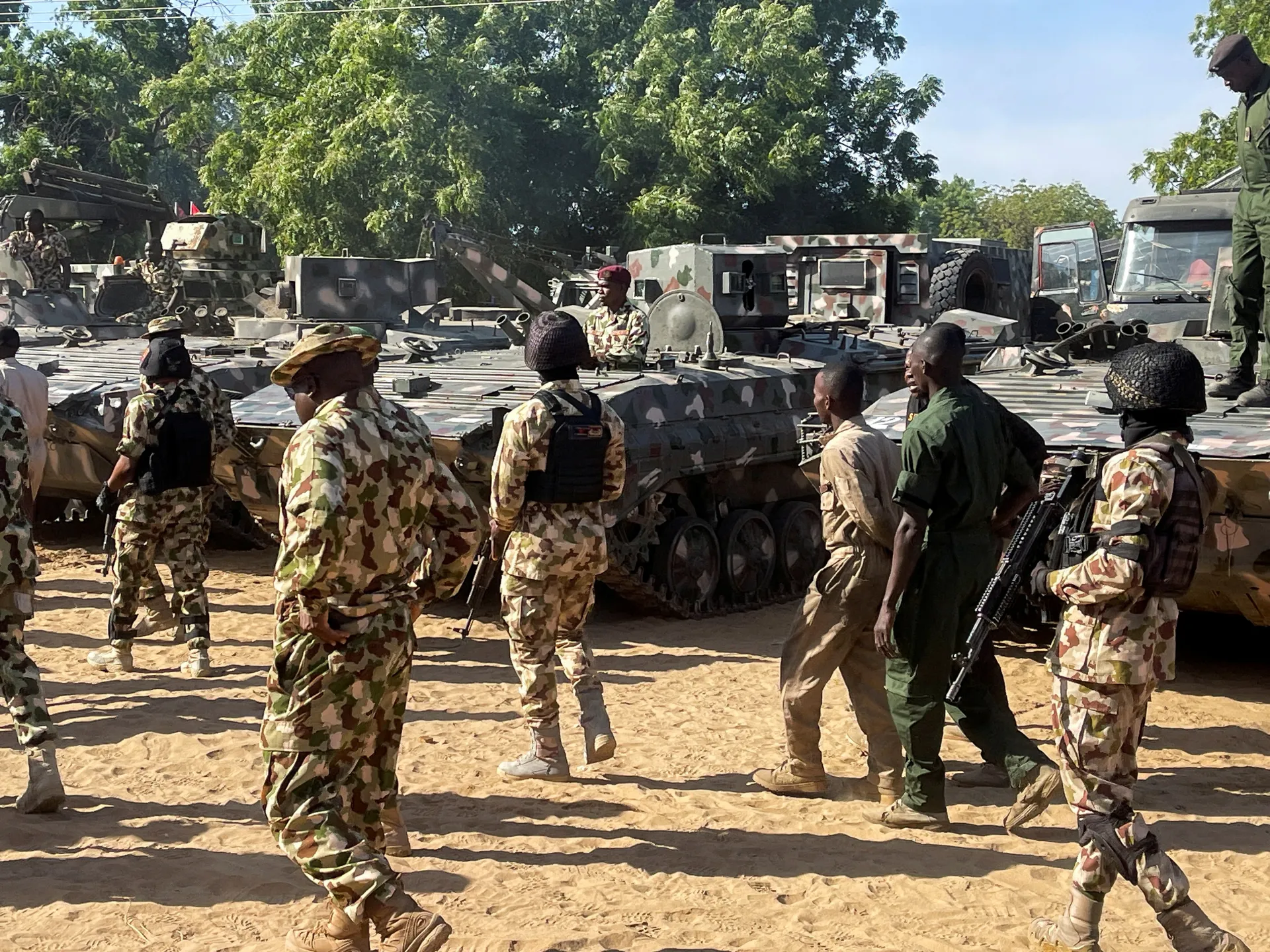
Across northeastern Nigeria, former Boko Haram insurgents now move with Nigerian troops into forests they once controlled. They identify footpaths that insurgents use after attacks, point out where improvised explosive devices are most likely buried beneath soft sand roads, and decode habits, voices, and movement patterns invisible to the average soldier. They explain how camps are structured during the rainy season and identify commanders at a distance. Some of these ex-insurgents die in combat fighting the same insurgency they once served.

One of the first such defectors was Abubakar Umar from Bama in Borno State. Soldiers called him Small and say he was presumably in his mid-20s when he died in 2023. Before then, he had fought on the frontlines of multiple operations across Sambisa, Timbuktu, and the Lake Chad basin.

Before surrendering, Small spent years in the insurgency as a Naqeeb, a low-ranking fighter, enabling him to know the terrain intimately. By the time he defected to the Nigerian Army, he already knew which routes disappeared under floodwater during the rains, where insurgents buried weapons before abandoning camps, and how insurgents escaped after raids. He understood the logic behind ambushes because he had once planned and carried out attacks against the same army he would later fight beside.

Others followed a similar path. Among them was Zakariyya from Pulka in Gwoza, another ex-insurgent who later supported military operations across Borno and Yobe. He died in late 2025.

At first, many soldiers distrusted them, especially as some of them had lost close friends and colleagues to Boko Haram attacks. For them, accepting a former insurgent carrying a rifle beside them was never easy. Operation after operation changed the relationship, however. According to military sources familiar with the missions, Small and Zakariyya repeatedly identified patterns that helped troops avoid deadly traps and ambushes. With time, commanders began listening whenever they spoke.

Then came a particular operation deep inside Sambisa in 2023. Small moved ahead of the troops in a way one soldier later described to HumAngle as “fearless, almost reckless,” as though death no longer frightened him, having already crossed too many moral boundaries to fear its arrival. He never returned.

Three individuals in headscarves and uniforms holding weapons, with "RIP" labels over two of them, standing in an outdoor setting.
Ex-surgents who defected and were actively engaged in combat against Boko Haram. Late Abubakar Umar “Small” is seen in the middle in this file photo.

The soldiers who survived that operation spoke about him afterwards with the kind of tone usually reserved for men buried in decorated military uniforms. 

There are many stories like this now scattered across the northeastern region–former insurgents fighting alongside the state. 

From the islands and marshes of Lake Chad to the forests of Zamfara, Sokoto, Kaduna, Niger, Kebbi, and the roads stretching toward Kwara, Nigeria is confronting a conflict system that has changed shape. In response, security forces are increasingly turning toward defectors.

The unseen war

For years, the Nigerian state has made progress against the Boko Haram war. When villages like Bama and Gwoza fell to the terror group, the military reclaimed them very quickly. They have also killed commanders over time, while still exploring non-kinetic approaches that made it possible for insurgents to surrender. Through this approach, defections occurred at an unprecedented rate. 

Boko Haram fractured internally as ISWAP consolidated its presence in parts of the Lake Chad Basin. Many did not want to remain in the Lake Chad theatre, but they also did not trust a formal surrender to Nigerian authorities, so some of them moved to other parts of Nigeria.

HumAngle has tracked the movement of former Boko Haram elements to the North West region and parts of central Nigeria as far back as 2020. Some joined criminal armed groups, others became trainers, bomb makers, couriers, informants, guards, or logistics brokers. Others disappeared into cities following the death of Abubakar Shekau and clashes between factions within the group.

In Kano and several urban areas, defectors and affiliates blended into urban life. Some became labourers, mechanics, phone repairers, commercial drivers, or petty traders. Some drifted into robbery and informal criminal economies, while others married and completely concealed their past.

This creates a difficult security dilemma for many reasons. How does a state track men who have left the insurgency but not entered any formal process? How does it distinguish between a deserter seeking anonymity and one rebuilding operational networks elsewhere? How does it protect communities without criminalising everyone who once lived under insurgent rule?

Nigeria has not answered those questions through a coherent national framework. Instead, it improvises.

The intelligence war nobody sees

When HumAngle spoke with soldiers and intelligence officers who served in the North East, their language was different. They do not romanticise former Boko Haram insurgents nor do they describe them as heroes, but they call them assets.

Before defectors became operationally useful, troops often entered unfamiliar terrain with insufficient intelligence from local hunters, the civilian joint task force, and satellite imagery. Equipment like drones and maps was useful but had limitations, as it could not predict movement patterns or likely landmines. Former insurgents helped dismantle part of that advantage. According to several defectors interviewed for this report, many military successes now depend partly on information provided by them.

“Whenever soldiers go for operations,” one explained, “some of us move ahead because we know the roads, the bushes, and where bombs are planted. We tell them which road not to use.”

Another former insurgent described how they identified hidden weapon caches and camp positions.

“Some of us know where weapons were kept. So when operations happen, we guide soldiers directly to those places.”

They also described helping troops understand insurgent movement patterns after attacks.

“When fighters escape,” one said, “we know the routes they use because we ourselves used those routes before.” The source added, “We advised soldiers to evacuate the women and children left behind by fighters to Maiduguri, which encouraged a lot of the fighters to defect from the group easily at a later date.”

The moral fracture

For victims, however, these battlefield contributions rarely erase memory. A widow whose husband was executed does not easily accept that the man who once terrorised her community now works alongside soldiers. A farmer whose village was burned does not find emotional comfort in hearing that a former insurgent helped identify buried bombs. A displaced family living with hunger in an abandoned resettled community does not easily understand why former insurgents appear to receive rehabilitation support while survivors struggle alone.

That anger has become one of the deepest unresolved tensions inside Nigeria’s reintegration strategy. Many affected communities perceive former insurgents as receiving privileges unavailable to victims. Some surrendered members received food support, accommodation, vocational training, phones, stipends, or reintegration assistance. Meanwhile, many survivors still live with displacement, trauma, hunger, unemployment, grief, and insecurity.

Nigeria's reintegration includes 129,000 surrendered persons: fighters, families, and followers, emphasizing rehabilitation beyond surrender.
Infographics: Akila Jibrin/HumAngle. 

One former insurgent described how resentment intensified after communities observed rehabilitated insurgents riding motorcycles, carrying weapons alongside soldiers, wearing jeans and clean clothes, and moving relatively freely.

“What happened was mostly hatred and resentment,” he said. “People saw the boys looking comfortable and became angry.”

Kabiru Adamu, the Managing Director of Beacon Consulting, comments on this imbalance. “When we look at this from a transitional justice perspective,” he said, “the current imbalance is a significant vulnerability.”

According to him, communities may interpret reintegration programmes as rewarding violence while neglecting victims.

“If the state appears to reward insurgency while neglecting victims, it breeds a deep sense of injustice. Unaddressed grievances are the primary fuel for cyclical violence.”

Former insurgents speak

The former insurgents interviewed by HumAngle described themselves not as forgiven men, but as useful men. “There are those who go to war,” one former fighter said, “And there are informants.” He explained that some maintain communication with active insurgents and relay intelligence to security agencies.

“If attacks are being planned, information is passed quickly to intelligence officers so security can be strengthened.”

Others described identifying civilians secretly supplying insurgents with food, fuel, or information. “There are people in town transporting petrol, food, and information,” one explained. “Those who surrendered know many of them because they worked together before.”

According to the former insurgents, these intelligence networks disrupted insurgent logistics and prevented attacks. Some defectors also described participating directly in combat operations.

“They gave some of us motorcycles and guns,” one said. “Sometimes, operations happen without soldiers even accompanying us.”

Another described units led by surrendered insurgents moving independently through forests to intercept attacks or recover weapons.

“Some commanders are given twenty or thirty motorcycles and sent to carry out patrols,” he said. “They stop attacks and return with captured weapons… Nearly 40 per cent of ground troops’ successes achieved in the past three years in this war come from the contribution of surrendered fighters.”

HumAngle cannot independently verify this claim. Still, several military and intelligence sources who spoke to HumAngle on the condition of anonymity admit that defectors remain useful in operations. What is less clear is whether relying on them will be safe or sustainable in the long run.

Security expert Kabiru Adamu described former insurgents as “force multipliers” rather than the decisive force behind military gains. According to him, conventional military operations, air power, and the Civilian Joint Task Force remain central to weakening insurgent networks.

“Ex-fighters provide precision,” he explained. However, he warned that the strategic dangers remain severe. “The risks include infiltration, double agents, human rights concerns, institutional degradation, and loss of civilian trust.”

The risk of dependence also concerns some analysts and security officials. If military units become too reliant on defectors for intelligence, what happens when defectors lie, or when personal grudges shape accusations, or when former insurgents return to active criminal networks or, as in some cases, return to Boko Haram carrying sensitive operational knowledge? What happens when military institutions fail to build independent intelligence systems because surrendered insurgents appear easier to use?

The northwestern region is quite different from the North East. Boko Haram and ISWAP emerged through ideological insurgency structures combining theology, coercion, governance, taxation, and violence. In contrast, the armed groups in the northwestern region emerged differently, engaging in criminal activities such as cattle rustling, communal conflict, illegal mining, vigilante reprisals, extortion, kidnapping, and governance collapse.

Yet over time, the distinction blurred. Armed groups across Zamfara, Sokoto, Katsina, Kaduna, Niger, and Kebbi increasingly adopted tactics associated with insurgent warfare: IEDs, ambushes, and rural territories being subject to armed taxation systems.

Abubakar Abdullahi, a journalist who has reported extensively from Zamfara, said Boko Haram-linked elements have become increasingly visible inside parts of the northwestern region.

“In areas such as Dutsin Maiqardaji mountain,” he said, “Boko Haram members have a heavy presence. Both Lakurawa and Boko Haram terrorists preach to residents they keep under siege in ungoverned spaces. Ongoing armed operations in the North East pave the way for fighters to find Zamfara as a haven,” he explained.

Therefore, the state’s decision to use surrendered insurgents in counterinsurgency operations across parts of the northwest follows a grim internal logic.

Trauma beneath the surface

The psychological burden of the insurgency now stretches across an entire generation. In Maiduguri, Monguno, Bama, Dikwa, Gwoza, Damboa, Pulka, Banki, and dozens of smaller communities scattered across Borno and the wider Lake Chad region, trauma shows up in ordinary routines. Some people report waking suddenly at night whenever motorcycles pass too quickly outside their compounds. Parents instinctively gather children indoors whenever rumours of attacks on nearby roads spread. Men who once farmed freely now calculate distance from military formations before deciding whether land is safe enough to cultivate.

For many survivors, peace itself feels temporary.

Kauna Malgwi, a clinical psychologist directly affected by the insurgency during its early years, described northeastern Nigeria as a society living in a prolonged psychological survival mode.

“Prolonged violence keeps societies in chronic hypervigilance,” she explained. “People shift from acute stress into collective survival mode. Nervous systems remain activated for years. Unresolved trauma normalises fear, weakens communities, and erodes cohesion. Ongoing violence keeps trauma active and prevents healing.”

The effects appear everywhere: overcrowded displacement settlements, classrooms where children struggle to concentrate because conflict has interrupted the normal architecture of childhood, families where fathers withdraw emotionally after years of violence, and young men who have grown up around guns, funerals, military convoys, and uncertainty.

“Children in chronic conflict develop emotional, learning, and behavioural problems that, if unaddressed, persist into adulthood and become the generational norm,” Malgwi warned

She listed the consequences as cycles of violence, emotional detachment, chronic anxiety, educational disruption, social mistrust, difficulty forming secure relationships, and increased vulnerability to recruitment by armed groups.

“If trauma among children is ignored,” she warned, “national stability itself is at risk. Peacebuilding that ignores collective healing produces fragile and temporary peace. When victims feel forgotten as ex-fighters are supported, trauma deepens and trust in institutions erodes. Forgiveness must not be forced. Communities require safety and acknowledgement before reconciliation.”

According to her, communities need public acknowledgement of suffering before reintegration can become emotionally sustainable.

“Victim-centred support systems are essential. Communities need visible justice, visible care, and transparent communication before trust can begin to recover.”

She also warned about the development of emotional desensitisation among conflict-affected populations.

“Without support, grief becomes anger or despair,” she explained. “Violence itself can become normalised.”

Many young people in northeastern Nigeria have never experienced sustained normalcy. They grew up hearing stories about massacres the way previous generations heard folktales. They learned directions through checkpoints and geography through displacement.

Kauna Malgwi believes recovery in such environments cannot depend solely on psychiatrists or formal hospitals because the scale of trauma is too large.

“Community healing includes training community health workers in psychosocial support, group therapy, trauma-informed schools, faith-based healing spaces, and safe storytelling forums,” she explained, stressing the importance of collectively restoring dignity. “The goal is not only treatment. The goal is restoring function, trust, and resilience across society.”

For many survivors, however, the war never became a discussion about tactical adaptation. It remained personal. A missing daughter. A burned house. A father was executed beside a road. A child was buried after an explosion and nights of screaming.

A life divided permanently into before and after.

The state’s impossible calculation

For Kabiru Adamu, the question is not whether the state should use former insurgents operationally. The deeper issue is whether Nigeria can do so without weakening its own legitimacy. He described the current approach as a fragile balancing act between military necessity, transitional justice, and social stability.

“The Nigerian military faces a highly asymmetric threat,” he said. “Using former fighters offers distinct immediate operational advantages because these individuals possess granular, real-time intelligence. They know Sambisa Forest, the Mandara Mountains, the Lake Chad islands, and the internal communication structures of factions like JAS and ISWAP.”

Still, he repeatedly returned to the dangers. “The strategic risks are severe and multifaceted.” The operational usefulness of former insurgents can serve as an excuse to abandon accountability. “There must be transparent triage,” he argued. “Low-level associates and coerced participants cannot be treated the same way as high-level perpetrators. Most residents of Borno, Adamawa, and Yobe reject blanket amnesty for commanders associated with mass atrocities.”

For Adamu, reintegration without visible justice creates long-term instability.

“If communities feel abandoned by the state in favour of their attackers, it erodes the social contract. It opens the possibility of vigilantism or future militant mobilisation driven by resentment. Demobilisation is not simply a military process,” he said. “Reintegration is generational and should remain civilian-led.”

He pointed to global examples from Iraq, Afghanistan, and Colombia as warnings.

“When stipends dry up without sustainable livelihoods, ex-combatants often return to criminal economies.”

According to him, Nigeria risks repeating similar mistakes unless rehabilitation becomes economically viable. “Cash support alone is not enough. Long-term reintegration requires market-driven livelihoods and ongoing monitoring.”

He also warned against grouping defectors into separate armed formations.

“Never create isolated paramilitary monopolies from ex-combatants,” he said. “If they are used operationally, strict oversight and accountability systems are essential.”

Perhaps most importantly, he insisted that reintegration cannot survive politically unless victims see equal investment in their own recovery.

A group of seated individuals in uniformed khaki outfits, numbered on their backs, listen to military personnel on an airfield.
A group of former Boko Haram insurgents who were rehabilitated by Nigeria’s Operation Safe Corridor programme in northeastern Nigeria. 

“For every dollar spent on DDR,” he argued, “an equal or greater amount should be visibly invested in victims and receiving communities.”

Without that balance, he believes the state risks winning short-term tactical gains while deepening long-term social fractures.

The soldiers and the boys

One of the strangest transformations inside this war is the relationship between soldiers and former insurgents. Many soldiers lost friends to insurgent attacks, some carry visible scars, and others carry memories they rarely discuss. Meanwhile, former insurgents themselves live in a state of permanent ambiguity. They are neither fully accepted civilians nor recognised soldiers. They exist inside a grey zone.

According to the former insurgents HumAngle spoke to, several surrendered members deployed to Zamfara and other northwestern states were killed during operations against armed groups.

“In this war,” one said, “many of those helping the government have lost their lives. Some died fighting people they once called brothers.”

A Nigerian soldier told HumAngle he never imagined he would one day fight alongside former Boko Haram members.

“I thought the only relationship I would ever have with these bastards was to kill them or be killed,” he said, speaking on condition of anonymity because he’s not permitted to speak to journalists on this matter

Now deployed with some of the defectors against their former comrades, the soldier said the experience has reshaped parts of his perception over time. Some of the former insurgents have proven useful in combat operations, particularly because of their familiarity with insurgent tactics and terrain.

“They have been very helpful since we started working with them. They are constantly watched and supervised, but the contributions of some of them have been priceless,” said the staff sergeant.

What a serious framework would require

Nigeria does not need to pretend former insurgents are useless. Evidence from the field suggests they have helped disrupt attacks, expose explosives, identify camps, trace logistics, and support military operations. At the same time, experts say the state cannot continue to manage reintegration through improvisation and silence. A credible framework would require clear categories that separate coerced associates from high-level perpetrators. It would require transparent accountability systems. Victims would receive compensation, trauma support, livelihood recovery, education, and public acknowledgement.

The northwest would be treated as its own conflict system requiring tailored responses rather than simple transplantation of northeastern models.

Repentant volunteers

The former insurgents interviewed for this report did not seem to want public sympathy. Most acknowledged that many Nigerians would always see them as part of the violence they once took part in. Yet, beneath their answers was a recurring theme. They insisted they no longer recognised the movement they had joined years earlier.

Abu Muhsin, now 38, said he entered Boko Haram as a teenager after preachers repeatedly visited his village.

“I joined them when I was around 16 years old,” he said. “They used to come and preach in our village, near Damasak. I got convinced, and I joined them.”

Over time, he rose within the movement and eventually became a Naqeeb, a field commander operating around the Lake Chad region. But years inside the insurgency changed his view of the organisation.

“We saw that the group was not following the rules of Islam,” he said. “They kill people and loot their properties. We started communicating with those who surrendered before us. They directed us and later escaped from the bush with some of our families.”

After surrendering, Abu Muhsin said he volunteered to support military operations because former insurgents understood terrain and insurgent movement patterns better than most troops.

“No one forced us to volunteer,” he said. “We just felt we should assist the military since we know the bush better than they do.”

For that assistance, he said, volunteers receive irregular payments. “They give us some allowance. They pay us ₦100,000, sometimes ₦50,000 or ₦30,000.”

Another former insurgent, Ibn Mus’ab, traced his recruitment to family influence. “My cousins were already members and used to visit us,” said the 35-year-old former fighter from Wulgo in Gamboru Ngala. “They used to preach their doctrines to us. Later, they convinced me, and I followed them to the bush.” That was in 2014. 

Inside the insurgency, Ibn Mus’ab became Amirul’Uddah, responsible for weapons management. Like several defectors interviewed for this report, he framed his disillusionment in religious terms.

“I left them because some of their activities are becoming un-Islamic,” he said. “They kill people unnecessarily. They kill someone for taking drugs, which is not so in Sharia.”

His departure from Boko Haram was shaped partly by internal persecution. He said he was accused of an offence and that members of the group declared him wanted. “I escaped to Giedam, not even knowing that the military was accepting people who surrendered,” he recalled. “I was later told I could submit myself, and I surrendered to them.”

He escaped alone, and his family joined him later. Asked why he now assists the military against former comrades, he answered without hesitation.

“I decided to assist because those people are no longer following the Sharia accordingly. There are many of us who are ready to assist, and a lot are doing well.”

Like others, he described financial incentives as modest and inconsistent.

“The usual pay is ₦100,000, sometimes ₦50,000,” he said. “If they can pay more than this, many more would be willing to volunteer.”

Abu Faruq’s story begins differently. Unlike some defectors who joined as adults through ideological persuasion, he said he was absorbed into the movement as a child during Boko Haram’s expansion across Gwoza.

“They took me when I was a kid,” the 35-year-old said. “It was in Gwoza when they were preaching. I grew up in their place and got married.”

He said he became part of the Rijaal, the fighting cadre within the insurgency structure.

Years later, he concluded that the movement no longer reflected the religious principles it claimed to defend. “I left them because they were not practising what the Qur’an and Hadith say about Sharia,” he explained. “They kill innocent people, they loot and destroy people’s properties.”

According to him, communication with earlier defectors again played a critical role in encouraging surrender. “Some of our friends have earlier surrendered, and they told us how they were received warmly,” he said. “They directed us on the phone on how we could come out and meet the military.”

After leaving the bush, Abu Faruq eventually joined operations supporting Nigerian troops, including deployments far beyond the northeast. “Yes, I did,” he said when asked whether he travelled with soldiers to the northwest. “They selected some of us to assist them in Zamfara and Sokoto.”

According to him, defectors participated in operations across multiple villages affected by armed groups. “They first took us to Sokoto, and from there we went to many villages in both Sokoto and Zamfara for operations.”

He said he remained there for about two months. For that deployment, he received what he described as ranger allowances. ‘They pay us ₦100,000 per month as rangers.”

These stories show men trying to find a new place for themselves in a war that has already taken over much of their lives. But none of their reasons answers the deeper moral question about Nigeria’s use of former insurgents.

Source link

Former Boko Haram Terrorists Accused of Killing Displaced Farmer in Borno

Muhammed Kaumi had just stepped out of the mosque when his phone rang on the evening of Friday, May 29. He had recently returned from Dikwa, a town in Borno State, northeastern Nigeria, and assumed the call was from a relative checking on his journey home. Instead, the voice on the other end delivered news that left him numb.

“Bulama has been killed,” the caller said. “They have killed Bulama.” Muhammed felt his chest tighten. “I instantly felt a sharp pain in my heart,” he recalled.

Bulama Ali was his cousin, a farmer, a father of five, and one of thousands, like him, who have been displaced by the Boko Haram insurgency that has scarred the region for more than a decade.

Within minutes, Muhammed was on his way to the Custom House Internally Displaced Persons’ Camp in Muna, on the outskirts of Maiduguri, where Bulama had lived with his family for nearly a decade.

As he rushed there, questions flooded his mind: “What had happened? Who had killed him? Why?”

When he arrived, residents told him that Bulama had allegedly been beaten by men they identified as “repentant Boko Haram fighters”, locally known as “Hybrids”.

For many residents of Maiduguri, the allegation struck a painful nerve.

For years, former insurgents who surrendered to authorities have passed through government rehabilitation and reintegration programmes such as Operation Safe Corridor and the Borno Model, before returning to civilian communities. However, some have bypassed both interventions completely. 

The Nigerian authorities have involved some of these deserters in security operations, where they help troops with intelligence gathering, their knowledge of terrorist-held terrain, and even operational activities. The arrangement has remained controversial among many survivors of the conflict and among security analysts. 

Now, residents in these communities say their fears have been justified. 

They brought him back dead

Bulama’s final hours began shortly before the Friday Muslim congregational prayers.

Muhammed was told by relatives and eyewitnesses that “[Bulama] was on his way to the mosque on his bicycle when he received a phone call. He stopped by the roadside [close to Muna, on the Maiduguri-Gamboru highway] to answer it.” Behind him was a vehicle carrying armed men dressed in black uniforms. “They honked at him to move,” Muhammed said. “But he was speaking on the phone and did not hear them.”

Abbas Shettima, who witnessed the incident, said the confrontation, which occurred between 1:15 p.m. and 1:30 p.m., quickly escalated. 

“We were all heading to the mosque when we saw them beating him,” Abbas recounted. According to him, the group consisted of about ten men carrying guns and sticks. “They said he was blocking their way,” he said.

Bulama tried to explain. He apologised repeatedly, but his pleas fell on deaf ears. 

“He kept begging them to spare him,” Abbas said. “He crouched down and covered his head with his hands while they beat him.” When bystanders attempted to intervene, the armed men threatened them. Residents watched helplessly. Eventually, the men forced Bulama into their vehicle and drove away.

No one knew where he had been taken.

At the time, witnesses said they believed the group were members of the Civilian Joint Task Force (CJTF) because of their uniforms.

Hours later, shortly after 3 p.m., the vehicle returned. “They brought him back severely wounded,” Abbas recounted. “He could barely move.”

Residents rushed toward him to help, but within ten minutes, he died.

The incident was immediately reported to the soldiers stationed at the camp’s entrance. According to Muhammed, the soldiers said they had seen the vehicle dropping Bulama but did not know what had transpired. “They were the ones who told us the men were Hybrids and that they had come from the Maiwa axis,” he said.

Residents later learned that Bulama had allegedly been taken to Maiwa Kura, a remote village in Mafa Local Government Area, Borno State, where the group was reportedly stationed. 

Although “Hybrids” are often perceived as operating independently, they are typically attached to military formations and work alongside security forces, according to a member of a local volunteer security outfit involved in counterterrorism operations who spoke to HumAngle.

“The commanding officer of the military base gives instructions to the ‘Hybrid’ commander attached to that formation, who then relays orders to his men,” the source explained. “During broader operations involving multiple locations, they also have a state commander from whom they receive directives.”

However, this does not necessarily imply military involvement in the attack that claimed Bulama’s life, as Hybrid patrols sometimes operate independently.

Bulama’s family subsequently reported the matter to the police. 

Muhammed said that soldiers, police officers, and members of the CJTF later travelled to Maiwa, where they arrested three suspects, including a commander. “They told us the others had travelled to Mafa for an operation,” he said.

The suspects were taken into custody and transferred to the Borno State Criminal Investigation Department for further investigation.

According to family members, the suspects claimed Bulama died after jumping from the back of a moving Hilux vehicle. But the relatives remain unconvinced. “The doctors told us he had been severely beaten,” Muhammed said. “His hands were tied, and he had internal bleeding.”

The family retrieved the body on Saturday morning and buried him later that afternoon. When the body was prepared for burial, he said, blood continued to seep from his eyes, ears, and nose. “It stained the white shroud.”

A large group of people stand in rows outdoors, appearing to observe or participate in an event under a clear sky.
Mourners at Bulama’s interment at the Custom House IDP camp. Photo: Abbas Shettima.

When HumAngle contacted the Borno State Police Public Relations Officer, Nahum Kenneth Daso, he said he was not aware of the case and would make inquiries. As of publication, no official update had been provided.

The men known as ‘Hybrids’

In many communities across Borno State, the word “Hybrid” carries different meanings depending on who defines it. 

To security officials, they are a practical asset in a war that has stretched for more than 15 years. For many residents, they are former terrorists trying to rebuild their lives. To others, especially those who lost relatives, homes, farms, and livelihoods during the conflict, they are a constant reminder of wounds that have never fully healed.

The term is commonly used to describe some former Boko Haram members who surrendered and passed through official rehabilitation and deradicalisation programmes, and later became attached to security operations in various capacities.

Since they possess intimate knowledge of terrorist operations and hierarchy, security agencies have increasingly relied on some of them to help in identifying former colleagues, navigating difficult terrain, and providing information that security forces may otherwise struggle to obtain.

For authorities, the arrangement is often viewed as a necessary component of the counterterrorism campaign. However, many civilians find it deeply unsettling.

A group of men in numbered uniforms sit on the ground, facing military personnel on an airstrip.
File: A group of former Boko Haram terrorists who were rehabilitated by Nigeria’s Operation Safe Corridor programme in northeastern Nigeria.

That is why, for some residents, the sight of former terrorists carrying weapons or working alongside security forces can be difficult to accept.

Bulama’s death has reopened those anxieties. Yet, the resentment many residents express today did not begin with his killing. It has been building for years.

In August 2021, as thousands of terrorist deserters began surrendering from the Sambisa Forest and the Lake Chad region, the Borno State Government convened a high-level stakeholders’ meeting at the Government House in Maiduguri. Government officials, security agencies, traditional rulers, religious leaders, civil society organisations, journalists, and community representatives gathered to discuss the reintegration of former insurgents into society.

At the end of the meeting, participants agreed in principle to forgive and accept these deserters back into their communities. Their acceptance, however, was not unconditional. The stakeholders insisted that surrendered terrorists must be thoroughly screened before reintegration. They also warned against the release of hardened extremists into the communities. They further called for meaningful reconciliation between victims and former terrorists.

The gathering was widely presented as a collective endorsement of reconciliation.

But beyond the conference hall, acceptance has proved far more complicated.

Many residents who had survived the violence felt they had not been part of that conversation. Some had lost parents, spouses, siblings, and/or children. Others had spent years moving between displacement camps, uncertain whether they would ever return home. For them, forgiveness was not a policy decision that could be reached through consensus among stakeholders. It was an intensely personal choice shaped by trauma, memory, and loss.

“The people making these decisions are not always the people who suffered directly,” Abba Gana told HumAngle.

Over the years, some residents have complained of harassment and intimidation by former terrorists and their families. Others say they simply feel the reintegration process has moved faster than community healing.

The debate became even more sensitive as some former terrorists began assisting security operations. To many survivors, the transformation can be difficult to reconcile: people who once arrived as attackers returning as neighbours and protectors, and in some cases, as men carrying authority.

Some government officials have repeatedly defended the reintegration policy. Recently, General Olufemi Oluyede, the Chief of Defence Staff and chairperson of the Operation Safe Corridor National Steering Committee, likened terrorist deserters to the biblical Prodigal Son, arguing that they deserve rehabilitation because they remain Nigerian citizens. 

Those concerns were further amplified by reports that not all former terrorists were passing through official rehabilitation channels. In 2025, a HumAngle investigation documented allegations that some defectors were quietly leaving the forest and reintegrating into communities without participating in formal deradicalisation programmes, raising questions about screening, accountability, and oversight.

Over the years, several incidents involving terrorist deserters have also contributed to public unease. In April, a former Boko Haram member allegedly shot and killed a CJTF member during an argument in the Mafa LGA. According to reports, the victim was rushed to the hospital but was confirmed dead on arrival, while the suspect was later arrested and handed over to the police.

People in uniforms and civilians gather on a street, with yellow tape indicating a restricted area.
File: Police officers at the scene of an explosion at the Maiduguri Monday Market in March 2026. Photo: Al’amin Umar/HumAngle. 

Two years earlier, some deserters reportedly stormed a police station in Maiduguri in an attempt to secure the release of their colleagues arrested over alleged drug-related offences. In another case that generated public outrage in 2023, a deserter was accused of killing his wife at the outskirts of Maiduguri.

Concerns about the reintegration programme are not new. As far back as 2020, Ali Ndume, the senator representing Borno South Senatorial District, publicly criticised aspects of the government’s amnesty efforts, recounting the case of a deserter whom he alleged killed his father and later absconded with his property. The senator argued that the victims and survivors’ concerns were not receiving the same level of attention as the rehabilitation of the deserters.

Taken individually, the circumstances surrounding these incidents differ significantly from Bulama’s case. Collectively, however, they have helped shape public perceptions of the reintegration programmes and deepened anxieties among some residents about the monitoring, supervision, and accountability of deserters, particularly those involved in security-related activities.

For many survivors of the conflict, such incidents reinforce a lingering fear that rehabilitation alone may not be enough. Bulama’s death has now brought those long-simmering concerns into sharper focus. 

“The community is deciding on an action,” Abbas said.

Residents gathered after Bulama’s burial to discuss possible legal steps. Some suggested pooling money to hire a lawyer. Others proposed approaching human rights organisations.

“We are thinking of contributing money and hiring a lawyer,” Abbas said.

Justice and unfinished wounds

For Muhammed, grief and anger now coexist. His cousin survived displacement and years of uncertainty. He, however, did not survive a short journey to the mosque.

When asked what justice would look like for his family and the displaced community, Muhammed replied, “The law does not play by sentiments; it follows laid-down rules. I hope they will do what is right. If it is by my sentiments, I would not want them to be free. I would want them imprisoned for life.”

He paused.

“I don’t care about compensation. I don’t care about apologies. Justice for me is their imprisonment.”

A family left devastated 

Bulama was only 30 years old. He left behind two wives and five children.

He earned a living as a farmer. And before displacement forced the family from Boboshe in 2016, his father was killed. His elderly mother remains alive and still lives with them at the displacement camp.

The survival of his family, which was Bulama’s responsibility as the breadwinner, hangs uncertainly over relatives, who are also struggling to survive. “We are not rich people,” Muhammed said. “Caring for five children in addition to our own children will be difficult.”

Around the camp where he lived for over a decade, residents gather beneath makeshift shelters to rest, but the conversations about Bulama’s death remain on their lips. 

What remains immediate is his nuclear family, and the space left by a man who left home for Friday prayers and never returned.

Source link

The Making of the Boko Haram Army

On a hauntingly cold night in 2008, a 28-year-old impressionable fan of Mohammed Yusuf sat in the latter’s compound in the London Ciki area of Maiduguri, northeastern Nigeria, at 1 a.m., placed his hand in his, and swore to give his life for Boko Haram. He would advance to become a top commander in the terror group.

That night, the Man was accompanied by a few trusted friends, all of whom pledged their allegiance to the cause. Yusuf started by reciting eight commandments to the small group and asking that they swear to abide by them. He made it clear they could refuse to join the army, in which case, they were not to disclose any of the things that happened that night to another living soul. 

Many of them would die in battle in the years that followed, and Yusuf himself would be killed in a matter of months, but the Man would survive. He had been led there by his friend, who had also been led there by his own friend. 

Mohammed Yusuf, the founder of the Boko Haram terror group, was preparing to wage war against the Nigerian state and was assembling what would later become an army. This army would go on to kill over 35,000 people between 2009 and 2020, indirectly lead to the death of over 300,000 others, and displace over two million more. Through fieldwork involving extensive interviews with a few first-generation members of the terror group who are still alive, victims, and a review of nearly 100 archival materials, such as newspapers and videos, this report documents the strategy that made that army possible.

Since his preaching was still largely peaceful at the time, Yusuf recruited men covertly, so as not to alert the government to the war he was planning. 

But the story of the Man’s radicalisation began long before that night. As far back as 1995 and 1996, the Man, then merely a boy, had begun to listen to Mohammed Yusuf’s preaching, agreeing with a lot of the things he was hearing. But beyond Yusuf, the Man was also an ardent follower of Sheikh Jafar Mahmud, who had been schooled at the University of Madina, Saudi Arabia, a feat he found astonishing.

“That time, I was impressed with the way Malam [Mohammed Yusuf] was. He was a young man like me–he was just a bit older than me. But he was so educated, and that was my dream, too. To become so knowledgeable about the religion,” the Man told me one October afternoon in 2025 in northeastern Nigeria. We were sitting on a mat just outside a rafia hut.

“He had started becoming popular among the Izala and the Abba Aji students, just like how the likes of Gambo Kyari, Bukar Mustapha, Umoru Mustapha, and the rest were popular then. Like Malam Ibrahim Gomari, Bashir Kashara, who was killed, and so on. He [Mohammed Yusuf] was their peer when it came to Islamic scholarship.” 

His ideologies aligned with those of scholars like Sheikh Jafar, who was based in Kano but was preaching regularly at and leading prayers at the Indimi mosque every Ramadan in Maiduguri. In 1999, Yusuf’s fame began to rise beyond his immediate community, his words taking root in the minds of young men and women all across Borno State. The support and fandom were massive. The Man thinks this was due to two things.

“One, he was very young then. Two, he used to preach in both Hausa and Kanuri.” This enabled him to reach a wider audience without a language barrier, as these were among the most widely spoken languages in Borno State. 

Over time, around 2000 and 2002, his preaching began to diverge from that of the likes of Sheikh Jafar and other revered scholars popular at the time. He began to speak against Western education, voting, democracy, and modern science and civilisation. He preached about a radical form of religion that had total government control over the people’s private and public lives. 

Barren field with scattered plants and rocks, a tall communication tower, and buildings in the background under a clear sky.
This used to be the main entrance to Yusuf’s house. Photo: Al’amin Umar/HumAngle. 

In about 60 videos of him around this time that HumAngle reviewed, each 3-6 minutes long, he can be seen preaching against democracy and the West. “The thing the West brought is apostasy,” he said in one of them. “We reject it. This democracy is not good. These soldiers are not genuine soldiers–they do not protect the religion of Islam… God said we should kill them. Allah said in the Qur’an that he would humiliate the enemy by our hand. Did you think he meant our hands holding prayer beads?” and here he chuckles. “Of course not,” he answered himself to the ecstatic screams of his congregation. “He was referring to our hands wielding guns.”

At this time, many of the scholars he used to be known with began to withdraw from him. Rather than see this as the alarm that the larger public saw it as, the Man and many young people like him saw it as a sign of legitimacy. They saw Yusuf as brave, courageous, and unwavering. 

“We believed what he was preaching was the truth because what he was saying regarding the government, jihad, correlated with Qur’an verses and hadiths,” he said. He quoted verses from Chapters Ahzab and Taubah to back up his claim, saying that the scriptures had already said that nothing could change the world if not jihad, which he personally interpreted as war.

Islamic scholars have long disproved this interpretation of scripture and the word ‘jihad’. HumAngle shared the Man’s interpretation of the verses in Ahzab and Taubah with a prominent Islamic scholar, Prof. Ibrahim Maqari, who currently serves as the Chief Imam at the central mosque in Abuja, the federal capital. He said the interpretation was inaccurate. 

“Those verses have been taken out of context. Islam is very clear on there not being compulsion in religion,” he said. “Islam allows war only when war is brought upon you. In that sense, you have a responsibility to fight back in order to protect yourself. There are laws on how warring parties must treat even animals and trees–how can the same religion be used as an excuse to slaughter innocent, unarmed populations, if even animals and trees are expected to be protected even in times of war?”

He also offered an additional, but often ignored, definition of the word: restraint, whether emotional or mental. 

“To stay away from what one craves but has been outlawed by Islam could also be a form of jihad.”

The Boko Haram group views it differently. “Jihad means blood must be spilt,” the Man said.

Following his split with Sheikh Jafar, Yusuf stopped preaching at the Indimi mosque and began preaching in his home, then at the Al’amin Daggash Mosque for several months before he was kicked out again, before eventually establishing the Markaz (Ibn Taimiyya) mosque. 

“Only about 40-50 of us went with him then. That was 2002–2003. With the help of Allah, after like two years, Markaz couldn’t even contain people; we could not even count the number of students anymore.”

Dry, littered field with rocks and sparse vegetation under a clear sky, trees line the horizon in the background.
Mohammed Yusuf’s Markaz mosque used to stand here. Now, it’s rubble and bushes. Photo: Al’amin Umar/HumAngle. 

There were very few journalists or researchers at the time who were able to accurately document this sociological (and religious) revolution. One of them was Ahmad Salkida, who dispatched the first-ever news article on Mohammed Yusuf in 2006 and was the first to alert the public to what was brewing. He observed in one report that Yusuf enjoyed wide acceptance from young people at the time because of the effects of bad governance and the resulting socioeconomic inequalities—corruption, rampant inequality, lack of education. 

By appealing to a shared victimhood philosophy, he created an Us (victims) Vs Them (the government/the oppressor) dichotomy and garnered a large following. The weaponisation of a sense of community to further genocidal violence is a tactic that is recurring in speeches of warlords or leaders of violent movements. It was apparent in the popular 1943 speech made by Heinrich  Himmler, one of the key military leaders who executed the Holocaust. In it, he frames the killing of jews as a moral obligation, while making the Nazis out to be the victims.  “We have a moral right, we had the duty to our people to do it, to kill [some use the word ‘destroy’ here as the original speech was in German] these people who would kill us… We have carried out this most difficult of tasks in a spirit of love for our people,” he said in the speech. 

A man in white traditional attire and cap smiles, turning his head to the side. Others in similar attire are in the background.
A screenshot from one video in which Mohammed Yusuf was delivering a sermon. 

As the number of his students and followers began to increase, Yusuf decided it was time to take his message beyond his house and Maiduguri. He began to travel to Konduga, Bama, and Gwoza. He soon went beyond Borno State into Yobe State, to places like Potiskum, Gashua, Geidam, and others. He also went to Bauchi. 

“We started getting senior students like Abu Mohammed Bauchi, Abu Maryam, etc. It later crossed to Kano, and there, we got senior scholars, even though they later withdrew.”

It was at this time, when his preaching became regular in Bama, that Fatima, another first-generation member of the group, began to attend. Alongside her entire family, she became a loyal follower of Yusuf. She took the bay’ah in a way that resembled what the Man described. 

“We were gathered around 4 p.m. and then separated into men and women, then took the oath,” she recalled. At this time, the preaching was mainly that the government did not have their best interest at heart, and did not care about Islam. Fatima went alongside her parents and husband. She remembers being told that the Nigerian constitution was forbidden for them to follow or abide by. They also told them that they might be killed, but they should rest assured that they would go straight to paradise if that happened. 

“There are people, these days, who claim that the drinking of blood is somehow part of the oath-taking process. This is not true. At least, not during our time,” she said.

The preachings, at this time, had started to grow more and more radical and inciting.

“This caused some people to lose their wives, some their parents, some their trading partners, and some to destroy their school certificates,” the Man said. Young people, in compliance with the very foundation of Boko Haram, which directly translates to “Western education is forbidden”, began to publicly burn school certificates that they had already acquired before they became radicalised.

Abandoned building with graffiti in a littered, barren area under a clear sky.
Remnants of the classrooms where Yusuf used to teach. Photo: Al’amin Umar/HumAngle. 

“We all knew this was going to happen; it wasn’t a secret,” the Man said of the eventual uprising. “There are scholars who would preach saying we have to shed blood in this country, but once they are done preaching, you will see them with the same government they are criticising in their houses, with cars given to them. But Malam was never like that. He was never in cahoots with the government, so we all believed in him and that he was going to carry out what he had intended–the war.”

The early army

The Man claimed that Yusuf first appointed 11 close friends, whom he termed his commanders. They were the first members of the Boko Haram army. He sat with these 11 and explained the reason for the war, assuring them it would happen soon. He told them they each must be willing to sacrifice their lives if it came to that, and also bring men who believed in the cause and would be willing to do the same. 

He trained them for an initial period of nine months. Some CDs were played for them on war preparation. There were long periods of preaching and indoctrination. 

“Some of these men are in prison, but most of them have died. The only person who is not in prison and is alive was released from prison two years ago: Mohammed Idris. He was imprisoned in 2009. There is Usman Sidi in the Malam Sidi deradicalisation centre in Gombe, and Ibrahim Agaji, who is still in prison. And so on.”

It was one of these first 11 commanders who reached out to the Man, inviting him to join the army. Yusuf had mandated that each of them come with three trusted men who could join. This was not as easy as it sounded, especially because speaking to the wrong person could jeopardise the entire plan if they chose to go to the authorities with what they knew. When the commander reached out to the Man, he explained this, adding that he himself did not know up to three people he could trust, only the Man. He asked the Man to bring the other two. He, too, only trusted one person and asked that person to bring one person as well. In that way, the commander fulfilled his assigned quota of three. Soon, the 11 commanders and their individual recruits totalled 40. Together, they formed the first version of the army, gathering in Yusuf’s house that night in the London Ciki area of Maiduguri and taking the bay’ah after listening to the commandments.

“The first commandment was that we must agree to give our lives if it came to it; then, seeking Islamic knowledge to understand our ancestors; we must also not do things except as stated in the books, whether we like it or not; then, there was confidentiality. I have forgotten most of the conditions. There were like eight conditions. If you agree to them, Malam would take your hand and hold it as you took the bay’ah. You would promise never to discuss it with anyone. If you do, it’s like you have betrayed the religion.”

After that night, they proceeded to undergo a four-month intensive period of prayer and training. They had access to one man, Habib, who used to be a sergeant in the Nigerian Army but whom Yusuf had won over with his preachings. He trained them in combat. Yusuf had also won over one medical doctor, a prominent consultant from Yola known as Abu Adam. He equipped them with basic medical skills, including how to remove a bullet lodged in a wound and how to stitch a wound.

“To this day, whenever my kids get sick, I am able to administer injections for them once they are prescribed and I buy them, because of the skills I learned from that doctor,” the Man said. 

The initial group of 40 was also mandated to come with recruits – some were mandated to come with up to 10 recruits each, others were mandated to come with only three – and in that way, the army expanded little by little. Once they were in their hundreds, Yusuf broke them into battalions and named each battalion after an Islamic historical figure. The Man was under the Zubair Ibn Awwam battalion. Those who later moved to the Timbuktu triangle were named after Umar Farouk. Each of the 11 commanders was also assigned four sub-commanders known as Munzir. The Man was a Munzir at this time. Each Munzir was in charge of about 70–100 people. The Munzirs, in turn, appointed people they called the Naqeeb, each of whom had 25 people under their care. This system made organising easier. 

Organizational chart with commanders, Munzir units (70-100 each), and Naqeebs (25 each), set against a forest background.
Organogram of Boko Haram’s command structure at the time. Photo: Damilola Lawal/HumAngle.

“Whenever Mohammed Yusuf says to the leader of Zubair Ibn Awwam battalion, ‘I want you to gather your people for me,’ the leader would look for other Munzirs and me. At that time, four of us were Munzirs under that battalion: Mohammed  Sani Tela, Bako Mai Madara, Abdullahi, and me. So, when Malam says to our commander, ‘Gather your people for me,’ he would just call us (the Munzirs) and say, ‘Gather your people.’ If, for example, I have 100 people under my care, how would I reach them? They’re too much for me, so I would call my Naqeeb and tell them to each bring the 25 people under their individual care. You see, this way it is easier for both me and my superior because 25 people are not a lot to gather.”

“That time, we had not yet relocated to the forest. This all happened in Maiduguri,” he clarified. 

There were several locations used for training in Bauchi and Biu in Borno. As things began to heat up, with preparation for the war being heavily underway, Yusuf got word that the government suspected a war was brewing and planned to attack him and his followers. He was invited multiple times by the DSS and the police in both Maiduguri and Abuja, where he was detained briefly and interrogated over those allegations. He denied arming or preparing for war.

“Since they were planning to attack us, we were supposed to also get ready for them. Before they attack us, let’s attack them. We should just be prepared. So we got ready as much as we could. We got our war arms–Malam and a few people had been getting the arms ready all this time with the help of the former sergeant in the Nigerian Army.”

Just then, they began to face some logistical challenges. Some members of the group who had been entrusted with guns in the past few months of preparation and had been told to bury them for safekeeping suddenly said they no longer remembered where they had buried the guns. This caused a setback with planning, and Yusuf, at first, found it puzzling. 

“But he later said we are going to be optimistic, whether they did not buy it, whether they cheated, or they did buy it and truly couldn’t find the place they buried it, it was still amusing. But he said we will not dwell on this, we will just seek Allah’s help with what we have with us.”

According to another source, another setback in the arms gathering department involved a man known as Aliu Tashaku, whom Yusuf met and presumably radicalised during one of his detentions at the Police headquarters in Abuja. Tashaku was later accused by Yusuf and several Boko Haram leaders of defrauding the group. They say he collected millions of naira with a promise to deliver dozens of AK-47 rifles, which he never fulfilled.

Still, plans continued. From Friday to Sunday, dawn till dusk, they were trained to use the guns they did procure: how to cock and shoot them. “Only a few of us were taught how to wield guns. Just the leaders. Not everyone.”

Finally, on that fateful day in June 2009, the ‘helmet’ incident happened. The incident has since been regarded as the beginning of the war. Some even say it was what caused it.

“I need you to understand,” the Man said, “that the helmet incident was not what led to the war. We had already assembled the army, gathered arms and supplies, and put the structure in place.”

What the incident did was accelerate the inevitable.

The helmet incident

In January 2009, authorities in Borno announced that anyone wishing to ride a bike in Maiduguri must wear a helmet as a safety precaution. The Boko Haram group did not agree with the rule (“how dare an illegitimate body tell us what to do?”). And so on that fateful day in June 2009, they came out en masse to bury four members who had died in a motor crash, flooding major roads. Many of them rode on bikes, and there was not a single helmet in sight. The police formed a blockade and refused to let them through, daring them to cross a particular line. They crossed the line, literally, and the police opened fire on the unarmed crowd. It was an act of extrajudicial violence, but for a people who already fancied themselves a parallel and legitimate government, the sect saw it as an act of war. And so they responded, warring for five days and killing indiscriminately across Borno, Yobe, and Kano. A review of Daily Trust newspapers during the whole week showed that the war dominated its front pages from July 27 to July 31 2009. Reports say that up to 800 people were killed. Abubakar Shekau, who was second-in-command at the time and would later lead the violent group after Yusuf, was wounded.

Yusuf himself was in Kaduna, northwestern Nigeria, on the day of the helmet incident. Sources say he flew into a rage when he learned of it. It was when he returned that he became more public and explicit about the war that must be fought, since the state, he said, had drawn first blood.

Collage of Daily Trust newspaper headlines about sect violence in Nigeria, mentioning soldiers, clashes, and a sect leader killed.
A snapshot of the front pages of the Daily Trust paper from July 27 to July 31, 2009, featuring a headline about the incident. 

“He preached that if we didn’t do anything about these soldiers talking about helmets, there wouldn’t be peace, so at that time, he had not yet been captured. It wasn’t long after that the war happened in July, when everything became messy in Markaz. He spoke during evening prayers that this war was beyond us. For three days, it was like victory was on our side, but now security forces were well prepared, planning to attack us, and the little we had was already finished, and our senior commanders were all dead, so he said everyone should just find their way. That was when we went out, that was when he was arrested.”

The last time the Man saw Yusuf, they were trying to escape from their location as authorities advanced. One of his students insisted that Yusuf hop in his car so they could leave together, but Yusuf refused. By this time, he had sustained a bullet wound to the arm. And so when news of his capture and eventual summary execution arrived, it did not come entirely as a shock to the Man.

Ahmad Salkida, who was being held in a cell at the police headquarters at the time Yusuf was killed there, wrote that over 50 policemen emptied bullets into his body, making sure to avoid his head so that his identity could never be disputed. 

In a video of Yusuf’s remains that HumAngle obtained, there were tens of bullet wounds, his body mangled as though slashed open repeatedly, the inner bloody flesh hanging out in several places. The only body part that remained unwounded was his head. His eyes remained open, as though staring straight ahead. In the background, voices could be heard worrying about the stench. In another video I reviewed, this time of Yusuf being interrogated after he was arrested, he was questioned about medical supplies and arms being found in his home. This corroborates the Man’s accounts about medical supplies and arms having already been gathered. 

Later, the government claimed he had been trying to escape when he was shot and killed. The execution drew nationwide condemnation, and the then-President Umaru Musa Yar’adua ordered a probe into the officers responsible.

In the immediate aftermath, authorities went on a hunt for all members of the group. So the premature army and other followers of the group dispersed, and the Man himself relocated to Gwagwalada in Nigeria’s federal capital, Abuja.

He lived there for about two years with his wives and children, until one day, when former associates found him. Abubakar Shekau had healed, emerged from hibernation, and was ready to lead the army into war, the associates told him. He had sent them to him to deliver the message, and they would do so to as many key members of the army as they could find. They put him in touch with Shekau on the phone. 

“We spoke, and he said he was in good health, and he tasked me with gathering the people from my battalion and to lead them since our leader, as I told you, got captured and was only released last year. That was when I felt the weight of the world on my head because we were in hiding, and now we were being told we were to continue with operations.” 

Abandoned concrete structures with green plants growing amid rubble, with a telecom tower in the background under a clear sky.
Old classrooms where Yusuf taught. Photo: Al’amin Umar/HumAngle. 

And so the work of regrouping commenced. The structure that Yusuf had put in place helped in this process. Each commander searched for his Munzirs, and each Munzir searched for his Naqeebs. It was not as easy as it would have been were they all still in Maiduguri and not in hiding, because now they were scattered everywhere, and some people had even died.

HumAngle gathered that at this time, several members whom Yusuf facilitated in their travels to North Africa for arms training and other terrorism-related operations, a clear signal that preparations for war were underway long before the July 2009 ma’araka, returned to boost the army Shekau was assembling. Many of them were unable to return by the time the conflict erupted.

Once they had regrouped, the strategic efforts to topple the Nigerian government and establish what they believed to be an Islamic state started. This strategy, mainly, had to do with bombings, abductions, assassinations, and taking control of certain villages and towns to be able to forcefully radicalise and loot.

“We bombed towns, mosques, markets, and churches, too. We were the ones who put everything together. We later realised staying in town would not work because they started arresting our people. So we went to the forest.”

When the group migrated to Sambisa Forest, they turned it into their daulah – the “sovereign territory” – and operated fully from there. But this, in no way, lessened the brutality of the operations. This brutality was due, in part, to the fact that they had run out of supplies and money and were frantic. The Man had sold the lands he owned and used the money to purchase arms, and so had many others. Yusuf’s death had decimated a lot of plans. So they began to take villages.

On the surface, when villages fell to them, it was because they wanted to recruit or radicalise. But they were aware that no village or town could stay in their grip for long, as the Nigerian Army would eventually take it back. So, the more urgent reason was to loot the banks in the villages as soon as they took possession. 

“We held towns for months, except for places like Mubi, which wasn’t held for long but which still yielded us a lot of money because it had like nine to ten banks then. Only three banks were looted before the soldiers came and took over the town. So we started using the money, though a jet came and burnt down the money later on.”

HumAngle has interviewed dozens of people who were stuck in villages like Bama, Kirawa, Gwoza, Kumshe, Boboshe, Andara, and many others, during the periods when Boko Haram held the villages hostage. They described a heavily militarised setting, with people being killed on often unfounded allegations of spying. Baana Alhaji Ali, a man who used to be a trader in Andara before it fell to Boko Haram, told me that many of the laws sought to take complete control of their lives. “They refused to let us go out of the village; they imposed their laws on us; they said we shouldn’t allow our women to fetch water, gather firewood, and that we should be doing all that for them. Our women were never to be seen publicly. They took foodstuff away from us.”

During this time, the government was announcing on the radio that if anyone was brave enough to escape the villages and make it to Maiduguri, the capital city, they would be safely accepted and put into Internally Displaced Persons (IDP) camps. Thousands of people took the risk. Some were caught by the terrorists and brutally killed, but others made it out safely. Tragically, many of them were intercepted on the road and profiled by the Nigerian Army as members of the terror group. They went on to be detained without trial at detention centres like Giwa barracks, Borno Maximum Security prison, and Wawa military cantonment for about a decade. Some of them died. Others disappeared and have never been seen again. Baana and his family made it to Cameroon, where the local army transferred them into the hands of the Nigerian Army in Banki, a border town. While his wife and children were allowed to go, Baana was detained on allegations of being part of the terror group and held for seven years in conditions that bring tears to his eyes to recount. 

“We didn’t get enough water … some people died of thirst,” he said. “There were about 400 people in one cell, and people died from the heat … We didn’t have proper toilets at first, just plastic buckets to urinate and defecate. People would take them out when they were full and empty them.”

Person in a blue outfit appears deep in thought, sitting against a light-colored wall, with head resting on hand.
Baana Alhaji Ali sits in the Dalori IDP camp, Maiduguri, northeastern Nigeria. Photo: ‘Kunle Adebajo/HumAngle.

Amid all these, when taking villages became no longer sustainable, the Man said, they began to abduct for money. Though the Chibok abduction of 276 schoolgirls, as has already been extensively reported, was not planned but executed by lower Boko Haram members on their way back from a different assignment, it turned out to be one of their most successful money-making attempts. The Man says up to ₦300 million was paid as ransom for each girl who was released. Reports show that between 2016 and 2018, 103 girls were released, with the BBC reporting that $3.3 million was paid for them. The government, officially, insists that no ransom was paid.

“Abducting the Chibok girls became a blessing for us all in the forest because it touched the whole world. We got a lot of money. Money was made that time! At the time, the group was already facing financial difficulties. You know, when we first migrated to the forest, we would go and break into a shop and steal money, or steal cows and sell. We were struggling financially.”

The Man lived in Sambisa for over a decade with his three wives and nine children. He held numerous positions, including commander, judge, and, later, member of the Shura council.

Once in Sambisa, under the heavy-handedness of Shekau, he began to find ideological differences between what Shekau was doing and what he himself believed the scriptures said to do. This is a popular complaint among members of the group. Shekau believed deeply in violence and had no patience for negotiations. He believed that anyone who did not live in the daulah deserved to be killed. Hence, the bombing of markets, motor parks, mosques, churches, and other public places within state-controlled territories.

“We, on the other hand, believed our target was the Nigerian security forces and those who deserved it. We all agreed on that, but carrying out attacks on mosques, churches, motor parks, and killing children? We were not in support of Shekau doing that,” the Man said of himself and a growing group that had begun to plan to rebel.

“With Shekau, anybody that does not live within those forests, even if he prays, even if he goes to the Holy Ka’abah in Saudi Arabia to pray, then comes back every day, he sees him as a non-believer. He can be killed, and his money or belongings can be collected.”

There were also allegations of witchcraft against some elderly women in the group, who would then be stoned to death and sometimes beheaded. According to Fatima, the follower from Bama, things escalated wildly during that time and caused many people to fear. 

And so in 2016, a faction led by Mamman Nur, another high-ranking member, decided to break away into what is now known as the Islamic State West Africa Province (ISWAP), linked to the global Islamic State (IS) group.

ISWAP, at the time and perhaps even now, fancied itself purer and less violent than the Shekau-led sect. Still, over time, the Man began to feel as though even they were “not honest about the work they were doing.” 

As he spoke, it became clear to me that though he was no longer part of the group, he still believed in the cause and thought there was an “honest” or “right” way to do it. And so I asked: Why did he leave the terror group and return to state-controlled territories?

He paused for a moment, then asked, “Are you a Muslim?”

I said yes.

“So you know about the Islamic Khalifs?” he enquired. 

“Yes, Ali, Umar Ibn Khattab, Usman Ibn Affan and the rest?”

He nodded in satisfaction. “Those people you mentioned were among the Prophet’s most knowledgeable and trusted advisors. So, whenever they spoke or offered counsel during that time, they were listened to and taken seriously. We were supposed to be that for ISWAP, but whenever we spoke up against things that were wrong, nobody listened to us. It was made as though we were the ones spoiling people, even when all we were doing was finding them ease.”

He explained that his decision to leave was the culmination of many things, not just one, but the refusal to listen to him and his peers made it clear that the original cause, which he believed in and was once prepared to lay down his life for, no longer existed.

Leaving was risky because he was very high-ranking, he said. It meant that he could never just change his mind and decide to go back because he would be executed. It meant he would leave behind all the wealth he had acquired over the past decade. It also meant he would leave behind a life of status and comfort and take on an uncertain future, doubtless filled with hardship. 

Finally, in 2024, less than two full years ago, he defected with his entire family and surrendered to the Nigerian state. He underwent the Borno state-modelled deradicalisation programme – which is different from Operation Safe Corridor – and offered up his services to the state to aid its fight against the insurgency. He provides regular high-level intel to the government, remains a law-abiding citizen, and in return, the state pays his house rent.

“They paid last year, and they just renewed it this year,” he said.

Towards the end of our interview, I asked what he would do if a young man came to him today seeking guidance on how to join Boko Haram. 

“Kai. I’ll stop him!” he said immediately. “I can’t tell anyone to go, I am even trying to tell those there to come back. I won’t advise anyone to go because if that’s the case, I wouldn’t have come back.”

His own children now go to school. I ask what has changed to make him agree to them going to school, especially since the very foundation of the insurgency was that school was forbidden.

“There were a lot of mistakes I made from the start, and I admit this without shame. One thing we didn’t understand then was that, despite our fears about the ills of Western education, it was still useful. Now, I have come to understand that I only need to arm my children with a good upbringing at home and Islamic knowledge, so that when they come across any harmful teachings in school, they would have the sense to not take them to heart… I have a daughter who has graduated from secondary school, a son who is now in SS1 and another who is going to JSS1 soon.”

I spoke to several other former members whose children are now in school and who now share the same line of thinking.

The Man is now engaged in efforts to deradicalise young people at risk of falling into the same errors he made many years ago. Sometimes, he posts videos on TikTok, countering violent extremism and challenging violent interpretations of scripture. 

Researchers insist that accepting surrenders from people like the Man has always been integral to counter-terrorism efforts worldwide. But many Nigerians, especially those who have lost loved ones, feel differently, because there is still so much suffering, there is little justice and chance of reparations to those who have been wronged, and the institutional failures that led those young boys to Yusuf’s house that cold night in 2008 to take the bay’ah still remain.

Before the war, Baana Alhaji Ali, the man who fled with his family when Boko Haram attacked his village and was subsequently held for seven years in detention, was a trader who lived peacefully with his family. Now, he lives in a tarpaulin tent in Nguro Soye, cramped with his family, with no access to education, healthcare, or basic amenities. The past decade has seen him in prison, in a camp for internally displaced persons, and now in a resettlement site. 

When I talked to his wife about their feelings about former combatants being allowed back into the community, she was angered.

“All I can say is that we have been cheated, we have been violated, and we have been dehumanised.”


HumAngle has chosen to use the phrase “the Man” to anonymise the central source for this story in order to protect him from harm. 

Source link

Ideology, Blood, and War: Rethinking the Origins of Boko Haram

Before he became a fugitive preacher, during which time security officials learned to mutter his name with a foreboding weight, culminating ultimately in his killing,  filmed and circulated across local and international news platforms, Mohammed Yusuf was a boy seated before his father, learning the Qur’an. This is where this story begins.

Not in 2002 or in July 2009, which are often cited as the landmark years. The beginning lay far away from prying eyes, in the ordinary intimacy of religious learning, in a world of fathers and sons, mallams and pupils, recitation and repetition.

Those who knew Yusuf’s early life describe a child shaped in his father’s image. According to one of his sisters, who does not wish to be named, “He learned to recite the Qur’an under Baba. He was our father’s student before he became anyone else’s.” He imbibed that discipline, the rigour and rhythm of recitation, correction, and memorisation. 

He went on to study under Goni Bulama, who was reportedly knowledgeable in fiqh (the human interpretation and application of Sharia law). Later, he travelled to Potiskum in Yobe State to continue learning under his uncle, Goni Madu. He stayed there for two or three years, “then he returned home and continued seeking knowledge in several places” as part of the Almajiranci system, his sister recalled. 

Among the clerics repeatedly named by people who followed that part of his life is Goni Modu in Lamisula, a suburb in Maiduguri. He occasionally took lessons from the late Sheikh Abba Aji, a well-respected Mufassir (Qur’anic exegete)in Maiduguri. “Yusuf did not emerge from the bubble; he was shaped through the interplay of ideologies,” said Kyari Mustafa, a researcher and one of Yusuf’s former students. One of his childhood friends, who is now a moderate cleric in Maiduguri, described Yusuf as a very curious child, adding that he thinks “that was what made him learn faster than all his peers”.

According to many who encountered Yusuf, he was many things, some of them deeply dangerous, but he was not a man who wandered by accident into religious influence. He read, listened, argued, absorbed, and faltered like many clerics before him and after him. He later recast those ideas into a corrosive, doctrinal political weapon, with devastating consequences that plunged more than five countries bordering Lake Chad into violence, killing and maiming tens of thousands, and uprooting millions from their communities.

Long before he created a movement the world would come to know as Boko Haram, he moved through circles of da’awah and doctrinal activism that were themselves products of a wider shift in Muslim politics. At one stage, he was linked to the Muslim Brothers, a movement of mostly students active in the 1980s and 1990s that promoted political Islam and reform. Some accounts also linked him to circles associated with Sheikh Ibrahim El Zakzaky, the Shia cleric and leader of the Islamic Movement in Nigeria. Those familiar with that era said Yusuf pulled away immediately from what he regarded as Shi’a framing by key figures in the movement, since he was inclined toward Sunni religious beliefs. However, Yusuf was not separated from their struggle; instead, he was separated over the terms, over authority, aqeedah, and over who would define the path ahead.

The claim that Yusuf was a disciple of the late Kano-based Salafi scholar Sheikh Ja’afar Mahmud and his circle does not hold under closer scrutiny. However, those who observed the stint at Muhammad Indimi’s mosque in Maiduguri and the eventual split describe a sharper divergence. “Ja’afar argued that Muslims should engage formal schools and institutions, then reform them from within. Yusuf rejected that path, calling for a boycott. He pushed for parallel systems built on Islamic guidance with zero secular influence,” said Mustafa.

From the beginning, there were overlaps between Yusuf and dozens of clerics in broad questions about jihad and Sharia. Still, Yusuf pushed toward establishing a totalitarian Sharia system on terms others did not share, or not yet. Across the Sahel, a broad clerical ecosystem continues to propagate hardline doctrinal interpretations reminiscent of those once advanced by Mohammed Yusuf. Many remain obscure, not for lack of ideological alignment, but because they have not transitioned into open confrontation with the state. Unlike Yusuf, whose influence escalated when he mobilised disaffected youth into armed resistance, these figures operate below the threshold of insurgency and restrict themselves to preaching. 

There was also an organisational history that has been largely buried beneath the violence that came later. “Yusuf was once part of a movement in 1997/1998 identified as ‘Jamatul Tajdid Islami’, which was first created in Kano and headquartered there,” said Malam Mohammad, Yusuf’s former associate now based in Kano. By early 2000, he was back in Maiduguri, beginning or deepening preaching activities across several mosques. He was pushed out from Mohammed Indimi’s Mosque, moved to Al’amin Daggash Mosque, was stopped again, and then continued from his own house, given to him by his father-in-law. He named the sanctuary Ibn Taymiyya Masjid after a 13th-century Islamic scholar. 

This was a precursor phase built on a study circle, not an insurgent cell. At the time, young men in white jalabiyas and their wives in black long jalbabs flooded Maiduguri. They were encouraged to bond tightly, abandon schools, and resign from secular institutions. “They shared food amongst themselves. They sold farm produce at subsidised rates from their large farm in Benisheikh. They provided free medical care through two clinics in Maiduguri. They ran a small revolving loan scheme for indigent members,” said Malam (name withheld), one of the movement’s former clerics currently in Maiduguri.

A fighter still active told HumAngle he dropped out as a sophomore at the University of Maiduguri, leaving his parents’ home to move in with a member of the group. “Between 2006 and 2007, I had no skills or a job. I survived on daily meals and food stamps from the Ibn Taymiyyah mosque. I will never forget that support by Malam Mohammed Yusuf,” said the 42-year-old Boko Haram member.

Ideology and a premeditated war

Boko Haram did not erupt because of the high-handedness of security agents, though that high-handedness was real and consequential. It did not begin because Mohammed Yusuf was extrajudicially killed in July 2009. However, that killing transformed him into a martyr in the eyes of his followers and helped harden the foot soldiers in the war that came thereafter. It did not begin because of one helmet law, one police confrontation, or one week of clashes in Biu, Bauchi, Maiduguri, Damaturu, Potiskum, and elsewhere.

Those events merely accelerated the rupture.

The deeper fuse was ideology, and that ideology did not grow in isolation. It travelled with money, with wars fought elsewhere, with transnational religious currents, and with the afterlife of global politics that Nigeria still refuses to examine closely.

In the 1980s, amid oil-fuelled prosperity and the protracted Cold War contest in Afghanistan, a distinct wave of Salafi thought was actively scaled by a Gulf state. It travelled through well-funded clerical networks, charities, publications, scholarships, and layers of international patronage that gave it both reach and structure.

For external backers, the fine details of ideology did not matter. What mattered was shared strategy. As long as this movement in Afghanistan put pressure on the Soviet Union, its beliefs were rarely questioned and were sometimes quietly supported.

In Afghanistan, jihad evolved from a theological concept into something more kinetic, a pathway, a destination, and, for many, a defining personal transformation. Young men from across the Muslim world answered that call. Nigerians were among them. Many of them were strikingly from the southwest region, but when they returned, they did not find the same fertile conditions in their home environment for a project of violent proselytisation. The idea survived, but it did not easily reproduce itself in that terrain.

In the north, these returnee fighters from Afghanistan did not arrive on stable ground. They met a generation of young men with little education and a grim future, a generation that knew the state only through force, neglect, and theft. They met boys raised on the daily humiliation of poverty and poor investment in education by corrupt officials.

That was the combustible field in which Yusuf picked up most of his ideas in the late 90s and began to nurture them into a movement in the early years of 2000. By the time the July 2009 ma’araka occurred, the insurgency had already been imagined, nurtured, and prepared for years. The movement had passed through the stages of learning, da’awah, withdrawal, factional dispute, internal sorting, and ideological hardening.

“Operation Flush” and the broader security pressure during that period disrupted a longer period of preparation. When the confrontation came, the group had not yet fully built what they intended to build. If they had been left to prepare longer, and if the rupture had come later rather than in July 2009, Nigeria might have faced a movement with greater organisational maturity and strategic capacity.

In the weeks after the confrontation between Boko Haram members and Operation Flush in Maiduguri, triggered by the enforcement of helmet regulations on motorcycle riders, tensions escalated sharply. Security forces shot around 20 sect members, an incident that hardened positions within the group and deepened mistrust of state authority.

Mohammed Yusuf responded with an open declaration, signalling that the group would confront the state if certain demands were not met. Within the cult-like community, preparations began quietly but deliberately. Members started liquidating personal assets. Cars, motorcycles, and even houses were sold. Women parted with jewellery and household items. Contributions came from across the network, each person offering what they could.

This mobilisation unfolded in earnest in the month leading up to July 2009. 

Long before the war, there were also fractures inside the movement that foreshadowed what would come later. One notable example is that of Muhammed Alli, who, after disagreeing with Yusuf, left for Hijra to Kanamma in Yobe State with dozens of youths in 2003. They isolated themselves from normal civil life in a remote location. When the traditional leader in the vicinity noticed a strange group of people in his turf in December 2003, he approached them, and one thing led to another; the group had violent confrontations with the Police that resulted in the loss of lives and properties. 

At the height of Yusuf’s sectarian authority between 2006 and 2009, a fracture was already taking shape within his movement. Beneath the surface, a harder, more impatient current was consolidating around Abubakar Shekau, his top lieutenant. “Yusuf believed in sequencing. Build strength first. Recruit deeply. Arm deliberately. Accumulate resources. Then, confront the state from a position of capacity,” said Mustafa.

Shekau, like Muhammad Ali, who led Kanamma, rejected that procedure. They both pushed for immediacy. Strike now and absorb the consequences later. Death itself, whether inflicted or received, was framed as victory through martyrdom, according to those inclined to Shekau’s hardline views.

Malam Hassan (Gandrova), a staff member of the Nigerian Prison Service, who was radicalised during one of Shekau’s brief remands at the Maiduguri Maximum Security Prison, would eventually join the terror group’s bomb-making unit. On Friday, July 24, 2009, he was assembling an IED with two other individuals at his rented apartment in Umarari, ‘Bayan quarters’ in Maiduguri. “Hassan and the two other bomb-making members of the sect were unskilled at the time, and their explosives blew up everyone in the room,” said a former member currently in one of Nigeria’s deradicalisation programmes set up to reintegrate former fighters back to normal civil life in their communities. 

The following day, Saturday, July 25, Yusuf’s followers were attacked in Bauchi. On the night of Sunday, July 26, Yusuf faced mounting pressure from his own ranks after the bomb incident and the raids in Bauchi, compounded by a sting operation by the police in Maiduguri, “who falsely tipped Yusuf’s men that security forces would launch an assault against them before dawn,” said a senior police officer familiar with the events of July 2009. Shekau’s more radical supporters within the group demanded action.

On the evening of July 26, 2009, hours before they launched an attack on the Borno State Police headquarters, Yusuf condemned the attacks on his men during an interview with this reporter, who worked for Daily Trust at the time. “What I said previously that we are going to be attacked by the authorities has manifested itself in Bauchi, where about 40 of our brothers were doing what Allah said, arm yourself and your religion in the face of an attack and an attack was imminent. This was what Malam Hassan [bomb victim] was doing when he became a martyr,” he said.  

Had Yusuf refused the group’s attack on the Police Force headquarters in Maiduguri, he would not have remained leader after that night, said several senior members of the group interviewed by HumAngle. The movement was already shifting beneath him. At best, he would have been sidelined. At worst, he would have been removed entirely by the very hardline faction he had tried to restrain.

A group of people, some in uniform, stand outside a building engaged in conversation during daylight.
File photo of former Borno State Executive Governor, Ali Modu Sheriff, with the former state Commissioner of Police, Christopher Dega, at the police headquarters in Maiduguri on July 27, 2009. 

Blood ties and the machinery of war

To understand how this story has unfolded, one has to see Yusuf as the centre of a household as well.

He had four wives and a large number of children, between 24 and 26, according to the accounts available. His first wife was Aisha, also known as Ya Bintu or Yaya Bintu. Among the children attributed to her are Yusuf, Habib, Ibrahim, Ahmad, Imam Muslim, Abdullahi (also called Abba), Isa, and Abdulazeez.

His second wife was Fatima, also called Ummu Zara. Children linked to her include Zarah, Alhaji Ba (recalled unclearly in one account), Iya Gana, Ummu Kulthu, Aish, Uma, and Abdulwahab.

His third wife was Hajja Gana, also called Ba’ba. Children associated with her include Zainab (often called Ummi), Maryam, Umar, and Khadija (also known as Ya Dija).

The fourth wife was Ummu Tulaf, or Ummuthulab in some accounts. Muazu is consistently named among her children. This is not a perfect register, but a family history carried through oral memory, insurgent secrecy, death, displacement, and the distortions that come when names are repeated across generations. But the uncertainties do not dilute the central point. Yusuf did not leave behind a disembodied ideology. He left behind a house, and that house has remained part of the machinery of war to date.

One relative of Yusuf, based in Kano, who spoke in detail about the family, put it simply: “All of his children are part of the insurgency. Some are dead now. But they are all part of it with no exceptions.”

The first son, Yusuf, married in Hotoro, Kano State, in 2010. The marriage was brief; he died not long after, leaving no children. His death followed the September 7, 2010, prison break in Bauchi, when Boko Haram freed hundreds of their members. Some of the escapees of that prison break were later traced to a hideout in Hotoro, where Yusuf lived. Security forces moved in. In the exchange that followed, Yusuf, the first son of Mohammed Yusuf, was killed.

Habib, the second son, known as Abu Musab, became the most consequential. Family testimony about his domestic life varies in detail, as such testimony often does in clandestine worlds, but the core is clear. He had multiple wives and many children. Zainab is recalled as one wife, Halima as another, Aisha as another. Their children, depending on who recounts the family tree, include Mus’ab, Humaira, Rumaisa, Muhammad, another Muhammad, Shifa’u, Ramla, Zarah, Rufaidah, Kasim, Abdullahi, and Amir. In one account, there is mention of a concubine or enslaved woman who bore him a daughter. 

After the July 2009 violent outbreak, most of Mohammed Yusuf’s children, except his first son, were moved out of Nigeria. They were first taken to Kusiri in northern Cameroon, then to N’Djamena in Chad, where they continued their religious education under Sudanese and Chadian tutors. This relocation appears to have taken place within months of Yusuf’s death and was aimed at preserving both their safety and their symbolic value within the movement.

In 2012, after Abubakar Shekau left Rijiyan Zaki in Kano and established himself in the Sambisa forest, he ordered Yusuf’s children to be brought back into the insurgent enclave, which the group had begun to frame as its Daula. This move reflected a deliberate effort to consolidate legitimacy by reabsorbing Yusuf’s lineage into the insurgency’s core.

Among those elevated during this period was Abu Musab al-Barnawi. He was progressively assigned roles that combined religious authority and operational relevance, positioning him as a bridge between doctrinal leadership and battlefield command.

From 2015 to 2016, tensions between Shekau and ISIS leadership intensified. The central issue was Shekau’s expansive use of takfir, particularly Takfir al-‘Umum, which justified violence against broad segments of the Muslim population. ISIS leadership, including Abu Muhammad al-Adnani, engaged in repeated efforts to moderate Shekau’s position. These attempts also addressed concerns over targeting practices, the use of female suicide bombers, and command discipline. All efforts failed.

In August 2016, ISIS formally intervened. Through its Al-Naba publication, it announced the removal of Shekau as leader and the appointment of Abu Musab al-Barnawi as Wali of the Islamic State’s West Africa Province (ISWAP). This marked the formal split between Boko Haram and ISWAP. The decision was externally driven by ISIS central and reflected a strategic shift toward a more controlled and population-focused insurgent model under new leadership. 

Abba (aka Abu Umaysa), whose given name is Abdullahi, is also one of Yusuf’s sons. He reportedly had multiple wives and children, including Muhammad, Maryam, Aisha, and at least one other son. Within the insurgent structure, he played a technical and operational role, particularly in communications. Sources indicate he was responsible for managing encrypted messaging platforms that facilitated contact between ISWAP leadership and ISIS-linked actors in the Middle East.

Cluttered desk with a laptop, many phones, and various tech gadgets. A software program is open on the laptop screen.
A file photo of the workstation Abba shared with Baban Hassan during their time as senior members of the ISWAP media unit in the Lake Chad basin.

Despite his communications role, Abba was known to participate directly in combat operations, a pattern that reportedly drew disapproval from senior leadership due to the sensitivity of his liaison responsibilities. Internal disputes led to repeated detentions. Abba was imprisoned on four separate occasions by his brother Abu Musab, including periods of detention alongside that of Mamman Nur, a senior figure associated with Mohammed Yusuf’s lifetime.

In one instance, he escaped custody with other fighters and fled to the Niger Republic, but later returned. According to a source, he was subsequently pardoned and allowed to reintegrate without facing the death penalty typically imposed on members accused of attempting to defect.

A senior ISWAP defector, Malam Ibrahim, stated that during one period of detention linked to internal disagreements, ISIS-linked contacts “declined communication with ISWAP as long as they did not hear his voice. He was released immediately to continue his work.” 

Abba later died in early 2023 during an engagement with the Multinational Joint Task Force in the Kangarwa forest area.

The other sons, Muslim, Abdulazeez, Isa, and Abdulwahab, are described by one source as married and without children at the time of this report. However, Muslim was arrested in Chad when he was trying to defect from the group to live outside of Nigeria. 

Even inside the household of a movement that would later devastate the northeast, family life is still narrated through the intimate vocabulary of births, marriages, hopes, namesakes, and unanswered prayers for children. That is exactly why the story resists easy reduction. The people at the centre of violence remained human in their own domestic worlds. That does not mitigate their responsibility, but it explains how such worlds sustain themselves.

The patriarch’s execution

Yusuf’s rise spiked because of his soft-spoken, unusual, and persuasive verbal skills rather than his scholastic proficiency. He did not need the theatrics many expected from Sahel’s religious authorities. He could name what young men already felt but had not yet organised into doctrine. Corruption. Injustice. Absence. State impunity. The feeling that rulers had abandoned both God and the governed. He took those scattered injuries and gave them a single haunting frame.

Yusuf was carrying a worldview shaped by transnational currents, doctrinal disputes within Nigeria and the broader Sahel Islam, and his own insistence that the Nigerian state was religiously illegitimate.

Then came the extrajudicial killing.

Outside the police headquarters in Maiduguri, Yusuf was captured on camera,  alive in custody, seated and handcuffed. Later, he was dead, his body riddled with bullets. The state said he had been shot while trying to escape. The footage with his hands tied, however, invalidated that claim.

What followed was brutal and systematic. Raids spread across northern states, with Maiduguri at the centre. Security forces targeted hospitals and local pharmacies. They forced staff to identify and lead them to patients treated for gunshot wounds or related injuries. Those patients were taken to the State Police headquarters. Some could barely stand. Some were on crutches. Some were executed at close range in the presence of this reporter, as documented here.

Armed personnel stand near two people on crutches, with more individuals lying on the ground in the background. Trees line the street.
File photo of suspected members of Boko Haram in crutches before they were summarily executed at the entrance of the Borno State Police Command Headquarters by security forces. 

For followers, the image of Yusuf became proof of everything he had preached about state injustice. This was the moment the war entered the family’s bloodstream. His children, who had already grown up under his teachings, now witnessed his extrajudicial death. 

Abu Musab was central to the next phase.

The rise and fall of Abu Musab

Relatives remember him first as a disciplined son who rose through the ranks. He became a Munzir, later Ka’id, fiya, then a Waliy. He read deeply. He gained influence not only because he was Yusuf’s son but because he appeared to embody knowledge and steadiness.

Some accounts describe him as a serious internal voice within the insurgency, especially in doctrinal disputes over takfir and the treatment of ordinary Muslims. At one point, some within the movement argued that any Muslim who refused to migrate to the bush and live under insurgent control was an unbeliever. The practical effect of that doctrine was robbery, extortion, and killing. 

Abu Musab is remembered by those close to him as having resisted that direction. “People had reasons they could not leave,” he said in one of his recorded messages. “Not everyone outside the bush was an apostate.” That detail does not make him humane in any broad sense. He remained a leader in a movement that killed, abducted, raped, extorted, and terrorised civilians. But it does place him more accurately within the insurgency’s internal tapestry. He was part of the crop of leaders who believed Shekau had gone too far.

That split would define the next phase of the war.

After Yusuf’s death, Abubakar Shekau turned what remained of the movement into a machine of spectacle and indiscriminate terror. His fighters razed villages, bombed markets, assassinated Muslim clerics, and turned young women and girls into delivery systems for explosives. Entire communities were punished under expansive accusations of unbelief or collaboration. Shekau did not merely fight the Nigerian state. He fought whole populations, including the Muslims his faction claimed to defend.

Inside the movement, dissent built over time. Some of Yusuf’s old followers, including members of his family, believed Shekau had broken from the founder’s original doctrinal line. They still believed in jihad. They still rejected the Nigerian state. But they did not accept his disregard for restraint and counsel.

When the movement pledged allegiance to the Islamic State, those internal disputes widened. That split changed the insurgency’s logic. Shekau’s faction remained rooted in Sambisa and in a politics of fear, punishment, and theatrical violence. ISWAP, under Abu Musab, moved toward an equally brutal but more organised form of insurgent governance around the Lake Chad Basin. It taxed fishermen, farmers, and traders. It built courts, regulated movement, and sought not merely to kill but to rule.

It was still a terrorist organisation. It still abducted, extorted, murdered, raped and coerced. But its method of domination differed from Boko Haram. Where Shekau often destroyed civilian life outright, ISWAP frequently sought to occupy it, supervise it, and harvest from it. Communities brutalised by both insurgents and the military often did not think in abstract moral categories. They thought in terms of survival. To some, ISWAP looked more predictable than Shekau’s men, less erratic, and more likely to tax than to massacre. In this phase, Yusuf’s family became an infrastructure.

Some sons moved into command, others into ideological work. Some daughters married senior figures, tightening bonds between bloodline and leadership. One of Yusuf’s wives, Hajja Gana, later married Abubakar Shekau. The geography of Lake Chad then amplified everything.

Once a vast inland body of water, the lake has, over the decades, become a shifting geography of reeds, channels, islands, marshes, and seasonal passages where state borders blur, and state authority thins into abstraction. A fighter can move from Nigeria into Niger or Chad with less friction than a trader might face at a conventional checkpoint. Armouries can be hidden on islands. Training camps can be relocated across terrains that conceal unfriendly surveillance. Tax routes can be imposed on fishing channels more effectively than the Nigerian state can regulate ordinary commercial life in some border communities.

Yet dynasties do not move cleanly. They fracture from within.

Abu Musab’s rise inside ISWAP did not end in settled power. Internal struggles sharpened. Rivalries widened within the rank-and-file and the shura. Family accounts describe a period of captivity that placed him in real danger. The Boko Haram faction led by one Bakura Doro wanted him dead. Some within ISWAP opposed his return to influence, reflecting deeper internal fractures shaped by ideology, loyalty, and competition for authority. Yet he retained a critical asset: He was a recognised member of the shura within the broader Islamic State network. That status placed him within a transnational decision-making architecture that extends beyond the Lake Chad Basin, linking local commanders to the central leadership historically based in the Levant and later dispersed across multiple theatres.

According to a high-profile source, “a decision was made to extract him, perhaps toward North Africa or the Middle East.” Such a move would align with patterns seen in the Islamic State’s global operations, where experienced figures are sometimes redeployed across provinces. These decisions are often driven by strategic need, internal distrust, or the desire to preserve individuals with institutional memory and ideological legitimacy within the wider ISIS ecosystem.

That plan never reached its destination.

Instead, he moved through Nigeria under concealment. He spent time with one of his wives and their child. He moved through Kano. He surfaced in Kaduna. The high-profile source said, “Kaduna was the location chosen for him to wait for his travel documents to be processed.” HumAngle gathered that he was in the process of obtaining a Niger Republic international passport. At his Kaduna hideout, between April 21 and May 19, 2023, one of his couriers was tracked and security agents followed the trail to the house.

What remains most striking is that they appear not to have known whom they were closing in on. They suspected criminality, but by available accounts, they did not know they were approaching Abu Musab al-Barnawi himself. 

Abu Musab heard heavy banging at the gate, mixed with men shouting and the rumble of vehicles. He knew immediately it was security forces. HumAngle gathered through extensive interviews that he was calm, almost detached. He told his young wife, who was holding their young child, to open the gate. As she moved toward it, he slipped into the room’s toilet. Moments later, he detonated the explosive vest strapped to his body.

The blast stunned everyone outside, including his wife. The sound cut through the compound without warning. He chose death over arrest, over public disgrace, over the certainty of spending the rest of his life behind bars.

There was no public announcement after the blast that killed Abu Musab, no official triumph, no clear state recognition that one of the most significant insurgent figures in the region had died in that house. The insurgents, too, remained quiet, neither publicly mourning nor confirming the incident. Instead, the kunya Abu Musab continued to circulate, adopted by others as part of the deception and continuity that sophisticated insurgent networks rely on.

So he died in near silence.

A complex conflict

The temptation in telling this story is to simplify it into a mirror, a dreadful, clean reflective script revealing the ugliness and wretchedness of ruthless power mixed with aloof governance. The state is wholly guilty. The insurgents are evil. The civilians are trapped. All of that is true, and none of it is enough.

Yusuf’s movement drew strength from three elements that must be held up together if the story is to make sense.

The first was ideology. A structured creed, nourished by transnational currents, that delegitimised secular authority and imagined an Islamic order justified by violence.

The second was a grievance about corrupt governance, collapsed services, absent justice, police extortion, and growing poverty and unemployment across northern Nigeria.

The third was impunity: lawlessness by the state, extrajudicial killings, collective punishment, detention without process, and the routine treatment of poor people as disposable.

Some of the young men who heard and looked up to Yusuf died in 2009, before the insurgency fully matured. Some fled and returned. Some crossed into Chad, Niger, Cameroon and Sudan. Some started living normal lives. Some became commanders, teachers, recruiters, executioners, or administrators in the insurgent order. Some of his children, like Abu Musab, moved into leadership. Others remained within family or support structures inside the insurgent ecosystem. Some died. Some vanished. Some married deeper into the insurgency. Some had children in forest camps and island settlements. Those children then formed a third generation.

That third generation may be the hardest part of this story.

Across parts of the Lake Chad Basin, children have grown up under insurgent authority or the culture of violence, with no memory of peace. Their parents’ stories are not about school, court, civic life, or public trust. They are about raids, camps, betrayal, martyrdom, command, and survival.

In Borno, Yobe, and across the Lake Chad region, insurgency is not sustained only by ideology at the top. It is sustained by marriages, kinship, cattle routes, fishing economies, clerical contentions, clans, dialects, borderland trade, and the practical calculations of communities trying to stay alive between insurgent taxation and military suspicion. A woman’s marriage can be an alliance, survival, coercion, and entrapment all at once. A boy’s movement from the city to the forest can be due to indoctrination, family obedience, or a lack of alternatives. A trader may pay insurgents not because he supports them but because the state has left him no other safe route.

That is also why the story cuts beyond Nigeria. 

The symmetry is brutal. The state killed the father after capture. The son killed himself to avoid capture. Between those two deaths lies the whole distortion of the northeast conflict. A state too often governed by force rather than law. An insurgency that chose violence over any serious claim to humanity. A population trapped between them, paying in graves, hunger, displacement, and silence.

More than a decade after Yusuf’s death, the conflict he helped set in motion has not collapsed into victory or defeat. Instead, it has settled into a prolonged contest between military containment and insurgent adaptation.

The Nigerian military and the Multinational Joint Task Force have, despite operational limitations, prevented a full territorial takeover by Boko Haram and ISWAP. At multiple points, especially between 2013 and 2015, insurgents controlled significant territory. That phase was rolled back through sustained military pressure.

However, these successes were fundamentally limited. The military has achieved containment, not resolution. This creates a circle where military gains are repeatedly eroded in the absence of credible state presence, turning the conflict into a durable stalemate rather than a solvable war.

The danger now is not only that Nigerians forget Mohammed Yusuf’s actual place in this history. The danger is that the next generation inherits only the myths. On one side, the state myth that terrorism came from nowhere and can be resolved through raids, procurement, press releases, and more force. On the other side, the insurgent myth is that an unbelieving state martyred a “righteous founder” and that his children merely carried forward a sacred duty.

Both myths kill.

The truer version is harder. Yusuf was a product of corrosive ideology, ambition, and grievance. That is why this story still matters.

Nigeria did not invent militant Salafi ideology. It did not write the script of the Afghan jihad. It did not create global takfiri currents. But Nigeria did something unforgivable in its own space. It abandoned millions of citizens to conditions in which men like Mohammed Yusuf could speak with authority. Then, when the blowback came, it answered with the same habits that had already emptied the state of legitimacy in the eyes of many.

There is one final image that remains.

Somewhere in northern Nigeria, perhaps in Lake Chad, perhaps in a displacement camp, perhaps in a community held loosely between one armed authority and another, a child is being taught. The question is not whether that child will learn religion. The question is what will be wrapped around it. 

Source link

The Adamawa Towns Emptied by Boko Haram Insurgency

At the end of every farming season, farmers across Kwapre, an agrarian community in Hong Local Government Area (LGA) of Adamawa State in northeastern Nigeria, come together to mark an annual event. Known for their guinea corn farming, the men in Kwapre take turns harvesting each other’s farms. A date is fixed for each farmer, and the rest join him on the farm. While the men work, a set of drummers line up behind them, and the women scatter across the field, singing and dancing to the melody of the talking drum.

Harvest season here was always a farming festival that held the community together for generations. It was the celebration of a bountiful harvest, and after every farmer’s crop had been harvested, the whole community came together to drink and make merry. The festival, however, would later stop as insurgency and violence steadily eroded the safety and cohesion of the community.

Buba Baba, a farmer who used to live in Kwapre, remembers the festival with nostalgia. 

“We were living well. We had an abundant food supply, and our families were well taken care of,” he recounted. 

Everything changed in 2014. The insurgency in the region intensified. The Boko Haram terror group peaked and began spreading its influence across Borno State through sustained attacks and by asserting control over captured communities. From Bama in Borno to Sambisa Forest, the group pushed into hinterland settlements, imposing its rule in areas under its control while terrorising those beyond it.

This influence extended across border communities, cutting through the edges of Borno and spilling into northern Adamawa. Violence moved easily through these indistinguishable boundaries, reaching rural communities in Adamawa. Places like Kwapre, Shuwari, Kaya, and several localities across Madagali, Hong, and Michika LGAs fell within the terror group’s reach. Across these local governments, communities faced the threat of displacement from their land and the loss of their ancestral culture, a fate that soon reached Kwapre. 

That same year, terrorists invaded the community. The annual farming festival became inconsistent over the years and eventually stopped when the once-vibrant area was finally completely abandoned in 2025. 

The violence that broke ties 

Buba is among the over 200,000 persons who have been displaced by Boko Haram in Adamawa State, with most of them from Michika and Madagali local government areas.

He told HumAngle that Boko Haram first attacked his community in 2014, and residents fled the area. After a year, the locals returned, but the terrorists kept storming the area at intervals. Some left for good, while others, like Buba, stayed behind, clinging to their ancestral inheritance and hoping that the violence would end. 

“We go back when everything is calm and flee when the conflict starts again, but by 2025, we have all left, and there is currently no one in Kwapre,” Buba said. 

Boko Haram has been displacing residents in Adamawa since 2014. About 40 people were killed after the terrorists attacked seven villages in Michika and its environs in 2014. In 2016, the group invaded the Kuda Kaya village of Madagali LGA and killed 24 people during indiscriminate shooting. 

In 2019, Boko Haram struck again, but some of them were killed in Madagali after they tried to infiltrate a military camp. However, one soldier and a civilian were killed. In 2020, Kirchinga village in Madagali was attacked after the insurgents stormed the area. Houses were razed and shops looted, causing residents to flee. 

Other attacks were unreported. Data from the International Organisation for Migration (IOM) shows that a total of 665 individuals from 133 households were displaced from their communities in Madagali by a non-state armed group in June 2022. 

Chinapi Agara, a resident of Garaha, another community in Hong, told HumAngle that when the Islamic State West Africa Province (ISWAP), a Boko Haram breakaway group, attacked a military base in the area in February, communities within Garaha had experienced a surge in kidnappings in the last few years, which had forced many to flee. 

“Lots of communities like Kwapre, Gabba, and Lar have been completely displaced,” he said. Chinapi’s relative died from a stray bullet during the attack. 

Shuwari in Kirchinga, under the Madagali LGA of Adamawa State, is one community that has been deserted following insurgents’ attacks in the area. Despite the recurring attacks in the last decade, locals stayed back, but in February, the entire village was deserted after Boko Haram stormed the area and opened fire on locals. HumAngle learned that 21 people were killed, including the Shuwari community leader. 

Bitrus Peter, a resident of Kirchinga, told HumAngle that this was not the first Boko Haram attack in the area. “Since we came back from displacement in 2015, we have been facing this challenge. Sometimes, they give a break of a year or two and then return,” he said.  

Gambo Stephen, a survivor of the February attack in Shuwari who has since fled the area, told HumAngle that residents have now been scattered across various places.

Back in Shuwari, Gambo owned a barbing salon that brought in a modest income to support his wife and four children. “I opened the shop immediately after I was done with my tertiary education, and for years, it helped me to provide for my family,” he noted. 

On February 24, when Boko Haram raided Shuwari, Gambo’s salon was burnt to the ground alongside other houses and properties in the area. “I narrowly escaped because five people who were running with me were all shot dead,” Gambo said. 

‘Geographically threatened’

These localities around Kirchinga are geographically at risk of cultural loss.

Kirchinga town itself is a border settlement between Adamawa and Borno states. It lies along the banks of a large river that sustains a livelihood built around fishing. Even with seasonal drying of the water, satellite imagery shows stretches of low-lying land between the levelled terrain,  supporting farming during the dry season.  

Beyond this, the area serves as a pathway between Borno and Adamawa, with a road tracing the river’s path and linking a chain of localities. Agricultural fields, water sources, and this road network connect these settlements across the local government area through markets and other primary commercial activities. 

The land around the settlement dwarfs it. The road sustains movement and exchange, but along that same path is the spread of insurgent influence.

Illustration of a group of people walking while carrying bundled items on their heads, with trees in the background.
Illustration: Akila Jibrin/HumAngle 

Zooming out from Kirchinga through satellite imagery reveals the other settlements facing similar patterns of displacement and abandonment. To the north lies Bikiti. While its layout differs from Kirchinga, the parallels are clear in the vast cultivation fields surrounding the settlement. Alongside these are a mix of swampy wetlands and local streams, supporting a range of ecosystem services, from farming to aquatic life and small game. 

Beyond this lies a large stretch of uninhabited land, many times larger than the settlement itself, composed almost entirely of cultivated fields. Further out, this landscape opens into forested areas that connect toward Sambisa Forest, long associated with insurgent strongholds.

Though these places differ in their satellite layouts, their cultural identities are evident from above. Whether through farming, fishing, hunting or trade, the patterns on the land reflect the life of the people who lived there. These are the same patterns that begin to disappear as displacement takes hold.

Kuda Kaya, another such settlement, offers another case in point. Located northeast of Kirchinga, it has become known for both attacks and displacement. 

It is a small settlement, easy to miss at a wider satellite scale. Within its tight layout are key structures: a primary school, a health post, and an administrative building, surrounded by clusters of homes. The settlement itself is heavily vegetated, with tree cover rising to roof level. Beyond this, shorter grasslands spread into cultivated fields, intersected by small streams. While hunting may not be the dominant activity, the landscape supports tree crops and grain farming.

Aerial view shows settlements, agricultural land, and a wetland/stream labeled in the Kaya landscape.
Kuda Kaya is known for both attacks and displacement. Satellite illustration: Mansir Muhammed/HumAngle

The intent behind settlement patterns becomes clear when looking at historical imagery, even as far back as 2004, available on Google Earth. The ancestral communities chose flat terrain near rivers or streams, or large forest areas, settling in compact clusters while using the surrounding land for food production.

At present, signs of abandonment are not always as obvious as in parts of Borno or Benue in the country’s North Central. Some of these communities endured repeated attacks, with residents returning each time. But over time, the strain of persistent insecurity led to wider displacement and, in most recent cases, total abandonment.

In a few years, many of these buildings will begin to collapse. Roofs will give way, and some structures will be burned, patterns already observed across abandoned communities affected by insurgency in Nigeria. What will also become visible is the absence of farming. Recent imagery already shows early signs of neglect across what were once actively cultivated lands. 

The same likely extends to the rivers. While satellite imagery cannot fully capture changes in aquatic life, the absence of regular human activity around these waters will affect both the ecosystem and the human systems tied to it, similar to what has been observed in parts of the Lake Chad region.

Zooming further out shows northern Adamawa marked by these border communities, many of which are now within displacement hotspots.

Map showing locations in Adamawa and Borno, Nigeria, with marked points such as Izge, Kaya, and Uba along a dotted border.
Some abandoned communities in northern Adamawa state. Map illustration: Mansir Muhammed/HumAngle

Today, many of their residents live in resettled communities and displacement camps still active across the region, some farther away, removed from the cultural heritage their ancestral lands once provided. They adapt to the host communities, the only available way for them. They can no longer point to land and trace ownership or inheritance. Even when they take up familiar activities like farming, fishing, or hunting, they remain outsiders for a time.

The geographic shift may not always be extreme, but the separation from their roots is. The connection is severed, even when practices are carried into new environments. For those displaced, especially across generations or into prolonged uncertainty, that break becomes harder to repair. It is reinforced by the trauma of the violence that forced them out.

Some still hold on to the hope of return. Others are already preparing to move on, regardless of what becomes of home.

Resettlement 

When the terrorists returned to Kwapre in 2025, Buba faced a near-death experience, and that was the last straw. He fled with his wife and five children alongside other community members when the village was being set ablaze. 

“I left home empty,” he stated, adding that his family didn’t flee with any belongings. 

Buba moved into Hong town, where he settled with his family. With each passing day, he remembered home, but he knew it would be unwise to return. It’s been about a year since Buba resettled in Hong town. He describes the last couple of months as hell. 

“We are suffering, and since I was born, I have never suffered like this,” he said. Buba is unsure of his exact age, but is estimated to be in his 50s. “We have to pay for house rent, and there is no money to do so. We are always pleading with the landlord. We are also managing food supply,”  he lamented. 

Back at Kwapre, Buba had his own house. As a full-time farmer, he said his harvest was always bountiful, and his family was always cared for, but now, they even struggle to feed themselves. He currently works as a labourer on a construction site. His task is to fill up trucks with sand and transport them, but the wage barely covers his family’s needs. Since he has been a farmer all his life, Buba acquired a plot of land in his new area so he could cultivate crops, keep some, and sell the rest to augment his income from his labouring job. 

“I cultivated last year, but it was destroyed by cattle, and I couldn’t get even a bag of maize during the harvest,” he said. 

While he considers himself lucky to be alive, Buba says life has taken a difficult turn. “I can’t even pay my children’s school fees. I registered them in a school here in Hong town but they have just been sent back home,” he said. 

After making it out of Shuwari, Gambo travelled to Yola, the capital of Adamawa State, and settled in an old secondary school in Saminaka, a neighbourhood in the city. 

“I didn’t leave with anything because they burnt everything, so someone gave me a student mattress to lie on,” he said. 

After taking shelter at the school, he was able to phone his wife, who had made it out safely with his four children. 

“They are currently staying with her relatives in Madagali town,” he said. 

Gambo feels his family is better off without him because he has nothing to offer them. 

“Thank God for relatives because they do buy things and give them, and also some friends. If I had left home with some of my valuables, I would have started a business, but I don’t have anything on me. They (Boko Haram) also burnt my farm produce, slaughtered all my cattle alongside others in the village,” he said. 

If the violence ever ceases and peace is permanently restored, Gambo said he would never return to Shuwari, for he had seen enough. 

“My friends died there, and it’s only God that protected me, especially my wife and children,” he said. 

Gambo told HumAngle that the community is completely deserted and that his main concern right now is raising capital to start a business at his new location in Saminaka. If things somehow get better, he would send for his family to join him. 

In 2025, HumAngle reported how many displaced persons from Adamawa are stuck in displacement camps for about a decade because their hometowns remain unsafe. 

Ghost towns

While he has not kept in touch with anyone from his community since he fled, Buba fears that the name ‘Kwapre’ will be erased from history, as the once-lively village now lies empty and silent. He wished things were different. He dreams of a time when the terrorists will stop invading the area, and his people will return and carry on with their regular lives. He looks forward to the annual harvest festival, but he believes his aspirations are not enough to hold water. 

“People from Kwapre have been scattered across different regions. It’s even difficult to keep in touch with close relatives,” Buba said. 

But if the violence ceases and peace is permanently restored, Buba said he will return home even if it means he will be the only one living there. At least, he’ll have his house, his large farmlands and grains filled in his store. His children won’t go hungry, and he won’t have to labour day and night. 

However, some questions linger in his mind: When will the violence end, and even if it does, will Kwapre be the same again?

According to Gambo, the fact that he misses Shuwari can’t be denied. It was the only home he had known all his life. “We used to celebrate together when we were in the village. We lived peacefully, but when the insurgency started, everything crumbled,” he said.

While he misses the community that has stood by him his whole life, Gambo has made up his mind: he is done with Shuwari.

“I won’t go back because the village is on the border of Sambisa Forest,” he said. 

Studies have shown that the Boko Haram insurgency in Adamawa, which targets communities near the Sambisa Forest, has caused several communities within the Northern Senatorial District of the state to vanish. Madagali, Michika and Hong local governments specifically have the highest number of abandoned communities as attacks continue to intensify. From 2023 to 2025, villages in Kwapre, Zah, Kinging, Mubang, and Dabna in the Hong local government, with a combined population of over 10,000, were said to have been massively displaced, with many residents fleeing to safer towns. 

Burnt-out car on a dirt road with two people nearby and a tree in the foreground.
Boko Haram insurgency in Adamawa targets communities at the Borno border, especially near the Sambisa Forest, causing several communities within the state’s northern region to vanish. Photo: Cyrus Ezra

Sini Peter, the youth leader of Kirchinga community in Madagali, told HumAngle that a lot of cultural festivals have stopped due to Boko Haram’s consistent attacks in the area. 

The Yawal festival, the most popular cultural event in the area, was held annually in the middle of the year and is no longer held. 

“A grass would be tied to a guinea corn stem, which is a year old, and we would go out early in the morning, around 3 a.m., to chant,” Sini recalls how the festival used to be held. 

The Yawal festival was so significant to the Kirchinga people that the ritual had to be completed before locals could carry out their daily activities. The chants were traditional songs believed to ward off death from the community and were sung every morning on the day of the festival. Locals were always eager to participate in the ritual and sing the song until terrorists started invading the area.

However, they no longer believe in the ritual’s efficacy or mark the festival, according to Sini. “Boko Haram attacks made death a normal thing to us today,” he said. 

According to the youth leader, the February attack on Shuwari, which had caused residents to flee the area completely, shows a broader displacement pattern across Madagali communities that have been affected in the area. 

“Villages like Imirsa, Madukufam, Balgi and Yafa, which are bordering Kirchinga, are empty due to the Boko Haram issues,” he said, adding that the terrorists have been looting properties like roofing sheets in some of these communities from time to time. 

While many have deserted these areas for good, including Kirchinga town, Sini is among those who stayed behind. “I know that wherever a Marghi man goes, he will remember home because he will not enjoy anywhere like home. Even with the killings, we don’t have anywhere like Kirchinga,” he stated. 

A burned motorcycle lies on the ground in a dirt alley. A group of people stand in the background, gathered in a discussion.
One of the Motorcycles burnt in the Wagga-Mongoro community of Madagali after terrorists invaded the area in 2025 and killed civilians. Photo: Cyrus Ezra 

Speaking on the security situation in the area, he noted that the security architecture in Kirchinga is very poor. “What should be done is not done because fear is all over us, including the security personnel,” he said. 

When Ahmadu Fintiri, the governor of Adamawa State, visited the area following the attack in Shuwari, he vowed to secure the area, but Sini fears the promise will not translate into action. 

“There are people trained now; they are called Forest Guards, and when the attacks happen, they do not have arms, but after the governor left, they were given AK-47s, but when they want to go for duty, they have to go to Shuwa to get the arms and return them after duty,” Sini said. 

He explained that this strategy might not work, as the forest guards spend over ₦1,000 daily to obtain and return arms in Shuwa, as protocol demands. 

It’s been a month since people treaded the Shuwari path, and with the community now completely deserted, Gambo fears that his children might never know their ancestral homes or experience the cultural heritage that once united their people. 

What’s left of the ghost towns?

The analysis of satellite imagery from 2013 to 2025 across 14 communities in Adamawa State, using specialised satellite sensors (Landsat/Sentinel), shows environmental change linked to abandonment and displacement. When fields are left uncultivated, the land does not simply freeze in time. In some areas, weeds overtake cultivation, while in others, the soil and greenery collapse, leaving the land barren. 

Map showing areas with circular overlays in green and red near locations Yaza, Bitiku, Kaya, Kirchinga, Shuwa, and Kopa.
The vicinity of the abandoned communities. Green shows shrub reclamation. Red shows the growing barrenness of abandoned lands. Data source: Landsat & Sentinel/ illustration: Mansir Muhammed/HumAngle.

In communities like Larh and Dabna, the data shows a steady increase in shrubs and bushes. In recent times, peak vegetation values in Larh have risen by nearly 12 per cent, as weeds are left unattended in places where farmlands used to be. 

The seasonal variation has also increased, indicating that the lands now support vegetation growth in response to rainfall rather than following a stable, cultivated rhythm. Mubang and Banga show similar trends, with significant growth in peak farmland weed growth over the same period. The land is reclaiming itself in a chaotic, unregulated way, with invasive, fast-growing plants dominating.

On the other hand, several communities tell a different story. Kirchinga and Kopa have experienced dramatic declines in greenness, with vegetation dropping by 27 per cent and 23 per cent, respectively. These are areas where abandonment appears to have compounded other pressures, such as erosion, burning, or neglect, leaving the soil exposed and vulnerable. 

Shuwari and Yaza have also lost nearly one-fifth of their peak greenness over the same period. Unlike Larh or Dabna, these communities are not witnessing vigorous shrub growth. Instead, the land shows signs of degradation, with both peak greenness and seasonal variability shrinking, suggesting that vegetation’s capacity to recover is weakening. 

This has long-term implications for returnees. The data highlights a dual response to abandonment. In some areas, the absence of farming has allowed nature to fill the gaps, though not always in ways that benefit local livelihoods. In others, the land deteriorates quickly once cultivation stops, leaving behind increasingly unproductive expanses. 

These two observed outcomes will shape the future of the homes should locals return. 

Source link