HumAngle Foundation gathered students, professors, and community journalists on Tuesday, June 21, at the University of Maiduguri in northeastern Nigeria to hold timely conversations around ways to strengthen community journalism in Nigeria.
The event, which also featured the launch of a guide to community journalism, is part of the Strengthening Community Journalism and Human Rights Advocacy in Northern Nigeria (SCOJA) project, implemented with support from the Embassy of the Kingdom of the Netherlands in Nigeria. Through a fellowship, the project has trained 90 journalists and human rights defenders in the past year.
During the event, three SCOJA Fellowship alumni reflected on the journey so far and called on relevant organisations to commit to similar projects. The session had Yahuza Bawage, Faiza Jibrin, and Nathaniel Ishaya in attendance.
“There aren’t many trainings that focus on the ethics of journalism in a very practical way,” Yahuza said. “One of the sessions we treated during the three-day workshop in Plateau State was Journalism Ethics and Standards, and that taught me a lot. I was able to learn about minimising harm.”
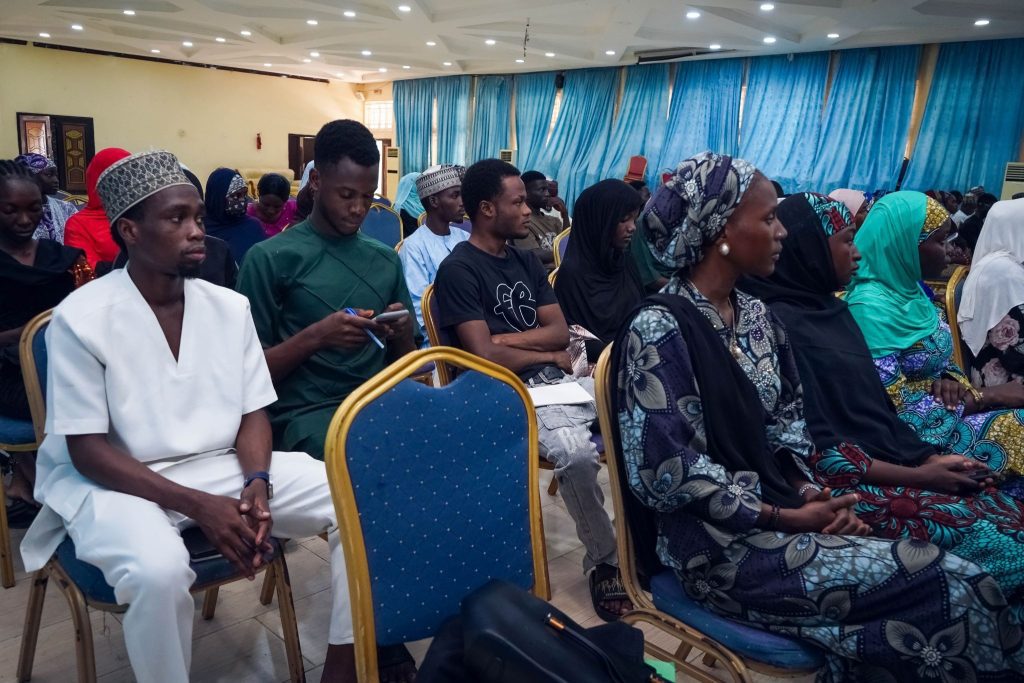
Cross-section of the audience at the event. Photo: Al’amin Umar/HumAngle.
The same sentiment was echoed by the other fellows. They highlighted that interviewing vulnerable people is a delicate skill that not many journalism training programmes cover in depth, and that they were happy to have learned it during the fellowship.
“One skill I sharpened during the fellowship was my interview skills. I learned about building connections with the subjects first, and I practised it. It really works because instead of sticking strictly to my interview guide, I connected first, and the person became eager to share [their] experience with me. I also learned about not re-traumatising my sources through the questions I ask,” said Faiza.
They also offered some advice and encouragement for fellow young journalists trying to find their feet.
“One thing I will tell student-journalists is that they should not allow fear to hold them back. They should try out new opportunities, and with mentorship, they can do so much,” Nathaniel added.
During another session at the event, Hassana Danyerwa, a SCOJA Fellowship alumnus, talked about the elevation she experienced as a result of the fellowship.
“Although I am not a journalist and I joined the SCOJA Fellowship as an advocate, my experiences from the fellowship set me up for a global experience where I was the only Nigerian selected. The mentorship aspect of the fellowship helped me and opened a new professional pathway for me.”
She offered some words of advice on the conditions necessary for journalists to do their work.
“Sometimes, we do not know what we need until we are given it, but one thing community journalists need is mentorship. Also, trust and avoiding micromanagement so journalists can express themselves and explore different topics is important.”
During the six-month fellowship, the fellows produced several investigative reports and carried out advocacy activities on various issues, including human rights, gender-based violence, and climate change. In Kano, northwestern Nigeria, some of the fellows launched the Kano Climate Change Journalists’ Network as a direct result of their fellowship.
HumAngle Foundation, in collaboration with the Embassy of the Kingdom of the Netherlands, has launched a guide for community journalism, as part of the Strengthening Community Journalism and Human Rights Advocacy in Northern Nigeria (SCOJA) project. The project, which started in 2025, has trained 90 journalists and human rights advocates so far, and their work has recorded some impact in their communities.
The launch was held on Tuesday, July 21, at the University of Maiduguri in Borno State, northeastern Nigeria, and was hosted by the Faculty of Communication and Media Studies. Angela Umoru-David, HumAngle Foundation’s Programme Director, welcomed dignitaries, students, and speakers to the gathering. In her remarks, she noted that partnerships like these were instrumental in ensuring the reach of journalism resources to those who need them the most.
“We developed this manual to serve as a guide for community journalists in Nigeria,” she said.
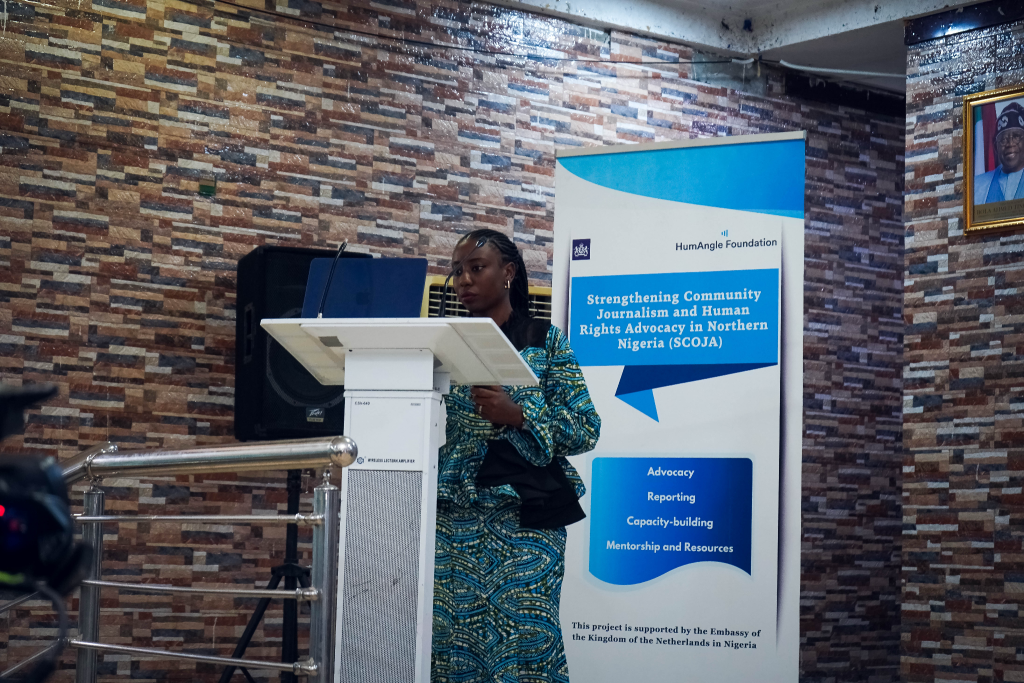
Angela Umoru-David, Programme Director of HumAngle Foundation. Photo: Al’amin Umar/HumAngle.
HumAngle’s Founder/CEO, Ahmad Salkida, noted in his introduction to the manual that the role of community journalists was crucial to social cohesion. “Community journalists, often the first witnesses to crises and transformation, are the unsung custodians of enduring social realities,” he wrote. “Their proximity to the people and understanding of local realities make them indispensable to the national narrative… We hope that every journalist who engages with this manual will find in it a field companion, a guide, and an inspiration to tell deeper, more authentic stories, to stand firm in truth, and to amplify the voices that matter most.”
Cross-section of the audience. Photo: Al’amin Umar/HumAngle.
Jessica Odudu, Senior Policy Advisor on Human Rights and Public Diplomacy at the Embassy of the Kingdom of the Netherlands in Nigeria, reiterated this point in her welcome remarks.
“While information has become abundant, trust is increasingly scarce. In moments like these, the role of journalists becomes even more important. Community journalists are often the first to report conflict. They understand the realities in their communities in a way outsiders don’t. Yet, many do this work with very few resources. Over the past year, the Embassy of the Kingdom of the Netherlands has had the privilege of strengthening community journalists’ capacity to do their work,” she said.
During the keynote speech, Prof. Mu’azu Abubakar, Dean, Faculty of Communication and Media Studies, University of Maiduguri, emphasised the importance of viewing ‘community’ as an expansive and diverse concept. On his behalf, Mohammed Auwal Umar delivered a paper they co-authored, which sought to understand the fragile conditions in which community journalism must thrive.
Prof. Mu’azu Abubakar, Dean, Faculty of Communication and Media Studies, University of Maiduguri, delivers a keynote speech. Photo: Al’amin Umar/HumAngle.
“Community journalism curates content, generates it, and develops it in a way that is relevant to the community we are serving. It is not meant to serve a classical divide,” he said.
The event also featured a panel discussion with Dr Abdulmutallib Ado Abubakar, Head of the Department of Mass Communication, University of Maiduguri; Abdulhamid Al-Gazali, Editor-in-Chief, Yerwa Express; Hauwa Shaffii Nuhu, Managing Editor, HumAngle Media; and Hassana Danyerwa, Founder, FeelandHeal Initiative and SCOJA Fellowship alumna. The discussion, which focused on strengthening community journalism in Nigeria, was moderated by Abdussamad Ahmad Yusuf, HumAngle Foundation’s Human Security and Policy Analyst.
Speaking during the discussion, Abdulhamid said, “We have to understand that as a people, the most important aspect of our society is the kind of information our people consume. Communities must have media that understand their fundamental issues, curate relevant information, and take responsibility for disseminating the right information. If we do not take control of what we consume, it affects society.”
The panellists discuss strengthening community journalism in Nigeria. Photo: Al’amin Umar/HumAngle.
Hassana, while reflecting on the impact of the SCOJA Fellowship, said, “Although I am not a journalist and I joined the SCOJA Fellowship as an advocate, my experiences from the fellowship set me up for a global experience where I was the only Nigerian selected. The mentorship aspect of the fellowship helped me and opened a new professional pathway for me.”
Abdulkareem Haruna, NUJ President, Borno State chapter, offered some closing remarks at the end of the event. Photo: Al’amin Umar/HumAngle.
Other past SCOJA fellows, including Faiza Jibrin, Yahuza Bawage, and Nathaniel Ishaya, also shared their experiences with attendees.
As the guide was formally launched, Angela Umoru-David announced the donation of copies to the University of Maiduguri. The guide, available in both Hausa and English, can be downloaded here for free.
Chellu Masaram’s shelter stands on a patch of land in Goniri, a community a few kilometres from Bama town in northeastern Nigeria.
At 85, she does not have the strength to build a house. So when she and her grandchildren arrived after the closure of the Government Senior Science Secondary School (GSSS) camp in Bama, one of the largest displacement settlements in Borno State outside Maiduguri, they used the only materials they had.
“We still do not have a room,” Chellu told HumAngle. “We made a room out of the tarpaulin we brought from the camp. The room leaks when it rains.”
For more than a decade, displacement has shaped her life. She fled Sabsabwa, a town in Bama, in 2014 when Boko Haram terrorists attacked the community and killed her son. Since then, she has raised his three children alone: a year at the Bama General Hospital camp, then ten years at GSSS.
Now she is displaced again.
On June 25, Borno State announced the closure of the GSSS camp as part of its broader policy of ending camp-based displacement and resettling people to their communities of origin or nearby settlements. The announcement was made by Dauda Iliya, spokesperson to Governor Babagana Umara Zulum. The exercise was described as the relocation of about 3,000 households to settlements including Abbaram, Darajamal, Mainti, and Goniri, though the actual number of individuals moved remains unclear. Authorities also indicated that the displacement camp in Gwoza could be among the next to close.
The numbers associated with the GSSS camp have varied considerably over the years. In 2023, the camp’s own management estimated it was hosting more than 100,000 people, four times its designed capacity of 25,000. Government statements on the recent closure referenced approximately 3,000 households being relocated to surrounding communities. But that figure came with its own complications. During the closure announcement, Governor Zulum noted that a year earlier the camp had held no more than 400 households, and expressed surprise that the number had risen to 3,000 shortly before closure. “Most of them are residents living within the town,” he said, suggesting that a significant share of those counted at the end were not long-term displaced persons but local residents who had re-entered the camp, most likely to access aid distributions. If that is accurate, the 3,000 figure may overstate the number of people who were genuinely in need of resettlement support, while simultaneously obscuring how many actual long-term IDPs were moved and to where. Humanitarian and official figures detailing the exact number of individuals relocated have not been publicly released.
HumAngle wrote to the Borno State Emergency Management Agency (BOSEMA) seeking clarification on the number of households and individuals relocated, the preparedness of receiving communities, and plans for future camp closures. The agency had not responded by the time of publication.
What is emerging from Goniri and other receiving communities is a more complicated picture than the language of “camp closure” suggests. For some families, displacement may not have ended. It may simply have changed location.
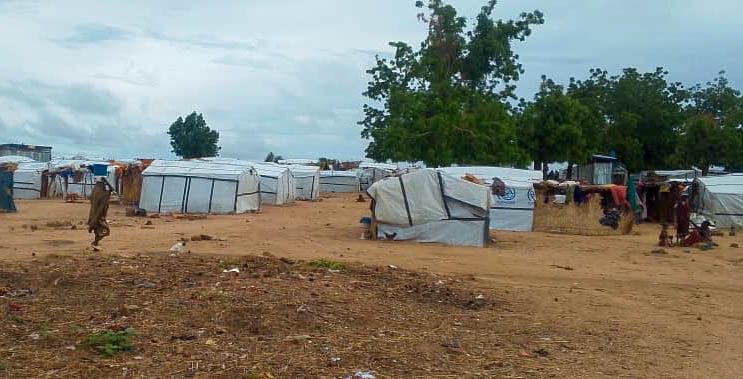
Abubakar Mohammed, 36, lives with his wife and children in a single-room tarpaulin shelter in Goniri after being relocated from the GSSS camp. “The Aja [District Head] said, ‘You may live here pending when you find your own place,’” he recalled. The roof leaks when it rains. Photo: Al’amin Umar/HumAngle.
From Camp Residents to Makeshift Settlers
Chellu and her grandchildren left the camp in the evening, a truck transporting their belongings. “We paid ₦7,000,” she said.
The move brought them to Goniri, one of the communities receiving former camp residents. The grandchildren she cares for are now 17, 15, and 12 years old. None attend formal school. The oldest studies at a Tsangaya school in Bama and returns there to sleep each night. The two girls remain with their grandmother.
The family survives through a combination of small trading and firewood collection. Chellu sells groundnuts when she can. The more demanding work falls to her granddaughters. “The girls go to the bush to gather firewood to sell,” she said. According to her, they spend up to three hours walking into surrounding bush areas before returning with wood that earns around ₦2,000 daily. “This is what we depend on majorly.”
Chellu Masaram at the entrance of her makeshift shelter in Goniri. Since relocating from the GSSS camp, she sells groundnuts outside the structure while her granddaughters venture into surrounding bush areas to gather firewood for sale. Photo: Al’amin Umar/HumAngle.
The arrangement is not unusual. Across displacement settings in Borno and the wider North East, firewood collection has become one of the primary survival strategies available to women and girls. In 2020, HumAngle reported how this burden traps women in a cycle of poverty that limits access to education and economic opportunity while increasing exposure to violence.
For Chellu’s granddaughters, the hours in the bush are not a choice. They are an economic necessity shaped by the inadequacy of humanitarian support and the absence of alternative livelihoods. But in Borno, those hours carry a risk that goes beyond physical exhaustion.
Firewood collection in conflict-affected parts of the northeast has long been documented as a moment of acute danger for women and girls. A 2018 World Food Programme survey found that 85 per cent of women in four local government areas of Borno feared rape, murder, or abduction while collecting firewood. UNHCR protection monitoring reports have recorded incidents of rape during firewood collection, alongside the persistent threat of abduction by terrorists. In March 2024, more than 200 internally displaced women were abducted in Ngala, Gamboru Ngala LGA, while collecting firewood in the bush around Jillam and Wurga villages, approximately 15 kilometres from town. Older women and children under 10 were reportedly released; scores of others remained unaccounted for. In August 2023, at least 42 women were abducted by suspected Boko Haram terrorists while gathering firewood in Mafa. This often forces relatives in camps to crowdsource ransom.
In Goniri, Chellu’s granddaughters are navigating that same risk. They go anyway, because the family has to eat.
Chellu’s granddaughters rest outside their makeshift shelter after returning from a firewood collection trip. HumAngle spoke with their grandmother, Chellu Masaram, while they rested that evening. Photo: Al’amin Umar/HumAngle.
The broader consequences of this dependence extend beyond the households bearing it.
As hundreds of families like Chellu’s converge on Goniri and surrounding communities, demand for firewood is rising sharply in an environment already under significant ecological pressure. The Lake Chad Basin, of which Borno is a part, has experienced accelerating deforestation driven by displacement, conflict, and climate stress. A study examining the impact of internally displaced persons on forest cover in Jere LGA found that displaced populations destroyed approximately 12 square kilometres of forest and vegetation. Research on the Lake Chad Basin has found that competition between displaced populations and host communities for firewood is driving deforestation and natural resource degradation, reducing the resilience of both groups. Governor Babagana Zulum has acknowledged that displacement-linked deforestation in Borno is contributing to soil erosion, reduced water availability, and increased vulnerability to climate change.
“It was not like this at the camp,” Chellu said.
Food worries now dominate her thoughts. She said she recently cried because she did not know how she would provide enough. For water and medical care, she and the children walk to Bama, a journey she estimates at over an hour on foot. “As old as I am, I must trek with the children for at least an hour daily,” she said. The move has also introduced tensions with neighbours. A nearby resident has repeatedly told her family they are not welcome. “He said he does not want us beside him,” she said. She says the man has attempted to physically attack her and her granddaughters on multiple occasions, and that complaints to local leaders have produced no resolution.
“I wish the government would intervene.”
The uncertainty surrounding shelter, water, food, and social acceptance has left her wondering what exactly changed when the camp closed. For a woman who has spent 11 years moving between displacement sites, the answer is not obvious.
The shelter gap in Goniri
The Borno State government has long argued that prolonged camp life is not a sustainable solution. Camp closures form part of a broader strategy aimed at restoring communities, reducing dependency on humanitarian assistance, and facilitating recovery from years of insurgency. But interviews with former camp residents in Goniri suggest the transition has been uneven.
Abubakar Mohammed, 36, arrived in Goniri after years in displacement. He first fled Alagarno in Damboa Local Government Area when insurgent attacks devastated the community, spent three months at the Bama General Hospital camp, and then moved to the GSSS camp, where he remained for several years. Like many residents, he said the relocation came with little explanation. “We were asked to relocate two weeks ago,” he told HumAngle on July 7. “We were not given any reason.”
The token Abubakar Mohammed received at the GSSS camp before relocation. Households holding a token received ₦30,000 along with 25-kilogram bags of rice and maize flour when they left the camp. Those without tokens, including Babagana Ali, received nothing. Photo: Al’amin Umar/HumAngle.
Before departure, he received a token card later exchanged for a document used during aid distribution. The government distributed ₦30,000 to each household that held a token, along with 25-kilogram bags of rice and maize flour. “Only those who had tokens got the money,” he said. Even so, the assistance did not resolve the housing challenge. “The government constructed some shelters before asking us to relocate,” he acknowledged. “But it is not sufficient.” He now lives in a makeshift tarpaulin shelter on land temporarily provided by community heads. “The Aja [District Head] said, ‘You may live here pending when you find your own place,’” he recalled. His wife and children share the structure with him; his mother and three sisters are staying elsewhere in Goniri with a friend. Many other households have improvised similar arrangements, renting accommodation or relying on relatives. Some remain more exposed. “Other people could not even afford to set up shelters,” he said. “They sleep in the open.”
With no shelter of their own, some displaced families sleep in the open in Goniri. “Other people could not even afford to set up shelters,” said Abubakar Mohammed, who was relocated from the GSSS camp. “They sleep in the open.” Photo: Al’amin Umar/HumAngle.
The experience of Babagana Ali, 38, illustrates how unevenly the same process was administered.
His displacement history spans multiple locations. He first fled Warafaya in 2017 and settled in Kumshe, both in Bama; in 2022, violence displaced him again, eventually bringing him to Bama town and the GSSS camp. When officials announced the closure, residents received approximately one week’s notice. “They came on a Thursday and gave us a week’s notice,” he said. Unlike Abubakar, Babagana never received a ration card. He was working on his farm when distributions took place and as a result received none of the food items, zinc sheets, or money given to other households. Without money for a truck, he rented a pushcart for ₦1,500 and made two trips to move his belongings. Today, he shares a single tarpaulin shelter with two wives, six children, and four children belonging to his late brother. When it rains, water enters through the roof.
His experience points to a concern emerging across interviews: the closure of the camp may have reduced the visibility of displacement without resolving the housing deficit it created.
Earlier, humanitarian actors have made appeals for emergency shelter interventions in Goniri and Abbaram following the influx of relocated households. Those appeals suggest that aid agencies themselves recognised accommodation gaps after the movement began. This pattern is not new to Borno’s camp closure process. A 2022 Human Rights Watch report documenting earlier rounds of camp closures found that housing, water, healthcare, schools, and other infrastructure necessary to meet basic needs were lacking in many receiving communities, and that the closures had stripped over 200,000 displaced people of food and shelter without adequate alternatives.
Residents gave varying estimates of how many people have arrived in Goniri since the closure. Chellu believed there could be about 3,000 people in the settlement; Abubakar estimated as many as 6,000, with roughly half lacking adequate shelter. HumAngle could not independently verify these figures, but both accounts point to the same reality: Goniri’s population has grown rapidly, and the question is whether the community has the infrastructure to absorb it.
Life beyond the camp
For government officials, the success of relocation will ultimately depend on what happens after families arrive. Housing is only one part of that equation. Access to livelihoods, water, healthcare, sanitation, education, and social acceptance all determine whether a relocation becomes sustainable. In Goniri, many of those systems remain under pressure.
Water emerged repeatedly during HumAngle’s reporting. Chellu, Abubakar, and Babagana all described the same daily routine: a walk to Bama that can take up to an hour. OCHA’s 2025 Humanitarian Needs and Response Plan identifies overcrowding in camps and receiving settlements, alongside lack of access to clean water and sanitation, as conditions that have worsened as a direct result of IDP movements linked to camp closures in Borno. Healthcare follows the same route as water. Abubakar estimated transportation costs at about ₦300 per trip, a burden that falls hardest on older residents, pregnant women, and households without steady income.
Sanitation presents another strain. Babagana said the communal latrines built for an earlier displaced population are now being shared by hundreds of newly arrived households. “There are insufficient toilets,” he said. “We have to queue. It is also dirty.” He estimated that only five fenced latrines serve the settlement.
A communal latrine in Goniri, now shared by hundreds of newly arrived households relocated from the GSSS camp. “There are insufficient toilets,” said Babagana Ali. “We have to queue. It is also dirty.” He estimated only five fenced latrines serve the settlement. Photo: Al’amin Umar/HumAngle.
Livelihoods present a different challenge. Before the closure, many residents relied on a combination of humanitarian support and informal income. Outside the camp, they face greater pressure to generate income independently. Abubakar is a farmer by training, but insecurity has limited access to agricultural land this season. “I now do menial jobs,” he said, earning around ₦3,000 on a good day. Babagana manages similarly. “Anything that my strength can do,” he said, with income averaging around ₦2,000 daily. Neither considers it sufficient for households of their size.
For children, the transition raises additional concerns. None of Chellu’s grandchildren attends formal school. Their days revolve around religious education and income-generating activities, the girls spending long hours collecting firewood that contributes directly to household survival. They are not alone in this. UNICEF estimates that 56 per cent of displaced children across Borno, Adamawa, and Yobe states do not attend school, with roughly two million children out of school across the three states. The situation in Goniri illustrates how economic hardship reshapes childhood after displacement, turning survival into a full-time occupation.
Social integration remains unresolved. While some host community members have provided land and accommodation, not all relationships appear harmonious. Abubakar said some residents blame the displaced for ongoing insecurity. “They say we caused the ongoing insecurity,” he said. Such perceptions breed friction in communities already stretched by scarce resources and years of conflict.
A state moving toward more closures
The debate over Bama is likely to intensify as the camp in Gwoza is expected to be the next major closure.
Many residents of Borno also want to leave camps behind. After years of displacement, the idea of living in a community rather than a crowded camp carries real emotional weight.
“I expected the government to wait for peace before asking us to relocate,” he said.
That concern reflects a broader uncertainty in Bama and surrounding areas. Several communities continue to experience insecurity, farming restrictions, and periodic displacement linked to insurgent activity and military operations. Earlier in 2024, OCHA conducted area-based assessments of both the GSSS camp in Bama and the camp in Gwoza, both of which document the fragility of receiving communities and the scale of unresolved displacement needs. Sabsabwa, from which Chellu was displaced in 2014, experienced renewed disruptions in late 2022 and 2025. Warafaya, where Babagana once lived, was emptied by violence years ago. Alagarno, Abubakar’s hometown, was devastated by insurgent attacks. For many families, displacement has not been a single event but a series of movements from one place to another.
Without clear data from BOSEMA, several questions remain unanswered. How many people were actually moved from the camp? How many houses were completed before the relocation? How many households are still living under tarpaulins or in the open? What support is planned for communities such as Goniri and Abbaram as their populations grow? Those questions matter not only for Bama but for every future camp closure in Borno.
Chellu Masaram spreads a wrapper soaked by the previous night’s rain, as her granddaughters sit nearby. At 85, she is among the elderly displaced persons for whom daily life in Goniri, with no nearby water, healthcare, or secure shelter, has been the hardest adjustment since the camp closed. Photo: Al’amin Umar/HumAngle.
As evening approaches in Goniri, Chellu’s grandson leaves for the Tsangaya school where he sleeps, her granddaughters prepare for another trip into the bush to gather firewood, and the tarpaulin roof remains patched against the next rain.
When Kaka Ali said those words over the phone on June 8, I nearly asked him to repeat himself. I had been speaking to him about farming and survival in northern Borno for nearly two years. Kumalia was where he was born, but it was also a place that most people had long stopped calling home.
The community is located within Monguno Local Government Area (LGA) in Borno State, northeastern Nigeria. The Boko Haram insurgency had emptied it in 2016, forcing residents to flee to Monguno town and Maiduguri, the state capital. The government never formally reopened the community. In the years that followed, its name surfaced mostly in conversations about what the insurgency had taken.
“Why would you go back there?” I asked.
“The negotiations did not go through,” Kaka replied.
I did not fully understand what he meant until weeks later.
On June 21, I reached him again. I learnt that he had returned to Monguno to attend the funerals of four friends who were killed the previous day by suspected Islamic State West Africa Province (ISWAP) terrorists while working on a farm near Kartari, a remote settlement close to Cross Kauwa town in Kukawa LGA, on the shores of Lake Chad. Twelve other farmers were also killed in the incident.
The men had travelled to Kartari from different parts of northern Borno, drawn by the search for land to cultivate after farming had been disrupted closer to home. That same day, in Zabarmari, a farming community in Jere LGA, another 11 farmers were reportedly killed. By then, Kaka’s explanation about Kumalia finally made sense.
The warning had come months earlier at the onset of cultivation in February, when farmers across parts of northern Borno began receiving warnings from ISWAP terrorists not to farm this season. The message spread among returning farmers and community leaders through word of mouth.
“They approached farmers who had gone to Kartari and told them we must not cultivate this year,” said Musa Abubakar, a farmer from Cross Kauwa. “They also informed community leaders in villages close to them, and those leaders passed the message to us in other towns,” he said.
According to Musa, farmers who wished to cultivate were instructed to relocate with their families to terror-controlled territories, locally known as Daula, and farm there instead. Many initially assumed it was another extortion attempt because for years, cultivating in parts of northern Borno had meant paying terror groups for access to land. In 2024, HumAngle documented how farmers in the region paid millions of naira in levies and so-called farming permits to ISWAP. This season, farmers pooled their money together, some contributing at least ₦50,000 each, hoping to negotiate their way back to their fields. However, the effort failed, and the warning held.
So they began looking elsewhere. Some moved toward the Lake Chad region. Others returned to abandoned communities. More than 100 farmers from Monguno, according to Kaka, relocated to Kumalia, where they erected makeshift shelters from sticks and dry grass to plant their crops. They plan to stay until the harvest season in November or December.
The women were not left behind either.
“My sister is there,” Kaka, the 30-year-old father of two, said. “Many women went with their children. The older ones trekked with their parents. The younger ones are carried on their backs or transported in push carts.”
Kaka’s older sister, Yabusam Ali, travelled with one of her children and left the others with their grandmother in Monguno. Other women made similar calculations, weighing which children could endure the walk and which would be safer left behind. Yabusam said conditions remain basic but manageable.
“There is drinkable water there,” she told HumAngle.
For now, that is enough. Kumalia has no schools, no health facilities, and no visible state presence. It is a settlement held together by necessity. Over the coming months, the community will once again have residents, not because it is safe, but because it has become the least dangerous option left.
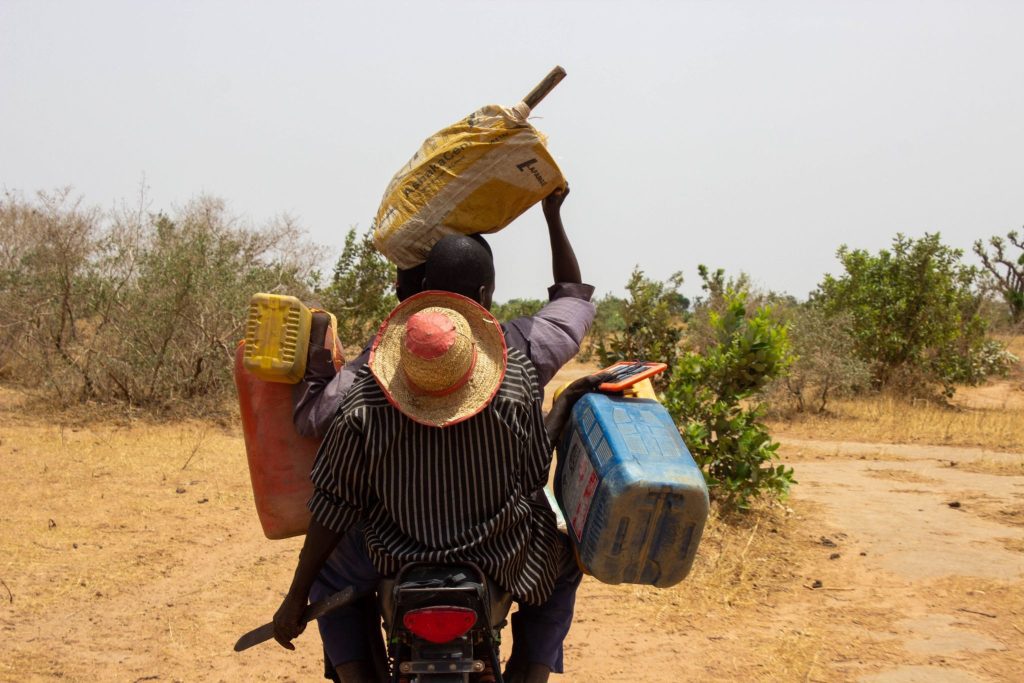
File: A family riding to their farm on a motorcycle in rural Gombe in 2024. Photo: Al’amin Umar/HumAngle.
Across Borno, the farming ban, enforced through violence and the threat of it, is reshaping how rural families survive. Some have abandoned cultivation entirely. Others have confined themselves to plots within sight of military positions. A growing number are returning to communities the state had given up on, betting that the promise of a harvest is worth living beyond its protection. Together, these choices are accumulating into something larger than disrupted planting seasons: a food security crisis taking shape incrementally, in the daily calculations of people who can no longer be certain what the harvest will bring, or whether there will be one at all.
The consequences extend far beyond the communities where cultivation has been disrupted. Agriculture remains one of Nigeria’s largest employers and a critical source of food for millions of households. The World Bank estimates that nearly four in every five rural households in Nigeria depend on farming, while livestock rearing is especially common across the country’s northern regions. When insecurity forces farmers off their land, harvests decline, market supplies tighten, and food prices rise.
The Famine Early Warning Systems Network (FEWS NET), a food security monitoring and forecasting initiative, estimates that between 21 and 22 million people across northern Nigeria will require humanitarian assistance during the June-to-August lean season, driven by escalating conflict, lower-than-expected household food production, and constrained access to food. The Integrated Food Security Phase Classification (IPC) similarly projects that more than six million children across northern Nigeria will experience acute malnutrition this year, with conflict, displacement, and reduced access to food among the principal drivers.
Get our in-depth, creative coverage of conflict and development delivered to you every weekend.
Subscribe now to our newsletter!
Kaka had already made these calculations. “Are you not afraid of attack from the terrorists, or of being mistaken for one by troops?” I asked him. “We will die even if we don’t go,” he replied. “So, it is all the same.”
Flags on the farm
Just as Kaka mentioned, several farmers in northern and central Borno say the people who first heard the warnings were often those who had gone ahead of the rains to clear their fields.
In Monguno, Koso Abubakar said farmers preparing their land were approached and warned against cultivation. They returned to town carrying the news, and from there, the message spread from household to household. In Cross Kauwa, a farming and fishing community on the shores of Lake Chad, the warning reached those working near Kartari, a remote settlement under Kukawa LGA. Community leaders received it and relayed it to surrounding towns.
In Lassa, a farming community in Askira-Uba LGA in southern Borno, it arrived with violence. Andrew Adamu, a farmer there, said suspected terrorists attacked and flogged women they found working on their fields at the beginning of the season. “They said nobody should farm there,” he said. “They [the women] said they had mounted their flags on those lands.”
The flags, a territorial marker used by terror groups across the region to signal control, were understood immediately. Few people in Lassa are now willing to venture beyond the land immediately surrounding the town.
Musa, a farmer in Cross Kauwa, said the warning came with an additional condition in the northern Borno community. He said that farmers willing to cultivate were instructed to relocate permanently with their families to terror-controlled territories and continue to farm there while paying levies instead. The requirement to relocate permanently was new. The levies were not. But this time around, levy negotiations failed in some places.
Farmers handing over money to armed and masked terrorists in a rural setting. Illustration: Akila Jibrin/HumAngle.
However, in parts of southern Monguno, some farmers were reportedly permitted to cultivate after paying ₦50,000 each. The inconsistency stirred speculation that the restrictions reflected internal disagreements among ISWAP commanders rather than a unified policy.
“It was said that two Amirs controlling two farming villages had a dispute over farming fees,” Kaka explained. “The Amir controlling where we farm said he would not allow anyone to farm this season. The other Amir said farmers were welcome to cultivate in his territory after paying this year’s levy.”
HumAngle could not independently verify the claim.
When negotiations collapsed, the consequences began to accumulate. In Lassa, Andrew said, women were beaten while working on their farms. In Auno, Konduga LGA, a 55-year-old farmer was attacked and killed while working on his land earlier in February, according to residents. News of his death, Aja Bukar, another farmer, said, spread quickly through surrounding communities, confirming what many had hoped was merely a threat.
Then, on June 20, 15 farmers were killed near Kartari while working on their fields. Bashir Suleiman, a farmer from Doron Baga, said the victims included four farmers from Monguno, six from Kukawa town, three from Baga, and two from Cross Kauwa.
In Cross Kauwa, Musa said most farmers have stayed away from their fields since. The few still cultivating have been permitted by the military to plant low-growing crops, such as beans and groundnuts, within a fixed distance of the community’s defensive trench. Beyond that line, he said, most no longer believe the harvest is worth the risk.
The return to Kumalia
For the first time in nearly a decade, Kumalia has residents again. Not many, and not enough to resemble the farming community it once was before the insurgency emptied it in 2016, but enough to bring movement back to a place which has long given up — children’s voices have returned. Smoke rises from cooking fires in the morning. The fields are being planted. And temporary shelters made from sticks, ropes, and dry grass stand across parts of the settlement.
Getting there, however, is not easy. According to Modu Baluye, a farmer who also relocated to Kumalia, reaching the settlement takes five hours of walking over terrain most vehicles cannot cross. “We travel by foot,” he said. “There is no means of transportation except push carts.” The shelters, he said, are simple: stick frames with dry grass roofing, which offers little protection from rain or wind, but they are enough to house families for the months between planting and harvest.
A family working together in their field. Illustration: Akila Jibrin/HumAngle.
For years, displacement pushed families out of places like Kumalia and into towns where security forces could better protect them. Now, insecurity around farming is pushing some of those same families back, not into safety but into a different kind of exposure: too far from the state to be protected, yet close enough to armed groups to be noticed.
Communities across northeastern Nigeria have learned, often through grief, that living or farming in remote and ungoverned territories can attract a different kind of violence during military operations. Aerial surveillance, in vast terrains where terror groups move through civilian spaces, collect levies, and use local markets, must be able to distinguish between farmers and fighters. In places like Kumalia, unrecognised by the government, absent from any official resettlement record, populated by people living in makeshift shelters on cultivated open land, that distinction is not guaranteed.
In April 2026, reports showed that more than 30 civilians were killed when a Nigerian Air Force strike hit a village market in Jilli, a remote settlement between Gubio LGA in Borno State and Geidam LGA in Yobe State. Military authorities described it as an active terrorist enclave. Borno State Governor Babagana Zulum later acknowledged that the area’s market had been officially closed due to terrorist activity, yet civilians were among the dead. It was not the first such incident. In 2017, a military aircraft bombed a displaced persons camp in Rann, Kala-Balge LGA, killing more than 100 people including aid workers. And in 2024, HumAngle documented cases in which fishermen around Lake Chad were reportedly misidentified during military operations.
Farmers in Kumalia are aware of this history. It sits alongside the warnings from ISWAP, the distance from town, and the inadequacy of their shelters. It is part of what they weighed before they went.
The price of survival
Every morning before sunrise, Esther Danjuma sets up her stall on the roadside outside the Divisional Council Church (DCC) Internally Displaced Persons’ camp in Shuwari, Maiduguri. She heats cooking oil, prepares her bean paste, and waits for the first customers. By the time most people in Maiduguri are awake, she is already working.
Esther Danjuma fries kosai every morning outside her settlement in Maiduguri. The farming restrictions this season led her to switch professions. Photo: Al’amin Umar/HumAngle.
The 26-year-old was displaced from Amuda in Gwoza LGA years ago. Until recently, she measured time by farming seasons, not calendar months. Before the warning reached Chabbal, a farming community in Magumeri LGA where she and thousands of others from the DCC displacement camp cultivate each season, she grew sorghum, sesame, and groundnuts. Last year, she harvested five bags each of sorghum and sesame and three bags of groundnuts. This year, she planted nothing.
“I never thought I would sell kosai,” she told HumAngle. She earns at least ₦3,000 daily. This helps her care for herself and her elderly grandmother at the camp, she said.
A few shelters away from Esther lives Andrawus Yakubu. While Esther replaced farming with a small business, Andrawus has replaced it with whatever work presents itself each day. On some days, he works at construction sites. On other days, he digs pits, cuts logs, or takes on manual labour wherever opportunities arise. The work is irregular and physically demanding, but Andrawus says he cannot afford to be selective. “I will do whatever legal thing that my strength can do,” the father of nine told HumAngle.
For years, Andrawus supplemented his household income through farming in Limanti, a rural community in Konduga LGA. Like many displaced residents of the DCC Shuwari camp, he relied on the farming season to feed his family and reduce their dependence on the market. Last season, he cultivated four hectares of land, harvesting five bags of millet, 12 bags of groundnuts, and eight bags of beans. This season, however, the farming restrictions have forced him to abandon farming.
Andrawus has replaced farming with whatever work presents itself each day. Photo: Al’amin Umar/HumAngle.
Others have chosen to leave Borno altogether. In Auno, Aja Bukar said the killing of a farmer earlier this year convinced many residents that remaining in the area was no longer worth the risk. Some households, including his, have since relocated to Damaturu in neighbouring Yobe State, hoping to find safer opportunities elsewhere.
These different responses – the roadside stall, the day labour, and relocation to another state – all lead back to the same question: what can replace a harvest, if anything?
Agriculture remains the backbone of rural livelihoods across Borno and the wider North East. In Borno, farming is not only an occupation but also a source of sustenance for families; it is how they feed themselves, pay school fees, buy medicine, and prepare for the long dry season. Yet years of conflict have steadily eroded that foundation, limiting access to farmland, disrupting markets, and deepening food insecurity.
When farmers abandon their fields, the consequences ripple far beyond the households directly affected: Harvests decline, local markets receive fewer supplies, and children and other vulnerable groups bear the greatest nutritional burden. The effects are felt not only in the villages where cultivation stops, but across communities that rely on those harvests for food and trade.
A boy sits, selling grain at the Baga Road grain market in Maiduguri. Humanitarian organisations project that food prices may skyrocket, driving food insecurity across Borno and the wider northern region due to increasing restrictions on farming and attacks on farmers. Photo: Al’amin Umar/HumAngle.
The region has been here before. In 2023, HumAngle documented how repeated attacks on farming communities forced many residents to abandon cultivated fields, leaving crops worth millions of naira to wither or be destroyed. A year later, the trend persisted, contributing to worsening food insecurity and malnutrition among vulnerable households, particularly children.
What is unfolding this season is not unique to Borno. Across the North West and North Central, terror groups have used similar tactics to control access to rural farmland, taxing farmers, threatening communities, and displacing those who resist. In Zamfara, HumAngle reported in June that farmers were displaced despite paying millions in levies. Another report the same month showed that 17 farmers were killed in Maradun while working their fields. In 2024, Reuters reported from Katsina that attacks on farmers were driving up food prices. According to SBM Intelligence, a Lagos-based consultancy, 1,356 farmers have been killed across Nigeria since 2020.
The scale of what is at stake is significant. UNICEF estimates that around three million children may require treatment for severe wasting in 2026, with conflict-affected northeastern states carrying a disproportionate share.
Across Borno, people are making decisions whose consequences they cannot yet fully see.
Students at Government Day Secondary School in Lassa, Askira-Uba Local Government Area of Borno State, northeastern Nigeria, were preparing to sit for their National Examinations Council (NECO) Biology paper on the morning of Monday, June 29, when terrorists stormed the school, killing at least one teacher, abducting staff and students, and forcing another disruption to education in a community still reeling from a school abduction barely a month ago.
The attackers struck shortly before 9 a.m., according to school officials and residents, arriving on more than 40 motorcycles, many dressed in military camouflage and armed with AK-47 rifles. Witnesses said the assault lasted about 20 minutes before security personnel pursued the attackers into nearby bushland.
The exact number of abducted students remains unclear as authorities and school officials continue compiling names.
Imperiju Mamza, the school’s examinations officer, told HumAngle that the senior students had assembled for their Biology paper, scheduled to begin at 10 a.m., when the attackers arrived. “They invaded the school some minutes to 9 a.m.,” he said.
“Only one student who is sitting for the exams was abducted. She came very early and was, unfortunately, abducted alongside the other students who were from other classes. The others are safe and are currently writing their paper,” he said.
The ongoing NECO examinations began on June 23. According to Mamza, 243 candidates registered for the examination. “Apart from the one abducted, 242 are currently writing their exams,” he said. “I am trying to compile names of those abducted and cannot yet confirm how many were taken.”
Following the attack, candidates were relocated under armed protection to Government Girls Secondary School, Lassa, where the Biology examination continued.
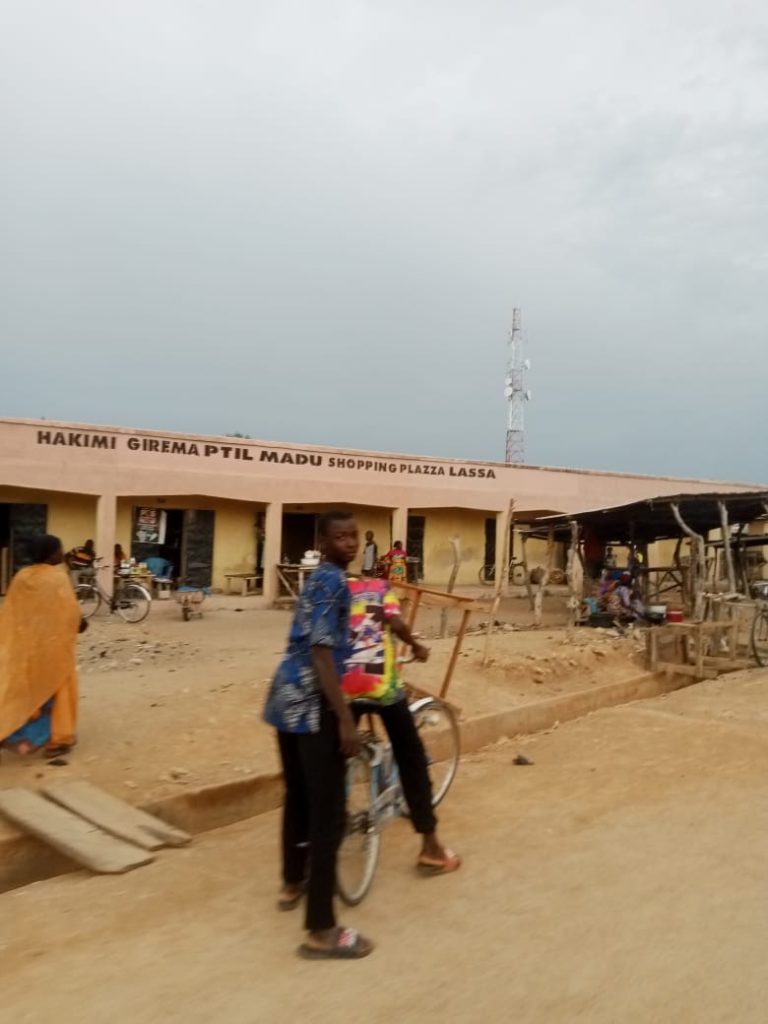
The Hakimi Girema Ptil Madu Shopping Complex at the Lassa Central Market. The Government Day Secondary School, where the abduction happened, sits a few kilometres away. Photo: James Lucky.
Teachers killed, others abducted
Residents who witnessed the aftermath said the attackers appeared to target the school directly rather than the wider community.
Timothy Apagu, whose shop is located near the school, said the community had received reports as early as 7 a.m. that armed men had been sighted around Muthalavu village on the outskirts of Lassa. Community vigilantes were deployed towards the Dille axis after residents raised the alarm, believing the gunmen were approaching from that direction.
“Unfortunately, another team of terrorists followed a different route and attacked the community,” he said.
Apagu said the attackers went straight into the school. “They did not enter the community. I suspect it was a targeted attack.”
He said more than 40 motorcycles participated in the raid. “Most were wearing military camouflage. Others were wearing black trousers. Some wore boots while others wore bathroom slippers. From afar, you would know they were terrorists.”
According to Apagu, one teacher died at the scene while another, who sustained gunshot injuries, later died at the Lassa General Hospital.
He said two teachers, a male Vice Principal identified as Mr Paul and a female teacher popularly known as Madam Angelina, were initially abducted alongside students. The Vice Principal was later rescued after security personnel pursued the attackers, while the female teacher remained in captivity at the time of reporting.
The corpse of the teacher killed at the scene is covered in leaves. Photo: James Lucky.
Another resident, Andrew Adamu, gave a similar account, saying security personnel rescued one teacher and five students during the pursuit and recovered six motorcycles abandoned by the fleeing gunmen.
He added that one female student escaped with gunshot injuries. HumAngle could not independently verify these rescue figures.
Security response
The military and local vigilantes immediately pursued the attackers into nearby bushland, residents said. Adamu said one soldier and one vigilante were killed during the pursuit.
Residents said the military and local vigilantes immediately pursued the attackers into nearby bushland, rescuing the vice principal and six students. Photo: James Lucky.
“There is a military base here, but the soldiers are few. They are not more than 50,” he said. “The school and the military base are less than a kilometre apart.”
The Borno State Police Command confirmed the attack but said the number of abducted students remained unverified. Nahum Kenneth Daso, the Police Public Relations Officer, said the Area Commander for Askira-Uba had deployed to the scene alongside other officers.
Asked what security measures had been introduced after last month’s abduction of more than 40 schoolchildren in nearby Mussa, Daso said police deployments around schools in the area had been increased.
Get our in-depth, creative coverage of conflict and development delivered to you every weekend.
Subscribe now to our newsletter!
“The challenge we had in Lassa is that the school does not have a fence,” he said. “When the invasion happened, they took advantage of that.”
The school vice principal, Mr Paul, and six students who were rescued by security operatives.
Mamza said school authorities had repeatedly raised concerns about the absence of perimeter fencing following the Mussa attack. “The Government Day Secondary School has no fence, and we have complained to the government following the Mussa incident,” he said. He explained that the school is located about a kilometre from the town centre and shares a boundary with the Lassa Vocational Training Centre.
When contacted, Mada Saidu, the Chairperson of Askira-Uba LGA, declined to discuss the attack, saying he was channelling his time and efforts into coordinating the emergency response, which he felt was more important than speaking to journalists.
The latest attack comes barely a month after dozens of schoolchildren were abducted in neighbouring Mussa, also in Askira-Uba LGA, renewing fears over the security of schools across southern Borno despite assurances that protective measures had been strengthened.
Terrorists attacked the Government Day Secondary School in Lassa, northeastern Nigeria, killing at least one teacher and abducting others, causing a significant disruption to the students who were preparing for their NECO Biology exams.
The assault involved approximately 40 armed men on motorcycles and targeted the school specifically, leading to the abduction of students and staff, including the Vice Principal, who was later rescued.
In response, security forces, including the military and local vigilantes, pursued the attackers, with some casualties on both sides. Authorities could not confirm the exact number of abducted students, but following the attack, surviving students continued their exams under increased security at a different location. Residents and officials have raised concerns about the lack of perimeter fencing at the school, an issue highlighted in previous incidents, as local security efforts have been increased following similar abductions in the nearby area.
When the first three people fell sick on Thursday, June 11, residents of Doron Baga were unsure what was happening. The symptoms – vomiting, diarrhoea, and weakness – were familiar enough in a rural community where access to healthcare is limited, and illnesses are often treated at home or by local patent medicine vendors. However, as more people began showing the same signs, and deaths followed within days, concern spread across the community.
Ahmadu Haruna watched the disease move rapidly through his household. He is the community leader of Randa, an area within Doron Baga, a fishing and farming community on the shores of Lake Chad, less than three kilometres from Baga town in Kukawa Local Government Area (LGA) of Borno State, northeastern Nigeria.
He lives in a large compound that houses nearly 150 people, including his four brothers, their wives, children, and grandchildren. Within seven days, he said, at least 20 people living in his compound became ill. Seven died. “It started with three people,” Ahmadu recalled. “One of my brother’s children and another brother’s wife were the first to be infected.”
As cases multiplied, residents began drawing connections to reports they had been hearing from Maiduguri, the state capital, where a cholera outbreak had already overwhelmed health facilities and infected thousands. “We knew it was cholera because the symptoms matched what we heard on [the radio] about the outbreak in Maiduguri,” said Bashir Suleiman, a resident. “The people there were vomiting and having diarrhoea, and that was exactly what we were seeing here.”
The outbreak has unsettled Doron Baga, a community that has spent the last six years rebuilding after it was displaced by the Boko Haram insurgency. Residents were officially resettled in September 2020 by the state government. Many residents say that returning home symbolised the beginning of recovery. Families rebuilt their houses, fishermen returned to the lake, and farmers reclaimed their fields. Gradually, life appeared to be returning to normal. The cholera outbreak, however, has revealed how incomplete that recovery remains.
Cholera, according to the World Health Organisation (WHO), is “an acute diarrhoeal infection caused by consuming food or water contaminated with the bacterium Vibrio cholerae”.WHO), is “an acute diarrhoeal infection caused by consuming food or water contaminated with the bacterium Vibrio cholerae”.
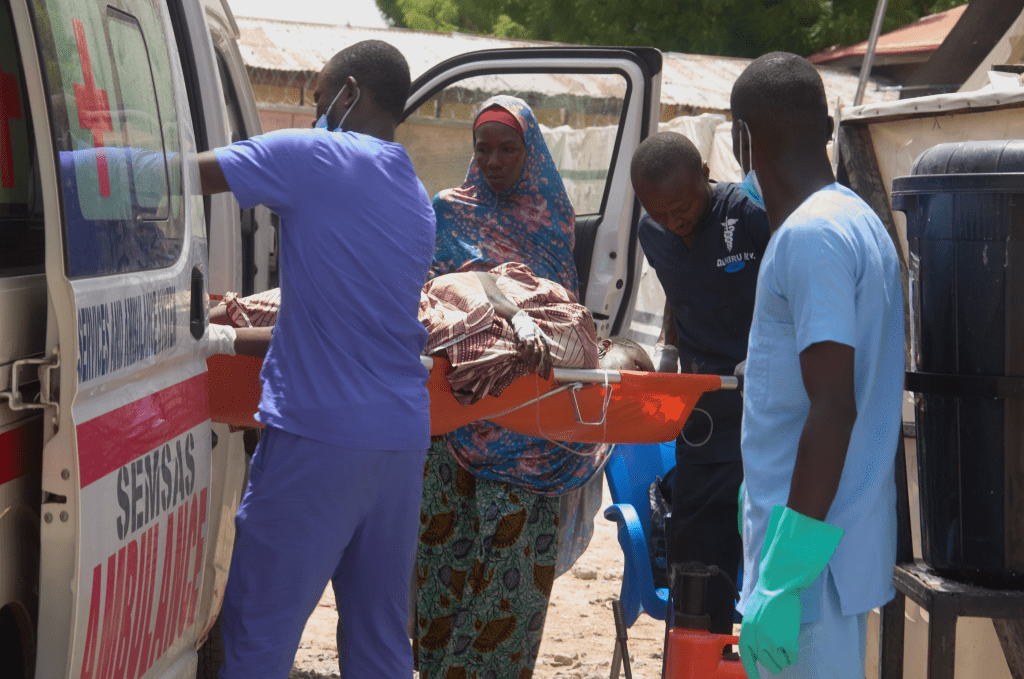
A cholera patient is being carried into a waiting ambulance at an MSF facility by health workers in Maiduguri on Monday, June 8. Photo: Jude Mike/AP.
The disease is not new to communities along the Lake Chad shoreline. In 2018, the Borno State Ministry of Health recorded 502 cases and one death across Baga, Doro, and Kukawa wards. Doro accounted for the highest burden, with 254 reported cases. Response efforts at the time involved the Ministry of Health, WHO, and the Alliance for International Medical Action (ALIMA). Six years later, residents of Doron Baga say many of the conditions that enable cholera transmission remain unresolved.
Access to healthcare remains limited, many households depend on self-built water sources, and sanitation challenges persist in parts of the community.
Unlike many urban households, Ahmadu’s home is a large family compound that functions almost like a small settlement. At its centre is a manually operated hand pump, and near the entrance sits an open well. Built by the family years ago, the two sources continue to supply most of the household’s water needs. “Our main source of drinking water is the hand pump and the open well,” Ahmadu told HumAngle.
The compound also relies on pit latrines. Each household maintains its own facility, while another serves as a communal latrine for residents and visitors.
The source of the infection has not been established. But in a compound where dozens of people share water sources and common spaces, many residents may have been exposed to the same source of contamination. The outbreak also comes during the rainy season, a period when cholera cases often increase as flooding and runoff can contaminate drinking-water sources.
From Maiduguri to Lake Chad
The outbreak that has now reached Doron Baga began hundreds of kilometres away in Maiduguri, where it was first detected in early May. Health authorities had reported more than 2,700 suspected cases and 39 deaths across eight LGAs by mid-May, with Maiduguri Metropolitan Council recording the highest burden.
The spread, according to the international medical humanitarian organisation Médecins Sans Frontières (MSF), overwhelmed treatment facilities, prompting an emergency response from the state government and humanitarian organisations.
As the days went by, the numbers continued to climb. By June 7, Borno had recorded 7,850 suspected cases and 74 deaths across 14 local government areas, according to figures cited by MSF and state health authorities. MSF alone said it had treated 7,439 patients between May 1 and June 7.
To contain the outbreak, the Borno State Ministry of Health and Human Services said it is implementing emergency health measures, improving sanitation, and increasing public awareness. In addition, humanitarian organisations such as MSF and Save the Children have activated emergency responses that include cholera treatment centres, oral rehydration points, surveillance, hygiene promotion campaigns, and water, sanitation, and hygiene interventions. MSF expanded treatment capacity in Maiduguri and opened additional cholera treatment units as admissions surged.
At the height of the outbreak, between June 5 and 7, MSF reported treating as many as 500 patients in a single day. Another organisation, Save the Children, said it was responding to more than 7,000 suspected cases reported across the state. The Nigerian Red Cross also supported awareness campaigns, case management, community sensitisation, and emergency response activities.
For weeks, the outbreak appeared largely concentrated in and around Maiduguri and other major population centres. Then it reached Doron Baga.
An MSF nurse carrying a patient with suspected cholera out of a facility in Maiduguri. Photo: Merel van de Geyn/MSF.
The unfinished work of recovery
As cases spread through Doron Baga, residents and health workers say longstanding challenges in healthcare, water access, sanitation, and public infrastructure have complicated efforts to contain it.
Many residents did not consider the local health facility a realistic option. When HumAngle asked why his family did not immediately seek treatment at the hospital, Ahmadu laughed. “Hospital?” he asked. “Do you expect us to take our sick relatives to a hospital without doctors and drugs?”
Residents say the Doron Baga Primary Healthcare Centre suffers from chronic shortages of personnel and medicines. “There are no staff, too,” Bashir said. “Those coming from Baga don’t spend more than an hour.” As a result, many families depend on patent medicine stores as their first source of treatment.
Get our in-depth, creative coverage of conflict and development delivered to you every weekend.
Subscribe now to our newsletter!
The nearest alternative is Baga town, but the cost of transportation, combined with the expense of purchasing prescribed medicines, often places formal healthcare beyond the reach of many households. “We usually take sick relatives to Baga,” Ahmadu said. “However, we did not take these ones there because it is expensive.”
Residents’ complaints come despite years of government investments aimed at improving healthcare services in the area. During a visit to Baga in July 2023, Borno State Governor Babagana Zulum ordered the rehabilitation of the Baga General Hospital and Doro Primary Healthcare Centre. Residents confirmed that the rehabilitation was carried out.
More recently, in May, Kukawa Local Government Chairperson, Mustapha Kukawa, distributed drugs to healthcare facilities across the LGA and warned against the diversion or mismanagement of medical supplies. At the state level, the Executive Secretary of the Borno State Contributory Healthcare Management Agency (BOSCHMA), Saleh Abba, said on June 4 that the agency had disbursed more than ₦400 million to 171 primary healthcare centres and nine secondary health facilities providing free treatment to vulnerable persons across Borno.
Yet residents of Doron Baga say shortages of staff and medicines persist, raising questions about the extent to which investments in infrastructure, medical supplies, and healthcare financing are translating into accessible services in some resettled communities.
Their concerns reflect a broader pattern documented across conflict-affected communities in Borno. In 2023, HumAngle reported that residents of Kirawa, a resettled border town in Gwoza LGA, frequently crossed into neighbouring Cameroon to access healthcare services. In 2024, residents of Baga and Dalori, another resettled community in the Konduga LGA, similarly complained about inadequate drug supplies and limited healthcare services. That same year, a Premium Times investigation found that despite significant investments in rehabilitating primary healthcare facilities across rural Borno, many communities continued to struggle with staffing shortages and inadequate medicines.
Together, these accounts suggest that while reconstruction has improved physical infrastructure in many communities, ensuring consistent access to healthcare workers, medicines, and essential services remains a challenge in parts of the state.
The primary healthcare centre in Doro was reconstructed two years ago, but the residents say the facility lacks adequate medicine and staff. Photo: Umar Ahmad.
Faced with these realities, many residents turn to informal healthcare providers. One of them is Kasim Muhammad Auwal, a patent medicine vendor and community health worker who has operated in Doron Baga since the community was resettled.
“I have recorded 40 cases so far,” Kasim said. “Most have recovered. Four have died.”
Kasim holds a diploma in community health from the College of Health Technology in Maiduguri and believes that sanitation may also be contributing to the outbreak. “One major thing I have observed is increasing open defecation in the community,” he said. “This, I suspect, is the leading cause.”
According to him, the practice is particularly common among children, residents living on the outskirts of the settlement, and visiting fishermen from neighbouring communities.
Public health research supports concerns about the relationship between water, sanitation, and cholera transmission. The WHO identifies contaminated drinking water and inadequate sanitation as major drivers of cholera outbreaks, while studies have linked unprotected wells and poor sanitation practices to increased infection risks.
Like Ahmadu’s household, many residents rely on self-built infrastructure, including open wells and manually operated pumps, to meet their daily water needs. Although these sources may serve communities for years, they can become significant public health risks during disease outbreaks. Studies consistently show that communities dependent on untreated water and limited sanitation infrastructure face a higher risk of waterborne diseases.
Children fetch water at a manually operated pump in the Randa area of Doron Baga. Photo: Umar Ahmad.
As cases spread through the community, humanitarian organisations also began carrying out preventive measures. Residents said volunteers from the Nigerian Red Cross and other organisations had conducted sensitisation campaigns, educating households about cholera symptoms, hygiene practices, and ways to reduce transmission.
A Red Cross volunteer in Kukawa confirmed that awareness activities were ongoing in the community but declined to comment officially, saying he was not authorised to speak on behalf of the organisation.
As of June 23, residents said new suspected cases were still being recorded in the community and that additional deaths had occurred in recent days, indicating that the outbreak had not yet been fully contained. They also said at least 11 patients were receiving treatment at the Doro Primary Healthcare Centre. HumAngle could not independently verify a community-wide death toll.
Residents say most of the staff at Doro Primary Healthcare Centre come from Baga, a town three kilometres away. They leave by 3 p.m. and the burden of catering for the sick falls on volunteers and patent medicine vendors. Photo: Umar Ahmad.
For many residents, the persistence of new cases points to challenges that extend beyond emergency response efforts. Community leaders like Ahmadu say the conditions facing Doron Baga are rooted in a longer history of conflict, displacement, and uneven recovery.
The community was among several settlements around Lake Chad that were emptied by years of insurgency before residents gradually returned under the state’s resettlement programme. Yet rebuilding communities after conflict involves more than restoring security. Across Borno State, reconstruction projects have frequently been disrupted by insecurity, while healthcare, water, and sanitation infrastructure have not recovered at the same pace as population returns.
Studies of recurrent cholera outbreaks in northeastern Nigeria have identified weak water infrastructure, sanitation gaps, poverty, displacement, and fragile health systems as recurring risk factors. Researchers argue that outbreaks often reveal deficiencies that remain hidden until disease transmission occurs.
In Doron Baga, the current outbreak has done exactly that.
It was midnight on April 12 when Modu Baluye woke to the sound of gunfire.
He was asleep with his family inside a classroom at Government Girls’ Secondary School (GGSS), in Monguno, Borno’s north, in northeastern Nigeria, which now serves as a temporary displacement camp, when the first shots rang out. Then came another burst, and another, cutting through the night in rapid succession.
“These people are attacking again,” he remembered saying.
He whispered a prayer and stayed awake. Around him, other displaced families were stirring as well. In the darkness, people listened without speaking, measuring the distance of the violence by the sound of the guns. The attack went on for hours.
By Modu’s account, the gunshots lasted about four hours. He later learned it was a gun battle between terrorists and military officers at the nearby Sector 3 base. As the troops pursued the terrorists along the exit route between Gana Ali, another displacement shelter, and the GGSS, they drove over buried explosives, which detonated and killed the commanding officer and six other soldiers.
By morning, fear had settled over the communities.
The military, residents said, became suspicious of the settlements around the base. The attackers had entered on foot under the cover of darkness, and the communities were not far from the military formation.
“They suspected we were hiding some of them,” Modu said. In the days that followed, soldiers raided Gana Ali and the GGSS camp. Residents told HumAngle that five suspected informants in the communities were arrested, and weapons were recovered. Then came an order for the communities to leave.
“They told us: leave or we will kill you all and burn down your houses,” Modu recounted. Within two days, families began dismantling their makeshift shelters. They packed what they could carry and left. Some were moved to a government settlement on the outskirts of Monguno, along the Monguno-Gajiram road, which is about a 30-minute walk from town.
“It is two weeks today,” Modu said when he spoke to HumAngle on May 10. “The place was torched after we left. I am not sure who torched the buildings.”
For Modu, displacement is not new. He fled Ala, his village in the Marte Local Government Area (LGA) of the state, in 2016 as insurgent violence spread across northern Borno. At the time, he was unmarried and found refuge with his parents at the ‘Water Board’ displacement camp in Monguno, where they lived for about six months. He later moved to the GGSS settlement after securing his own shelter and spent nearly a decade there. In 2024, he got married. By the time soldiers ordered residents to leave the community in April, he had begun building a mud house on a piece of land he purchased the previous year. It was there, in the unfinished house, that he and his family began rebuilding their lives after years of displacement.
A war returning to the bases
The Monguno attack came during a renewed wave of terror assaults on military formations and rural settlements across Borno.
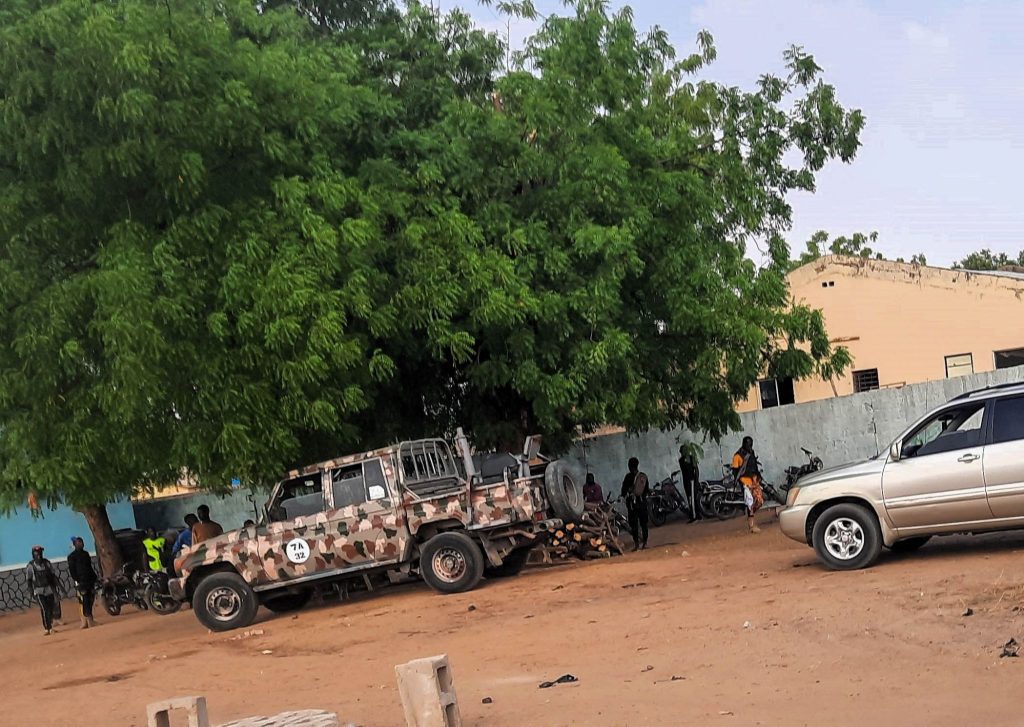
File: A military patrol vehicle with personnel parked outside a Civilian Joint Task Force office in Maiduguri. Photo: Kunle Adebajo/HumAngle.
In recent months, terrorists from Jama’atu Ahlis Sunna Lidda’awati wal-Jihad (JAS), commonly known as Boko Haram, and the Islamic State West Africa (ISWAP) have repeatedly targeted troops, bases, weapons, and supply routes. The attacks have killed soldiers, including senior military officers, and Civilian Joint Task Force (CJTF) members.
In Nov. 2025, terrorists ambushed a military convoy along the Damboa-Biu road. Two soldiers and two CJTF members were killed. Brigadier-General M. Uba, commander of the 25 Task Force Brigade, was abducted and later killed.
On Jan. 26, terrorists attacked a military base in Damasak, killing seven soldiers and capturing 13 others, including the commanding officer. Eleven later escaped. Five days later, on Jan. 31, another terror attack on an army base in Sabon Gari killed nine soldiers and two CJTF members; about 16 injured security personnel were evacuated for treatment.
On March 10, a military base in Kukawa came under attack; the commanding officer, Lt. Col. Umar Farouq, and several of his soldiers were killed.
On April 9, three days before the Monguno attack, terrorists launched a joint assault on the headquarters of the 29 Task Force Brigade in Benisheikh, killing its brigade commander, Brigadier-General Oseni Braimah.
The attacks have already weakened the military formations in rural areas. In some places, troops have withdrawn or consolidated around larger garrison towns, leaving smaller settlements more exposed. But when soldiers are killed, residents say the anger does not end on the battlefield. It returns with the troops.
The Nigerian Police officers at the scene of an explosion at the Maiduguri Monday Market in March. Photo: Al’amin Umar/HumAngle.
The trails of suspicion
In rural Borno, civilians are often trapped between two armed powers. Terrorists demand information about troop movements, military positions, and security operations. Soldiers, in turn, demand information about insurgent hideouts, movements, and informants. Refusing either side can be deadly.
Those suspected of helping the military may be abducted or killed by the terrorists. Those suspected of helping terrorists may be arrested, detained, displaced, or punished by security forces. As a result, civilians often face impossible choices, with serious consequences regardless of whom they cooperate with.
Get our in-depth, creative coverage of conflict and development delivered to you every weekend.
Subscribe now to our newsletter!
Despite these risks, communities have at times provided intelligence to the military. In March, for example, residents of Doro, a rural community in Kukawa LGA on the shores of Lake Chad, reportedly alerted troops after observing suspicious insurgent movements, helping security forces prepare for an attack.
The consequences of such actions can be severe. In March 2022, ISWAP executed four civilians in communities within the same local government area after accusing them of spying for government troops. Residents said the killings were intended to deter others from sharing information with security forces. For many civilians, the message was clear: speaking to the military could carry a death sentence.
The Chief of Defence Staff (CDS), Gen. Olufemi Oluyede, recently argued that residents in Borno and Yobe knew some of those behind the attacks during an operational visit to Maiduguri in March, reflecting a long-held security assumption that residents in affected communities often know more than they admit. The CDS said communities must take ownership of the crisis, citing Kukawa, where he claimed two of the attackers were from within the village.
But for many civilians, knowing does not mean consenting. They say in places where terrorists move freely, buy food, collect supplies, and threaten residents, silence is often a currency for survival.
Professor Abubakar Mu’azu, former director of the Centre for Peace, Development, and Diplomatic Studies at the University of Maiduguri, said this suspicion has existed since the early years of the insurgency.
“Right from the start, there was suspicion by the security agencies that the people who are living in areas where these terrorist activities were happening are also supporting the terrorists,” he said. “They never considered the fact that there is a majority of people who disagree with these terrorists’ activities.”
Mu’azu said the reactionary nature of security operations has prevented the military from building a reliable system of trust with local communities.
“They assume that the locals are giving information to the terrorists willingly,” he said. “But they keep saying they want the people to give them information about the terrorists.”
For him, this contradiction is at the heart of the crisis.
The military needs civilian intelligence to fight terrorism, but if civilians fear that any contact with terrorists, even under duress, will be treated as collaboration, they may stop speaking altogether.
File: Men seated, playing a game on a smartphone in an IDP camp in Maiduguri. Photo: Usman Abba Zanna/HumAngle.
Life under duress
In Monguno, residents say terrorists still move in and out of town despite the presence of security forces.
Koso Abubakar, a displaced farmer, said the terrorists often enter on motorcycles, buy food items, and leave.
“They come and leave at will,” he said. “Sometimes, they come to kidnap people. They don’t attack the military, and the military does not confront them. But on other days, they attack the military. That is when the military retaliates.”
According to Koso, most residents live with the knowledge that they can be accused by either side at any time.
“People are living in fear because everyone is a potential target,” he said.
In many rural communities, even work has become dangerous. A farmer going to his field, a fisher heading towards the water, or a trader moving goods through bush paths may first have to pay those who control the routes. The payments are called taxes, levies, or sometimes simply “settlement”, but residents understand what they are: money paid under fear. To refuse is to risk punishment, in lighter cases, or killing and abduction, in extreme cases, from terrorists. To pay is to risk being seen by soldiers as someone sustaining the insurgency. In this way, even the small acts people perform to feed their families can become evidence against them.
Farmers handing over money to armed and masked terrorists in a rural setting. Illustration: Akila Jibrin/HumAngle.
Professor Mu’azu said this fear terrorists use violence to discipline communities.
“They are very good at setting a very deadly example by killing or eliminating people, with or without evidence,” he said. “If they are attacked by security agencies and they did not hear anything from people living in these settlements, they would assume the people gave information about their positions.”
This was what many residents believe happened in Ngoshe in March, when terrorists attacked the community, killed many residents, and abducted others, including women and children. The attack was suspected to be retaliation for a previous military operation in the Mandara Mountains that killed some terrorist commanders. The terrorists reportedly believed residents had given up their location.
For civilians, the lesson is brutal: giving information can kill you. Not giving information can also kill you.
When protection becomes punishment
The military has long accused some civilians of aiding terrorists. In the early years of the war, many young men were arbitrarily detained. Some disappeared. Some were killed. In April 2014, soldiers arrested 42 adult men from Gallari, a village in the Konduga LGA of Borno, on suspicion of links to the insurgency. They were taken to the Giwa Barracks detention facility in Maiduguri. Twelve years later, only three have regained their freedom after years in detention and alleged torture. Through months of on-the-ground investigation and analysis of satellite imagery, HumAngle has also previously reported on disappearances and mass graves linked to military operations, while the wives of detained and disappeared men later formed the Knifar Women movement to demand justice.
Terrorists and suspected civilian collaborators arrested by the military. Illustration: Akila Jibrin/HumAngle.
For communities already carrying the memory of those years, new raids and forced evacuations reopen old wounds.
Mu’azu said security forces should approach communities with more care, especially when allegations of collaboration arise.
“One would assume that when security forces are dealing with situations like this, they would not come with the mindset that the people are sympathetic to the terrorists, or that all the people are giving information to the terrorists,” he said.
He added that soldiers have a difficult job and deserve sympathy for the burden they carry. But he argued that this does not justify indiscriminate punishment.
“They are the ones who are supposed to protect the civilians,” he said. “If there are people they suspect, they should arrest them and hand them over to the police for proper investigation, without compromising the little support they have in the community.”
When communities are burned or displaced after attacks, the consequences go beyond the immediate loss of shelter. Food stocks disappear. Children are pulled out of school. Families scatter. People who had already fled violence once are forced to flee again.
In resettled or displaced communities, where people have spent years coping, another displacement can mean the collapse of everything they had slowly rebuilt.
A dangerous silence
After the Monguno raid, Koso said some residents became so afraid of the military that they fled into the bush.
“Many people, about 30, also left for the bush,” he said. “Most of them fear the military. The military does not trust them.”
Mu’azu warned that this kind of fear can damage counterterrorism efforts.
“They will lose trust, respect, and block chances of receiving information,” he said. “This could also push them to be recruited by the terrorists.”
For Mu’azu, the solution is not to abandon intelligence work, but to make it safer and more systematic. He said the military should cultivate trusted informants within communities, create secure channels of communication, and protect residents when terrorists retaliate.
“This is the gap,” he said. “Oftentimes, communities are attacked after successful military operations. The patterns should be studied. They should do a statistical analysis. They should be mindful of the time and be prepared against such actions.”
He also called for stronger collaboration among the military, DSS, police, civil defence, and intelligence agencies in neighbouring countries such as Cameroon, Chad, and Niger, because terrorists move across borders.
But for Modu and others displaced from Gana Ali and the GGSS, these policy questions remain distant. What they know is simpler: they fled one danger and met another. They were told to leave the place they had made into a home. Then they watched, or heard, that what remained had been burned.
In Borno’s war, civilians are often asked to prove their loyalty to the state while surviving under the shadow of terrorists, and in that narrow space between fear and suspicion, many are losing everything.
Nigerian troops say they have rescued 360 people abducted during a deadly terrorist attack on Ngoshe, a resettled community in Gwoza Local Government Area of Borno State, northeastern Nigeria, more than three months after terrorists overran the town, killing residents and forcing thousands to flee.
Solomon Ali Talake, a primary school teacher and survivor of the March 3 attack, said community members had received information about the rescue.
“I was told they have been rescued,” Solomon told HumAngle on Sunday. “Families have been informed, but they have not allowed us to see them yet. They said they are assessing them and will release them to their families afterwards.”
The March 3 attack on Ngoshe was one of the deadliest assaults on a resettled community in southern Borno in recent months. Residents said the attackers first struck a military formation in the town before moving into the community. Homes were set ablaze, civilians were killed, and hundreds of residents were reportedly abducted.
Solomon survived by hiding in a tree throughout the night while the attack unfolded beneath him. From his hiding place, he watched as gunmen moved through the community, burning houses and pursuing fleeing residents.
The attack displaced thousands of people, many of whom fled to Pulka, a neighbouring community about 12 kilometres away. Others sought refuge in Maiduguri, Cameroon, and other locations. The exact number of people killed or abducted remains disputed. While some media reports estimated that about 100 people were killed and more than 300 abducted, residents told HumAngle that the scale of the attack made precise figures difficult to establish. Victims were later buried in a mass grave, according to survivors.
Among those abducted were two of Solomon’s nephews, aged 14 and 11. On Sunday, he said he had not yet been able to confirm whether they were among those rescued.
Asabe Ali Talake, Solomon’s sister and the children’s mother, also said she had received reports of the rescue but remained uncertain about the fate of her children.
Asabe said she was still waiting for confirmation from authorities. Relatives of the freed victims say communication with them remains restricted while security agencies conduct assessments.
Military authorities typically screen and profile people freed from insurgent-controlled territories before reuniting them with their families. The process is intended to establish identities, assess physical and psychological conditions, and determine whether further investigation or rehabilitation may be required.
This comes amid a broader wave of insecurity affecting communities across Borno State. In recent months, terrorists have launched repeated attacks on military formations, reconstruction projects, and resettled communities, raising concerns about the sustainability of government resettlement efforts in conflict-affected areas.
Part of a broader rescue effort
A politician from Gwoza, who spoke to HumAngle on the condition of anonymity because he was not authorised to discuss the matter publicly and who was involved in advocacy efforts for the victims’ release, claimed a ransom was demanded for the release of the victims. HumAngle could not independently verify the claim, and the military has not publicly indicated that any negotiations took place.
This development is the latest in a series of operations by troops of Operation Hadin Kai targeting terrorist enclaves in the Mandara Mountains and surrounding areas.
Three days earlier, troops rescued a woman and her infant child after killing several terrorists. On May 1, troops rescued six abductees during an operation around the Mandara Mountains. Six more victims were rescued on May 14. In April, 12 victims, including men, women, and children, escaped during a military operation targeting a terrorist camp.
The latest operation, however, represents the largest reported release linked to the March 3 attack on Ngoshe, offering renewed hope to families who have spent months waiting for news of their relatives.
While military authorities described the operation as a rescue, questions remain about how the victims regained their freedom.
Nigerian troops have rescued 360 people abducted during a terrorist attack on the resettled community of Ngoshe in Gwoza, Borno State, over three months after the attack.
The March 3 assault was one of the deadliest, with homes destroyed, civilians killed, and hundreds taken hostage, displacing thousands to nearby areas.
Survivors like Solomon Ali Talake reported receiving news of the rescue, though they have yet to reunite with the freed individuals, including his nephews. Authorities are evaluating the rescued individuals before reuniting them with their families to ensure proper identification and assess any need for rehabilitation.
The rescue is part of broader operations by Operation Hadin Kai aimed at dismantling terrorist strongholds in the region.
Get our in-depth, creative coverage of conflict and development delivered to you every weekend.
Subscribe now to our newsletter!
A local politician suggested a ransom was involved, though this remains unverified. This largest reported rescue related to the Ngoshe attack provides hope to families anxiously awaiting news of their loved ones.
In the previous episode of Vestiges of Violence, we told the story of Bintu Suleiman, whose daughters and grandchildren were abducted during the attack on Ngoshe, northeastern Nigeria, on March 3, 2026. She was still waiting for news, still hoping for their return.
Now, we have some updates.
In this episode, her 16-year-old daughter, Aisha Muhammad Shuaibu, has escaped captivity after spending a period of two months and two weeks with the terrorists. She returned home carrying her four-year-old nephew on her back.
She shared with HumAngle what happened to her in captivity and how she escaped.
Reported by Sabiqah Bello
Voice acting by Rukayya Saeed and Khadijat Isah Baka
Multimedia editor is Anthony Asemota
Executive producer is Ahmad Salkida
In a recent update on the Vestiges of Violence series, Aisha Muhammad Shuaibu, aged 16, managed to escape after being held captive for over two months during a terrorist attack in Ngoshe, northeastern Nigeria. Aisha returned with her young nephew, offering insights into her experiences and escape strategy. The episode is reported by Sabiqah Bello, with voice acting by Rukayya Saeed and Khadijat Isah Baka, multimedia editing by Anthony Asemota, and executive production by Ahmad Salkida.
Across northeastern Nigeria, former Boko Haram insurgents now move with Nigerian troops into forests they once controlled. They identify footpaths that insurgents use after attacks, point out where improvised explosive devices are most likely buried beneath soft sand roads, and decode habits, voices, and movement patterns invisible to the average soldier. They explain how camps are structured during the rainy season and identify commanders at a distance. Some of these ex-insurgents die in combat fighting the same insurgency they once served.
One of the first such defectors was Abubakar Umar from Bama in Borno State. Soldiers called him Small and say he was presumably in his mid-20s when he died in 2023. Before then, he had fought on the frontlines of multiple operations across Sambisa, Timbuktu, and the Lake Chad basin.
Before surrendering, Small spent years in the insurgency as a Naqeeb, a low-ranking fighter, enabling him to know the terrain intimately. By the time he defected to the Nigerian Army, he already knew which routes disappeared under floodwater during the rains, where insurgents buried weapons before abandoning camps, and how insurgents escaped after raids. He understood the logic behind ambushes because he had once planned and carried out attacks against the same army he would later fight beside.
Others followed a similar path. Among them was Zakariyya from Pulka in Gwoza, another ex-insurgent who later supported military operations across Borno and Yobe. He died in late 2025.
At first, many soldiers distrusted them, especially as some of them had lost close friends and colleagues to Boko Haram attacks. For them, accepting a former insurgent carrying a rifle beside them was never easy. Operation after operation changed the relationship, however. According to military sources familiar with the missions, Small and Zakariyya repeatedly identified patterns that helped troops avoid deadly traps and ambushes. With time, commanders began listening whenever they spoke.
Then came a particular operation deep inside Sambisa in 2023. Small moved ahead of the troops in a way one soldier later described to HumAngle as “fearless, almost reckless,” as though death no longer frightened him, having already crossed too many moral boundaries to fear its arrival. He never returned.
Ex-surgents who defected and were actively engaged in combat against Boko Haram. Late Abubakar Umar “Small” is seen in the middle in this file photo.
The soldiers who survived that operation spoke about him afterwards with the kind of tone usually reserved for men buried in decorated military uniforms.
There are many stories like this now scattered across the northeastern region–former insurgents fighting alongside the state.
From the islands and marshes of Lake Chad to the forests of Zamfara, Sokoto, Kaduna, Niger, Kebbi, and the roads stretching toward Kwara, Nigeria is confronting a conflict system that has changed shape. In response, security forces are increasingly turning toward defectors.
The unseen war
For years, the Nigerian state has made progress against the Boko Haram war. When villages like Bama and Gwoza fell to the terror group, the military reclaimed them very quickly. They have also killed commanders over time, while still exploring non-kinetic approaches that made it possible for insurgents to surrender. Through this approach, defections occurred at an unprecedented rate.
Boko Haram fractured internally as ISWAP consolidated its presence in parts of the Lake Chad Basin. Many did not want to remain in the Lake Chad theatre, but they also did not trust a formal surrender to Nigerian authorities, so some of them moved to other parts of Nigeria.
HumAngle has tracked the movement of former Boko Haram elements to the North West region and parts of central Nigeria as far back as 2020. Some joined criminal armed groups, others became trainers, bomb makers, couriers, informants, guards, or logistics brokers. Others disappeared into cities following the death of Abubakar Shekau and clashes between factions within the group.
In Kano and several urban areas, defectors and affiliates blended into urban life. Some became labourers, mechanics, phone repairers, commercial drivers, or petty traders. Some drifted into robbery and informal criminal economies, while others married and completely concealed their past.
This creates a difficult security dilemma for many reasons. How does a state track men who have left the insurgency but not entered any formal process? How does it distinguish between a deserter seeking anonymity and one rebuilding operational networks elsewhere? How does it protect communities without criminalising everyone who once lived under insurgent rule?
Nigeria has not answered those questions through a coherent national framework. Instead, it improvises.
The intelligence war nobody sees
When HumAngle spoke with soldiers and intelligence officers who served in the North East, their language was different. They do not romanticise former Boko Haram insurgents nor do they describe them as heroes, but they call them assets.
Before defectors became operationally useful, troops often entered unfamiliar terrain with insufficient intelligence from local hunters, the civilian joint task force, and satellite imagery. Equipment like drones and maps was useful but had limitations, as it could not predict movement patterns or likely landmines. Former insurgents helped dismantle part of that advantage. According to several defectors interviewed for this report, many military successes now depend partly on information provided by them.
“Whenever soldiers go for operations,” one explained, “some of us move ahead because we know the roads, the bushes, and where bombs are planted. We tell them which road not to use.”
Another former insurgent described how they identified hidden weapon caches and camp positions.
“Some of us know where weapons were kept. So when operations happen, we guide soldiers directly to those places.”
Get our in-depth, creative coverage of conflict and development delivered to you every weekend.
Subscribe now to our newsletter!
They also described helping troops understand insurgent movement patterns after attacks.
“When fighters escape,” one said, “we know the routes they use because we ourselves used those routes before.” The source added, “We advised soldiers to evacuate the women and children left behind by fighters to Maiduguri, which encouraged a lot of the fighters to defect from the group easily at a later date.”
The moral fracture
For victims, however, these battlefield contributions rarely erase memory. A widow whose husband was executed does not easily accept that the man who once terrorised her community now works alongside soldiers. A farmer whose village was burned does not find emotional comfort in hearing that a former insurgent helped identify buried bombs. A displaced family living with hunger in an abandoned resettled community does not easily understand why former insurgents appear to receive rehabilitation support while survivors struggle alone.
That anger has become one of the deepest unresolved tensions inside Nigeria’s reintegration strategy. Many affected communities perceive former insurgents as receiving privileges unavailable to victims. Some surrendered members received food support, accommodation, vocational training, phones, stipends, or reintegration assistance. Meanwhile, many survivors still live with displacement, trauma, hunger, unemployment, grief, and insecurity.
Infographics: Akila Jibrin/HumAngle.
One former insurgent described how resentment intensified after communities observed rehabilitated insurgents riding motorcycles, carrying weapons alongside soldiers, wearing jeans and clean clothes, and moving relatively freely.
“What happened was mostly hatred and resentment,” he said. “People saw the boys looking comfortable and became angry.”
Kabiru Adamu, the Managing Director of Beacon Consulting, comments on this imbalance. “When we look at this from a transitional justice perspective,” he said, “the current imbalance is a significant vulnerability.”
According to him, communities may interpret reintegration programmes as rewarding violence while neglecting victims.
“If the state appears to reward insurgency while neglecting victims, it breeds a deep sense of injustice. Unaddressed grievances are the primary fuel for cyclical violence.”
Former insurgents speak
The former insurgents interviewed by HumAngle described themselves not as forgiven men, but as useful men. “There are those who go to war,” one former fighter said, “And there are informants.” He explained that some maintain communication with active insurgents and relay intelligence to security agencies.
“If attacks are being planned, information is passed quickly to intelligence officers so security can be strengthened.”
Others described identifying civilians secretly supplying insurgents with food, fuel, or information. “There are people in town transporting petrol, food, and information,” one explained. “Those who surrendered know many of them because they worked together before.”
According to the former insurgents, these intelligence networks disrupted insurgent logistics and prevented attacks. Some defectors also described participating directly in combat operations.
“They gave some of us motorcycles and guns,” one said. “Sometimes, operations happen without soldiers even accompanying us.”
Another described units led by surrendered insurgents moving independently through forests to intercept attacks or recover weapons.
“Some commanders are given twenty or thirty motorcycles and sent to carry out patrols,” he said. “They stop attacks and return with captured weapons… Nearly 40 per cent of ground troops’ successes achieved in the past three years in this war come from the contribution of surrendered fighters.”
HumAngle cannot independently verify this claim. Still, several military and intelligence sources who spoke to HumAngle on the condition of anonymity admit that defectors remain useful in operations. What is less clear is whether relying on them will be safe or sustainable in the long run.
Security expert Kabiru Adamu described former insurgents as “force multipliers” rather than the decisive force behind military gains. According to him, conventional military operations, air power, and the Civilian Joint Task Force remain central to weakening insurgent networks.
“Ex-fighters provide precision,” he explained. However, he warned that the strategic dangers remain severe. “The risks include infiltration, double agents, human rights concerns, institutional degradation, and loss of civilian trust.”
The risk of dependence also concerns some analysts and security officials. If military units become too reliant on defectors for intelligence, what happens when defectors lie, or when personal grudges shape accusations, or when former insurgents return to active criminal networks or, as in some cases, return to Boko Haram carrying sensitive operational knowledge? What happens when military institutions fail to build independent intelligence systems because surrendered insurgents appear easier to use?
The northwestern region is quite different from the North East. Boko Haram and ISWAP emerged through ideological insurgency structures combining theology, coercion, governance, taxation, and violence. In contrast, the armed groups in the northwestern region emerged differently, engaging in criminal activities such as cattle rustling, communal conflict, illegal mining, vigilante reprisals, extortion, kidnapping, and governance collapse.
Yet over time, the distinction blurred. Armed groups across Zamfara, Sokoto, Katsina, Kaduna, Niger, and Kebbi increasingly adopted tactics associated with insurgent warfare: IEDs, ambushes, and rural territories being subject to armed taxation systems.
Abubakar Abdullahi, a journalist who has reported extensively from Zamfara, said Boko Haram-linked elements have become increasingly visible inside parts of the northwestern region.
“In areas such as Dutsin Maiqardaji mountain,” he said, “Boko Haram members have a heavy presence. Both Lakurawa and Boko Haram terrorists preach to residents they keep under siege in ungoverned spaces. Ongoing armed operations in the North East pave the way for fighters to find Zamfara as a haven,” he explained.
Therefore, the state’s decision to use surrendered insurgents in counterinsurgency operations across parts of the northwest follows a grim internal logic.
Trauma beneath the surface
The psychological burden of the insurgency now stretches across an entire generation. In Maiduguri, Monguno, Bama, Dikwa, Gwoza, Damboa, Pulka, Banki, and dozens of smaller communities scattered across Borno and the wider Lake Chad region, trauma shows up in ordinary routines. Some people report waking suddenly at night whenever motorcycles pass too quickly outside their compounds. Parents instinctively gather children indoors whenever rumours of attacks on nearby roads spread. Men who once farmed freely now calculate distance from military formations before deciding whether land is safe enough to cultivate.
For many survivors, peace itself feels temporary.
Kauna Malgwi, a clinical psychologist directly affected by the insurgency during its early years, described northeastern Nigeria as a society living in a prolonged psychological survival mode.
“Prolonged violence keeps societies in chronic hypervigilance,” she explained. “People shift from acute stress into collective survival mode. Nervous systems remain activated for years. Unresolved trauma normalises fear, weakens communities, and erodes cohesion. Ongoing violence keeps trauma active and prevents healing.”
The effects appear everywhere: overcrowded displacement settlements, classrooms where children struggle to concentrate because conflict has interrupted the normal architecture of childhood, families where fathers withdraw emotionally after years of violence, and young men who have grown up around guns, funerals, military convoys, and uncertainty.
“Children in chronic conflict develop emotional, learning, and behavioural problems that, if unaddressed, persist into adulthood and become the generational norm,” Malgwi warned
She listed the consequences as cycles of violence, emotional detachment, chronic anxiety, educational disruption, social mistrust, difficulty forming secure relationships, and increased vulnerability to recruitment by armed groups.
“If trauma among children is ignored,” she warned, “national stability itself is at risk. Peacebuilding that ignores collective healing produces fragile and temporary peace. When victims feel forgotten as ex-fighters are supported, trauma deepens and trust in institutions erodes. Forgiveness must not be forced. Communities require safety and acknowledgement before reconciliation.”
According to her, communities need public acknowledgement of suffering before reintegration can become emotionally sustainable.
“Victim-centred support systems are essential. Communities need visible justice, visible care, and transparent communication before trust can begin to recover.”
She also warned about the development of emotional desensitisation among conflict-affected populations.
“Without support, grief becomes anger or despair,” she explained. “Violence itself can become normalised.”
Many young people in northeastern Nigeria have never experienced sustained normalcy. They grew up hearing stories about massacres the way previous generations heard folktales. They learned directions through checkpoints and geography through displacement.
Kauna Malgwi believes recovery in such environments cannot depend solely on psychiatrists or formal hospitals because the scale of trauma is too large.
“Community healing includes training community health workers in psychosocial support, group therapy, trauma-informed schools, faith-based healing spaces, and safe storytelling forums,” she explained, stressing the importance of collectively restoring dignity. “The goal is not only treatment. The goal is restoring function, trust, and resilience across society.”
For many survivors, however, the war never became a discussion about tactical adaptation. It remained personal. A missing daughter. A burned house. A father was executed beside a road. A child was buried after an explosion and nights of screaming.
A life divided permanently into before and after.
The state’s impossible calculation
For Kabiru Adamu, the question is not whether the state should use former insurgents operationally. The deeper issue is whether Nigeria can do so without weakening its own legitimacy. He described the current approach as a fragile balancing act between military necessity, transitional justice, and social stability.
“The Nigerian military faces a highly asymmetric threat,” he said. “Using former fighters offers distinct immediate operational advantages because these individuals possess granular, real-time intelligence. They know Sambisa Forest, the Mandara Mountains, the Lake Chad islands, and the internal communication structures of factions like JAS and ISWAP.”
Still, he repeatedly returned to the dangers. “The strategic risks are severe and multifaceted.” The operational usefulness of former insurgents can serve as an excuse to abandon accountability. “There must be transparent triage,” he argued. “Low-level associates and coerced participants cannot be treated the same way as high-level perpetrators. Most residents of Borno, Adamawa, and Yobe reject blanket amnesty for commanders associated with mass atrocities.”
For Adamu, reintegration without visible justice creates long-term instability.
“If communities feel abandoned by the state in favour of their attackers, it erodes the social contract. It opens the possibility of vigilantism or future militant mobilisation driven by resentment. Demobilisation is not simply a military process,” he said. “Reintegration is generational and should remain civilian-led.”
He pointed to global examples from Iraq, Afghanistan, and Colombia as warnings.
“When stipends dry up without sustainable livelihoods, ex-combatants often return to criminal economies.”
According to him, Nigeria risks repeating similar mistakes unless rehabilitation becomes economically viable. “Cash support alone is not enough. Long-term reintegration requires market-driven livelihoods and ongoing monitoring.”
He also warned against grouping defectors into separate armed formations.
“Never create isolated paramilitary monopolies from ex-combatants,” he said. “If they are used operationally, strict oversight and accountability systems are essential.”
Perhaps most importantly, he insisted that reintegration cannot survive politically unless victims see equal investment in their own recovery.
A group of former Boko Haram insurgents who were rehabilitated by Nigeria’s Operation Safe Corridor programme in northeastern Nigeria.
“For every dollar spent on DDR,” he argued, “an equal or greater amount should be visibly invested in victims and receiving communities.”
Without that balance, he believes the state risks winning short-term tactical gains while deepening long-term social fractures.
The soldiers and the boys
One of the strangest transformations inside this war is the relationship between soldiers and former insurgents. Many soldiers lost friends to insurgent attacks, some carry visible scars, and others carry memories they rarely discuss. Meanwhile, former insurgents themselves live in a state of permanent ambiguity. They are neither fully accepted civilians nor recognised soldiers. They exist inside a grey zone.
According to the former insurgents HumAngle spoke to, several surrendered members deployed to Zamfara and other northwestern states were killed during operations against armed groups.
“In this war,” one said, “many of those helping the government have lost their lives. Some died fighting people they once called brothers.”
A Nigerian soldier told HumAngle he never imagined he would one day fight alongside former Boko Haram members.
“I thought the only relationship I would ever have with these bastards was to kill them or be killed,” he said, speaking on condition of anonymity because he’s not permitted to speak to journalists on this matter
Now deployed with some of the defectors against their former comrades, the soldier said the experience has reshaped parts of his perception over time. Some of the former insurgents have proven useful in combat operations, particularly because of their familiarity with insurgent tactics and terrain.
“They have been very helpful since we started working with them. They are constantly watched and supervised, but the contributions of some of them have been priceless,” said the staff sergeant.
What a serious framework would require
Nigeria does not need to pretend former insurgents are useless. Evidence from the field suggests they have helped disrupt attacks, expose explosives, identify camps, trace logistics, and support military operations. At the same time, experts say the state cannot continue to manage reintegration through improvisation and silence. A credible framework would require clear categories that separate coerced associates from high-level perpetrators. It would require transparent accountability systems. Victims would receive compensation, trauma support, livelihood recovery, education, and public acknowledgement.
The northwest would be treated as its own conflict system requiring tailored responses rather than simple transplantation of northeastern models.
Repentant volunteers
The former insurgents interviewed for this report did not seem to want public sympathy. Most acknowledged that many Nigerians would always see them as part of the violence they once took part in. Yet, beneath their answers was a recurring theme. They insisted they no longer recognised the movement they had joined years earlier.
Abu Muhsin, now 38, said he entered Boko Haram as a teenager after preachers repeatedly visited his village.
“I joined them when I was around 16 years old,” he said. “They used to come and preach in our village, near Damasak. I got convinced, and I joined them.”
Over time, he rose within the movement and eventually became a Naqeeb, a field commander operating around the Lake Chad region. But years inside the insurgency changed his view of the organisation.
“We saw that the group was not following the rules of Islam,” he said. “They kill people and loot their properties. We started communicating with those who surrendered before us. They directed us and later escaped from the bush with some of our families.”
After surrendering, Abu Muhsin said he volunteered to support military operations because former insurgents understood terrain and insurgent movement patterns better than most troops.
“No one forced us to volunteer,” he said. “We just felt we should assist the military since we know the bush better than they do.”
For that assistance, he said, volunteers receive irregular payments. “They give us some allowance. They pay us ₦100,000, sometimes ₦50,000 or ₦30,000.”
Another former insurgent, Ibn Mus’ab, traced his recruitment to family influence. “My cousins were already members and used to visit us,” said the 35-year-old former fighter from Wulgo in Gamboru Ngala. “They used to preach their doctrines to us. Later, they convinced me, and I followed them to the bush.” That was in 2014.
Inside the insurgency, Ibn Mus’ab became Amirul’Uddah, responsible for weapons management. Like several defectors interviewed for this report, he framed his disillusionment in religious terms.
“I left them because some of their activities are becoming un-Islamic,” he said. “They kill people unnecessarily. They kill someone for taking drugs, which is not so in Sharia.”
His departure from Boko Haram was shaped partly by internal persecution. He said he was accused of an offence and that members of the group declared him wanted. “I escaped to Giedam, not even knowing that the military was accepting people who surrendered,” he recalled. “I was later told I could submit myself, and I surrendered to them.”
He escaped alone, and his family joined him later. Asked why he now assists the military against former comrades, he answered without hesitation.
“I decided to assist because those people are no longer following the Sharia accordingly. There are many of us who are ready to assist, and a lot are doing well.”
Like others, he described financial incentives as modest and inconsistent.
“The usual pay is ₦100,000, sometimes ₦50,000,” he said. “If they can pay more than this, many more would be willing to volunteer.”
Abu Faruq’s story begins differently. Unlike some defectors who joined as adults through ideological persuasion, he said he was absorbed into the movement as a child during Boko Haram’s expansion across Gwoza.
“They took me when I was a kid,” the 35-year-old said. “It was in Gwoza when they were preaching. I grew up in their place and got married.”
He said he became part of the Rijaal, the fighting cadre within the insurgency structure.
Years later, he concluded that the movement no longer reflected the religious principles it claimed to defend. “I left them because they were not practising what the Qur’an and Hadith say about Sharia,” he explained. “They kill innocent people, they loot and destroy people’s properties.”
According to him, communication with earlier defectors again played a critical role in encouraging surrender. “Some of our friends have earlier surrendered, and they told us how they were received warmly,” he said. “They directed us on the phone on how we could come out and meet the military.”
After leaving the bush, Abu Faruq eventually joined operations supporting Nigerian troops, including deployments far beyond the northeast. “Yes, I did,” he said when asked whether he travelled with soldiers to the northwest. “They selected some of us to assist them in Zamfara and Sokoto.”
According to him, defectors participated in operations across multiple villages affected by armed groups. “They first took us to Sokoto, and from there we went to many villages in both Sokoto and Zamfara for operations.”
He said he remained there for about two months. For that deployment, he received what he described as ranger allowances. ‘They pay us ₦100,000 per month as rangers.”
These stories show men trying to find a new place for themselves in a war that has already taken over much of their lives. But none of their reasons answers the deeper moral question about Nigeria’s use of former insurgents.
Muhammed Kaumi had just stepped out of the mosque when his phone rang on the evening of Friday, May 29. He had recently returned from Dikwa, a town in Borno State, northeastern Nigeria, and assumed the call was from a relative checking on his journey home. Instead, the voice on the other end delivered news that left him numb.
“Bulama has been killed,” the caller said. “They have killed Bulama.” Muhammed felt his chest tighten. “I instantly felt a sharp pain in my heart,” he recalled.
Bulama Ali was his cousin, a farmer, a father of five, and one of thousands, like him, who have been displaced by the Boko Haram insurgency that has scarred the region for more than a decade.
Within minutes, Muhammed was on his way to the Custom House Internally Displaced Persons’ Camp in Muna, on the outskirts of Maiduguri, where Bulama had lived with his family for nearly a decade.
As he rushed there, questions flooded his mind: “What had happened? Who had killed him? Why?”
When he arrived, residents told him that Bulama had allegedly been beaten by men they identified as “repentant Boko Haram fighters”, locally known as “Hybrids”.
For many residents of Maiduguri, the allegation struck a painful nerve.
For years, former insurgents who surrendered to authorities have passed through government rehabilitation and reintegration programmes such as Operation Safe Corridor and the Borno Model, before returning to civilian communities. However, some have bypassed both interventions completely.
The Nigerian authorities have involved some of these deserters in security operations, where they help troops with intelligence gathering, their knowledge of terrorist-held terrain, and even operational activities. The arrangement has remained controversial among many survivors of the conflict and among security analysts.
Now, residents in these communities say their fears have been justified.
They brought him back dead
Bulama’s final hours began shortly before the Friday Muslim congregational prayers.
Muhammed was told by relatives and eyewitnesses that “[Bulama] was on his way to the mosque on his bicycle when he received a phone call. He stopped by the roadside [close to Muna, on the Maiduguri-Gamboru highway] to answer it.” Behind him was a vehicle carrying armed men dressed in black uniforms. “They honked at him to move,” Muhammed said. “But he was speaking on the phone and did not hear them.”
Abbas Shettima, who witnessed the incident, said the confrontation, which occurred between 1:15 p.m. and 1:30 p.m., quickly escalated.
“We were all heading to the mosque when we saw them beating him,” Abbas recounted. According to him, the group consisted of about ten men carrying guns and sticks. “They said he was blocking their way,” he said.
Bulama tried to explain. He apologised repeatedly, but his pleas fell on deaf ears.
“He kept begging them to spare him,” Abbas said. “He crouched down and covered his head with his hands while they beat him.” When bystanders attempted to intervene, the armed men threatened them. Residents watched helplessly. Eventually, the men forced Bulama into their vehicle and drove away.
No one knew where he had been taken.
At the time, witnesses said they believed the group were members of the Civilian Joint Task Force (CJTF) because of their uniforms.
Hours later, shortly after 3 p.m., the vehicle returned. “They brought him back severely wounded,” Abbas recounted. “He could barely move.”
Residents rushed toward him to help, but within ten minutes, he died.
Get our in-depth, creative coverage of conflict and development delivered to you every weekend.
Subscribe now to our newsletter!
The incident was immediately reported to the soldiers stationed at the camp’s entrance. According to Muhammed, the soldiers said they had seen the vehicle dropping Bulama but did not know what had transpired. “They were the ones who told us the men were Hybrids and that they had come from the Maiwa axis,” he said.
Residents later learned that Bulama had allegedly been taken to Maiwa Kura, a remote village in Mafa Local Government Area, Borno State, where the group was reportedly stationed.
Although “Hybrids” are often perceived as operating independently, they are typically attached to military formations and work alongside security forces, according to a member of a local volunteer security outfit involved in counterterrorism operations who spoke to HumAngle.
“The commanding officer of the military base gives instructions to the ‘Hybrid’ commander attached to that formation, who then relays orders to his men,” the source explained. “During broader operations involving multiple locations, they also have a state commander from whom they receive directives.”
However, this does not necessarily imply military involvement in the attack that claimed Bulama’s life, as Hybrid patrols sometimes operate independently.
Bulama’s family subsequently reported the matter to the police.
Muhammed said that soldiers, police officers, and members of the CJTF later travelled to Maiwa, where they arrested three suspects, including a commander. “They told us the others had travelled to Mafa for an operation,” he said.
The suspects were taken into custody and transferred to the Borno State Criminal Investigation Department for further investigation.
According to family members, the suspects claimed Bulama died after jumping from the back of a moving Hilux vehicle. But the relatives remain unconvinced. “The doctors told us he had been severely beaten,” Muhammed said. “His hands were tied, and he had internal bleeding.”
The family retrieved the body on Saturday morning and buried him later that afternoon. When the body was prepared for burial, he said, blood continued to seep from his eyes, ears, and nose. “It stained the white shroud.”
Mourners at Bulama’s interment at the Custom House IDP camp. Photo: Abbas Shettima.
When HumAngle contacted the Borno State Police Public Relations Officer, Nahum Kenneth Daso, he said he was not aware of the case and would make inquiries. As of publication, no official update had been provided.
The men known as ‘Hybrids’
In many communities across Borno State, the word “Hybrid” carries different meanings depending on who defines it.
To security officials, they are a practical asset in a war that has stretched for more than 15 years. For many residents, they are former terrorists trying to rebuild their lives. To others, especially those who lost relatives, homes, farms, and livelihoods during the conflict, they are a constant reminder of wounds that have never fully healed.
The term is commonly used to describe some former Boko Haram members who surrendered and passed through official rehabilitation and deradicalisation programmes, and later became attached to security operations in various capacities.
Since they possess intimate knowledge of terrorist operations and hierarchy, security agencies have increasingly relied on some of them to help in identifying former colleagues, navigating difficult terrain, and providing information that security forces may otherwise struggle to obtain.
For authorities, the arrangement is often viewed as a necessary component of the counterterrorism campaign. However, many civilians find it deeply unsettling.
File: A group of former Boko Haram terrorists who were rehabilitated by Nigeria’s Operation Safe Corridor programme in northeastern Nigeria.
That is why, for some residents, the sight of former terrorists carrying weapons or working alongside security forces can be difficult to accept.
Bulama’s death has reopened those anxieties. Yet, the resentment many residents express today did not begin with his killing. It has been building for years.
In August 2021, as thousands of terrorist deserters began surrendering from the Sambisa Forest and the Lake Chad region, the Borno State Government convened a high-level stakeholders’ meeting at the Government House in Maiduguri. Government officials, security agencies, traditional rulers, religious leaders, civil society organisations, journalists, and community representatives gathered to discuss the reintegration of former insurgents into society.
At the end of the meeting, participants agreed in principle to forgive and accept these deserters back into their communities. Their acceptance, however, was not unconditional. The stakeholders insisted that surrendered terrorists must be thoroughly screened before reintegration. They also warned against the release of hardened extremists into the communities. They further called for meaningful reconciliation between victims and former terrorists.
The gathering was widely presented as a collective endorsement of reconciliation.
Many residents who had survived the violence felt they had not been part of that conversation. Some had lost parents, spouses, siblings, and/or children. Others had spent years moving between displacement camps, uncertain whether they would ever return home. For them, forgiveness was not a policy decision that could be reached through consensus among stakeholders. It was an intensely personal choice shaped by trauma, memory, and loss.
“The people making these decisions are not always the people who suffered directly,” Abba Gana told HumAngle.
Over the years, some residents have complained of harassment and intimidation by former terrorists and their families. Others say they simply feel the reintegration process has moved faster than community healing.
The debate became even more sensitive as some former terrorists began assisting security operations. To many survivors, the transformation can be difficult to reconcile: people who once arrived as attackers returning as neighbours and protectors, and in some cases, as men carrying authority.
Some government officials have repeatedly defended the reintegration policy. Recently, General Olufemi Oluyede, the Chief of Defence Staff and chairperson of the Operation Safe Corridor National Steering Committee, likened terrorist deserters to the biblical Prodigal Son, arguing that they deserve rehabilitation because they remain Nigerian citizens.
Those concerns were further amplified by reports that not all former terrorists were passing through official rehabilitation channels. In 2025, a HumAngle investigation documented allegations that some defectors were quietly leaving the forest and reintegrating into communities without participating in formal deradicalisation programmes, raising questions about screening, accountability, and oversight.
Over the years, several incidents involving terrorist deserters have also contributed to public unease. In April, a former Boko Haram member allegedly shot and killed a CJTF member during an argument in the Mafa LGA. According to reports, the victim was rushed to the hospital but was confirmed dead on arrival, while the suspect was later arrested and handed over to the police.
File: Police officers at the scene of an explosion at the Maiduguri Monday Market in March 2026. Photo: Al’amin Umar/HumAngle.
Two years earlier, some deserters reportedly stormed a police station in Maiduguri in an attempt to secure the release of their colleagues arrested over alleged drug-related offences. In another case that generated public outrage in 2023, a deserter was accused of killing his wife at the outskirts of Maiduguri.
Concerns about the reintegration programme are not new. As far back as 2020, Ali Ndume, the senator representing Borno South Senatorial District, publicly criticised aspects of the government’s amnesty efforts, recounting the case of a deserter whom he alleged killed his father and later absconded with his property. The senator argued that the victims and survivors’ concerns were not receiving the same level of attention as the rehabilitation of the deserters.
Taken individually, the circumstances surrounding these incidents differ significantly from Bulama’s case. Collectively, however, they have helped shape public perceptions of the reintegration programmes and deepened anxieties among some residents about the monitoring, supervision, and accountability of deserters, particularly those involved in security-related activities.
For many survivors of the conflict, such incidents reinforce a lingering fear that rehabilitation alone may not be enough. Bulama’s death has now brought those long-simmering concerns into sharper focus.
“The community is deciding on an action,” Abbas said.
Residents gathered after Bulama’s burial to discuss possible legal steps. Some suggested pooling money to hire a lawyer. Others proposed approaching human rights organisations.
“We are thinking of contributing money and hiring a lawyer,” Abbas said.
Justice and unfinished wounds
For Muhammed, grief and anger now coexist. His cousin survived displacement and years of uncertainty. He, however, did not survive a short journey to the mosque.
When asked what justice would look like for his family and the displaced community, Muhammed replied, “The law does not play by sentiments; it follows laid-down rules. I hope they will do what is right. If it is by my sentiments, I would not want them to be free. I would want them imprisoned for life.”
He paused.
“I don’t care about compensation. I don’t care about apologies. Justice for me is their imprisonment.”
A family left devastated
Bulama was only 30 years old. He left behind two wives and five children.
He earned a living as a farmer. And before displacement forced the family from Boboshe in 2016, his father was killed. His elderly mother remains alive and still lives with them at the displacement camp.
The survival of his family, which was Bulama’s responsibility as the breadwinner, hangs uncertainly over relatives, who are also struggling to survive. “We are not rich people,” Muhammed said. “Caring for five children in addition to our own children will be difficult.”
Around the camp where he lived for over a decade, residents gather beneath makeshift shelters to rest, but the conversations about Bulama’s death remain on their lips.
What remains immediate is his nuclear family, and the space left by a man who left home for Friday prayers and never returned.