In the afternoon of May 31, 2026, the Anguwan Hausawa area of the Mokwa Local Government Area of Niger State, North-Central Nigeria, was thrown into mourning. The news of Abubakar Usman’s death in the lodge water had spread through the area, and people were trooping to the house to extend their condolences to his parents.
Abubakar, a 13-year-old, had gone out to play with his friends. Hours later, he was brought back lifeless while his other friend was rushed to the hospital, having drowned in floodwaters caused by a blockage the construction workers working on a culvert had put in to hold the water as they worked.
As the lastborn of his parents, Abubakar was the kind of boy whose presence lit up every corner of the community. He attended the Islamic school close to his house, and his teachers admired how brilliant he was. Residents say he was respectful, and the elders in his community often praised him as he never passed by without greeting people warmly—a rare quality that made him beloved by all.
His father, Usman Shekare, an elderly man in his late sixties, stood heartbroken at the sight, lying on a mat, fixing his gaze on his beloved son. The only words he had the courage to utter were, “God gave him to me, and He has collected him back.”
What broke him further was a simple question: “What message do you have for the government?” He instantly broke down in tears, unable to speak further.
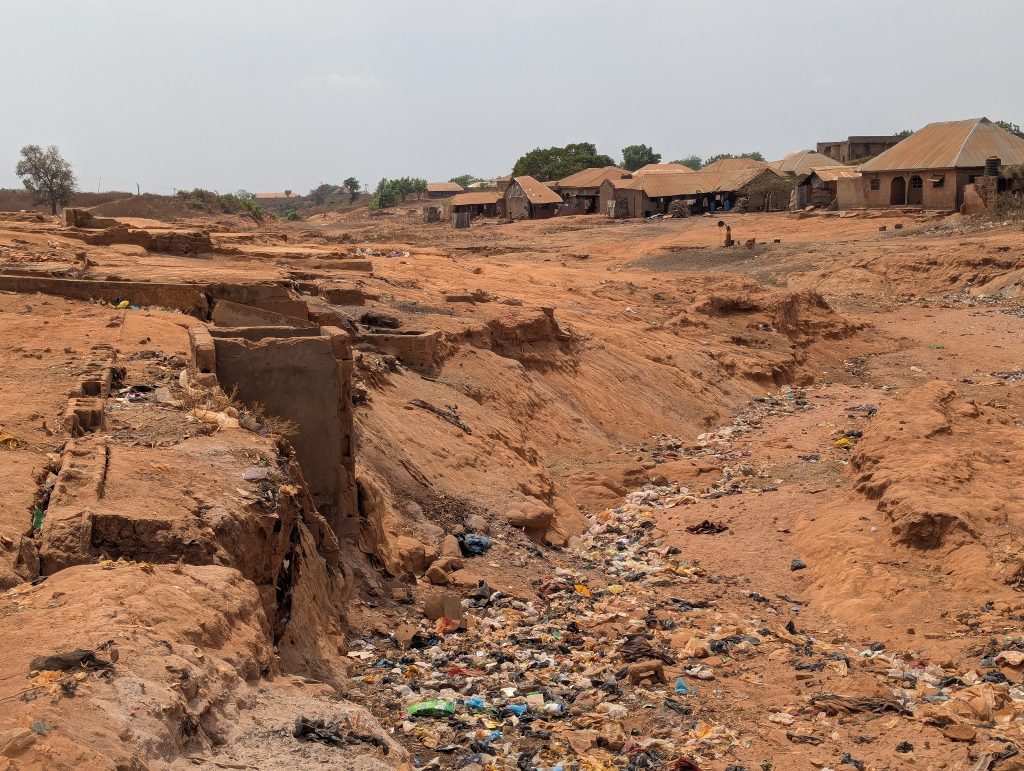
This tragedy is not an isolated incident. Just weeks earlier, residents told HumAngle that three boys fell into the clogged waters and were luckily rescued. The water continues to gather at last year’s Mokwa Flood site, fed by the heavy downpour flowing from the Zugurma and Yagbagba axis, and worsened by another source from gully erosion sites in nearby communities.

Hussaini Ibrahim, the Spokesperson of the Niger State Emergency Management Agency (NSEMA), told HumAngle almost a month after the incident that the agency is not aware of any loss of life due to the blockage but will reach out to the community leader and affected family for further actions.
In Mokwa, the echoes of last year’s devastating flood still haunt the community. Residents told HumAngle that farmers had raised alarm before last year’s disaster, warning that water was accumulating, but their concerns were ignored until after the flood struck. Now, the same warnings are being repeated, with little sign of preventive action.
“Barely a year after the flood, Mokwa is once again staring at water lodging in the same vulnerable zones,” Isah Mokwa, a community leader and activist in the community, told HumAngle. “The bridge and waterway reconstruction, meant to symbolise recovery, has inadvertently blocked water channels, creating a dangerous buildup. As we speak, the town is sitting on a ticking bomb.”
Residents told HumAngle how the first rainfall they witnessed in May made them apprehensive. That evening, they revealed, the sound of rushing water sent shivers down their spines. Mothers were seen rushing to gather their children as fathers stood at the site of collapsed structures, staring at the lodging of water in the same flood-prone channel that swallowed over 150 lives and many homes last year, with hopes of it not wreaking havoc again.
Studies indicate that the mental health and wellbeing of individuals, especially children affected by flooding in Nigeria, can deteriorate for extended periods, often lasting months or even years after the event.
The cumulative stress of rebuilding homes, restoring livelihoods, and coping with displacement has been shown to exert a heavier toll on affected populations than the initial impact of the flood, underscoring the need for comprehensive psychosocial support in disaster management strategies.
“The water was coming right from Yagbagba,” Ndako Usman, a resident, said. “It’s accumulating just behind the blockage. Once it gets bigger and more powerful, it could hit our homes again.”
Hussaini told HumAngle that the blockage was caused by construction workers working on the ongoing drainage construction, and the management has taken swift action to address the issue.
“During last year’s flood, we were taken unaware, but we have taken proactive measures to ensure that it does not repeat itself this year. We have a monitoring team, and also volunteers who constantly update us on the flow of water so that we take immediate action.”
“Regarding the culvert, we have written to relevant stakeholders, including the Ministry of Water Resources, to study and assess the situation of the culverts to see if they can handle the water volume in case of a flood-related disaster and advise appropriately,” Hussaini added.
A catastrophe remembered
The fear is not irrational. In May 2025, Mokwa was the epicentre of one of Nigeria’s deadliest flood disasters in recent memory. Torrential rains combined with structural failures to unleash devastation that claimed hundreds of lives, displaced thousands, and left the town grappling with hunger and grief.
Flooding has become one of Nigeria’s most persistent natural disasters, wreaking havoc on communities across the country almost every year. Heavy rainfall, poor drainage systems, deforestation, and the release of water from dams often combine to create devastating outcomes.
In 2024 alone, floods claimed over a thousand lives, displaced millions, and destroyed farmlands and infrastructure worth billions of naira, but the situation dropped in 2025, according to the National Emergency Management Agency (NEMA).
The agency revealed that floods killed 241 people and affected 459,995 residents across 27 states and 128 local government areas. Also, the disaster displaced 158,588 people, injured 839, and damaged 54,684 houses while destroying 96,649 farmlands.

Early warnings had been issued by the Nigerian Meteorological Agency (NiMet), but local authorities failed to act.
The disaster struck suddenly. Heavy rainfall battered Mokwa, but the real trigger was the collapse of a railway embankment and blocked drainage channels that redirected torrents into residential areas.
Within hours, homes were submerged, bridges collapsed, and farmlands were washed away. Reports varied, but estimates suggested between 200 and 700 people lost their lives, and about 3000 houses and properties were destroyed, leaving families stranded in makeshift camps.
In the wake of the disaster, the Minister of Information and National Orientation, Mohammed Idris, revealed that President Bola Tinubu approved the release of ₦16.7 billion for the immediate reconstruction of the Mokwa Bridge, which was destroyed by flooding, noting that the project would involve constructing a bridge with 10 spans.
In the months that followed, HumAngle published a damning investigation into the Mokwa flood, among other issues. Our findings painted a picture of systemic neglect. The investigation established that gully erosion in Mokwa has remained a destructive force despite years of significant financial allocations. The erosion continues to expand, damaging infrastructure and farmland and worsening during rainy seasons.
Equally, the report uncovered that billions of naira from ecological funds and World Bank loans were earmarked for erosion control, yet no substantial work has been executed. While officials claimed contractors were engaged, there was no evidence of transparent bidding processes. Field assessments confirmed that erosion control activities remain absent, exposing a gap between official pronouncements and actual implementation.
Last month, NEMA listed Mokwa among high flood-risk local government areas in Niger State for 2026. Yet on the ground, little seems to have changed.
Isah Mokwa, the activist based in Mokwa, confirmed to HumAngle that the bridge constructed to contain the water has proven inadequate. According to him, the community braces for the worst, fearing that heavier downpours could unleash destruction far greater than before.
“Nothing has changed. In fact, the situation has deteriorated even further. In the same direction where the water started gathering before the flood, farmers have raised the alarm that water is already accumulating,” he said.
“We believe there is no accountability for the funds contributed to the state government. What happened to the billions donated after the 2025 flood? Even the shelter that was promised for victims of last year’s flood has not been provided. Just recently, there was a flag-off ceremony, but no contractor has been mobilised to the site, no details were given about the number of houses to be built, and no project timeline was shared,” he said.
According to residents, some of the affected families who were lucky to receive ₦500,000 ($360) in financial support last year to rent houses have exhausted their funds, and the majority are now struggling to renew their rent.
For many in Mokwa, the suspicion is that the tragedy of 2025 has been reduced to a political talking point, while the lived reality of survivors remains ignored.
However, experts warn that Mokwa cannot afford another disaster.
Abbas Idris, the president of the Risk Managers Society of Nigeria (RIMSON), in an interview with HumAngle, said that before now, the government should have taken a proactive disaster management approach through risk assessment and hazard categorisation.
This, according to the risk expert, would help not only the government and state emergency management agency but also residents to put in place measures or tackle the disaster even before it strikes.
In the longer term, Abbas revealed that the Niger State government must enforce urban planning regulations, preventing construction on floodplains and investing in climate adaptation strategies.
“Neglecting risk assessments leaves communities defenceless when disaster hits,” Abbas stressed. “We must address corruption, weak governance, and poor ecological management as root causes of the crisis and pave the way for transparent, science-driven interventions to mitigate future disasters.”
It has been a year since the flood, and despite repeated appeals from the community, the state government, under the leadership of Umar Bago, has yet to provide a lasting solution. Families like the Shekare’s are still left to brace for waters that rise too quickly and claim too much.
And until their demands are met, Mokwa remains vulnerable — a place where the memory of one brilliant boy reminds everyone of both the fragility of life and the urgency for change.