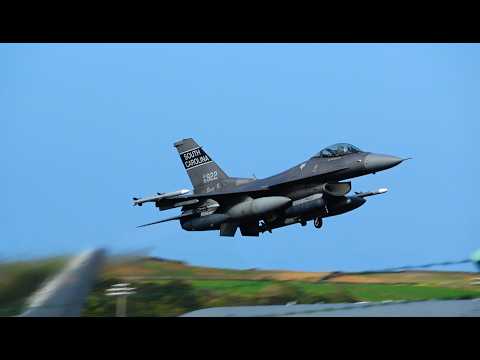
A group of Block 52 F-16CJ Vipers belonging to the South Carolina Air National Guard was recently spotted heading east across the Atlantic as part of a huge build-up of U.S. forces ahead of potential strikes on Iran. Each of the Vipers was notably seen carrying an Angry Kitten pod, a new electronic warfare system that helps defend against anti-air threats, and that may now be headed for its first use in real combat. Angry Kitten also has a very unique genesis, which we will dive into in a moment. These particular F-16s are primarily tasked with the Wild Weasel mission and are optimized for neutralizing enemy air defenses, something that would be crucial in any future operation aimed at the regime in Tehran. They can fulfill many other types of missions, as well.
The 12 F-16CJs arrived at Lajes on the island of Terceira in the Azores, a Portuguese archipelago in the mid-Atlantic, on February 17 and left the next day. The Vipers are readily identifiable as ones assigned to the South Carolina Air National Guard’s 169th Fighter Wing by the “South Carolina” emblazoned on many of their tails, as well as distinctive markings reflecting the wing’s nickname, the “Swamp Foxes.” They were accompanied by at least one KC-46A Pegasus tanker. A substantial U.S. Air Force tanker force is now also forward-deployed in Lajes to support the ongoing build-up.

Roar of the F-16s Over the Atlantic | KC-46A Opens the Afternoon ✈️🇺🇸

Military Stopover in the Azores | F-16 & KC-46A ✈️🇺🇸 at Lajes
The F-16s transiting through Lajes carried inert AIM-120 Advanced Medium Range Air-to-Air Missiles (AMRAAM) on their wingtips and drop tanks under each wing, as well as a single baggage pod. Each Viper also had a LITENING targeting pod and an AN/ASQ-213 HARM Targeting System pod. The AN/ASQ-213 is a key feature of Wild Weasel F-16s and is primarily designed to support the employment of members of the AGM-88 High Speed Anti-Radiation Missile (HARM) family. AGM-88-series missiles are chief among the munitions U.S. aircraft typically use during suppression and destruction of enemy air defenses (SEAD/DEAD) missions.
However, the most notable stores seen on the jets were the Angry Kitten pods hanging underneath their fuselages. U.S. Air Force F-16s, and especially Wild Weasel CJs, typically carry other types of electronic warfare pods, such as the AN/ALQ-184 and AN/ALQ-131, on that station.
Angry Kitten has a very different story from other electronic warfare pods in U.S. military service. It is a direct outgrowth of the AN/ALQ-167, a series of pods primarily used to mimic hostile electronic warfare threats for training and testing purposes for decades. There are some documented examples of U.S. aircraft carrying AN/ALQ-167s, at least on an ad hoc basis, on real combat missions.

The development of Angry Kitten, which dates back to the early 2010s, was originally focused on providing improved electronic warfare capabilities for testing and training use, especially by aggressors playing the role of ‘red air’ adversaries. However, the potential value of the new pods as operational assets to help protect friendly aircraft quickly became apparent. The ability to rapidly adapt the pods in training to provide different effects simulating enemy systems, in particular, opened the door to a much more agile electronic system for use on real-world missions.

“We had a jammer called ‘Angry Kitten.’ It was built to be an adversary air jamming tool,” now-retired Air Force Gen. Mark Kelly, then commander of Air Combat Command (ACC), told TWZ and other outlets back in 2022. “And all of a sudden, the blue team said, ‘you know, hey, we kind of need that, can we have that for us?’ And so I see this iterating and testing our way into this.”
Angry Kitten has been flying on F-16s since 2017. The pods have also been at least test flown on U.S. Air Force A-10 Warthog ground attack jets, MQ-9 Reaper drones, and HC-130J Combat King II combat search and rescue (CSAR) aircraft, as well as U.S. Navy F/A-18 fighters. AATC said last year that there were plans to evaluate the pod on KC-135 and KC-46 aerial refueling tankers.

As TWZ has previously written:
“Unlike the older AN/ALQ-167s, Angry Kitten is designed to be more readily modifiable and updatable to more rapidly adapt in parallel with the threat ecosystem. This is enabled in part by advanced Digital Radio Frequency Memory (DRFM) technology, which allows radio frequency (RF) signals to be detected and ‘captured,’ as well as manipulated and retransmitted. Electronic warfare systems that use DRFM can project signals from hostile radars (and radar seekers on missiles) back at them to create false or otherwise confusing tracks. Data collected via DRFM can also be used to help improve and refine the system’s capabilities, as well as for other intelligence exploitation purposes.”
“In general, electronic warfare systems need to be able to accurately detect, categorize, and respond to waveforms based on information contained in their built-in threat libraries to work most effectively. This, in turn, requires specialists to routinely reprogram systems to keep them as up to date as possible. Automating and otherwise shortening that process at every step of the way by developing what are known as cognitive electronic warfare capabilities has become a major area of interest for the entire U.S. military. The absolute ‘holy grail’ of that concept is an electronic warfare system capable of adapting its programming autonomously in real-time, even in the middle of a mission, as you can read more about here.”

Details the Air Force has previously shared about Angry Kitten have highlighted how the system important stepping stone for new cognitive electronic warfare capabilities.
“Unlike the F-16 tests, where pre-programmed mission data files were used, the C-130 testing includes development engineers aboard the aircraft who can modify jamming techniques mid-mission based on feedback from range control,” a release last March from the Air National Guard Air Force Reserve Command Test Center (AATC), which has been heavily involved in Angry Kitten’s development, explained.
“They are making changes [in] real-time to the techniques and pushing updates to the pod, seeing the change in real-time,” Chris Culver, an electronic warfare engineer involved in the work, said in that same release. “This approach allows for rapid optimization of jamming techniques against various threat systems.”

For F-16s supporting future operations in and around Iran, Angry Kitten would offer a valuable boost in self-defense capability for the fourth-generation jets. Stealthy B-2 Spirit bombers, as well as F-22 and F-35 fighters, spearheaded the Operation Midnight Hammer strikes on Iran last year, with non-stealthy platforms providing support on the periphery. A new protracted campaign would involve more substantial effort to break Iran’s air defense overlay, which would likely require heavier use of fourth-generation tactical jets. The SEAD/DEAD missions that the South Carolina Air National Guard jets are optimized for inherently involve added risk since the aircraft are deliberately tasked with finding anti-air threats and engaging them.
Past TWZ analysis of air defense capabilities that Iran has supplied Houthi militants in Yemen offers some sense of the risks involved, even to stealth aircraft. However, Iran’s own capabilities are more advanced. At the same time, Israeli strikes took a significant toll on Iranian air defense systems during last year’s 12 Day War, especially in the western end of the country. It’s unclear to what degree that capacity has been restored in the interim.
Angry Kitten is, of course, just one part of the massive array of electronic warfare and other capabilities that the U.S. military has deployed in and around the Middle East in recent weeks.
It remains to be seen whether President Donald Trump’s administration will launch a new operation, which could last weeks, against Iran. There continues a steady drumbeat of reports pointing to the increasing likelihood of strikes as U.S. military assets continue to flow into the region, but also stressing that no final decision has been made. Trump and other administration officials are at least still publicly pushing for a diplomatic resolution to the current crisis, focused primarily on curbing Iran’s nuclear ambitions.
“They better negotiate a fair deal,” Trump said today when asked if he had a message for the Iranian people.
“The most I can say – I am considering it,” Trump had also said earlier today when asked if he was considering strikes on Iran.
If the Trump administration does decide to move ahead with a new Iran operation, Wild Weasel F-16s from the South Carolina Air National Guard carrying Angry Kitten pods are among the capabilities that could be brought to bear.
Contact the author: joe@twz.com