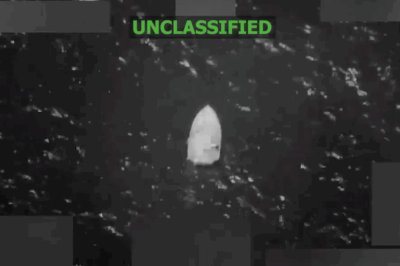

This photo shows moments before a boat suspected of carrying narcotics is struck in the Eastern Pacific on March 8. Photo by U.S. Southern Command
March 31 (UPI) — Increased military pressure by the United States on drug trafficking routes in the Pacific Ocean has forced criminal groups to sharply raise payments to those willing to transport narcotics by sea, a police official said.
In Ecuador’s coastal provinces of Manabí and Santa Elena, recruitment costs for local fishermen tasked with moving cocaine to Central America on speedboats have surged to unprecedented levels.
According to Ecuadorian outlet Primicias, in 2023 and 2024 criminal organizations paid up to $20,000 per trip to boat operators and about $5,000 to their assistants.
However, a large-scale deployment of U.S. and Ecuadorian forces under Operation Southern Spear, launched in October, has increased the risks of these journeys and driven up payments offered by traffickers.
Col. William Calle, head of Ecuador’s National Police in Zone 4, said operators piloting speedboats or semi-submersibles can now earn around $40,000 per trip. Assistants receive about $20,000, while those handling mid-sea refueling earn roughly $15,000.
Local reports, including from El Diario de Manabí, indicate payments can reach as high as $90,000 for high-risk missions or large shipments.
Since 2024, U.S. and Ecuadorian maritime authorities have conducted patrol flights and interdiction operations to monitor and intercept drug trafficking vessels in Ecuadorian waters.
President Daniel Noboa ratified two military cooperation agreements in February. The risk for traffickers has shifted from capture to potential airstrikes in international waters if vessels fail to stop.
Despite arrests and international warnings, criminal groups continue to rely on fishing vessels to transport drugs.
According to El Diario, fishermen detained after operations in Manta and Salinas on Thursday told courts that successful trips carrying one to two tons of drugs can yield payments of up to $90,000. Military intelligence has described these sums as the “price of silence” and compensation for the risk of attack.
Ecuador’s Navy said traffickers increasingly use so-called “mother ships” to extend range and cargo capacity, while smaller fiberglass boats serve as logistical support or for transfers at sea. This tactic complicates interdiction efforts, though shared intelligence has enabled several recent seizures.
Ecuador has become a primary departure point for cocaine produced in the region, with about 80% of shipments moving through the Pacific corridor.
For artisanal fishermen facing economic hardship due to declining catches and piracy targeting boat engines, a $40,000 payment can equal up to a decade of legal earnings.
However, many fishermen say participation is not voluntary but enforced under threats. Organized crime groups such as Los Lobos and Los Choneros control ports, extorting and forcibly recruiting experienced navigators whose knowledge of ocean currents helps evade detection.
The escalation of U.S. military actions under Operation Southern Spear has included at least 47 airstrikes against suspected vessels in the Caribbean Sea and Pacific Ocean. These operations, described President Donald Trump‘s administration as part of a fight against “narco-terrorism,” have resulted in at least 150 deaths.
Authorities have also reported significant seizures, including more than 2.9 tons of drugs near the Galápagos Islands and an additional 2 tons intercepted at sea in March
This month, the U.S. government also launched military and intelligence operations in Ecuadorian territory with authorization from Noboa.
The White House said the operations are aimed at dismantling Los Lobos and Los Choneros, which the U.S. State Department designated as foreign terrorist organizations in late 2025.
According to U.S. Southern Command, these groups are no longer treated solely as criminal organizations, but as threats to hemispheric national security.