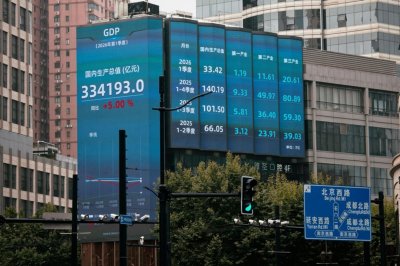

A large screen shows the latest stock exchange and economy data in Shanghai, China, 15 June 2026. Photo by ALEX PLAVEVSKI / EPA
July 28 (Asia Today) — China’s successful stock market debut of its largest DRAM manufacturer has fueled expectations that the company could challenge the three global leaders in memory chips, though Chinese media acknowledged that a significant technological gap remains.
ChangXin Memory Technologies, commonly known as CXMT, became the most valuable company in China’s domestic A-share market after its shares surged 465.82% during their first day of trading on Shanghai’s technology-focused STAR Market on Monday.
The shares closed at 49 yuan ($7.24), compared with an initial public offering price of 8.66 yuan ($1.28).
The closing price gave CXMT a market capitalization of about 3.28 trillion yuan ($484.5 billion), surpassing the Industrial and Commercial Bank of China, previously the country’s most valuable domestically listed company.
The shares lost some momentum Tuesday, closing at 47 yuan ($6.94). CXMT’s market value declined to about 3.14 trillion yuan ($463.8 billion), but it remained the largest company in the A-share market.
The listing followed Asia’s largest initial public offering of 2026. CXMT raised about $8.6 billion, nearly twice the amount initially sought, reflecting strong investor demand for Chinese semiconductor companies.
State media celebrates semiconductor advance
Chinese state-affiliated media described the listing as a milestone in Beijing’s drive for technological self-sufficiency.
The Global Times said the market response demonstrated growing investor confidence in China’s semiconductor industry as the country accelerates efforts to reduce its dependence on foreign technology.
The Chinese-language Global Times described memory chips as the “rice of the digital age” and said CXMT had broken the longstanding foreign dominance of large-scale DRAM production.
It said the company had built its design and manufacturing capabilities from virtually nothing over approximately a decade.
CXMT was founded in 2016 and produces DRAM chips used in smartphones, personal computers, tablets and servers. It is widely regarded as the world’s fourth-largest DRAM manufacturer after Samsung Electronics, SK hynix and Micron Technology.
China’s state media said the funds raised through the listing would be used to upgrade memory wafer production lines, expand DRAM research and development and pursue next-generation memory technologies.
Chinese analysts expressed hope that the investment could eventually weaken the dominance of Samsung Electronics, SK hynix and Micron in the global DRAM market.
CXMT’s progress has already heightened investor concern over increasing Chinese competition. Its market debut contributed to declines in several global semiconductor stocks, including shares of South Korean memory manufacturers.
Technology gap remains
Despite the celebratory tone, Chinese media cautioned that CXMT continues to trail South Korean and U.S. memory manufacturers in advanced production processes.
The company is estimated to remain two to three years behind leading foreign manufacturers in some advanced technologies and faces restrictions on access to sophisticated overseas chipmaking equipment.
CXMT’s roughly 8% share of the global DRAM market also remains well below the combined position of Samsung Electronics, SK hynix and Micron.
The memory chip industry is highly cyclical, meaning the current surge in prices and demand associated with artificial intelligence may not continue indefinitely.
Rapid capacity expansion by CXMT and other manufacturers could also increase supplies and place downward pressure on global memory prices.
Chinese state media urged investors and the semiconductor industry not to allow the listing’s success to create excessive confidence.
The debut nevertheless represents a major symbolic and financial achievement for Beijing’s semiconductor strategy. CXMT now has access to substantial capital that could accelerate research, manufacturing expansion and efforts to compete in higher-end memory products.
— Reported by Asia Today; translated by UPI
© Asia Today. Unauthorized reproduction or redistribution prohibited.
Original Korean report: https://www.asiatoday.co.kr/kn/view.php?key=20260728010010446