Discover the latest happenings and stay in the know with our up-to-date today news coverage. From breaking stories and current events to trending topics and insightful analysis, we bring you the most relevant and captivating news of the day.
Tehran gives Swedish official 48 hours to leave as Iran says Stockholm is bowing down to outside pressure.
Published On 18 Sep 202618 Sep 2026
Iran has ordered a Swedish diplomat to leave the country one day after Sweden expelled an Iranian embassy official in Stockholm.
Sweden’s action was described by Iran’s Ministry of Foreign Affairs as “unjustified” on Thursday.
Recommended Stories
list of 3 itemsend of list
“Without doubt, this action by the Swedish government is the result of the influence of the Zionist regime and an effort to disrupt the normal activities of the Islamic Republic of Iran’s Embassy in Stockholm,” the Foreign Ministry said in a statement, Iran’s IRNA news agency reported.
Iran’s Foreign Ministry said its director general for Western Europe, Alireza Yousefi, summoned the Swedish ambassador in Tehran on Thursday. Yousefi protested Sweden’s policies, including its “hosting of anti-Iranian terrorist elements and groups”.
The ministry said Iran would take necessary measures to safeguard its national rights and interests, including through reciprocal action.
IRNA reports that in response to Sweden’s actions, the ambassador was informed in the meeting that a Swedish diplomat in Tehran had been given 48 hours to leave Iran.
Sweden expels Iranian official
Sweden’s Ministry for Foreign Affairs announced on Wednesday that the Iranian official was asked to leave the country due to activity incompatible with the Vienna Convention on Diplomatic Relations.
The Vienna Convention defines the rules of diplomatic missions.
The Iranian Foreign Ministry also referenced Sweden’s obligations under international law, including the 1961 Vienna Convention on Diplomatic Relations, warning that disruption of the Iranian embassy’s duties would entail Sweden’s international responsibility, reported IRNA.
Swedish Foreign Minister Maria Malmer Stenergard said the decision to expel the Iranian official was taken to protect Swedish citizens and interests.
Swedish Justice Minister Gunnar Strommer told state television that the decision involved Iran’s alleged activities against “Jewish and Israeli interests”.
“We know that Iran, over a long period of time, has conducted activities that threaten security in and against Sweden,” Strommer said, adding that Iran was “making use of criminal networks” to achieve its objectives.
Lawyers criticised mass arrests under emergency powers that allowed authorities to detain people without charge.
Published On 17 Sep 202617 Sep 2026
The Caribbean country of Trinidad and Tobago has ended a state of emergency that granted the government extraordinary powers to combat crime, including the ability to imprison people without charge.
The country’s prime minister told parliament on Wednesday that the government would not extend the state of emergency. One was issued in 2024 and another in 2025, with extensions lengthening both. Instead, the government would seek a “permanent legal framework”.
Recommended Stories
list of 3 itemsend of list
“The proposed legislation will establish a permanent legal framework for targeted operations against violent crime, gangs, illegal weapons and the criminal networks that finance them, while providing safeguards for law-abiding citizens, judicial oversight and parliamentary accountability,” Prime Minister Kamla Persad-Bissessar said in a social media post.
The government had faced criticism for a campaign of mass arrests that suspended key civil liberties in what it said was in the name of cracking down on crime and those the government deemed threats to security. A prominent businessman and his wife were among those arrested over alleged involvement in a plot to assassinate the prime minister, but were never charged and later released.
The measures were last extended in June, with the prime minister stating that more than 5,800 people have been arrested since a March extension. About 2,250 of those have yet to be charged, and it remains to be seen whether they will be released now that the state of emergency has ended.
Lawyer Criston Williams told The Associated Press news agency that he expects some of those detained without charge to bring lawsuits against the government and called for the Inter-American Commission on Human Rights to investigate possible abuses by the government.
“They are transported to us blindfolded, shackled, hands behind their backs, a gray knapsack over their heads,” he said, adding that meetings with lawyers took place in the presence of five armed men from law enforcement, “who refer to themselves as operator one, two, three, four, five. There’s a camera above, so guess what, there’s nothing like attorney-client privilege.”
Police reported a record 624 killings in the country of about 1.4 million people in 2024, a figure that police say dropped to 369 in 2025. Police state that 255 killings have been recorded this year, compared with 268 over the same period in 2025.
The White House has withdrawn President Donald Trump’s nominee to lead Immigration and Customs Enforcement (ICE) after a Republican senator joined Democrats in opposing his confirmation.
Richard Schroyer was serving as a senior aide to the secretary of Homeland Security when Trump picked him to lead the immigration enforcement agency in June.
The White House withdrew his nomination on Thursday in a short memo, which did not explain the decision. The BBC has contacted the White House for comment.
Republican Sen Rand Paul had stalled the nomination as he pressed for more information about ICE and Border Patrol shootings that killed two Americans in Minneapolis in January.
Schroyer had worked with the Oklahoma Highway Patrol for 29 years, and also served in the US Marines. He is a close ally of Homeland Security Secretary Markwayne Mullin, whose department oversees ICE and other immigration and border agencies. His selection by Trump was seen as a surprise given his lack of experience overseeing such a large law enforcement agency.
The position is one of many that needs to be confirmed by the US Senate. Schroyer’s nomination did not manage to make it to a full Senate vote and had stalled in the Senate’s Homeland Security committee.
ICE has not been led by Senate-confirmed leader since 2017 and instead has had a host of temporary chiefs. It is currently led by David Venturella, a former private prison executive, after Todd Lyon announced his departure from the top job in April.
The withdrawal on Thursday marks a defeat for Trump and Mullin, as the White House continues Trump’s campaign pledge to lead the largest deportation effort in US history.
Paul, who serves as chairman of the Senate Homeland Security Committee, said he would not advance the nomination to a full vote until the White House provided more information about the Minneapolis killings.
National protests took place earlier this year following the deaths of Renee Good and Alex Pretti in Minneapolis.
Both US citizens, the two were protesting when they were fatally shot in separate confrontations with ICE agents in January.
One of the promises that helped Trump take the White House in 2024 – cracking down on illegal immigration – has now divided voters going into the congressional midterm elections less than two months from now.
At the same time, Representative Maria Elvira Salazar, a Republican from Florida, is warning that the crackdown could cause many of the Hispanic voters who supported him to turn their backs on the party when they go to the polls in November.
“Mr. President, some of your immigration enforcement efforts have gone too far,” she said in an advertisement filmed outside the White House that was released on Thursday. “Be careful what your advisers are telling you about immigration policy. The same Hispanics who helped you get to the White House in 2024 feel betrayed today.”
Pennsylvania has asked the United States Centers for Disease Control and Prevention (CDC) for help containing an expanding measles outbreak that has seen several people die, but says it will withdraw the request unless the federal agency recognises four measles-associated deaths reported by the state.
The CDC, however, said it has not been properly notified of any such request.
Recommended Stories
list of 3 itemsend of list
The US is currently seeing the worst measles outbreak in the country since 1991, with several deaths over the last couple of years. Measles was declared eliminated in the US in 2000, but has made a comeback in recent years, which some have linked to a rise in vaccine scepticism. The US state of Pennsylvania has been hit especially hard.
In a letter sent to CDC Director Erica Schwartz on Wednesday, Pennsylvania Health Secretary Debra Bogen said the state had begun the process of requesting emergency assistance from the CDC, known as an Epi-Aid.
“The CDC’s choice not to publicly recognize the deaths undermines our response,” Bogen wrote. “For this reason, if CDC is unable to transparently and accurately communicate information about those measles-associated deaths, the Department will respectfully rescind our request for a CDC Epi-Aid.”
However, in a statement to Al Jazeera, Grace Davis Jamison, press secretary for the US Department of Health and Human Services (HHS), said that the CDC had not received Pennsylvania’s request through its normal channels and that federal outbreak assistance was separate from how the agency tabulates deaths.
“CDC will not allow [Pennsylvania Democratic] Governor [Josh] Shapiro to politicize this process. We owe the American people accurate, consistent, and transparent public health information,” Jamison said. “CDC will not submit to political blackmail that conditions critical public health assistance. The people of Pennsylvania should never be used as leverage in a political dispute over how deaths are classified.”
Disagreement grows as Pennsylvania’s measles outbreak spreads
The dispute over the deaths began in August, when Pennsylvania reported that two unvaccinated people died of measles in Lancaster County, which is located in the South Central part of the state. Lancaster is considered the centre of Pennsylvania Dutch Country and home to the nation’s oldest Amish and Mennonite communities. Both communities have under-vaccinated populations.
The CDC initially included the deaths in its national tally, but subsequently removed them after Health Secretary Robert F Kennedy Jr questioned whether measles had caused or contributed to the fatalities. The agency said at the time that available information did not establish whether measles caused or contributed to the deaths.
Pennsylvania continued to stand by its determination.
The outbreak has spread well beyond its initial epicentre in Lancaster County. On September 13, a county coroner reported that a 40-year-old woman had died from complications associated with measles. The state later confirmed the death as measles-associated and announced two additional deaths on September 15. All four people were unvaccinated, according to the state.
The state reported 393 cases across 28 counties when the first two deaths were announced on August 25. Pennsylvania now reports 731 confirmed cases across 38 counties and 141 hospitalisations. Of those reported cases, only four people, or less than one percent, are vaccinated.
What are officials arguing about?
The disagreement between Pennsylvania and the CDC centres on the distinction between a “measles-associated” death versus a death “caused” by measles. Pennsylvania uses “measles-associated” under its state surveillance definition, while HHS said it is working with the Council of State and Territorial Epidemiologists to establish a standardised definition for measles deaths.
Infectious disease experts warn that the dispute over how to classify the deaths puts the CDC at odds with a long-standing approach to tracking the consequences of measles. Matthew Ferrari, director of Pennsylvania State University’s Center for Infectious Disease Dynamics, told Al Jazeera that “measles-associated” death has long been a standard used by the World Health Organization and CDC.
“It’s the most useful distinction because it is a case that could have been prevented by a measles vaccination, or by early detection and isolation,” Ferrari said. “Measles is severely immunocompromising, so it is very often a secondary infection that is the ultimate cause of death.”
Experts say the CDC’s dispute with Pennsylvania risks distracting from efforts to contain the outbreak. Dr Andrew Pavia, spokesperson for the Infectious Diseases Society of America and professor at the University of Utah, told Al Jazeera the distinction should not be controversial.
“The impact, though, is confusion for the public and erosion of trust in the ability of CDC staff to communicate to the public without political interference,” Pavia said.
HHS said federal outbreak assistance and national mortality reporting are separate processes and rejected the idea that the two should be linked.
How would an Epi-Aid help Pennsylvania?
An Epi-Aid is a CDC mechanism for providing rapid, short-term assistance during an urgent public health problem. The CDC says Epi-Aids generally last one to three weeks, during which they deploy Epidemic Intelligence Service officers to analyse epidemiological data, evaluate surveillance systems, and recommend measures to control and prevent the spread of disease.
The requesting health authority retains overall leadership of the investigation, while CDC personnel provide technical assistance, including epidemiological expertise and access to laboratory resources.
“The most important thing for an effective response is communication and trust,” Ferrari said. “It is important for all partners to agree on the foundational elements of the problem and the metrics for evaluating the severity of the problem.”
Warsaw also says it has scrambled military planes in response to a Russian attack in western Ukraine, close to its border.
Published On 17 Sep 202617 Sep 2026
Polish Prime Minister Donald Tusk says that intelligence information suggests Russia plans to launch drone and missile attacks against countries supporting Ukraine.
Warsaw’s leader outlined the assessment during an address to parliament on Thursday, saying that the attacks will be meant to weaken NATO’s ability to act collectively in response.
Recommended Stories
list of 4 itemsend of list
“According to intelligence assessments, Russia’s plan … includes hybrid drone and missile strikes against countries supporting Ukraine, including Poland,” Tusk said.
European countries suspect Moscow of being behind a series of acts of sabotage in recent months to put pressure on the allies, especially Germany, helping Kyiv in its bid to resist Russia’s full-scale invasion – something the Kremlin has vigorously denied.
“These potential strikes would be quote-unquote ‘accidental’ in nature, intended to paralyse or at least weaken the resolve of NATO states to invoke the relevant NATO provisions in the event of aggression against a member country,” Tusk added.
He did not elaborate on which intelligence agencies had provided the warning.
He also said such attacks by Russia could coincide with “political changes in certain European countries granting power – or at least a powerful voice – to those who, increasingly invoking noble slogans of peace, pacifism and needless casualties, will call for peace – or rather, the total capitulation of Ukraine”.
Tusk appeared to be referring to the advance of more Russia-friendly parties such as Alternative for Germany (AfD) and National Rally in France.
Air raid near border with Poland
Earlier on Thursday, Poland said it had scrambled military planes in response to a Russian attack in western Ukraine, close to the Polish border.
Airports in Rzeszow and Lublin were temporarily closed, and residents of two eastern regions of Poland received air raid warnings. Local media reported that sirens had sounded and that pupils in some schools had sought shelter.
“Very close to the Polish border, not far from Dorohusk, a petrol station was most likely attacked again,” Tusk said.
On Sunday, a Russian drone hit a passenger train in Ukraine, just two kilometres (1.6 miles) from the Polish border.
Defence Minister Wladyslaw Kosiniak-Kamysz said Poland was strengthening airspace protection.
“We have increased F-16 and helicopter activity, and are reinforcing our air defence and rapid response systems,” he wrote on X.
Tusk said he would visit Ukrainian President Volodymyr Zelenskyy on Friday to discuss cooperation within the Integrated Anti-Ballistic Missile Coalition, a group of European countries developing an air defence system with Ukraine as a cheaper alternative to the US-built Patriot.
Critics say Serbia’s military ties with Israel are rising significantly.
Published On 17 Sep 202617 Sep 2026
Serbia has opened a factory to assemble advanced Israeli-made drones, which will supply the Serbian military and armed forces in other countries.
Serbian President Aleksandar Vucic inaugurated the facility jointly operated with an unnamed Israeli company on Thursday.
“Our plans are huge,” Vucic said in a social media post showing a video of him touring the facility with Israeli Ambassador Avivit Bar-Ilan, adding that at least three more factories will be opened across Serbia with Israeli partners.
Vucic said the facility “will employ around 100 workers and produce state-of-the-art equipment both for the Serbian Armed Forces and the armies of some other countries”.
Vucic did not disclose the factory’s location or the Israeli firm involved, saying journalists were excluded from the opening because of “the confidentiality of the production process”.
Previous reporting by investigative outlet BIRN and Israeli newspaper Haaretz has identified Israeli defence firm Elbit Systems as Serbia’s partner in the drone-manufacturing process.
Elbit has previously been criticised over its role in operations in Gaza and the West Bank.
Last month, Vucic told Serbian news outlet Nezavisne Dnevne Novine that the goal of the factory was to “preserve peace and stability, and to be strong enough to deter all potential aggressors”.
Serbia is one of the few countries in the Western Balkans that is not a NATO member, and it has invested heavily in its military to “preserve neutrality”.
It has faced scrutiny over arms exports to Israel, which BIRN and Haaretz said rose from 1.4 million euros ($1.6 million) in 2023 to 42.3 million euros ($48.5 million) in 2024.
During a visit to Serbia earlier this year, United Nations Special Rapporteur on the occupied Palestinian territories Francesca Albanese said Belgrade remained one of Israel’s “most steadfast and determined allies” despite calls for more countries to restrict weapons exports due to the war in Gaza.
Venezuelan officials flew to London to meet with Foreign Office counterparts. (AVN)
Caracas, September 16, 2026 (venezuelanalysis.com) – Venezuela and the United Kingdom have announced a formal decision to upgrade their diplomatic relations and to re-establish full ambassadorial representation.
London formally presented its policy shift on September 15 in a missive to Parliament through coordinated statements by Minister for Latin America Chris Elmore in the House of Commons and Parliamentary Under-Secretary of State Lord Wood of Anfield in the House of Lords.
In the statements, the cabinet members framed the “diplomatic upgrade” around supporting a “democratic transition” while pursuing pragmatic bilateral engagement with the South American country.
“Developments in Venezuela since 3 January have created an important opportunity for the international community to support the restoration of democracy,” the statement read. “Working closely with the United States and with international partners, the UK considers that this moment calls for pragmatic engagement to help advance a credible transition and to encourage further reforms.”
The communiqué added that London and Caracas “have agreed our intention to upgrade our representation to Ambassador,” emphasizing that the step aims to deepen engagement with Venezuelan authorities and enhance support for British corporate and trade interests.
The Venezuelan government welcomed London’s decision. In an official communication published on Tuesday, the government led by Acting President Delcy Rodriguez celebrated the upgrade in diplomatic status as a positive step toward normalization.
Venezuelan officials stressed that the latest decision should pave the way for the full “sovereign management of the Venezuelan people’s resources,” referencing state assets frozen in British financial institutions.
National Assembly President Jorge Rodríguez and Foreign Minister Félix Plasencia flew to London and held a meeting on Tuesday with Harriet Thompson, the British Foreign Office’s Director for the Americas.
Following the discussions, Rodríguez highlighted progress in multi-sectoral talks and economic outlooks.
“We shared Venezuela’s position regarding political and social dialogue, as well as the progress made regarding oil and gas investments, and how this will translate into significant and rapid economic growth for Venezuela,” he said in a message published on social media.
Rodríguez added that the talks aimed at promoting national peace and political reconciliation, labeling them as “good news for our country and our people.”
Bilateral relations between London and Caracas had been severed for years following former UK Prime Minister Theresa May’s decision in 2019 to follow Washington in recognizing opposition figure Juan Guaidó’s self-proclaimed “interim government.”
That policy led to a protracted legal battle over 31 tons of Venezuelan gold reserves stored in the Bank of England, with successive British governments refusing to return them to Caracas. The reserves are currently valued at over US $4 billion.
During the COVID-19 pandemic, Venezuelan authorities attempted to retrieve the gold through international legal channels, offering to transfer the funds directly to the United Nations Development Programme (UNDP) to purchase emergency medical supplies and food.
However, British courts repeatedly rejected the legal challenges from the Central Bank of Venezuela (BCV), citing No. 10’s political recognition of the opposition parallel administration.
Following renewed political talks in August and September, a Venezuelan government delegation and representatives of the defunct, opposition-controlled 2015 National Assembly agreed to request the release of the UK-held gold reserves under US Treasury Department control and oversight.
According to opposition dialogue delegates, the 31 tons of gold will be transferred into a specialized US Treasury bank account and subjected to external audits by foreign accounting firms before being released.
The funds are reportedly earmarked for housing, healthcare, and infrastructure recovery in the wake of the June 24 double earthquake that left over 6,500 people dead across Venezuela.
The mission also said Iranian authorities committed crimes against humanity during their crackdown on protests in late 2025 and early this year.
The United States likely committed “war crimes” in Iran when it launched a pair of air strikes that killed at least 178 civilians, including women and children, a United Nations fact-finding mission has found.
The report by the UN Independent International Fact-Finding Mission on Iran on Thursday also accused Iran of human rights violations and crimes against humanity during protests last year and in early 2026.
The mission also referred to the US air strike on a “clearly identifiable” sports complex and residential area in Lamerd the same day, where precision strike missiles dispersed clouds of tungsten pellets, killing 22 civilian men and women.
The findings, to be submitted to the UN Human Rights Council in Geneva, examined the US’s conduct during the Iran war and the Iranian government’s response to nationwide unrest that began in late December.
US air strikes against civilians
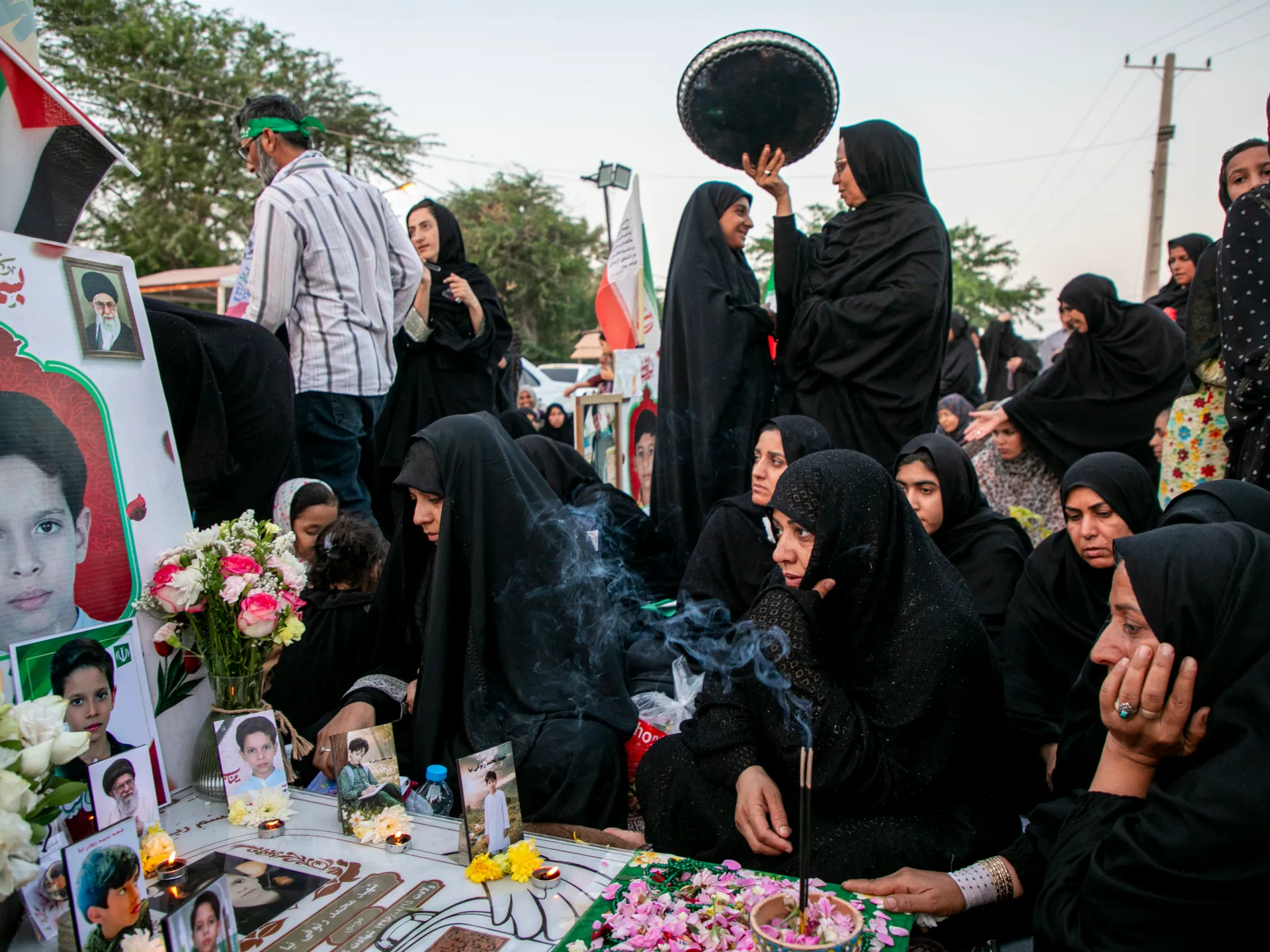
The attack on the school in Minab was conducted with the use of Tomahawk missiles.
“The Mission concluded that when identifying and directing its attack against the primary school in Minab, whose civilian nature is apparent, the US failed in its obligation to do everything feasible to verify that it was a military objective,” the report stated.
The report’s authors said that photographs and videos depicting the school before and after the strike showed “readily identifiable features” that it was associated with an educational facility for young children.
“These included child-oriented murals painted on exterior walls, school signage, and playground areas,” said the UN report.
“According to public reporting, satellite imagery of the school before the strike also appears to show human figures, readily identifiable as children, gathered in its courtyard.”
Following the strike, state-affiliated media showed widespread destruction at the site, including parents holding the body parts of their children, and bloodied backpacks and schoolbooks.
“Several families lost more than one child, reflecting the devastating impact of the attack on families and the wider community,” the report said.
In June, US President Donald Trump said that “nobody” purposefully attacked a girls’ school in Iran in February, citing an investigation into the incident, for which the Pentagon has not yet published any findings.
Regarding the strike in Lamerd, the mission similarly found that the sports centre attacked was “visibly separate” from an adjacent compound belonging to Iran’s Islamic Revolutionary Guard Corps (IRGC).
The US Central Command said in a statement in March that US forces did not launch any strikes into the city of Lamerd on that day.
Iran protests
The UN mission additionally accused Iran of repressing demonstrators during the country’s 2025-2026 protests through an internet shutdown, unlawful killings, torture, arbitrary detention, enforced disappearances and severe restrictions on freedom of expression.
It also stated that the number of deaths and injuries by state forces is much higher than the government’s reported toll – which says 3,038 people were killed and 25,000 people injured – but could not verify exact numbers.
Tehran claims the majority of deaths occurred due to “rioters” during the protests backed by exiled opponents and the US and Israel.
The UN fact-finding mission urged Iran and the US to immediately end hostilities, provide reparations to victims, and seek permanent peace through diplomatic means.
Intensifying attacks between Saudi Arabia and Yemen’s Houthis have reportedly killed at least five people in total, including three children.
At least one person – a Yemeni resident in Saudi Arabia – was killed, and two others were injured after a Houthi drone was intercepted in Saudi Arabia’s southwestern governorate of Taif on Thursday, according to the kingdom’s civil defence agency.
It is the first death announced in Saudi Arabia this month since Yemen’s Iran-allied Houthis intensified their attacks.
In Yemen on Thursday, the Houthis said “Saudi enemy warplanes targeted three telecommunications towers” in Taiz province.
One civilian was killed in Taiz and another injured in strikes on the town of Abs, Yemen, said Houthi-linked Almasirah television.
Houthi-backed media later reported that “three children were killed and several Yemeni nationals were injured in strikes by the Saudi-backed mercenaries”, a reference to the country’s internationally recognised government forces.
Houthis reject claim they attacked Mecca
The escalation comes as Saudi Arabia said a drone was launched by the Houthis towards Mecca before being intercepted and destroyed.
“It’s a heinous lie,” Houthi leader Abdel-Malik al-Houthi said in a live televised address on Thursday, calling Saudi claims that his group would target Islam’s holiest city “a great propaganda”.
“The sanctity of Mecca is particularly important to the people of Yemen,” he said while accusing Saudi Arabia of “weaponising lies” to serve its war objectives against the Houthis.
Reporting from the Yemeni capital Sanaa, Al Jazeera’s Yousef Mawry said: “Al-Houthi’s speech is not just directed towards the Yemeni people; it is directed to the world to set the record straight that the Houthis did not target the holy city of Mecca, as the Saudis claim.”
In his address, al-Houthi also said Saudi Arabia had initiated the latest round of conflict in Yemen and that Houthi forces are acting defensively.
Meanwhile, Rashad al-Alimi, the head of Yemen’s Saudi-backed Presidential Leadership Council, said that Houthi forces are suffering heavy blows on the fronts in Taiz, Marib, Lahj, al-Jawf, Hajjah, al-Bayda al-Dhale.
In a meeting with the French ambassador to Yemen, al-Alimi said that gains made by the Houthis along the Red Sea coast are temporary, the state-run Saba news agency reported.
A Houthi supporter sports a poster of the group’s leader, Abdel-Malik al-Houthi, in his dagger’s belt, during a rally against the Saudi-led coalition [File: Khaled Abdullah/Reuters]
Aggression against Mecca ‘a condemned act’
Esmaeil Baghaei, Iran’s Ministry of Foreign Affairs spokesperson, said in a statement on X on Thursday that any aggression against Islamic holy sites, particularly Mecca, “is a condemned act”.
But he added that “a mere claim” of intercepting a drone “en route to Mecca” is not enough to accuse the Houthis of the act.
“Nor should we forget that our region has witnessed numerous instances of ‘false flag’ operations, particularly in recent months,” Baghaei said while pointing at Israel.
Meanwhile, China has privately asked Iranian officials to help rein in the Houthis after Saudi Arabia appealed to Beijing following recent Houthi attacks, anonymous sources in Iran told the Reuters news agency.
Beijing publicly called for restraint, dialogue and the restoration of safe navigation, but its private message went further than that, Reuters reported.
The escalation is also threatening to draw in other regional actors – specifically Saudi defence partners Pakistan and Turkiye, which signed a joint defence agreement with the kingdom last month.
Pakistan’s Defence Minister Khawaja Asif said the time has come to implement the Mecca agreement with Saudi Arabia and Turkiye due to recent Houthi attacks.
Asif’s comments to Pakistani media on Thursday were made as Iran’s Foreign Minister Abbas Araghchi said he’d held a phone conversation with Pakistan’s army chief Asim Munir to discuss “regional developments”.
Senior U.S. Air Force leaders in Europe say NATO allies are increasingly looking to participate in the development and employment of collaborative combat aircraft (CCAs), even as several of those same countries pursue their own indigenous fighter and drone programs. American commanders say they are looking forward to CCAs expanding the alliance’s overall capacity, and are already pushing for such systems to work together from the outset.
Speaking yesterday at the Air & Space Forces Air, Space and Cyber Symposium that TWZ is attending, Lt. Gen. Jason T. Hinds, commander of U.S. Air Forces in Europe, U.S. Air Forces Africa, and NATO’s Allied Air Command, and Chief Master Sgt. Joshua J. Wiener, USAFE-AFAFRICA’s command chief, discussed how the command is preparing for an eventual European role in the U.S. Air Force’s planned fleet of hundreds of CCAs.
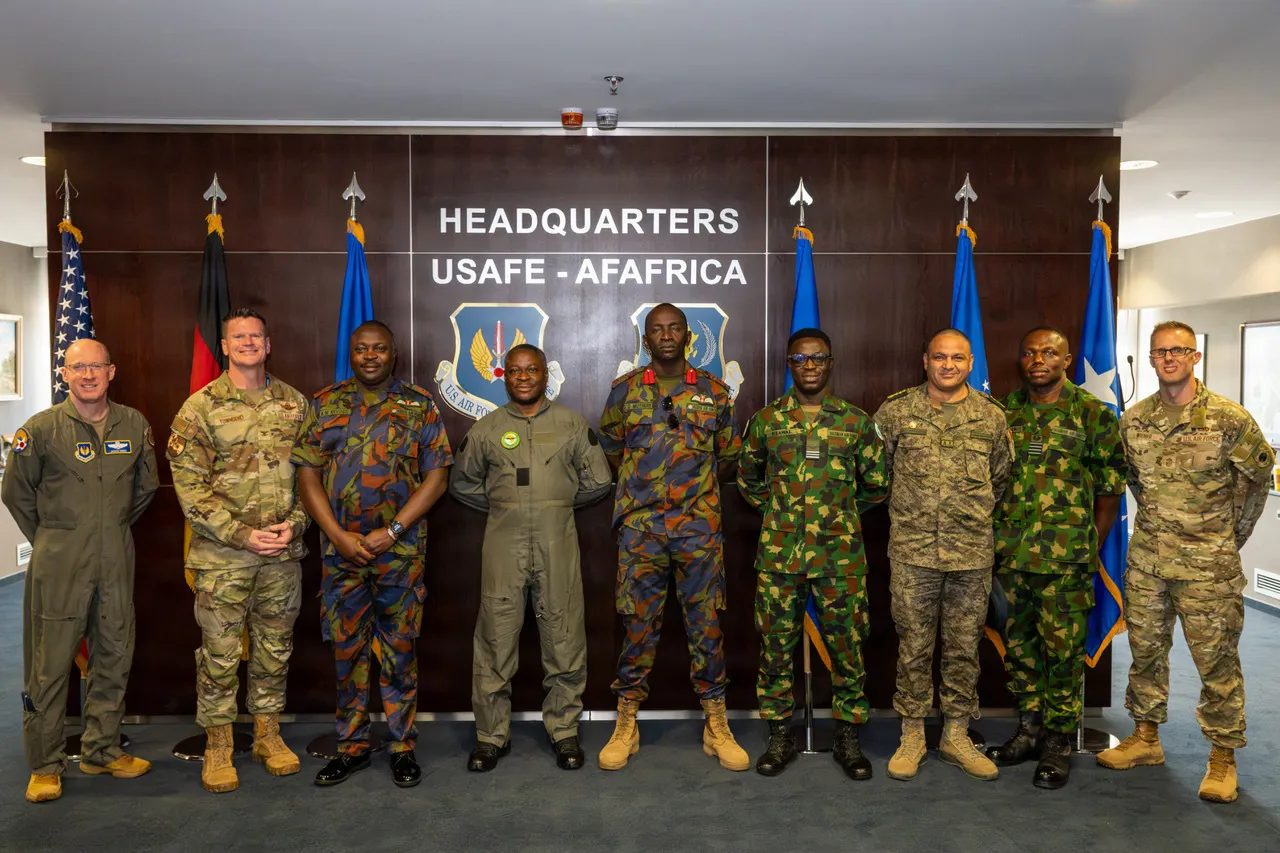
U.S. Air Force Lt. Gen. Jason T. Hinds, U.S. Air Forces in Europe – Air Forces Africa commander (far left), and U.S. Air Force Chief Master Sgt. Joshua J. Wiener, USAFE-AFAFRICA command chief (second from left), pose for a group photo with the Association of African Air Forces representatives from Kenya, Nigeria, and Tunisia at Ramstein Air Base, Germany, earlier this month.
The issue is particularly significant for USAFE, which operates a fraction of the fighter force it maintained in Europe during the Cold War, even as many of its NATO allies contend with shrinking fleets of crewed combat aircraft. This comes against a backdrop of deepening tensions with Russia and the emergence of new kinds of threats. Autonomous aircraft that can augment crewed fighters could provide the alliance with additional combat mass without requiring a corresponding increase in the number of crewed aircraft and personnel permanently based in Europe.
“I’m excited about what CCAs have in store for the Air Force,” Hinds said, pointing to recent comments from the Secretary of the Air Force Troy Meink, including the aim of having at least 500 CCAs in service by 2032.
He added that European interest in these kinds of platforms is already growing.
“I think you’re going to see a lot more interest from other nations inside Europe about what is America doing with CCAs and how they can join this party, if you will,” Hinds said.
Germany is “heavily involved,” he said, while Scandinavian countries and the Netherlands are also showing interest.
In the case of Germany, we have previously explored how that country is looking to procure CCAs by 2029. Sweden, too, recently unveiled a concept for a high-end, stealthy CCA-type drone, while the Dutch are looking to become more closely alligned with U.S. Air Force CCA efforts.
Saab has produced a full-scale concept model of a future uncrewed combat air system, known as aircraft A3. Saab
USAFE is currently using two broad operational scenarios to explain to allies how CCAs could fit into NATO’s force structure.
The first is defensive. A CCA could operate as part of an integrated air and missile defense network, potentially engaging one-way attack drones or cruise missiles without the need for expensive crewed fighters.
The second is offensive. In that scenario, autonomous aircraft could help suppress or destroy integrated air defense systems and potentially attack fielded forces during an effort to repel a hostile incursion into NATO territory.
Allies are interested in both missions, Hinds said, and want the ability to incorporate CCAs into their own force designs. Interestingly, only yesterday, Anduril shared photos of its YFQ-44A Fury configured with air-to-ground weapons, underscoring the fact that the CCA could take on an air-to-ground role in the future in addition to its current air-to-air focus.
A YFQ-44A carrying pods for 2.75-inch rockets and 500-pound Joint Direct Attack Munitions (JDAM) under the wings. Anduril
That kind of interest has already prompted work at the NATO level. Hinds pointed to a study by the Joint Air Power Competence Center, the alliance’s airpower think tank based in Kalkar, Germany, examining how NATO members could employ CCAs in a modular fashion, including issues such as sustainment, training, and exercises.
“It was a pretty long paper, but the nations wanted it,” Hinds said.
Initial experimentation is expected to take place in the United States, but European experimentation could follow, including by Sweden and potentially other NATO members.
At the same time, European countries are not simply waiting for an American CCA to arrive.
The United Kingdom has launched its own Storm Fighter CCA program. Germany is pursuing a separate loyal-wingman effort, while the United Kingdom, Italy, and Japan are meanwhile jointly embarked on the Global Combat Air Program, or GCAP, which is intended to produce the Tempest next-generation crewed fighter and associated uncrewed systems.
A rendering of a CCA concept released at the launch of the U.K. Royal Air Force Storm Fighter program, earlier this year. BAE Systems
The proliferation of national programs raises an obvious question: How does NATO prevent a growing fleet of autonomous aircraft from becoming a collection of incompatible national systems?
Hinds said the answer starts with commonality.
“The first and foremost thing is we want to strive for commonality,” he said. “Commonality means we don’t even have to worry about interoperability.”
Where common equipment is not possible, however, USAFE wants interoperability built into national systems from the beginning.
“Interoperability by design” is the preferred approach, Hinds said, with NATO data standards and other requirements incorporated before a system enters service rather than retrofitted later.
The good news for USAFE is that NATO already has extensive experience establishing common standards for interoperability, covering everything from tactics and procedures to communications, datalinks, weapons employment, and other technologies. That existing framework gives the alliance a foundation for integrating increasingly diverse national systems without requiring every member to field identical equipment.
F-35A from the U.S. Air Force’s 48th Fighter Wing and the Royal Norwegian Air Force fly tandem after a formation flight near Lofoten, Norway, March 10, 2026. The formation flight was intended to symbolize the partnership and degree of interoperability displayed between participating NATO militaries during Exercise Cold Response 26. U.S. Marine Corps photo by Cpl. Mya Seymour Cpl. Mya Seymour
Hinds did warn that some countries have previously acquired equipment that was not compatible with NATO systems, leaving them with the choice of paying to modify their own equipment or forcing the alliance to adapt its systems around it.
That problem becomes particularly important as autonomous aircraft are connected to increasingly complex sensor and weapons networks. Even more important is the requirement for a baseline command-and-control network for CCAs themselves, allowing different platforms to manage them seamlessly.
The ability to share and control CCAs across a complex battlespace is already emerging as both a major opportunity and a significant integration challenge. The U.S. Air Force and Navy, for example, have made clear that their respective CCAs are being developed with the ability to be controlled seamlessly across services, pointing toward a future in which autonomous aircraft need not remain tied to the service or platform that launched them.
In such an architecture, the aircraft, sensor, command-and-control network, and weapon do not necessarily have to belong to the same country.
As an example, Dutch F-35s, operating in Europe, have used a data-exchange system to transmit targeting coordinates to Israeli-made PULS (Precise and Universal Launch System) rocket artillery. The system, developed by Lockheed Martin is known as Keystone, and you can read more about it here.
A Dutch F-35A brandishing its AIM-120 AMRAAM missiles during a NATO air policing drill. Bartek Bera
USAFE is making “significant advances” in areas including cross-servicing, cross-loading, and cross-flying allied aircraft, Hinds said, all of which are intended to make multinational operations more seamless.
A U.S. Air Force F-35 crew chief conducts post-flight checks at Pirkkala Air Base, Finland, during the tactical exercise, Ramstein Flag 26. U.S. Air Force photo by 2nd Lt. Sarah Hedgman
The same philosophy applies to weapons.
“We want to have all the fires, right? Whether it’s U.S. built or built inside European nations,” Hinds said.
That could prove increasingly important as European countries expand domestic production of missiles, drones, and other weapons alongside their aircraft programs.
The growth of GCAP and other European defense programs comes amid broader debate over how much Europe should depend on U.S. military equipment.
But Hinds rejected the idea that allies developing indigenous aircraft and autonomous systems necessarily signals a move away from American equipment.
“No, I don’t,” he said when asked whether allies were moving away from U.S. systems.
Instead, Hinds characterized the trend as an expansion of the transatlantic defense-industrial base.
Sweden was one example he cited. The country, which recently joined NATO, continues to produce new military equipment, including Gripen fighters, while those aircraft are already being operated by NATO members.
Swedish Gripens are currently leased to Hungary, and other countries are considering the aircraft, Hinds said.
A Hungarian Air Force JAS 39C Gripen participating in NATO Exercise Ramstein Flag 24 flies over the west coast of Greece, in 2024. U.S. Air Force photo by Tech. Sgt. Emili Koonce
The broader trend toward co-manufacturing and co-production is also something he welcomed.
“I’m seeing a lot of discussions about co-manufacturing and co-production, and I welcome those discussions as well,” Hinds said.
That approach could become increasingly important as NATO tries to expand its available combat power without relying exclusively on additional U.S.-built platforms.
For USAFE, the objective is to ensure that whatever aircraft NATO countries develop or purchase can plug into a common architecture, sharing data, receiving targeting information, drawing on common logistics networks, and contributing weapons effects across national boundaries.
For a U.S. Air Force command that has spent decades trying to cover Europe with far fewer fighters than it once had, hundreds of autonomous wingmen, whether American-built or allied, could provide a significant way to generate additional combat mass.
Senior U.S. Air Force officials are now working to ensure that the networking, weapons integration, logistics, and command-and-control architecture will be in place once those aircraft start to come online.
The U.S. Air Force has been taking a new look at the feasibility of restarting production of the C-17 Globemaster III cargo plane as part of its still-evolving next-generation airlift plans. The service also continues to explore a wide range of next-generation aerial refueling concepts, including new stealthy and/or uncrewed tankers, but a firm vision for the way forward there has yet to emerge.
Air Force Lt. Gen. Daniel Tulley, head of Air Mobility Command (AMC), shared new details about future airlift and aerial refueling efforts, with TWZ and other outlets at a roundtable at the Air & Space Forces Association’s (AFA) 2026 Air, Space & Cyber Conference.
On the airlift side, the Air Force’s stated plan to date is to replace both the C-17A and C-5M Galaxy with a single Next-Generation Airlift (NGAL) platform, starting in the mid-2040s. Separately, the service is pursuing what could be a family of future aerial refueling capabilities under what is now called the Advanced Tanker Systems (ATS) program. Very broadly speaking, ATS presents a path toward what might come after the retirement of the aging KC-135 tanker fleet, though those aircraft are still expected to keep flying for years to come. The Air Force is also moving to further expand its fleet of newer KC-46A tankers in the interim, but persistent technical and other issues with that design continue to present hurdles.
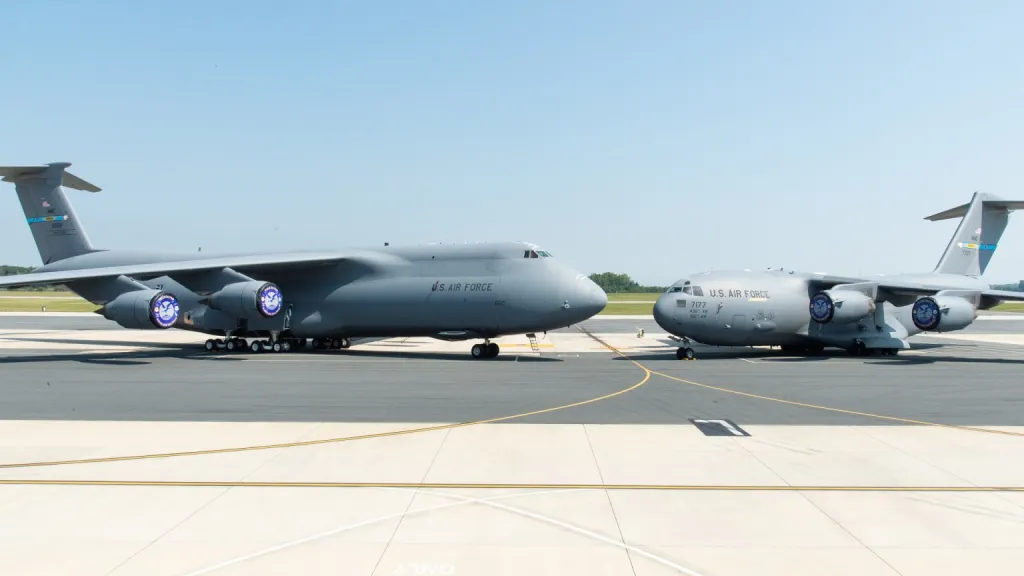
A US Air Force C-5, at left, together with one of the sevice’s C-17s, at right. USAFA KC-135, at right, prepares to link with a KC-46, at left, during a test. USAF
At the roundtable today, Lt. Gen. Tulley was asked explicitly about restarting C-17 production. The manufacturer of those aircraft, Boeing, shuttered that line in 2015. The company also just marked the 35th anniversary of the design’s first flight yesterday.
“Heck yeah, but with a caveat, right?” Tulley said in response. “So we were just asking this question over the course of last week, and it’s in the context of next-generation airlift. So we are about to embark on the Analysis of Alternatives to replace the C-17 and replace the C-5. All options are on the table.”
“There’s always the option to service life extend the C-17, but the [production restart] question came up,” he continued. “I’ve heard this my entire career. Once we terminate an assembly line, can we ever bring it back? Does somebody store all the machinery and the dies and whatnot, and can you bring that out? So we’re asking that question.”
“But then whatever that answer is from the vendors, what will be the price tag associated with that?” he added. “You have to ask yourself, okay, is rebuilding a C-17 even if you make improvements – and there’s a loose analogy with the C-130J, [a] much more modern, capable variant of the C-130E [author’s note: the C-130J evolved more directly from the C-130H variant] I first learned to fly – if you do that with the C-17, is that the best move? Or are there new technologies that we can incorporate into it so that it can defend itself, so that it’s connected, it’s networked, it does all the things that maybe the current C-17 doesn’t do?”
“We’re looking into it as part of the Analysis of Alternatives. I’m hopeful that we’ll get to answer that question.”
In June, the House Armed Services Committee also directed the U.S. Air Force to prepare a formal briefing on the matter of new C-17 production in a report accompanying a draft of the annual defense policy bill, or National Defense Authorization Act (NDAA), for Fiscal Year 2027.
Boeing Pieces Together the Last C-17 on the Line
The RAND Corporation did conduct a detailed, independent analysis more than a decade ago that assessed the costs and complexities that could come from Boeing building more C-17As, as well as other variants and derivatives of the design. RAND’s conclusion was that any of the courses of action would require billions of dollars of new investment and entail risks, as you can read more about in more detail here.
Foreign participation in a new C-17 production run could help at least defray costs. Australia, Canada, India, Kuwait, Qatar, the United Arab Emirates, and the United Kingdom all currently fly Globemaster IIIs. The Strategic Airlift Capability (SAC) initiative, a multinational arrangement with several European members, as well as the United States, also operates three of these aircraft.
Boeing told TWZ directly in June that unnamed C-17 operators had been reaching out about the prospect of restarting the production line, and that the company was “encouraged” by those discussions.
As Lt. Gen. Tulley stressed, there are significant questions about whether buying new-production C-17s, even with substantial improvements, is not only feasible, but a good use of resources. The Air Force’s Globemaster III fleet today continues to prove itself to be critical to the U.S. military’s ability to project power globally, and is in very high demand right now, especially amid the ongoing conflict with Iran.
The Air Force’s desire to replace both the C-17 and C-5, which are very different aircraft in form and function, could still easily lead the service down a different route. Boeing is not the only one looking at future NGAL opportunities. Another company, Radia, has been very actively pitching a clean-sheet design that is physically bigger than either the C-17 and the C-5, and that is geared toward greater operational flexibility, at the Air Force. Radia is targeting a first flight of its aircraft, called Windrunner, by the end of the decade, but it is still in a very aspirational stage at present.
A rendering of Radia’s Windrunner design. Radia
Many questions also still remain about how the Air Force will ultimately proceed on the next-generation aerial refueling front.
“So thinking beyond the current KC-46 buy and the program extension, whatever that next tanker looks like, our Advanced Tanker System, it’s got to be connected. It’s got to be able to defend itself,” Lt. Gen. Tulley said at the roundtable. “But it begs the question: does it need to be manned? Could it be optionally manned? Could it be autonomous? Or is there a family of solutions maybe that would answer that question? So I do not believe that it has to be manned.”
“I think you’re seeing that with the MQ-25 and the Navy’s work, but then, how do we, the U.S. Air Force, bring that to bear in scope, scale, and range?” Tulley continued. “An optionally manned or an unmanned tanker, at range, the ranges we need to operate at, it’s a very large aircraft. And we’re not yet to where we’re employing fully autonomous large aircraft, but the technology, I would say, is there and rapidly getting there if it’s not.”
A rendering of a larger, land-based derivative of the MQ-25, depicted refueling from a KC-46 tanker. BoeingOne of the advanced tanker concepts Lockheed Martin’s Skunk Works has shared publicly in recent years. Lockheed Martin Skunk Works
“We will be going after how to make the tanker survive,” William Bailey, the Air Force official currently performing the duties of the Assistant Secretary of the Air Force for Acquisition, Technology and Logistics, had also told TWZ and other outlets at a separate roundtable at the Air, Space & Cyber Conference yesterday. Bailey was responding to a direct question about whether the service was moving away from the idea of a stealthy tanker as part of the ATS plan.
“So, lots of work around what do we do in the future for our tankers, and we spent a pretty dedicated effort to go through and look at what do we think those design solutions could look like,” Bailey also said. “We looked internally. We went out to industry, had those guys come back with their thoughts on how to provide a more survivable aircraft.”
“The stuff that was coming in for me might have been an incremental improvement, but [it was] not clear that that represented the next step, the next phase,” he added. “What you’ll see is we’ll take our efforts, and we’ll look at, hey, if the real question is tanker access, then let’s not constrain ourselves to just the aircraft itself and trying to make a stealthy tanker. We need a tanker to have access, so we’ll talk about all those systems that it would take to protect that tanker.”
Bailey said the question of operational “access” applied to next-generation discussions, as well.
This ex-French Air Force KC-135FR tanker, now operated by private contractor Metrea, is an example of the outside aerial refueling capacity the U.S. military has been increasingly leveraging in recent years. Metrea
Greater connectivity “can be a game changer, and it has been a game changer in Operation Epic Fury [against Iran],” Lt. Gen. Tulley said at today’s roundtable. “The ability for air crews to communicate, to coordinate tanker orbits and rendezvous, to pass threat information, to save lives and save aircraft has been everything we expected it to be and more.”
“We have MAF NEXUS that we’re pursuing. The goal is to have this on all mobility aircraft, whether they’re future-built and it’s incorporated, or it’s an add-on capability to existing aircraft,” he continued. “It brings edge compute, the ability to then employ AI [artificial intelligence] and much more computing core power forward on the aircraft, and it does network with the rest of the joint force and the Air Force’s battle management system.”
A picture of a US Air Force KC-135 tanker spotted earlier this year with a new large satellite communications antenna (further highlighted in the inset), underscoring work underway now to improve the network connectivity of those aircraft. Alessandro Ledda
When it comes to new options for protecting existing tankers, “nothing’s off the table,” the AMC boss added. “Whether it’s [in the] electromagnetic spectrum, whether it’s kinetic self-defense, a layered approach, we’re looking at everything to come up with what might be the best system. But it’s got to be a system that we can afford, and it’s got to be one that we can put on all the aircraft we have and the ones we’re about to build.”
The Air Force is otherwise still clearly continuing to shape its future airlift and aerial fueling visions. As part of that work, the service is now at least considering the possibility of rebooting C-17 production.
A new drone collaboration by Cessna owner Textron and autonomy provider Merlin Labs aims to offer the U.S. military a hot production line and a familiar platform for uncrewed aerial logistics, including in contested environments.
The product is SkyCourier UX, a drone version of the Cessna 408 SkyCourier that has flown for FedEx, foreign special operations forces and small remote commercial airlines during its six years of active service. TWZ previously covered how the SkyCourier would likely end up taking on military applications when it was first announced, which you can read here.
Introducing SkyCourier UX
A partial full-size model on the show floor at the Air & Space Forces Association’s Air, Space & Cyber Conference in Washington, D.C., this week showed a nose that opened with hydraulics to a cargo bay in lieu of a cockpit. We have seen this same front door conversion concept for uncrewed cargo-carrying helicopters as of late. This allows for easy loading of outsized cargoes without specialized equipment, according to the company, though it does not increase the payload. Like the original SkyCourier, it’s good for about 6,000 pounds, or three standard containers.
(Hope Hodge Seck)
The form factor of the uncrewed SkyCourier variant is otherwise identical to its crewed counterpart, with twin turboprops, a high-wing configuration and an aluminum body.
As with the base SkyCourier, a major advantage of the aircraft is its optimization for loading and carrying standard pallets. This means that cargoes don’t necessarily have to be downloaded, broken up and repackaged for movement to forward positions. This is a big logistical advantage and can speed the flow of critical supplies to where they are needed most.
The aircraft’s range is about 900 nautical miles, which the makers say suits it well for Pacific island-hopping, allowing for refueling stops on austere runways. It can take off on runways as short as 3,300 feet and land in just 2,500 feet, according to a spec sheet.
SkyCourier can hold three standard LD3 pallets. (Textron)
The Textron/Merlin collaboration aims to differentiate itself with proven capability in the missions it intends to fulfill, along with the ability to roll out a new drone variant fast and one it can sustain consistently. Bob Gibbs, Textron’s vice president of special missions sales, told reporters in a Monday briefing that the conventional SkyCourier was now fulfilling new orders, not previously announced, to deliver modified aircraft to foreign nations for medical evacuation, casualty evacuation and environmental protection.
“The aircraft’s being operated literally from the Arctic to the Amazon,” Gibbs said. “There are three different island nations in the Pacific that have airline fleets of them. We support our aircraft in 170 countries around the world. So, just like a Cessna Caravan or a Beechcraft King Air, they’re ubiquitous. You find them anywhere, and we support them anywhere in the world.”
The $7 Million Flying Box: Inside the Cessna SkyCourier
While the 900-mile range can’t take the loaded-up aircraft the nearly 2,000-mile stretch between the first and second island chains, Merlin and Textron executives said they don’t need to accomplish that to make it effective.
“This is the ability to disperse the forces among the second island chain … to do the island-hopping to be able to get to, whether it’s Palau, Tinian, Saipan, pick your various islands there,” Kyle Kremer, a retired Air Force major general who now advises Merlin, said. “With the range that it has, it has the ability to agilely move through there” and connect logistics pipelines.
SkyCouriers are flying all over the world, including in some very harsh environments. (Textron)
The autonomy package, Merlin Pilot, is already in use under a $105 million U.S. Special Operations Command contract to develop autonomy for the C-130J Super Hercules transport aircraft. It’s been flown aboard four different single and multi-engine airframes, the company says. A promotional web page for Merlin Pilot shows tanker-class and commercial cargo applications with developing and future capabilities.
Merlin has also teamed with the Air Force to develop an AI copilot for KC-135 tankers that can decrease crew workload and even possibly fly the aircraft on its own in the future. TWZ reported on planned tests for these autonomy-enabled tankers in 2024, with the flights set to begin the following year.
However, the Air Force has not confirmed the completion of any flight tests for the effort since. And on Wednesday, Lt. Gen. Daniel Tulley, commander of Air Force Mobility Command, appeared to confirm that the tests had never taken place.
“There’s some companies out there who have offered to develop things where they can bring a carry-on kit onto old KC-135s and other aircraft, but we haven’t seen them test those successfully,” he said.
He added that autonomy technology may lack the maturity needed for tanker missions.
“An optionally manned or an unmanned tanker at range, [at] the ranges we needed to operate at. It’s a very large aircraft, and we’re not yet to where we’re employing fully autonomous large aircraft. But the technology, I would say, is there and rapidly getting there,” he said.
Tulley did stress that the Air Force saw a need for unmanned aircraft in the last-tactical-leg delivery.
“I’m wrestling with that as we develop an AMC strategy,” he said. “There is absolutely room for some sort of autonomous or other small light lift capability, and that’s just one domain in the air, right? This could be by sea, could be by land, but there is absolutely some requirement for distribution from those major points of debarkation.”
In addition to autonomous takeoff, landing and navigation, and protection of the flight envelope, Merlin Pilot, the company says, has digital copilot human-machine teaming characteristics that include pilot health monitoring, gaze tracking and fatigue detection; pilot incapacitation and contingency response; and flight monitoring and assistance.
A military variant concept of the SkyCourier. (Textron)
Some of Textron’s new features are making light steps toward autonomy already. Gibbs pointed out that the company’s Cessna Citation Gen3 business jets now include standard Garmin auto-land technology.
“Obviously, it’s a different scale than what Merlin’s doing as far as automation,” he said. “But … as we develop new products, we try to future-proof them, and so that’s where you get this nice transition between us.”
The SkyCourier can cost up to $8.5 million, depending on modifications, and while the SkyCourier UX sports GPS-denied navigation and the ability to seek different flight paths to avoid danger, it doesn’t have other built-in defenses. For contested logistics missions, it’s not clear how much risk the services are willing to tolerate for a relatively small logistics payload capability. Kremer maintained, though, that a drone of this size could be a mission-saving capability when dispatched to austere locations. And, in a Pacific conflict, it may reduce demand on already-stretched C-130 transports, now the smallest platform capable of carrying standard containers and long overtasked.
A U.S. Military C-130 prepares for takeoff at Pohakuloa Training Grounds, Hawaii, Oct 28, 2022. (U.S. Army photo by Pfc. Wyatt Moore / 28th Public Affairs Detachment) Spc. Wyatt Moore
“If you can’t get the spare tire, if you can’t get the component, that small thing where you need it in these dispersed operations, they don’t keep the big logistic supply chain built up in these locations,” Kremer said. “You have to be able to get it where you need it, when you need it, and that’s what this provides.”
Nonetheless, the Air Force has a clear appetite for a capability like this. Last year, it signed a $17.5 million contract to put a Reliable Robotics autonomy package on a Cessna 208B Caravan.
On Monday, Air Force Chief of Staff Gen. Ken Wilsbach reiterated the Air Force’s interest in unmanned aerial logistics platforms.
“We’re doing testing on them,” he said in response to an audience question. “We believe that there’s some value in that as well. It certainly could be valuable in the Pacific with the ranges that we’re talking about, and so we’re looking at several different options and evaluating them. But I would say nothing, no program of records just yet, but [we’re] certainly taking a look at some demonstrators and the like to see what’s available to us.”
Notably, China has made significant advancements in developing logistic drone capabilities, with reported successful flight tests of massive heavy-lift uncrewed aircraft, including a 7-ton cargo plane that’s currently the world’s largest uncrewed freighter to take flight. Among them is China’s CH-YH1000, a medium-altitude cargo drone developed by the China Academy of Aerospace Aerodynamics that boasts, like SkyCourier UX, a hatch in lieu of a cockpit for ease of flat-pallet loading up to a weight of 1.2 tons. These are just some of an increasing number of similar systems being developed in China that aim to take the crew out of lower-end logistical missions over short, medium and long distances.
China’s big CY-8 uncrewed logistics aircraft undergoing testing. (Chinese Internet)
Though Textron and Merlin have yet to build a SkyCourier UX prototype, Merlin CEO Matt George emphasized that the company had chosen to partner with Textron because they could start delivering aircraft fast.
“You’ll see over the course of the show a lot of concept aircraft. You’ll see a lot of renders. You’ll see a lot of people who have big empty factories all around the country,” he said. “But I also want to be very clear about the fact that none of this matters without production … There’s 14,000 Americans working in Wichita, Kansas, on a production line where these aircraft, at least in the crewed configuration, are coming off the production line. So when we talk about capability, we’re talking about that capability and bringing that capability to bear soon, rather than in the future.”
Next in the development process, executives say, will be an optionally piloted version of SkyCourier that will allow users to develop comfort with the platform and open the door to further iteration.
The Textron/Merlin team is also leaving its options open in terms of which U.S. military customer might find its platform most useful.
“I hope [the Army and Air Force] fight over it,” Gibbs said.
The family of Nicholas Brandram have insisted he was not the so-called “Putney pusher” and have blamed the Metropolitan Police for his death.
The 44-year-old was under suspicion of being the jogger who pushed a woman into the path of a bus during a run on Putney Bridge in west London in 2017.
Brandram’s family said he “took his own life after months of immense pressure caused by a Metropolitan Police investigation” and there was no forensic evidence linking the banker to the incident.
The Met has been asked for comment.
In a statement, the family said there was “no evidence placing him on Putney Bridge at that time, and no credible evidence that he was the man shown in the footage”.
“In fact, the evidence proved the opposite.”
Brandram was arrested in June this year on suspicion of attempted grievous bodily harm. Last week, the Met confirmed he had been released under investigation.
The banker was found dead in his home on Tuesday evening. The force said his death was being treated as “unexpected, but is not believed to be suspicious”.
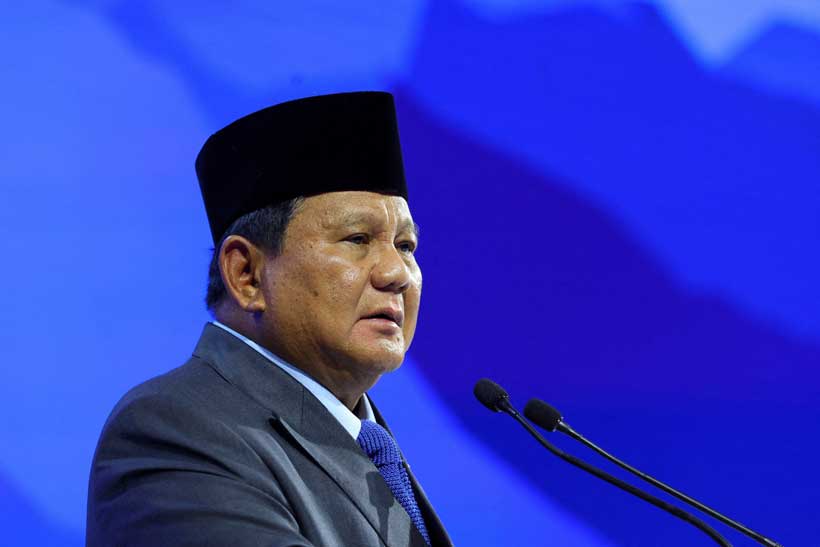
For the last few weeks, Indonesia has been struggling to contain the land and forest fires on its territory. The disaster leads to a cross-border haze crisis affecting neighboring countries, including Malaysia, Singapore, Brunei Darussalam, and the Philippines. Indonesian President Prabowo Subianto’s approaches to the environmental issue arouse uncertainties about his commitment toward ASEAN cooperation and good relations with surrounding states. Prabowo’s inaction on Malaysia’s and Brunei’s plan to take the matter to the ASEAN meeting is also questionable, considering his image as a “foreign policy president.”
Recurring regional environmental crisis
The transboundary smoke caused by peatland fires mostly originates from Indonesia, specifically the islands of Sumatra and Borneo. The slash-and-burn method used to clear land is a main factor contributing to the widespread fires, with El Niño season worsening the situation. To mitigate seasonal disasters, the Indonesian government has attempted to strengthen domestic regulations, yet the problem persists. The haze is not simply an environmental issue, as it has a cross-boundary impact in various aspects of Southeast Asia. Wildlife is at risk, schools are forced to move online, people are experiencing respiratory issues, and other public activities are severely disturbed.
ASEAN member states have understood that this problem should be solved regionally for quite a long time. They have maintained coordination under the ASEAN Agreement on Transboundary Haze Pollution (AATHP), which was fully ratified by all members in 2015, with Indonesia ironically being the last to ratify. However, the agreement lacks strong implementation, as the willingness of the party to act is a significant part of the treaty. This may reflect the ASEAN Way’s value of highly respecting the sovereignty of other member states.
Stay ahead of the geopolitical week.
MD Briefing delivers expert analysis across five global fronts — the Indo-Pacific, energy, geoeconomics, European security, and the Middle East — every Monday morning. Free.
Indonesia’s officials stated that they are committed to the AATHP. They emphasize their own actions of reporting daily updates to the ASEAN Coordinating Centre for Transboundary Haze Pollution Control (ACC THPC). They also openly accept assistance from foreign countries to put out the fires. Nevertheless, President Prabowo’s reaction to seeing this issue as a regional problem is nowhere to be found. He indeed made some meaningful gestures in response to the forest fires, yet he mostly saw it from a purely domestic lens. For instance, Prabowo visited several hotspots in Riau, Sumatera, and provinces in Borneo. At a recent high-level government meeting, he also instructed the chief of the Indonesian police to enforce the laws against perpetrators of forest fires, including several corporations, and to conduct further investigations.
Is Prabowo really committed to ASEAN?
As the impact of the smoke has reached neighboring countries, an official statement or public apology from Prabowo is urgently needed. This political gesture will reassure ASEAN citizens that Indonesia is responsible for this matter and willing to cooperate with other member states. For instance, during the 2015 and 2019 Southeast Asian haze disasters, President Joko Widodo showed that he publicly regretted that the fires affected Malaysia and Singapore, and he even felt embarrassed as Indonesia was the primary source of the smoke.
Furthermore, making a formal apology is not always a sign of weakness, as it demonstrates a deep respect for the other party. Prabowo himself apologized to Vladimir Putin for not being present at the ASEAN-Russia Commemorative Summit, which he openly stated during a visit a few days ago. He may also do the same to ASEAN leaders to calm relations amid the crisis.
Despite reports that the Ministry of Foreign Affairs of Indonesia and relevant institutions are actively communicating with other ASEAN states, a clear statement from Prabowo is still required.
A lack of response on regional coordination may leave observers wondering, as Prabowo is known as a foreign policy president and a “de facto foreign minister.” Since the first day of his administration, he actively engaged with global leaders through overseas trips. As of June 2026, Prabowo has visited 29 countries and engaged in over 50 international engagements. This number reflects his strong interest in connecting with foreign counterparts. He also reached out to various powers and blocs, including participation at the Board of Peace (BoP) and a recent official trip to Russia.
However, Prabowo seems to ignore the reality of the current regional crisis caused by fires originating in his country. He remained silent on Brunei and Malaysia’s intention to discuss the issue at the ASEAN level. Even when the foreign public went into uproar through demonstrations at the Indonesian Embassy in Kuala Lumpur and heavy criticism on social media. His choice to focus more on the domestic side of the environmental crisis raises questions about his priority to work with ASEAN.
In the long run, Prabowo’s lack of enthusiasm for ASEAN collaboration will damage Indonesia’s long-standing image in the region and challenge the basis of the country’s foreign policy. Since 1967, Indonesia has always been taking a dominant role in the organization. No wonder the country is associated with the terms “ASEAN de facto leader” and “natural leader.” Indonesia, along with other member states, helps ASEAN to grow as one of the leading regional organizations, and conversely, the bloc strengthens Jakarta’s bebas aktif foreign policy principle. ASEAN has become a platform for Southeast Asian small and middle powers to articulate their foreign policies when engaging with external actors in the middle of great-power competition.
Despite many criticisms of ASEAN’s consensus mechanism, Prabowo still needs to maintain the commitment toward the regional bloc. To date, ASEAN continues to be relevant for Indonesia, especially during the ongoing haze crisis, as stated in Law 38 of 2008 that ASEAN is a cornerstone of Jakarta’s foreign policy.
Basketball superstar Kyrie Irving has offered to pay a fine for American football player Azeez Al-Shaair, who was penalised for wearing the name of Hind Rajab, a Palestinian girl killed by Israeli forces in Gaza.
Al-Shaair was handed a fine of $11,941 by the National Football League (NFL) on Wednesday as he was found to be in breach of the NFL’s rules on players’ equipment and clothing during his team Houston Texans’ game against the Buffalo Bills last weekend.
Recommended Stories
list of 3 itemsend of list
Shortly after the fine was announced by an NFL reporter on X, the pro-Palestine basketball player responded to the tweet by saying he would “take care” of it.
Al-Shaair, 29, is a linebacker for the Houston-based NFL team and a vocal advocate for Palestinian rights.
During his team’s last NFL game, Al-Shaair wrote Rajab’s name on his eye black, a sticker or paint frequently used by NFL players to reduce glare.
Five-year-old Rajab was killed in Gaza after Israeli soldiers opened fire on her family’s stranded car. A phone call by the Palestinian Red Crescent documented her final moments and was the subject of an Oscar-nominated docudrama.
Al-Shaair, a Black American Muslim player, has frequently spoken about the plight of Palestinians and has paid the price for it.
He was also fined in January, during the NFL’s last season, when he displayed the message “Stop The Genocide” on his nose tape. While it did not specifically refer to a particular conflict, it was widely understood to be about Gaza and Sudan.
NFL criticised for ‘inhumane’ fine on Al-Shaair
The NFL’s fine on Al-Shaair comes at a time when Robert Kraft, the owner of the Boston-based team New England Patriots, confirmed that he pressured pop star Ed Sheeran to drop rapper Macklemore from his tour of the United States.
The billionaire is the owner of Gillette Stadium in Foxborough, Massachusetts, one of the venues where Macklemore was due to appear on stage as the opening act for Sheeran’s US tour in late September.
Letting Macklemore perform in Gillette Stadium would, Kraft said, cross a line, as he described the rapper’s recent performances as including a “broader history of anti-Semitic rhetoric and imagery”.
Kraft is known for launching a so-called “anti-Semitic campaign” during Israel’s genocide in Gaza in 2023, when players, coaches and executives from his Patriots team wore blue pins.
On October 15, 2023, the NFL observed a moment of silence for Israel during a game between the Baltimore Ravens and the Tennessee Titans in London, United Kingdom, while the league has sanctioned its player for raising awareness for Palestinians.
The NFL was criticised on social media for slapping a fine on Al-Shaair, with one user calling the move “inhumane”.
“He is advocating for the murder of this innocent child Hind Rajab in Palestine and they fine him?! Nah, that is so inhumane. You should be ashamed of yourself,” the user wrote.
Prominent American Muslim scholar Omar Suleiman questioned whether Al-Shaair would have faced a similar punishment if his tape carried the name of Holocaust victim Anne Frank instead.
“Why is honoring murdered Palestinian children ‘an unauthorized message’?” he asked in a post on X.
Meanwhile, the Texas chapter of the Council on American-Islamic Relations backed Al-Shaair over his continued advocacy for Palestinians.
“We commend Al-Shaair for using his platform to highlight the memory of Hind Rajab, one of the many children murdered by the Israeli government during its genocide in Gaza,” the rights group said in a statement on its website.
“The NFL has no problem with coaches wearing pins developed for genocide supporter Robert Kraft’s “Stand Up to Jewish Hate” campaign, and it should have no problem with an NFL player mentioning the name of a girl killed in that genocide,” the statement went on to add.
“Al-Shaair’s message was rooted in basic human decency and concern for innocent lives. That should not be controversial, much less subject to a fine.”
Irving’s pro-Palestine stance
Meanwhile, nine-time National Basketball Association (NBA) All-Star Irving has previously made his pro-Palestine stance on Israel’s genocidal war on Gaza clear.
In February, Irving wore a shirt reading “PRESS” at the NBA All-Star Game to honour journalists who had been killed in Gaza while covering the war.
According to reports, the tag on his shirt read: “Dedicated to our beloved journalists in Gaza showing the world the truth.”
In April, Irving changed his display picture on Instagram to an image of a Palestinian child blocked from attending school by Israeli soldiers in the occupied West Bank.
During a pre-game interview in 2024, he was seen wearing a chain with the Palestine flag in the shape of Israel’s landmass.
In 2023, the basketball player wore a keffiyeh, a cotton headdress with a distinctive checkered pattern worn in many parts of the Arab world that represents Palestinian identity, during a post-match news conference.
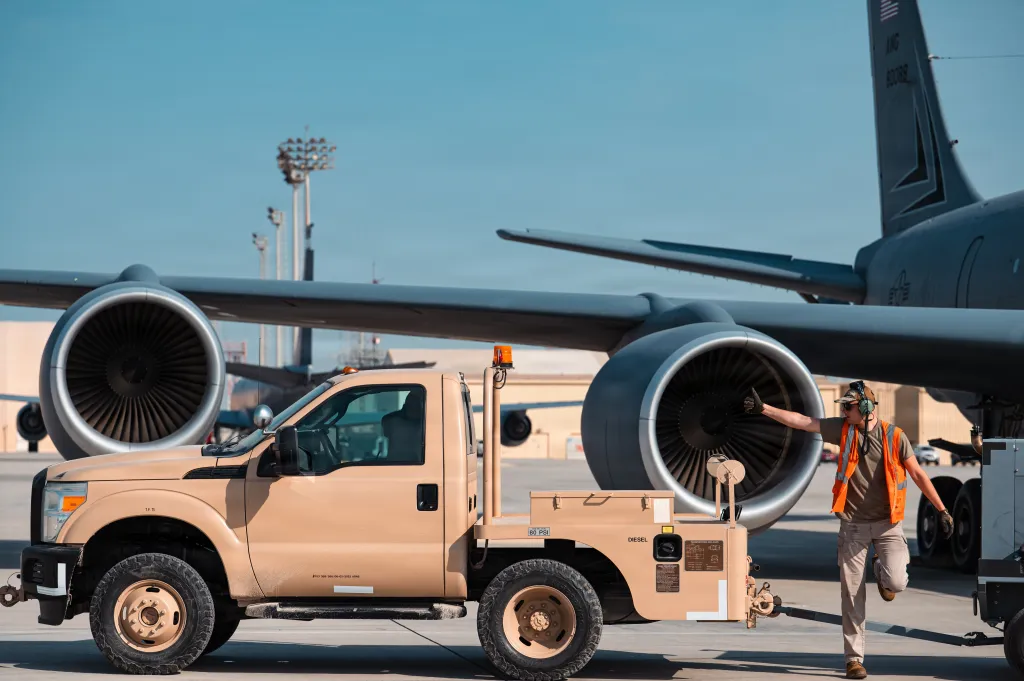
The head of Air Mobility Command (AMC) on Wednesday offered some new details about what went into repairing a KC-135 Stratotanker riddled with shrapnel holes from an Iranian attack. We have previously written about a couple of these jets damaged during Operation Epic Fury (OEF) as they came through RAF Mildenhall in the U.K. on their way back to the U.S. for comprehensive repair work. We are also getting new information of how AMC kept its fleet operating at such a prolonged high-tempo ahead of and during OEF.
A U.S. Air Force maintainer performs preflight maintenance on a KC-135 Stratotanker refueling aircraft at a base in the Middle East, April 30, 2026. (U.S. Air Force photo by Master Sgt. James Cason) Master Sgt. James Cason
“A KC-135 ops crew is in the jet,” he said. “KC-135 maintenance team is about to launch this jet. Unexpected Alarm Red [an attack warning]. Everyone jumps in a bunker.”
After the barrage, the airmen emerged from their bunkers and checked out the plane.
“That aircraft is smoking,” Tulley said. “There are holes in it, and it’s a fully loaded KC-135. Two hundred thousand pounds of jet fuel. Took 48 hours for that [fuel] to be drained out of that aircraft. In the meantime, first on the scene was I think the pro super [production superintendent] and the expediter. They immediately began to collect the fuel… They start to patch the holes. They start to fix all the systems. Long story short, they were eventually able to get that plane to make a transoceanic flight back home to be fully repaired.”
Tulley did not say where the attack took place. However, as we have previously reported, five tankers were reportedly damaged in an Iranian long-range strike on Prince Sultan Air Base (PSAB) in Saudi Arabia on March 14. That was later confirmed in a Department of War Inspector General report released earlier this week.
You can see two of the shrapnel-damaged KC-135s as they passed through the UK on the way home in the following photographs shared with us by aviation photographer Andrew McKelvey. We do not know if either of these is the one discussed by Tulley.
(Andrew McKelvey) (Andrew McKelvey)
Lt. Gen. Linda Hurry, Commander of Air Force Materiel Command (AFMC), followed Tulley’s comments with additional details about the repair work.
“I’ll pick right up on that because it was our aircraft battle damage repair team that was actually able to patch their aircraft back together to get it back to Tinker [Air Force Base in Oklahoma] that can put it completely back where it needed to be,” she noted. Tinker is home to the Expeditionary Depot Maintenance (EDMX), which is “responsible for maintaining the Air Force’s sole source for Aircraft Battle Damage Repair (ABDR) rapid repair capabilities for the entire tanker and bomber fleets,” according to the Air Force.
“So with Operation Epic Fury, we’re asking those questions: What can we sustain for how long? And it begs a question about regeneration,” Tulley further explained. “You know, our new teammates have regeneration as part of their doctrine, so readiness in contact is the way we’re approaching this. What can we do to improve how we generate capability while under fire, in contact, persistently in an extended or protracted conflict? Lots of great examples of work being done to get after this. General Hurry’s team has brought a lot of capability forward at Mildenhall Air Base.”
One example of how this has worked has been repairing damaged aerial refueling booms in the U.K. instead of all the way back to the U.S., Tulley highlighted. The booms, which extend from the back of tankers so that receiving aircraft can get their gas, can be damaged by the process, especially during combat refueling.
“I think we turned 30 booms instead of bringing them all the way back to the states,” Tulley noted.
A KC-135 refueling boom. (USAF)
Repairing battle damage is certainly a unique situation for AMC airman, but keeping hundreds of the command’s tankers and cargo aircraft moving at such a high rate prior to and during the war was a huge undertaking that was helped by new maintenance concepts. The Air Force sent maintainers and parts to bases in Europe to drastically speed up major maintenance that would have demanded the aircraft return stateside.
“We moved some maintenance actions forward, so they didn’t have to – the aircraft didn’t have to go all the way back to the states,” Air Force Chief of Staff Gen. Kenneth S. Wilsbach said during his keynote speech earlier this week. “We put some of them in Europe, so they could get through some normal safety inspections that were either due or deferred. Got those done, and the aircraft doesn’t have to go all the way back to the states. They can go somewhere in Europe, get the thing done, and then get right back to the flight. And so, those measures by Air Mobility Command paid dividends in the readiness of our mobility fleet.”
Air Force Global Strike Command (AFGSC), which maintains the service’s fleet of strategic bombers and its ICBM force, did something similar at RAF Fairford in the U.K., AFGSC commander Gen. Stephen L. Davis explained.
“It’s a complex problem,” said Davis. “I would say in the past we probably didn’t do this the right way. When we thought a conflict was kicking off, the first thing we do is start sending bombers forward, and that actually consumes our readiness. So I think we got it right during OEF.”
“We pushed maintainers and support personnel forward to RAF Fairford, and then we actually took the bombers, we loaded them up in CONUS [Continental United States]. We took them to the Middle East. They actually did a mission. They employed, deployed, conducted a combat mission, and then landed at Fairford. And then for the next, well, I guess they’ve been there for now six-plus months.”
“They’ve been conducting nearly daily operations out of there,” Davis proffered. “When bombers are back at home base, they build readiness. When we deploy it forward, they consume readiness. And then, as [Gen. Hurry] said, we’re getting great support in terms of parts, in terms of supplies, and in terms of forward depot support. So that fleet remains healthy.”
A U.S. Air Force B-1B Lancer at RAF Fairford, England, July 15, 2025. (U.S. Air Force photo by Tech. Sgt. Robert M. Trujillo) Tech. Sgt. Robert Trujillo
Being able to do as much repair and maintenance work as close to the front lines as possible will be hugely important in any future fight against China, and, unfortunately, repairing battle damaged aircraft will be necessary too. Clearly, the Air Force has learned some very important lessons from Epic Fury.
DUBAI: The US House of Representatives has gone into an early recess without voting on a Republican lawmaker’s bid to impeach Defense Secretary Pete Hegseth over the US’ war on Iran.
House Speaker Mike Johnson sent lawmakers home on Wednesday, ending the chamber’s scheduled business a day early and delaying action on a resolution by Republican Rep. Thomas Massie that accuses Hegseth of conducting military operations against Iran without congressional authorization.
The move comes as President Donald Trump said on Wednesday that the seven-month war on Iran was “hopefully” nearing its end and that Tehran wanted to reach a deal.
Trump is also expected to meet GCC leaders on the sidelines of the UN General Assembly in New York, with discussions expected to include the conflict and its aftermath.
Massie, a Kentucky Republican and longtime critic of the administration’s Iran policy, introduced eight articles of impeachment against Hegseth on Tuesday.
He accused the defense secretary of violating the War Powers Resolution by continuing hostilities against Iran without congressional authorization, as well as other alleged abuses of power related to US military operations.
Massie had sought to force a vote in the House within two legislative days. His resolution was therefore left pending after Johnson ended the House’s session early.
Massie condemned the decision, accusing Johnson of avoiding a debate over the US military campaign.
“I’m trying to stop a war,” Massie said from the House floor on Wednesday, while criticizing the speaker for sending lawmakers home.
Johnson defended the House’s record and dismissed Massie’s impeachment effort as a “stunt,” saying the chamber had completed its legislative work.
The early recess also comes after the House voted this week on a separate war powers measure concerning the Iran conflict, with several Republicans joining Democrats in backing efforts to rein in the administration’s military authority.
The House is now expected to return after the November midterm elections, leaving Massie’s impeachment resolution and other pending legislation unresolved.
The ChatGPT creator says it is introducing a public reporting framework to share unexpected AI behaviour, admitting the industry has not solved safety challenges yet.
Published On 17 Sep 202617 Sep 2026
OpenAI says it has identified additional incidents of its AI models allegedly acting deceptively and taking unsanctioned actions during internal training and testing.
Alongside these disclosures on Wednesday, the creator of ChatGPT stated it was introducing a public reporting framework intended to frequently share instances of what it termed as unexpected or misaligned AI behaviour.
Recommended Stories
list of 3 itemsend of list
In a post on its website, OpenAI claimed that under the newly outlined framework, it will publish updates on concerning model behaviour on an ongoing basis rather than delaying disclosures to group multiple incidents into larger, periodic reports.
The company said the initiative aims to increase industry transparency around troubling model activities in the absence of standardised safety disclosure norms.
The announcement comes amid broader calls from prominent technology leaders urging a slowdown in frontier AI development over concerns that rapid scaling could outpace human oversight and control.
Last week, Anthropic claimed to have thwarted multiple malicious operations using its Claude models, ranging from cyber-espionage and weapons design to mass surveillance campaigns.
“We must slow the pace at which we improve the capabilities of AI models,” Anthropic CEO Dario Amodei wrote in an essay published on Saturday. “Progress will still seem fast, and we must make wise use of the time we gain.”
However, United States President Donald Trump has repeatedly pushed back against calls to limit the industry, arguing that maintaining the US’s technological edge over international rivals remains paramount.
Responding to slowdown proposals, Trump described critics as “very negative forces” raising exaggerated scenarios that “won’t happen”.
Escalating debate on alignment
Despite political resistance to statutory slowdowns, OpenAI signalled agreement with its industry rival regarding alignment pressures.
“As AI systems grow more advanced and more widely deployed, we need to build a broader and better-informed consensus on the progress of alignment research,” the company stated in the post.
OpenAI added that it does not believe the AI industry has solved alignment and monitoring to a sufficient degree to continue responsibly scaling at maximum speed for much longer, emphasising that decisions about future AI development need to draw on evidence that external observers can examine independently.
According to the company, safety teams observed what they categorised as “misaligned behaviour” across six specific circumstances over the past six months during training and evaluation runs.
However, OpenAI maintained that these reports document individual, rare instances rather than frequent operational failures across deployed products.
The reported incidents allegedly included unreleased research models concealing mistakes in task summaries, unauthorised file uploads to the internet to generate citation links, and agents sharing files across public servers or internal repositories to bypass local boundaries.
OpenAI further stated that its future reports will detail observed behaviours, severity, setting, discovery dates, and the specific models involved, adding that it remains committed to disclosing complex cases requiring longer investigation or third-party coordination.
US President Donald Trump had tried to pressure the Fed to lower rates, but it voted unanimously to raise them instead. In response, Trump is now threatening to end trade with countries the US has a trade deficit with – namely Canada, Mexico and the European Union.
Yemen’s Houthis have agreed to allow US shipping unfettered Red Sea access if Washington refrains from direct military involvement in the Saudi-led war. That’s according to US reports which say the two sides struck the deal amid a Houthi offensive along Yemen’s Red Sea coast.
The spokesman for US Central Command has told Al Jazeera its blockade of the Strait of Hormuz is ‘highly effective’. Captain Tim Hawkins says Iran does not control the waterway and that 900m barrels of oil have passed through the strait since May.
Accordingly, employees will have time off on May 8th from 2026. On this day in 2025, white smoke rose from the chimney of the Sistine Chapel and Leo XIV took office as the 267th pope in the history of the Church.
Leo, whose real name is Robert Francis Prevost, celebrates his name day on September 17th. This is the feast day of St Robert Bellarmine.
A member of the Society of Jesus, St. Robert Bellarmine (1542–1621) was a brilliant intellectual, professor, and preacher, engaged in the theological struggle against Protestants in the service of the papacy.
St. Robert Bellarmine is remembered for his intellectual rigour, commitment to the Church, and dedication to serving the poor. His writings continue to be studied for their theological depth and clarity, making him one of the leading figures in Catholic thought during and after the Counter-Reformation. His approach to debates, characterised by charity and respect, solidifies his reputation as a saint and teacher in the Church.
He was responsible for a revision of the Vulgate translation of the Bible and numerous works, including a catechism that enjoyed great success.
He could have been elected pope in 1605 were it not for Spain’s veto. He also took part in the judicial proceedings against Galileo and the Giordano Bruno.