Discover the latest happenings and stay in the know with our up-to-date today news coverage. From breaking stories and current events to trending topics and insightful analysis, we bring you the most relevant and captivating news of the day.
Acclaimed Russian film director who won 2026 Grand Prix award at Cannes, has been critical of the war in Ukraine.
Published On 18 Sep 202618 Sep 2026
The winner of a prestigious Cannes Film Festival award has been declared a foreign agent by Russian authorities for his criticism of Moscow’s war in Ukraine.
Acclaimed Russian film director Andrey Zvyagintsev was designated a “foreign agent” by the Kremlin on Friday, according to state news agency TASS.
Recommended Stories
list of 3 itemsend of list
Zvyagintsev won the 2026 Grand Prix at the Cannes Film Festival for, Minotaur, a film depicting a Russian businessman who is forced to decide which of his employees should be mobilised to go and fight in Ukraine.
“Millions of people on both sides of the front line dream of only one thing: for the massacres to stop,” Zvyagintsev said in his acceptance speech, adding that Russian President Vladimir Putin was the only person capable of ending the war.
Moscow has kept casualty numbers from the fighting in Ukraine heavily restricted and has not provided timely or complete public updates, but estimates of Russian soldiers killed in the four-year war range from anywhere from 200,000 to half a million.
Russia’s Ministry of Justice on Friday accused Zvyagintsev of disseminating “false information about decisions taken by the public authorities of the Russian Federation and the policies they pursue”.
“He interacted with foreign agents and resides outside the Russian Federation,” it said.
The 62-year-old director, who has lived outside Russia since the COVID pandemic, is known for a series of other films including, The Return, The Banishment, and, Leviathan, a bleak portrayal of life in rural Russia.
People listed as foreign agents are subjected to onerous bureaucratic requirements and restrictions on their income in Russia.
They are barred from holding public office and forced to register their activities with the authorities.
They also have to add warnings on everything they publish, including on social media, that the content was produced by a foreign agent.
The label adds connotations of espionage to numerous people, including public figures, whom it deems to be engaging in anti-Russian activity with support from abroad.
Previously, writer Boris Akunin and rock musician Boris Grebenshchikov have been labelled as foreign agents by Moscow.
The officer who led the 31st Marine Expeditionary Unit (MEU) on its recent combat deployment to the Middle East told us he needs his own uncrewed surface vessels (USVs) on future deployments. Operationalizing USVs is an area where the Marines are lagging behind. In particular, he wants the ability to send USVs forward to reconnoiter potential highly-contested beach landing areas, a mission largely assumed by the Navy.
As we have frequently reported, the military use of USVs is now proliferating around the globe at an increasing rate. Ukraine has employed sea drones to devastating effect against Russia’s Black Sea Fleet vessels and facilities, forcing the general evacuation of Russian naval assets from occupied Crimea to bases in Russia proper. During Operation Epic Fury, the U.S. used them for the first time in combat, as one-way attack weapons against Iranian targets, to hunt for mins, and for a search and rescue operation to locate the crew of an AH-64 Apache helicopter downed by Iran, as well as general broad-area surveillance and awareness. China is investing heavily in the space, as well, along with many other navies around the globe, both friend and foe.
The following video shows the first U.S. use of a USV as a kamikaze weapon.
Yesterday, using multiple one-way attack surface drones, CENTCOM forces successfully struck a submarine and ship maintenance facility in Iran. Three Corsair unmanned surface vessels hit the port at Bandar Abbas Naval Base, marking the first time American forces have employed sea… pic.twitter.com/bOM2kmgRxz
“There was a lot in theater that were being used, but it wasn’t something that we went out with,” Col. Chris P. Niedziocha told us when we asked if the 31st MEU deployed with USVs. He answered in the affirmative when we asked him if MEUs need sea drones on future deployments. He said it is part of the “explosion in robotics and autonomy” being used in combat.
“These systems are incredibly useful and capable,” explained Niedziocha, now director of the USMC Expeditionary Warfare School. “And you say, ‘Hey, you know, [in] the next war, if the first thing you’re putting through the breach isn’t a robot, something’s wrong. You say never send a Marine someplace you haven’t sent a bullet. I think the new way is [you] never want to send a Marine someplace you haven’t already sent a robot. So yeah, we’re embracing [the technology] and we’re not leaders. We’re fast followers in that regime.”
Asked for specific use cases he sees for USVs, the colonel talked about using them before putting Marines ashore.
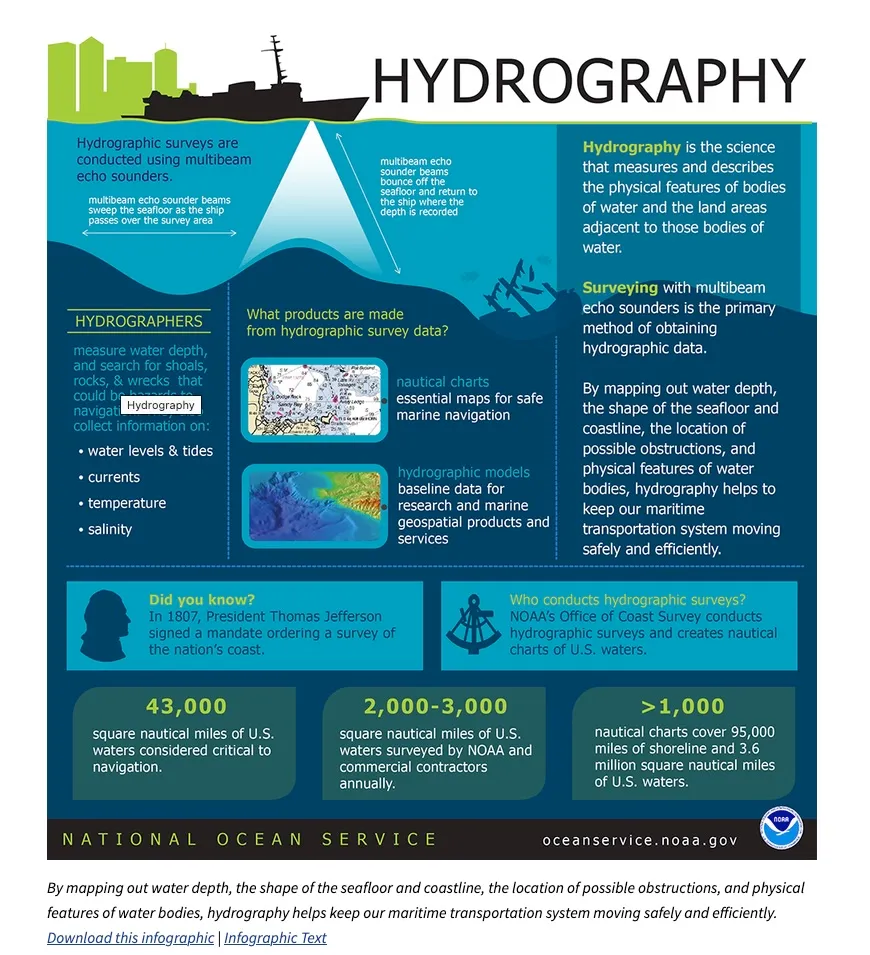
“I can tell you if you’re doing an amphibious operation, you want to understand what’s waiting beneath the surface in the water column,” Niedziocha noted. “So something can go either with a side-looking sonar array or even forward-looking to demonstrate that there’s nothing there, and the hydrography and bathymetry is what you… need for the operation to be successful.”
Hydrography measures “the shape and features of the shoreline; the characteristics of tides, currents, and waves; and the physical and chemical properties of the water itself,” according to NOAA. Bathymetry, which is part of that, focuses on mapping the depths and shapes of underwater terrain.
NOAA
These functions are critical for mine detection and determining whether there are man-made or natural obstacles that would impede landing operations. While these missions are largely being performed by the Navy, including with USVs, the Marines are moving toward making that an organic capability. Recently, the Marines announced they were testing a counter-mine USV system. The evaluation was conducted late last month at Camp Pendleton by the Program Manager Combat Support Systems (PM CSS) Explosive Hazard Defeat Team.
The test of the USV was “in response to a littoral capability gap,” according to the media release. “The solution: seek a commercial USV solution that is equipped with integrated autonomous driving and payloads that consist of Sonar, Forward-Looking Infrared (FLIR) cameras, Line of Sight (LOS) Communications and Acoustic Communications (AComms).”
This was part of the overall effort to develop “solutions that enable increased standoff for Marines to detect, investigate and neutralize threats,” the release added. “The innovation of Explosive Ordnance Disposal (EOD) and Littoral Explosive Ordnance Neutralization (LEON) systems will provide Marine EOD Technicians with the confidence to operate in contested environments while preserving combat power, increasing operational reach, and minimizing exposure to explosive threats.”
LEON is a so-called system of systems, using a remotely operated vehicle, diver equipment, an unmanned underwater vehicle (UUV), a USV, and an Amphibious Unmanned Ground Vehicle to enable “EOD to confirm and mark hazards and obstacles from very shallow water to the beach zone,” the media release added.
While unmanned systems have long been part of EOD operations, “we’re expanding that into maritime systems that allow more endurance and less risk for operators,” said Chief Warrant Officer 2 Alfredo Andrade, officer in charge, Explosive Ordnance Disposal Company, 7th Engineer Support Battalion (ESB). “Some of the conflicts that we are engaged in take a toll on the force, and surging in new forces is costly. It turns into a logistical problem. To preserve the safety and the health of the forces… the USV and the [LEON] program exist to ensure that we have readily available combat power.”
In late August at Camp Pendleton, the PM CSS Explosive Hazard Defeat Team tested an unmanned surface vessel in response to a littoral capability gap. (PAE Marine Corps photo by Kristiana Gehly) Kristiana Gehly
While Niedziocha didn’t address USVs for offensive combat roles, the Marines have evaluated them for that use as well as for logistics, among other functions.
Our Autonomous Low-Profile Vessel (ALPV) solicitation is now accepting submissions.
The @DeptofWar and the @USMC need to resupply units spread over wide distances in contested littoral environments. Increased all-domain threats targeting logistics capabilities, locations, and… pic.twitter.com/Af8v0DTRHS
— Department of War Innovation Unit (@DIU_x) March 3, 2026
There have been many other tests, as well. Including one just this summer at RIMPAC. These trials saw the launch and recovery of one of Splash Industries’ Typhoon USVs aboard the USS Essex. The ‘Gator Navy’ of amphibious assault vessels that haul Marines and their kit around the oceans is uniquely suited to act as USV motherships. Their well decks allow for easy deployment and recovery of USVs of many sizes and capabilities near seamlessly. So it won’t be surprising if these vessels and the Marines aboard them quickly become staples in the Pentagon’s USV playbook.
Watch us land one of our drone-boats inside a moving US Navy warship during RIMPAC. This world-first resupply mission was performed completely autonomously using a Splash Industries Typhoon USV. pic.twitter.com/AEzNzZjsL1
You can see that engagement in the following video.
Ukraine’s Navy says a Sargan unmanned surface vessel destroyed a Russian unmanned boat with machine-gun fire in the Black Sea, the first-ever battle between unmanned surface vessels. Ukrainian Navy personnel operated in coordination with HUR. #Ukrainepic.twitter.com/Avg4ecz8m6
Having recently returned from a six-month deployment that saw the Marine Corps’ first use of its Expeditionary Advanced Base Operations (EABO) concept in a combat setting during the fight against Iran, Niedziocha has a good sense of the realities of modern warfare. His Marines operated forward arming and refueling points (FARPs) for various aircraft in combat for the first time and set up remote sensing locations.
That a commander like him who sees value in USVs is a good sign for progress in the development of these systems.
Japan has said it is keeping the door open to acquiring nuclear-powered submarines, a potentially major shift for a country whose submarine force has historically relied exclusively on conventional propulsion. Defense Minister Shinjiro Koizumi confirmed recently that Tokyo is not ruling out nuclear-powered submarines as it considers the future requirements of the Japan Maritime Self-Defense Force (JMSDF).
Should Japan ultimately pursue the capability, it would join an exclusive group of nations operating nuclear-powered submarines. China, France, India, Russia, the United Kingdom, and the United States are currently the only countries with nuclear-powered submarines in active service. Brazil is already working to join the club, while Australian and South Korean nuclear-powered submarine plans are somewhat longer-term.
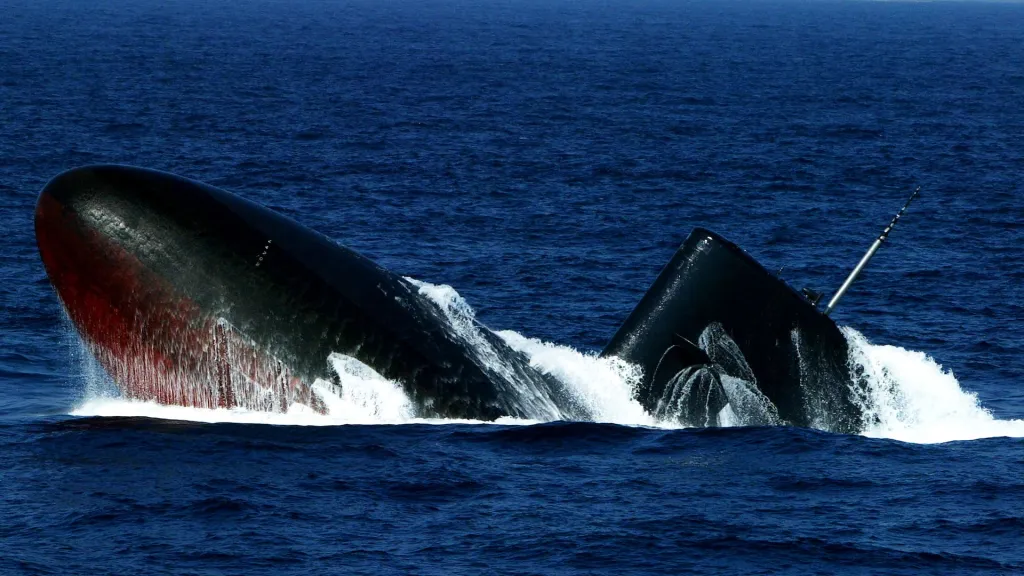
A submarine of the Japan Maritime Self-Defense Force surfaces during a naval review off Sagami Bay, Japan. Photo by Koichi Kamoshida/Getty Images
Japan’s submarine fleet is already regarded as among the most capable conventionally powered forces, and is very much at the forefront of advanced naval propulsion technologies. Even with that considerable expertise, however, developing and sustaining a nuclear propulsion capability would represent a huge challenge, requiring expertise and infrastructure far beyond those needed to build Japan’s existing conventionally powered submarines.
Koizumi’s comments do not represent a decision to acquire nuclear-powered submarines, nor do they indicate that Japan has begun a procurement program. They do, however, mark a significant evolution in the country’s public debate over submarine propulsion and point to a growing willingness within the Japanese defense establishment to consider capabilities that were previously largely outside the mainstream of defense planning.
Secretary of War Pete Hegseth hosts a bilateral meeting with Japanese Minister of Defense Shinjirō Koizumi at the Pentagon, Washington, D.C., Jan. 15, 2026. (DoW photo by U.S. Navy Petty Officer 1st Class Alexander Kubitza)
Currently, Japan operates one of the world’s most capable conventional submarine fleets, centered on increasingly sophisticated diesel-electric boats equipped with air-independent propulsion and advanced lithium-ion batteries. These submarines are well suited to operations around Japan and the country’s surrounding waters.
The JMSDF currently operates 22 conventionally powered submarines, maintaining the force structure established in the 2010s while progressively replacing older boats with the more capable Taigei class. Five Taigei class submarines are now in JMSDF service, with additional boats in the pipeline.
The first-of-class Taigei was launched on October 14, 2020, at the Mitsubishi Heavy Industries (MHI) shipyard in the city of Kobe, in the western prefecture of Hyogo. Japan Maritime Self-Defense Force
Nuclear propulsion, however, would offer substantially greater endurance and sustained underwater speed, allowing Japanese submarines to conduct longer-range operations across the broader Western Pacific with minimal support. This is a requirement that is becoming increasingly relevant as Tokyo’s strategic focus expands beyond its immediate maritime approaches.
China’s rapidly expanding naval force, including its growing submarine fleet and increasingly distant maritime operations, is forcing Tokyo to consider how it would monitor and potentially counter Chinese forces farther from the Japanese archipelago. A nuclear-powered attack submarine could remain submerged for extended periods without the endurance limitations imposed by conventional propulsion, making it particularly useful for long-range surveillance, tracking, and sea-denial missions.
Japan’s debate is also unfolding alongside a significant development in neighboring South Korea. Seoul has confirmed plans to develop a new class of nuclear-powered submarines, a move that could add further momentum to an emerging undersea competition in Northeast Asia. South Korea’s decision is particularly relevant to Tokyo because it demonstrates that nuclear propulsion is no longer merely a theoretical capability for U.S. allies in the region. While the missions and strategic priorities of the Japanese and South Korean navies are different, both countries face the challenge of operating in waters increasingly contested by China and North Korea.
A South Korean Ministry of Defense rendering shows how the nuclear-powered Jang Bogo N Project boats may look. MND
A Japanese decision to pursue SSNs could eventually create a much deeper basis for cooperation with Australia, including submarine interoperability, undersea warfare, workforce and technical expertise, infrastructure, sustainment, and potentially aspects of the industrial base. Analysts have already examined how Japan could fit into the wider AUKUS submarine ecosystem as Australia’s nuclear-submarine program develops.
Concept art of the submerged SSN-AUKUS nuclear-powered attack submarine. U.K. Ministry of Defense illustration
A Japanese nuclear-powered submarine with a robust capacity to launch land attack cruise missiles would also be a powerful component in the country’s emerging “counterstrike” posture, which is increasingly centered on acquiring the ability to strike targets at longer ranges.
Launch of the first Tomahawk missile from the Kongōclass Aegis destroyerChōkaiat an undisclosed location in the Pacific. Japan Ministry of Defense
An SSN would potentially add a highly survivable, mobile platform to this emerging strike architecture, allowing Japan to position long-range weapons farther from its home territory and complicating an adversary’s efforts to locate and neutralize them. That could be particularly valuable in a conflict in which Japanese air bases, missile batteries, and other fixed infrastructure were under attack.
The potential SSN requirement also fits with Japan’s expanding expeditionary ambitions. As the JMSDF converts its Izumo class helicopter destroyers to operate F-35B fighters, giving Japan a more credible carrier aviation capability, nuclear-powered attack submarines could provide a valuable escort for these increasingly important surface groups. Their speed, endurance, and ability to remain submerged for extended periods makes SSNs particularly well suited to accompanying carrier forces on longer-range deployments and supporting contingencies farther from Japanese waters.
U.S. F-35B Flies From Japanese Carrier; First Fighter Launched From Japanese Warship Since WWII
Looking at the bigger picture, it is highly significant that nuclear propulsion was effectively excluded from Japan’s conventional defense debate for decades. More recently, however, Japanese defense officials and policymakers have begun examining whether future submarines will require a different propulsion system. The issue is now one that can now be discussed openly at the ministerial level.
Nevertheless, pursuing a nuclear-powered submarine program would come with huge challenges.
The Japan Maritime Self-Defense Force Sōryū class submarine Hakuryū arrives at the submarine piers of Joint Base Pearl Harbor-Hickam. U.S. Navy photo by Mass Communication Specialist 1st Class Steven Khor/Released
Building and operating nuclear-powered submarines would require Japan to establish an entirely different industrial, regulatory, and training infrastructure. The vessels would also be considerably more expensive and complex to build and operate than Japan’s existing conventionally powered submarines. Tokyo would have to resolve questions involving nuclear regulation, reactor technology, maintenance facilities, crew training, and the handling of nuclear material.
There would also be a significant political dimension. Although naval nuclear propulsion is fundamentally different from possessing nuclear weapons, any move in that direction would inevitably receive scrutiny in a country whose postwar security policy has been shaped by its experience with nuclear weapons and its longstanding non-nuclear principles.
For those reasons, Koizumi’s statement should be viewed less as an announcement of a Japanese nuclear-submarine program than as evidence that the political barrier to discussing such a program is falling.
The Japanese Oyashio class submarine Yaeshio transits the Philippine Sea during Exercise Pacific Vanguard 23. U.S. Navy photo by Mass Communication Specialist 3rd Class Santiago Navarro
The next question is whether the Japanese government will move from keeping the option open to actually studying a nuclear-powered submarine design, propulsion technology and acquisition pathway in detail.
If it does, the consequences could extend well beyond Japan’s submarine fleet. A Japanese nuclear-powered submarine capability would represent a major enhancement of Tokyo’s ability to operate across the Western Pacific and could alter the undersea balance between Japan, China, and the United States’ other regional allies. At the very least, the idea is one that is now part of wider discussions at the highest levels.
United Nations says 22 million people need humanitarian aid as conflict intensifies.
Published On 18 Sep 202618 Sep 2026
More than 112,000 people have been displaced in Yemen and close to 3,000 have fled the conflict to Djibouti, according to the United Nations, as fighting intensifies between the Iran-allied Houthis and Saudi-backed forces loyal to the internationally recognised government.
“Our resources are very, very, very limited and our stocks will be depleted very soon,” Abdusattor Esoev, mission chief in Yemen for the International Organization for Migration, told reporters on Friday.
Recommended Stories
list of 3 itemsend of list
Most of the more than 112,000 internally displaced people have been displaced over the last two weeks, mainly along the west coast and in the provinces of Taiz and Lahj, he added.
The displacement began when the Houthis made a rapid advance, seizing control of the entire Red Sea coast of Yemen to tighten their grip on the vital shipping route, the Bab al-Mandeb Strait.
Esoev estimates 22 million Yemenis – or nearly half the population – are in urgent need of humanitarian aid.
More than 65,000 registered refugees and asylum seekers in Yemen, mainly from Somalia and Ethiopia, are also threatened.
3,000 Yemenis flee to Djibouti
The crisis is growing “by the hour”, warned Francesco Galtieri, a representative for the UN Population Fund (UNFPA), adding that thousands of women who have lost all their possessions are on the run with their children.
Galtieri estimates that 2,000 pregnant women are among the displaced and around 200 are expected to give birth shortly.
Around 3,000 Yemenis have fled Yemen by boat to Djibouti, the UN refugee agency said. The shortest route across the Bab al-Mandeb Strait is just over 25 kilometres.
The UNHCR reports that more than 2,400 people made the voyage in the past week – mostly women, children and older people.
The influx is adding pressure on Djibouti and population of about one million people. It already hosts around 36,000 refugees, most from Somalia and Ethiopia, said UNHCR representative Sandrine Desamours.
“While the number may sound small,” it must be seen in proportion to the population, she added.
The strategically important Bab al-Mandeb links the Red Sea with the Gulf of Aden and has become an alternative shipping route as the United States’ war against Iran choked the Strait of Hormuz.
The Al-Farsi camp for internally displaced people in Ras Imran in southern Yemen, September 17, 2026 [Mohamad Hakim/AFP]
Police in Ceuta used batons and fired shots into the air as they began moving migrants from beaches to a new camp. Nearly 10,000 remain in the Spanish territory weeks after a record influx saw more than 72,000 people cross from Morocco.
Spain’s Lamine Yamal says most racism he has suffered has come from people unaware of their own comments or behaviour.
Published On 18 Sep 202618 Sep 2026
Barcelona forward Lamine Yamal said he has experienced racism “a thousand times”, with many people unaware that their comments or behaviour are racist.
The 19-year-old has been the target of racial abuse during his rapid rise to prominence.
Recommended Stories
list of 4 itemsend of list
In October 2024, footage appeared to show Lamine, Raphinha and Ansu Fati being racially abused during Barcelona’s match against Real Madrid at the Santiago Bernabeu.
The Spanish Observatory on Racism and Xenophobia said in a bulletin published in March that Lamine and Vinicius Jr were the most frequent targets of online racist abuse in Spain in the final quarter of 2025.
Asked by former Argentina international Jorge Valdano in an interview with Spanish broadcaster Movistar whether he had directly experienced racism, Lamine said: “A thousand times.
“People are indirectly racist toward you, but maybe don’t realise it. There are a lot of comments or looks that are racist, and they don’t even notice.
“If someone calls me Black, it’s not going to bother me at all, ultimately I’m Black, I’m not any other colour. Another thing is whether it’s good or bad, whether they’re saying it to offend me.
“But if I’m playing a match and they paid for a ticket to see me, I’m not going to get angry just because they disrespected me.”
La Liga has stepped up efforts to combat racist abuse in stadiums following several high-profile incidents in Spanish football in recent years.
Ex-Manchester United and Real Madrid forward Cristiano Ronaldo named in Portugal squad to face Norway and Denmark.
Published On 18 Sep 202618 Sep 2026
Cristiano Ronaldo has been included in new Portugal manager Jorge Jesus’s first 25-man squad for the defending champions’ upcoming four Nations League matches.
In August, Ronaldo fuelled speculation about his retirement plans after saying the coming year would probably be the last of his playing career.
Recommended Stories
list of 4 itemsend of list
The 41-year-old Portugal captain is one of the most decorated players in football history, having won major trophies with Manchester United, Real Madrid, Juventus and current club Al Nassr since making his senior debut for Sporting in 2002.
Ronaldo, a five-time Ballon d’Or winner, was unable to add a World Cup title to his list of honours after Portugal were knocked out in the last 16 by eventual champions Spain, leaving the sport’s biggest prize absent from his trophy cabinet.
Ronaldo confirmed in July that the 2026 edition of the FIFA World Cup would be his last in that competition, but he was unwilling to make a hasty call on his international future.
“His performance is what matters. The past doesn’t count,” Jesus told a news conference on Friday.
“In this squad, there are 13 players who have worked with me. I don’t have a set core, so within this group, there were several players who were important for this squad.
“Cris is a player like any other. If he performs, he plays; if not, he doesn’t. He has a different status – he has five Ballon d’Or awards – but does that factor into my decisions? No. However, the fact that he is different is.”
Jesus will make his debut as Portugal manager against Wales at home on September 24. Portugal then travel to face Norway and Denmark on September 27 and October 1 respectively, before hosting Norway on October 4.
Portugal appointed the 72-year-old former Al Nassr boss in July, days after Spaniard Roberto Martinez stepped down following the country’s World Cup exit.
Portugal’s Nations League squad
Goalkeepers: Diogo Costa (Porto), Rui Silva (Sporting), Samuel Soares (Benfica)
Defenders: Goncalo Inacio (Sporting), Joao Cancelo (Barcelona), Diogo Dalot (Manchester United), Nuno Tavares (Lazio), Nuno Mendes (Paris St Germain), Renato Veiga (Villarreal), Ruben Dias (Manchester City), Tomas Araujo (Benfica)
Midfielders: Bruno Fernandes (Manchester United), Joao Palhinha (Benfica), Joao Neves (Paris St Germain), Ruben Neves (Al-Hilal), Vitinha (Paris St Germain), Bernardo Silva (Real Madrid)
Forwards: Cristiano Ronaldo (Al-Nassr), Fabio Silva (Borussia Dortmund), Francisco Trincao (Al-Ahli), Francisco Conceicao (Juventus), Goncalo Ramos (AC Milan), Joao Felix (Al-Nassr), Pedro Neto (Chelsea), Rafael Leao (Galatasaray)
WOMEN have reminded their boyfriends, husbands and male family members that they can see who they follow on Instagram and have no intention of pretending they cannot.
The warning has shattered men’s collective belief that tapping ‘Follow’ on the account of an attractive stranger was a private act nobody would ever discover, much less judge.
28-year-old Jess, not her real name, said: “It’s sweet how naive they are. Imagining we don’t go straight to their follower list once we find their accounts. I’ve done it from the car park after first dates.
“And it’s all there – Only Fans models, ‘fitness’ videos clearly designed only to give your wrist a workout and obvious AI scam bots with names like ‘Big Tits Zilla’ and ‘Legs Daily’.
“They always say ‘I don’t know her’. Of course they don’t. She’s a porn star living in LA and they’ve hardly left Doncaster. But they seem to think liking all her posts is the first step to a sexual relationship.
“It’s not like we’re hacking into the Pentagon, boys, there’s an actual search button. We’re also looking for exes, anyone a bit young for you, friends you’d clearly bang given the chance and any sudden, suspicious interest in women’s sports.
“Why don’t they understand the whole world can see when you comment under a thirst trap with ‘yummy’? I haven’t been able to look at Grandad the same way since.”
Husband Anthony, not his real name, aged 39, said: “Jess’s is a massive hypocrite. She claims she’s following my ex for ‘fashion tips’.”
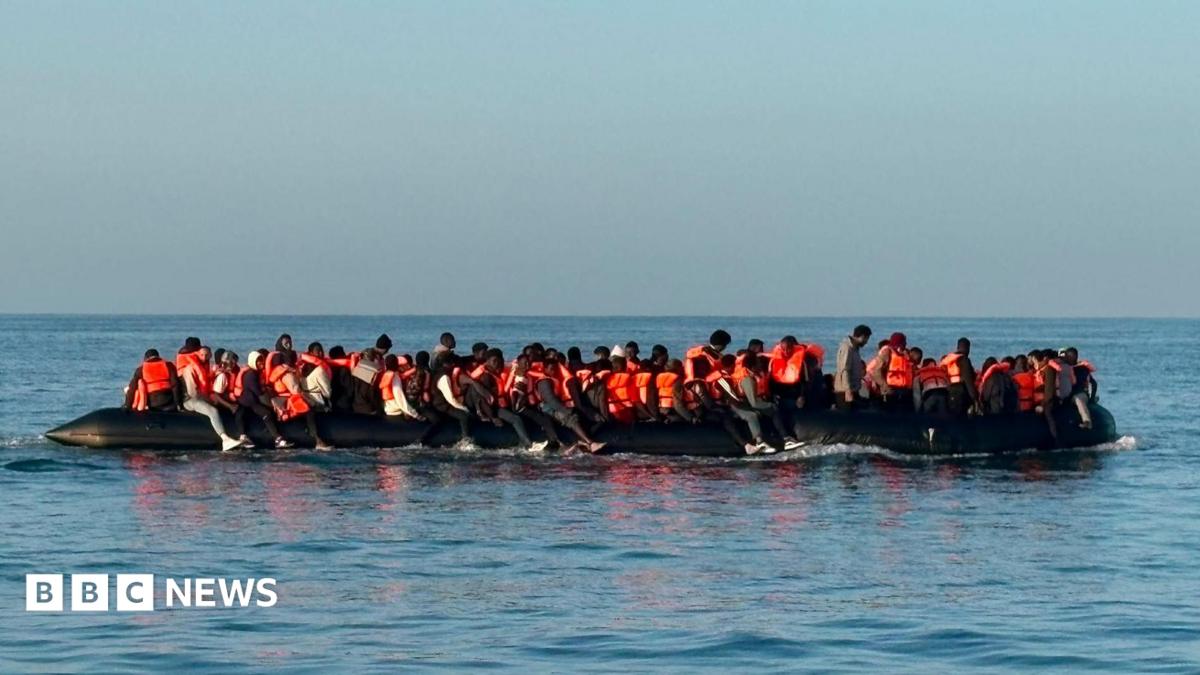
A teenager who piloted a dinghy carrying a then-record 165 migrants across the English Channel to the UK has been sentenced to two years and three months in prison.
Chan Mathok Atak, 19, from South Sudan, admitted endangering others during a sea crossing on 23 July.
Prosecutors at Canterbury Crown Court said Atak created a risk of death or serious personal injury to others on board the boat.
At the time, the so-called “mega dinghy” set a record for the largest number of migrants brought over on a small boat in recent years. That figure has since been surpassed with 230 people on board a vessel in August.
At Canterbury Crown Court on Friday,Judge Sarah Counsell said the offence was so serious “only an immediate custodial sentence can be justified”.
She warned Atak that as a foreign national he was liable in principle to automatic deportation once he completed his sentence.
James Harrison, prosecuting, told the court the boat Atak was piloting was 12.8ft (3.9m) wide and 46.9ft (14.3m) long, a similar length to a standard bus.
The boat had travelled between Calais and the UK and was deflating when it was picked up by border force vessels.
The dinghy, which had 31 children on board with the youngest aged 14, had two outboard engines but one was not working, the court heard.
The proposed deal, worth an estimated total cost of $24.3 billion, was announced as the Kingdom is in the midst of a fierce fight against the Houthi rebels of Yemen. It marks a major policy shift, with Washington previously being unwilling to export the advanced stealth fighters to Arab states and will likely serve as a reminder at a very challenging time for the Saudis of the unique security capabilities that only the U.S. can provide them.
In addition to the jets, which will be conventional takeoff and landing variants, Saudi Arabia has requested 49 Pratt & Whitney F135-PW-100 engines, support and other items.
Despite concerns from Israel that providing Saudi Arabia with the advanced fighters will tip the balance of power in the region, the proposed sale of this equipment and support “will not alter the military balance in the region,” the State Department noted.
The United States has a requirement to maintain Israel’s so-called qualitative military edge, which essentially guarantees that Israel will be prioritized for advanced U.S. weapons ahead of Arab states in the region. Among these advanced weapons, the stealthy F-35 is highly prominent.
You can read our past feature about the wide-ranging impacts of an F-35 sale to Saudi Arabia here.
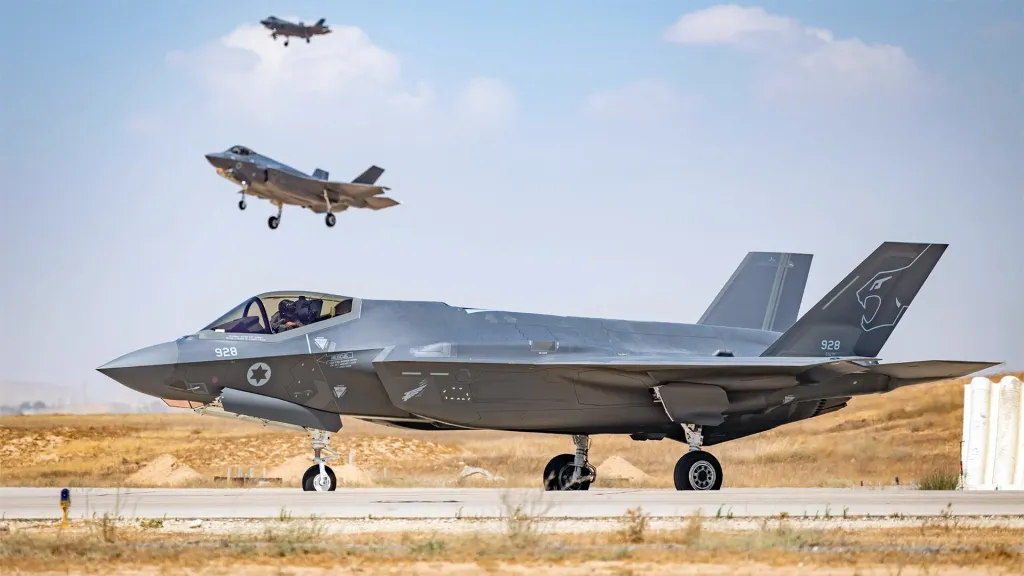
Israeli Air Force F-35i fighters. (Israeli Air Force)
“This proposed sale will support the foreign policy and national security objectives of the United States by improving the security of a major non-NATO ally that is a force for political stability and economic progress in the Gulf region,” the State Department wrote. “The proposed sale will improve Saudi Arabia’s capability to deter current and future threats by strengthening its homeland defense, and improving interoperability with U.S. forces, and other regional and NATO forces. The proposed sale will also augment Saudi Arabia’s operational aircraft and enhance its air-to-air, and air-to-ground self-defense capability. The Kingdom of Saudi Arabia will have no difficulty absorbing this equipment and services into its armed forces.”
In November, “President Trump approved a major defense sale package, including future F-35 deliveries, which strengthens the U.S. defense industrial base and ensures Saudi Arabia continues to buy American,” according to the White House.
Trump has pushed for closer ties between Israel and Saudi Arabia and wants the Kingdom to join the Abraham Accords initiative. This is a set of agreements that establish normalized diplomatic relations between Israel and different Arab states. Doing so would be a major breakthrough, following the United Arab Emirates, Bahrain, Morocco, and others.
A Saudi F-35 deal was also discussed under the Biden administration, as part of a broader deal that sought to normalize the Kingdom’s relations with Israel.
Attack not immediately claimed, but an ISIL affiliate and the Pakistani Taliban (TTP) are both active in the region and regularly target troops.
Published On 18 Sep 202618 Sep 2026
A bomb attack at a mosque in Pakistan’s restive north-west has killed at least 15 people, with more than 50 reported injured.
An explosive-laden car was rammed into the entrance of a mosque at a police headquarters in Kohat, in the province of Khyber Pakhtunkhwa near the Afghan border, as people gathered for Friday prayers.
At least 15 bodies and more than 50 injured people were taken to hospital in the town, Dr Tahir Shah said, according to the dpa news agency. The death toll could rise as several injured people were in a critical condition, he added.
There was no immediate claim of responsibility for the attack. However, both a regional affiliate of the ISIL armed group and the Pakistani Taliban (TTP) are active in the region and regularly target security forces.
Violence has surged in Pakistan’s remote regions near the Afghan border in recent years. Islamabad accuses Afghanistan’s Taliban rulers of allowing militants who orchestrate attacks in Pakistan to operate from Afghan territory.
Officials in Kabul deny the accusation. However, the issue has seen the pair swap strikes across the border across recent months.
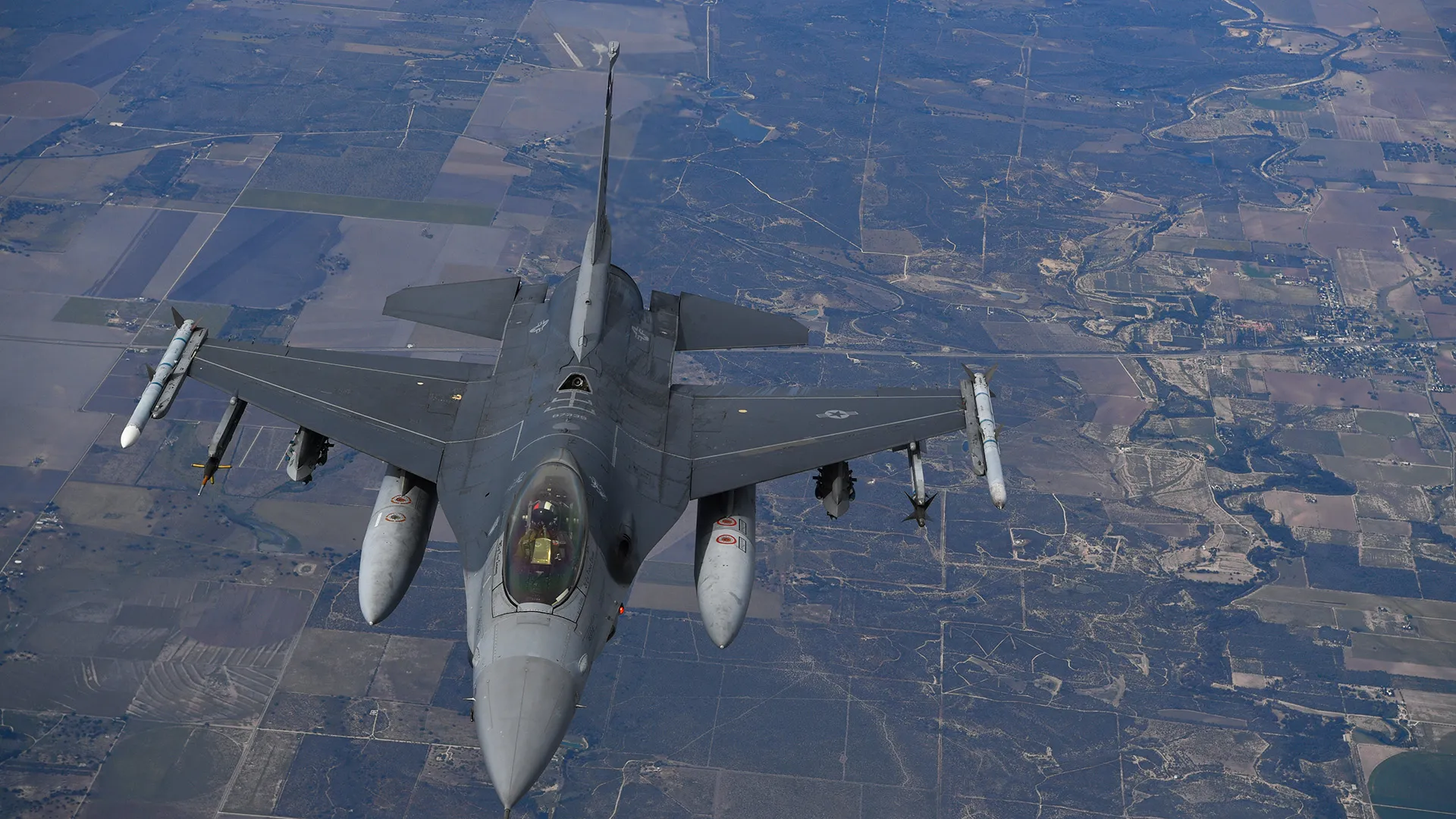
A U.S. Air Force F-16 Fighting Falcon crashed in northern Michigan today, according to WOOD-TV, a local NBC affiliate. The pilot was reported to be in stable condition after ejecting from the aircraft.
A spokesperson with the Michigan Department of Military and Veterans Affairs told the station that “the F-16 is a part of the 149th Fighter Wing from Joint Base San Antonio-Lackland in Texas.”
Video emerging on social media showed what is claimed to be the wreckage of the aircraft in flames.
According to air traffic control (ATC) audio, the pilot’s wingman said, “we have a possible mayday. My wingman may have taken a bird.” TWZ cannot independently confirm what caused the crash. The audio continues and offers a fairly dramatic and raw look at how the incident occurred over the air waves.
We have reached out to the 149th Fighter Wing, the Michigan Department of Military and Veteran Affairs, the Grand Traverse County Sheriff’s Office and the Grand Traverse County Emergency Management Office for further details.
A shelter-in-place order was issued by Grand Traverse County Emergency Management for residents near the plane crash.
“Shelter indoors, close windows/vents,” the order stated. “Follow instructions from emergency personnel. More information to follow. This shelter in place applies to residents in the indicated area ONLY.”
The family of a Scottish Sikh activist who has been locked up in India for almost nine years without conviction have said he has been granted bail.
Jagtar Singh Johal, from Dumbarton, was arrested in 2017 in connection with alleged terror offences.
He was arrested for his alleged role in a series of targeted killings of religious and political figures.
His family said they were still waiting for the details of what will happen next but are “relieved” by the Indian court’s decision.
The 39-year-old was acquitted last year in a case in which he was accused of financially supporting terror group the Khalistan Liberation Force (KLF), which has carried out attacks in the Punjab region.
But he still faces federal charges lodged by the Indian authorities.
Johal’s imprisonment was recognised by a UN panel as arbitrary detention in 2022 and he has claimed to have been tortured.
Indian authorities have previously denied the torture claim and have repeatedly maintained due process is being followed.
He was arrested in the Punjab region just weeks after his wedding in the country.
His supporters say he was targeted for blogging about alleged human rights abuses against the Sikh community in India and was coerced into signing a false confession to participation in the killings.
His brother Gurpreet Singh Johal has lobbied successive governments calling for his brother’s release.
Israeli politicians reacted to sanctions by states including the United Kingdom, France, and Canada on the country’s illegal settlements in the occupied West Bank with self-righteous anger. But what is the latest example of Israel’s international isolation brought on by its treatment of the Palestinian people has not been influential in swaying the electorate in the run-up to October’s elections, analysts tell Al Jazeera.
Responding to the UK Foreign Minister Ed Miliband’s accusation that Israelis were ethnically cleansing the occupied West Bank, Israel’s Gideon Saar accused his counterpart of spreading “outrageous lies” and attempting to interfere in the election through foreign pressure.
Recommended Stories
list of 4 itemsend of list
Israeli President Isaac Herzog also condemned the measures, branding them a “gross interference in the democratic elections” of Israel.
But, in reality, the majority of Jewish Israelis have supported their country’s genocidal war in Gaza and the occupation of the West Bank.
A poll from August, published as the death toll for Palestinians killed in the West Bank had already reached 76 this year, showed that more than half of Jewish Israelis supported retaining the illegal settlements as part of any future agreement on a Palestinian state, while nearly 40 percent supported annexing the territory in defiance of international law.
“People just don’t care that settlements are illegal,” Israeli political analyst Ori Goldberg said.
”Ed Miliband expressed a number of laudable sentiments when announcing the measures,” Goldberg said, referencing the UK foreign secretary’s references to his own Jewish heritage when announcing the cessation of trade with Israel’s illegal outposts. “But we’re at the stage where Israelis aren’t even interested in the truth so much as they are the sentiment.”
Little political impact
Israeli Prime Minister Benjamin Netanyahu goes into the elections at serious risk of losing, with many polls predicting that a coalition of parties opposed to him could win the majority in Israel’s parliament.
But it will not be issues like the settlement-related sanctions that will lose him votes, analysts said.
Public backing for the “government and opposition blocs are pretty hardened, and nobody is going to switch from one side to the other over sanctions arising from [the settlements],” Michael Koplow, chief policy officer at the Israeli Policy Forum, said. He added that the sanctions were unlikely to weigh as heavily with the electorate as “this government’s record and the related feelings people have about Netanyahu”.
“When people were asked what would determine their vote, security came first,” Israeli sociologist Yehouda Shenhav-Shahrabani said.
“I think there are several mechanisms operating simultaneously,” he added.
First, he said, is the normalisation of the settlements. In Israeli public discourse, the occupied West Bank is increasingly referred to by the biblical name “Judea and Samaria” – a shift he said was becoming institutionalised.
“Second, external sanctions don’t necessarily translate into domestic political costs,” Shenhav-Shahrabani said. “And perhaps most importantly, politically foreign pressure can be absorbed into an existing Israeli narrative [of anti-Semitism] rather than [changing how the issue itself is understood].”
No criticism of the voters
None of Israel’s most prominent politicians has criticised the government for its support of the settlements in defiance of international condemnation. Yair Lapid, a former prime minister and one of Netanyahu’s leading opponents, has, instead, focused his ire on the countries condemning Israel. “Imposing boycotts and sanctions on Israel is a grave mistake,” he said. “This is a wrong and dangerous policy, at the wrong time and for the wrong reasons.”
Another of Netanyahu’s principal rivals, Gadi Eisenkot – whose Yashar Party manifesto does not mention either the West Bank or Gaza – has declined to speak on the sanctions directly. Netanyahu has also yet to comment on the sanctions publicly, despite his Likud party having championed settlement expansion for decades.
“The sanctions haven’t particularly hurt Netanyahu, at least not as far as we can see in terms of direct influence on … polling,” said Dahlia Scheindlin, a pollster and public opinion researcher based in Tel Aviv.
Instead, the focus has been on other elements of an eventful electoral cycle, including the emergence of new challengers to Netanyahu on the right.
“We aren’t seeing any real backlash from the sanctions,” Scheindlin said. “Instead, it’s just getting filtered through what people already think of him – his critics dislike him even more, and his supporters basically say, ‘Well, the world hates us no matter what.’”
In the memoir, Earl Spencer writes of his sister’s troubled marriage – claiming a friend of Diana’s had told him that on the eve of their wedding in July 1981, Prince Charles had told her he was “very happy to marry her, but… not actually in love with her”.
Things became “very difficult indeed” in the marriage early on, Earl Spencer writes, adding that he is “sure that both spouses despaired of the other at times”.
He now believes his sister had attention deficit hyperactivity disorder, external (ADHD), and as part of her condition suffered from Rejection Sensitive Dysphoria – describing the latter as an “intense emotional pain in the face of others’ rejection or criticism”.
In her later years, he writes, Princess Diana considered taking her own life on more than one occasion but love for her sons “stopped her from going further”.
The former press secretary to Queen Elizabeth II described the latest claims serialised in the Daily Mail of Charles sounding “giddily elated” as “hogwash”.
Dickie Arbiter, who was press secretary to the late Queen at the time of Princess Diana’s death and funeral, told BBC Newsnight that Charles was “devastated at the time” and that “it’s not in his character”.
“There’s no way he could have ever said anything like that. Charles Spencer is just talking hogwash,” he added.
Royal commentator Jennie Bond meanwhile said Earl Spencer’s “vindictive account” was “extraordinary”.
“I have no reason to disbelieve this is his memory of what happened, but there are usually two sides to a conversation and a story,” she told BBC Breakfast.
Amid the royal drama, Prince Harry, the Duke of Sussex, attended the inaugural Invictus Spirit Awards in Greenwich on Thursday evening.
In his first public appearance since moving back to the UK, Prince Harry posed for photographs for the press and selfies with veterans, before delivering a speech.
South Korea will continue efforts to facilitate talks between Washington and Pyongyang.
Published On 18 Sep 202618 Sep 2026
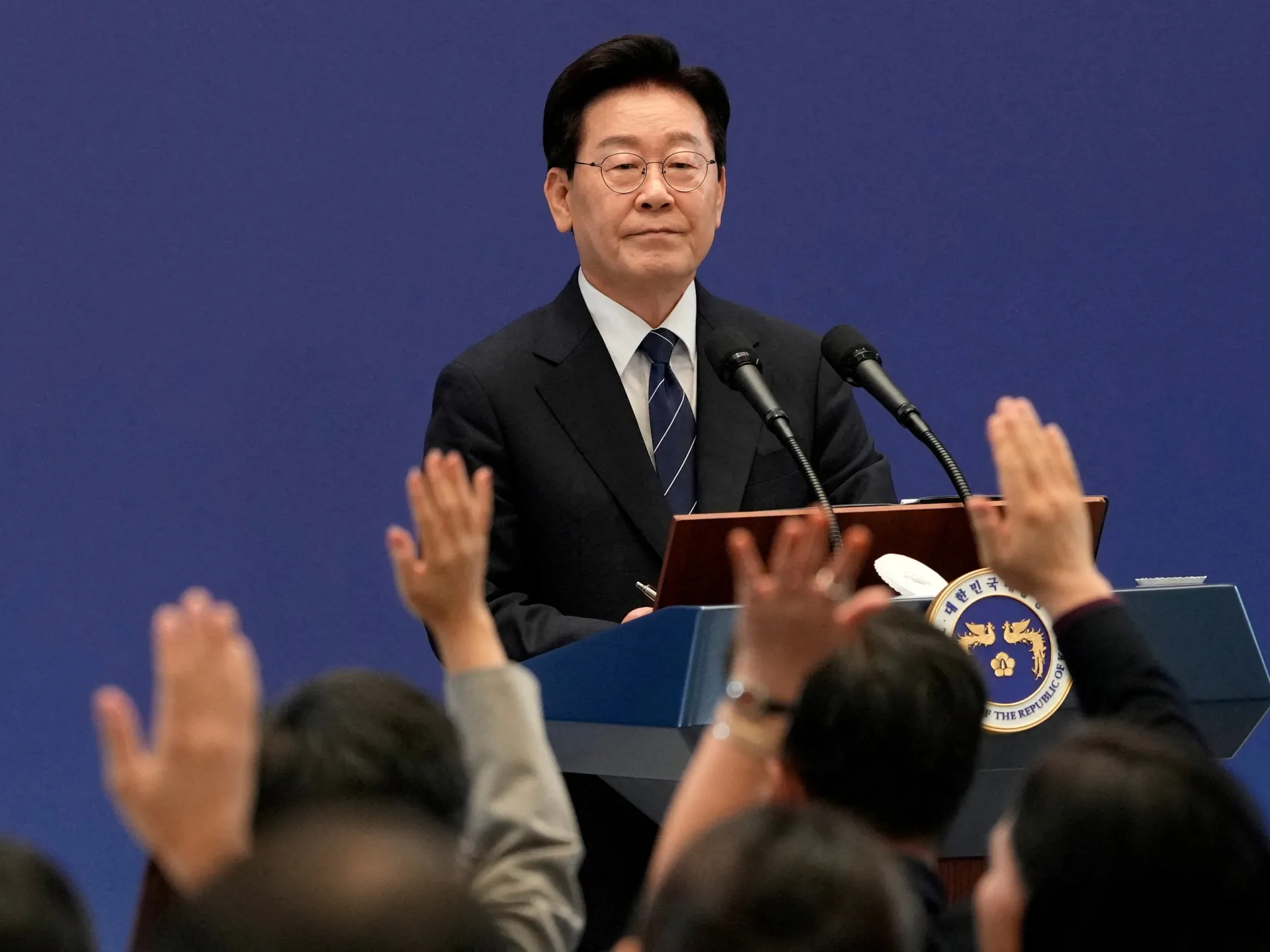
South Korean President Lee Jae Myung said on Friday that United States President Donald Trump wants dialogue with Pyongyang and confirmed Seoul will not be deploying troops to intervene militarily in the Iran war.
“Trump clearly wants dialogue with North Korea,” Lee said on Friday.
Recommended Stories
list of 3 itemsend of list
He added that while such talks are uncertain, they are not impossible.
South Korea was continuing “preliminary coordination efforts” to facilitate dialogue between North Korea and the US.
“The resumption of North Korea-US dialogue would be far easier than resuming inter-Korean dialogue,” he said, according to South Korean news agency Yonhap.
Trump, seeking to revive the bond he claims to have forged with North Korean leader Kim Jong Un in his first term, said he plans to meet Kim later this year.
The US president said it was important to “get along” with Kim, adding that Pyongyang now had 57 “very powerful” nuclear weapons.
Seoul has assessed that Pyongyang has about 80-120 nuclear warheads.
North Korea, which has secured critical backing from Russia in recent years, did not clearly respond to Trump.
Inter-Korean relations reached a high in 2018 but deteriorated after talks between Kim and Trump collapsed in February 2019.
On Thursday, a court in Seoul ordered North Korea to pay roughly $32.5m for blowing up the Inter-Korean Liaison Office building in 2020. The office was intended to improve relations on the peninsula but was destroyed amid rising tensions between the neighbours.
South Korea is working to strengthen relations with other regional partners. The first-ever presidential summit between Seoul and five Central Asian states was held on Wednesday, aiming to establish deeper economic engagement with the Russian-allied countries.
South Korea will not dispatch troops
Despite growing pressure from the US, Lee reiterated three times that South Korea will not deploy troops to the Strait of Hormuz.
“Let it be clear. There will be no dispatch of troops that will lead to involvement in a conflict. There will be no engagement or involvement in war,” Lee said.
The South Korean government found itself at odds with large parts of Korean society as protests broke out in recent weeks opposing a potential deployment of South Korean military assets to the Strait of Hormuz.
Lee added that South Korea will “carry out the minimum necessary activities” to protect its own merchant ships and oil shipping routes.
Bank of Japan raises benchmark interest rate from 1 to 1.25 percent, pledging to help counter inflation risks.
Published On 18 Sep 202618 Sep 2026
The Bank of Japan (BoJ) has raised interest rates by 0.25 to 1.25 percent, pushing borrowing costs to their highest level in 31 years, amid rising inflation and wages, and pressure from Washington.
The move on Friday marked the first hike since June, and takes interest rates closer to levels the BoJ deems neutral to the economy, marking another step away from decades of ultra-low rates that cemented the yen’s status as a cheap global funding currency.
Japan is grappling to contain inflation, which is being driven by factors including rising energy prices, global supply pressures and domestic inflation exceeding the 2 percent target.
Core consumer inflation held steady near the target in August, data showed on Friday, as companies continued to pass on rising costs for a wide range of food and grocery items.
The country also faced a “slow-moving demographic shock” with a shrinking labour pool lifting wages, a structural factor that cannot be dismissed as temporary, BoJ Executive Director Koji Nakamura said on Monday.
The Federal Reserve’s rate hike on Wednesday, and the prospect of another one later this year, have added pressure on the BoJ to keep pace.
Further widening of the United States-Japan rate gap risks weakening the yen and lifting inflation through higher import costs, analysts told the Reuters news agency.
Its policy rate also remains lower than the European Central Bank, which raised its key rate to 2.5 percent last week.
Such pressure could affect the tone of BoJ Governor Kazuo Ueda’s post-meeting briefing, which will be closely watched by markets for clues on the timing and pace of further increases.
The 31st Marine Expeditionary Unit’s (31st MEU) recent deployment to the Middle East marked the first time the United States Marine Corps (USMC) used its Expeditionary Advanced Base Operations (EABO) concept in a combat setting, the service confirmed to TWZ on Thursday. At its core, EABO involves relatively small groups of Marines quickly establishing bases of operation in forward areas, often within the enemy’s weapons range. During operations in the fight against Iran, Marines refueled and rearmed their own aircraft, as well as those from the joint force, at these austere locales. They also set up remote sensing locations, among other actions from the EABO playbook.
This employment of EABO for Epic Fury is a highly significant development. After years of progressively evolving the EABO playbook, it was no longer an experimental exercise. This meant that Marines were forward deployed in a contested area in a region where established bases were taking heavy fire from Iranian missile and drone barrages. Troops were killed in some of these attacks and U.S. aircraft, buildings and equipment were damaged and destroyed across the Middle East. Pushing aircraft from the MEU, as well as the joint force, to FARPs (forward arming and refueling point) would have been a relevant asset preservation tactic as well as one that would help accelerate combat operations, and it’s exactly what EABO is meant to do.
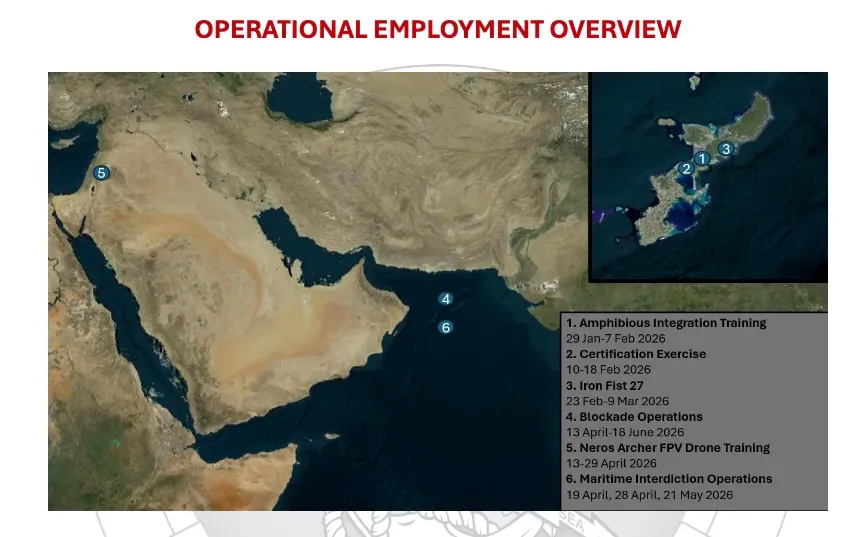
The 31st MEU’s six-month deployment began in January in the Pacific, before the unit was ordered to the Middle East in March, returning to Okinawa, Japan, in July. That’s where it is stationed as the USMC’s only continuously forward-based MEU.
A map of the 31st MEU’s deployment. (31st MEU)
“This was the first time we were able to implement EABO in combat operations since the concept was created for the force,” Capt. Steven J. Keenan, a USMC spokesperson, told us. “We have practiced it many times, but this was a first for supporting a Joint Force named operation with forward FARPs and forward bases that supported joint ops and combat power sustainment.”
EABO was first introduced in 2020 by then-Commandant Gen. David Berger in his Force Design 2030 plan for the future of the Corps. It was created with a fight against China in mind, especially utilizing small Pacific islands. The idea is to have highly mobile, low-signature forces deployed forward in austere, contested or potentially contested maritime locations. The mission is to “support sea control operation, conduct sea denial operations within the littorals, contribute to maritime domain awareness, provide forward command, control, communications, computers, combat systems, intelligence, surveillance, reconnaissance, targeting, and counter-targeting capability and forward sustainment,” according to the Marines.
A Marine holding a Stinger missile launcher stands in front of a Combat Rubber Raiding Craft on Ukibaru Island off the coast of Okinawa during Exercise Hagatna Fury 21. (USMC) A Marine holding a Stinger missile launcher stands in front of a Combat Rubber Raiding Craft on Ukibaru Island off the coast of Okinawa during Exercise Hagatna Fury 21. USMC
The news of the first activation of the EABO concept in combat came Wednesday during a media roundtable with Col. Chris P. Niedziocha, who commanded the 31st MEU during its deployment to the Middle East in support of Operation Epic Fury. Now director of the USMC Expeditionary Warfare School, Niedziocha discussed EABO and a range of other operations during that deployment, including boarding vessels during the blockade of Iranian ports.
The 31st MEU was embarked aboard the Tripoli Amphibious Ready Group (ARG), which consisted of the America class amphibious assault ship USS Tripoli, San Antonio class amphibious transport dock ship USS New Orleans, and Whidbey Island class dock landing ship USS Rushmore. You can read more about the ARG/MEU and its assets in our initial story about the deployment to the Middle East here.
USS Tripoli. (Staff Sgt. Samuel Ruiz)
“You’re starting to see this has been validated,” the colonel said of the EABO concept during the roundtable TWZ attended virtually. “It’s still nascent, but we actually, for the first time, demonstrated what we thought we were able to do, which I think is pretty exciting. And then things like forward arming and refueling to extend the operational reach of aircraft and expeditionary reloading, and then the ever-present logistic challenge of doing something like that. So that’s pretty significant.”
“We successfully implemented critical Expeditionary Advanced Base Operations (EABO), establishing sensor expeditionary advanced bases and forward arming and refueling points (FARPs) where none existed,” the colonel added. “Through our forward logistic elements, we proved that an agile Marine Air-Ground Task Force can sustain itself and generate ready, lethal power in contested maritime environments, directly setting the theater for follow-on joint forces.”
“There was all manner of tankers all the time, but the FARP is to extend the operational reach, and if you can do it, you reduce the load on that,” Niedziocha noted. “Because there’s some aircraft that are basically for expeditionary austere operations, especially the F-35B,” the Marine Corps’ variant of the aircraft designed for short take off and vertical landing.
“There are some trade-offs associated with the Bravo,” Niedziocha pointed out, using a slang for the jets. “There’s less internal fuel, but you have the lift [system], which gives you the option to do these kinds of things. So, the goal there was to walk that fine line between providing the full sortie over wherever you needed it, and keeping the ships far enough away to make them as survivable as possible.”
An F-35B Lightning II aircraft taxis to a forward arming and refueling point in the U.S. Central Command area of responsibility, May 26, 2026. (U.S. Marine Corps photo by Cpl. Maksim Masloboev) Cpl. Maksim Masloboev
In addition to the F-35Bs and other aircraft organic to the 31st MEU, the FARPs were also used by Army helicopters, Keenan told us. Imagery posted on the Pentagon’s image distribution site also showed U.S. Army Gray Eagle drones and Marine MV-22B Osprey tiltrotor aircraft were included.
A Gray Eagle drone lands at a forward arming and refueling point in the U.S. Central Command area of responsibility, May 26, 2026. (U.S. Marine Corps photo by Cpl. Maksim Masloboev) Cpl. Maksim MasloboevU.S. Marines with the 31st Marine Expeditionary Unit transport AIM-120 AMRAAMs to a forward arming and refueling point in the U.S. Central Command area of responsibility, May 26, 2026. (U.S. Marine Corps photo by Cpl. Maksim Masloboev) Cpl. Maksim Masloboev
Niedziocha did not provide details about where the FARPs were set up, but a U.S. defense official told us they were “disaggregated throughout the Middle East.” The official declined to provide further information, citing operational security concerns since they are still being used.
“Throughout the deployment, the Tripoli ARG and 31st MEU successfully conducted over 1,600 mishap-free flight hours of combat aviation missions, including precision strikes, transporting 800,000 pounds of cargo, and moving 5,000 personnel,” a 31st MEU overview of the deployment explained. “The units also provided sustained combat support to joint force operations by delivering critical intelligence and refueling over 300 aircraft ashore and underway.”
The colonel also didn’t provide details about the sensor expeditionary advanced bases. According to the Marines, “a sensing expeditionary advanced base (SEAB) brings together coastal surveillance radars, electronic sensors, and Marines ashore to extend maritime domain awareness, complementing the radars and sensors already at work aboard naval ships off the coast.”
“When SEAB systems identify surface vessels in nearby sea lanes, small unmanned aircraft system (sUAS) operators launch their platforms to visually identify and track the contacts,” the Marines added. “Sensor data and imagery are transmitted in real time across the blue-green command network to decision-makers.”
U.S. Marines with 12th Marine Regiment, 3rd Marine Division, prepare to set up a Ground/Air Task Oriented Radar (G/ATOR) system during a routine unit level training exercise on Iejima, Okinawa, Japan, July 15, 2023. (U.S. Marine Corps photo by Staff Sgt. Manuel A. Serrano) Gunnery Sgt. Manuel Serrano
This capability could have been used to track Iran’s remaining fleet of small boats that it has used to harass shipping and mine the Strait of Hormuz, as well as larger vessels trying to transport oil. Other sensors, like radars and counter-drone systems, could also help identify incoming threats and provide general situational awareness. The EABO concept was employed as part of the 31st MEU’s larger role in supporting the blockade and mine clearance efforts.
The 31st MEU interdicted four vessels during the deployment, three of which led to boardings. On April 19, Marines boarded the MV Touska; on April 28, the MV Blue Star III; and on May 19, the MT Celestial Sea.
The Touska was boarded after USS Spruance fired multiple 5-inch rounds, targeting the engine room and disabling the vessel’s propulsion. The crew of the vessel was retained for about two weeks before being repatriated.
Niedziocha told us that none of the crews offered any resistance.
“At two in the morning, when 30 Force Reconnaissance Marines fast rope onto your vessel, [you are] just compliant with a capital C. They did exactly what they were directed to do. The overmatch that you put onto that vessel is pretty surprising. And then there’s overwatch provided by UAS and manned aircraft, so you create this bubble around the vessel. So yeah, they complied.”
You can see the Touska being boarded in the following video.
The U.S. just released a video of its forces boarding and seizing the Iranian container ship M/V Touska near the Hormuz Strait after it tried to break the U.S. naval blockade pic.twitter.com/FpB2obb3jY
Two years ago, as the EABO concept was maturing, TWZ was invited to get an exclusive look at how an advanced EABO concept would be put into action, including how squadrons operated the F-35B out of an austere combat environment while generating combat sorties. It was an unprecedented and exclusive peek into the EABO playbook and what a real fight in the Pacific with the USMC’s most advanced fighter aircraft could actually look like. You can read about that in our story here. It appears the operations in the Middle East mirrored this exercise closely.
James Deboer
Now back in Japan, the ARG/MEU is getting ready for a new deployment, said the colonel.
“We got back to Okinawa, I think July 22nd, and they had already begun their workup cycle in earnest to be on the water in early January to go out and do another Iron Fist [training exercise] with the Japanese, and then long periods of a crisis response,” said Niedziocha, who relinquished command in August before moving on to his new role. “Just being there, present in the First Island Chain to partner with your allies, demonstrates the resolve and commitment to deter whatever needs deterring.”
As noted earlier in this story, the EABO concept was designed with a Pacific fight in mind. Its first combat employment in the Middle East clearly offers lessons that can now be adapted to enhance EABO operations globally.
Venezuela has opened its energy and mining sectors to US interests. (PDVSA)
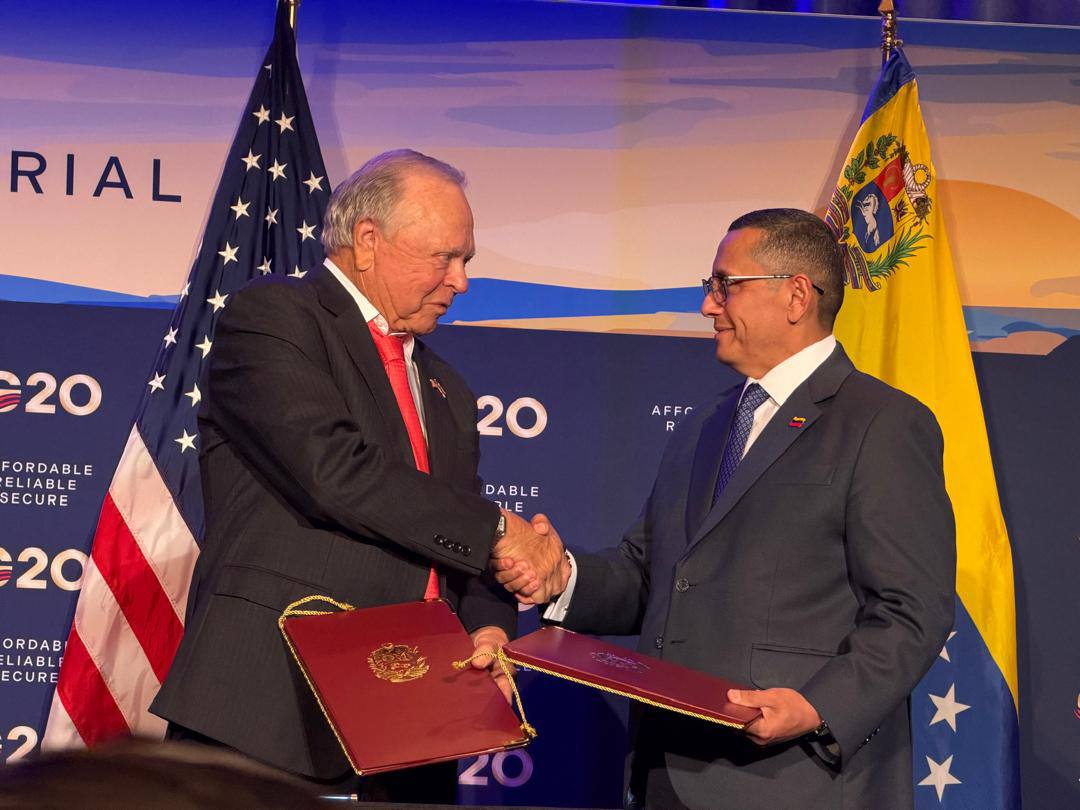
Lisbon, Portugal, September 17, 2026 (venezuelanalysis.com) – Continental Resources, a firm owned by billionaire and Trump donor Harold Hamm, struck a deal on Wednesday to exploit one of Venezuela’s largest oilfields.
Under the agreement with Venezuelan state oil company PDVSA, Continental will receive a long-term concession with “100 percent working interest” for the 500 square-kilometer Ayacucho 2 block in Venezuela’s Orinoco Oil Belt. The block contains an estimated 30 billion barrels of extra-heavy crude.
“Continental was built to recognize great resource opportunities and have the conviction to pursue them,” Hamm told Fox News, vowing that the deal would take his company to an “entirely new level.”
For her part, Venezuelan Acting President Delcy Rodríguez claimed that the agreement would “strengthen [Venezuelan] oil production” and “create opportunities for economic growth.”
Hamm and PDVSA Vice President Jovanny Martinez signed the contract in Houston on the sidelines of the G20 energy summit. Martínez and Oil Minister Paula Henao attended the conference to pitch investment opportunities in Venezuela’s oil and gas sector.
PDVSA had previously assigned the Ayacucho 2 block to Chinese private firm Anhui Guangda in 2025. However, no information on investments or output were publicly disclosed, while Venezuelan authorities have not justified rescinding the contract with Anhui.
US government-controlled corporation NABEP, which recently received long-term concessions to 17 major Venezuelan oilfields containing 65 billion barrels in reserves, will also take over projects formerly run by Chinese enterprises, including state-owned CNPC. Beijing has called for its investments and interests in Venezuela to be respected.
Hamm was one of the corporate executives present at the White House on January 9, when Trump announced that Washington would control Venezuela’s oil industry and called on Western majors to invest. Since the January 3 US attacks and kidnapping of President Nicolás Maduro, the White House has managed the South American country’s crude export revenues.
The White House has also backed Venezuelan authorities’ pro-business overhaul of the energy sector while issuing sanctions exemptions to select US-aligned corporations. Chevron, Shell, and Eni are among the companies that have signed new contracts or renegotiated existing ones in recent months.
According to Bloomberg, ExxonMobil is in advanced talks to return to the Caribbean country after a litigious past. The energy giant is negotiating rights to four major oilfields in the Orinoco Oil Belt, two of which it previously owned before they were nationalized by former President Hugo Chávez.
In the 2000s, the Texas-based corporation refused to comply with reforms implemented to assert state sovereignty over the oil industry. ExxonMobil refused compensation offers and pursued international arbitration after its assets were nationalized. The company received an arbitration award significantly below its demands.
ExxonMobil was additionally denounced repeatedly by Caracas after it spearheaded offshore drilling projects in the territorial waters of the disputed Essequibo Strip.
On Wednesday, Venezuelan authorities likewise inked a 20-year agreement with Florida-based Denarius Holding Group, controlled by Turkish energy group Çan2 Termik. Denarius is taking over the Petrokariña project in Anzoátegui state, which contains 10 oilfields producing a variety of crude types.
Heeney Capital receives gold mine concession
In parallel to its oil opening, Venezuelan authorities have also fast-tracked reforms opening the country’s mining sector to multinational corporations.
On Wednesday, New York-based Heeney Capital and commodities trader Mercuria Energy received a 30-year concession to operate the Chocó 10 mine in Bolívar State. The project holds considerable gold deposits and was run by Rusoro Mining in the 2000s before being nationalized by the Chávez government.
Heeney and Mercuria pledged US $1 billion in initial investment in the Chocó project. The two firms had struck a previous agreement with Caracas to purchase and trade Venezuelan minerals and other commodities.
One of Heeney’s co-founders, Sean Pi, signed the deal at the presidential palace in May and praised Trump’s “leadership” in defending US access to mining resources abroad. Pi has endorsed legislative initiatives deregulating and streamlining mining projects to bolster the US supply of critical minerals.
Under the trading agreement, Heeney and Mercuria are reportedly preparing to ship 15,000 metric tons of Venezuelan aluminum to the US. The corporate partners are likewise seeking to take over VENALUM, Venezuela’s biggest aluminum smelter. Glencore, an Anglo-Swiss mining and trading multinational, is also interested in VENALUM, according to reports.
Venezuelan authorities have not commented on the negotiations for the aluminum smelter. In April, Rodríguez appointed a commission to evaluate privatization of “non-strategic” state assets.
The Trump administration has identified securing access to Venezuelan mineral riches as a key national interest and is reportedly preparing an executive order to boost US corporate participation in Venezuelan mining projects.
Former Syrian official sentenced to 60 years in US prison for torturing prisoners under al-Assad’s regime.
A former Syrian military official convicted of torturing prisoners during the rule of former President Bashar al-Assad has been sentenced to 60 years in a United States prison.
A federal judge in Los Angeles sentenced Samir Ousman Alsheikh on Thursday. A jury found him guilty in March of one count of conspiracy to commit torture and three counts of torture while in charge of Syria‘s infamous Adra Prison from roughly 2005 to 2008.
Recommended Stories
list of 3 itemsend of list
“The conduct was heinous, unimaginably cruel, and almost unspeakably violent and brutal,” the judge said before announcing the sentence.
Human rights groups and the United Nations have accused the Syrian government officials of widespread abuses in detention facilities, including torture and arbitrary detention of thousands of people, in many cases without informing their families.
US prosecutors said Alsheikh, seeking to quash political dissent, sent certain prisoners to a wing of Adra where they were held in small isolation cells and tortured.
At the two-week trial, three victims recounted beatings while suspended from pipes on the ceiling for hours or days and the use of a device that folded their bodies in half at the waist, according to a press release from the US Department of Justice. One person testified that Alsheikh stomped on the device with his foot, according to the department.
“Defendant knew that what he was doing was wrong,” Justice Department prosecutors said in a sentencing memo filed this month. “Nonetheless, he ordered and participated in the torture of his victims because he had the power to do so and because he thought he would never be held accountable.”
The memo included statements from several victims, one of whom, Nidal Shikhani, said he can “still hear the screams of others begging for mercy, repeating, ‘Leave me, leave me.’”
The prosecutors asked US District Judge Hernan D Vera for a minimum sentence of 80 years. Alsheikh’s lawyers, Nina Marino and Collin Cate, called for a five-year sentence, noting that he is 74 years old and has “significant medical and cognitive conditions”. They also said he was willing to be deported to Syria, where a new government has sought to hold Assad-era security officials accountable.
“Whatever moral weight this case carries in the broader arc of history — however much the world, or the victims, or the public might wish the sentence to ‘send a message’ — that desire cannot be the foundation of a just sentence,” Marino and Cate wrote in their September 3 memo.
Alsheikh came to the US in 2020 and applied for citizenship, but the Justice Department said he lied about his past. Federal authorities arrested him at Los Angeles international airport in July 2024.
Jurors also convicted him in March of lying to US immigration authorities and fraudulently obtaining a green card and attempting to naturalise as a US citizen.
“The acts Alsheikh ordered and directly participated in are gruesome and disturbing. We would like to offer our gratitude to the brave victims who testified leading to today’s sentencing,” Heith Janke, assistant director of the FBI’s criminal division, said in a press release Thursday.
Al-Assad was ousted in a lightning rebel offensive in December 2024, bringing a 14-year civil war to an end, but the country has continued to suffer from sporadic outbreaks of violence.
In March 2025, armed groups aligned with al-Assad ambushed the new government’s security forces on Syria’s coast. A government counteroffensive then spiralled into sectarian revenge attacks and the massacre of hundreds of civilians from the Alawite religious minority, to which al-Assad belongs.
On Thursday, three people were sentenced in the Syrian city of Aleppo in connection with the violence. One member of the pro-Assad groups was sentenced to death and another to life in prison, while a member of the government security forces who took part in the revenge attacks was convicted of murder and sentenced to 20 years in prison.
In the Orthodox and Armenian Churches, it is believed that the Holy Cross used to crucify Jesus had been found at the beginning of the 4th century by St. Helena, mother of the Roman Emperor Constantine I. The Holy Cross was kept in Jerusalem and venerated by Christians.
In 610 the Persian King Khosrov II attacked the Byzantine Empire, and in 614, the Persian army entered Jerusalem. The Persians took the Holy Cross from the Church of the Holy Sepulchre.
Supported by the Armenian army, the Byzantines went after the Holy Cross, retrieving it after defeating Khosorov in battle. The Holy Cross was returned to Jerusalem. On the way to Jerusalem, the Holy Cross was carried aloft to celebrate its recapture. On its journey, it traveled through Karin in Armenia.
In the Armenian Apostolic Church, this day is known as a ‘Merelots’ a Remembrance Day of the Dead that is observed. ‘Merelots are observed on the day after five religious holidays in Armenia. The five Remembrance Days of the Dead are on the days after Christmas, Easter, Feast of the Transfiguration, Assumption of the Holy Virgin Mary and the Feast of the Exaltation of the Holy Cross.
The first church in the world was built in Armenia and Armenia was the first country to adopt Christianity as a state religion.
Tehran gives Swedish official 48 hours to leave as Iran says Stockholm is bowing down to outside pressure.
Published On 18 Sep 202618 Sep 2026
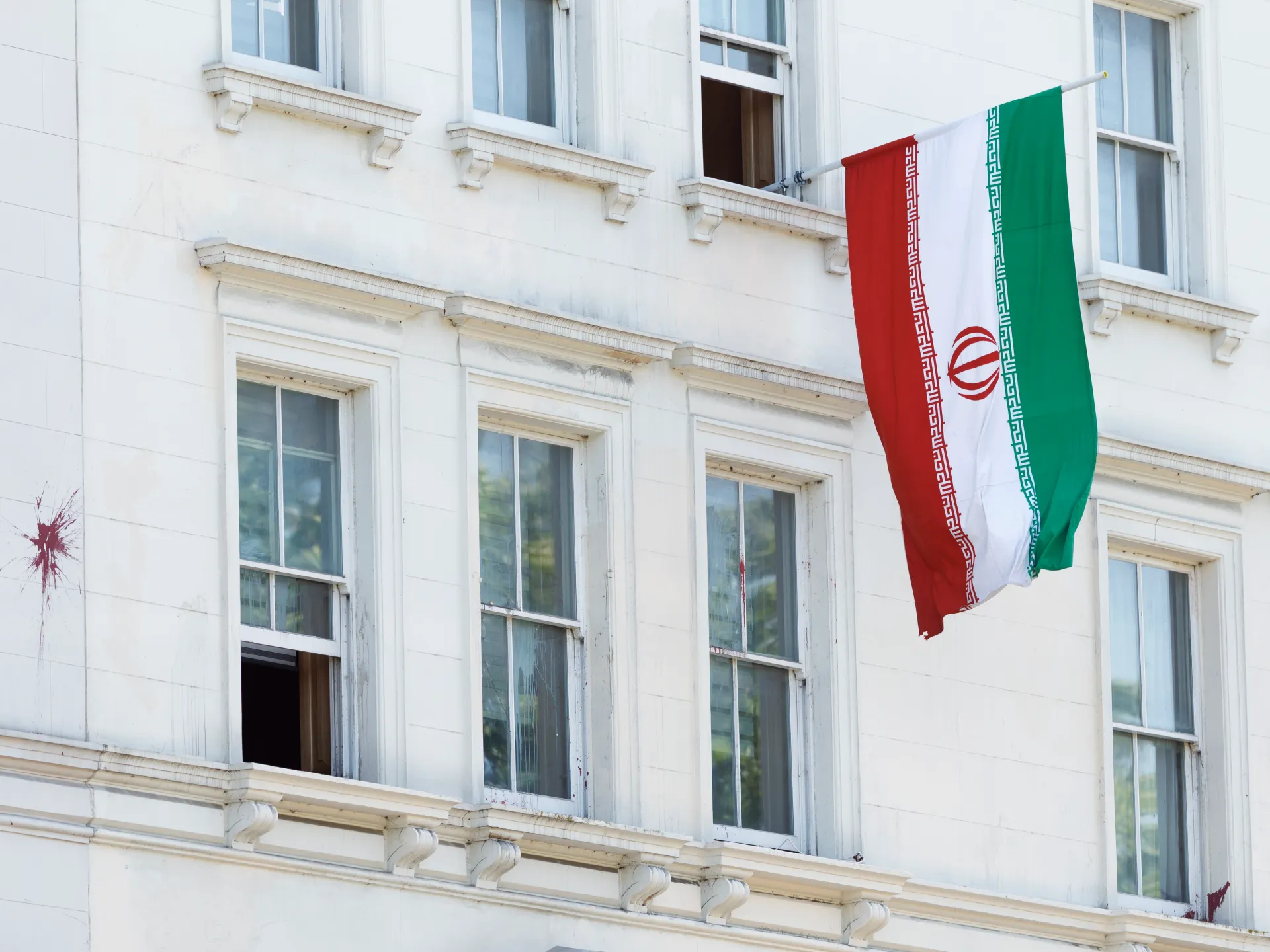
Iran has ordered a Swedish diplomat to leave the country one day after Sweden expelled an Iranian embassy official in Stockholm.
Sweden’s action was described by Iran’s Ministry of Foreign Affairs as “unjustified” on Thursday.
Recommended Stories
list of 3 itemsend of list
“Without doubt, this action by the Swedish government is the result of the influence of the Zionist regime and an effort to disrupt the normal activities of the Islamic Republic of Iran’s Embassy in Stockholm,” the Foreign Ministry said in a statement, Iran’s IRNA news agency reported.
Iran’s Foreign Ministry said its director general for Western Europe, Alireza Yousefi, summoned the Swedish ambassador in Tehran on Thursday. Yousefi protested Sweden’s policies, including its “hosting of anti-Iranian terrorist elements and groups”.
The ministry said Iran would take necessary measures to safeguard its national rights and interests, including through reciprocal action.
IRNA reports that in response to Sweden’s actions, the ambassador was informed in the meeting that a Swedish diplomat in Tehran had been given 48 hours to leave Iran.
Sweden expels Iranian official
Sweden’s Ministry for Foreign Affairs announced on Wednesday that the Iranian official was asked to leave the country due to activity incompatible with the Vienna Convention on Diplomatic Relations.
The Vienna Convention defines the rules of diplomatic missions.
The Iranian Foreign Ministry also referenced Sweden’s obligations under international law, including the 1961 Vienna Convention on Diplomatic Relations, warning that disruption of the Iranian embassy’s duties would entail Sweden’s international responsibility, reported IRNA.
Swedish Foreign Minister Maria Malmer Stenergard said the decision to expel the Iranian official was taken to protect Swedish citizens and interests.
Swedish Justice Minister Gunnar Strommer told state television that the decision involved Iran’s alleged activities against “Jewish and Israeli interests”.
“We know that Iran, over a long period of time, has conducted activities that threaten security in and against Sweden,” Strommer said, adding that Iran was “making use of criminal networks” to achieve its objectives.