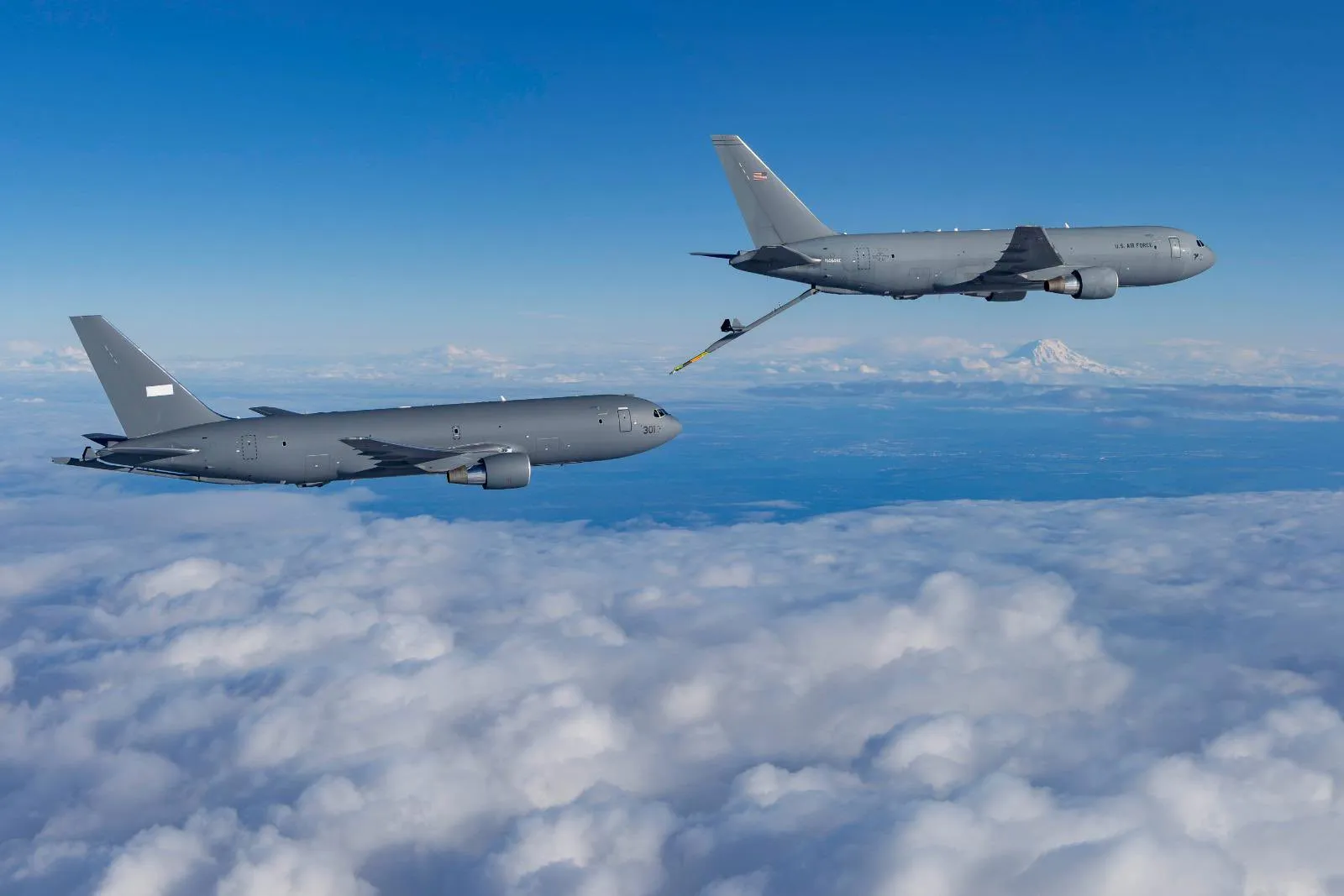
Israel’s first Boeing KC-46A Pegasus tanker — now given the Hebrew name Gideon, after a biblical judge and military leader — has completed its first flight in the United States, with delivery expected soon. As we have discussed in the past, new tankers that can provide additional refueling capacity to support its operations are much in demand with the Israeli Air Force.

New imagery of the first flight of an Israeli KC-46 — with national markings yet to be applied — came just one day after Israeli Prime Minister Benjamin Netanyahu hinted at plans to develop “groundbreaking Israeli-made aircraft,” as well as referencing the approval for two additional fighter squadrons. As you can read about here, these will be made up of F-15IA and F-35I Adir jets, providing an eventual total of four squadrons of F-35Is and two of F-15IAs.
Announcing the first flight of an IAF KC-46, the Israeli Ministry of Defense said the tanker would be delivered to Israel in “approximately one month.” It is the first of six examples on order as part of what the ministry describes as a “wide-scale force buildup program.”

Back in 2020, the U.S. State Department approved the potential sale of eight KC-46s to Israel, with the entire package having an estimated price tag of $2.4 billion.
In 2022, the U.S. Department of Defense awarded Boeing a $930-million contract for the first four KC-46s for Israel. At this time, it was said that deliveries were due before the end of 2026.
On the back of very heavy utilization of its aging Boeing 707 Re’em tanker fleet in operations against Iran, as well as for other long-range combat missions and domestic ones, Israel added two more KC-46s to its order last year.

The Israeli Ministry of Defense says that the KC-46 will be equipped with Israeli systems and adapted to the operational requirements of the IAF. It is unclear what systems will be added, but Israel has a long history of adapting foreign-made aircraft with locally made equipment, and its tankers have been no exception.
One strong possibility is that the KC-46s will be equipped to serve as a command-and-control station and communications node. The current 707 Re’em tanker carries a satellite communications suite to provide critical, secure beyond-line-of-sight communications with appropriately equipped tactical aircraft like the F-15 and F-16, and command centers far away. This is especially important for long-range strike operations.

Were Israel to order more KC-46s, this would not be entirely surprising.
Currently, the IAF is assessed to field no more than seven 707 tankers.
The 12-day war against Iran in 2025 had already led to questions about the IAF’s aerial refueling capacity, and the U.S. government was forced to deny — despite claims to the contrary — that it had provided additional tanker support for the operation.
U.S. Air Force tankers also arrived at Ben Gurion International Airport in Israel in significant numbers earlier this year, when the United States and Israel launched combined strikes against targets across Iran.

Bearing in mind the problems of various kinds that have beset the KC-46 program as far as the U.S. Air Force is concerned, the IAF will be happy that the first delivery is still on track for 2026, in line with the original schedule.
At the same time, it’s not entirely clear how the KC-46s will be outfitted.
In the past, it was expected that they would be delivered with the next-generation version of the critical Remote Vision System (RVS) that has proven so challenging to perfect. Ironically, the Israeli 707s that the KC-46 will replace have long used a locally developed RVS that has apparently proven very effective, and which you can read more about here. We have reached out to Boeing for more details on that feature.

With its existing tanker fleet (and with or without U.S. refueling support), the IAF has demonstrated that it can sustain a remarkably high tempo of operations, striking multiple targets across great distances, as well as supporting combat air patrols and multiple other requirements.
Now, with its first KC-46 Gideon set to arrive in the coming weeks, the Israeli Air Force will begin the start of a long-awaited modernization period for its aerial refueling capacity, ultimately allowing the withdrawal of the antiquated 707.
Contact the author: thomas@thewarzone.com