Discover the latest happenings and stay in the know with our up-to-date today news coverage. From breaking stories and current events to trending topics and insightful analysis, we bring you the most relevant and captivating news of the day.
Native authorities issue condolences after two adults and a child swept away by floodwaters in southwestern US state.
Published On 17 Sep 202617 Sep 2026
Indigenous authorities in the United States have said that three people have been killed in flooding in the southwestern state of New Mexico, where heavy rains left roadways blocked by water.
Navajo Nation President Buu Nygren said on Wednesday that police had responded to reports of people being swept away by floodwater at 12:30am (06:30 GMT) near the community of Newcomb in northwestern New Mexico.
Recommended Stories
list of 3 itemsend of list
Nygren said that two adults and a child were killed in the incident and offered condolences to the community, while advising residents to exercise caution in areas impacted by rainfall.
“There are no words that can ease the pain of losing a loved one so suddenly, and our hearts are especially heavy knowing that three lives were lost,” Nygren said. “To the family, relatives, and loved ones who are grieving today, we offer our deepest condolences. We pray that you are surrounded by strength, comfort, and the love of your family and community in the difficult days ahead.”
The National Weather Service (NWS) in Albuquerque, New Mexico, issued a special briefing on Tuesday warning of the possibility of widespread thunderstorms in the coming days. The service repeated those warnings on Wednesday, noting that moisture levels are expected to be at record levels for mid-September.
“A Flash Flood Watch is in effect for the western third of New Mexico and the South Central Mountains today,” NWS Albuquerque said in a social media post on Wednesday. “However, flash flooding could occur anywhere in central and northern New Mexico today.”
Heavy rainfall is predicted across parts of Arizona, New Mexico, Colorado and Utah through Thursday. Flash flood warnings were issued for parts of northwestern New Mexico, along with flash flood watches for large areas of central and northern Arizona.
The deaths on Wednesday come several weeks after three hikers were swept away and dozens were rescued after heavy rainfall caused flooding at the Grand Canyon, a popular destination for tourists and outdoor recreation in Arizona.
Palestinians in the occupied West Bank know they shouldn’t ask what time their loved ones are going to make it home.
There’s simply no way to give an accurate answer. What used to be a short ride from one place to another could now take hours, or it might not happen at all.
Recommended Stories
list of 3 itemsend of list
Before driving, Palestinians check dedicated WhatsApp and Telegram groups and channels where people share updates on road conditions. But this isn’t typical traffic news: Instead, chats focus on which Israeli military checkpoints are open, which roads are off limits to Palestinians and whether Israeli settlers are attacking Palestinians as they drive their vehicles.
Sometimes pins are sent to warn people driving near towns where Israeli forces are conducting raids.
And if there’s no time to check the groups, then there’s always Basma FM. The Palestinian radio station, based in Rawabi near Ramallah, carries three traffic updates per hour.
The channel started broadcasting on October 2, 2023 – just days before the Hamas-led attack on Israel on October 7 and the start of Israel’s genocidal war on Gaza, and what has become a pogrom against Palestinians in the West Bank.
“Our idea was to target young people. We wanted to offer entertainment and culture news. But five days later, we realised we couldn’t,” said Fatima Barqawi, Basma FM’s news and traffic director.
The team had originally planned traffic updates as part of their programming. “We thought we could tell parents picking up their children from school to know where there was traffic, but after the war on Gaza started, we had to shift focus,” Barqawi said.
Her department has seven employees who verify information with their sources and provide updates on roadblocks.
“Things change each second. We could say there’s a closed checkpoint and Israeli soldiers decide to reopen it. Or vice versa,” Barqawi explained.
Dangers on the roads
The issue for Palestinians driving through the West Bank isn’t simply being late for appointments or held up for hours – it’s that there is an inherent danger to travelling in the occupied territory.
Palestinians in the West Bank drive white-plated vehicles, making them easily identifiable compared to the yellow-plated cars driven by Israeli settlers.
Israeli soldiers have killed Palestinians near checkpoints after claiming they were conducting ramming attacks, and Israeli settlers often attack Palestinian cars or block them from using certain highways.
These attacks are increasing as illegal Israeli settlements grow at a record pace.
It is hard to miss the large infrastructure projects Israel is implementing, expanding highways to connect Israeli settlements to one another and to Israel. This ends up isolating Palestinian communities, often forcing Palestinians to use poorly paved roads or dangerous mountainous routes to avoid Israeli settlers and roadblocks.
It’s a journey of fear and anxiety, a young Palestinian woman who did not wish to be named told Al Jazeera. “I used to blast my music and drive, now I’m on high alert. Always on edge.”
The woman recounted how Israeli soldiers assaulted her fiancé near a checkpoint in Hebron, in the southern occupied West Bank, because they mistakenly thought he had passed without stopping. A year later, she said, a soldier pointed his rifle at her.
“He was shouting at me. The sun was blocking my view, and I was careful crossing the checkpoint but that wasn’t enough. I saw the green beam [from the gun] and thought that was the end,” she said.
Attacks at checkpoints
Many Palestinians report being assaulted, humiliated and sometimes arrested at these checkpoints and roadblocks.
Israel has long imposed movement restrictions on Palestinians, controlling the road system and Palestinians’ access to the wider world. But since the war on Gaza began, these restrictions have intensified.
As of December 2025, the United Nations documented 925 barriers across the occupied West Bank including East Jerusalem, a 43 percent increase over the 20-year annual average of 647, the UN’s humanitarian affairs agency, OCHA, reported.
Almost all of of the villages and cities in the West Bank have iron gates at their entrances, and Israeli forces close them arbitrarily. Some of the gates are only open during certain hours.
A new report by the Israeli human rights group B’Tselem said the restrictions are used to deliberately fragment Palestinian life, with roadblocks and military checkpoints cutting off people from their work, schools, hospitals and one another.
The report, titled The Elimination Project, says there’s a broad rapid and systematic Israeli assault in the West Bank that aims to dismantle the foundations of Palestinian existence, and road closures are just one of them.
That is why, as Heba Erkat prepared her notes before heading into the studio for Basma FM’s Wednesday afternoon bulletin, she knew the information about to be read out could change rapidly.
Her colleague read the news, and then Erkat started listing updates at 61 checkpoints across the West Bank.
It was a relatively good day: only 12 of the checkpoints were either closed or had long queues.
But, as Erkat noted at the end of the segment, “the situation changes by the minute”.
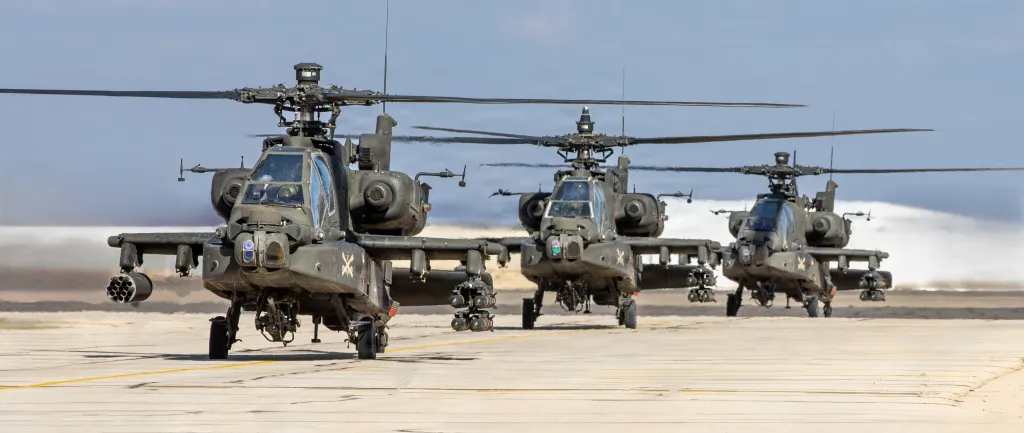
The U.S. military’s top officer on Wednesday talked about how AI is changing the character of warfare and offered two examples to illustrate his points. His comments included new insights into how two U.S. Army AH-64 Apache crew members were rescued after being shot down by an Iranian drone near the coast of Oman in June. The recovery effort involved America’s first known use of an uncrewed surface vessel (USV) executing a personnel recovery action as part of a military search and rescue operation.
“Information moves so fast that leader decision times have compressed from weeks down to days down to seconds,” explained Air Force Gen. Dan Caine, chairman of the Joint Chiefs of Staff, during his keynote speech at the Air & Space Forces Air, Space and Cyber Conference that TWZ is attending. “In the future fight, advantage will go to the side who can see first, who can understand first, decide first, and act first, and along the way, be a learning organization, and no factor is accelerating change as fast as artificial intelligence and advancing cyber capabilities.”
“AI is here now, and it’s already changing the way militaries see, sense, decide, and act across the joint force,” the chairman proclaimed.
The first example Caine used to highlight these changes took place on June 8. After the Apache went down, “U.S. CENTCOM launched a rapid, responsive joint search and rescue effort to recover the crew. That response drew on the totality of the joint force, and ultimately was required to use enabled unmanned vessels to participate in the rescue of downed U.S. service members for the first time ever.”
A flight of U.S. Army AH-64 Apache attack helicopters, armed with rockets and Hellfire missiles, taxi out to conduct a scheduled flight in the U.S. Central Command area of responsibility. In addition to rockets and missiles, the Apache is additionally armed with a 30mm chain gun. (U.S. Army photo) U.S. Army Central
As we noted in our previous coverage, CENTCOM deployed “a U.S. Navy Corsair unmanned surface vessel,” the command’s spokesman told us at the time.
The Corsair uncrewed surface vessel (USV) (Saronic)
The ability to pull off that rescue mission “did not appear overnight,” Caine pointed out. “It came from the men and women of Task Force 59, CENTCOM’s forward-leaning unmanned joint maritime unit who spent the last several years testing, integrating, and operationalizing unmanned systems and AI in one of the most demanding and kinetic environments on Earth right now.”
“What helped make this possible was not a bunch of general officers and flag officers,” Caine continued. “What made this possible was a bunch of entrepreneurial sailors and members of the joint force on watch floors, at piers, managing networks of unmanned systems across thousands of miles of water, and using AI to turn massive amounts of data into a crisp, clear, perfect maritime picture that allowed us to go grab those two soldiers in the water.”
A top-down view of the Saronic Corsair USV. (Saronic)
The second example Caine shared about the use of AI “points in the other direction, not how quickly we are using these tools, but how quickly these tools are changing the threat.”
In Ukraine, “we see first-person view drones operating in heavily contested EMI [electromagnetic interference] environments. Some now using AI-enabled computer vision to continue to drive towards targets, even when there’s no GPS or the links are cut. That gives small units affordable precision and shows how quickly software and autonomy are changing what is possible at the tactical edge, and the results are stark.”
“In certain locations on the front line of troops right now, the life expectancy of a new Russian recruit arriving on the front lines is as little as 20 to 30 minutes,” Caine added. “Think about that. This is what happens when low-cost precision is fielded fast, adapted quickly, and scaled across the battlefield.”
“The price of lethal exchange is decreasing day over day,” the chairman noted. “One wonders what the future of close air support looks like, but I am comforted by the fact that each and every one of you are in this room thinking about that. Taken together, these examples from the Straits of Hormuz to the front lines in Ukraine show how quickly technology is changing the character of war, and this means our joint force needs to do two things at one time.”
“[W]e need to prepare the joint force to win in this kind of conflict,” the general stated. “We have to assume from now on that our formations will be hunted by autonomous systems, jammed across the spectrum, and tracked in real time, and we have to transition the joint force to be prepared to fight and win our future war by generating and delivering lethality at scale with an agile, optimized, high-low mix of combat capabilities to give the young members of the 2.8-million member all volunteer joint force the tools that they need before they need them.”
The former minister was handed over to US agencies in May. (Archive)
Caracas, September 16, 2026 (venezuelanalysis.com) – Former Venezuelan Industry Minister and government envoy Alex Saab pleaded guilty to conspiracy to commit money laundering and illicit financial transactions after reaching a plea deal with US prosecutors in a federal court in Miami.
Appearing before the US District Court for the Southern District of Florida, Saab changed his previous “not guilty” plea, entered on July 24, during a hearing before Judge Kathleen M. Williams. “Guilty, Your Honor,” the 54-year-old businessman stated during Tuesday’s session.
In his guilty plea, Saab admitted to participating, alongside “high-ranking officials” in the Nicolás Maduro government, in an “illegal scheme” involving bribes and illicit payments linked to the CLAP subsidized food program. The money allegedly obtained through the scheme was wired through accounts located in South Florida.
In the 12-page plea agreement, Saab named Socialist Party (PSUV) lawmaker José Gregorio Vielma Mora, who was governor of Táchira state at the time, as an alleged accomplice, alongside Colombian nationals Álvaro Pulido Vargas, Emmanuel Enrique Rubio González, and Carlos Rolando Lizcano.
However, he also referred to two other individuals as “co-defendant 1” and “co-defendant 3.” Their identities have not been publicly disclosed by US prosecutors.
Saab also agreed to “fully cooperate” with the US Department of Justice (DOJ) by providing “truthful and complete information and testimony, and producing documents, records, and other evidence” in “any trial or judicial proceeding” requested by the US government.
He likewise agreed that he would not “protect any person or entity through false information or omission,” nor falsely implicate “any person or entity.”
The Colombian-born businessman also agreed to surrender US $195 million, along with properties and assets derived from the alleged crimes, to prosecutors. The government gave him 14 days to disclose all assets related to the offenses.
Saab, who stated that he suffers from post-traumatic stress disorder and takes antidepressants every night to sleep, could face a maximum sentence of 20 years in prison, as well as a $500,000 fine.
Nevertheless, prosecutors reportedly agreed to recommend a reduced sentence if his cooperation against the other defendants in the case proves valuable. His sentencing hearing has not been scheduled but is expected to take place in January.
The DOJ warned that it “reserves the right to evaluate the nature and extent of the defendant’s cooperation,” as well as the “quality and significance” of the information provided for the relevant investigations.
The agreement does not publicly specify which investigations Saab will be required to assist with or which other Venezuelan officials the US Justice Department is targeting. With Saab having been a key figure for Caracas to circumvent US economic sanctions, analysts have speculated that he could be a witness in the case against President Nicolás Maduro.
Maduro and First Lady Cilia Flores are facing charges, including drug trafficking conspiracy, after being kidnapped by US special forces on January 3.
The current case is the second criminal prosecution Saab has faced in the United States. In 2020, when traveling as a Venezuelan government envoy, he was arrested in Cape Verde during a refueling stop and subsequently extradited to the United States. He was on trial for separate money laundering accusations.
However, in December 2023, then-President Joe Biden granted Saab a pardon as part of a prisoner exchange between the United States and Venezuela. Saab returned to Caracas and joined the government as minister of industry. Following Maduro’s kidnapping, Acting President Delcy Rodríguez removed the former envoy from the cabinet in January before authorities handed him over to US agencies in May.
Venezuelan high-ranking officials claimed that Saab had committed fraud in acquiring Venezuelan citizenship and vowed to present evidence of his alleged long-term cooperation with US agencies, but no further details have been released to date.
The 25 basis-point hike is the first raise in three years and comes ahead of critical midterm elections in the United States.
The United States Federal Reserve has said it will raise interest rates by a quarter of a percentage point as inflation, driven by soaring fuel prices amid the US-Iran war, continues to weigh on the economy.
The Fed, which is the central bank of the US, said on Wednesday that it will hike interest rates by 25 basis points to 3.75 percent to 4 percent.
It is the first hike in more than three years and comes just weeks before the US midterm elections, despite repeated demands from US President Donald Trump to lower rates.
“Economic activity is expanding at a solid pace. While uncertainty remains elevated owing, in part, to geopolitical developments, domestic spending has been resilient,” the Fed said in a statement on Wednesday.
“Inflation remains elevated. Today’s policy action will support a timelier return to the Committee’s 2 percent goal. The Committee will deliver price stability.”
After Wednesday’s hike, Fed officials expect one more rate increase this year, according to their quarterly projections.
CME FedWatch, which tracks the likelihood of monetary policy decisions, forecast a 92.3 percent chance of the Fed increasing rates to 3.75 to 4 percent. A week ago, that forecast was a 40 percent chance of a quarter-percent rate increase.
But in the days since, a slew of data shifted those expectations.
Since then, benchmark crude oil prices have continued to soar as strikes in the US-Israel war on Iran have intensified. Brent crude hovered near $109 per barrel on Tuesday.
The average price for a gallon (3.8 litres) of petrol is $4.36, up 14 cents in the past week, and up from $4.06 in the last month, according to the American Automobile Association (AAA), which tracks daily petrol prices.
Diesel, on the other hand, was at $6.31, the highest recorded average and roughly double from a year ago. That, in turn, is expected to further stoke prices as diesel is used in trucks to haul everything from fruits and vegetables to steel and cement.
At the same time, the benchmark 10-year Treasury yield broke above the psychologically important 5 percent threshold on Tuesday, hitting 5.02 percent, its highest level in 19 years. The yield serves as a benchmark for borrowing costs, including car loans and home mortgages, and is a bellwether for inflation.
“The economy is in an unusual place,” Michael Klein, professor of international economic affairs at Tufts University’s Fletcher School and executive editor of EconoFact, a nonpartisan economic and social policy publication, as unemployment remains at a comfortable level while higher prices continue to stick, sending inflation beyond the Fed’s target of 2 percent.
“There [has been] a lot of pressure on Chairman Warsh to raise interest rates because of inflation coming in high, and that has been compounded by concerns about Trump’s pressure” as the president has continued to demand that interest rates be lowered, Klein said.
“Higher interest rates tend to weaken the economy… but if the market believes that there’s going to be a rate increase, it’s priced in already as prices move on news, so this won’t be news,” Klein said, adding that should help steady yields.
Schools in England are to get around £500 million in extra funding towards the teachers’ pay award this school year, reducing the risk of a strike ballot by the largest education union.
Daniel Kebede, the General Secretary of the NEU, said the offer of more funding was a “significant” step in negotiations.
In a letter to the union on Wednesday, which has been seen by the BBC, the government said the increase would be funded by savings in employers’ contributions to the local government pension scheme.
The letter said the 4.9 percentage point drop in what employers are expected to contribute will deliver “significant savings” on the pay bill for support staff, which will not be clawed back by central government.
The National Education Union said it expected the extra money to be around £500m, which schools can now use towards teachers pay this year.
In July, ministers accepted the recommendation of the independent pay review body for teachers and agreed a 3.5% increase from September 2026 would be followed by 3% the following year.
The pay increase had been partly funded by an additional £700m for 2026-27 and £1.1bn for the following year.
Independent economists at the Institute for Fiscal Studies (IFS) said that left schools facing a shortfall of around 1% between rising costs and funding this year.
Luke Sibieta, IFS research fellow, said the extra money would mean the pay increase this year was fully funded – and on top of other funding increases, schools would be £1.6bn better off by next year than they had expected this summer.
The additional money could potentially bring the uplift for this year into line with next year.
Kebede said schools has been “running on empty” and the funding signalled “a welcome return to reality, and a message of hope for the entire school community”.
Paul Whiteman, General Secretary of the National Association of Headteachers, said the decision is “certainly welcome”, putting schools in a “better position”.
He said his union would look carefully at the detail “to determine whether this means the pay uplift is genuinely fully funded” for schools.
Pepe Di’Iasio, General Secretary of the Association of School and College Leaders, said he was “pleased” at the announcement of additional funding but “the wider pressure on school and college budgets remains intense”.
Similarly, the NASUWT union welcomed the news. General Secretary Matt Wrack added schools needed “a sustainable, long-term injection of extra funding” to meet the needs of young people.
In an indicative ballot by the NEU in April, 90% of teachers who voted said they would be prepared to take industrial action over funding and pay, on a turnout of 48%.
A formal ballot was due to begin on 3 October and close 15 December, raising the prospects of teachers pay strikes early in 2027.
The national executive of the NEU will meet on 24 September to consider whether to call that off following the additional funding on offer from the government.
A spokesperson for Education Secretary Lucy Powell said the government was “confident schools can now meet the costs of the award at a national level”.
“The Secretary of State has been clear from day one that supporting teacher recruitment, retention and wellbeing, and rebuilding the relationship with the profession, are among her top priorities.”
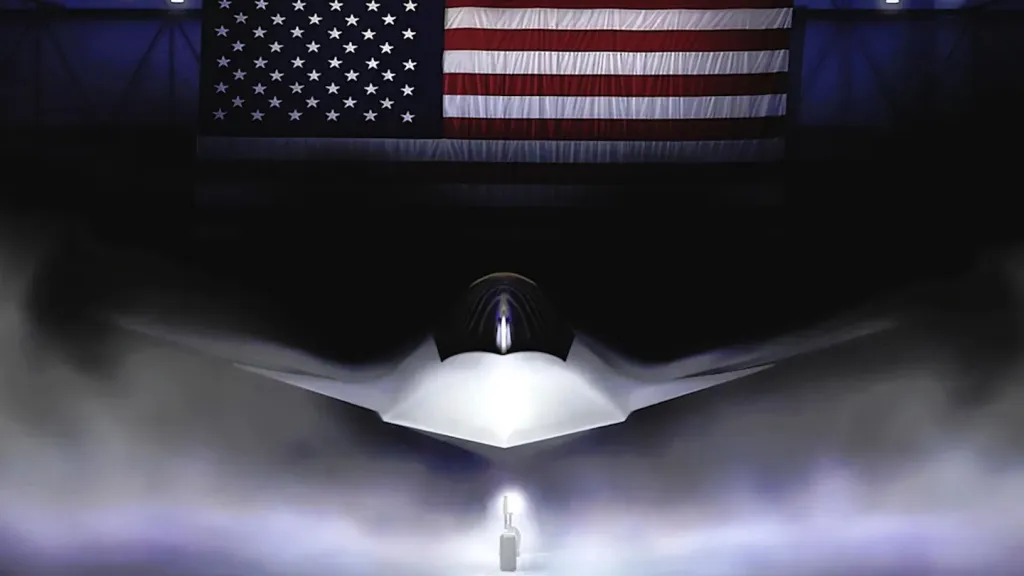
As both the Navy and the USAF were racing to field a new generation of advanced tactical jets, the seagoing service’s program hit a wall. A major reason behind this from the Pentagon was concern that the U.S. industrial base could not handle simultaneous final development and production of two extremely complex new fighter aircraft. This was a controversial justification that many had a hard time swallowing. The Navy’s program, dubbed F/A-XX, is supposedly back on and a down-select on who will build it is coming soon, but that concern appears to linger among at least one of the Department of War’s top acquisition officials.
Though he remains confident that the U.S. Air Force F-47 sixth-generation fighter will fly in the next two years, Air Force Gen. Dale R. White, Director, Critical Major Weapon Systems — the service’s leading weapons procurement advisor — remains concerned about the overall capacity of industry to provide the military with the aircraft it needs, including two new fighters. His comments were in response to questions about the Navy’s challenges in building its own sixth-gen fighter alongside F-47.
The concerns are “not unique” to the F-47 or the Navy’s program but the problem exists to various degrees across the industrial base too, White told reporters Tuesday during a media roundtable at the Air & Space Forces Air, Space and Cyber Conference that TWZ is attending.
White has a dual-hatted role, serving as the Pentagon’s top weapon’s procurement officer and as the senior acquisition advisor to the Secretary of the Air Force for all acquisition matters.
A rendering of the F-47. (U.S. Air Force) U.S. Air Force
“We’re seeing it in multiple platforms,” said White, who did not elaborate. “And so what we’re having to do is, at some point, we’re having to make some trade space in between some of these.”
“I see Boeing making smart investments,” White said of the prime contractor of the F-47, selected for the U.S. Air Force’s Next Generation Air Dominance (NGAD) ‘fighter’ initiative. “They have a lot of CAPEX [capital expenditure] that they’re pouring in, but we have to get through the process of the design piece, getting that completed and closed out. Then we all hit some major milestones with things like flight tests and software and those things.”
F-47 specifications infographic (USAF)
“Really, it’s just being able to manage the overall resourcing as it relates to number one, people resources,” the general added. “Number two, when you start getting into the production conversation, do we have enough capacity to be able to produce at that rate? And so, by and large, I have concerns. I have concerns about the capacity of our industrial base, but they are not unique to F-47 or to any program.”
As for the F-47, White said the program “continues to progress exceptionally well.”
“As you know, many, many years in tech maturation and risk reduction gave us a tremendous head start on this program,” White explained. “Extremely proud of what the team has done, what they continue to do each and every day. We are still absolutely on path to be able to hit the mark of flying within this administration. So we see no issues in front of us right now.”
While the first example of the F-47 has been in production for about a year now, the Navy has yet to even select a prime contractor for its next generation fighter. The current competitors for the F/A-XX are Boeing and Northrop Grumman. A decision was supposed to have been made by last month.
“The F/A-XX program remains on track, and we have no further information to provide at this time,” a Navy official told us last week.
In response to a question from TWZ earlier this year, the Chief of Naval Operations acknowledged the uncertainty over the F/A-XX program.
“One of the challenges we’re seeing is, not only [are] our peer competitors improving their capability for anti-air, either air-to-air or surface-to-air, but the lower cost of entry of very capable weapons is also making more players on the field in which that level of stealth and technology is required,” Adm. Daryl Caudle told us back in April at the Sea-Air-Space 2026 exposition. “So this is not about the need for a peer adversary. This is just having an aircraft that can operate with a level of uncertainty and with the acceptable level of risk.”
With Boeing as a finalist, it is also possible that F/A-XX could be a variant of the F-47. As we noted in a past story, the Boeing render for its F/A-XX concept is remarkably similar to artwork for its F-47.
Last year, Steve Parker, Boeing Defense and Space CEO, said he didn’t see a problem with his company building both jets stating that this had been part of the strategy all along.
If this is the case, the company’s claim that it would not have a problem building both the Navy and Air Force next-generation fighters would make more sense. There are a number of advantages when it comes to establishing a high-degree of commonality between F/A-XX and F-47, although there would also be challenges, especially when it comes to getting the most out of a design that was not meant to operate from a carrier deck and scaling production up for both services. There is already significant sharing of elements of both the Navy’s and Air Force’s sixth-generation fighter programs. So commonality in some subsystems and interoperability is already baked in.
We should hopefully finally get a clearer picture in the coming weeks about the status of the F/A-XX and possibly the answer to who will actually build it, which will give us a better idea of what the industrial base impact actually will be.
Saudi Arabia has intensified air strikes against Houthi positions in Yemen as the Iran backed group expands its territorial gains along the Red Sea coast, opening a new front in the wider Middle East war and adding pressure to already disrupted global energy supplies.
The Houthis have swept through several Yemeni towns and seized islands near the Bab el Mandeb Strait, a strategically important maritime route connecting the Red Sea with the Gulf of Aden. The group has also released footage showing its fighters capturing armoured vehicles from Saudi backed forces.
Houthi military spokesman Yahya Saree claimed that the group had shot down a Saudi F 15 fighter jet and said Saudi Arabia had conducted as many as 450 air strikes in Yemen during the week. Saudi authorities have not confirmed the aircraft claim, while officials supporting the internationally recognised Yemeni government have acknowledged that Saudi and allied forces are carrying out strikes against Houthi positions.
Saudi Arabia faces growing security pressure
The escalation has brought the conflict closer to Saudi territory. The Houthis have repeatedly launched attacks toward Saudi Arabia over the past week, prompting alarms in cities across the kingdom’s south and west.
Stay ahead of the geopolitical week.
MD Briefing delivers expert analysis across five global fronts — the Indo-Pacific, energy, geoeconomics, European security, and the Middle East — every Monday morning. Free.
Saudi Arabia said its air defenses intercepted a Houthi drone south of Mecca before it entered restricted airspace over the holy city. Riyadh described the incident as a serious escalation because of the threat to religious sites. The Houthis denied targeting Mecca and accused Saudi Arabia of using the incident for propaganda.
The United States has also tightened its travel warning for Saudi Arabia, barring government employees from travelling within 20 miles of the Yemen border.
The latest escalation marks a sharp deterioration after several years in which the Saudi led conflict in Yemen had largely quietened under a ceasefire. The Houthis declared a naval blockade against Saudi Arabia in July and resumed attacks on areas in the kingdom before making rapid gains against forces aligned with the Saudi backed Yemeni government.
Energy markets face another shock
The renewed fighting is particularly significant because global energy markets are already under pressure from disruptions caused by the wider war involving Iran.
An attack blamed on Iran aligned fighters in Iraq last week knocked out Saudi Arabia’s East West Pipeline, an important route that allows the kingdom to move oil without relying entirely on the Strait of Hormuz.
Traders estimate that a prolonged closure of the pipeline could affect as much as 4% of global oil supply. Saudi Arabia has not given a timetable for restoring operations, although U.S. Energy Secretary Chris Wright said oil should begin flowing through the pipeline within days.
Brent crude was trading around $108 a barrel on Wednesday, close to its highest level since May. The average U.S. retail diesel price also reached a record above $6.30 a gallon.
The simultaneous disruption around the Strait of Hormuz and Saudi Arabia’s alternative export infrastructure increases the vulnerability of global energy markets to further regional escalation.
Washington faces another difficult choice
The developments also create a new challenge for the United States.
Saudi Crown Prince Mohammed bin Salman spoke with President Donald Trump last week seeking additional military support. So far, U.S. assistance has been limited to intelligence support.
The United States previously conducted a two month bombing campaign against the Houthis in 2025 before Trump announced a ceasefire with the group.
Washington now faces competing pressures. Greater support for Saudi Arabia could help contain the Houthi advance and protect regional energy infrastructure, but deeper military involvement could also expand the U.S. role in another theatre of the Middle East war.
What’s next
The immediate concern is whether the Houthi advance can be contained before the fighting causes further disruption to Saudi energy infrastructure and shipping routes.
For Saudi Arabia, the challenge is to push back against the Houthis while preventing the conflict from developing into a broader regional confrontation.
For global markets, the key issue will be whether disruptions to Saudi oil infrastructure remain temporary. Continued attacks on energy facilities or shipping routes could place additional pressure on already strained supplies.
The developments in Yemen therefore carry consequences well beyond the country’s existing conflict. The combination of Houthi territorial gains, pressure on Saudi Arabia and disruption to major energy routes has created another potential source of instability for the global oil market.
It is stunning to see the impact the USAF’s Collaborative Combat Aircraft (CCA) program has made on discourse surrounding the future of the Air Force since it was officially announced. There is still much to prove regarding the concept, but testing is accelerating and the USAF now plans on buying 500 CCAs by 2032. At the same time, the USAF is now hunting for a successor to the MQ-9 Reaper, with plans on procuring hundreds of those drones, as well, by early in the next decade.
With all this in mind, TWZ’s Jamie Hunter talked to Mike Shortsleeve from General Atomics on the show floor at Air, Space & Cyber 2026. The two discussed the latest progress for the company’s newly-named FQ-42 Vengeance Collaborative Combat Aircraft, as well as General Atomics’ new Wildfire platform designed to address the lower-cost Massed Modular Aircraft program that could replace the company’s iconic MQ-9 Reaper.
Check out the interview below or at the top of this post.
FQ-42 Vengeance fighter drone update from General Atomics
A secondary school teacher could not care less what some kid they taught 20 years ago is up to these days.
Upon being approached by a former pupil while doing the big shop, history teacher Martin, not his real name, made it clear he had no interest in reminiscing about his underpaid day job.
He said: “Apparently I was an inspirational Robin Williams fromDead Poets Societyfigure to this guy. Shame I didn’t inspire him to leave me the f**k alone. He’s blocking the frozen chips.
“Why would I be happy to see him? He’s a grim reminder of the relentless passage of time. Since I last saw him he’s all grown up, yet I’m still droning on about Nazis to a bunch of Year 9s who don’t give a shit.
“What did he expect to happen? That I’d be overwhelmed with nostalgia and we’d pick up where we left off? The last thing we talked about was probably the failure of the League of Nations, which isn’t the basis of a friendship.
“To be honest I don’t even remember him. Pupils blend into one greasy, amorphous blob after a while. The only ones us teachers recall are the arseholes. We like to read in the local paper when they’re sent down.”
Martin’s ex-student Cad, not his real name, said: “I thought he’d be happy to hear my knowledge of history had led to a fulfilling career. But all he said was his hasn’t.”
Taiz, Yemen – Hajja Fatima Mohammed Saleh, a 70-year-old Yemeni woman, is among the countless people and families displaced from Taiz governorate, southwest Yemen, in recent fighting between government forces and the Houthis.
The Iran-backed rebel group, also known as Ansar Allah (supporters of God), now controls most parts of northwestern Yemen, including the capital, Sanaa.
Recommended Stories
list of 4 itemsend of list
Saleh’s village in Maqbanah district, on the border of Yemen’s western coast, is situated at the epicentre of last week’s Houthi assault in which the group captured the whole of the Red Sea coast, including the port city of Mocha.
At least 100,000 people have now fled their homes following renewed fighting between the two sides, according to the United Nations’ refugee agency, most leaving with few belongings due to the speed of the Houthi offensive.
Saleh said she had to leave her wheelchair behind as it was unsuitable for the rugged terrain her family had to navigate to find shelter.
“The attack was massive, we had never seen anything like it before. Shells were falling heavily on the village, and bullets were flying in every direction,” she told Al Jazeera.
“We had no choice but to leave and flee to a safe place. We left everything we owned and walked a long distance on foot. For me, I suffered especially because I am disabled and cannot walk, so I had to crawl – using both hands – for a long distance through rain and floods before we found a vehicle to carry us.”
UN agencies and the internationally recognised Yemeni government say that Taiz governorate has witnessed most of the displacements, with Taiz City among the Houthis’ next targets after their victory on the Red Sea coast. This means the humanitarian situation could worsen even further.
Ali al-Shumairi, director-general of the Executive Unit for the Management of IDP Camps in Taiz governorate, told Al Jazeera that 65,845 people were displaced between August 10 and September 15. About 95 percent of those displaced come from the five districts which witnessed the heaviest fighting: Jabal Habashi, al-Maafer, Maqbana, al-Wazi’iyah and Mawza.
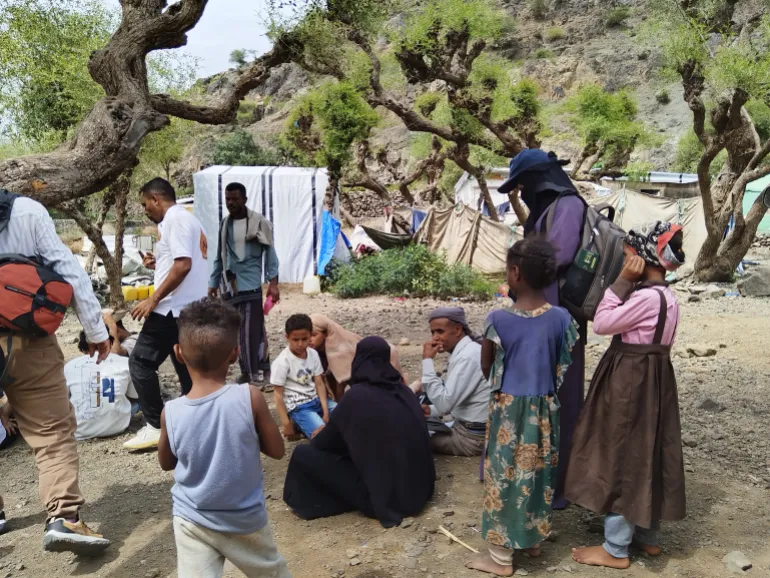
Newly displaced people at al-Munij camp [Al Jazeera]
Fighting has intensified on several fronts in Yemen as government forces have carried out air attacks on Houthi positions in attempts to retake Mocha, days after the group captured the strategic port city, tightening its grip on the Red Sea – a vital shipping lane.
This development has placed the Bab al-Mandeb Strait, the strategic waterway that connects the Red Sea to the Gulf of Aden and the wider Indian Ocean, at the heart of the war between the United States and Iran, and amplifies pressure on global trade routes.
Yemen’s more than 10-year civil war was reignited in July, threatening a United Nations-brokered truce that halted large-scale violence in 2022, after the Houthis declared a maritime blockade on Saudi Arabia and began targeting its ships in the Red Sea.
Forces affiliated with Yemen’s internationally recognised government have launched a campaign against the Houthis on a number of fronts since last week. They have retaken some positions and are advancing in the southwestern Taiz province as clashes intensify.
Osama al-Wafi, supervisor of the Mushrifa camp in Wadi Bikhawlan in Taiz governorate and a representative of the Yemeni government’s Executive Unit in Jabal Habashi district, described the situation as “dire and tragic”.
“These people have been displaced and have lost all the basic necessities of life, after having homes, farms, and livestock. Now they are only looking for a shelter to house them,” al-Wafi told Al Jazeera.
He said the number of displaced people arriving at the camp is steadily rising, with more than 1,500 families entering over the past six days, most living in the open due to a lack of shelter.
The al-Munij camp in the al-Bireen area, about 40 kilometres southwest of the semi-besieged city of Taiz, has become a temporary refuge for Yemenis fleeing the area after another bout of conflict between government and Houthi fighters in 2020.
Over the years, al-Munij has extended over a space of two square kilometres to house more displaced families, while other larger camps have been established in the area. Most residents complain they lack access to the most basic services – such as sporadic drinking water supplies and few toilets – in the camps.
Hajj Saif Qaed Thabet, 73, has been living with his wife and four children in an exposed space with no doors since arriving at al-Munij on September 10. He left behind a farm and livestock from his home in al-Kadaha, western Taiz governorate.
“We were displaced because of the war, fleeing bullets and artillery shells falling over our heads. Since arriving at the camp, we have been living like this, waiting for our situation to be addressed and for us to be housed in a suitable place,” said Thabet. “Praise be to God in all circumstances.”
Displaced man Hajj Saif Qaed Thabet, 73, has been living in the open air since he arrived with his family at al-Munij camp on Thursday, September 10 [Al Jazeera]
Malouk Ahmed Ali, 55, from the al-Kadaha area in Taiz, said her family of 14 all escaped drones, shelling and gunfire on foot, including five children under her care, seven under her daughter’s care, and her elderly grandmother.
“We fled to an area near our village in the hope that the war would calm down quickly and we would return to our homes, but the clashes expanded until they reached us, so we were displaced again to here aboard a military vehicle that came to transport the threatened homeless people,” she told Al Jazeera.
“When we arrived at this camp, we were received and placed in this small tent as temporary housing for all members of the large family. Although they took all our information, our situation has not improved much so far, and we still hope it will improve.”
Ali hopes the war will end soon so she can return home but believes her family’s possessions, including solar panels and a battery, will have gone.
“As for our livestock, most of them died, some fled to the mountains and valleys, and what remained was looted,” she said.
RIYADH: A US economic delegation has held meetings with Syria’s sovereign fund to explore investment opportunities, as Damascus seeks to deepen ties with the world’s largest economy and attract international capital.
The meetings, which included representatives from government bodies and private companies, were focused on assessing the Syrian market and available investment opportunities amid the country’s economic opening and the lifting of sanctions, the Syrian Arab News Agency reported.
The discussions come as the Middle Eastern nation’s seeks to capitalize on the momentum generated following Washington’s termination of sanctions against Syria in July 2025.
“In his remarks during the meeting, Yasir Kahf, Director of Development and Planning at the Syrian Sovereign Fund, explained that the fund’s investment portfolio encompasses a diverse range of sectors and companies. He emphasized the Fund’s openness to establishing various forms of partnerships with US and international companies — including joint ventures — tailored to the specific nature of each sector,” the newly released SANA statement said.
Kahf also said the US Chamber of Commerce delegation’s inaugural visit to Syria represents a significant step toward enhancing economic cooperation.
Mohammad Mastat, director of public relations at the Syrian Sovereign Fund, said US companies had shown interest in entering the Syrian investment market, adding that several agreements and projects were currently under negotiation and would be announced in due course.
The easing of US sanctions has also created greater scope for investment and private-sector activity.
In May 2025, the US Treasury said sanctions relief would enable new investment in Syria and facilitate activity across all sectors of the Syrian economy as part of efforts to support its economic recovery.
It said the recovery is being supported by improving agriculture, hydrocarbon production, electricity provision, trade and services, alongside policies aimed at restoring macroeconomic stability and achieving a strong, private-sector-led recovery.
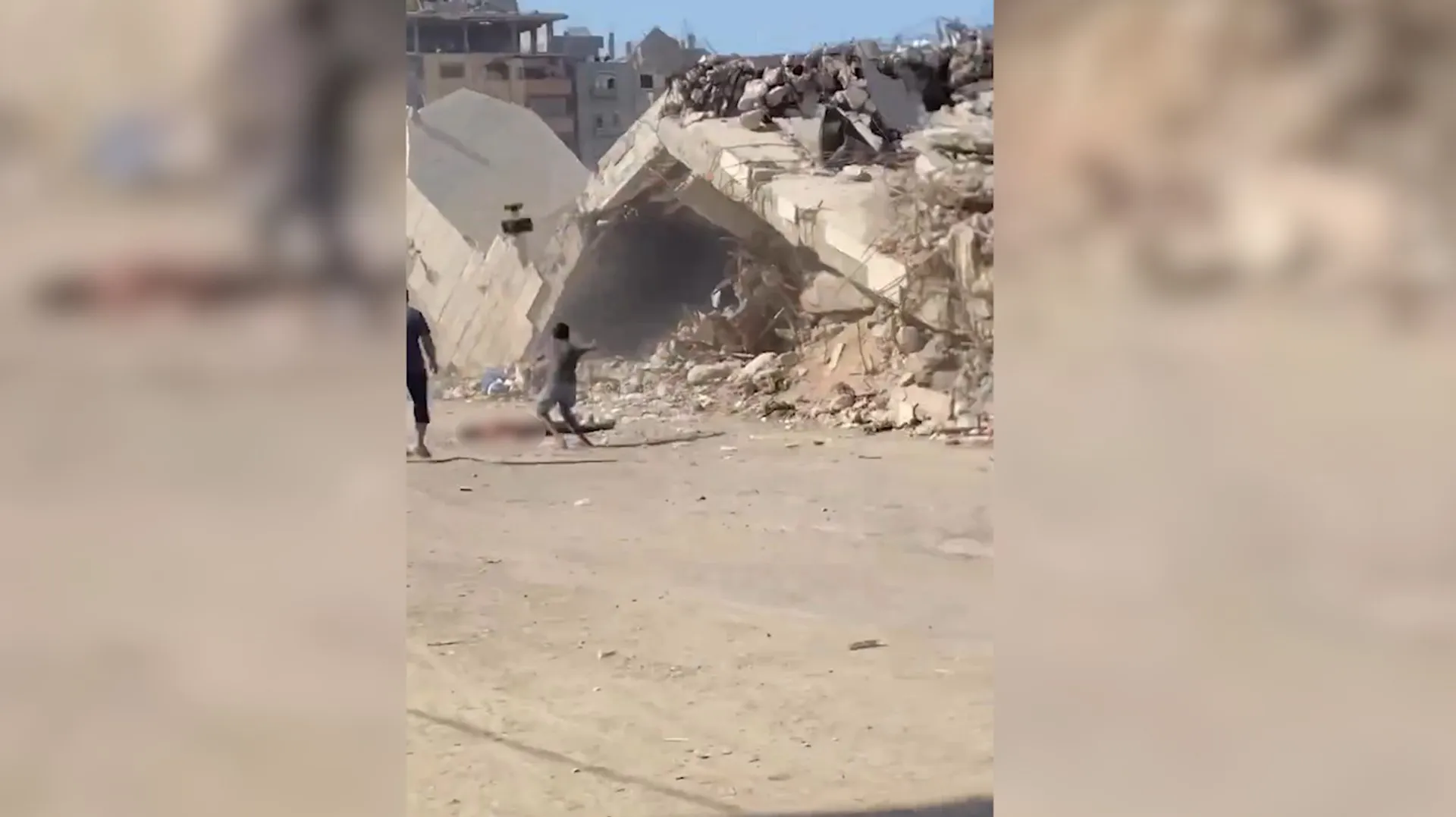
A 15-year-old boy has been killed in an apparent Israeli double-tap strike as he rushed to help a paramedic wounded in an attack moments before. Israel has killed around one child per day in Gaza since the 2025 ‘ceasefire’.
The European Union is preparing to use a broader range of economic measures to reduce what European Commission President Ursula von der Leyen described as an unsustainable trade deficit with China.
Speaking to the European Parliament on Wednesday, von der Leyen said the imbalance had reached a critical point, with the EU running a goods trade deficit with China equivalent to around €1 billion ($1.15 billion) a day last year.
She warned that Europe was experiencing what she described as a second “China shock”, with growing Chinese industrial exports contributing to pressure on European manufacturing and raising concerns about deindustrialisation.
Europe seeks concrete results
The issue has become a priority in EU China relations as European governments seek to address the growing imbalance through negotiations as well as economic policy tools.
Stay ahead of the geopolitical week.
MD Briefing delivers expert analysis across five global fronts — the Indo-Pacific, energy, geoeconomics, European security, and the Middle East — every Monday morning. Free.
EU leaders asked the European Commission in June to deliver results from its dialogue with Beijing and ensure that the bloc had sufficient instruments to protect its economic interests.
European Trade Commissioner Maros Sefcovic, who is leading the discussions, has said he wants tangible progress by October.
Von der Leyen said cooperation remained in both sides’ interests but warned that the EU was prepared to move beyond dialogue if negotiations failed to produce results.
“We will use all the tools at our disposal to rebalance our relationship,” she said.
The approach reflects a broader European effort to reduce economic vulnerabilities without completely severing commercial ties with China, one of the EU’s most important trading partners.
Critical minerals add to concerns
Trade is not the only area creating pressure on the relationship. The EU also remains heavily dependent on China for several critical raw materials, including rare earth elements that are essential for industries such as electronics, renewable energy, defense and advanced manufacturing.
Von der Leyen said the EU needed to accelerate efforts to secure supplies and build strategic reserves.
The European Commission plans to establish a European corporation focused on critical raw materials to help the bloc secure and stockpile essential resources.
What’s next
The EU’s approach is likely to combine negotiations with measures aimed at strengthening its own industrial capacity and reducing dependence on Chinese supply chains.
For Beijing, the growing European focus on trade imbalances, industrial competition and critical minerals could create additional pressure to make concessions while preserving access to the European market.
For the EU, however, reducing the deficit will require more than trade restrictions. Europe will also need to expand domestic production, diversify suppliers and address the competitiveness challenges facing its own industries.
The October deadline for trade talks could therefore become an important test of whether Brussels and Beijing can reach practical agreements or whether the EU moves toward a more defensive economic relationship with China.
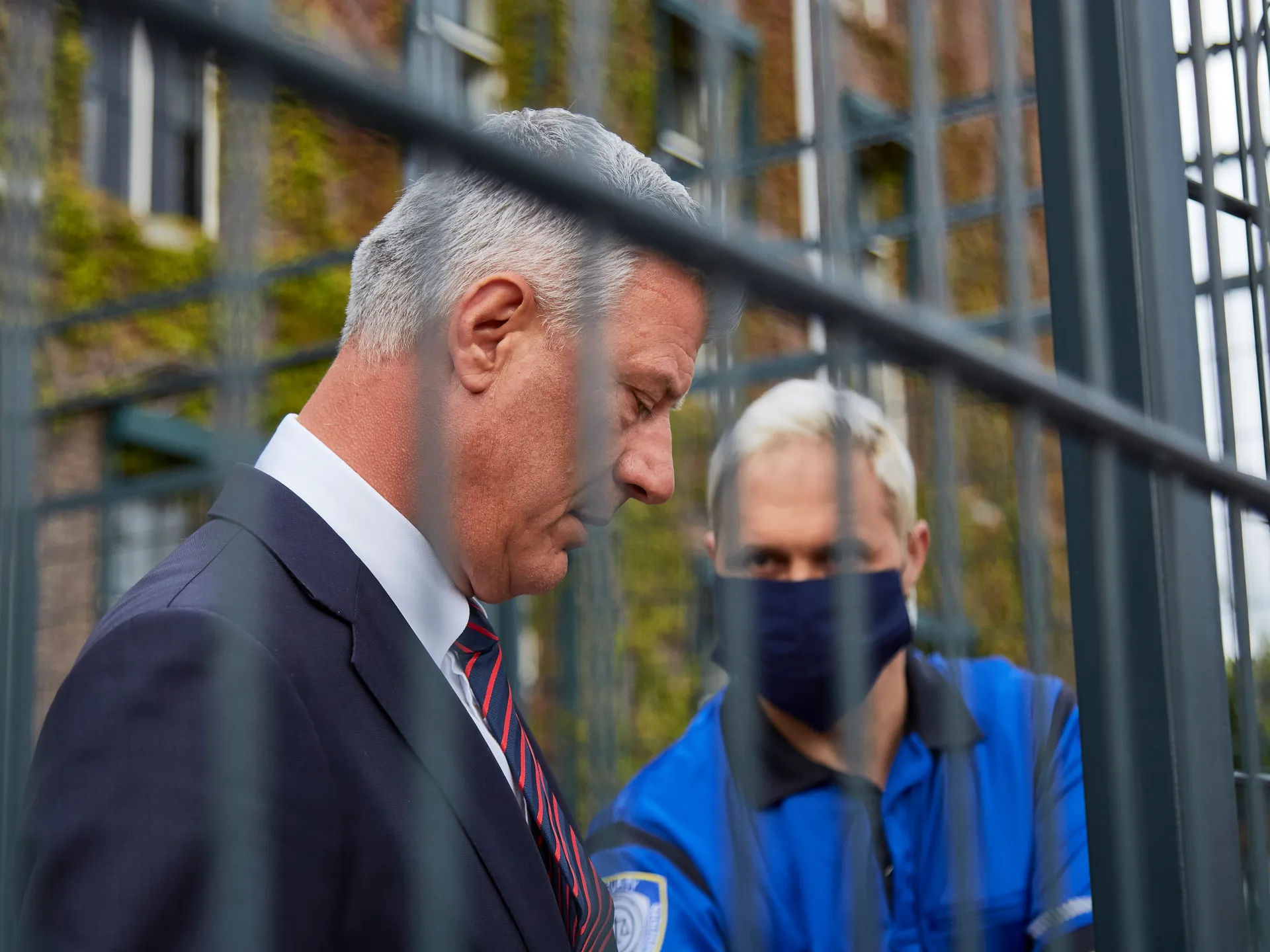
Prosecutors have requested a 45-year jail sentence for Thaci and three wartime commanders accused of war crimes.
Published On 16 Sep 202616 Sep 2026
The Kosovo war crimes tribunal will on Wednesday deliver its verdicts in the case of former President Hashim Thaci and several wartime commanders accused of murder and torture during the self-declared republic’s break from Serbia.
Thaci, 58, is facing several counts of war crimes and crimes against humanity, including murder, torture and persecution, along with three former commanders from the ethnic Albanian Kosovo Liberation Army (KLA), a separatist militia that fought Serbian troops.
Recommended Stories
list of 3 itemsend of list
Thaci and the other former high-ranking commanders, Jakup Krasniqi, Rexhep Selimi and Kadri Veseli, deny the charges.
Prosecutors have requested 45-year prison sentences for each of the men.
The case is extremely contentious within Kosovo, where Thaci remains a revered figure for many Kosovan Albanians due to his role in the 1998-99 independence war.
On Saturday, tens of thousands gathered in the capital, Pristina, to call for their acquittal in the latest of several rallies since the trial began. Portraits of the four former KLA fighters have been plastered across the city along with a huge digital clock counting down to the verdicts.
“In the name of the people, declare them innocent,” one banner read.
According to prosecutors, the men targeted political opponents and civilians perceived as collaborators and traitors during their time in the KLA.
Thaci’s lawyers argued in February there is no evidence that directly links him to any of the crimes.
“There are no orders in the record from Thaci to perpetrators of crimes. There are no reports from perpetrators of crimes to Thaci,” lawyer Luka Misetic told judges at the Kosovo tribunal in February.
Most of the 13,000 people who died in the war in Kosovo were ethnic Albanians. A 78-day campaign of NATO air attacks against Serbian forces ended the fighting. About one million ethnic Albanian Kosovars were driven from their homes.
In 2008, Kosovo declared its independence from Serbia, a move that Belgrade refuses to recognise. Ties between Kosovo and Serbia remain tense, despite years of negotiations mediated by the European Union.
U.S. Air Force Collaborative Combat Aircraft (CCA) are set to take part in a large-force employment (LFE) exercise for the first time later this year. Sending CCAs to the next iteration of the Emerald Flag test exercise is another important new stepping stone toward fielding the drones operationally.
“We have not yet done a LFE with these [CCAs], for real. The first one is going to be Emerald Flag. That’s in December,” Lt. Col. Lyndon “OTTO” Bartlett, Director of Operations for the Experimental Operations Unit (EOU) at Nellis Air Force Base in Nevada, said earlier today. “That’ll be our first tip dip of the toe in an actual force integration.”
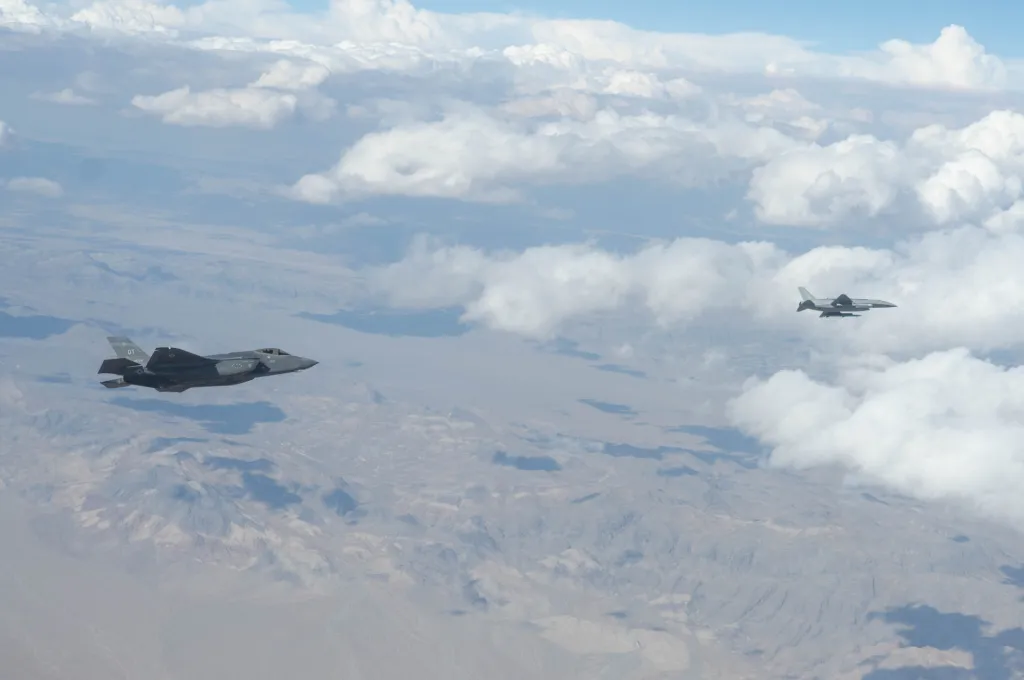
One of the Air Force’s YFQ-44A Fury CCA drones flies together with an F-35 Joint Strike Fighter. Anduril
It is worth noting here that Boeing’s MQ-28 Ghost Bat, a CCA-type design, did take part in Valiant Shield 26, another LFE exercise, earlier this year. The EOU was also involved. However, the MQ-28, originally developed for the Royal Australian Air Force, is not officially part of the Air Force’s CCA program at present.
Emerald Flag in December “will, in OTTO’s mind, be the first time that we will ever do some CCA end-to-end chain [demonstration] live. That’s the first time we’ll ever be integrated in a fourth- and fifth-gen combined OCA [offensive counter air] push,” Lt. Col. Bartlett added. “It’ll be small, but those type [sic] of building blocks are where I think you get the intangibles like trust in the CCA.”
“Those learnings are going to be just as valuable as the technical, [like] does the radio work properly? Does the button I push to say ‘target’ work properly?” he continued.
A General Atomics YFQ-42A CCA drone during an earlier test flight. General Atomics
“If it’s in a simulated environment, it’s immediate,” Lt. Col. Bartlett said during the panel when asked about the “feedback loop” in testing the EOU is already taking part in. In that environment, “when the mission autonomy iterations are happening, our guys are literally with the programmers … They give the feedback, and if it’s possible to do immediately, they take that feedback. If not, then they work on it on the next turn of the software.”
Real-world testing, of course, offers opportunities to explore additional aspects of future CCA operations, including when it comes to loading weapons and maintenance. A key component of the Air Force’s vision for CCA employment is being able to forward deploy the drones to far-flung locations, including airstrips with limited infrastructure and access to logistics chains. Rapid, distributed deployments like this are central to still-evolving concepts of operations currently referred to collectively as Agile Combat Employment (ACE). The EOU has been involved in at least two rounds of ACE-focused testing this year, one at Edwards Air Force Base in California in April and another at Creech Air Force Base in Nevada in July. TWZ was the first to report on the latter event.
Visualizing ACE
During the panel today, Lt. Col. Bartlett also talked more generally about work EOU has done to date. This has included exploring “sortie generation, how easy they are to maintain, [and] how small a footprint could be.”
“We’ve been pleasantly surprised. The jets are extremely easy to maintain,” he continued. “We’re at a one-to-one maintainer-to-airplane ratio, which is crazy small.”
With “CCAs, [it] seems like because they’re a little bit simpler, because their role is so focused, what we found is that just about any – not just about, but we found that any AFSC [Air Force Specialty Code; alphanumeric codes used to identify specific jobs within this service] can be trained to generate sorties to load weapons, and we’ve done some of those things already,” he further explained. “It’s our job to bring them [CCAs] out and make sure that, beyond the technical specifications of it, that we’re kind of experimenting with the more complex things like logistics, and C2 [command and control], and how do we battle manage these things.”
Airmen prepare to load an inert AIM-120 Advanced Medium Range Air-to-Air Missile onto a YFQ-44A CCA drone. USAF/Senior Airman Renee Blundon
The head of the EOU did acknowledge challenges that still have to be surmounted. This notably includes hurdles currently imposed by Federal Aviation Administration (FAA) regulations on the operation of fully uncrewed aircraft, even by the U.S. military, within U.S. airspace. This is further compounded by the explicit intention to operate CCAs with far more minimal human engagement compared to most existing drones.
“Mission autonomy is going to be the secret sauce that lets these things become decisive or not, and we’ll know that over the next couple years as that develops,” according to Bartlett. “If I were to identify the two biggest problems from the trenches of the EOU, [one] is FAA integration or policy implications to an autonomous airplane.”
“So these things don’t have pilots. They’re not RPAs [remotely-piloted aircraft]. They’re not manned fighters. They have no pilots,” he continued. “Our system is not set up for that, and that is a challenge that we are finding extremely hard to navigate through, and to not go around, but to make a policy.”
“We need to make sure the Air Force is ready for these things, to set policies that make sure the enterprise and the country is [sic] ready to receive these, and internalize an autonomous fighter that does not have a pilot that is running on a mission autonomy agent that doesn’t listen to ATC [air traffic control],” he added.
Another look at a YFQ-44A prototype during at test in 2026. USAF
The second problem, per Bartlett, is making sure the Air Force develops new internal policies and doctrine that are not “copy and pastes from old regulations” that do not take into account the specific nuances that CCAs will bring. What the service needs is “something that enables us to move quickly with these things, to weigh what we need, and to experiment with novel types of air superiority.”
All of this circles back to the discussion of trust in autonomous capabilities. It also speaks to the potential for future operations where CCAs could operate far more independently.
“It’s in the name that they’re collaborative,” Bartlett said. “Taking them out of that could technically be effective, but would not enhance the joint force the way that we see a collaborative, integrated force package to be.”
“What we need autonomously to do is written down. I won’t discuss the particulars in this forum, but we know what we need it to do, or we know what we think it really needs to do,” he noted. “We’ve structured our experimentation game plan to analyze ‘can it do those things?,’ and if not, then how do they need to be different? And then as they iterate on it, which we’ve already seen a couple times, we get that at the EOU, we get the new version down, we fly it again. Is it fixed? Yes or no.”
A General Atomics YFQ-42A seen from another angle during earlier testing. General Atomics
Some members of industry are clearly envisioning futures with different definitions of ‘collaborative’ that could lean more toward independent operations involving highly autonomous drones.
What “the whole entire program is trying to do is [figure out] what is the requirement to put out into the field to get to the warfighter and to start operating this thing this [sic; in] real time?” Robert “Otis” Winkler, Vice President of Corporate Development & National Security Programs at dronemaker Kratos, another one of the panelists, said. “The collaborative part of this makes it a much easier, I think, technical problem to be able to limit and grow the autonomy as you field this.”
“I think eventually we may see these aircraft utilized as collaborative aircraft, but not in conjunction with your traditional pulsed operation, but in support of that pulsed operation when the pulse isn’t there yet. But I do think that that is a bit of a stretch goal that’s going to be down the road.”
CCAs “have been designed really around increasing both survivability and lethality of current force packages. So there are many manned platforms that you would describe in the exact same fashion,” Jason Levin, Senior Vice President for Air Dominance and Strike at Anduril, who was also on the panel, said. He was responding here to a specific question about whether his use of the term “fighter” to describe these drones implied more emphasis on independent operations.
All of this underscores the importance of bringing CCAs to Emerald Flag in December, as well as other events in the future offering opportunities to see how the drones really fit in with other crewed platforms. The Air Force is hoping to start seeing CCAs enter operational service around the end of the decade, and have 500 of them, at least, in inventory by 2032.
During the panel today, the EOU’s Lt. Col. Bartlett made clear that “we’re going to learn a lot over the next couple years.”
WASHINGTON: For a third time, the US House has voted to end the war in Iran, approving a war powers resolution that would halt President Donald Trump’s ability to continue military action without congressional approval.
The roll call late Tuesday, 220-204, was similar to earlier efforts this summer, with a few more Republicans joining all Democrats voting to bring an end to the conflict. None of the resolutions have made it to the president’s desk, where Trump would almost certainly veto the measure.
“Remember when Donald Trump said that this war would last just a few weeks?” said Rep. Seth Moulton, D-Mass., who served as a Marine during the Iraq War and pushed the resolution forward.
He said it’s time for Congress to “actually ask tough questions, as the Constitution directs us to do, rather than be subservient to another warmongering administration.”
Republican Rep. Brian Mast of Florida, the chairman of the House Foreign Affairs Committee, questioned which military resources Democrats would want to remove from the region where he said Iran remains a threat.
Mast said Trump is against “forever wars, and that is what he is ending” — the decades of hostilities from Iran.
“They are a continuous ongoing threat to the United States,” Mast said. “Enough is enough.”
Last war powers vote before the midterms
The action is likely the last House vote on the Iran war ahead of the midterm elections, where the conflict overseas is playing a substantial role in the political campaigns. The war that Trump launched Feb. 28 has dragged, with on-again, off-again deadly missile strikes being exchanged and causing havoc in the region for nearly seven months.
Lawmakers are heading home at the end of the week to campaign nearly full-time, with less than 50 days to go before the elections that will determine control of Congress as Democrats try to wrest power from Republicans.
Voters are confronting high prices, particularly for gas at the pumps, as the conflict disrupts the flow of oil resources through the vital Strait of Hormuz.
The Congressional Budget Office said Tuesday that the war has cost more than $38 billion, as of Aug. 1, and is projected to be costing between $2 billion and $3 billion monthly, depending on the intensity of the fighting. The budget office projected inflation will be 0.5 percentage points higher than expected heading into 2027 due to the war.
Trump himself had promised not to involve the U.S. in foreign wars when he won a second term in the White House, and his actions against Iran are weighing on the Republican Party that controls the House and Senate. Most Americans say the war in Iran has not been worth fighting, according to an AP-NORC poll in July.
In the previous House actions, four Republicans voted to halt the war in Iran, but that number rose to seven in Tuesday’s war powers vote, including GOP lawmakers from battleground Iowa, Rep. Zachary Nunn and Rep. Mariannette Miller-Meeks, and retiring Rep. Nancy Mace of South Carolina.
They joined GOP Reps. Tom Barrett of Michigan, Warren Davidson of Ohio, Brian Fitzpatrick of Pennsylvania and Rep. Thomas Massie of Kentucky voting in favor of the war powers resolution, with all Democrats.
War powers being put to the test
Congress has tried repeatedly to alter the trajectory of the war against Iran, but efforts to limit the Trump administration’s military action remain a longshot so long as the president is able to fend off or veto the measures.
The House first approved a war powers resolution in June, and followed up with another one in July, all seeking to halt U.S. action in Iran. The Senate on its 10th try also approved a war powers resolution to end the conflict, but GOP senators quickly reversed course the next day after Trump berated them during a closed-door lunch.
While the Constitution gives Congress the authority to declare war, it also gives the president authority as the commander in chief to engage in some military actions. The War Powers Act, created in the aftermath of the Vietnam conflict, sought to put a more specific time limit on the president’s power, requiring congressional approval for sustained military actions after 60 or 90 days.
House Speaker Mike Johnson acknowledged at a press conference Tuesday the need to bring gas prices down.
But the Republican speaker said he believes the Iran conflict is entering a “new phase” as allies step up to help stabilize the region. When that happens, he said, “you’re going to see, as the president said, anytime gas prices will go down again, the cost of groceries will as well.”
Johnson said Trump expects the shift after the election, and the speaker added, “I’d love it to happen today.”
The US has poured billions into cancer research, yet it remains one of the country’s biggest killers. Ted Okon, executive director of the Community Oncology Alliance, tells Al Jazeera’s ‘This is America’ that even with a cure, the US wouldn’t be able to treat everyone.
Anthropic’s CEO says he ‘didn’t appreciate’ the speed with which AI’s growth would underpin the global economy. His call to slow down AI development sent shockwaves in global stock markets, but was supported by other tech leaders who believe better safeguards are needed.
OpenAI boss Sam Altman thinks people should have more faith in his company and others like it to do the right thing when it comes to artificial intelligence (AI) development amid rising public concerns about all the risks.
“The world should trust that we are going to do the right thing because it’s the right thing and we feel the magnitude of this,” Altman said on Tuesday during a conference in San Francisco.
However, Altman noted that people were justified in their fears around AI, as the capability of the tools has progressed rapidly.
“It doesn’t take as much imagination as it used to for [us] to imagine how this could go wrong,” he said. “I think the world is right to be afraid of this.”
Altman’s comments came during an appearance at an annual conference hosted by software firm Salesforce.
It was the first time he had spoken publicly since a post went viral last week by a researcher who quit the AI firm Anthropic. The researcher claimed AI could kill all humans by the end of the decade if left unchecked.
A handful of other AI executives and experts responded by saying they agreed with the assessment, though they didn’t explain how they came to their conclusions or how exactly AI could accomplish such a thing.
The fervor over the claims has led to more scrutiny of AI development in recent days, and in response, Anthropic chief executive Dario Amodei called for the pace of all AI development to slow, external and urged governments to regulate the industry.
The post was applauded by Altman, as well as co-founder of Google’s DeepMind Demis Hassabis, and Elon Musk, owner of social media site X and AI assistant Grok.
By Tuesday, more AI leaders were voicing support for self-regulation rather than government involvement.
Altman said that he felt AI companies like his own were capable of essentially regulating themselves.
“We will get it right, I’m very confident in our company’s and industry’s ability to do this safely,” Altman said, adding that he was sure that they would “keep alignment and safety way ahead of capabilities” and if they couldn’t, they would “slow down or stop”.
After Altman’s comments, Meta boss Mark Zuckerberg wrote on X that every AI lab has the ability and the incentive “to take its own actions” towards making AI tools and models that are designed for safety.
“Any lab that doesn’t focus on alignment will fall behind,” Zuckerberg wrote. “Labs face significant liability if their models cause harm, so they have a strong incentive to prevent this as well.”
Jensen Huang, head of Nvidia, also said at the same Tuesday conference that the AI firms should decide if new versions of the technology should be released and not be managed by outside forces.
“We don’t need new laws or regulations,” Huang said, adding that there should not be a “false choice” between the speed of innovation and the safety of AI products.
Nvidia is the biggest company in the world by valuation, with its profits having boomed as a result of rampant demand for the AI computing chips it makes.
“Safety is paramount. However, safety is an engineering problem,” Huang said.
He added that if at any time a leader of an AI company lacks confidence in their product they should choose to not release it.
“That’s a very obvious thing to do,” Huang said. “Run as fast as you can, but if at any time you feel the institution is not in control, take a pause.”
Some industry figures have argued resurgent AI fears were overblown and were being jumped on to generate hype for the industry.
During the conference, Altman addressed a crowd of hundreds of business people, telling them they should use AI tools to aid in their work, but also needed them in order to protect their businesses from potentially AI-enabled cyber attacks.
The idea of AI executives being left to entirely regulate themselves has struck some in the industry as a bad idea.
Jack Clark, an Anthropic executive and co-founder, told the BBC on Monday that leaving AI to be a “totally unregulated industry” was “rolling dice with immense risks”.
“The only institution that Americans might trust less than Washington these days is Silicon Valley. I have worked and lived in both and I assure you both have earned this scepticism,” Hillman said.
“If you believe what you are building is dangerous, show us what you are prepared to stop doing,” he added.
Papua New Guinea occupies the eastern half of the island of New Guinea and its offshore islands in the southwestern Pacific Ocean.
The region was first visited by Portuguese and Spanish explorers in the first half of the sixteenth century. They didn’t establish any notable colonies, but gave the island its name and ports on the island became important staging posts for fishing expeditions.
The Spanish named the island ‘ New Guinea’ as the inhabitants reminded them of the people of Guinea in West Africa.
In 1884, Britain established the protectorate of British New Guinea over the south-eastern part of New Guinea, while Germany annexed the north-eastern part of the island.
In 1906 control of British New Guinea was transferred to the newly independent Commonwealth of Australia and renamed Territory of Papua.
The Hooded Pitohui only lives in Papua New Guinea and is the world’s only poisonous bird.
At the onset of the First World war, Australian troops occupied German New Guinea. Following Germany’s defeat, the League of Nations granted Australia a mandate to run German New Guinea, albeit separately from the Territory of Papua.
The two territories only joined together as the Territory of Papua and New Guinea in July 1949 after the whole of New Guinea had been occupied by the Japanese during the Second World War.
Papua New Guinea is a country with a population of only seven million (about the same size as London), yet has a staggering 850 languages, which makes it the country with the most languages in the world. Each language has its own customs and traditions. The official languages are Hiri Motu, Tok Pisin, Papua New Guinean, and English.
On September 16th 1975, Papua New Guinea gained full independence from Australia, with Sir Michael Somare becoming prime minister. Papua New Guinea remains part of the Commonwealth.
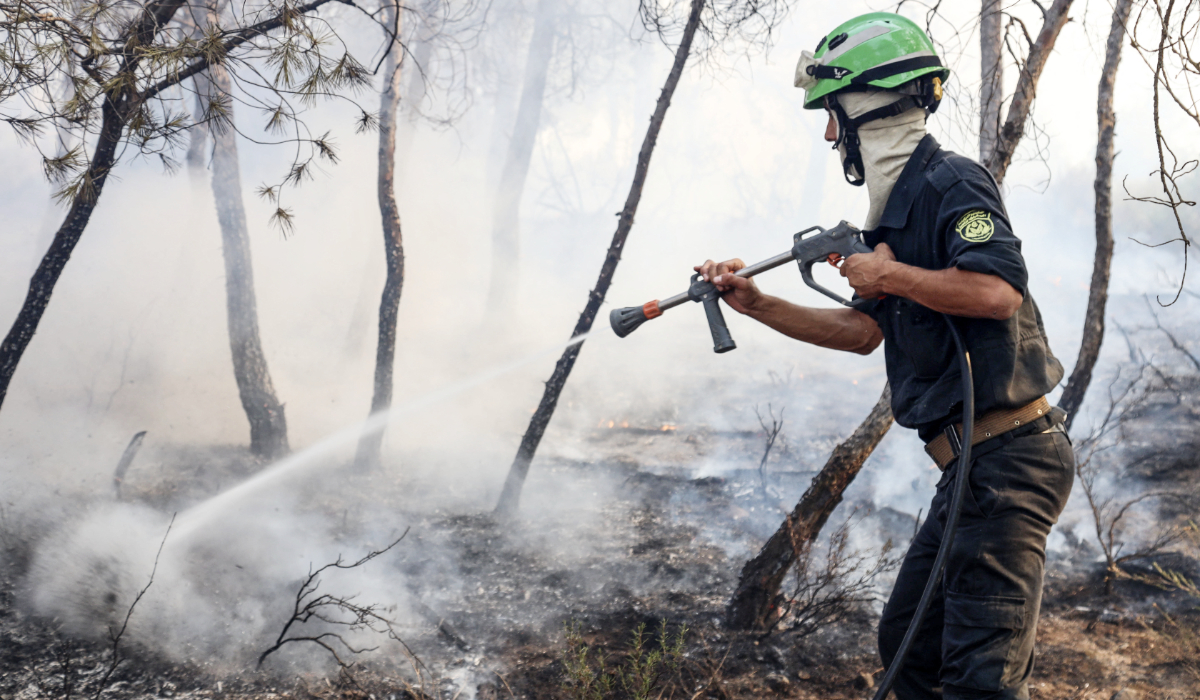
TUNIS: Amnesty International urged Algeria’s government on Tuesday to abandon plans to resume executions after it pledged to give the death penalty to those responsible for wildfires following deadly blazes last month.
Algeria struggled to put out fires that swept through its northeast and killed 12 people last month, according to an official tally, while witnesses spoke of dozens of deaths.
A member of a civil protection unit battles a wildfire in a mountainous area near the town of Al Hachimia, Bouira Province, on July 21, 2026. (AFP)
The North African country has not carried out executions since 1993 but has handed down the death sentence in some instances, including terror-related cases, without carrying it out.
Last month President Abdelmadjid Tebboune ordered the justice minister to amend the penal code to impose the death penalty for people who start wildfires after the deadly blazes.
“Algeria’s authorities must immediately abandon any plans to expand the scope of the death penalty or resume executions after more than three decades without carrying one out,” Amnesty said in a statement.
It also called for the country to impose an official moratorium “as a first step toward fully abolishing the death penalty.”
Tebboune also said that people sentenced to death should be executed right after exhausting their right to appeal.
The government began looking at draft penal code amendments this month.
Tebboune said “child abductors and abusers” would also be included in the expanded death penalty plans.
Forest fires occur regularly in northern Algeria during the summer, but climate change is amplifying their impact by causing increasingly frequent droughts and intense heat.
But Tebboune alleged that there was “something criminal” about the recent blazes.
Amnesty also said “credible sources have since reported significantly higher casualties” than the official tally in the latest wildfires, “including over 70 deaths in a single municipality.”
More than 30 people were killed in July 2023 when fires tore through thousands of hectares of forests and farmland in Algeria, as well as hundreds of homes.
In 2023, Algeria handed the death penalty to more than 50 people — some in absentia — over the lynching of a 38-year-old man who was falsely accused of starting deadly forest fires two years earlier.












![Newly displaced persons at Al-Munayyaj camp [Al Jazeera]](https://i0.wp.com/www.aljazeera.com/wp-content/uploads/2026/09/%D8%A7%D8%AB%D9%86%D8%A7%D8%A1-%D8%AA%D9%82%D9%8A%D9%8A%D8%AF-%D8%A8%D9%8A%D8%A7%D9%86%D8%A7%D8%AA-%D8%A7%D9%84%D9%86%D8%A7%D8%B2%D8%AD%D9%8A%D9%86-%D8%A7%D9%84%D8%AC%D8%AF%D8%AF-%D9%81%D9%8A-%D9%85%D8%AE%D9%8A%D9%85-%D8%A7%D9%84%D9%85%D9%86%D9%8A%D9%8F%D9%91%D8%AC-%D8%B5%D9%88%D8%B1%D8%A9-%D8%AE%D8%A7%D8%B5%D8%A9-%D9%85%D9%86-%D8%AA%D8%B5%D9%88%D9%8A%D8%B1%D9%8A-1789545157.jpg?w=640&ssl=1)
![Displaced man Hajj Saif Qaed Thabet, 73, has been living in the open air since he arrived with his family at al-Munij camp on Thursday, September 10 [Al Jazeera]](https://i0.wp.com/www.aljazeera.com/wp-content/uploads/2026/09/%D8%A7%D9%84%D8%AD%D8%A7%D8%AC-%D8%A7%D9%84%D9%86%D8%A7%D8%B2%D8%AD-%D8%B3%D9%8A%D9%81-%D9%82%D8%A7%D8%A6%D8%AF-%D8%AB%D8%A7%D8%A8%D8%AA-%D9%85%D8%A7-%D8%B2%D8%A7%D9%84-%D9%8A%D8%B3%D9%83%D9%86-%D8%A8%D8%A7%D9%84%D8%B9%D8%B1%D8%A7%D8%A1-%D9%85%D9%86%D8%B0-%D9%88%D8%B5%D9%88%D9%84%D9%87-%D9%85%D8%AE%D9%8A%D9%85-%D8%A7%D9%84%D9%85%D9%86%D9%8A%D9%8F%D9%91%D8%AC-%D8%A7%D9%84%D8%AE%D9%85%D9%8A%D8%B3-10-%D8%B3%D8%A8%D8%AA%D9%85%D8%A8%D8%B1-%D8%B5%D9%88%D8%B1%D8%A9-%D8%AE%D8%A7%D8%B5%D8%A9-%D9%85%D9%86-%D8%AA%D8%B5%D9%88%D9%8A%D8%B1%D9%8A-1789545163.jpg?w=640&ssl=1)