Discover the latest happenings and stay in the know with our up-to-date today news coverage. From breaking stories and current events to trending topics and insightful analysis, we bring you the most relevant and captivating news of the day.
TUNIS: Amnesty International urged Algeria’s government on Tuesday to abandon plans to resume executions after it pledged to give the death penalty to those responsible for wildfires following deadly blazes last month.
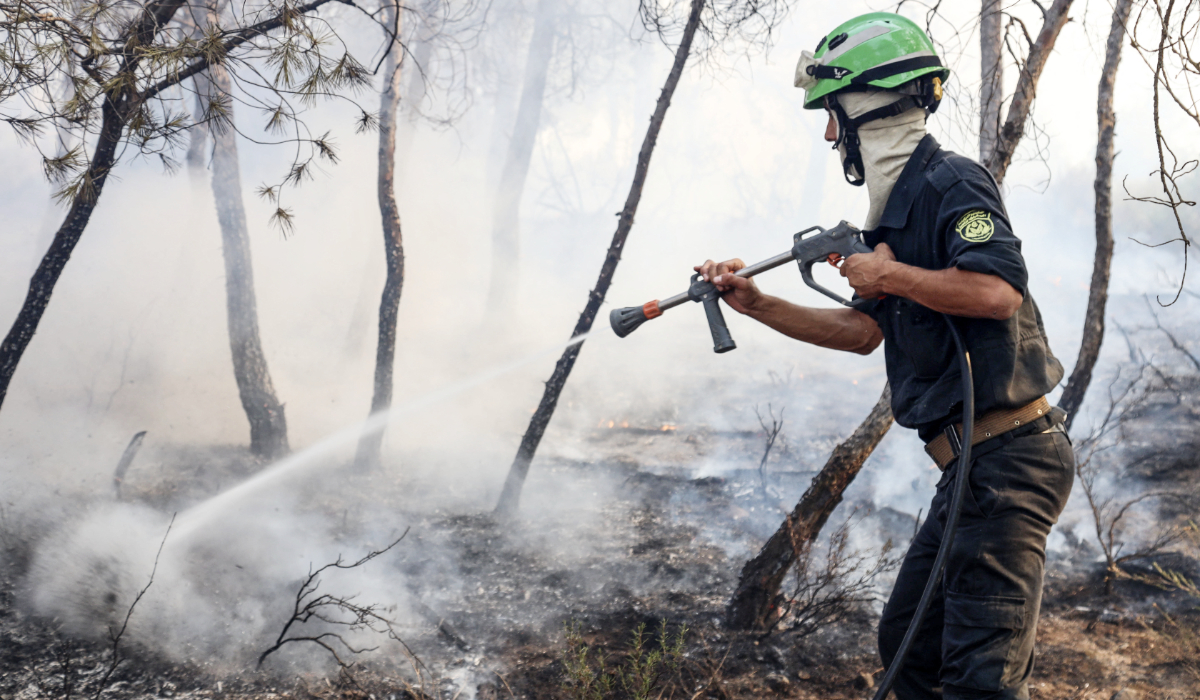
Algeria struggled to put out fires that swept through its northeast and killed 12 people last month, according to an official tally, while witnesses spoke of dozens of deaths.
A member of a civil protection unit battles a wildfire in a mountainous area near the town of Al Hachimia, Bouira Province, on July 21, 2026. (AFP)
The North African country has not carried out executions since 1993 but has handed down the death sentence in some instances, including terror-related cases, without carrying it out.
Last month President Abdelmadjid Tebboune ordered the justice minister to amend the penal code to impose the death penalty for people who start wildfires after the deadly blazes.
“Algeria’s authorities must immediately abandon any plans to expand the scope of the death penalty or resume executions after more than three decades without carrying one out,” Amnesty said in a statement.
It also called for the country to impose an official moratorium “as a first step toward fully abolishing the death penalty.”
Tebboune also said that people sentenced to death should be executed right after exhausting their right to appeal.
The government began looking at draft penal code amendments this month.
Tebboune said “child abductors and abusers” would also be included in the expanded death penalty plans.
Forest fires occur regularly in northern Algeria during the summer, but climate change is amplifying their impact by causing increasingly frequent droughts and intense heat.
But Tebboune alleged that there was “something criminal” about the recent blazes.
Amnesty also said “credible sources have since reported significantly higher casualties” than the official tally in the latest wildfires, “including over 70 deaths in a single municipality.”
More than 30 people were killed in July 2023 when fires tore through thousands of hectares of forests and farmland in Algeria, as well as hundreds of homes.
In 2023, Algeria handed the death penalty to more than 50 people — some in absentia — over the lynching of a 38-year-old man who was falsely accused of starting deadly forest fires two years earlier.
The US defence department’s inspector general says the war with Iran has led to “shortfalls” in munitions and a bottleneck in resupply, contradicting President Donald Trump who has repeatly denied the US is facing shortages.
Trump has claimed US munitions supplies are “virtually unlimited” and said reporting otherwise is “fake news”.
But the independent watchdog said the US spent more than $22 billion on munitions from February through June, leading to “strategic inventory shortfalls”.
The BBC has contacted the White House for comment about the discrepancy.
The new report provides a first-of-its-kind, independent glimpse into US weapons stockpiles, data that is typically classified.
Over the course of the war, US forces have expended vast quantities of both long-range ground attack systems and the air and missile defences used to intercept incoming Iranian attacks.
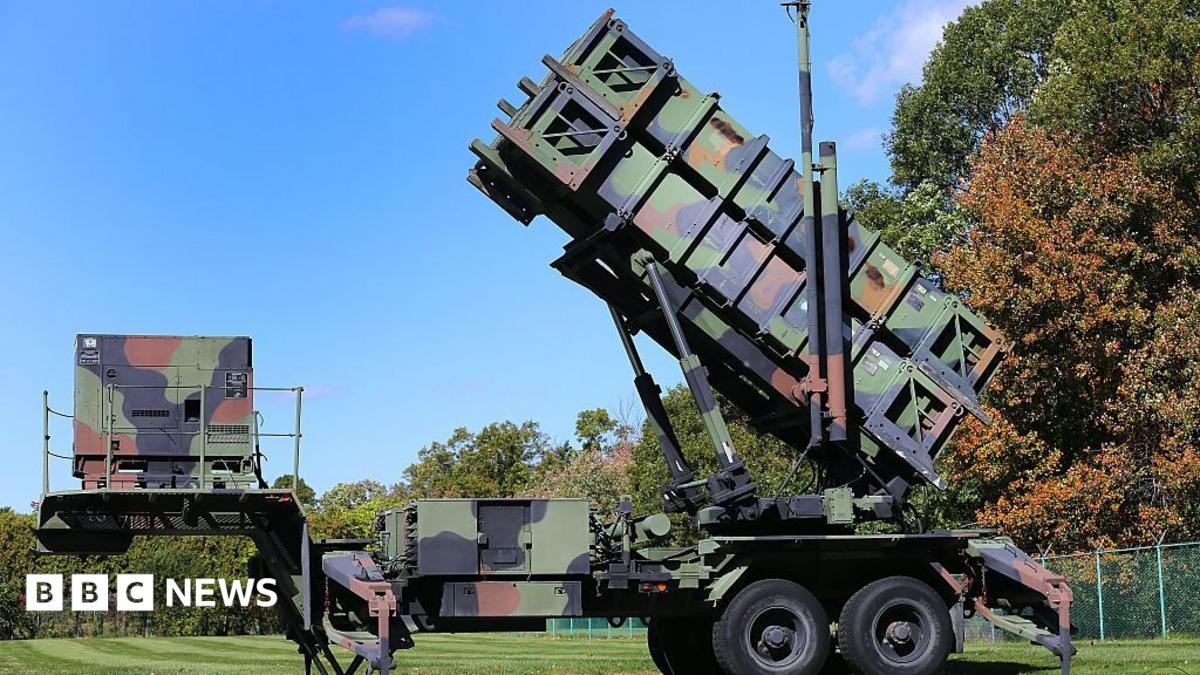
A late July estimate from the Center for Strategic and International Studies, or CSIS, found that stocks of some interceptors – such as the Patriot missile and Terminal High Altitude Area Defense, or THAAD – were significantly depleted, in some cases by more than half.
The inspector general’s report did not disclose exactly how many of the weapons remain.
It did, however, note the inventory shortfalls and reveal “industrial base bottlenecks” for munitions resupply.
The report added that the defence department is now working to “streamline procurement processes and production lead times” to address the shortages and “respond rapidly to a contingency”.
In a 4 August X post, for example, Defence Secretary Pete Hegseth described news reporting on the shortages as “not true”.
And in a lengthy Truth Social post on 3 September, Trump claimed that the US had “virtually unlimited” amounts of ammunition and is “stockpiling and preparing for any contingency that could happen”.
The watchdog’s report also notes that equipment losses have totaled $3.7bn, with other $7.4bn in other expenditures. Overall, the US spent $33.4bn (£24.7bn) on the war from 28 Feb to 30 Jun.
A separate estimate released on Tuesday by the Congressional Budget Office put the total cost of the war at higher at $38bn, which includes replaced expended munitions and equipment lost in battle, increased flying hours and greater fuel costs.
Among the losses have been four F-15e fighter jets, a highly advanced F-35 Joint Strike Fighter and 30 MQ-9 drones destroyed in “various circumstances”.
When US and Israeli strikes began, Trump repeatedly said that the conflict would be over within weeks.
More recently, he said the conflict might not end until “right after” the November midterm elections in the US.
Polls show that the war is unpopular among Americans.
One Reuters/Ipsos poll released in early September found that only 23% of Americans – and only half of Republicans – believe the US to be in a stronger position with Iran compared with before hostilities broke out.
Another Metropolitan Police officer has been dismissed following BBC Panorama’s undercover investigation into the force’s Charing Cross station.
PC Mason O’Connor was sacked after a hearing found he had breached standards of professional behaviour, relating to a comment he made to a female colleague, the Met said.
O’Connor was reported to a “proactive wider investigation” following the broadcast of the programme in October 2025 and he has become the 13th officer to be sacked since then, the force added.
Other officers who were covertly filmed for the documentary were seen calling for immigrants to be shot, boasting about excessive use of force and joking about rape and sexual assault.
O’Connor’s dismissal relates to a comment he is alleged to have made to a female colleague while off-duty in a pub in October 2024.
A hearing held on Tuesday found he had breached standards of professional behaviour for authority, respect and courtesy, equality and diversity, and discreditable conduct.
At a highly sensitive juncture, and amid increasing talk regarding the possibility of a third round of regional escalation, Iraqis are confronted with a fateful question: Is there someone seeking to make Iraq a part of this conflict – not merely a venue from which messages are dispatched or through which pressure is managed, but rather one of its open arenas?
There can be no avoiding the question, as the answer is linked to Iraqi blood, state sovereignty, the future of the economy, and Iraq’s standing among its brethren, neighbors, and the world. The matter is no longer a limited security issue; rather, it is a question of statehood, destiny, and direction, as well as a question of Iraq’s ability to protect itself from being dragged into what it does not want.
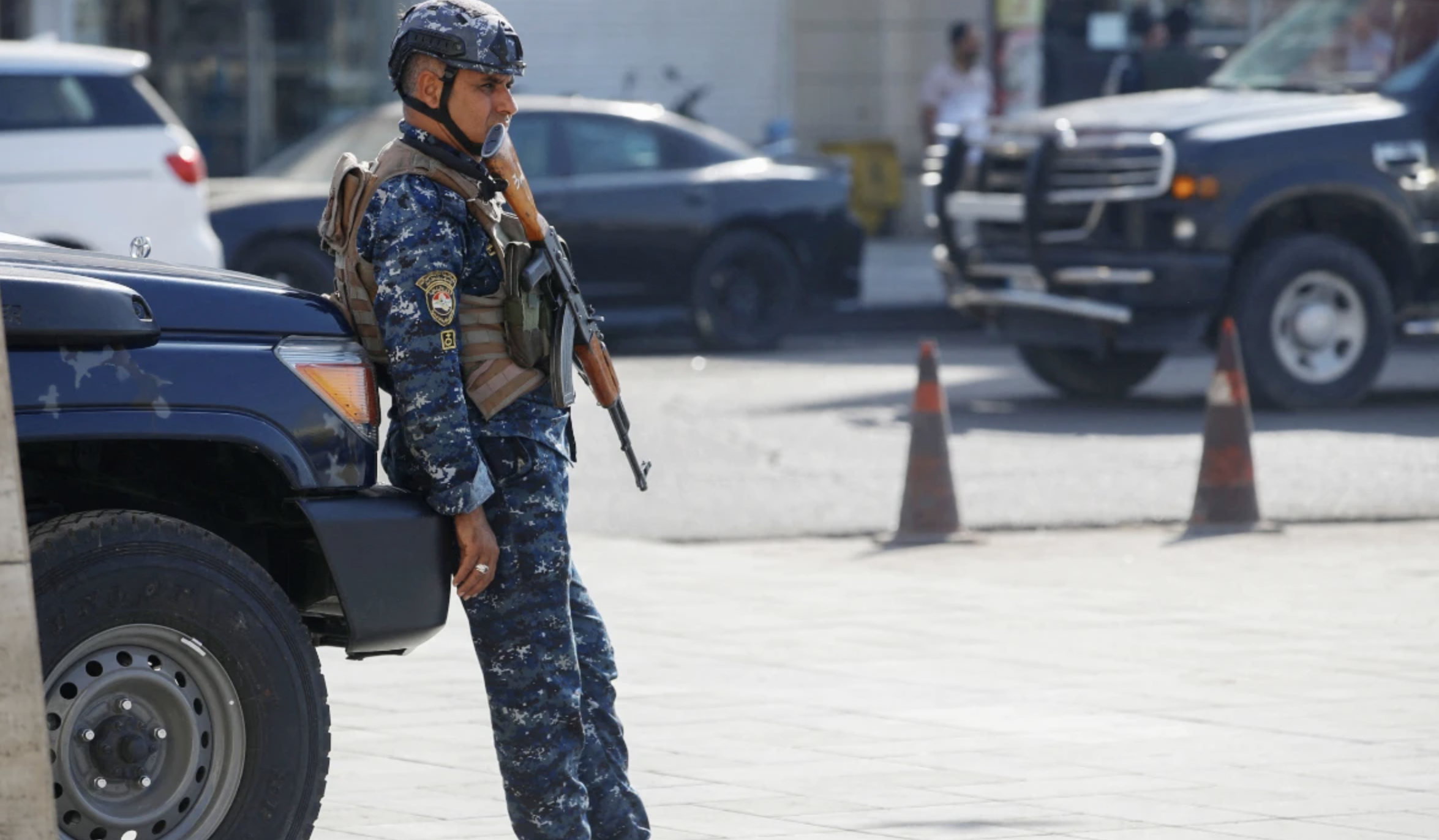
Repeated attempts to use Iraqi territory to target fraternal and neighboring Arab countries – the latest of which was the announced targeting of Saudi Arabia, preceded by the United Arab Emirates, Kuwait, Bahrain, and Jordan – reveal that we are facing a systematic trajectory rather than an isolated incident. If not decisively resolved, this trajectory could transform into a de facto policy.
Should the state succumb to the blackmail of forces acting outside its authority, it loses not only its security decision-making power but the very meaning of statehood itself. Iraq must not remain a conduit for messages, a proxy mailbox for others, a negotiating card in their conflicts, or an arena pushed forward during every regional escalation.
The problem is no longer about issuing a statement after each incident or settling for a reassuring narrative that does not prevent the recurrence of danger. The deeper problem is the existence of a repeating pattern that consumes Iraq’s political and moral capital, leaving the government to face the consequences of actions that do not reflect its own decisions. The longer a decisive resolution is delayed, the more a dangerous perception takes root abroad that the Iraqi state alone does not control its security decisions. This is an unfair image of Iraq and harmful to its interests, but it cannot be corrected by words alone.
Sovereignty is not safeguarded through slogans; rather, it is maintained by the state’s capacity to serve as the sole authority for force and decision-making. Consequently, restricting weapons to state control is neither a stance against any faction nor a detraction from anyone’s sacrifices. Instead, it is a prerequisite for the survival of the state and the protection of everyone. A state that does not hold exclusive authority over the decisions of war and peace can neither demand that others respect its borders, reassure its citizens, nor build stable relations with its neighborhood. It is in the interest of all forces, above all others, for the state to be strong, because a weak state protects no one; instead, it leaves everyone exposed.
Today, under highly sensitive circumstances, the Iraqi government is working to reconnect Iraq with its Arab, regional, and international surroundings, and to sincerely leverage available support and openness to serve the interests of Iraqis. These efforts deserve support – not because they are the efforts of a specific government, but because they represent the trajectory of a state. However, there are those, both internally and externally, who do not want Iraq to move past the logic of conflict and axes, and who seek to undermine any attempt to solidify its position as a balanced, secure partner state that is capable of speaking for itself, rather than for others.
The truth is that the Arabs, despite all the complexities that have affected the relationship, have not turned their backs on Iraq; rather, they have continued to view it as a pivotal country indispensable to regional stability. Throughout the difficult years, there remained an Arab readiness to embrace Iraq and restore it to its natural position, out of belief in its role, presence, and civilized and political depth. The problem has never been an Arab desire to break ties with Iraq; rather, it lay in Iraq’s ability to present itself as a state with a single decision-making authority – not a country where decisions are contested between the government and factions, the constitution and weapons, and national interest and wills that do not emanate from Iraqi state institutions. It is unfortunate that opportunities for openness and trust are squandered due to practices that reflect neither the will of Iraqis nor the interest of their state.
The risk of slipping today is greater than some believe. Every uncalculated action could drag Iraq into a confrontation it does not want, and every use of its territory outside state decisions could push it an additional step toward isolation. Isolation is neither heroism, an interest, nor a viable option in a world where countries thrive on economy, partnerships, investment, and trust. Every armed message launched outside the state is met with a message of concern from the investor, the partner, and the fraternal state, and every new disruption reflects on the market, labor, energy, banks, and Iraq’s image in the world. Iraq needs projects, energy, job opportunities, education, infrastructure, and openness – not more anxiety, armed messages, and alignments that deplete it.
We must be candid with our people: statements are no longer enough. Neither the domestic public is convinced by statements, nor is the outside world reassured by them. What preserves Iraq’s standing is action: a professional investigation, fair accountability, real control, and a clear decision that no entity, regardless of its title, can place the country in war, isolation, or economic loss. Backing the government along this path is a national duty, because it is a support for the state, its right to protect sovereignty, preserve relations, and build the future.
Iraq is subordinate to no one, an enemy to no one, and an arena for no one. It is a great homeland, and the decision of war and peace within it belongs to the Iraqis and their state alone. This is the hour of the state, the hour of reason, and the hour to say clearly: Iraq first.
It’s been more than six years since teenager Noah Donohoe was found dead 600m into a freezing underground water tunnel in Belfast.
His death – and the speculation over what happened to him in the week between his daylight disappearance and the discovery of his body – became a huge news story that provoked countless unanswered questions.
Now, after an inquest and months of exhaustive hearings and long deliberations by a jury, there is a verdict – but much is still unknown about what happened to Noah.
Why, the night before he disappeared, did he leave his home in the middle of the rain-soaked night? Where did he go? Why did he come back 34 minutes later, as documented by CCTV, barefoot?
Hours later, on Sunday 21 June 2020, he left the south Belfast home he shared with his mother for the final time.
Why did he leave and go to an unfamiliar part of north Belfast? Why was the teenager naked when he was last seen in the area of the water tunnel entrance?
And what might have been if he had seen the social media message sent him by one of two friends he planned to meet in north Belfast telling him their plans were cancelled?
An autopsy found Noah had died from drowning, with the tunnel he was found in heading towards Belfast Lough and its tides.
Now, after years of delays, a jury has found that it was possible, but not probable, that failings by the Department of Infrastructure over the tunnel in which he was found contribute to his death.
They also found 13 failings by the Police Service of Northern Ireland (PSNI) but that these did not in any way contribute to the 14-year-old’s death.
Having spent months in court following all the evidence, it was clearly not an easy process for the men and women of the jury.
They heard from dozens of witnesses and received voluminous amounts of official and expert documentation.
This week they deliberated on Monday and Tuesday. But it came more than two months after the inquest was dramatically adjourned in the early hours after three days of deliberations did not lead to a verdict.
“No more imported rice” sign at a recent protest. (Archive)
Caracas, September 14, 2026 (venezuelanalysis.com) – The US Department of Agriculture’s (USDA) Foreign Agricultural Service announced a package of measures to boost US agricultural exports to Venezuela amid growing concerns about the South American country’s national production.
According to the USDA, the plan will facilitate Venezuelan corporations’ purchase of US food products and agricultural commodities through government-backed credit and will include the delivery of food assistance and training for Venezuelan technicians.
“The Trump administration is committed to Venezuela’s economic prosperity, and USDA is leveraging its export financing, market development programs, technical scholarships, and food assistance initiatives to address this situation,” said Under Secretary for Trade and Foreign Agricultural Affairs Luke J. Lindberg.
Lindberg added that he “looks forward to positioning US agriculture to help meet needs and build lasting trade relationships.” The US official visited Venezuela as part of an official delegation in early July.
Washington’s credit program for food exports will be provided through the reactivation of the GSM-102 guarantee program. The mechanism offers guarantees to exporters that reduce the risk for financial institutions backing the transactions in case importers fail to meet their commitments.
The Agriculture Department also announced that it will lift restrictions to allow foreign banks to back Venezuela-related transactions.
A USDA report had already estimated that Venezuela would need to import 1.5 million metric tons of wheat during the 2026-2027 marketing year. Corn and soybeans are likewise identified as key staples to be exported to the Caribbean nation. The latest initiative
The Trump administration also lifted restrictions under its Feed the Future Agricultural Resilience Mission Initiative and plans to include Venezuela in a regional agribusiness trade mission scheduled for early 2027.
A bigger influx of US farm products will place an additional strain on Venezuelan food production, with local campesinos increasingly protesting against imports from agribusiness corporations that seek to drive crop prices down.
On September 9, rice growers from Guárico and nearby states organized a “tractorazo,” blocking a major highway in Calabozo with trucks and tractors to demand that the government halt the entry of imported rice during the domestic harvest season and ensure that agroindustrial companies adhere to established prices.
Protesters complained that imports from countries where food production is subsidized, including the US, create unfair competition and risk driving Venezuelan campesinos bankrupt. The latest mobilization was sparked by the reported arrival of a shipment of 355 thousand tons of rice, more than half of the Venezuelan production in 2025.
Rural organizations have likewise denounced the exoneration of tariffs and import taxes as another factor putting national production at a disadvantage. Venezuelan authorities, including the National Assembly and the Agriculture Ministry, have vowed to review the import issue but have offered no measures to date.
In the Calabozo protest, producers denounced that imported rice had saturated silos and storage facilities during the 2025-2026 winter-summer crop cycle, forcing them to sell below production cost or lose their crops altogether. Demonstrators demanded a $0.25-per-kilogram subsidy from the state to compensate for the losses incurred and vowed to take the protests to Caracas if they receive no response from authorities.
The September 9 “tractorazo” was the latest in a series of mobilizations in recent months in Venezuela’s main agricultural states. Rice growers have complained about high fuel and input costs and urged the government to establish and enforce fair crop prices.
According to agriculture lobby FEDEAGRO, more than 2.2 million metric tons of white corn, yellow corn, and rice have entered the country so far in 2026, more than triple the recent combined high of 709,000 metric tons in 2023.
“We cannot continue depending on a neighbor’s pantry. That is a failure. In Venezuela, we have the land, a committed agricultural sector, and people investing in farming, but excessive imports place us at a dramatic disadvantage,” stressed FEDEAGRO President Osman Quero.
Quero stressed that foreign producers have access to credit programs, fuel and fertilizer subsidies, and better infrastructure, while Venezuelan farmers face inflation and a lack of financing programs.
The United States Supreme Court has rejected Donald Trump’s bid to restrict voting by mail ahead of the November midterm elections, in a setback to the US president’s efforts to change rules governing elections.
The ruling on Monday by the conservative supermajority court allows states to continue sending out mail ballots as they have done for years, dealing a blow to Trump’s plans to stop the ballots before the elections and halting possible last-minute legal actions as voting begins in some states.
Recommended Stories
list of 4 itemsend of list
Trump has repeatedly cast doubt on the security of mail-in voting, citing debunked claims of widespread election fraud associated with it. That is despite the president voting by mail himself, including during the 2024 election.
Mail ballots, in place for decades, have been found to increase voter turnout and currently account for a third of all votes cast in the US.
Here’s what we know about the legal challenge to overturn them:
President Trump speaks at the Republican National Midterm Convention in Dallas, Texas, US, September 9, 2026 [Evan Vucci/Reuters]
What are mail-in votes?
Voting by post works by sending ballots to the homes of registered voters, who then mail them back before a deadline.
Eight states, several of them Democratic-leaning – California, Colorado, Hawaii, Nevada, Oregon, Utah, Vermont and Washington – as well as the District of Columbia, allow all elections to be conducted entirely by mail.
Others only allow smaller elections to be conducted by mail.
Although there are cases of forgery or repeat voting, they are rare and amount to just four in 10 million mailed votes, according to the Brookings Institution.
What has Trump said about the mail-in votes?
Trump falsely blamed his 2020 presidential election loss on mail-in voting fraud. He and his supporters also opposed changes made during the COVID pandemic to expand mail-in voting.
During the 2020 Republican National Convention, Trump called mail-in voting changes “the greatest scam in the history of politics”.
His attempt to push the SAVE America Act, which calls for sweeping voting laws, has stalled in the US Senate. The bill, passed in the House of Representatives in February, faces opposition over concerns that millions of voters will be disenfranchised.
How did Trump target mail-in votes?
In March 2026, Trump signed an executive order directing the US Postal Service to take control of mail voting by designing new envelopes with special barcodes that would allow the federal government to ensure ballots are only from eligible voters.
For the midterms, that move would force all states to adopt a uniform envelope style in a short time.
The order also required states to provide the US Postal Service with a list of eligible voters ahead of elections. Several government departments, including Homeland Security and US Citizenship and Immigration Services, would also have the voters’ lists.
The postal agency was additionally empowered to deny mailed ballots if they did not comply with new standards or were not associated with registered voters on the states’ lists.
What happened to the order?
Democrats and activists challenged the order in several courts, resulting in a series of back-and-forth rulings between May and August.
US District Judge Indira Talwani imposed an injunction against the rule in June on the basis that it likely violated the US Constitution. Talwani also noted in her injunction that Trump’s executive order would be impossible to apply when the midterms were already so close.
But her ruling was overturned by the conservative-majority Supreme Court in late August in a temporary judgement.
The Supreme Court had not decided at the time whether Trump’s move was constitutionally legal. Rather, it only sided with the Trump administration on procedural grounds after the administration argued that Democrats sued too soon.
What does the latest judgement mean?
In the latest and final decision, the Supreme Court refused to lift Judge Talwani’s injunction.
In a brief written order that did not go into detail, the court noted that the administration was likely to fail in its push to restrict mail-in votes ahead of the midterms.
Justice Brett Kavanaugh, who was appointed by Trump, voted with the majority against the administration, though he indicated he could support the policy at a later stage. Two judges, Samuel Alito and Clarence Thomas, dissented.
Critics have long warned that restricting mail-in ballots could disenfranchise some voters who typically rely on this method.
It could also disrupt the delivery of mailed votes, as some states, including Alabama, North Carolina and Wisconsin, have begun sending in midterm ballots.
Artificial intelligence is increasingly being treated not simply as a technology sector but as a strategic capability tied to economic power, national security and geopolitical competition. Recent warnings from leading AI researchers and executives that increasingly autonomous systems could pose extreme risks have intensified debate over whether development should be slowed.
Yet the same warnings could make a slowdown less likely. If advanced AI can provide major military, economic and technological advantages, governments may view continued development as a strategic necessity. The result could be a paradox in which growing concerns about the dangers of AI encourage countries to accelerate the race to control it.
The United States and China are at the center of this competition. Both governments have strong incentives to maintain their technological advantage, while companies are investing enormous sums in data centers, chips and computing infrastructure.
The scale of investment shows why reversing course would be difficult. Goldman Sachs estimates that cumulative global AI spending through the end of the decade could reach as much as 5% of global GDP. At the same time, financial markets are increasingly sensitive to whether the extraordinary investment in AI infrastructure will ultimately generate sufficient economic returns.
Stay ahead of the geopolitical week.
MD Briefing delivers expert analysis across five global fronts — the Indo-Pacific, energy, geoeconomics, European security, and the Middle East — every Monday morning. Free.
Why it matters
The central question is no longer simply whether AI development should be regulated. It is whether governments can realistically agree to meaningful limits while competing for technological dominance.
A country that slows development unilaterally risks allowing competitors to move ahead. That creates a classic security dilemma: measures intended to reduce risk can themselves create strategic vulnerability.
The problem is particularly significant because AI has applications far beyond commercial technology. Advanced systems could affect cybersecurity, intelligence, military planning, financial markets, biotechnology and critical infrastructure.
That makes AI different from many previous technology debates. Governments may be willing to regulate individual applications, but they are less likely to accept restrictions that could permanently reduce their strategic advantage.
The investment dilemma
The AI boom has already become deeply connected to wider economic growth.
Companies are spending heavily on computing capacity and data centers, while investors have placed enormous valuations on firms expected to benefit from AI adoption. A significant slowdown could therefore have consequences far beyond technology companies.
Morgan Stanley has estimated that almost $200 billion in U.S. data center projects were cancelled or delayed amid political resistance to new infrastructure. The bank has also argued that capital expenditure linked to AI could account for roughly one third of U.S. GDP growth over the current period.
This creates another obstacle to restraint. AI investment is no longer only a corporate decision. It has become connected to employment, infrastructure, financial markets and national economic growth.
The longer the investment cycle continues, the more difficult it becomes for governments and companies to voluntarily step away from it.
Washington and Beijing
The geopolitical dimension makes a coordinated slowdown even harder.
U.S. policymakers increasingly view technological leadership in AI as an element of national power. China, meanwhile, sees AI development as part of its broader effort to reduce dependence on Western technology and strengthen its own economic and strategic capabilities.
That means Washington and Beijing have incentives to monitor each other’s progress rather than simply establish limits.
The political rhetoric surrounding AI increasingly reflects this competition. Trump has portrayed opposition to AI infrastructure as benefiting China, while Chinese state media has described warnings about AI as part of a broader geopolitical strategy against Beijing.
The result is a familiar strategic dilemma: if either side believes the other may continue developing advanced AI, neither has much incentive to slow down first.
Can international rules work?
Meaningful AI restrictions would ultimately require international cooperation.
Individual countries can establish domestic safety standards, require companies to conduct risk assessments or impose restrictions on specific applications. But those measures cannot fully address the geopolitical problem if competitors outside those jurisdictions remain free to develop more powerful systems.
The nuclear comparison illustrates the difficulty. The first nuclear weapon was developed in 1945, but the Nuclear Non-Proliferation Treaty did not emerge until 1968. Even after the treaty, nuclear proliferation continued beyond the five states formally recognized as nuclear-weapon states.
AI could present an even more complicated challenge because it is not confined to a small number of military facilities. Its development involves thousands of companies, researchers, data centers and computing systems spread across multiple countries.
Economic security could become the new arms race
The most important shift may be that AI competition does not need to resemble a conventional military arms race to produce similar strategic pressures.
Advanced AI could generate advantages in productivity, financial markets, scientific research, cybersecurity and military technology. Falling behind could therefore be perceived as an economic and national security threat even without the development of an explicit weapon.
This could produce what might be described as mutually assured economic dependence. Countries may recognize the dangers of uncontrolled AI while simultaneously believing that abandoning the technology would be even more dangerous.
That dynamic makes voluntary restraint increasingly difficult.
Implications and analysis
The growing warnings about AI may therefore have an unintended geopolitical consequence: they could accelerate the race they are intended to constrain.
If governments become convinced that highly capable AI could fundamentally alter national power, they are unlikely to leave its development to private companies or accept restrictions that allow competitors to gain an advantage. Instead, the technology could become more closely integrated with national security policy.
That could eventually mean greater government involvement in AI companies, computing infrastructure, semiconductor supply chains and access to advanced models.
The biggest danger is therefore not simply that AI becomes too powerful to control technologically. It may become too strategically important for governments to willingly slow down.
For meaningful safeguards to emerge, major powers would need to treat AI safety as a shared security interest rather than another arena of geopolitical competition. Without that shift, every warning about the potential consequences of advanced AI could strengthen the argument for moving faster.
The paradox is clear: the more dangerous AI becomes, the more governments may feel they need to control it. And the more they compete to control it, the harder it becomes to slow the race.
Jean Smart earns fifth Emmy for “Hacks,” becoming the first to win lead comedy actress for every show season.
Published On 15 Sep 202615 Sep 2026
Emergency room drama “The Pitt” and comedy-horror “Widow’s Bay” have won television’s highest honours, the 78th Primetime Emmy Awards, presented in Los Angeles.
Set in a cursed New England town, “Widow’s Bay” won the best comedy series prize on Monday, overcoming last season’s winner, “Hacks”.
Recommended Stories
list of 3 itemsend of list
Matthew Rhys, starring in “Widow’s Bay”, made history by becoming the first person to win two lead acting honours at the same ceremony. Fellow actor in the TV series, Stephen Root, won best supporting actor in a comedy, beating favourite Harrison Ford of “Shrinking”.
“Thank you, sir, for all your many years of great, great, great acting,” Root told Ford during his acceptance speech.
“Hacks” actress Jean Smart won her fifth Emmy for portraying stand-up comic Deborah Vance, making her the first actress to win the award for best lead comedy actress for every season of a show’s run. Smart has won eight Emmys overall in her acting career.
“What a ride this has been,” Smart said after receiving a standing ovation.
Jean Smart accepts the award for outstanding lead actress in a comedy series for “Hacks” during the 78th Emmy Awards at the Peacock Theater in Los Angeles on September 14, 2026 [Chris Pizzello/AP]
Actress Julia Louis-Dreyfus is the only performer to come close to Smart’s comedy lead actress sweep, having won the award for six of the seven seasons of the political satire “Veep”.
Noah Wyle, who starred as Dr “Robby” Robinavitch on “The Pitt”, told the Emmy audience it felt overwhelming to win his second straight Emmy for best lead drama actor.
“The Pitt”, set in a Pittsburgh emergency department, won its second consecutive Emmy award for best drama series, beating fellow nominees including “Pluribus”, “Paradise” and “The Diplomat”.
“This is the only club I’ve ever wanted to join. Thank you for accepting me,” Wyle said while accepting the award.
US actor Noah Wyle, winner of Outstanding Lead Actor in a Drama Series and Outstanding Drama Series for “The Pitt”, poses in the press room during the 78th Primetime Emmy Awards at the Peacock Theater at LA Live in Los Angeles on September 14, 2026 [Frederic J. Brown/AFP]
Rhea Seehorn won best actress in a drama for playing the lone character on “Pluribus”, after being nominated twice without receiving any honours for her breakthrough role on “Better Call Saul”.
Vince Gilligan, who created “Breaking Bad” and its spin-off “Better Call Saul”, won best drama writing for “Pluribus”.
“The Late Show with Stephen Colbert” won for best variety series, concluding its farewell season with six total Emmys after CBS cancelled the programme, citing financial pressures.
Colbert rejected that explanation, accusing network executives of succumbing to pressure from President Donald Trump over his frequent mockery of the administration.
The territory of modern Guatemala was once the heart of the Maya civilization, which extended across Mesoamerica.
Most of the country was conquered by the Spanish Conquistador Pedro de Alvarado in the first half of the 16th century, becoming part of the viceroyalty of New Spain.
Guatemala was the original source for potatoes, corn, chili peppers, and avocados.
In the first decade of the nineteenth century, Spain had been weakened by its involvement in the Peninsular War in Europe and local juntas had been created as local Spanish had revolted against the rule of King Joseph, Napoleon’s brother who was installed as ruler of Spain by the French in 1808.
This taste for independent rule persisted after King Ferdinand came to the Spanish throne and on September 15th 1821, the Act of Independence of Central America was declared by the Province of Guatemala.
Following independence and despite opposition from El Salvador, the regions became part of the Mexican Empire, until they ceded to become the Federal Republic of Central America in 1823.
The Emmy Awards take place in Los Angeles on Monday, with The Pitt, Hacks and Beef among the shows competing for trophies.
Many of this year’s prizes have already been handed out at the earlier Creative Arts Emmys, leaving only the most high-profile categories for the big night.
Here are the nominations for the main ceremony in full. This list will be updatied live throughout the night.
Drama series
Comedy series
Limited or anthology series
Lead actor in a drama series
Sterling K Brown – Paradise
Gary Oldman – Slow Horses
Mark Ruffalo – Task
Rufus Sewell – The Diplomat
Noah Wyle – The Pitt
Lead actress in a drama series
Carrie Coon – The Gilded Age
Chase Infiniti – The Testaments
Keri Russell – The Diplomat
WINNER: Rhea Seehorn – Pluribus
Zendaya – Euphoria
Lead actor in a comedy series
Yahya Abdul-Mateen II – Wonder Man
Steve Carell – Rooster
Matthew Rhys – Widow’s Bay
Jason Segel – Shrinking
Martin Short – Only Murders In The Building
Lead actress in a comedy series
Quinta Brunson – Abbott Elementary
Ayo Edebiri – The Bear
Elle Fanning – Margo’s Got Money Troubles
Lisa Kudrow – The Comeback
WINNER: Jean Smart – Hacks
Lead actor in a limited or anthology series or movie
Riz Ahmed – Bait
Jason Bateman – Black Rabbit
Charlie Hunnam – Monster: The Ed Gein Story
Oscar Isaac – Beef
WINNER: Matthew Rhys – The Beast In Me
Lead actress in a limited or anthology series or movie
Claire Danes – The Beast In Me
Sally Field – Remarkably Bright Creatures
Carey Mulligan – Beef
Sarah Pidgeon – Love Story: John F Kennedy Jr & Carolyn Bessette
Sarah Snook – All Her Fault
Supporting actor in a drama series
Patrick Ball – The Pitt
Billy Crudup – The Morning Show
Shawn Hatosy – The Pitt
Gerran Howell – The Pitt
Jack Lowden – Slow Horses
Tom Pelphrey – Task
Carlos-Manuel Vesga – Pluribus
Supporting actress in a drama series
Taylor Dearden – The Pitt
Fiona Dourif – The Pitt
WINNER: Allison Janney – The Diplomat
Katherine LaNasa – The Pitt
Sepideh Moafi – The Pitt
Julianne Nicholson – Paradise
Karolina Wydra – Pluribus
Supporting actor in a comedy series
Colman Domingo – The Four Seasons
Paul W Downs – Hacks
Harrison Ford – Shrinking
Nick Offerman – Margo’s Got Money Troubles
Stephen Root – Widow’s Bay
Michael Urie – Shrinking
Tyler James Williams – Abbott Elementary
Supporting actress in a comedy series
Dale Dickey – Widow’s Bay
Hannah Einbinder – Hacks
Janelle James – Abbott Elementary
WINNER: Kate O’Flynn – Widow’s Bay
Michelle Pfeiffer – Margo’s Got Money Troubles
Megan Stalter – Hacks
Jessica Williams – Shrinking
Reality competition programme
Dancing With the Stars
RuPaul’s Drag Race
Survivor
Top Chef
The Traitors
Variety series
Outstanding writing for a drama series
Debora Cahn – The Diplomat
Kirsten Pierre-Geyfman, R. Scott Gemmill – The Pitt
Valerie Chu – The Pitt
Vince Gilligan – Pluribus
Will Smith – Slow Horses
Brad Ingelsby – Task
Outstanding writing for a comedy series
Quinta Brunson – Abbott Elementary
Tim Robinson – The Chair Company
Michael Patrick King – The Comeback
Lucia Aniello – Hacks
Anthony King – Jury Duty Presents: Company Retreat
Nato fighter pilots have shot down a drone that entered Lithuania’s airspace overnight, the Lithuaninan president said.
Authorities said the drone likely entered southern Lithuania, near the second-largest city of Kaunas, from Belarus shortly after midnight on Tuesday.
Lithuanian President Gitanas Nausėda wrote in a statement on X: “A drone that just entered Lithuanian airspace was destroyed by NATO fighter jets.”
The origins of the drone are yet to be determined, a spokesperson for the Lithuanian national crisis management centre said.
Drone alerts sounded across the capital Vilnius and surrounding region earlier on Tuesday.
Nausėda’s post on social media added: “With Russia intensifying its aggression against Ukraine, such readiness is vital for our region. Together with our NATO Allies, Lithuania will defend its airspace.”
Lithuania shares a large part of its southern and eastern border with Belarus, a key Russian ally.
Military drone incursions have become increasingly common across Europe since the beginning of Russia’s full-scale of invasion of Ukraine.
Indigenous groups, environmentalists, and locals in several states have opposed the border wall construction.
Published On 14 Sep 202614 Sep 2026
A group of landowners, ranchers, businesses and a non-profit organisation have sued the administration of United States President Donald Trump to stop construction of a wall along the country’s border with Mexico in the remote Big Bend region of the southern state of Texas.
Trump officials “were woefully unprepared for the hornet’s nest they stirred up because they had no idea how much we love this place”, David Keller, an archaeologist and historian who specialises in the Big Bend and lives in the region, said in a news conference announcing the lawsuit on Monday.
Recommended Stories
list of 3 itemsend of list
“For us, the Big Bend is not an empty place on the map,” he said. “It is our home.”
The lawsuit was filed by Conserve Big Bend and six landowners, with the support of dozens more people along the border.
It comes as the Trump administration is ramping up a $46bn effort to line the roughly 3,219km (2,000-mile) border with a collection of 9-metre (30-foot) steel bollard walls, vehicle barriers and technology intended to keep out smugglers and migrants.
In Arizona, federal officials are pushing ahead with construction of the border infrastructure, even though it cuts through land belonging to the Tohono O’odham Nation, an Indigenous tribe that has said it does not want the barrier and that it is unnecessary.
In Texas, the effort has run up against numerous lawsuits and bipartisan opposition from sheriffs, elected officials, tour guides, environmental groups and landowners.
As part of its wall-building efforts, the administration has waived numerous regulations and statutes designed to protect the environment, archaeology or wildlife, on the basis that there is an urgent need to protect the border in what the US Department of Homeland Security has called areas of “high illegal entry”.
But in the lawsuit announced on Monday, the plaintiffs argue that when it comes to the Big Bend region, that is not an accurate description. They cite historical statistics from US Customs and Border Protection showing how few people cross the border in Big Bend compared with other areas along the US-Mexico border.
Big Bend has about 805km (500 miles) of border, roughly one quarter of the total length of the border with Mexico from the Pacific Ocean to the Gulf of Mexico. But the region accounted for only about 1 percent of arrests, according to the lawsuit.
“Since becoming the chief, I’ve had the privilege of spending time with airmen throughout CENTCOM [U.S. Central Command],” said Wilsbach, who assumed the position in November. “I have walked flight lines, visited maintenance hangars, and stood inside operations centers where young Americans were managing missions overhead. Let me tell you about a few courageous airmen I met on my recent trip to the Middle East. They told me about their experience on the flight line during an attack.”
Burning Hangar
“As missiles were inbound, airmen sprinted toward bunkers,” the service chief said, without providing details about which base. “Moments later, a missile struck nearby in a hangar, and the aircraft inside burst into flames. The bunker withstood the blast, but the force of the impact damaged the door so badly it wouldn’t open, trapping the airmen inside.”
“Picture the scene,” Wilsbach explained. “Fire was spreading, an aircraft was burning only feet away, their teammates were trapped inside, and they had no way out. Despite the danger, airmen ran toward the flames.”
“A security forces NCO grabbed a pry bar and forced the door open,” he continued. “Calmly communicated with the airmen trapped inside. Seconds later, the ejection seat on the burning aircraft ignited, sending glass and metal fragments through the air. Finally, the door gave way, and the airmen escaped and ran for cover.”
“Wherever I went, I saw airmen with that steely-eyed look of warriors, determined to get the mission done and protect their fellow airmen,” the chief noted. “More than 30,000 airmen deployed in support of Epic Fury to a dozen locations. They served alongside soldiers, sailors, Marines, Guardians, and Coalition partners.”
Launching F-15Es Under Fire
“Operation Epic Fury will be studied for its scale, precision, and speed,” said Wilsbach. “Over 38 days of combat operations, the Joint Force struck more than 13,000 military objectives. Five hundred aircraft executed 10,000 sorties, an average of more than 250 sorties every day. Our airmen accomplished this through 1,200 alarm reds while executing 48 airfield repairs and completing more than 420 reportable explosive ordnance disposal, long lonely walks.”
“That walk is exactly what the name suggests,” Wilsbach proffered. “EOD technician leaving a place of relative safety and approaching a suspected bomb or unexploded munition to render it safe for everyone else.”
“Behind those numbers were thousands of decisions made by airmen who had to keep the mission moving while the enemy was actively trying to stop them,” Wilsbach stated. “One was Garrett, a staff sergeant F-15E crew chief from East Texas. He joined the Air Force to travel and see the world. We sure allowed him to achieve that goal, but I’m not sure the Middle East was exactly what he had in mind. On the second day of Epic Fury, Garrett was on the flight line launching four Strike Eagles when alarm red sounded. Airmen around him started running for shelter. Garrett’s adrenaline spiked. He knew exactly what that alarm meant. Danger was inbound, but his launch was not complete.”
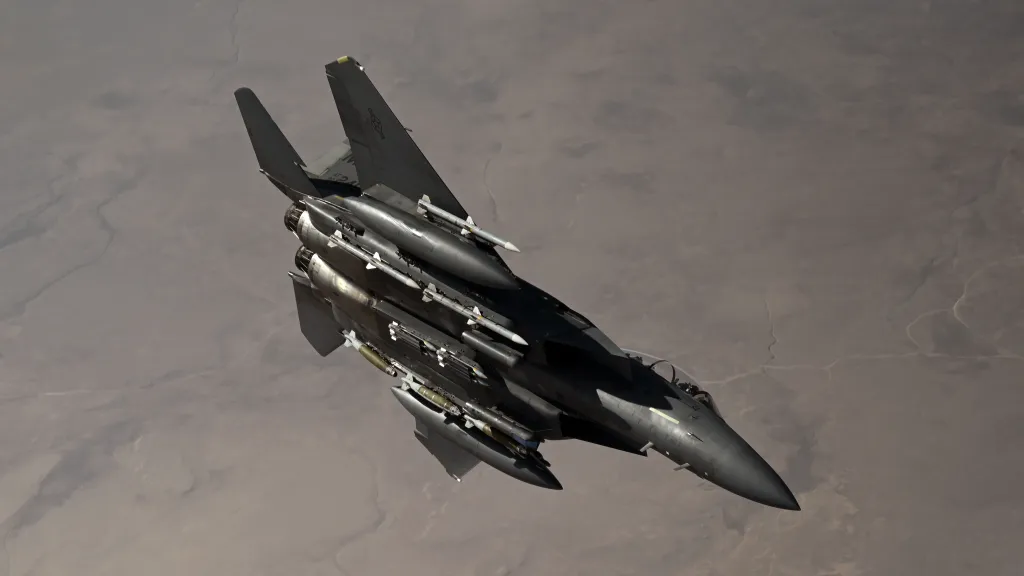
A U.S. Air Force F-15E Strike Eagle in the CENTCOM region. (U.S. Air Force photo by Staff Sgt. Gerald R. Willis) Tech. Sgt. Gerald Willis
“A young airman was working with him, and Garrett sent him to the bunker,” the service chief continued. “Garrett stayed. The rest of the team was separated, so he armed the weapons and cleared the jet. Proceed… While everyone else ran for cover, he decided to stay. Garrett understood why those Strike Eagles were in theater. He knew they were one of their best lines of defense, so he stayed until the job was done. Only after the last fighter taxied out, Garrett finally took cover. Later, when someone asked why, his answer was simple: his fellow airmen needed those airplanes in the air.”
Swatting Down Drones Under Fire
“Hundreds of miles away, two senior airmen, Shanae and Nolan, tracked a swarm of enemy drones headed toward their base,” Wilsbach pointed out. “Shanae joined the Air Force to provide for her family. During the opening days of Epic Fury, she found herself protecting another family – the hundreds of airmen depending on her.”
“People sprinted for shelter as alarm red announced an incoming attack, but Shanae and Nolan stayed focused on the screens in front of them because every inbound track could be a weapon aimed at their teammates,” the general said. “Shanae is 27 years old, and Nolan is 21. Think about the responsibility we placed on these two airmen. Hundreds of lives depended on them to identify the threats and employ countermeasures. Every second mattered. The stakes were life and death. Together, Shanae and Nolan achieved more than 10 surface-to-air kills that night, defeating threat after threat before it could reach the airmen they were protecting. There were moments when they were afraid, and most people would be, but courage is not the absence of fear. Courage is overcoming it. They stayed locked on, trusted their training, and did the job everyone around them was counting on.”
Picking Up The Pieces After An Attack
“Peter is a senior airman from New York who spent nine months in the Middle East as an air transportation airman,” Wilsbach said. “With his team, he moved heavy ordnance, prepared missile systems, and downloaded Patriot equipment, while ballistic missiles and attack drones repeatedly target their airfield.”
“One of those attacks became very personal,” the service chief noted. “Enemy fire destroyed Peter’s living quarters and nearly everything he had brought from home. Imagine coming back after a 12-hour shift to find the wreckage of your hooch. The few pieces of home he carried halfway around the world were gone. Peter’s response told me everything I needed to know about him. He said that his possessions could be replaced, but the mission could not.”
Keeping The Reapers Flying
“More than 4,000 dynamic targets had to be found, identified, validated, and engaged,” Wilsbach said. “Remotely piloted aircraft, airborne ISR platforms, cyber operators, space professionals, and countless others turn enormous amounts of data into intelligence commanders could use.”
“Suit is a first lieutenant with a family tradition of excellence,” Wilsbach said of one MQ-9 Reaper pilot. “Both of his grandfathers served in the Army. I’m sure they wanted a better life for their kids, which is why his parents chose the Air Force. Today, Suit flies the MQ-9 and carries his family tradition forward. He also scored a perfect 100 on its physical assessment this year, so apparently excellence runs in the family.”
MQ-9 Reaper (USAF)
“MQ-9s flown by pilots like Suit supplied critical ISR and kinetic strike capabilities, launching them from bases within range of enemy fires,” said Wilsbach. “Suit planned and launched an MQ-9 combat sortie during an active attack. While missiles hit the airfield, Suit taxied out and got his Reaper airborne. He handed off control to another crew, then switched to the ground control station to recover a different MQ-9. His crew destroyed a priority target and then turned their sensors back toward their own airfield to inspect the runway for damage and determine whether operations could continue.”
“The MQ-9 was a workhorse for combatant commanders during Epic Fury. It provided real-time intelligence, struck 860 targets, and gave our forces the edge while denying the enemy freedom of movement. Airmen-like Suit made sure this asset stayed in the fight and maximized its impact. The MQ-9 success demonstrates the need for a capable follow-on aircraft that achieves the same effects with greater survivability, adaptability, and at a lower cost.”
Rescuing An F-15E Crew Shot Down Over Iran
“Peaches is an air battle manager from Texas,” the chief stated. “During Epic Fury, she found herself in the middle of a story of her own her family will be telling for generations. Peaches led 134 joint and coalition operators responsible for command and control across a complex battle space. Her team supported operations involving more than 1,000 one-way attack drones and 1,200 enemy ballistic missile threats. Those numbers are difficult to comprehend, but for Peaches, command and control was not a collection of symbols moving across the screen.”
“Every symbol represented something real: an aircraft, a threat, a crew, an airman,” he explained. “It was during this time two of those airmen became isolated inside of Iran. What followed became one of the defining moments of the operation. Over 50 hours, Peaches was one of the many who coordinated the combat search and rescue effort, leading her team to integrate 176 aircraft, fighters, bombers, tankers, intelligence platforms, and Air Force Special Operations Command forces that converged on one objective: bringing those Americans home.”
“Think about the complexity of that problem,” Wilsbach noted. “Aircraft operating at different speeds, altitudes, fuel states, with different sensors, weapons, and responsibilities, while an adversary was actively trying to stop them. Maintenance teams generated additional fighters. Tanker crews extended the range and endurance of the force, intelligence professionals track the threats. AFSOC [Air Force Special Operations Command] airmen brought specialized capabilities need[ed] to reach out to our isolated teammates and get them out. Every one of those airmen was doing something different, yet all were contributing to the same mission.”
“The Dude 44 rescue demonstrates why integration matters,” Wilsbach added. “To someone outside of our profession, committing that much combat power to recover two people might appear extraordinary. To an airman, the reason is simple: we make a promise to one another in our Airman’s Creed. I will never leave an airman behind. If you are isolated, injured, or trapped behind enemy lines, we are coming to get you. The courage and performance displayed during that mission was so impressive that 10 airmen received battlefield promotions. I had the distinct honor of promoting six of those heroes, ranging from staff sergeant to chief master sergeant during a recent trip. Everyone understood that their success depended on someone else doing their job. That is how our air and space forces fight.”
An artificial intelligence “kill switch” which can be checked by a third-party may need to be mandatory for companies, a co-founder of one of the world’s largest AI firms has said.
Jack Clark, one of seven founders of Anthropic, said a way of shutting off AI software completely if it gets too dangerous was the kind of thing society “might want to eventually pass rules around”.
Clark said “most labs have different ways of being able to pull the plug”, including Anthropic, but said policymakers may need to enforce having one.
The rapid development of AI and fears over the risks that the technology poses to humanity have been thrust into the spotlight by a series of warnings from executives and staff at AI firms.
Some have said publicly there is a chance that the technology could, if unchecked, kill all humans.
Anthropic head Dario Amodei over the weekend called for the pace of AI development to slow and be more closely monitored, as the company has done before, though some have questioned the motivations behind this.
Amodei did not say how exactly how AI development could be slowed down and said any action to reign in AI development should be done “without sacrificing commercial advantage”.
Clark told the BBC that specifics around “kill switch” requirements and verification should be part of “the larger policy conversation” taking place around AI.
“Should you mandate for companies to definitely have a kill switch? Is that kill switch verifiable by a third party?” he asked.
“I think that’s the kind of thing society is going to want to know and might want to eventually pass rules around.”
Anthropic, which was formed in 2021 by a group of former employees of its rival OpenAI, is currently at the centre of a debate around AI safety.
Last week, a post from an artificial intelligence researcher who quit Anthropic over concerns AI could wipe out humanity went viral.
In response, Anthropic scientist Evan Hubinger said he personally thought the possibility of human extinction from AI was “>10% within the next decade”.
Asked what percentage he would put on all humans being killed by AI, Clark said: “I don’t think these statistics are that useful”, but added that allowing AI to continue as a “totally unregulated industry” was a bad idea.
“We are rolling dice with immense risks,” Clark said. “And the point is, we have to change the course of this industry.”
KHARTOUM: The World Food Programme’s funding for Sudan — the world’s largest hunger crisis — has fallen by about half this year, its acting head told Reuters, as war drives more people into hunger while the regional crisis raises prices and aid budgets plummet.
Speaking from the Darfur region after a trip across the country, acting Executive Director Carl Skau said that while access had represented humanitarians’ largest obstacle in the past, now “we have (a) presence that we are not fully utilising because of the lack of funding.”
The gap to sustain current operations was just short of $300 million, he said.
This year, we’re about half what we were in terms of funding last year, says Carl Skau, Acting executive director of The World Food Programme
“This year, we’re about half what we were in terms of funding last year,” Skau said. Last year, the agency received $645 million, but almost three-quarters into this year funding is only at $206 million.
The war between Sudan’s army and the paramilitary Rapid Support Forces has devastated wide swathes of the country, displacing up to 14 million people, ruining harvests and decimating the economy.
Almost 20 million people face hunger in Sudan, but budget cuts have forced the agency to focus efforts on the 5 million most in need, of whom it has recently scaled up to reach 4 million people.
Even then, the organization, the UN’s largest by budget, is forced to make difficult decisions.
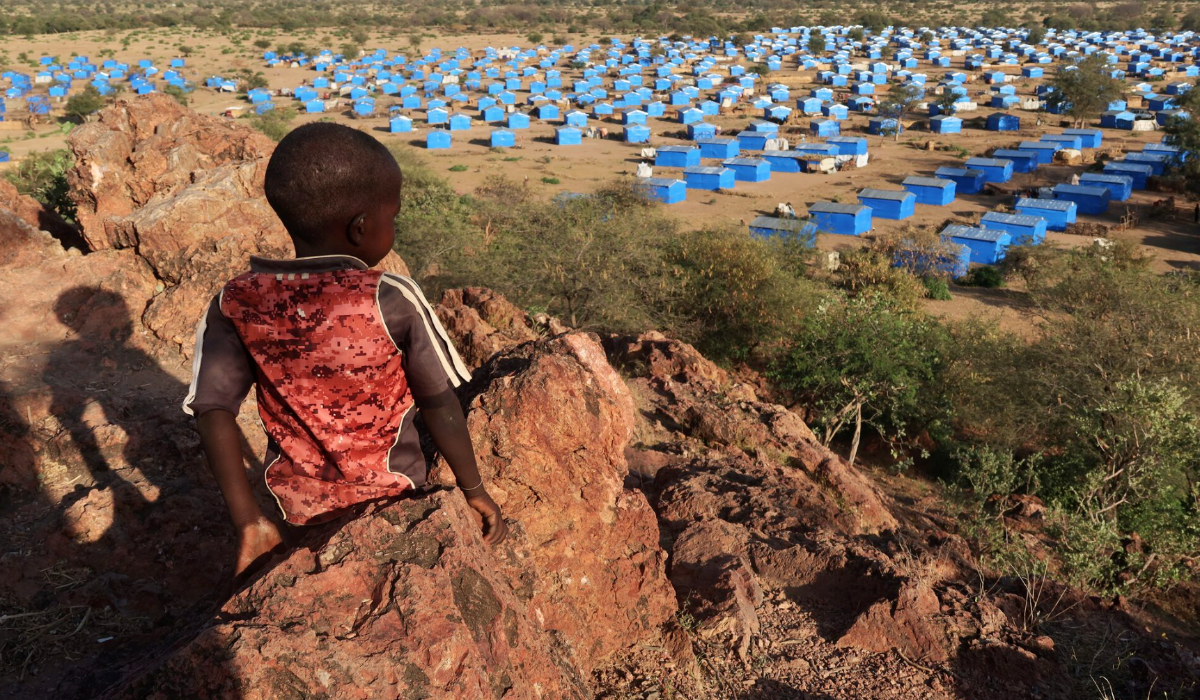
In Tawila, North Darfur, the makeshift home to about 1 million people, the agency is able to reach everyone monthly but with only a half ration that covers two weeks’ food, Skau said.
“It’s not clear how they really are surviving the other two weeks,” he said.
In El-Obeid, the central Sudanese city where about 1 million and counting have sought refuge since the start of the war in April 2023, the agency is only able to provide help to those who arrived in the past several months.
“We are providing, but less and less. A year ago it was better because of resources,” Skau said.
agency recently began providing aid in the city of Al-Fashir, once home to 1 million people, where an RSF attack last year, “bore the hallmarks of genocide,” according to investigators. Skau said, “there is little sign of life having returned.”
His organization is not the only one struggling as major donors reduce aid. The International Organization for Migration said on Monday that emergency relief supplies for hundreds of thousands of people displaced by the war could run out within weeks unless donors step in with urgent funding.
The UN agency said supplies of shelter materials, sanitation items and emergency household goods are expected to run out by the end of September. The aid system itself can only keep functioning until December without more money.
Aid groups like IOM are struggling with funding shortfalls after the Trump administration — the US was previously the world’s biggest aid donor — cut billions of dollars in foreign assistanceto UN agencies and charities over the past year. Other major donor countries have also cut aid budgets, citing tight finances and higher defense spending.
“We simply can’t turn our back on the people of Sudan,” IOM Director General Amy Pope said in a statement, adding: “The entire humanitarian system could collapse within weeks if we don’t act now.”
IOM says 8.6 million people remain displaced within Sudan, while another 4.9 million have returned to their homes. The agency says it needs $15 million to keep the aid pipeline running for the rest of the year, supporting about 305,000 people. Without it, more than 100 humanitarian organizations would struggle to quickly deliver lifesaving aid.
Central banks’ record, price-insensitive gold buying is a more credible signal of the dollar’s structural trajectory than this year’s currency markets, because FX markets are structurally bad at pricing the discontinuous, wartime-style tail risk central banks are actually hedging — so this autumn’s calmer dollar should not reassure anyone that de-dollarization has stalled.
In June, the European Central Bank made an announcement most people missed: gold has overtaken US Treasuries as the world’s single largest reserve asset. Central banks bought 289 tonnes of it in the second quarter alone — a record for that quarter and five times Q1’s pace — with Poland’s central bank openly telling investors it was “buying the dip.” Here is the part that should stop you: gold’s price fell 22% between January and September. Central banks were never more convinced buyers of an asset than while it was crashing. Either the reserve managers are wrong, or currency markets — which show none of this urgency — are the ones asleep at the wheel.
Gold peaked at $5,589 an ounce on 28 January, the same month the dollar index hit a four-year low of 95.5 and the dollar’s share of global reserves fell toward its lowest level since 1995. Both moves reflected the same story: Fed rate cuts through 2025, a US debt load past $37 trillion, and BRICS states settling more trade outside the dollar. Then the picture split. Kevin Warsh, confirmed as Fed chair in May, signalled a hawkish pivot in August; the Iran war pushed oil and inflation higher through September, and markets began pricing a rate hike rather than a cut. The dollar index clawed back to 99.46. Gold fell to $4,330. Central-bank buying did not follow the price down — Poland alone added 82 tonnes this year toward a 700-tonne target, and a World Gold Council survey found a record 45% of central banks plan to buy more within twelve months.
State the gap plainly. Two signals, same underlying question — is the dollar-centred monetary order changing — and they disagree by a wide margin. The buying signal says yes, decisively: record quarterly purchases, gold displacing Treasuries at the ECB’s own reckoning, 74% of surveyed reserve managers expecting the dollar’s reserve share to keep falling over five years, and buyers adding tonnage through a 22% drawdown rather than fleeing it. The price signal says not yet: the dollar just posted one of its sharper rallies of the year, gold is down sharply from its high, and nothing in currency markets shows the kind of stress a genuine regime shift would produce.
Stay ahead of the geopolitical week.
MD Briefing delivers expert analysis across five global fronts — the Indo-Pacific, energy, geoeconomics, European security, and the Middle East — every Monday morning. Free.
The strongest objection to trusting the buying signal is a good one, and it needs to be taken seriously rather than waved away: foreign exchange is the deepest, most liquid market in the world, turning over more than $7 trillion a day. A few hundred tonnes of central-bank gold buying — perhaps $30–40 billion a quarter — is a rounding error against that. If professional currency traders, sitting on far more capital and far better short-term information than a handful of reserve managers, saw a serious de-dollarization story unfolding, it would already be in the price. Instead the dollar just rallied. On this view, central banks are not seeing something markets are missing; they are pattern-matching off 2022, when Russia’s $300 billion in reserves was frozen overnight, and over-hedging a tail risk that has not recurred and mostly will not.
That objection assumes FX markets and central-bank reserve committees are pricing the same kind of risk, on the same time horizon, and they are not. Currency markets are exceptionally good at pricing continuous, high-frequency variables — rate differentials, growth surprises, this week’s inflation print — because that is what moves flows daily. They are structurally poor at pricing discontinuous, low-probability events until those events occur: equity volatility did not price 2008 in 2007; sovereign spreads did not price the Russia reserve freeze in the weeks before it happened. A reserve freeze, a secondary-sanctions campaign, or exclusion from SWIFT-style settlement infrastructure is exactly that kind of event — binary, rare, and catastrophic for whoever it hits — which is precisely why Poland’s central bank governor, Adam Glapiński, described his buying not as a trade but as insurance: reserves that keep the state secure “under all circumstances, including wartime, which of course we’re not expecting.” That is not the language of someone chasing momentum. It is the language of someone who manages the one asset class that keeps its value if their country is ever cut off from the dollar system, and who would rather hold it and be wrong for a decade than not hold it and be wrong once.
The buying pattern itself supports that reading. Momentum money sells into a 22% drawdown; insurance money adds to it. Central banks did the latter through the first half of this year, which is the behavioural signature of a structural reallocation program with a fixed multi-year target — Poland’s is explicit, 700 tonnes — not speculative flow riding gold’s rally. Meanwhile the dollar’s autumn recovery has an identifiable, largely cyclical cause: a new, more hawkish Fed chair and a war-driven oil shock forcing a rate-hike repricing. Neither event reverses the debt trajectory, the BRICS settlement trend, or the reserve-freeze precedent that pushed the dollar to a four-year low in January. A rally built on this year’s Fed chair and this year’s war is not proof that last year’s structural story is over; it is evidence that a cyclical force is currently strong enough to mask it.
The Scenarios
Base case (55%): The gap persists rather than resolves. The dollar holds most of its autumn gains through the current rate-hike cycle, gold range-trades below its January peak, and central banks keep buying at a steadier, slower pace toward stated targets like Poland’s 700 tonnes. Nobody is “proven right” on any particular Tuesday, because reserve diversification is a decade-scale hedge, not a trade with a catalyst date. This is the least satisfying outcome for anyone wanting a verdict, and the most likely one.
Downside case (for dollar holders): A discrete trigger — a fresh reserve-freeze or secondary-sanctions episode, plausibly connected to the still-live US-Iran war spilling into action against a third country’s assets, or a shock to Fed independence under a more political Warsh chairmanship — crystallizes the exact tail risk central banks have been hedging. Gold spikes back through its January high, the dollar index breaks below its 95.5 low, and the gap closes in weeks rather than years, vindicating the reserve managers all at once and catching FX markets flat-footed exactly as the theory predicts.
Upside case (for the dollar): The Iran war resolves, Warsh’s rate hikes cool inflation without a recession, US fiscal metrics stabilize, and BRICS local-currency settlement growth stalls on friction between its own members. Central-bank gold buying does not reverse but plateaus as reserve managers hit conventional diversification ceilings — most target 15–20% of reserves in gold, not open-ended accumulation. The gap closes gradually as price drifts up toward the buying signal over several years, with no crisis required to force the reconciliation.
The Takeaway
The dollar’s calmer autumn is not evidence the de-dollarization hedge was a mistake; it is evidence that currency markets and central-bank reserve committees are pricing two different things on two different clocks, and only one of those clocks rings in a crisis. Central banks bought through a 22% drawdown because the point of the position was never this quarter’s return.
Watch for: the World Gold Council’s Q3 2026 Gold Demand Trends report, expected in early November. A third consecutive quarter of buying that ignores price direction will confirm this is policy, not opportunism — and the moment currency markets have to agree with that policy will not be a quiet one.
North Korea, enjoying support in the stands, were up 7-0 by half-time and are the favourites for the gold.
Published On 14 Sep 202614 Sep 2026
North Korea’s formidable women’s football team, cheered on by several hundred pro-Pyongyang fans in Osaka, Japan, launched their Asian Games campaign with a 10-0 hammering of Bangladesh.
The North Koreans have enjoyed stunning international success at the youth level and start among the favourites for gold in Japan.
Recommended Stories
list of 4 itemsend of list
They were far too hot for Bangladesh to handle and were seven goals ahead by half-time on Monday.
Striker Ri Song-a, who was born and raised in Japan, was in North Korea’s starting lineup and scored in the second half.
North Korea were cheered on by a large group of red-clad fans, who sang and chanted throughout the match.
The men’s and women’s football teams were welcomed by supporters waving flags as they arrived for the games last week wearing white blazers and pink ties.
More than 100 North Koreans are set to compete in 14 sports at the games, which take place in Nagoya-Aichi and officially open on September 19.
North Korea suspended participation in international sporting competitions during the COVID-19 pandemic, but returned at the Asian Games in China in 2023 and also took part in the Paris Olympics.
North Korea’s women face South Korea in a Group F grudge match on September 21.
The men’s team begin their campaign against China on Wednesday.
North Korean fans cheer for their team during the women’s group B football match [AFP]
America’s nuclear weapons deterrent and how it is controlled is increasingly critical in the face of the rapidly-expanding arsenals across multiple adversaries. A new fleet of E-4C nuclear-hardened survivable airborne operations center aircraft is now in development, as is the U.S. Navy E-130J, which will provide next-generation communications with nuclear ballistic missile submarines deep beneath the waves. Focus is also turning to a mission that’s dedicated to emergency communications with the U.S. nuclear forces in times of crisis, a role known as Operation Looking Glass, which is also poised for updating under a program dubbed Looking Glass-Next.
The comprehensive modernization of America’s nuclear strike muscle involves three major elements – new B-21 Raider stealth bombers, the LGM-35A Sentinel intercontinental ballistic missile (ICBM) program to replace Minuteman IIIs, and new Columbia-class nuclear ballistic missile submarines. A fourth facet that ties all these new elements, as well as existing ones, together is the next generation nuclear command, control, and communications (NC3) architecture. It securely connects nuclear weapons systems to decision-makers. Without it, America’s nuclear deterrent isn’t a deterrent at all.
A USAF E-4B assigned to the 595th Command & Control Group at Offutt Air Force Base, Nebraska. USAF/TSgt Codie Trimble
America’s nuclear modernization is set against a backdrop of rapidly-developing nuclear strength across adversaries and pacing threats, which could threaten not only U.S. fighting forces, but also the existing aging NC3 infrastructure. This could impede the collective responsiveness and effectiveness of the American nuclear enterprise. For example, a coordinated attack on NC3 could degrade the National Command Authority chain, which could prevent communications that are necessary to conduct a retaliatory strike.
If fixed underground command posts are targeted and rendered inoperable, the current strategy would involve turning to a set of highly-survivable air assets that are designed to be on hand to execute emergency war orders. This includes the U.S. Air Force’s E-4B National Airborne Operations Center (NAOC) “Nightwatch” aircraft, and the E-6B Mercury that is operated by the U.S. Navy.
A major recapitalization effort is already underway for the NAOC E-4Bs, which are being superseded under the E-4C Survivable Airborne Operations Center (SAOC) contract. It is being led by defense contractor SNC. The new SAOC aircraft are based on the far more modern 747-8i, and are planned to have a much broader mission set than the four E-4B Nightwatch types they are set to replace, as you can read more about here.
The Navy’s E-6B Take Charge and Move Out (TACAMO) aircraft have a primary role of strategic connectivity with the ballistic missile submarine fleet. These converted 707s also execute another mission known as the Airborne National Command Post (ABNCP), more recently renamed “Looking Glass.” For this they are manned by U.S. Air Force missileers and U.S. Strategic Command (USSTRATCOM) battle managers who are responsible for running the airborne nuclear NC3 systems.
An E-6B Mercury flies over U.S. and UK submarines during a joint exercise. U.S. Navy
The joint service team on Looking Glass mirrors some operations performed by USSTRATCOM’s underground command posts, and a small portion of what the NAOC executes. The Looking Glass mission is really focused on performing an airborne backup mission solely for USSTRATCOM to ensure another means of communicating with fielded nuclear bombers, their assigned tankers, ICBMs and deployed nuclear submarines. It is best known for its ability to supply airborne communications connectivity to the USAF’s ICBM force on the ground and can command remote launches of those weapons if necessary.
Additional NC3-related modernization is coming on the heels of SAOC, with the new E-130J set to assume the Navy’s TACAMO role from the ageing E-6Bs, assuming strategic connectivity for nuclear ballistic submarines. It means that at some point roughly two-thirds of the E-6 current mission will go to the new E-130J aircraft – raising the question of what will fulfill the critical Looking Glass mission.
Since the E-130J is not planned to take on the Looking Glass role, the USAF is in the early stages of what’s dubbed Looking Glass-Next (LG-N), which presents the future pathway for USSTRATCOM’s mobile contingency operations. This could take on a number of forms, including NC3 communications functions being increasingly moved to space-based assets and more distributed operations across the ground, although an air platform is still likely to form a major part of the overall capability.
The need to modernize America’s NC3
Brian Golden is a retired USAF colonel who intimately understands nuclear command and control (NC2) and the associated NC3 equipment and processes from both a service and industry perspective. As a subject matter expert for SNC, he draws on his extensive experience as a former E-4B NAOC commander and he commanded much of the USAF’s multi-domain NC3 systems, including the Airborne Launch Control System onboard the current E-6B Looking Glass. He is also extremely familiar with all the nation’s continuity of government and continuity of operations missions for both Congressional and executive branches of the U.S. government.
“Everyone referred to the nuclear triad as the platforms that were controlled through the NC3 architecture,” Golden told TWZ during a detailed discussion. “Those platforms received their messages and executed their missions. But this isn’t just about that platform triad. The U.S. nuclear enterprise has four primary pillars, and nuclear command, control, and communications is a critical part of it. Without a robust NC3 system, it’s like having a brand new Bugatti Veyron but without the keys! It looks awesome on the driveway, but you can’t drive it.”
Secretary of War Pete Hegseth working aboard an E-4B Nightwatch. USAF/SrA Madelyn Keech
Golden explains that the current NC3 enterprise consists of a series of exquisite systems that are extremely reliable, but that are in need of modernization to stay ahead of the steepening threat curve, and stay in front of supply chain constraints. “What we have currently is very reliable, robust, and very survivable, but it can be difficult to maintain some of our legacy systems. Additionally, as threats evolve we must ensure our communications pathways also evolve.
“Our nation’s industrial base engineers figured out extremely robust methods of nuclear communications when these systems were fielded. Looking at the overall command and control [NC2], and then the NC3 communications pathways, any new systems that we introduce must be sustainable, scalable and modular.”
The U.S. nuclear enterprise is facing greater threats than ever with adversaries challenging U.S. nuclear infrastructure in multiple domains: space, cyber, ground, air. Because of this, NC3 demands a continuous process of improvement.
Going forward, the NC3 enterprise will likely need to integrate upgraded proven legacy systems with all-new technology. “Sometimes the physics of radio waves may dictate the need for a legacy approach with upgraded systems, such as communicating with a submarine that’s very deep in the ocean.”
Golden’s view is that NC3 requires a layered, open architecture approach as modernization is evaluated. “Applying those same physics and then adding new layers such as artificial intelligence may determine a better way of doing things.”
Upgrading to SAOC
Golden points to the SNC-led E-4C SAOC program as a clear example of critical NC3 modernization, while emphasizing that the NC2 mission is far from being the primary role of the E-4B and its forthcoming successor. “Nuclear command and control is only a fraction of what the current NAOC does and what the future SAOC will do for our nation and our allies and partners.”
An E-4B Nightwatch at Yokota Air Base, Japan. USAF/A1C David S. Calcote
The E-4B initially featured just a handful of communications systems, which have grown over time, leading to what Golden calls the “King Kong” of communication capabilities today. The E-4 is not a battlefield communications platform, its mantra is all about supporting Presidential-level requirements across the board. It does possess an extensive NC3 suite, but it also serves the White House Communications Agency (WHCA) and the Department of Homeland Security, through the Federal Emergency Management Agency (FEMA), in many other crisis roles. Another mission the E-4B fleet performs is to safely transport the Secretary of War on trips within the United States and abroad.
The E-4B NAOC and Looking Glass are two complementary tiers of the same survivable architecture. The NAOC (and future SAOC) is designed to anchor national-level decision-making and government continuity from the very top, while Looking Glass provides USSTRATCOM with the dedicated airborne command and battle-management capacity required to direct forces. Both roles are critical and non-negotiable.
An artist’s rendition of the new E-4C SOAC. SNC
“The new E-4C SAOC, like the E-4B before it, will deliver an expansive communications suite and increased capacity supported by a larger fleet,” Golden explains. “SAOC is built to ensure the President and national leadership can direct the entire country through any crisis. Looking Glass supports an equally vital and highly specialized mission. It is dedicated to USSTRATCOM’s operational needs, connecting directly to bombers, ICBMs and submarines. Attempting to merge these unique missions on a single airframe would compromise the unique, essential role that each was created to perform.”
Looking Glass-Next
The Looking Glass role and the platform that fulfills it is not classified as a national-level mission. As Golden alluded to earlier, it’s not assigned to the Chairman of the Joint Chiefs or to the Secretary of War. It’s exclusively assigned to USSTRATCOM; however, without the Looking Glass mission being upgraded soon, America has a gaping hole in its nuclear architecture.
An E-6B Mercury flying over Colorado. USAF/Greg L. Davis
The commander of USSTRATCOM is the customer and ultimately the decision-maker when it comes to Looking Glass-Next, and the USAF has been tasked by the Secretary of War to develop and field it. SNC is looking at several options for the requirement, with some sort of air platform at its core, which Golden refers to as an “E-6C.” He endorses that the current E-6B is one of the “cogs in the wheel that has to be replaced,” but adds that this doesn’t mean the next-generation Looking Glass is just an aircraft.
“At SNC, we have significant expertise and experience with mission system integration,” says Golden, adding that SNC is evaluating what he calls “aggressively creative options,” for the modernization requirement. He further noted that the modern threat is driving a requirement for Looking Glass-Next to be very difficult to target and must be dispersed.
“Having an aircraft as the only option for this USSTRATCOM mission is a legacy mindset,” Golden states. “We have advanced multi-domain capabilities, including numerous space capabilities available through the Sierra Space Corporation. Future mission resilience requires a creative and integrated approach.”
“We believe a creative approach to provide NC3 options will ensure a robust, reliable, survivable and cost-effective solution.”
Golden endorses this approach to creativity and development and indicated that SNC will continue to inform and respond to the ongoing Looking Glass-Next requests for information that may result in a future program.
One of the 747-8is that is being modified by SNC in Dayton, Ohio, to become an E-4C SAOC. SNC
“SNC has leaned heavily into the nuclear command, control, and communications architecture and it’s a natural fit for us, building on our work with the Department of War and our subcontractors on the E-4C SAOC. Our Looking Glass-Next responses and inputs will leverage relevant work and experience gained from SAOC, but we are also focused on being creative. We’re small enough to be agile, but big enough to deliver. That’s why we think we’re very well positioned in the NC3 space.”
The majority of SNC’s work on the E-4C SAOC is being completed at the NC3 Center of Excellence, housed in the Aviation Innovation and Technology Center (AITC) in Dayton, Ohio.
Golden believes the timing couldn’t be better to deliver bold and creative NC3 solutions. “The USAF is already asking the right questions, and industry is really able to innovate, which will result in a transformational era for nuclear command, control and communications.”
RIYADH: The performing arts in the Kingdom is undergoing a transformation driven by cultural investment, new venues, international collaboration, and a growing network of local professional and academic institutions, making it tempting for young Saudis to pursue.
While academic study in the field is comparatively new, Saudi theatrical production is not. The Kingdom has long produced recognized theater throughout the Gulf and regionally, but many practitioners studied overseas.
Today, Saudi Arabia is localizing the education of its creative talent through academic and professional training in the country.
Since 2020, Saudi has dedicated a Theater and Performing Arts Commission to regulate and develop a sector encompassing theater, dance, circus, improvisational comedy, street performance, ballet and opera.
Not only through training but also national competitions and workshops.
Undergraduate programs are offered at King Saud University, Princess Nourah University and most recently the Riyadh University of Arts. While the Royal Institute of Traditional Arts provides postgraduate and diploma-level education, Scene Institute, and Ithra have further professional training.
As Saudi universities begin their academic year, many students are continuing their conventional degrees. Other creatives are pursuing their passions academically, making the most of the opportunities the Kingdom has to offer.
Osama Almutairi, a final-year Bachelor of Arts in Theater student at King Saud University, spoke to Arab News about the feasibility of his academic choice.
“My love and passion for the arts, particularly theater, naturally led me to this specialization.”
Theater was not his first choice. “I initially considered studying political science but was accepted into theater as part of the first cohort at the College of Arts,” he said.
“Despite my initial interest in pursuing a conventional degree in the humanities, the continuous development of Saudi Arabia’s arts sector encouraged me to take this step.”
Saudi Arabia has been taking proactive measures while localizing performing arts scholarships.
The Ministry of Culture has been running a fully funded Cultural Scholarship Program that supports creative specializations at 278 approved institutions across 15 countries, including performing arts.
One beneficiary is Majed Al-Muwallad, an actor and theater teacher at Afaq Academy, who completed his Bachelors in Theater Studies at Royal Holloway, University of London.
“I travelled to London in 2021. During my studies, I participated in several theatrical productions, ranging from small projects to larger, more academically oriented university productions.
“I had loved acting since I was about 14 years old. I loved films, acting, stories and dramatic texts. When the scholarship opportunity appeared, I thought: ‘Why should I let this opportunity pass?’ I decided to take it.”
Al-Muwallad said he left a job at Aramco to pursue his childhood dream, although members of his community were uncertain about his unconventional choice.
“They were not sure about the professional opportunities available or where such a career could lead,” he said.
“It was a major career change, and leaving Aramco to pursue acting was an unfamiliar idea. People do not usually leave Aramco to become actors,” he added.
Now that he has graduated and is teaching Saudi youth to act, Al-Muwallad believes it was a good decision.
He is even considering pursuing a master’s degree in the performing arts, specifically in performance design. For him, the opportunities are not limited to acting. He hopes to build on his studies in costume, lighting and set design.
“Every theatrical production needs design. It requires a set, costumes and lighting. Rather than limiting myself to the acting and performance side of theater, I would like to develop expertise in design and contribute to the audience’s overall visual experience.”
Almutairi believes perceptions will continue to change as Saudi artists demonstrate the value of academic training.
“The future is wide open for the arts and artists. Society’s perception will continue to change as academically trained Saudi artists demonstrate their ability to represent their communities and country.
“This change is already becoming evident, with society playing an increasingly important role in supporting the success of Saudi artists nationally and internationally.”
For Al-Muwallad, theater should be approached holistically — not only as a career or degree, but also as a journey of self-discovery.
“I learned a great deal before I even began teaching the students. I had to learn how to communicate theatrical knowledge and present information in a way students could understand.
“The experience has taught me a lot about communication and how to identify students’ talents. Theater teaches communication and helps students discover themselves.”
Al-Muwallad encourages young people in Saudi Arabia to pursue their passions academically. “My advice is not to treat university as merely a stage that you pass through and finish,” he said.
“Students should engage with the experience deeply and benefit from it in every possible way.”
He said soft skills can be learned through theater, including communication, emotional intelligence and teamwork.
“Another piece of advice we were always given in London was to always ask questions. A question produces an answer, and that answer often generates another question.
“Asserting that openness and eagerness to learn is vital to a good actor, theater itself is founded on curiosity.
“Students should watch a wide variety of theater and explore different traditions, including Arab, English, Greek and Russian theater, as well as influential approaches such as Russian (theatre practitioner Konstantin) Stanislavski’s.”
On Saudi having a relatively emerging academic orientation to performing arts, Almuwallad sees it as a big opportunity rather than a challenge or a barrier.
“Saudi Arabia is still developing in this field, which means students now have an opportunity to participate in shaping it. What they create can become visible and make an impact relatively quickly.”
“Students should recognize that they are important. They should not treat themselves as secondary characters in this development. They have the opportunity to play a central role because the field is still new.”
For Saudi youth choosing an arts degree over a safer, conventional path, there is an opportunity to turn passion into a profession, and ultimately shape the nation’s creative scene.