
A city nestled in the south of France has seen a major transformation over the last 13 years, ditching its reputation and seeing a major investment, bringing in ‘chic’ and ‘hip’ food spots
Marseille in France has been dubbed as the ‘capital of cool’(Image: Getty Images)
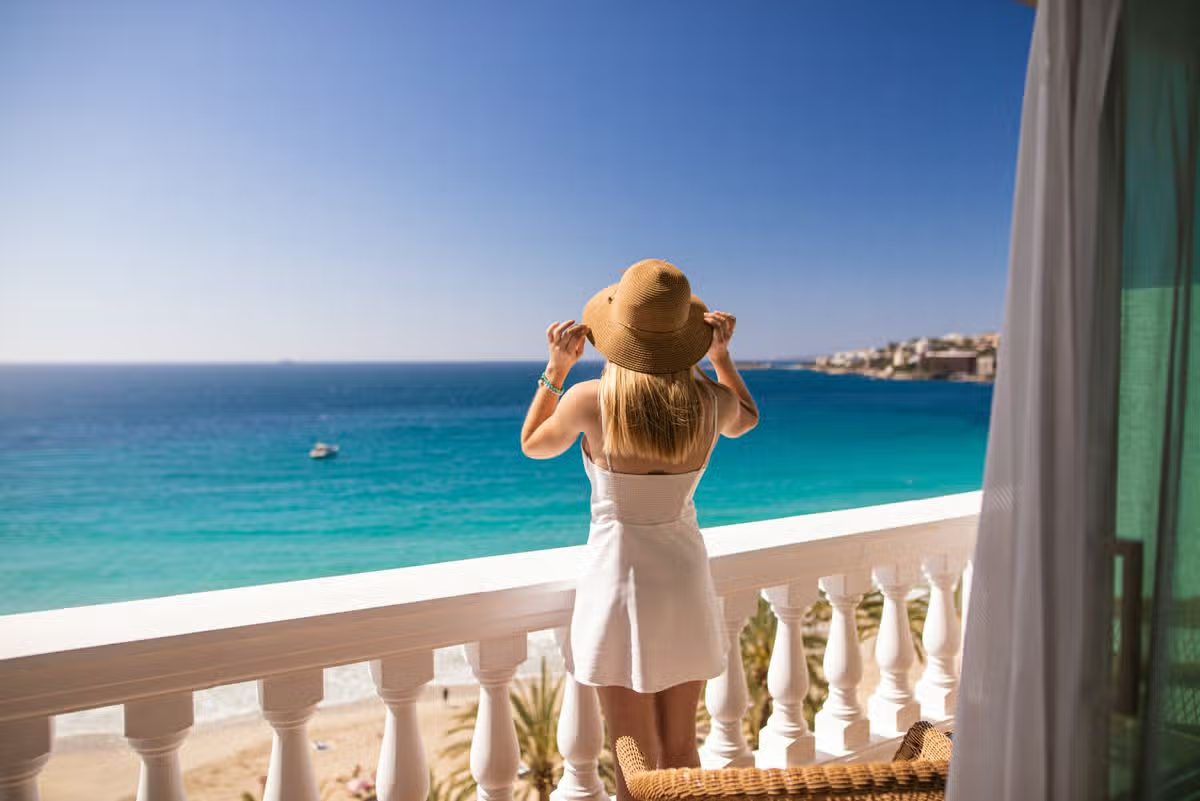
A stunning European city with UK flights and 20C temperatures in April has been branded the “capital of cool”. Marseille in the south of France secured half a billion euros of investment after being crowned the European Capital of Culture in 2013.
Since then the world famous port has become known for being “chic” and “hip”. It blends a mix of history thanks to the bustling Vieux-Port, which sits at the bottom of the Canebière, a kilometre-long main street in the city.
Visitors can take a selfie under the Ombrière – a giant umbrella at the port – and a stroll along the quayside before watching the fishing boats head out to sea. Towering above the port is the historic Notre-Dame de la Garde basilica, which offers 360 degree views of the stunning city.
The port however blends history with modern, boasting a range of “cutting-edge museums,” reports the Daily Mail, along with “foodie-approved restaurants” and “trendy bars”. The paper, which describes the city as the “capital of cool”, reports: “Marseille is wonderful for a short break at this time of year, with average daily highs of around 19C-20C – and the seafood is second to none.”
One popular dish in the city in particular is bouillabaisse, an “iconic” fish soup that is served in two dishes. One contains the fish and the other a broth on a stove, with the fish itself traditionally cut up in front of diners.
Bouillabaisse is then served with rouille or aioli sauces with croutons for dipping. The influence of the Mediterranean is also evident in the local cuisine, with anchoïade, a traditional dish made with anchovies, capers, olive oil and garlic, said to contain the “iodine taste of the sea” in “every bite,” reports Ville De Marseille.
Away from the food scene, visitors to Marseille can visit the Le Panier, the oldest district of the city which now boasts small café terraces, street-art coloured facades, and designer shops. Having now become an “open-air museum” the area was first inhabited by the Greeks in 600BC.
It developed a reputation for violence and prostitution in the 20th century but has seen a massive overhaul in the past 13 years. It is now described as one of Marseille’s “must-see districts”.
For nature lovers, the cliffs of the Calanques have been described as a “natural wonder”. The Calanques boast fine sandy beaches, miniature fjords and turquoise waters.
It is the perfect area for people who want to sun-bathe or enjoy a spot of kayaking. YouTuber Nathan Frank, who posts as On World Travel, described Marseille as a “city that doesn’t care if you like it or not”.
He said: “We’ve been here for three days now and I’ve spoken to quite a few locals and they’ve been so friendly. Like more friendly than a lot of places we’ve been to and super down to earth and friendly. Our first impressions of Marseille have been really positive, we have some really good food on the agenda.”
Marseille boasts average temperatures of around 19 to 20C in April. And according to Skyscanner, prices from Manchester Airport start from around £28.
The FCDO has all the latest travel warnings listed online, advising against all travel to multiple countries
10:08, 12 Apr 2026Updated 10:18, 12 Apr 2026
An FCDO warning can affect your travel insurance(Image: Getty )
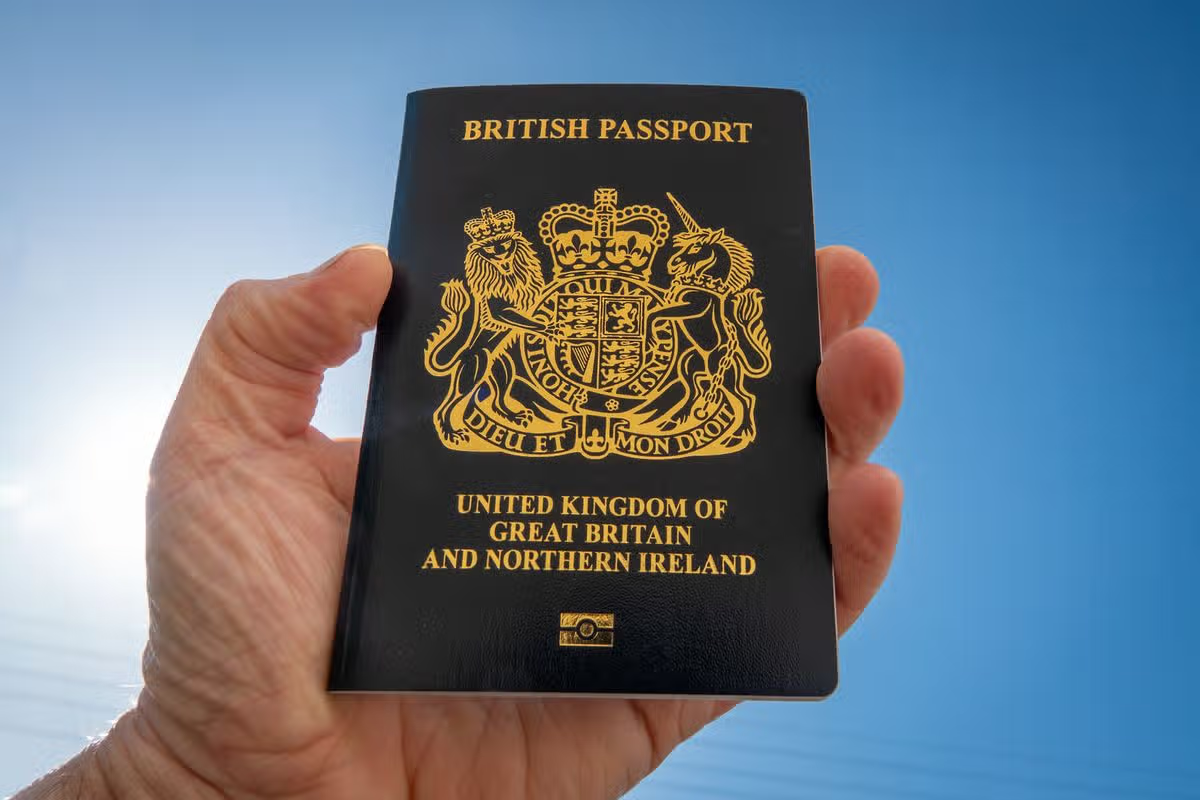
The Foreign, Commonwealth and Development Office (FCDO) provides regularly updated travel guidance for British nationals heading abroad. It’s vital to check the latest FCDO advice before your trip, as it could affect your holiday plans and travel insurance.
Choosing to travel against FCDO warnings can invalidate your travel insurance. You may also find that consular assistance is severely limited should you face an emergency. On its travel advice page, the government agency says: “No travel can be guaranteed safe. Read all the advice in this guide.”
To safeguard British nationals travelling overseas for work or pleasure, the FCDO provides up-to-date travel advice for every country worldwide. It’s essential to consult this guidance before every journey.
Should the FCDO consider a situation dangerous, it may advise against all travel or only non-essential travel to a particular country or specific regions within it. Alongside travel warnings, the FCDO provides useful information, including entry requirements, crime statistics, local laws and customs, and details regarding any forthcoming strikes or industrial action that could disrupt your holiday.
It’s important to be aware that if the FCDO issues a warning against all travel or all but essential travel to your chosen destination before your departure, your travel insurance is unlikely to provide cover. Consequently, any claims you make will in all probability be rejected.
Travel insurance is designed to safeguard you against unexpected and unforeseen risks. However, heading to a destination that the FCDO has declared dangerous carries a considerably greater risk than jetting off to a generally regarded safe country.
Should the FCDO issue a warning while you are already in an affected region, you will remain covered under the medical and personal accident sections of your travel insurance policy. However, this is provided you comply with the latest FCDO guidance for British nationals in that area.
While most travel insurance policies do not cover trips taken against official advice, there are a handful of exceptions. These particular policies were originally designed to protect individuals travelling to high-risk areas for professional reasons, such as journalists and aid workers. But, they are increasingly being taken up by leisure travellers keen to press ahead with their plans during the COVID-19 pandemic.
Political instability, natural disasters, and safety concerns are among the factors that can prompt an FCDO warning. The FCDO has issued numerous travel advisories, advising against “all travel” and “all but essential travel” to certain nations or regions across Europe, Africa, Asia, and South America.
Of the 226 countries featured on the FCDO’s travel advice page, certain destinations are currently marked as ‘do not travel’ zones owing to various concerns that ‘can not guarantee safety’, including security threats, health risks, and legal differences from Britain. Your travel insurance may be rendered invalid if you travel contrary to FCDO guidance concerning the following nations, as of April 2026.
Afghanistan
The FCDO advises against all travel to Afghanistan, saying: “Your travel insurance could be invalidated if you travel against advice from the FCDO.” The government agency says the security situation is volatile and tensions between Afghanistan and Pakistan have previously resulted in violent clashes in border regions.
It adds: “Travel throughout Afghanistan is extremely dangerous and a number of border crossings are not currently open. There is a heightened risk of British nationals being detained in Afghanistan. If you are a British national and you are detained in Afghanistan, you could face months or years of imprisonment. FCDO’s ability to help you is extremely limited and support in person is not possible in Afghanistan. For more details about the risks in Afghanistan, see Safety and security.”
Belarus
FCDO advises against all travel to Belarus. You face a significant risk of arrest if you have at any time engaged in any activity now considered illegal by the Belarusian regime. There is also a low risk that direct conflict linked to the war in Ukraine may spread to Belarus. Find out more about why FCDO advises against all travel.
Burkina Faso
FCDO advises against all travel to Burkina Faso. This is due to the threat of terrorist attacks and terrorist kidnappings, and the unstable political situation in the country.
It explains: “There is no British Embassy in Burkina Faso and all consular support is provided from the British Embassy in Accra, Ghana. They cannot provide in-person assistance. If there is serious violence, unrest or a deterioration in the security situation, it could be difficult to leave safely.
“Do not rely on the British government to evacuate you as they may not be able to do so. Have your own plans on how you would leave the country, make sure you keep all travel documentation up to date and monitor the local situation.”
Haiti
The FCDO advises against all travel to Haiti owing to the unstable security situation. There are presently no British consular officials in Haiti and the capacity to provide consular assistance is severely restricted and cannot be delivered in person in Haiti. British nationals may receive consular services assistance at our diplomatic mission in the Dominican Republic.
The government agency says: “If you choose to travel to or stay in Haiti against FCDO advice, try to avoid all crowds and public events, and take appropriate security precautions.”
Content cannot be displayed without consent
Iran
FCDO advises against all travel to Iran. It says: “If you are a British national already in Iran, either resident or visitor, carefully consider your presence there and the risks you take by staying. British and British-Iranian dual nationals are at significant risk of arrest, questioning or detention.
“Having a British passport or connections to the UK can be reason enough for the Iranian authorities to detain you.” British nationals should:
read if you’re affected by a crisis abroad. This includes guidance on ‘how to prepare for a crisis’ with suggestions on what you might include in your emergency supplies and ‘what to do in a crisis’
sign up to FCDO Travel Advice email alerts
monitor local and international media for the latest information
stay away from areas around security or military facilities
keep your departure plans under review, and ensure your travel documents are up to date
if you are advised to take shelter, stay indoors or find the nearest safe building or designated shelter. An interior stairwell or a room with as few external walls or windows as possible may provide additional protection
Mali
FCDO advises against all travel to the whole of Mali due to the unpredictable security conditions. The FCDO says if you’re in Mali, you should leave immediately by commercial flight if you judge it safe to do so.
It explains: “The international airport in Bamako is open, and commercial flights are available. Do not try to leave Mali by overland routes to neighbouring countries, as this is too dangerous. This is due to terrorist attacks along national highways. Terrorist group Jama’a Nusrat ul-Islam wa al-Muslimin (JNIM) has implemented blockades on key routes throughout Southern and Western Mali, including the capital city of Bamako.
“These blockades are targeting fuel trucks and are enforcing checkpoints for individuals attempting to pass through them. Attacks can occur at any time. There is a high threat of kidnapping and criminal activity across Mali, including in the capital, Bamako. If you choose to remain in Mali, you do so at your own risk. You should have a personal emergency plan that does not rely on the UK government. If you are a British national already in Mali, either resident or visitor, carefully consider your presence there and the risks you take by staying.”
Niger
FCDO advises against all travel to Niger. This is due to the rise of reported terrorist and criminal kidnappings of foreign nationals, which have taken place this year in Niger.
There is an ongoing risk of terrorist attacks throughout Niger, including in the capital, Niamey. The political situation remains unstable following the July 2023 military coup. Further instability is possible.
Russia
FCDO advises against all travel to Russia due to the risks and threats from its continuing invasion of Ukraine, including:
security incidents, such as drone attacks, and Russian air defence activity
lack of flights to return to the UK
limited ability for the UK government to provide support
There is an increased risk of British nationals being detained in Russia, including if the Russian authorities suspect you of engaging in or supporting activities against Russian law, even if the activities took place outside Russia.
Russia has a track record of targeting foreign nationals and holding them in detention as leverage over other countries. FCDO’s ability to assist you in these circumstances is extremely limited. There is also a high likelihood that terrorists will try to carry out attacks, including in major cities
South Sudan
The FCDO strongly advises against all travel to South Sudan owing to the threat of armed violence and criminal activity. The political and security situation remains unpredictable. Political tensions are high, and the security situation across the country could deteriorate rapidly and unpredictably.
If the unstable security situation deteriorates, routes into and out of South Sudan may be blocked. Juba airport may close or be inaccessible. Flights may be cancelled at short notice. Regional developments may also affect international transport. For example, in 2019 and 2023, events in Sudan caused South Sudan’s airspace to close temporarily. Consular assistance to British nationals is severely limited in South Sudan. In-person consular assistance is not available.
Syria
FCDO advises against all travel to Syria due to unpredictable security conditions and the threat of terrorist attacks. Regional escalation poses significant security risks and has led to travel disruption. British nationals should:
read If you’re affected by a crisis abroad. This includes guidance on “how to prepare for a crisis” with suggestions on what you might include in your emergency supplies and “what to do in a crisis”
follow advice from the local authorities and sign up to receive information and alerts
sign up to FCDO Travel Advice email alerts
monitor local and international media for the latest information
stay away from areas around security or military facilities
keep your departure plans under review, and ensure your travel documents are up to date
if you are advised to take shelter, stay indoors or find the nearest safe building or designated shelter. An interior stairwell or a room with as few external walls or windows as possible may provide additional protection
Yemen
FCDO advises against all travel to the whole of Yemen due to the unpredictable security conditions. If you’re in Yemen, you should leave immediately.
It says: “Support for British people is severely limited in Yemen. British Embassy services in Sana’a are suspended, and all diplomatic and consular staff have been withdrawn. The UK government cannot help British nationals leaving Yemen. There are no evacuation procedures in place.
“FCDO cannot offer advice on the safety of travelling to any potential departure point. The UK government’s ability to help with onward travel is severely limited and you’ll be expected to cover the cost of visas, accommodation, insurance and onward travel yourself. If you choose to remain in Yemen, you should minimise movement around the country and within cities and towns, monitor developments in the local security situation and follow other precautions in this travel advice.”
If you’re a British national in Yemen and need help from the UK government, you can call FCDO on 020 7008 5000 (24 hours).
THERE are English market towns that cling lovingly to the past — all Georgian facades, cobbled streets and the gentle chime of church bells.
And then there is Sherborne.
Sign up for the Travel newsletter
Thank you!
Sherborne in Dorset has all the features of a traditional English market townCredit: AlamyAmy and Sylvie at Oxford’s BakeryCredit: Supplied
A Dorset town that still manages to do all that, while at the same time establishing itself as one of the West Country’s most up-and-coming foodie destinations.
On its attractive high street, record stores and trendy coffee spots sit alongside chintzy tea rooms that seem preserved in time.
And slap bang in the middle of that action is Oxford’s Bakery, whose shelves are piled high with artisanal loaves, sticky doughnuts, chocolate-y treats and savoury pastries.
While the shop is in the heart of town, the real magic happens at the chain’s site in nearby Alweston where the Oxford family have been baking bread for over 200 years.
Led by head baker Dave Chapman, this flour-dusted kitchen pumps out between 250 and 800 loaves every day cooked in ovens that were first installed in 1921.
A 75-year-old antique dough mixer — a similar size to a hot tub — is also still used and is the last working one of its kind in the world.
Dave tells me: “Our ovens are our main feature and the main attraction — they are over 105 years old.
“I’m baking at nine tonight, and that’ll be billowing smoke,” he says.
Sherborne’s pretty abbey sits in the centre of townCredit: Alamy
“These ovens bake around seven days a week and they’re never cold.”
That inviting mix of old and new runs deep through Sherborne.
Sherborne Abbey stands grandly in the centre, its stunning fan-vaulted ceiling hailed as beautiful as any work of the Italian Renaissance.
The Abbey dates to 705 AD, and two Saxon kings are buried here. Another historical gem, Sherborne Old Castle, is 20 minutes’ walk away, and opens to visitors in summer.
And souvenir shoppers won’t be disappointed. Sherborne Antiques
Market has more than 40 dealers and is a cavern of curiosities. Of course, there’s plenty more to see of the local food scene and at its heart is The Clockspire.
Found in the village of Milborne Port, a short ten-minute taxi journey from Sherborne, the two AA Rosette restaurant resides in a former primary school. But you won’t find a turkey twizzler in sight.
With its wrought-iron chandeliers, low level lighting and a stylish mezzanine cocktail bar, it would make the perfect date spot, but my friend and I didn’t feel out of place with our two little ones either.
Having trained with Michael Caines at Lympstone Manor, chef Luke Bryant serves up first-class West Country produce — think crispy pork belly on a puddle of “bacon foam” or perfectly pink beef sirloin on top of an oozy onion sauce (£37).
There’s even a kids’ menu with hand-made fish goujons with chips and peas (£10), which my 22-month-old Sylive wolfed down.
Don’t leave without trying the stem ginger mousse with rhubarb and creme fraiche sorbet (£13), either. It was simply irresistible.
Sherborne Old Castle, is 20 minutes’ walk away, and opens to visitors in summerCredit: Alamy
We’d been staying at The Eastbury Hotel and Spa, a proud five-star joint in a listed Georgian townhouse.
Originally designed as an 18th century gentleman’s residence, our room felt suitably grand, with a free-standing bath, ornate Chinese screen and luxurious antique furniture.
There are 21 traditional rooms in the original buildings plus Potting Shed Suites set in the walled garden for those wanting extra privacy.
There’s a billiard room, a croquet lawn and garden spa, offering top quality treatments.
My hour-long full body massage (£80) was worth every penny. I could have easily drifted off into an afternoon snooze, dreaming of Oxford’s Bakery’s moreish loaves.
I wonder if there’s still time to stock up before the home leg. . .
GO: Sherborne
STAYING THERE: Rooms at The Eastbury start from £123.23 per night or £145 with breakfast.
SPAIN’S popularity might often leave you feeling like there isn’t a part of the country that is untouched and unexplored.
But just over an hour’s drive from Seville, you’ll find the much quieter coastal town of Mazagón.
Sign up for the Travel newsletter
Thank you!
The Spanish town of Mazagon is about an hour from SevilleCredit: AlamyThe small town features a long beach, backed by sandstone cliffsCredit: Alamy
The town of Mazagon dates back to the 14th century, when it used to be a fishing village.
It was initially a popular holiday destination for rich Spanish families from the nearby cities, and even now just a few thousand people live there.
According to The Telegraph, it is still more popular with Spaniards than Brits.
They said: “The low-key town is popular with Huelva locals, but it’s still relatively undiscovered by holidaymakers from the rest of Spain, let alone Britain.”
It largely remains untouched for two reasons – one being strict planning rules that ban anything from being built higher than three-storeys high.
Not only that, but the area is protected due to sitting near the Donana National Park.
The largest nature reserve in Europe, it is home to a number of endangered species including the Spanish imperial eagle and the Iberian lynx.
One of the main attractions of the town itself is the 3.4mile beach, backed by rocky, sandstone cliffs.
At the western end of the town, close to the marina, Playa de Mazagón is built up enough to have things like showers, sunloungers and parking facilities.
One tourist said it “offers a peaceful escape from crowded tourist spots,” while others said the calm waters made it ideal for families with young kids.
Along the beach you might also spot ‘chiringuitos’ – small, wooden hut beach bars – usually serving tapas and drinks.
Moving westwards from the town, the Playa de Mazagón leads into Playa de las Dunas – a quieter spot, with a number of villas littered at its edge.
Head even further west and you will reach Playa de Alcor which is a more rural beach that is backed by pine woods and sand dunes.
Don’t expect the beaches to have a promenade, instead you can explore then via wooden boardwalks.
The town centre itself is relatively small, but there are a number of sites worth visiting such as Ermita del Carmen chapel, which was restored in 2014, or the more modern Sagrados Corazones.
There’s also the Mazagón Lighthouse, dating back to 1861 and is still in use – and is bizarrely built 600metres inland.
Historically, the town was a fishing villageCredit: AlamyAnd key sites to visit include a lighthouse 600metres inlandCredit: Alamy
When it comes to grabbing a bite to eat, the town has many tapas bars where each dish can cost as little as €4 (£3.49), such as cheese croquettes and calamari.
At most bars and restaurants you can expect to pay a couple of euros for a beer.
If you are looking for a place to stay, you can’t get much closer to the beach than Playa de Mazagon Camping which is right on the sand.
There are a range of different accommodation options at the site including bell tents for between two and six people, a two-person cabin and camping pitches.
The campsite also boasts an outdoor swimming pool with a pirate ship, a restaurant and bar, sports courts and a playground.
A bell tent for two people costs as little as €50 (£43.63) per night and the two-person cabin costs from €60 (£52.35) per night.
Donana National Park is nearby too and is home to over 300 bird speciesCredit: AlamyIf you are looking for somewhere to stay, you could opt for Playa de Mazagon Camping, which is right on the beachCredit: Google Maps
Our favourite Spain holidays
*If you click on a link in this box, we will earn affiliate revenue.
Hotel Best Punta Dorada, Salou
The Spanish resort is a popular destination near PortAventura World, a theme park with over 40 attractions and huge rollercoasters. It’s also close to sandy beaches like Platja de Llevant, and the scenic Camí de Ronda coastal walk.The hotel itself has an outdoor swimming pool to enjoy, as well as two bars along with evening entertainment and shows.
With its palm tree-lined pool and Mediterranean backdrop, it’s a miracle this Majorca resort is so affordable. Expect a classic family holiday feel – where days revolve around soaking up the Spanish sunshine, chilling by the spacious pool and sipping on frozen cocktails. Set away from the busier resorts, it’s a good option if you’re after a more out-of-the-way escape.
The Magic Aqua Rock Gardens Hotel is African-themed and less than a mile from the beach. It has two outdoor pools, including a children’s freshwater pool with a waterfall and a tipping water bucket for the little ones. There’s also an aquapark with slides, and a kids club for both younger children and teens.
For a calmer side of Ibiza, this hillside resort has two pools, a kids’ splash zone, and an all-inclusive buffet with a poolside bar. It’s a 10-minute walk from Cala Llonga’s shallow turquoise bay, offering a scenic, family-friendly base away from the island’s main party zone.
If you fancy exploring further afield then you could head to the port city of Huelva, just a 20-minute drive away.
The city is famous for being the departure point for Christopher Columbus‘s first voyage to the Americas.
The easiest way to get from the UK to Mazagon is by flying to either Seville or Faro in Portugal – both taking just under three hours.
Flights from the UK to Faro cost as little as £13 one-way in April and May.
Once in Faro, you can either drive or hop on a bus for an hour-and-a-half, costing £16 per way.
Alternatively, if you head to Seville, flights from the UK cost from £15 in May and from the airport it is then an hour-and-20-minute drive or bus journey, which would cost around £6 per way.
The easiest way to get to Mazagon from the UK is by flying to Faro or SevilleCredit: AlamyFrom there, the town is about an hour-and-a-half drive awayCredit: Alamy
FROM sipping cocktails by an infinity pool to fine-dining restaurants, you might think you need to book a mega-expensive, five star all-inclusive to experience luxury.
But I’ll let you in on a secret – I’ve stayed in over 200 hotels through my job at a top holiday firm and some of the best holidays I’ve had haven’t been the fanciest or most expensive, but have been the ones that just get the basics spot on.
Holiday expert Rob Brooks has been to more than 200 all-inclusive hotels around the worldCredit: Rob Brooks
Clean rooms. Decent food. Good pools. Easy locations. And prices that feel like you’ve got away with something.
Because right now, I’m seeing all-inclusive holidays coming in cheaper than a weekend in the UK.
And these are the all-inclusive hotels that overdeliver for what you pay.
All prices were correct at time of publication.
Hotel Riviera Sousse, Tunisia – from £240pp
Hotel Riviera Sousse in Tunisia offers week-long breaks from just £240ppCredit: Google maps
Big central pool, water slides, direct beach access, plus multiple bars and a main buffet restaurant – everything you need is on site.
Where it wins is value. You’re getting a full resort experience, loads included, and proper winter sun – for less than most self-catering trips in Europe.
Book Your Stay
This deal for 7 nights at Hotel Riviera Sousse flying from London Southend in December, for £240pp all-inclusive, is about as cheap as it gets for this kind of setup.
*If you click on a link in this boxout, we will earn affiliate revenue.
Filion Suites Resort & Spa, Crete – from £375pp
You could stay at the Filion Suites Resort & Spa in Crete for a week from £375pp which never feels crowdedCredit: Google maps
This is one of those hotels that feels more expensive than it is.
You’ve got multiple pools spread across the resort (along with an indoor plunge pool), a main buffet restaurant plus bars dotted around, and loads of space – it never feels cramped.
What makes it great value is the setup. Big rooms, peaceful setting in the hills, and a slightly more premium feel without the premium price tag.
Book Your Stay
The Filion Suites Resort & Spa has a week available in October, flying from London Luton to Crete, coming in at £375pp all-inclusive – which is seriously good for this level of hotel.
*If you click on a link in this boxout, we will earn affiliate revenue.
Supreme Beach Hotel, Turkey – from £240pp
Supreme Beach Hotel in Turkey offers a affordable luxury at £240pp for a week-long stayCredit: Google maps
This is a smaller, adults-only hotel right on the beachfront.
You’ve got a pool area, bar, and restaurant – but the real selling point is how easy it is. Step outside and you’re right by the sea.
This works because it strips things back.
You’re not paying for loads of extras you won’t use – just a great location and a simple all-inclusive that does the job.
Book Your Stay
Supreme Beach Hotel has holidays available this May, flying from London Stansted to Dalaman, from £240pp all-inclusive.
*If you click on a link in this boxout, we will earn affiliate revenue.
Hotel Sineva Beach, Bulgaria – from £280pp
Hotel Sineva Beach in Bulgaria offers week-long stays from £280ppCredit: Google maps
This Sunny Beach property is one of the best-positioned hotels on the list, being right on the beachfront.
This means not only amazing sea views, but a big pool area, restaurant, and a couple of bars – everything is centred around that coastal setting.
What makes it great value is how much space you get. It feels open, relaxed, and easy – not overcrowded like some budget resorts.
Book Your Stay
Hotel Sineva Beach has May holidays from London Luton to Burgas for £280pp all-inclusive, which is strong value for a beachfront stay.
*If you click on a link in this boxout, we will earn affiliate revenue.
Mahdia Beach & Aqua Park, Tunisia – from £330pp
Families can make use of the giant pool, waterpark and slides at Mahdia Beach & Aqua ParkCredit: Google maps
This one’s all about the waterpark and beachfront combo.
Slides, multiple pools, a big buffet restaurant and bars – it’s designed for easy, all-day entertainment without leaving the hotel.
What makes it stand out is how much is included for the price.
It’s a full family resort experience at a fraction of what you’d normally pay.
Book Your Stay
Mahdia Beach & Aqua Park has November holidays from London Southend at £330pp all-inclusive – ideal if you want a cheap hit of sun when it’s freezing at home.
*If you click on a link in this boxout, we will earn affiliate revenue.
Falcon Hills, Sharm El Sheikh – from £300pp
Falcon Hills Hotel in Sharm El Sheikh is small but stunning – especially at sunsetCredit: Google maps
A simpler hotel, but one that delivers where it matters.
You’ve got pools, a restaurant, bars, and access to everything you need – plus that guaranteed Egypt sunshine.
This is all about value. Once you’re there, everything’s covered, and you’re not constantly spending.
Book Your Stay
Falcon Hills has November deals from London Luton to Sharm El Sheikh at £300pp all-inclusive, which is hard to beat for winter sun.
*If you click on a link in this boxout, we will earn affiliate revenue.
Greenwood Kemer Resort, Turkey – from £295p
Greenwood Kemer Resort is in Antalya, Turkey, and is known for its dramatic mountainous landscapeCredit: Google maps
This one feels more premium than the price suggests thanks to its huge swimming pool overlooked by mountains and greenery.
There are multiple restaurants and bars, including a buffet as well as Turkish and Italian a la carte.
What makes it great value is the overall feel – it’s a proper resort experience without the usual price tag.
Book Your Stay
Stay at Greenwood Kemer Resort this May with flights from London Gatwick to Antalya for £295pp all-inclusive, which is excellent for Turkey.
*If you click on a link in this boxout, we will earn affiliate revenue.
Villa Dorada, Salou – from £360pp
Stay in sunny Salou in Spain for a week from just £360pp at the Villa DoradaCredit: Alamy
Simple, well-located, and does exactly what you need, while still having a pool, restaurant, bar.
For families, there is everything from mini discos while for adults you can even learn some Spanish or Flamenco.
A short walk from the beach and everything in Salou, the value here is all about location. You’re not paying for extras, you’re paying for convenience – and it works.
Book Your Stay
Villa Dorada has May deals from London Stansted to Reus for £360pp all-inclusive, which is solid for Spain.
*If you click on a link in this boxout, we will earn affiliate revenue.
Tiana Beach Resort, Bodrum – from £245pp
Tiana Beach Resort in Bodrum has a luxurious feel, with a sleek outdoor pool and sun terraceCredit: Google maps
This is one of the cheapest on the list – and it still delivers.
A small beachfront setup, a pool, restaurant and bar, with everything close together and easy (and even a spa if you want to spend a little extra for some pampering).
What makes it brilliant value is how simple it is – you’re right by the sea, everything’s included, and you’re paying barely anything for it.
Book Your Stay
Nab a week-long stay flying from London Stansted to Bodrum in May for just £245pp all-inclusive – which feels almost too good to be true.
*If you click on a link in this boxout, we will earn affiliate revenue.
Melia Sunny Beach Resort, Bulgaria – from £325pp
Melia Sunny Beach Resort in Bulgaria is a wallet-friendly all-inclusive optionCredit: Google maps
Multiple pools, water slides, several restaurants and bars which includes some of the finest Bulgarian-themed dinners – it’s built for people who want everything in one place.
The value here comes from the quality of the offering. It feels a level above typical budget all-inclusives, especially when it comes to facilities and food.
Book Your Stay
Melia Sunny Beach Resort has May holidays flying from London Luton for £325pp all-inclusive, which is very good for a resort of this size.
*If you click on a link in this boxout, we will earn affiliate revenue.
Defra and UK Border Force warn travellers about strict customs rules
07:01, 12 Apr 2026Updated 07:56, 12 Apr 2026
You may not realise these things cannot be brought in(Image: ASphotowed via Getty Images)
Holidaymakers could face fines of up to £5,000 for bringing certain goods into England, even if those items were purchased at the duty free section of your departure airport.
The Department for Environment, Food and Rural Affairs (Defra) released an update at the end of March, calling on travellers to “take a simple step to help protect GB from animal diseases”. It continued: “To protect our animals from the devastating effects of diseases like foot and mouth, it’s illegal to bring meats such as lamb, pork or beef or dairy products from the EU into GB in your luggage.
“This means items such as cheese, cured or raw meats, sandwiches and milk, including duty free purchases. Products will be seized and you risk fines.”
Restrictions are in place regarding bringing meat, dairy, fish and animal products, as well as fruit, vegetables, nuts and seeds into Great Britain from overseas. Should you declare any prohibited food items to Border Force officers at customs, they will confiscate and dispose of them.
Additional guidance on Gov.uk cautions: “If you do not declare banned food products, you could be fined up to £5,000 (in England) or you could be prosecuted.” The regulations surrounding the importation of meat, dairy, fish and other animal products vary depending on the country of origin.
If you are returning from the EU, Switzerland, Norway, Iceland, Liechtenstein, the Faroe Islands and Greenland, you are prohibited from bringing in any of the following:
cheese, milk and dairy products like butter and yoghurt
pork
beef
lamb
mutton
goat
venison
other products made from these meats, for example sausages
You can bring in the following for personal use:
fish
poultry, for example chicken, duck, goose and any other products made from these meats
other animal products, for example eggs and honey
You can also bring in up to 2kg per person of powdered infant milk, infant food, or special food needed for medical reasons. You can only bring it in if it does not need to be refrigerated before use, and is in branded, unopened packaging (unless in current use).
If you’re coming from a country outside the EU, Switzerland, Norway, Iceland, Liechtenstein, the Faroe Islands and Greenland, you cannot bring any meat or meat products, or milk or milk-based products, except for powdered infant milk, infant food or special food needed for medical reasons.
You can bring in up to 2kg per person of:
honey
powdered infant milk, infant food, or special food (including pet food) needed for medical reasons – you can only bring it in if it does not need to be refrigerated before use, and is in branded, unopened packaging (unless in current use)
live mussels or oysters
snails – these must be preserved or shelled, cooked and prepared
frogs’ legs – these must be the back (hind) part of the frog with the skin and internal organs removed
insect protein
You can bring in up to 20kg per person in total of fish, including:
fresh fish – must be gutted
fish products
processed fish – must be dried, cooked, cured or smoked
Exploring the area west of Santander feels like being in a time machine. Within a half-hour drive of the Cantabrian capital on Spain’s green northern coast, you can stumble upon prehistoric cave art, a perfectly preserved medieval town and a laid-back beach resort.
When I began my weekend trip, it was raining, so my journey started in the Upper Paleolithic period, at the Cave of Altamira, a Unesco world heritage site, staring up at some of the oldest art on Earth. Well, almost. The original cave was largely closed to the public decades ago to protect the fragile paintings, so we were inside the Neocueva, a painstakingly reconstructed replica built beside it that costs just €3 to enter.
image Illustration: Guardian Graphics
Above me, bison and deer charged across the undulating rock ceiling, their bodies rendered in rich ochres and charcoals. The prehistoric artists who painted them – hunter-gatherers who lived here 13,000 to 36,000 years ago – used the natural bumps and hollows of the cave to give the animals a three-dimensional presence.
Altamira is often called the Sistine Chapel of prehistoric art, and standing beneath those larger-than-expected painted animals, it’s easy to see why. Knowing the paintings were replicas did little to blunt their impact.
The cave, whose main entrance was sealed around 13,000 years ago by rockfall, was discovered in 1868 by a local hunter and brought to wider attention by amateur archaeologist Marcelino Sanz de Sautuola. When, in 1880, Sautuola first presented the paintings to the scientific community, many experts dismissed them as fakes, unable to believe that prehistoric people were capable of such sophisticated artistry.
Walking through the museum, it’s striking how little humanity has changed. From handprints pressed against cave walls to the selfies visitors take beside them today, the impulse is the same – to leave a trace.
Time was slipping away and my travel companions – my husband and our infant son – were beginning to lose patience with my archaeological enthusiasm. Hungry and still slightly awestruck, we drove a few minutes down the road to Santillana del Mar, the small medieval town that serves as Altamira’s gateway.
Inside the Neocueva, a replica of the Cave of Altamira, in Santillana del Mar. Photograph: Thomas Coex/AFP/Getty Images
After a quick lunch, we found ourselves in the middle ages. Santillana del Mar feels as though it’s come straight from the pages of a fairytale or, for the less imaginative among us, Game of Thrones. Nobles’ houses, monastery buildings and towers line winding cobbled streets. At this point, the rain turned out to be something of a gift, emptying the streets of tourists.
Santillana traces its origins back to the ninth century, when monks carrying the relics of Saint Juliana settled here and built a small hermitage. Around it grew a monastery, then homes, farms and workshops, forming a settlement that gradually evolved into Santillana. During the middle ages, the town flourished as part of the Astur-Leonese kingdom and became an important stop for pilgrims travelling along the Camino de Santiago.
The flow of travellers brought trade and wealth, hence the grand stone houses and palaces. In 1209, King Alfonso VIII granted the town a charter, the height of its medieval prosperity.
The town sits close to the start of the Camino Lebaniego, a less well-known pilgrimage route that winds inland to the monastery of Santo Toribio de Liébana in the Picos de Europa mountains. Cantabria is the only region in the world crossed by two Christian pilgrimage routes recognised as Unesco world heritage sites.
For a town deeply tied to Christian pilgrimage, it is perhaps unexpected that Santillana is also linked to existential philosophy. In 1935, Jean-Paul Sartre visited the town with Simone de Beauvoir. A few years later, Santillana appeared in Nausea, Sartre’s first novel, as the narrator points to a photograph and describes it as “the prettiest town in Spain” during a conversation about the nature of adventure.
“Getting on the wrong train. Stopping in an unknown city. Losing your briefcase, being arrested by mistake, spending the night in prison,” says the Self-Taught Man. “Monsieur, I believed the word adventure could be defined: an event out of the ordinary without being necessarily extraordinary.”
By that definition, my own adventure was well under way.
The surfing hotspot Playa de Los Locos, near Suances. Photograph: Around the Corner Pics/Alamy
Travelling through medieval streets with an infant is not for the faint of heart. Umbrella in one hand and baby carrier in the other, we trudged through the rain and our son fell asleep – ruining his nap schedule and our chance of an afternoon rest.
Still, Santillana has a way of softening such moments. We ducked into the Casa Quevedo bakery, where the same family has served fresh milk and cakes since the 1950s. Inside the medieval building, a glass of milk felt like the perfect antidote to grey skies and parental exhaustion.
From Santillana, it’s a 10-minute drive to the seaside town of Suances, our final stop – and another lurch of the time machine. Driving past the main part of town and towards the more touristy area of the coast, apartment blocks and seaside hotels appeared in pastel shades. We checked into Costa Esmeralda Suites, a five-star hotel offering generous off-season discounts. On the outside, it resembles a traditional mansion. Inside, however, the design feels like a time capsule of turn-of-the-millennium luxury: red carpets, a Ferrari-theme and enormous whirlpools.
Just a short walk away lies Playa de la Concha, where Atlantic waves roll towards wide sandy dunes. The rain finally eased as we arrived.
Near the port, restaurants and cafes buzzed with activity. “Other surf towns in the area are dead in winter,” one resident, Inma, told me in the Marcelo Gourmet bar and restaurant. “But Suances is always full of life.”
Out of summer, wetsuited surfers paddle out into the surf, sometimes with views of the snow-capped Picos de Europa mountains behind them. And the food alone is reason enough to visit. At Bonito Verde, we ordered a plate of rabas (fried calamari, a local speciality), so fresh and crisp they disappeared almost instantly, along with delicious squid-ink croquetas. Curiosity also led us to Suka, an unassuming restaurant rumoured to serve some of the best sushi in Cantabria. It was another win.
For breakfast, locals pointed us to Castillo de Los Locos, which houses a restaurant perched dramatically above the cliffs of Playa de Los Locos, and where the food is good and the views are incredible.
Playa de la Concha in Suances. Photograph: Japhotos/Alamy
The last morning, I woke early and slipped out of the hotel room, leaving my sleeping family behind. Sunlight had finally broken through the clouds. I walked along the thin peninsula that juts out between Playa de Los Locos and La Concha, listening to birdsong and watching waves crash against the cliffs. It’s only a short walk beyond the Castillo de Los Locos, but it felt far from civilisation.
Standing there, breathing the salt air and feeling the sun, I relaxed.
After singing the praises of Santillana, Sartre’s Nausea protagonist reflects that adventure isn’t something we can experience while it’s happening. Instead, he says, adventures are made after the fact, by looking back and turning experiences into stories. “But you have to choose,” he continues. “Live or tell.”
EXCLUSIVE: This award-winning fish and chip shop may be in an unusual location, but its refreshingly simple menu – and the hype around it – prompted me to find out whether it lives up to its reputation
The Scrap Box: Inside award-winning fish and chips shop
A picturesque village just outside one of the UK’s most popular cities left me in awe – and it’s all down to one takeaway. I recently travelled to the delightful village of Dunnington, nestled in the beautiful Yorkshire countryside. Just 15 minutes from York, Dunnington has retained its peaceful, rural character, home to around 3,000 residents and previously recognised as one of the top 20 best places to live in Britain.
Before heading to the local chippy, I decided to wander through the village with my enthusiastic cocker spaniel, Luna. As I paused to appreciate the daffodil displays, I spotted an impressive wicker horse – a nod to Dunnington’s agricultural heritage.
Luna and I soon found ourselves making our way down a narrow public footpath towards open countryside, where we were met by farmland stretching as far as the eye could see. We stopped here briefly to breathe in the fresh, albeit rather crisp, March air.
After completing our stroll, we returned to the village to explore the local amenities, which featured a Costcutter shop, a bakery, and a pub: The Cross Keys on Common Road.
We also dropped into a local cafe, the Brew and Brunch, where I enjoyed a pot of tea and a delicious slice of Battenberg pie, though, looking back, this wasn’t the smartest choice before my fish and chip lunch.
Fully refreshed, we returned to the car to head towards the star attraction of the day. Just a three-minute drive away sits The Scrap Box, a fish and chip shop run by brothers Gavin and Aman Dhesi.
Situated on the busy A1079 Hull Road, this chippy occupies a rather unconventional location, yet its lay-by setting is arguably a stroke of genius. Perfectly positioned for passing commuters, it was plain to see that trade was thriving.
Earlier this year, The Scrap Box claimed the prestigious 2026 Takeaway of the Year title at the National Fish and Chip Awards – and judging by the rammed car park and lengthy queue already forming in the eatery, it was more than living up to its reputation.
Casting an eye over the menu, I found it pleasingly straightforward and quickly appreciated that the fundamentals are executed brilliantly. Diners can choose from hake, haddock or cod, alongside beloved classics such as sausage and mushy peas, with additional options including Spam or Yorkshire fishcake.
There’s also a lunchtime special available between 11am and 3pm throughout March – a tempting combination of hake and chips with a side, all for the very reasonable sum of £8.95.
For my own order, I opted for the classic cod and chips, mushy peas, a pot of curry sauce, and a box of scraps – those irresistible crispy batter fragments fresh from the fryer.
I threw in a can of Monster to combat my post-cake weariness, bringing the grand total to £17.95. After thanking the friendly staff, I made my way to the outdoor picnic tables to dig in, while Luna settled on the grass enjoying her own treats.
Having heard about its reputation as Takeaway of the Year, my expectations were high – and it didn’t disappoint. The fish was cooked to perfection, boasting a light, golden, crispy batter without a trace of grease.
Similarly, the chips were crisp and fluffy on the inside and paired perfectly with the peas and curry. In all honesty, I couldn’t fault it; it was the best fish and chips I’d had in years and a strong contender for the best ever.
So if you happen to find yourself nearby, do yourself a favour and pay it a visit – a resounding 10 out of 10.
It might seem unusual, but they can actually come in very handy when you’re travelling.
Nicola Roy Multimedia content creator
06:26, 12 Apr 2026
You should always remember to pack clothes pegs in your suitcase(Image: Kathrin Ziegler via Getty Images)
Planning what to pack for a holiday can be challenging. The task becomes even trickier if you’ve only booked hand luggage, as there’s nothing more frustrating than attempting to squeeze everything into limited space.
But there’s one small item you should always attempt to include in your suitcase when travelling anywhere. It comes in particularly useful if you’re heading somewhere far away and want to reduce your jet lag.
All that’s required is a few clothes pegs, which most of us have at home.
If you’re somebody who struggles to sleep unless the room is completely dark, staying in hotels can be problematic, as curtains don’t always meet properly.
This is where clothes pegs come in handy. You can simply use them to fasten the curtain fabric together, preventing any additional light from filtering through and disrupting your rest.
A similar technique circulated on TikTok in recent years, though it involved using a hanger rather than clips. Nevertheless, people have highlighted several flaws with this method, which is why it’s worthwhile packing a few extra pegs instead, reports the Express.
When travel influencer Emmaline Childs demonstrated the hack on TikTok, she explained: “Pull out a hanger with the clippies and use that.”
In the comments section, viewers acknowledged the hack worked effectively but also identified a problem. Anyone who has stayed in a hotel lately might have noticed that those types of hangers weren’t available.
In many cases , they’re permanently fixed to the rail and cannot be removed. One commenter noted: “Half the hotels don’t give you the option to remove the hangers now!! But the other half I sleep well.”
Due to this issue, travel specialists at Islands suggest packing some clips or clothespins as a precaution. The experts explained: “Not only do they help close those stubborn curtains, but they also serve other handy purposes.”
For instance, one Reddit user shared: “We always pack 4 wooden clothespins. The ones that have springs. Good for drapes, closing snack bags and whatever else.”
They’re equally useful for hanging damp clothing in the shower to dry overnight when you fancy doing laundry during your hotel visit, and resealing those crisp packets or toiletry pouches to prevent your items from spilling into your luggage.
A man splurged almost £7,000 on a first class flight with British Airways but one big issue left him feeling unimpressed with some saying he has “sufficient evidence for a refund”
Jess Flaherty Senior News Reporter
05:31, 12 Apr 2026
A man spend thousands on a first class flight with BA but had a “shocking” experience (stock image)(Image: Getty Images)
A man forked out almost £7,000 on a first class flight with British Airways but branded his experience “shocking” due to one specific downside.
Flying first class is a dream many people have, especially on a long-haul flight as standard airline seats are notoriously tight and cramped. For those lucky enough to snap up a first class ticket, their expectations may be as high as the price. Now one content creator, known as Jabz, splashed £6,800 on a first class ticket with British Airways and documented his experience in a vlog-style video which he shared to social media.
In the footage, which was posted on Instagram to his 213,000 followers, he narrated his thoughts. Jabz began: “I just flew British Airways’ first class which was £6,800 and it was shocking.”
He did praise the cabin, which looked quite “modern” with a “minimal” design. It also came with a “super wide” seat which offered “more than enough space” to stretch out his “long” legs.
Jabz said: “The only downside is there was no privacy door which is a shame because even business classes have them now.”
When he was handed an “amenity kit” and a set of pyjamas, he was immediately impressed, and then enjoyed a welcome drink while he familiarised himself with the features of his seat.
But things took a turn for the worst after he was handed a menu. First class passengers are able to “request different meals before departure”, which he did, but was told by staff that “they forgot to load it onto the plane”.
Jabz said sarcastically: “That’s fine because there’s gonna be other options, right?”
He had wanted a fish dish but this wasn’t possible. He continued: “BA said they only had one fish meal in first class and someone had already requested it but they said they’re gonna check what they had spare in the lower cabins to see what they could do.
“Talk about first world problems but that’s just not what I paid for. I’m over here getting treated like I’m Oliver Twist.”
Content cannot be displayed without consent
He then included clips of all the meals he was served onboard. He branded a tomato soup “actually quite decent” but said a “cold plate of tomatoes, paneer and couscous” was “really not good, unfortunately”.
Jabz jokingly described his main dish as a plate of “glippy gloop and fizzy widgets”. He said: “If this is what they’re serving in first class, the food in economy must be radioactive because I genuinely don’t know what this is supposed to be.”
He was “excited” for dessert which “looked good” but “tasted like baby oil and sugar” while the accompanying fruit plate contained mangoes which “weren’t even ripe”.
Jabz also noted the first class bathroom didn’t contain a shower, which differed to previous experiences he enjoyed on other first class flights.
Onto a positive feature, he praised the “really cool” wardrobe outside first class seats which allows passengers to hang up their clothes once they’ve changed into the provided pyjamas. After returning to his seat, he noted the flight attendant had made it into a bed so he could lay down and get some rest. Jabz was pleased it was “really spacious” and said it was “one of the more comfortable cabins to sleep in”.
But his final plate of food was made up of “miscellaneous ingredients” that he wasn’t impressed by.
In the comments section, fellow Instagram users were keen to share their thoughts. One person said: “Flying first class is a personal dream that I’ll likely never achieve. Thanks BA for making me feel so much happier about not being able to afford it.”
Another quipped: “You have sufficient evidence for 70% refund.”
A third said: “These for £6,700? No thanks.”
Another added: “That is pretty shocking. That food wouldn’t be barely passable in business but First? It should be pure gourmet.”
Meanwhile others had more positive things to say about their previous experiences. One said: “Yes I fly First Class to Barbados, worth it. I love BA, thanks.”
While someone else commented: “I’ve flown BA business with the new sliding doors and it was great.”
What does BA offer in First Class?
According to BA’s website, a first class experience comes with “exceptional, elegant service”. It added: “Your own private, spacious suite, a fully flat bed with luxurious bedding.
“Delicious, indulgent fine dining. Temperley London loungewear, amenity bag and slippers. Seven-piece luxury skin and body care collection from Elemis. Access to luxurious lounges. Exclusive and dedicated service. Priority boarding.”
The airline prides itself on providing a “luxury travel experience” where you can “cross the world’s skies comfortably, enjoying excellent food”.
Major UK airlines have warned that should the Strait of Hormuz not be fully reopened in the coming weeks then fuel shortages will have an impact of travel ahead of the summer holidays
Airlines give warnings as fuel shortages faced by EU airports
European airports will face “systemic” shortages of fuel if the Strait of Hormuz is not fully reopened within three weeks, experts have warned.
ACI Europe, which represents EU airports, noted that jet fuel reserves were running low with further supplies strained due to “the impact of military activity on demand”.
Despite a current ceasefire and negotiations of a deal underway, there will still be ‘ripple effects’ for airlines as the impact of reduced gas supplies was felt worldwide.
With JD Vance announcing today “no deal” has been reached yet, it means that the impact could be felt as early as the week of May 4.
A letter seen by the Financial Times, warned “increasing concerns of the airport industry over the availability of jet fuel as well as the need for proactive EU monitoring and action”.
“If the passage through the Strait of Hormuz does not resume in any significant and stable way within the next three weeks, systemic jet fuel shortage is set to become a reality for the EU,” the letter said.
Although major airlines still have weeks of supply left, the upcoming peak summer season raises further concerns about supply and costs.
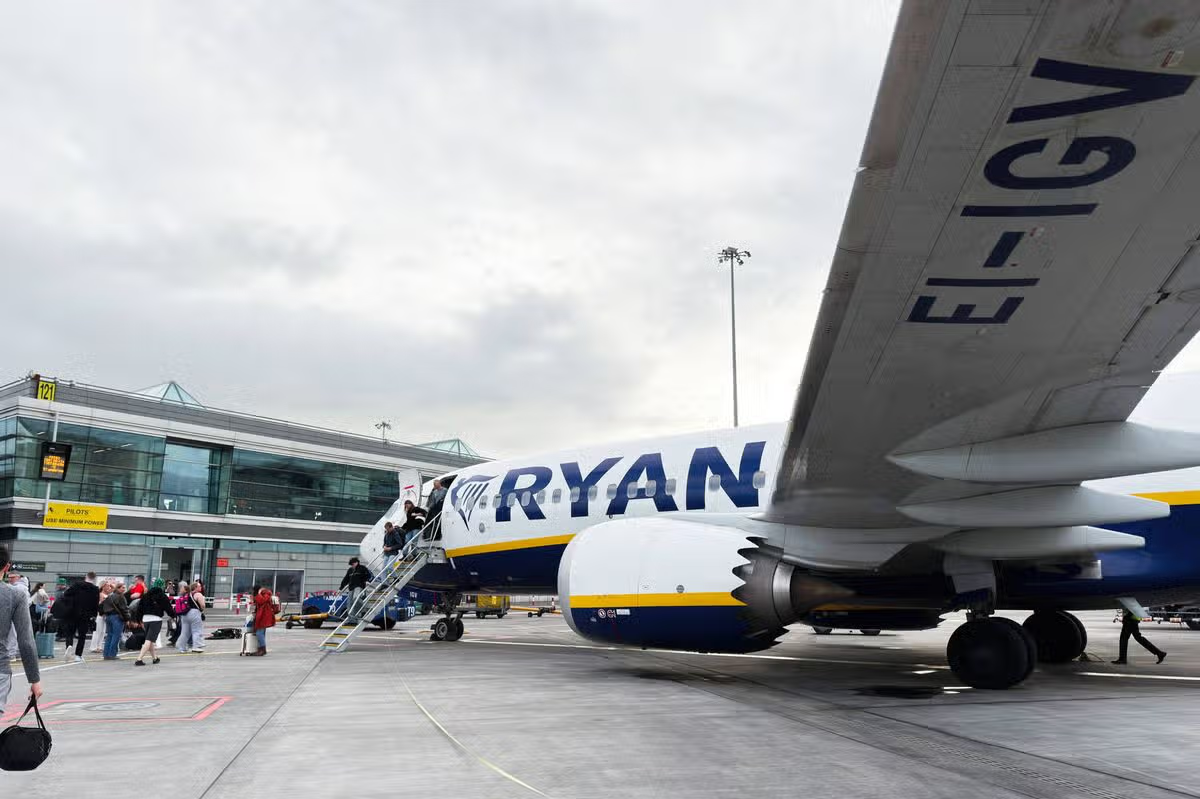
Ryanair has warned that if the war doesn’t end this month, there will be disruption from May.
Ryanair boss Michael O’Leary said: “Fuel suppliers are constantly looking at the market. We don’t expect any disruption until early May, but if the war continues, we do run the risk of supply disruptions in Europe in May and June, and we hope the war will finish sooner than that and the risk to supply will be eliminated.
“We think there is a reasonable risk, some low level, maybe 10 per cent to 25 per cent of our supplies might be at risk through May and June, so like everyone else in this industry, we hope the war ends sooner rather than later.
“If the war finishes by April and the Strait of Hormuz reopens, then there is almost no risk to supply.”
Despite the confidence that should negotiations be made, travel will not be under threat, it is reported that suppliers are unable to guarantee deliveries into May.
This week European jet fuel prices hit a record $1,900 per metric ton, according to specialised publication Argus.
The hike could see potential shortfalls coming in future months.
Kenton Jarvis, the boss of EasyJet, warned that pricing was “volatile” since this “terrible war started” however the company is “well hedged” in terms of supplies.
The likelihood of cancellations comes after four Italian airports last weekend introduced restrictions on jet fuel after disruption. Air New Zealand also cancelled a selection of flights due to high fuel prices.
Want a relaxed holiday in a place where you know kids will enjoy? TUI ranked the best spots for hassle-free family fun.
This article contains affiliate links, we will receive a commission on any sales we generate from it. Learn more
TUI ranked the best places to travel to with kids(Image: Getty Images)
Finding a place to travel where you can take kids and not worry about safe accommodation and fun activities can be difficult, but as of 2026, 86% of British parents agree that holidays are essential for family bonding, according to holiday giant TUI.
Taking into consideration factors such as where to keep children entertained while giving parents a chance to relax, reliable weather, open spaces and more, TUI ranked the top destinations in Europe that combine fun, sun, and convenience.
Here are the five best spots on the continent, according to the research.
5 – Barcelona, Spain
The well-known historical and architectural allures of Barcelona give way to family-friendly fun – as the city stands out with the highest number of TUI Musement excursions in the ranking (439). For those seeking a relaxed itinerary, the city also boasts 31 parks per 10 km².
The colourful Park Güell and the interactive CosmoCaixa Museum of Science are always hits with kids – and best paired with beach days along the Mediterranean for parents to enjoy.
4 – Catania, Italy
With a mean temperature of 26.7°C, Catania offers sunshine alongside rich history and cultural experiences – especially due to its location right next to Mount Etna, Europe’s most active volcano.
There, families can take excursions around the volcano and explore the deep roots of Catania’s lava caves and farms. When that’s done, it’s a great idea to head to the city’s bustling markets and grand piazzas to bask in the local culture or relax on the nearby beaches.
3 – Porto, Portugal
In third place is Porto, which TUI gives a score of 9.01/10. The city, located in the north of Portugal, is just a two-hour flight away, and is the perfect pick for families looking for simple, hassle-free fun.
Porto is easy to navigate, and offers 32 family-friendly hotels and 13 parks per 10 km². There, get ready to ride the historic Dom Luís I Bridge cable car or hop on a river cruise along the Douro.
To relax, enjoy beaches, riverside strolls, and vast parks.
2 – Naples, Italy
Naples scores 9.12/10, combining summer temperatures of 25.2°C and rich culture to be enjoyed by all ages.
Kids will have fun with authentic pizza-making immersive experiences and open spaces to explore with a good gelato in hand.
Time in the city is good enough, but from there you can set off to explore the ancient ruins of Pompeii, take a ferry to nearby islands, or stroll along the scenic seafront promenade.
1 – Lisbon, Portugal
The gold medal goes to Lisbon, crowned Europe’s most child-friendly city with a score of 9.16/10. The Portuguese capital has an average of 37 family-friendly hotels per 10 km², 17 parks and an entertainment score of 7.36/10.
Children are likely to love the Lisbon Oceanarium – one of Europe’s largest – and the beautiful trams that cross the city centre. After ticking those essential boxes, take time to explore riverside playgrounds and nearby beaches.
To get to Lisbon, flights depart from the main UK airports and take about 3 hours.
While budget airlines don’t typically offer complimentary products or refreshments on board, there is a time when passengers could get some extra perks, a flight attendant revealed
There might be some perks you can get on your next flight(Image: Getty Images)
It’s not unusual for airlines to charge extra for refreshments on board, but there’s a way you can get extra perks for free.
While we get to lap up the benefits of meals, drinks, and snacks included on long-haul flights, these sadly don’t apply to many short-haul flights, especially on budget airlines. Despite their appealing, affordable flight tickets, we can end up paying extra on board, especially if we’re in need of a snack or drink.
However, that doesn’t mean budget airlines never offer complimentary services. Adam Hodge, 35, who has worked as Wizz Air cabin crew for eight years and is based at Luton Airport, exclusively revealed to the Mirror just how passengers can take advantage of the perks on board without paying extra.
“If it’s someone’s birthday, if they’re travelling for a special occasion, or on their anniversary, I do like to go above and beyond where I can, “Adam, originally from Newcastle, explained.
“So I might make them a coffee or a tea just to say, ‘Happy wedding anniversary’, I try to make it special for them with what I can do.”
He sweetly added: “If someone purchases one of the lovely Proseccos that we have on board, I’ll tie a little handkerchief on the end, just to make it more special, for those little touches.”
While no one wants to be delayed on their flight, this is another time that airlines might offer a freebie to their passengers. Adam explained: “We do have situations where we have to do what’s called a ‘complimentary service on board’, that’s where we have a delay over a certain amount of hours. It depends on the actual destination and the journey time as to when we initiate a complimentary service.”
Explaining why this can occur, he added: “Sometimes in the summer when there’s really bad air traffic control delays, we can be faced with what’s called the ‘air traffic control slot’ where you have to wait.
“We could have been boarded 10 minutes early, but because we have a slot, we then might have to wait for 45 minutes or more to actually have that permission to get up due to the airspace. Sometimes, when passengers are onboard the aircraft for an X amount of time, we’ll offer a complimentary service, providing them with a snack and water on the house.”
But if it’s not a special occasion while flying, and without any unwanted delays, there’s plenty of chargeable refreshments onboard for passengers to enjoy. Adam even noted that Wizz Air has a new, nifty on-board ordering service available on flights, where passengers can order a drink or snack to their seat through an app, without waiting for the trolley service.
“After take off, we do app ordering first, followed by the trolley service,” he said. “Passengers scan the QR code and connect to our bluetooth where they can browse all of our products and promotions, and order to their seat. When the order arrives at their seat, they pay for it.
“It gives passengers more freedom and flexibility; they can order when they want. That service is available from after take-off to before landing, so they can order throughout the flight.”
For more information about Wizz Air flights or to book your next trip, visit their website.
Do you have a travel story to share? Email webtravel@reachplc.com
This destination is a ‘like for like’ alternative to pricey Italian hotspots with beer under £2
Isobel Pankhurst Audience Writer
02:10, 12 Apr 2026
This stunning region is a perfect ‘dupe’ for the Amalfi Coast(Image: Getty)
While a trip to the Amalfi Coast might seem like the ideal getaway, it’s one that can prove rather pricey, particularly once you account for spending money while you’re there. Yet elsewhere across Europe, there’s another breathtaking coastal spot that serves as an excellent alternative.
Laura Evans-Fisk, head of digital and engagement at Eurochange, has noted a substantial rise in British tourists visiting Bulgaria, with Sozopol emerging as a fantastic alternative to the Amalfi Coast.
Laura says: “Although Bulgaria has joined the euro, prices for things like food, accommodation and drinks are still particularly low compared to other popular holiday destinations like Greece, Spain and Italy.”
For example, you can expect to pay less than €2 (£1.7) for a beer and around €10 (£8.7) for a meal.
“And, Brits don’t need to compromise on the beautiful scenery and beaches these popular hotspots offer. In fact, there are plenty of destinations in Bulgaria that are almost a ‘like for like’ but at a fraction of the cost.”
Championing Sozopol specifically, she added: “This gorgeous coastal town has a really similar feel to the likes of Positano and Cinque Terre, in Italy’s famous Riviera.
“Sozopol’s old town is dotted with quaint wooden houses and cobbled streets that overlook the stunning coastline and bright blue waters.” Stunning Sozopol ranks among Bulgaria’s most ancient coastal towns and remains far less crowded than many other European hotspots.
Sozopol boasts Kavastie and Harmani beaches, along with several beach bars, ensuring that whether you’re after a family outing or an evening of drinks, you’ll find exactly what you need.
And if you fancy a change from lounging on the sandy coastline, there’s no shortage of alternative activities, from discovering the town’s historic churches, to soaking up some culture at Ravadinovo Castle or Sozopol Archaeological Museum, or enjoying a fun-packed day at Aquapark Neptun.
A recent visitor to Kavastie Beach posted on Tripadvisor: “Fantastic beach, one of the very best that I’ve ever been to. Extremely clean, wonderful sand and safe sea ideal for children. Decent bars and restaurants. We’ll definitely be back next year.”
Meanwhile, a tourist who explored Ravadinovo Castle wrote: “A very eclectic castle, but a marvel to behold. A place of wonder. Around every corner was an amazing sight and a surprise. The floors inside the chapel and the ceiling were incredible. A stunning day out.”
And a visitor to the Sozopol Archaeological Museum added: “We spent a few hours at the museum this summer. Although it’s not a huge museum, they have interesting exhibitions. The lady who was in charge of the museum was very nice and told us some peculiar facts about the history of Apolonia. Recommend taking a look at the second floor, where you can find an ancient ‘vampire’ skeleton.”
NEW Delhi doesn’t ease you in. Noise and colour come at you from every direction, and it both rewards your curiosity and leaves you exhausted.
One moment you’re weaving through packed markets in a rickshaw, the next you’re sitting in quiet contemplation at the Lotus Temple, which is shaped like an open petal.
Sign up for the Travel newsletter
Thank you!
Noise and colour come at you from every direction in New DelhiCredit: Alamy Stock PhotoTake a refreshing dip in the rooftop pool at Crowne PlazaCredit: Supplied by hotel PR
I also find calm at Crowne Plaza New Delhi Okhla in the south of the city.
Modern design is peppered with subtle Indian touches, and rooms are opulent with light streaming through large windows and bathrooms with big tubs and separate rain showers.
Plus, there’s a rooftop pool, where I take a refreshing dip before tucking into wok-tossed vegetable hakka noodles, £6.50, at the Edesia restaurant.
Come morning, after feasting at the breakfast buffet on an incredible dosa with coconut curd and mouth-watering medu vada (a crunchy, lentil doughnut), a rickshaw ride through the narrow streets of Old Delhi’s Chandni Chowk proves not for the faint-hearted, but essential for soaking up the culture.
I pass street performers walking tightropes, while food vendors fry pakora and kachori at astonishing speed.
Wandering through Khari Baoli, a market dating back to the 17th century, I’m hit by clouds of fragrant spices, before I visit the Red Fort, a magnificent structure built from deep-red sandstone that served as the residence of Mughal emperors for almost 200 years.
The Red Fort is a magnificent structure built from deep-red sandstoneCredit: Getty ImagesWeave through packed markets in a rickshawCredit: Alamy Stock Photo
The next day, I explore the newer district of the city. Standing proud at the heart of the capital is India Gate, built in 1931 as a memorial to fallen soldiers.
A 10-minute taxi away is the free National Gandhi Museum, which is full of photographs, letters and personal items from Gandhi’s life (Gandhimuseum.org/museum).
And I find I need three hours at the Swaminarayan Akshardham temple, to wander the gardens and explore the exhibitions, which cost just £2.50.
The landmark also comes alive lit up at night with a spectacular fountain show, tickets cost 90p (Akshardham.com).
Chai and stop me!
Hauz Khas Village offers a different rhythm and is a brilliant labyrinth of shops, bars and cafes.
I find Chumbak, an adorable homeware shop filled with playful glassware, notebooks and ornamental plates (Chumbak.com), before unwinding with a masala chai at The Tea Room From Blossom Kochhar (Facebook/Thetearoomhkv).
After a stroll around the calm of Deer Park, home to monkeys, peacocks and a handful of spotted deer, I catch the sunset from the terrace at Hauz Khas Social.
Feast on a superb paneer curry with buttered naanCredit: Getty Images/Maskot
Here, delicious momos – vegetable dumplings coated in rich masala sauce, £3 – pair perfectly with a glass of crisp chardonnay, £6.10 (Socialoffline.in).
Another evening, I head to Karol Bagh market, home to Hooter Restro & Bar, which offers superb paneer curry with buttered naan, £6 (@Hooter_restrobar), before watching live musicians performing on the buzzy rooftop at Epic Restro Bar (@Epicrestrobar).
India is also the birthplace of yoga, so before I set off to explore this intoxicating country further, I decide to join an early-morning class at Seema Sondhi, £10 (Theyogastudio.info).
It proves to be the perfect moment to reflect on an exhilarating and unforgettable city break.
The provided text commemorates Juan Santamaría Day, a significant national holiday in Costa Rica that honors the country’s most famous military hero. The article recounts the Battle of Rivasin 1856, where a young drummer boy sacrificed his life to set fire to a stronghold occupied by the forces of American filibuster William Walker. This courageous act forced the enemy to retreat and ultimately secured a vital Costa Rican victory. Today, Santamaría is immortalized through various monuments and landmarks, most notably the nation’s primary international airport. His legacy serves as a lasting symbol of patriotism and national identity for the Costa Rican people.
SMOKE dramatically billowing from the cake stand, you could be forgiven for thinking one of my children had accidentally set their menu on fire during our afternoon tea at the Ampersand Hotel in London.
But luckily for us, this was all part of the thrilling theatrical experience that is the Science Afternoon Tea.
Sign up for the Travel newsletter
Thank you!
We enjoyed a science themed afternoon tea at the Ampersand Hotel in LondonCredit: SuppliedCaroline’s three children aged five, eight and 12 were captivated from the very first momentCredit: Supplied
Brilliant for kids, and an ideal treat for the school holidays, it is a tea like no other, where cake stands arrive festooned in smoke, courtesy of a clever dry-ice science trick.
My three children aged five, eight and 12 were captivated from the very first moment.
Even before tea arrives, a collection of scientific-looking glass beakers are brought to the table and everyone is invited to mix their own lemonade using sachets of fixing powder, syringes of sugar syrups and pipettes of delicious raspberry and blackcurrant flavourings.
The fun science lesson continues with the arrival of rocket-shaped cake stands for the kids.
Dainty jam sandwiches were cut in the shape of dinosaurs, the delicious cheese straw was a rocket and the tasty blackberry mousse cake was shaped like Saturn.
But my daughter’s favourite was the out-of-this-world planet-shaped cake pop, covered in sprinkles.
Grown-ups get to enjoy the fun too, with their adult cake stands also doused in dry-ice and featuring the same delicate blackberry cake.
But we also got a sophisticated mango, pistachio and almond moon cake topped with a coffee-and-chocolate astronaut – a very cute touch.
There was a lighter-than-air macaroon, too, into which we were invited to inject our own raspberry filling via a syringe.
We even saw real-life astronaut suitsCredit: Supplied
Then, both kids and adults alike are treated to a refreshing mandarin-and-redcurrant jelly served, of course, in a petri dish.
Kids are also invited to become palaeontologists by “excavating” a dino cookie buried in a tin of chocolate dust using a brush.
While adults can choose from a menu of teas – with the option to upgrade to champagne – children are brought steaming mugs of milk and asked to create their own hot chocolate using solid-chocolate lollies, marshmallows and crunchy chocolate pearls.
The whole experience is so playful.
It is the kind of culinary magic you might expect to find at Heston Blumenthal’s Fat Duck restaurant – but with young guests also in mind.
The unusual experience has been inspired by the hotel’s location next-door to London’s Science Museum – which is free to visit.
Fuelled by our rocket tea, we combined our visit with a trip to the museum’s fascinating galleries where we saw real-life astronaut suits, spacecraft and moon rock . . . not the edible kind.
GO: The Science Afternoon Tea is from £39.50 per child and £64.50 per adult.
TikTok travel influencer Luke Patrick described the city as “highly underrated”. He said: “It’s unfairly a bit overshadowed by Istanbul, but I’m here to change that.
16:00, 11 Apr 2026Updated 16:04, 11 Apr 2026
Bursa’s old town is just one of the great things to see in the city(Image: Getty Images)
While Turkey is already an incredibly popular holiday destination among Brits for its stunning beaches and the historic city of Istanbul, there’s another part of the country you might not have considered for your next break. And if you’re looking for somewhere a bit off the beaten track filled with history, culture, and great food, one travel influencer has you covered.
Luke Patrick, who regularly shines a light on lesser-known destinations in Eastern Europe and further afield on TikTok, where he has more than 22,000 followers, recently posted a video showcasing the city of Bursa. The city in north-west Turkey lies south of Istanbul, across the Sea of Marmara, and has a lot to offer.
Opening his video, Luke said: “I am in Bursa, one of the largest cities in Türkiye, and one of the former capitals of the Ottoman Empire. Here’s how to spend a day in this wonderful city.”
The Ottoman Empire spanned much of South East Europe, West Asia, and North Africa, with its heart in modern-day Turkey. It lasted more than 600 years, from the 14th century up to 1922.
Continuing, Luke said: “Bursa is one highly underrated city. It’s unfairly a bit overshadowed by Istanbul, but I’m here to change that.
“The first place you should visit is Tophane Park. It’s where the old Ottoman Sultans are buried, and here you can get the best views over the city.”
He continued by highlighting the cuisine on offer, saying: “Bursa is in my opinion the best food city in Türkiye. What you want to get is iskender and tahini bread with simit.” Iskender is a dish consisting of sliced lamb or chicken with hot tomato sauce over pieces of pita bread, topped with sheep’s milk butter and yoghurt, while simit is a ring-shaped bread which looks similar to a bagel.
Luke said: “You eat it by dipping the simit in the tahini. This is usually my go-to breakfast.”
Continuing, he said: “Another place you definitely want to visit in Bursa is Koza Han. A Han is basically an old rest stop for merchants and travellers. Here you can get the best Turkish coffee.
“And finally, you want to visit the Grand Bazaar. Here they sell everything, and it’s all much cheaper than at the one in Istanbul.”
One person in the comments added their own suggestion for people visiting the city. They said: “Bursa is also renowned for its skiing resort, and also the oldest Ottoman village, Cumalıkızık.”
Content cannot be displayed without consent
How can I get to Bursa?
The closest airport to the city is Bursa Yenişehir Airport, which is about 30 miles east of the city itself. However, no airlines currently offer direct flights from the UK.
The most direct option is to fly to one of Istanbul’s two airports – Istanbul or Sabiha Gokcen. Direct flights to both are available from a number of UK airports. The flight takes around four hours.
From there, you can either hire a car, or travel by bus to Bursa. The journey takes around two hours.
JUST off the Algarve coast, near Faro, is the Ilha Deserta.
This literally means “deserted island”, but there was no going hungry when I hopped on a boat to this unique spot.
Sign up for the Travel newsletter
Thank you!
There is a quiet sandy island just off the Portuguese coastCredit: SuppliedJill took a trip to Ilha DesertaCredit: SuppliedPraia Do Canal Nature Retreat is a five-star hotel set in the heart of the Vicentine Coast, offering tranquillity and relaxationCredit: Supplied
Call me Jill Robinson Crusoe, if you will.
Alongside seven kilometres of gorgeous white sand, the island is home to just one building – the fish restaurant Estamine.
And every dish on the menu is worth the trip alone.
My delicate, buttery, grilled sea bass was cooked to perfection and served with roasted potatoes and vegetables.
The choice is dizzying, with everything from giant carabinero prawns and Atlantic lobster to crispy sand shrimps and Grandma’s squid stew.
Reached by boat taxi in around 15 minutes, the restaurant has stunning views of the Atlantic from its floor-to-ceiling windows.
Afterwards, you can sunbathe beside the crystal-clear waters, or take a peaceful stroll while trying to spot the rare birds and chameleons that frequent the island.
If, however, you prefer something a little more fancy, you can enjoy a catamaran trip around the Ilha Deserta, which is part of the Ria Formosa Natural Park — a coastal lagoon stretching 60km from Faro to Manta Rota.
I sailed with a local company called iSea and have to admit, sitting on deck with a glass of prosecco and the sun on my face was a highlight of my trip.
But if you don’t have the sea legs for a boat trip, the Algarve has plenty for you to enjoy on dry land.
Faro itself has a marina and historic old town with cobbled streets.
And here, you can delve into fabulous Portuguese cuisine at Tertulia Algarvia, which is set in an historic whitewashed building.
Alongside cooking classes, craft workshops and cooking demonstrations, it serves up some real classics.
Fish restaurant Estamine sits on the sandy shoresFpraiCredit: Unknown
There’s still plenty of seafood, from octopus rice to grilled golden bream, but a standout on the menu was the chicken piri-piri.
This original grilled chicken dish comes with a spicier marinade than your local Nando’s as well as a huge portion of crispy chips, all for just £12.60.
Meat dishes are as big a deal as seafood and fish across much of the region, and I was always spoilt for choice when it came to getting my daily fix of protein.
One of my favourite places was in Aldeia da Pedralva — a rural village which has been lovingly rebuilt after many of the buildings were left in ruins.
Now, most of the village buildings are available as accommodation to hire, but the main restaurant, Sitio da Pedralva, is a destination in itself thanks to its incredible farm-to-table offerings.
From succulent wild boar to melt-in-your-mouth pork cheeks, it was a true meat lover’s paradise.
As well as the meat dishes, the chef also serves another classic dish from the region, bacalhau no pao — creamy cod served in a rustic, hollowed-out crusty-bread bowl. Delicious.
After all that food, I needed a walk and, thankfully, a short drive away was a stunning coastal route which makes up part of the Fisherman’s Trail.
Covering 226km from Sao Torpes (near Sines) to Lagos, it is considered one of the best coastal paths in the world.
Along the way, it offers views of dramatic, rugged cliffs that drop off into incredible turquoise waters, and waves that keen surfers seek to ride.
If you want to see the sights but don’t fancy a hike or walk, a Jeep tour is another fun option — and I did a morning trip with Sagres Discovery.
Our charismatic driver took us off-roading to the western Algarve, including Sagres and Cape St Vincent Lighthouse — one of the most powerful in Europe.
All the adventure, food and sea air can certainly make you feel sleepy and, thankfully, I had the perfect place to stay a little further along the coast.
Praia Do Canal Nature Retreat is a five-star hotel set in the heart of the Vicentine Coast, offering tranquillity and relaxation, not to mention incredible decor and attention to detail.
A brief glance at the delicious grilled fish menuCredit: supplied
With an infinity pool, yoga classes and exceptional food in its restaurant, it’s perfect if you want to reconnect with nature — and yourself.
The huge rooms also offer a shower that is bigger than my entire bathroom at home, massive beds and views across the rolling hills to the Atlantic Ocean.
But if you want to stay closer to the action and not somewhere as remote as Praia Do Canal Nature Retreat, Faro is a great place to base yourself.
I finished my stay in the region with a couple of nights at 3*B Faro, the only five-star hotel in the downtown area of the city, and just a short walk from the old town and marina.
With a rooftop infinity pool and terrace, as well as indoor spa facilities, the hotel offers some quiet calm once you’ve finished a day of exploring the region.
The Algarve is also a top destination for wine lovers, and a trip to a local vineyard is a must for any itinerary.
I enjoyed a lovely lunch and afternoon at Morgado do Quintão — a family-owned vineyard that also offers a farm-stay experience if you want to linger a little longer.
The estate offers guests a farm-to-table experience with a wine flight from its collection, which has revived the indigenous Negra Mole grape.
It is known for having an unusual variation of grape colour within the same bunch.
I had the chance to try a white, rose and red during my visit, all while enjoying fine views of the vineyard and the imposing 2,000-year-old olive tree which sits in the grounds.
I left the Algarve with a totally different perspective.
From deserted islands to delicious dishes, I’d encourage anyone to go and enjoy every tasty morsel of it for themselves.
GO: Algarve
GETTING THERE: There are multiple daily flights to Faro from most UK airports with British Airways, Ryanair, easyJet, Wizz Air and Jet2. Fares start from £29 return in May.
STAYING THERE: Double rooms at the Praia do Canal Nature Retreat are from £209, including breakfast.
The laid-back, authentic island is packed with charming fishing villages, family-run tavernas and stunning underground caves
13:13, 11 Apr 2026Updated 13:14, 11 Apr 2026
This island is overlooked but shouldn’t be(Image: miljko via Getty Images)
Summer is just around the corner, and millions of Brits are probably already mapping out their sunshine escapes. If that sounds like you, then Greece offers the perfect combination of sun and sea. But with countless islands on offer, deciding where to go can feel overwhelming.
Through examining search data, TripAdvisor reviews and geological information, yacht charter firm Sunsail has uncovered some of Greece’s hidden treasures where you can dodge the masses.
Among these islands is Meganisi – a relaxed, authentic Greek destination brimming with picturesque fishing villages, family-run tavernas and spectacular underground caves.
The island boasts a fascinating history, ideal for discovery.
Among the unmissable attractions is Papanikolis cave, one of the largest and most renowned sea caves in Greece, reports the Express.
Previously used as a submarine hideout during WWII, this enormous cave extends 120 metres in length and 60 metres in width.
Visitors can join one of the numerous boat excursions and take a refreshing dip in the crystal clear waters inside the cave.
There’s also a secret beach within that you can reach by swimming. One TripAdvisor review stated: “You cannot realise how huge it is until you actually get in there, then you feel so small… an interesting natural wonder.”
On dry land, Meganisi offers plenty to discover. Spanning just 20 square kilometres, it’s compact yet impressive.
Frequently overlooked in favour of its bigger neighbour Lefkada, the island remains wonderfully untouched by overtourism.
Vathi, the island’s largest of two ports, is a delightful, traditional fishing village bookended by two churches, built to bestow blessings upon every vessel arriving and departing the island.
A handful of waterfront tavernas and cafés line the harbour, serving up freshly caught seafood.
The smaller port of Spilia is equally charming, with fewer tavernas but just as much beauty to offer.
A brief stroll around the bay brings you to a lengthy sandy beach, complete with a further selection of snack bars.
A British woman who left the UK for the USA has spoken about how one incident forced her to re-evaluate her whole life in the country
Kari Wells swapped Yorkshire for the USA but found herself reevaluating life after one moment(Image: Getty)
A woman who moved from Yorkshire to the United States at the age of 22 has spoken about how one moment in her new home country caused her to re-evaluate everything.
Kari Wells, who built a career on the American cable channel Bravo, moved to Aspen, Colorado where she met her now husband Duncan with whom she has two children.
Later, the pair moved to Atlanta, Georgia, which is where things took a turn when she was robbed in October 2019 by two gunmen.
In the ensuing robbery, Wells was knocked out when she was hit on the back of her head by one of the gunmen. Despite surviving, the robbery would have a major impact on her with Kari telling the Telegraph she later received treatment for Post Traumatic Stress Disorder (PTSD) that in turn led to her writing her book ‘From Attitude to Gratitude’.
Speaking to the publication, she said that the incident was a “literal way” of being forced to “re-evaluate” her life. She explained: “It’s like I was juggling it all, and I was so busy that I wasn’t really living my life. I was on this treadmill, missing out on a lot of great things.
“The aftermath was more traumatising than the event because you go into this state… something that I cannot even explain.”
During her recovery, Wells convinced her husband to make several changes to their home including parking their car across their gate that they secured with cable ties.
Furthermore, the pair also moved back to where they’d first met in Aspen, Colorado. The incident also brought into even sharper relief for Wells the “insanity” of gun violence in the USA.
Although Kari is one of many people who has moved from the UK and Europe to the USA, in recent years there has been a growing trend in the opposite direction with Americans now moving to the UK and Europe.
According to data from the Brookings Institution reported in The Wall Street Journal, the USA saw negative net migration for the first time in nearly a century in 2025 with more people leaving than arriving last year for the first time since 1935 and the peak of the Great Depression.
Although this massive moment has happened during US President Donald Trump’s second term, in a phenomenon some have dubbed ‘The Donald Dash’, others say the situation is more complex than one person becoming leader.
Other examples include economic changes and the rise of remote working meaning more people can work from anywhere on the planet and don’t have to be tethered to their job by geography.
Gun violence is also a factor with Berlin-based employee of a Texas real estate investment firm Chris Ford using an example of active shooter drills, reports the Independent.
This, he said, was one major difference between life in the USA and life in European nations such as Spain and the Netherlands: “You don’t face the prospect of your five-year-old going into a kindergarten and doing an active shooter drill. The wages are higher in the U.S. but the quality of life is higher in Europe.”
For emotional support, you can call the Samaritans 24-hour helpline on 116 123, email jo@samaritans.org, visit a Samaritans branch in person or go to the Samaritans website.
IF you want the beauty of the Amalfi coast but without the hefty price tag, then there is an alternative to consider.
The pretty fishing village of Camogli in northern Italy has beautiful multi-coloured houses and has even been dubbed a gem of the Italian Riviera.
Sign up for the Travel newsletter
Thank you!
Pretty Camogli is a cheaper alternative to jetting off to the Amalfi CoastCredit: AlamyCamogli has similar qualities to Positano town on Amalfi CoastCredit: Alamy
Camogli sits on the Ligurian Riviera and its main stretch of beach is lined with pretty pastel buildings – much like towns on the Amalfi Coast.
Spiaggia di Camogli is the village’s pebbled beach that is lined with restaurants, cafes as well as sunloungers and parasols.
It’s quite a famous spot so it can get quite busy, especially on the weekend when there are daytrippers from Portofino.
One visitor who recommends visiting in low season said: “Camogli seafront always offers a bit of magic.”
Summers on the Amalfi coast are known for being hot and dry – Positano can reach highs of 33C.
It’s a tad cooler in the north of Italy and Camogli has average highs of 27C in July and August.
Another multi-coloured town along the coastline that you might want to tag onto your trip is Boccadasse.
Like Camogli, it has pastel-coloured houses built on top of cliffs and was a former fishing village.
It’s said to look like it’s ‘frozen in time’, and sits outside the city of Genoa and is a 30-minute drive from Camogli.
You’ll get the best views of the coastline if you walk along Corso Italia which connects Boccadasse to Genoa.
Boccadasse is also has independentrestaurantsthat you’ll want to pop into and try Ligurian specialities like focaccia and pesto-based pasta dishes are served.