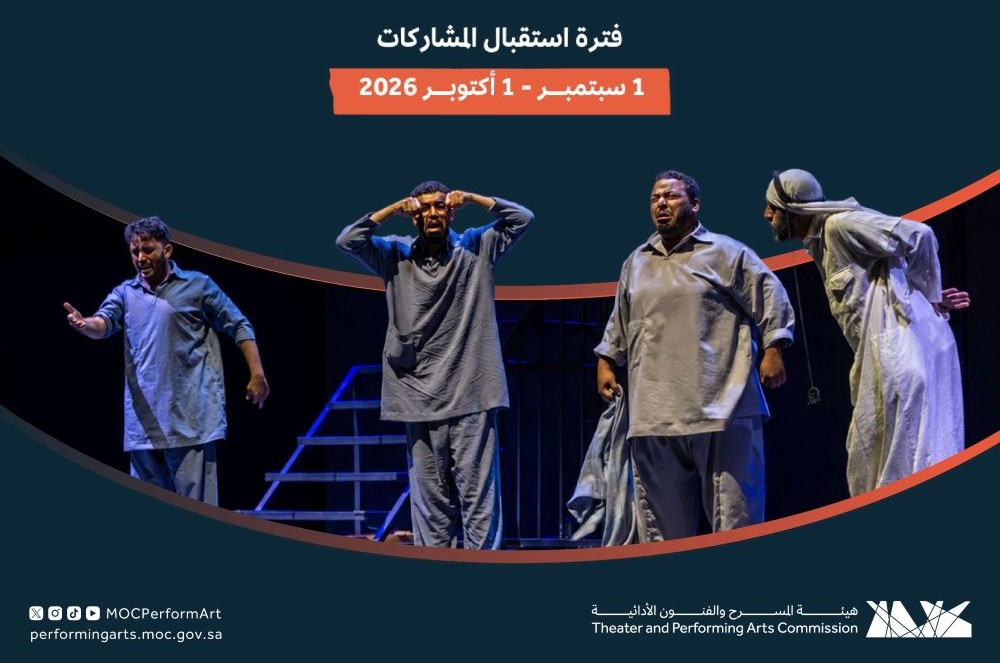

RIYADH: The performing arts in the Kingdom is undergoing a transformation driven by cultural investment, new venues, international collaboration, and a growing network of local professional and academic institutions, making it tempting for young Saudis to pursue.
While academic study in the field is comparatively new, Saudi theatrical production is not. The Kingdom has long produced recognized theater throughout the Gulf and regionally, but many practitioners studied overseas.
Today, Saudi Arabia is localizing the education of its creative talent through academic and professional training in the country.
Since 2020, Saudi has dedicated a Theater and Performing Arts Commission to regulate and develop a sector encompassing theater, dance, circus, improvisational comedy, street performance, ballet and opera.
Not only through training but also national competitions and workshops.
Undergraduate programs are offered at King Saud University, Princess Nourah University and most recently the Riyadh University of Arts. While the Royal Institute of Traditional Arts provides postgraduate and diploma-level education, Scene Institute, and Ithra have further professional training.
As Saudi universities begin their academic year, many students are continuing their conventional degrees. Other creatives are pursuing their passions academically, making the most of the opportunities the Kingdom has to offer.
Osama Almutairi, a final-year Bachelor of Arts in Theater student at King Saud University, spoke to Arab News about the feasibility of his academic choice.
“My love and passion for the arts, particularly theater, naturally led me to this specialization.”
Theater was not his first choice. “I initially considered studying political science but was accepted into theater as part of the first cohort at the College of Arts,” he said.
“Despite my initial interest in pursuing a conventional degree in the humanities, the continuous development of Saudi Arabia’s arts sector encouraged me to take this step.”
Saudi Arabia has been taking proactive measures while localizing performing arts scholarships.
The Ministry of Culture has been running a fully funded Cultural Scholarship Program that supports creative specializations at 278 approved institutions across 15 countries, including performing arts.
One beneficiary is Majed Al-Muwallad, an actor and theater teacher at Afaq Academy, who completed his Bachelors in Theater Studies at Royal Holloway, University of London.
“I travelled to London in 2021. During my studies, I participated in several theatrical productions, ranging from small projects to larger, more academically oriented university productions.
“I had loved acting since I was about 14 years old. I loved films, acting, stories and dramatic texts. When the scholarship opportunity appeared, I thought: ‘Why should I let this opportunity pass?’ I decided to take it.”
Al-Muwallad said he left a job at Aramco to pursue his childhood dream, although members of his community were uncertain about his unconventional choice.
“They were not sure about the professional opportunities available or where such a career could lead,” he said.
“It was a major career change, and leaving Aramco to pursue acting was an unfamiliar idea. People do not usually leave Aramco to become actors,” he added.
Now that he has graduated and is teaching Saudi youth to act, Al-Muwallad believes it was a good decision.
He is even considering pursuing a master’s degree in the performing arts, specifically in performance design. For him, the opportunities are not limited to acting. He hopes to build on his studies in costume, lighting and set design.
“Every theatrical production needs design. It requires a set, costumes and lighting. Rather than limiting myself to the acting and performance side of theater, I would like to develop expertise in design and contribute to the audience’s overall visual experience.”
Almutairi believes perceptions will continue to change as Saudi artists demonstrate the value of academic training.
“The future is wide open for the arts and artists. Society’s perception will continue to change as academically trained Saudi artists demonstrate their ability to represent their communities and country.
“This change is already becoming evident, with society playing an increasingly important role in supporting the success of Saudi artists nationally and internationally.”
For Al-Muwallad, theater should be approached holistically — not only as a career or degree, but also as a journey of self-discovery.
“I learned a great deal before I even began teaching the students. I had to learn how to communicate theatrical knowledge and present information in a way students could understand.
“The experience has taught me a lot about communication and how to identify students’ talents. Theater teaches communication and helps students discover themselves.”
Al-Muwallad encourages young people in Saudi Arabia to pursue their passions academically. “My advice is not to treat university as merely a stage that you pass through and finish,” he said.
“Students should engage with the experience deeply and benefit from it in every possible way.”
He said soft skills can be learned through theater, including communication, emotional intelligence and teamwork.
“Another piece of advice we were always given in London was to always ask questions. A question produces an answer, and that answer often generates another question.
“Asserting that openness and eagerness to learn is vital to a good actor, theater itself is founded on curiosity.
“Students should watch a wide variety of theater and explore different traditions, including Arab, English, Greek and Russian theater, as well as influential approaches such as Russian (theatre practitioner Konstantin) Stanislavski’s.”
On Saudi having a relatively emerging academic orientation to performing arts, Almuwallad sees it as a big opportunity rather than a challenge or a barrier.
“Saudi Arabia is still developing in this field, which means students now have an opportunity to participate in shaping it. What they create can become visible and make an impact relatively quickly.”
“Students should recognize that they are important. They should not treat themselves as secondary characters in this development. They have the opportunity to play a central role because the field is still new.”
For Saudi youth choosing an arts degree over a safer, conventional path, there is an opportunity to turn passion into a profession, and ultimately shape the nation’s creative scene.