degree

‘Flying too close to the sun.’ Fans endure heat at Dodger Stadium

It was so hot at Dodger Stadium on Saturday…

How hot was it?

It was so hot a team that averaged nearly 50,000 fans for often meaningless regular-season games beat the Atlanta Braves 5-3 in its first postseason game before thousands of empty seats — some of which were literally too hot to sit in.

It was so hot the Dodgers set up pallets of bottled water near the gates and anyone brave enough to enter the stadium was given a plastic 16-ounce Dasini bottle. Gatorade also set up a cooling tent under the right-field pavilion.

It was so hot Nicolas Gonzalez, a fan sitting in the shade of the reserved level, saw a stadium attendant, overcome by heat, stretchered before the game even started. She wasn’t the only one. By the later innings, other fans on the reserved level were reportedly seeking medical attention on the concourse.

The Dodgers declined comment.

So how hot was it?

The game started 45 minutes after the National Weather Service issued an extreme heat warning, cautioning against “extremely dangerous heat conditions” as the temperature reached 100 degrees at first pitch. By the third inning, the temperature reading atop the left-field scoreboard peaked at 103 degrees, matching the highest first-pitch temperature at 64-year-old Dodger Stadium.

“I’ve been coming to games my whole life and this is easily the hottest game I’ve ever been to,” said Gonzalez, 38, of Culver City. “Having a game in these conditions feels like we’re flying too close to the sun, both literally and figuratively.”

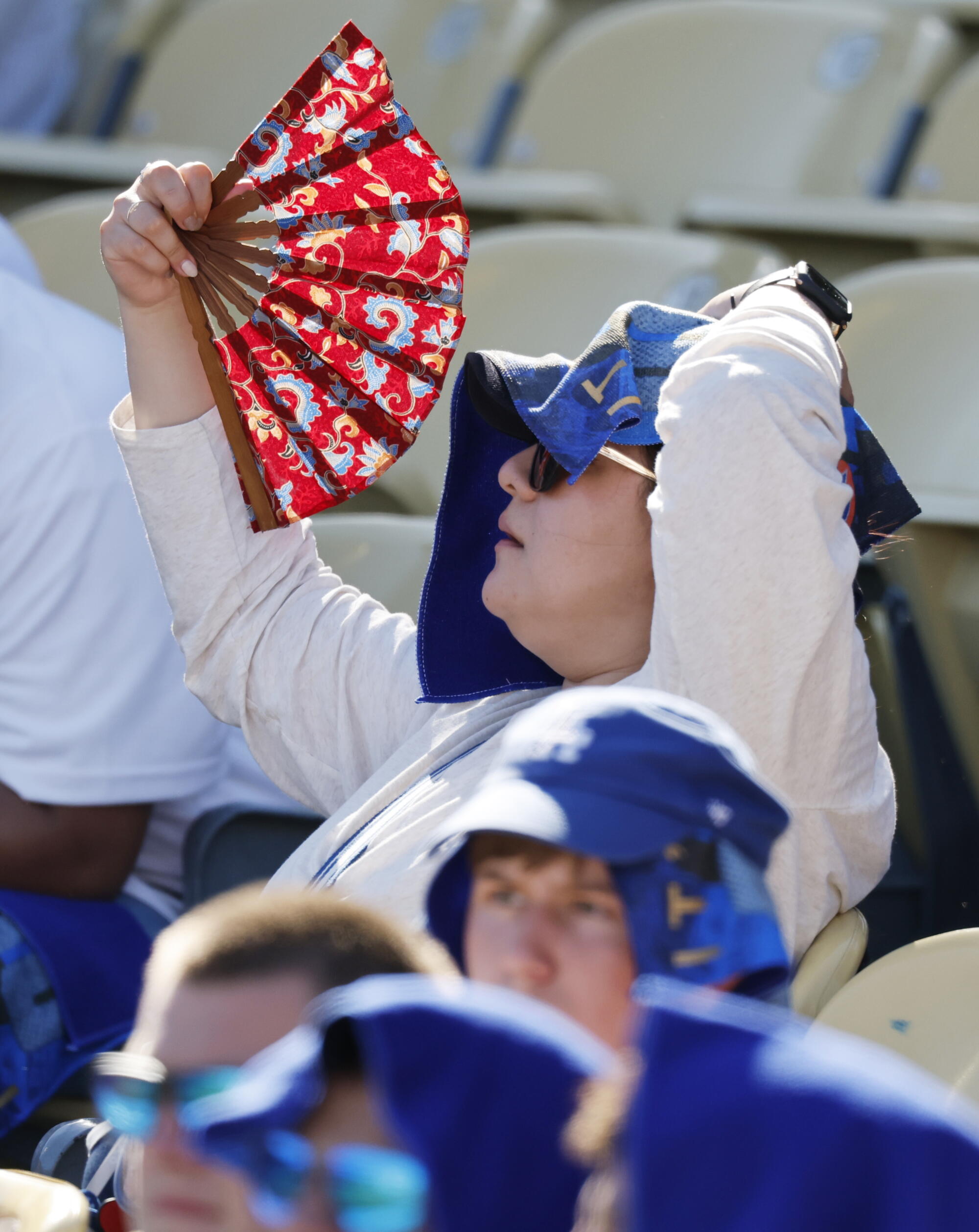
A fan tries to stay cool during Game 1 of the NLDS between the Dodgers and Atlanta Braves at Dodger Stadium on Saturday.

A fan tries to stay cool during Game 1 of the NLDS between the Dodgers and Atlanta Braves at Dodger Stadium on Saturday.

(Gina Ferazzi / Los Angeles Times)

Around him, fans tried to cool themselves by waving makeshift fans. It didn’t work.

But the weather didn’t just effect the way the game was watched. It effected the way it was played, too. The cloudless skies made every pop-up an adventure and the warm, dense air reduced drag, allowing batted balls to travel further. As a result, the teams combined for five homers, accounting for all eight runs.

“That’s probably one of the hottest games that we’ve ever had here. And so shout out to the Dodger fans; they were amazing,” said Max Muncy, who hit of those five homers.

“My feet were hot. Really hot.”

The Dodgers wound up with an early afternoon game in the middle of a historic heat wave because MLB and the TV networks — in this case Fox and TBS — set conditional start times for the four Division Series games before the teams and matchups were known. When the San Diego Padres eliminated the Chicago Cubs in the wild-card round, Saturday’s early NL game went to the Dodgers.

Left-hander Tarik Skubal, who gave up just a run on two hits in six innings to get the win in his Dodger postseason debut, said he didn’t really notice the heat until he came out of the game.

“I walked back into the dugout, and I asked — I forget who, I think it was [Blake] Snell — I was like, ‘has it been this hot all game?’ It’s amazing what your brain can do in certain circumstances and moments,” he said.

“I actually didn’t think it was horrible when I was pitching.”

But then Skubal pitched in much hotter conditions as a kid growing up in northern Arizona.

“I played a Little League game in 127 [degrees]. Lake Havasu,” he said. “[Saturday’s] up there with as hot a baseball game that you can play in.

“Every team’s playing in it, right? They’re playing in the same conditions we are. It shouldn’t really impact how you are mentally or how it’s going to impact how you pitch. Just go out there and play baseball and try to drink water. That’s really it.”

At least Skubal got to drink his water in the relative cool of the dugout between innings. Umpire Roberto Ortiz, wearing 10 pounds of protective gear and a black-and-gray uniform, got no such relief. He had to stand behind the plate for 2 hours 44 minutes and all 290 pitches, one of which smoked him in the seventh inning.

That’s why his five fellow umpires made a point of patting him on the back or shoulder before jogging to their positions for the first pitch.

“He stayed tough,” Dodger catcher Will Smith said of Ortiz. “I’m sure he’ll rehydrate and be ready for tomorrow.”

Speaking of tomorrow, the Dodgers, Braves and the umpires will all get some relief for Game 2. At first pitch Sunday afternoon the Weather Channel is forecasting a temperature of just 97 degrees.

“The dark silver lining,” Gonzalez, the heat-weary fan said in a nod to global warming, “is this might be the coolest October of the rest of our lives.”

Source link

Arab News | Is a performing arts degree worth it for young Saudis?

RIYADH: The performing arts in the Kingdom is undergoing a transformation driven by cultural investment, new venues, international collaboration, and a growing network of local professional and academic institutions, making it tempting for young Saudis to pursue.

While academic study in the field is comparatively new, Saudi theatrical production is not. The Kingdom has long produced recognized theater throughout the Gulf and regionally, but many practitioners studied overseas.

Today, Saudi Arabia is localizing the education of its creative talent through academic and professional training in the country.

Since 2020, Saudi has dedicated a Theater and Performing Arts Commission to regulate and develop a sector encompassing theater, dance, circus, improvisational comedy, street performance, ballet and opera.

Not only through training but also national competitions and workshops.

Undergraduate programs are offered at King Saud University, Princess Nourah University and most recently the Riyadh University of Arts. While the Royal Institute of Traditional Arts provides postgraduate and diploma-level education, Scene Institute, and Ithra have further professional training.

As Saudi universities begin their academic year, many students are continuing their conventional degrees. Other creatives are pursuing their passions academically, making the most of the opportunities the Kingdom has to offer.

Osama Almutairi, a final-year Bachelor of Arts in Theater student at King Saud University, spoke to Arab News about the feasibility of his academic choice.

“My love and passion for the arts, particularly theater, naturally led me to this specialization.”

Theater was not his first choice. “I initially considered studying political science but was accepted into theater as part of the first cohort at the College of Arts,” he said.

“Despite my initial interest in pursuing a conventional degree in the humanities, the continuous development of Saudi Arabia’s arts sector encouraged me to take this step.”

Saudi Arabia has been taking proactive measures while localizing performing arts scholarships.

The Ministry of Culture has been running a fully funded Cultural Scholarship Program that supports creative specializations at 278 approved institutions across 15 countries, including performing arts.

One beneficiary is Majed Al-Muwallad, an actor and theater teacher at Afaq Academy, who completed his Bachelors in Theater Studies at Royal Holloway, University of London.

“I travelled to London in 2021. During my studies, I participated in several theatrical productions, ranging from small projects to larger, more academically oriented university productions.

“I had loved acting since I was about 14 years old. I loved films, acting, stories and dramatic texts. When the scholarship opportunity appeared, I thought: ‘Why should I let this opportunity pass?’ I decided to take it.”

Al-Muwallad said he left a job at Aramco to pursue his childhood dream, although members of his community were uncertain about his unconventional choice.

“They were not sure about the professional opportunities available or where such a career could lead,” he said.

“It was a major career change, and leaving Aramco to pursue acting was an unfamiliar idea. People do not usually leave Aramco to become actors,” he added.

Now that he has graduated and is teaching Saudi youth to act, Al-Muwallad believes it was a good decision.

He is even considering pursuing a master’s degree in the performing arts, specifically in performance design. For him, the opportunities are not limited to acting. He hopes to build on his studies in costume, lighting and set design.

“Every theatrical production needs design. It requires a set, costumes and lighting. Rather than limiting myself to the acting and performance side of theater, I would like to develop expertise in design and contribute to the audience’s overall visual experience.”

Almutairi believes perceptions will continue to change as Saudi artists demonstrate the value of academic training.

“The future is wide open for the arts and artists. Society’s perception will continue to change as academically trained Saudi artists demonstrate their ability to represent their communities and country.

“This change is already becoming evident, with society playing an increasingly important role in supporting the success of Saudi artists nationally and internationally.”

For Al-Muwallad, theater should be approached holistically — not only as a career or degree, but also as a journey of self-discovery.

“I learned a great deal before I even began teaching the students. I had to learn how to communicate theatrical knowledge and present information in a way students could understand.

“The experience has taught me a lot about communication and how to identify students’ talents. Theater teaches communication and helps students discover themselves.”

Al-Muwallad encourages young people in Saudi Arabia to pursue their passions academically. “My advice is not to treat university as merely a stage that you pass through and finish,” he said.

“Students should engage with the experience deeply and benefit from it in every possible way.”

He said soft skills can be learned through theater, including communication, emotional intelligence and teamwork.

“Another piece of advice we were always given in London was to always ask questions. A question produces an answer, and that answer often generates another question.

“Asserting that openness and eagerness to learn is vital to a good actor, theater itself is founded on curiosity.

“Students should watch a wide variety of theater and explore different traditions, including Arab, English, Greek and Russian theater, as well as influential approaches such as Russian (theatre practitioner Konstantin) Stanislavski’s.”

On Saudi having a relatively emerging academic orientation to performing arts, Almuwallad sees it as a big opportunity rather than a challenge or a barrier.

“Saudi Arabia is still developing in this field, which means students now have an opportunity to participate in shaping it. What they create can become visible and make an impact relatively quickly.”

“Students should recognize that they are important. They should not treat themselves as secondary characters in this development. They have the opportunity to play a central role because the field is still new.”

For Saudi youth choosing an arts degree over a safer, conventional path, there is an opportunity to turn passion into a profession, and ultimately shape the nation’s creative scene.

Source link