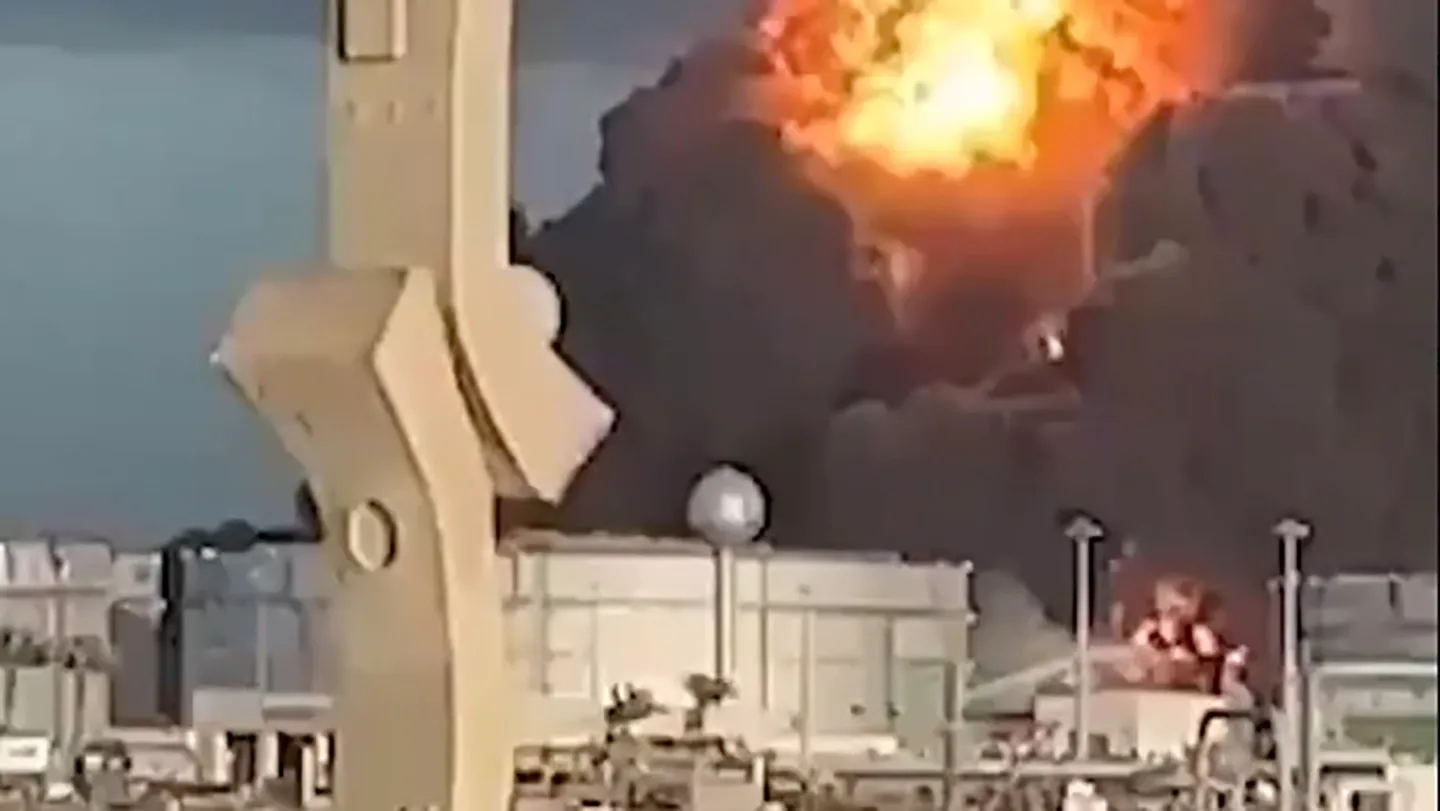
Saudis

Trump Vows Revenge For Iranian Missile Attack, U.S. And Saudis Join Forces To Strike Iraq (Updated)

President Donald Trump on Wednesday vowed to retaliate for Iran’s surprise attack on U.S. forces in Jordan launched Tuesday. His comments came a day after fighting in the region erupted anew after a several-day pause in U.S.-Iranian tit-for-tat actions. After the Iranian barrage, the U.S. and Saudi Arabia hit Iranian-backed militia groups in Iraq. That was in response for previous strikes from Iraq on U.S. and Saudi assets. Meanwhile, the Houthis are reportedly considering imposing a toll on Bab al-Mandeb Strait transits, adding to the region’s heightened tensions.

“We’re going to beat the fucking shit out of them,” Fox News reporter Troy Yingst says the president told him this morning, referring to Iran. “We’ll be hitting them hard. They’re going to get a beating.”

Yingst also said Trump told him that “U.S. forces had just minutes to shoot down these incoming Iranian ballistic missiles. The president says he has reviewed video of the shootdown, and it was U.S. forces conducting this operation to defend that area. He said it was real time; they were calling out coordinates and ensuring that none of this incoming Iranian fire got through.”

“In terms of possible talks with the Iranian regime, the president says ‘we’re going to let them keep talking,’” Yingst added. “…those talks are taking place as we speak behind the scenes.”

On Tuesday, the Islamic Revolutionary Guard Corps (IRGC) “launched multiple ballistic missiles from Iran in an attempted surprise attack on U.S. forces based in the Middle East,” U.S. Central Command stated on X. “All Iranian missiles were successfully intercepted. U.S. forces remain vigilant and at a high state of readiness.”

The attack began at 5:45 p.m. ET, according to CENTCOM.

The official Iranian Press TV media outlet released video it claims showed a missile attack on Muwaffaq Salti Air Base (MSAB) in Jordan. As we have pointed out in the past, the base has been frequently targeted by Iranian missiles and drones. Three U.S. Army soldiers were killed in an attack there on July 17.

Trump also addressed the combined U.S.-Saudi strike on Iraqi militias linked to the Islamic Revolutionary Guard Corps (IRGC). The action appears to marke the first publicly known instance of the U.S. and Saudi Arabia joining forces to carry out attacks in this conflict.

The president “says those strikes were coordinated with the Iraqi government,” Yingst explained. “He called these Iran-backed militias a cancer on the world, and says he is considering additional warnings against Iranian proxies and their link to the Iranian regime.”

Hours before Trump spoke with Yingst, Iraqi militia groups condemned the action.

Harakat al-Nujaba (HaN), an armed group in the Popular Mobilization Forces (PMF), said those would be avenged, Al Jazeera reported. The PMF said at least 20 of its members were killed and 32 wounded in the U.S.-Saudi airstrikes, which took place across Iraq.

In a statement, HaN demanded the expulsion of U.S. forces from the country, saying their continued presence “has become an imminent threat to the country’s security and stability,” the outlet added. The group also called for an end to cooperation with Saudi Arabia and for the deployment of advanced air defense systems and threatened retaliatory attacks against U.S. and Saudi interests.

Meanwhile, influential Iraqi cleric Muqtada al-Sadr urged the IRGC and allied armed groups to stop launching attacks from Iraq.

“Since this holy land was not a launching point for bombing the Islamic Republic, then our brothers in the Revolutionary Guard must not bomb our independent and holy lands,” al-Sadr posted on X. “Likewise, the rogue militias must not give our brothers in the Gulf Arab states a pretext to target our holy land.”

“Everyone must embrace the spirit of brotherhood and peace and not be drawn into the schemes of the Zionist-American enemy to drag brothers into fighting and conflict,” the cleric added. “While I condemn the targeting of the holy Iraqi lands by all countries and parties, and I condemn the shameless actions of the militias to drag Iraq into a pointless war, I call upon the Iraqi government to establish security, enforce sovereignty, and work diligently for the safety of the Iraqi people and their holy sites, and not to be drawn into the abhorrent sectarian myths.”

CENTCOM on Tuesday said its forces, along with the Saudi Arabian Armed Forces, “conducted precision strikes in Iraq, July 28, against Iran-aligned terrorists that the Islamic Revolutionary Guard Corps (IRGC) directed to attack U.S. forces and Saudi energy infrastructure.”

“U.S. and Saudi fighter aircraft struck multiple terrorist logistics and weapons sites across eastern Iraq in a strong response to over 30 IRGC-directed aerial drone attacks in the last 72 hours. The unwarranted attacks against U.S. forces were not successful,” CENTCOM added. “From February through April 2026, there were more than 600 attempted attacks on U.S. citizens and facilities by Iran-aligned terrorist militias in Iraq. The IRGC and its terrorist proxies must cease these attacks to avoid further U.S. military response.”

A U.S. official told TWZ Tuesday night that the combined U.S.-Saudi attacks came after the Iranian barrage.

“To be clear, the IRGC-directed attacks at our forces and our Saudi partners since over the weekend came without any provocation,” the official added. “This is a clear message that we will not let those attempts go unanswered.”

An A-10 Thunderbolt II close attack jet depicted on CENTCOM’s X announcement of joint U.S.-Saudi strikes on IRGC-connected groups in Iraq. (CENTCOM)

U.S. troops are adding to the danger they face by posting cellphone videos of attacks online, CENTCOM commander Adm. Cooper warned, according to Reuters. The command is also considering having some personnel surrender their phones, the outlet added.

Cooper, in a previously unreported letter, “said Iran was benefiting from being able to see the success or failure of its strikes in near real-time by searching news reports or online posts by journalists referencing ‘reactions, photos, and footage from the cellphones of our troops,’” Reuters stated.

The CENTCOM commander appeared to reference the following video in his letter, Reuters suggested.

“The direct, unavoidable cost of this open-source intelligence could be measured ​in the lives of American service members and civilian residents in targeted Gulf countries,” Cooper wrote in his July 28 letter, a copy of which was obtained by Reuters.

He ​called on troops to “redouble our focus on operational security,” without prescribing specific steps in the memo,” the news organization further noted.

“Admiral Cooper’s top priority is the well-being and protection of over 50,000 American service members operating in the Middle East,” CENTCOM spokesman Navy Capt. Tim Hawkins told TWZ in response to our questions about the letter. “His guidance to troops about operational security reinforces this priority.”

Cooper’s letter follows moves by U.S. satellite companies like Vantor and Planet Labs to delay posting imagery from the region out of similar concerns about operational security.

Amid the renewed U.S.-Iran hostilities, the Houthi rebels of Yemen are considering imposing fees on ships transiting the Red Sea, according to Reuters. The move follows the group’s imposition of a blockade on Saudi ships and its firing on Saudi vessels. It mirrors a similar effort Iran is trying to impose on ships transiting the Strait of Hormuz.

“The Houthis were looking into imposing fees on most traffic through the narrow Bab el-Mandeb [BAM] gateway,” Reuters noted, citing sources. The narrow waterway, between Yemen and Djibouti, links the Red Sea to the Gulf of Aden. “No timeframe was given ​at this stage for implementation,” the sources added.

The Houthis’ media office did not respond to a request for comment.

As we have frequently detailed, Houthi actions in the BAM threaten to add far greater pressure on oil exports from the Middle East, already drastically affected by the Iranian closure of the Strait of Hormuz and the resumption of the U.S. blockade on Iranian ports. The Yemeni rebel group has already expanded its target set, hitting oil terminals and infrastructure Saudi Arabia is using to pump supplies to tankers in the Red Sea. The kingdom has diverted millions of barrels of oil per day through pipelines to its Yanbu port on the Red Sea in an effort to minimize the energy shortages due to the hostilities in the Persian Gulf. Even with the BAM closed, oil exports could still head to the West, via the Suez Canal. But if the infrastructure used to convey these energy products is put out of action, the consequences could be even more severe, with far less or even no energy supplies from Saudi Arabia moving out of the Red Sea. The closing of the BAM, and the possible imposition of tolls, also raises the specter of the U.S. having to get as involved as it did during the previous Houthi campaign against shipping that ended last September, which could pull resources away from Iranian-focused operations.

Bab al-Mandeb Strait. (Google Earth)

Despite the increased risks, transits through both straits are trending upward, according to the Kpler risk management firm.

“Daily monitoring shows stronger transit volumes across the Strait of Hormuz and Bab el-Mandeb, with 12 and 41 confirmed crossings respectively on 28 July,” Kpler noted on X. “Yet higher traffic should not be mistaken for lower risk. Hormuz routing remains concentrated outside traditional traffic separation patterns, while Bab el-Mandeb continues to present elevated operational and compliance challenges through dark transits, sanctioned vessels and shadow fleet movements.”

“With 62 confirmed maritime security incidents recorded by the IMO as of 27 July and geopolitical tensions still unresolved, vessel behavior remains a more meaningful indicator than crossing volumes alone,” Kpler added. “For operators and markets alike, transparency, routing choices and emerging disruptions remain the key signals to watch over the coming days.”

In the wake of new fighting in the region and threat of Houthi tolls on the BAM, oil prices are once again trending upward. The per barrel price of Brent Crude has risen to nearly $90, according to OilPrice.com. It had fallen to just over $83 per barrel yesterday when the pause in hostilities was still holding.

As we have previously noted, the U.S. and Iran had stopped firing at each other late last week, leading to a pause after 13 straight days of continuous tit-for-tat operations. U.S. President Donald Trump hadn’t ordered a U.S. strike on Iranian territory since last Thursday. This was ostensibly to give another round of diplomacy a chance. However, lingering concerns over the supply of munitions, especially air defense interceptors, reportedly played a role in Trump’s thinking.

The U.S. has burned through hundreds of Terminal High Altitude Area Defense (THAAD) and Patriot interceptors since a shaky ceasefire went into effect on April 8, according to the Center for Strategic and International Studies (CSIS) latest assessment. CSIS was updating a previous analysis of munitions expenditures during Epic Fury that you can read more about here.

According to CSIS, the U.S. had about 2,300 Patriot interceptors in its inventories before Epic Fury, 1,030 by the time the ceasefire was agreed to and between 759 and 827 as of July 27.

As for THAADs, there were 452 interceptors in the U.S. inventory before Epic Fury, between 232 and 262 on the date of the ceasefire and between 234 and 278 as of July 27.

The report authors noted that “[e]stimated inventories today account for additional interceptor use and new deliveries since the April 8 ceasefire. THAAD deliveries during the ceasefire outpaced estimated use over the same period, resulting in higher inventories today than in April. Patriot calculations include the latest MSE variant and PAC-3s. Several hundred PAC-2s, not represented in the chart, are estimated to remain in the U.S. inventory.”

The lack of sufficient magazine depth is an issue that TWZ has raised frequently for years, and especially in regard to America’s air and missile defenses, in particular. In fact, we laid out in detail these exact concerns and how they would be a major issue in war with Iran just prior to the conflict starting in a feature you can read in full here.

Given Trump’s threat against Iran today, those concerns may be set aside out of a need to respond to the ballistic missile attack. The coming hours should give us a better picture of how all this will develop.

UPDATE: 1:16 PM EDT –

Two vessels were struck by drones in the Egyptian port of Damietta, according to the Ambrey maritime security firm.

One of the ships was a U.S.-owned and operated, Marshall Islands-flagged liquefied natural gas (LNG) floating storage facility and the other was a Greek-owned and operated, Bermuda-flagged LNG tanker, Ambrey stated.

“Reportedly, the incident occurred during LNG discharge operations, with the strike causing a fire on board” the floating LNG storage facility, Ambrey said in an alert. “Ambrey was aware that a second vessel reportedly experienced a fire in connection with the incident. AIS data indicated that the vessel was subsequently towed by two tugs to a position 2.9 NM northeast of the port, accompanied by a fire-fighting vessel.”

The security firm added that it “was aware that the crew had been evacuated and that the fire had subsequently been brought under control. At the time of writing, no party had claimed responsibility. No casualties, damage to port infrastructure or pollution had been reported in connection with the incident.”

After being struck by a drone and experiencing a fire, the Greek-owned and operated Bermuda-flagged LNG tanker “departed and anchored in a position approximately 10.2 NM northwest of the port,” Ambrey noted. 

A maritime security specialist told us that the U.S.-owned and operated, Marshall Islands-flagged floating gas storage facility was the Energos Winter while the other ship was the Gaslog Salem.

TWZ cannot confirm claims about the drone attacks, however, NASA FIRMS shows two thermal anomalies within the port limits near the vessels’ berths.

NASA FIRMS

Video emerging from the scene shows what is purported to be smoke wafting from the Energos Winter after the attack.

UPDATE: 4:38 PM EDT-

Asked during a press conference whether Iran was behind the drone attack on Egyptian port, Trump said “it’s a little more of the same, but it’s going to be straightening out, it’s going to be straightening out. But in the meantime, we are going to be hitting them very hard, because it is our turn to hit ’em. They know it’s coming, they are asking us not to do it.”

UPDATE: 8:33 PM EDT –

As promised by Trump, the U.S. is hitting Iran tonight.

“U.S. forces began launching strikes against Iran at 8 p.m. ET today,” CENTCOM announced on X. “The strikes are a powerful response to yesterday’s attempted Iranian attacks on U.S. forces based in the Middle East.”

UPDATE: 10:37 PM EDT –

In a post on X, CENTCOM announced that at 10 PM ET, its “forces successfully completed a heavy wave of strikes against Iran in response to yesterday’s attempted missile attacks on U.S. forces.”

“CENTCOM assets struck dozens of Islamic Revolutionary Guard Corps (IRGC) targets in Iran, including military command centers, missile and drone facilities, coastal surveillance and defense sites, and maritime capabilities,” the command stated. “The strikes aimed to further diminish threats posed by Iran and its proxies to American forces, commercial shipping, and neighboring Gulf countries.”

Contact the author: howard@twz.com

Howard is a Senior Staff Writer for TWZ. He writes frequently about conflict, focusing heavily on the Middle East and Ukraine, and interviews with military and intelligence officials and industry leaders from around the globe. He lives near Tampa, Florida, home of U.S. Central Command, U.S. Special Operations Command.


Source link

Saudis must recognise Israel for nuclear deal, says Trump

Saudi Arabia’s de facto ruler, Crown Prince Mohammed bin Salman, told CBS News in 2018 that his own nation was not planning to acquire a nuclear weapon, but that “without a doubt if Iran developed a nuclear bomb, we will follow suit as soon as possible”.

Earlier US media reports suggested the deal could allow Saudi Arabia to enrich uranium in the future – which can be used as fuel for power plants, but also potentially to make nuclear bombs. However, Trump’s remarks appear to deny this.

Rosemary Kelanic, the director of the Middle East programme at the US-based Defense Priorities think tank, said it would be “quite shocking” if the US were to allow Saudi Arabia uranium enrichment facilities.

“The US has never done that before. We have never helped another country enrich on their own soil,” she said, adding that this was because “if you can produce your own nuclear fuel, you become a much bigger risk” for building nuclear weapons.

The agreement will now be sent to the US Congress for review.

Some lawmakers on both sides of the political aisle are expected to oppose the deal, though Trump’s Republican Party controls both the upper and lower chambers and opponents of the deal do not appear to have the votes needed to block it.

Source link

Saudis Cleared To Buy A Whopping 20,000 Laser-Guided Rockets

The State Department has approved a possible $2 billion deal to sell up to 20,000 Advanced Precision Kill Weapon System (APKWS II) laser guidance kits to the Kingdom of Saudi Arabia. The approval for these munitions comes as Iran is increasing attacks on nations hosting U.S. troops in the Middle East and tensions with the Houthi rebels of Yemen are heating up again. The air-to-air variant has become a critical cost effective weapon to shoot down large numbers of long-range one way attack drones and lower-end cruise missiles. Meanwhile, the air-to-ground variant provides extremely precise low-collateral strike capabilities against a wide variety of targets.

Saudi Arabia wants to buy 10,000 APKWS II air-to-air guidance sections and up to 10,000 air-to-ground guidance sections. The package includes an undisclosed number of LAU-131/A seven-shot 70mm rocket pods, Mk66 rocket motors, Mk-152 high explosive warheads and proximity fuzes.

APKWS are now flying on Ukraine's F-16s.
APKWS rockets. (USMC photo) USMC

All versions of the APKWS rocket are made up of three basic components: a laser guidance section inserted between one of a variety of warhead options and a standard 70mm rocket motor.

An air-to-air optimized variant, designated the AGR-20F and also referred to as the Fixed Wing, Air Launched, Counter-Unmanned Aircraft Systems Ordnance (FALCO), was subsequently developed. The FALCO configuration includes a proximity fuze and changes to the munition’s guidance and sensing algorithms.

An infographic showing the current warheads and motors that are compatible with the APKWS due to its modular design. The GD OTS HEAT/APAM warheads have yet to be added to the list. (BAE Systems) An infographic showing the current warheads and motors that are compatible with the APKWS due to its modular design. The GD OTS HEAT/APAM warheads have yet to be added to the list. Credit: BAE Systems

The deal does not include the rockets themselves, and the State Department notice does not say on which aircraft the Royal Saudi Air Force will carry these munitions. However, they will most likely be loaded onto the RSAF’s Eurofighter Typhoon and F-15SA fighter jets.

A pair of RSAF F-15SA jets, each armed with two AGM-84L Harpoon missiles. @MbKS15/via Twitter

As we have previously reported, an air-to-air APKWS capability is being rapidly added to an increasing number of U.S. military aircraft. U.S. Air ForceF-15E Strike Eagle, F-16C Viper, and A-10 Warthog combat jets are known to be cleared to employ the weapon. The USMC’s legacy F/A-18 Hornets can also now use APKWS against aerial targets. Other types, like the U.S. Navy’s F/A-18E/F Super Hornet, will likely receive the munitions too. The Eurofighter Typhoon has been recently cleared to employ APKWS, as well.

TWZ was the first to report that U.S. Air Force F-16 Vipers were employing APKWS IIs, originally designed as air-to-ground munitions, as a lower-cost option for downing Houthi drones. Today, Ukrainian F-16s are employing APKWS against Russian drones.

APKWS, The Innovation Continues thumbnail

APKWS, The Innovation Continues


As we noted earlier in this story, this all comes as Iran has been lobbing missiles and drones across the region in response to U.S. attacks. In addition, Saudi Arabia and the Houthis recently traded strikes on airports.

“This proposed sale will support the foreign policy and national security objectives of the United States by improving the security of a Major non-NATO Ally that is a force for political stability and economic progress in the Gulf Region,” the State Department said in a release. “The proposed sale will improve Saudi Arabia’s capability to deter current and future threats by strengthening its homeland defense, and improving interoperability with U.S. forces, and other regional and NATO forces. The proposed sale will also augment Saudi Arabia’s operational aircraft and enhance its air-to-air, and air-to-ground self-defense capability. The Kingdom of Saudi Arabia will have no difficulty absorbing this equipment and services into its armed forces.”

Saudi Air Force Eurofighter Typhoon fighter jets perform during a ceremony marking the 50th anniversary of the creation of the King Faisal Air Academy at King Salman airbase in Riyadh on January 25, 2017. / AFP / FAYEZ NURELDINE (Photo credit should read FAYEZ NURELDINE/AFP via Getty Images)
Saudi Air Force Eurofighter Typhoon fighter jets perform during a ceremony marking the 50th anniversary of the creation of the King Faisal Air Academy at King Salman airbase in Riyadh on January 25, 2017. (FAYEZ NURELDINE/AFP via Getty Images) FAYEZ NURELDINE

U.S. Air Force leaders have lauded the APKWS II system.

“It’s our primary weapon against a drone,” Air Force Lt. Gen. Derek France, head of Air Forces Central (AFCENT), the service’s top command in the Middle East, told us last year on the sidelines of the Air & Space Forces Association’s 2025 Air, Space, and Cyber Conference. “We’ve had multiple shoot-downs with it.”

Since then, APKWS has become the primary weapon system used by American fighters to shoot down Iran’s long-range one-way attack munitions, doing so for just a tiny fraction of the cost of the cheapest available air-to-air missile. The Saudis have the same use case and are keenly aware of just how expensive downing drones can be via a fighter platform after years of fighting the Houthis in Yemen. You can read all about this here. The APKWS II guidance section has a unit cost between $15,000 and $20,000, with the rocket motor and warhead adding a few thousand dollars more to the full price tag. Current generation AIM-120 air-to-air missiles cost around $1 million apiece, while the AIM-9X has a price point around $450,000.

With the APKWS being nearly plug-and-play on both the F-15SA and the Typhoon, the Saudis are clearly preparing to shoot down a lot of drones far more cheaply than in the past with their current fighter force.

Contact the author: howard@twz.com

Howard is a Senior Staff Writer for TWZ. He writes frequently about conflict, focusing heavily on the Middle East and Ukraine, and interviews with military and intelligence officials and industry leaders from around the globe. He lives near Tampa, Florida, home of U.S. Central Command, U.S. Special Operations Command.


Source link