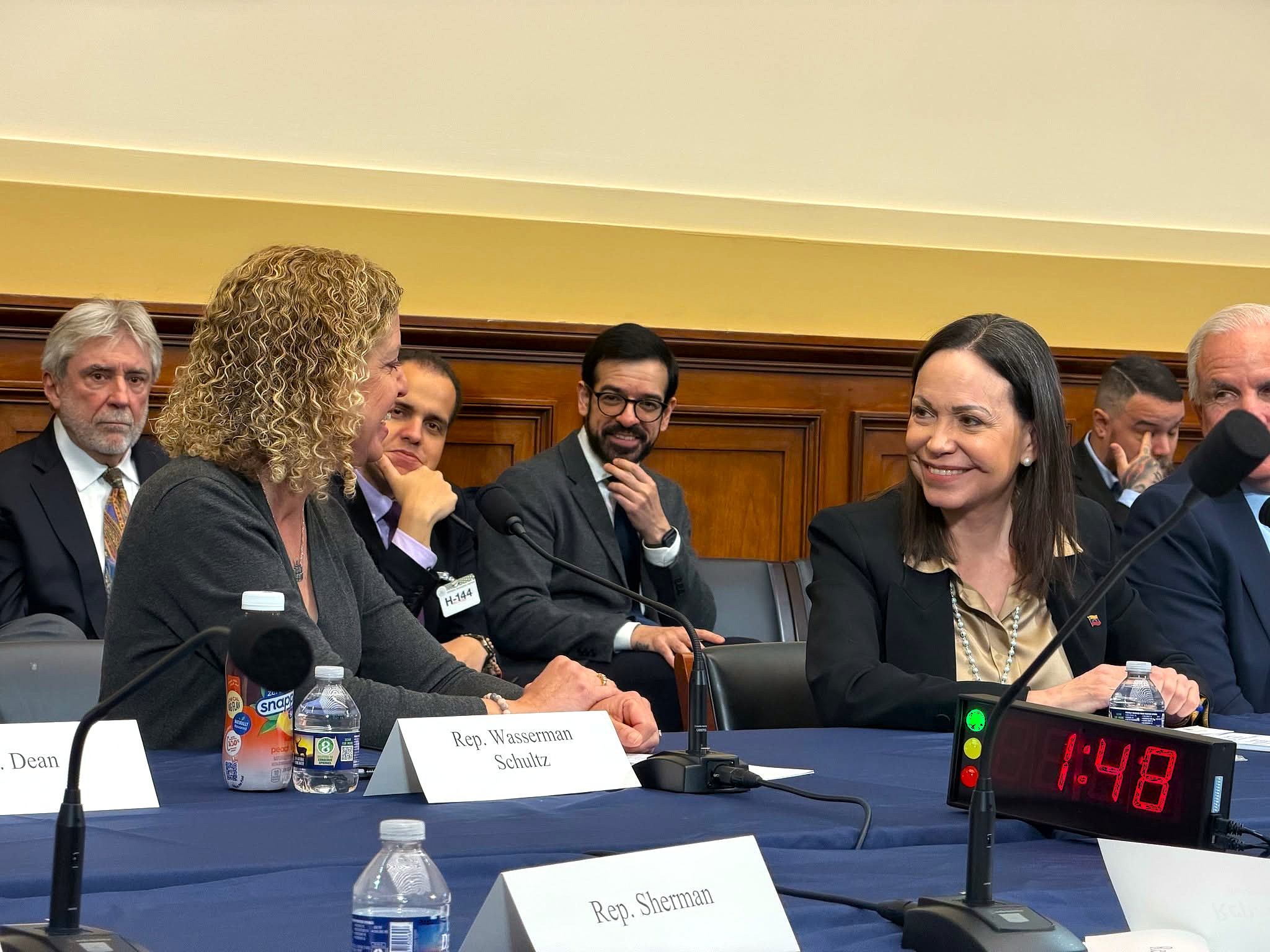
Rep. Debbie Wasserman Schultz (D) with María Corina Machado and her aides in January 2026.
Last night’s results confirmed what had long been signaled. As of this writing, Democrats are winning the House of Representatives with at least 228 seats, and the Senate with 54. Beyond Congress, they secured a majority of governorships for the first time in 16 years.
The White House’s reaction is a preview of what the next two years will look like. This morning, they posted a photo of the president with the caption: “Notice: Trump is still your president,” an idea echoed on X by his communications director, Steven Cheung. With this message, the administration appeared to signal that Trump will continue governing by executive fiat, bypassing Congress.
For Venezuelans, the question today is: what changes with this new majority? The answer remains the same: oversight. The tools Democrats have just regained could enable them to pressure the administration into accelerating an electoral process in Venezuela.
The races behind the shift
The surprise of the night came in South Carolina, where Annie Andrews won by four points in a state Trump carried by 18 in 2024. Results in Texas (James Talarico against Ken Paxton), Ohio (Sherrod Brown), Kansas (Adam Hamilton), Iowa (Josh Turek), and Maine—where Troy Jackson defeated Susan Collins—illustrate how White House policies exacted a toll on congressional Republicans.
This pushback was not confined to Congress: Democrats took governorships in Georgia, Ohio, Iowa, Nevada, Michigan, Wisconsin, Pennsylvania, and Arizona. In Texas, Gina Hinojosa alongside James Talarico became the first Democrats to win a statewide race in more than three decades.
Even in Florida, which remains predominantly Republican, the figures make voter discontent clear. Byron Donalds won the governorship with 50% against David Jolly’s 48.7%. In a state Trump won just two years ago by 13 points, the margins secured by Republicans last night ought to worry them.
The line that could work for Democrats is the one led by Wasserman Schultz and Garcia: accepting that what happened on January 3 cannot be undone, while demanding that priorities shift.
In Miami, margins collapsed for Republican representatives. María Elvira Salazar leads Eliott Rodríguez by roughly 1,100 votes in a district Trump won by 20 points in 2024, and every sign points toward a recount. Mario Díaz-Balart is winning by less than a point in District 26, while Carlos Giménez dropped from 64.6% to 53% in District 28. Despite a district map redrawn to favor Republicans, Democrat Jared Moskowitz won District 25.
Debbie Wasserman Schultz retained her seat, now in District 20, with 74.4% of the vote. Her campaign exemplifies the platform currently working for Democrats in South Florida: she publicly distanced herself from the Democratic Socialists of America (DSA); criticized Trump for leaving Maduro’s inner circle in charge of Venezuela; and spearheaded the legal defense of Temporary Protected Status (TPS) for Venezuelans. Her unyielding stance against chavismo paired with protections for the diaspora reflects both deep familiarity with the country and a roadmap for how Democrats may operate starting in January.
Translating victory into effective oversight
Over the past two years, the Republican Congress served more as Trump’s shield than as a check on his power. The president’s policies may stay the course or harden, but oversight is where the real shift occurs. Starting in January 2027, when the new Congress convenes, Democrats can leverage their victory across four fronts.
First, subpoenas. House committees will shift to Democratic hands. Robert Garcia and Gregory Meeks—previously ranking members on the Oversight and Foreign Affairs committees—will no longer be in the minority. They will have the authority to compel document production and testimony from the administration. In the Senate, the Judiciary and Foreign Relations committees will also change leadership.
Second, the budget. Unlike the past two years, Republicans must now negotiate spending bills with Democrats. This gives Democrats the leverage to condition funding on greater executive transparency.
Third, appointments. High-level officials require confirmation from a Senate Trump no longer controls. Should a Supreme Court vacancy arise, that same Senate will confirm the replacement.
Alongside Meeks, Garcia requested a copy of the agreement with Alejandro Betancourt’s firm and received only a single document. Come January, those letters can become subpoenas.
Fourth, legislation. War powers resolutions that stalled in a Republican-led Congress could now pass with both chambers under Democratic control. Immigration bills long shelved in Republican drawers might finally see progress.
Real constraints remain: most legislation requires 60 votes in the Senate, and overriding a presidential veto requires a two-thirds majority in both chambers. Trump will continue advancing policies unilaterally, but sustained pressure on information flow and budgetary purse strings can alter outcomes.
Venezuela is a clear example of this new dynamic. Robert Garcia has spent the year probing the management of Venezuelan oil revenues. He has demanded accountability over more than $13 billion in proceeds and requested communications between the administration and companies including Chevron, ExxonMobil, Vitol, and Trafigura. Alongside Meeks, Garcia requested a copy of the agreement with Alejandro Betancourt’s firm and received only a single document. Come January, those letters can become subpoenas, and Salazar—who blocked Joaquín Castro’s subpoena request in September—will no longer chair the Western Hemisphere subcommittee.
Venezuela in the new dynamic between Trump and Dems
In September, I wrote that Democrats would likely take the House, that reclaiming the Senate was an uphill climb, and that Venezuela was not a party priority. The first proved accurate; the second underestimated the field. While polls anticipated Democratic gains, yesterday’s wave reshapes Venezuela’s place in the broader policy conversation.
With the White House on the defensive, Venezuela stands as one of the few accomplishments Trump can point to. Consequently, the administration will likely double down on its Venezuela policy—not out of concern for Venezuelans, but because it yields political capital. For Democrats, Venezuela exemplifies what Trump can execute without Congress, while underscoring that the diaspora does not tolerate leniency toward chavismo.
If Democrats approach Venezuela as an anchor for institutional oversight and work to make it a bipartisan cause, it will serve as one of the few issues where this new majority exercises its mandate while projecting moderation.
In other words, amid this anti-Trump wave, the reflexive impulse will be to oppose everything the president does regarding Venezuela. That would also be an error. The viable path forward for Democrats is the one charted by Wasserman Schultz and Garcia: acknowledging that the events of January 3 cannot be undone, while demanding that priorities shift—placing free elections and the release of political prisoners ahead of oil contracts.
This approach mirrors the incentives driving Republicans in Miami. Even as they supported Trump’s hardline immigration policies (only voicing reservations weeks before the election), they also urged the White House to back María Corina Machado.
If Democrats treat Venezuela as an anchor for institutional oversight and steer it toward bipartisan consensus, it will become one of the few areas where this new majority executes its constitutional duties while projecting moderation, turning Congress into a venue for governance rather than another theater in the partisan war.
State governments also act as counterweights: governors determine whether to cooperate with ICE, sign 287(g) agreements, and administer election systems. Holding a majority of statehouses, including Texas and Georgia, gives Democrats greater influence over how the 2028 presidential race is run.
A first step toward 2028
This outcome is not a blank check for Democrats. Just as yesterday’s results served as a reprimand to the governing party in the White House, failure to convert this win into tangible outcomes will leave Democrats with little leverage by 2028. To preserve their gains, they must deliver on three fronts:
First, visible results. Voters penalized the cost of living, not just the president. If the new majority limits itself to holding hearings and releasing findings, it will alienate those who voted based on economic concerns.
Second, safeguarding the coalition. The margins in Texas and Florida demonstrated that Latino voters shifted over immigration and the economy rather than an ideological realignment. Retaining the Latino vote through 2028 will require legislative momentum on immigration reform.
Third, discipline. If oversight devolves into a weekly spectacle or a bid for social media engagement, Republicans will frame it as obstruction. Limiting executive overreach is not a partisan campaign; it is a constitutional imperative. Republicans who have broken with Trump on select issues remain natural allies.
What matters is forging a shared vision among potential Democratic contenders that enables them to demand swift, free elections in Venezuela.
Throughout the campaign, Republicans routinely characterized Democrats as socialists—a narrative fueled by statements from the DSA, some of whose members went so far as to demand Maduro’s release. Yet the DSA’s actual leverage within the party remains far smaller than Republicans suggest. Its candidates expanded margins primarily in safe Democratic seats.
The decisive shift in this election occurred where centrists won over independent voters by substantial margins, such as Jon Ossoff taking 59% in Georgia or Chris Pappas winning by 14 points in New Hampshire. A sensible Venezuela policy should therefore focus on building bipartisan ground: advancing mechanisms like the Jeanne Shaheen–Ted Cruz resolution or Jared Moskowitz’s transition framework.
It is too early to settle on Democratic presidential contenders, but early discussions include Alexandria Ocasio-Cortez, Jon Ossoff, Kamala Harris, Pete Buttigieg, and Gavin Newsom.
Beyond Ocasio-Cortez’s consistent critique of interventionist foreign policy and former Vice President Harris’s familiarity with the Biden administration’s stance toward Caracas, none of these figures has really managed a deep portfolio on Venezuela.
Harris endorsed Machado while running against Trump, while AOC refused to recognize Maduro as the winner of the July 28, 2024 election. Among the potential candidates, AOC, Newsom, Buttigieg, and Harris have all commented—some with sharp criticism, others with calculated ambiguity—on the events of January 3.
What matters moving forward is forging a shared vision among these leaders that enables them to demand swift, free elections in Venezuela. At its core, Venezuelans are demanding a government that improves everyday life, rather than one distracting the public with opaque oil deals that benefit a narrow few.
Democrats now have an opening to help shape Venezuela’s transition. Doing so requires activating the oversight and transparency tools they have long championed, including demanding visibility into the White House negotiations that began this past August.