Tanner Scott stuck upside-down beers in Friedman’s shirt. Alex Freeland dumped beer into his mouth and all over his face. Eric Lauer coordinated a sneak attack, announcing that he was heading to the showers before reappearing from a side entrance.
Friedman never stopped grinning. But it almost looked like he had an extra glint in his eye when asked whether he’d rather take on the Milwaukee Brewers or San Diego Padres in the NLCS.
“I just want chaos,” Friedman said.
Later that night, the Brewers advanced, locking in an NLCS rematch that could certainly deliver chaos.
The Dodgers and Brewers are meeting in the playoffs for the fourth time in nine years. Last season, the Dodgers swept Milwaukee in the NLCS.
Usually before playing a big-market team like the Dodgers, Brewers manager Pat Murphy leans into the underdog narrative by saying he suspects the opponent can’t name many of the Brewers players. But by becoming perennial playoff contenders, and posting the best record in the majors over the past two seasons, the Brewers have given up whatever anonymity they may have had when they promoted Murphy a few years ago.
The cast of characters on both sides has remained relatively consistent since last October. But even after trading away top pitcher Freddy Peralta, Milwaukee is a more complete team than last season.
But losing talented players hasn’t stopped the Brewers from winning the last four NL Central titles. They keep saying goodbye to top players — including Cy Young winner Corbin Burnes, closer Devin Williams and shortstop Willy Adames — then raise their win total.
The biggest difference-maker has been Jacob Misiorowski, who had the lowest ERA (1.80) in the majors this season and is the NL Cy Young favorite. As a rookie last year, the flame-thrower was relegated to the postseason bullpen until the NLCS. This year, he was the Brewers’ Game 1 starter in the NLDS against the Padres.
The Brewers have long hung their hat on playing sound baseball, from pitching and defense to baserunning. But the knock on them has been the lack of thump in their lineup.
First baseman Jake Bauers had a career season, leading the team in home runs (26), on-base percentage (.389) and on-base-plus-slugging percentage (.873). Jackson Chourio, who was hobbled by a hamstring injury in the last NLCS, hit a career-high 25 home runs and led the team in slugging percentage (.487). And though the Brewers likely won’t out-slug the Dodgers — they hit 50 fewer home runs during the season — they have a pesky roster that stole 90 more bases.
The Brewers also had a better regular-season record (103-59) than the Dodgers (100-62), so the series will begin in Milwaukee on Sunday.
Signs point to a more competitive series than last year. The Brewers even entered the postseason with the better World Series odds (18.5%) than the Dodgers (16.7%), according to Baseball Prospectus’ PECOTA standings.
“The mistake that the outside perspective kind of gets sometimes is to underestimate certain teams,” said Kiké Hernández as the Dodgers celebrated their NLDS victory. “And we knew we had a tough task ahead of us. [The Braves are] a team that was playing really good baseball, had a lot of momentum, and they were throwing the ball really well. They had a really good bullpen, a lot of different kinds of arms, and, fortunately for us, they were a little bit short on starting pitching, so they had to tax their bullpen to a point where it paid off for us.”
The Dodgers ended the series before it returned to Los Angeles for an if-necessary Game 5. So they got to turn their attention to the Brewers a couple days early.
“I think the strength of our team is our rotation,” Friedman said. “And so even if we weren’t able to reset it, we still feel like it would be a strength of ours. But to be able to line it up the way we want to, certainly advantageous. To be able to have a few days off our feet and rest up for Sunday, also really helpful.”
Of all the heroes in the Dodgers’ 5-3 victory over the Atlanta Braves in their National League Division Series opener Saturday at Dodger Stadium, none was more stunning than the shrugging, somnolent, underachieving right fielder whom Dodger fans have treated like an overpaid outcast.
Just listen to them now.
Booo…Yayyyyy!
Locked in a one-run game on a scorching 100-degree afternoon, Tucker drove an AJ Smith-Shawver fastball 408 feet over the right-field fence in the sixth inning for a two-run homer that essentially ended the Braves’ afternoon and set up the Dodgers for what appears to be a certain series sweep.
Yes, the Dodgers only lead one game to none in this best-of-five deal, but the Braves are clearly out of breath and out of pitching after enduring last week’s wild-card series against the Philadelphia Phillies.
The Braves dug deep in their bullpen for all eight innings Saturday. They may have to dig even deeper in Game 2 on Sunday or desperately start ace Chris Sale on short rest.
Their offense looks wasted, their bullpen is taxed, and they spent most of Saturday in one sweaty mess.
Of course, the Dodger bullpen almost handed the game back to them when Ozzie Albies hit a two-run homer off Tanner Scott in the ninth to close what seemed to be an insurmountable gap. But Scott was mercifully lifted for Evan Phillips, who recorded the final out of the game to save the Dodgers from disgrace.
And to etch Tucker into the rare role of hero.
“Obviously for us it’s about winning a championship,” said manager Dave Roberts when asked about Tucker afterward. “Our fans, they really remember what you do in the postseason. So this is certainly a way to change the story for a season in 2026.”
Indeed, except for the back end of the bullpen, Dodgers old and new rose to the championship occasion.
Skubal in his first Dodger postseason start after being traded here from Detroit on Aug. 2? Six innings of brilliance, 15 batters in a row retired at one point, only one three-ball count in the first five innings, two allowed hits, seven strikeouts, two walks and only nicked by a Sean Murphy homer.
Dodgers pitcher Tarik Skubal delivers during the first inning Saturday against the Braves.
(Eric Thayer / Los Angeles Times)
Teoscar Hernández, almost benched during a rocky regular season? Same old Teo, the guy who leads the Dodgers with 27 RBIs over the last three postseasons, this time opening the scoring with a two-run homer in the fourth.
Max Muncy, the forgotten stalwart who always seems to show up huge in October? Same old Max, blasting a ball over the right-field fence in the sixth to give the Dodgers a 5-1 lead.
But Kyle Tucker? This was not the same old Tucker. Nobody saw this coming. Certainly, he finished the regular season strong with a .969 OPS in September with six homers and 13 RBIs, but he was awful for most of the previous five months after joining the team this winter with baseball’s highest annual salary of $60 million.
Tucker batted .196 at home. He seemingly jogged after fly balls, wildly swung and missed at fastballs, and who would have thought he would take control with one out in the sixth and the Dodgers leading 2-1?
There was one out. This was a big moment. Skubal was out of the game and the Dodgers had lost all their early momentum when Hernández popped a single to center, bringing up Tucker.
On Smith-Shawver’s second pitch, he connected, and after Tucker trotted across home plate, the most amazing thing happened.
He smiled.
“I think that we all know — it’s been well talked about — the struggles he had this year,” said Roberts. “I give him a lot of credit for grinding through it, not running from it, always posting and kind of getting to the other side of it.”
It was an otherwise ordinary Dodger playoff win that began with a rare bit of Dodger second-guessing.
Many questioned the Dodgers choosing to pitch Skubal in Saturday’s opener while slotting Blake Snell into Sunday’s spot and leaving last season’s playoff hero Yoshinobu Yamamoto on the bench until Game 3.
The reasoning was that Skubal could get two starts in this series on full rest while Yamamoto, who requires an extra day’s rest, was only getting one start in the series regardless. Furthermore, by holding him back in this series, the Dodgers ensured that Yamamoto would get two starts in the National League Championship Series.
Still, you have to wonder, how do you take a guy with a 7-0 postseason record with a 2.25 ERA and put him third in the rotation?
Turns out, the Dodgers knew what they were doing, and before the game, even Andrew Friedman acknowledged this was their best pitching staff of this era.
“I feel like this is the best and deepest pitching staff we’ve ever had going into October,” said the Dodgers president of baseball operations. “I think we had some tough conversations in leaving some guys off the roster. That would have never happened before.”
There were also pregame question marks surrounding the health of Shohei Ohtani and Freddie Freeman.
Those questions remain, as the two future Hall of Famers went two-for-seven with two singles and not much power.
Ohtani, fighting arm and leg injuries, entered the game batting .157 since Aug. 18 with zero home runs during that time.
“As of now, it’s something I’m just going to have to manage,” he said through interpreter Will Ireton.
Ohtani and Freeman are going to have to manage better than this for the Dodgers to three-peat.
Maybe they should take some advice from the Dodgers’ latest candidate to be christened Mr. October.
NEW YORK — The New York Liberty are peaking at the right time and were able to complete a historic sweep of the Minnesota Lynx to advance to the semifinals of the WNBA playoffs.
Jonquel Jones had 21 points and 13 rebounds and the No. 8 seed Liberty beat the top-seeded Lynx 87-71 in Game 2 of their WNBA playoff series Tuesday night. New York became the first No. 8 seed to eliminate a No. 1 seed in the league’s 30-year history.
The WNBA has undergone a number of different playoff formats. And in many of the formats, it wasn’t possible for those seeds to match up. However, in 2022, the league changed to the current format in which the top eight teams play in the quarterfinals.
“It feels good, we understand who we are as a team,” Jones said. “We’re not listening to outside noise, we understand that we can do a lot of great things. We feel like we can play with anybody and beat anybody. That’s the mindset we have moving forward. It feels good to make history. It had to be done for us to advance. It’s nice to say it’s been accomplished, but we have a lot of work to do.”
Breanna Stewart added 21 points and Sabrina Ionescu had 18 for the Liberty, who await the winner of the Atlanta-Washington series. The Dream are up 1-0 and play at Washington on Wednesday night. The semifinals begin Sunday.
A year after losing in the first round to Phoenix after going up 1-0 in that series, New York was determined not to have that happen again.
The Liberty were up five points after one quarter and led 40-35 with 2:39 left in the half. New York scored nine of the final 11 points in the second quarter to go up 49-37 at the break.
New York was up 52-39 with 6:26 left in the third when Stewart drove to the basket and was hit in the face by Olivia Miles as she tried to block the shot. Stewart was down for a minute as the officials reviewed the play and upgraded the play to a Flagrant-1 foul.
As Stewart walked off the court, she raised her hands to the sellout crowd of 17,593, who serenaded her with “MVP!” chants. Stewart hit both free throws.
Minnesota couldn’t get closer than seven points the rest of the way.
“New York is a great basketball team,” said Courtney Williams, who led Minnesota with 18 points. “You dig a hole for yourself and try to get out of it. We wanted to go on a run, but they had answers for everything.”
The Lynx’s season ended in disappointment again. The Lynx had the best regular-season record, but just couldn’t put it together against New York. On Monday, Cheryl Reeve won the league’s coach of the year and Miles was a unanimous choice for rookie of the year.
Miles struggled in both games against New York. She had five points, missing seven of her eight shots in 17 minutes, on Tuesday night. The Liberty’s size and ability to protect the rim bothered the stellar first-year player.
Reeve said she offered encouragement to her star rookie after the game.
“As I told her. When was the last time a rookie led the first-place team? Never happened before,” Reeve said. “That’s what we shared with her. This hurts for her.”
Napheesa Collier and Kayla McBride each added 14 to for the Lynx.
Only the Pirates and Cubs have met more often than the Dodgers and Giants, who faced off for the first time in 1889. And over all that time, the Dodgers are just two games better, with 1,294 wins to the Giants’ 1,292.
The Dodgers and Giants have also won more pennants, made more World Series appearances and have more players wearing their caps in the Hall of Fame than any other National League teams, all of which fueled a rivalry that was once among the most visceral and passionate in American sports.
But that was then and this is now.
After Sunday’s 3-1 victory over the Giants, the Dodgers’ 14th win in their last 17 games, the team could finish a season with 100 wins for the fourth time in six years. The Giants have had just one winning record in that time.
The Dodgers (96-60), who have won five straight division titles, are headed to the postseason for a record-tying 14th consecutive year. The Giants will miss the playoffs for a fifth straight season.
So is the rivalry dead? That depends on who you ask.
“It’s always a rivalry,” Giants pitcher Logan Webb. “We’d like to make it a little closer when it comes to the standings. But I definitely feel it when I throw against them.”
But then Webb, who is from Northern California, grew up with the rivalry and, as the longest-tenured Giant, pitched against the Dodgers in games that mattered. Giants coach Ron Washington, who made his major league debut with the Dodgers when the rivalry was still a thing, said many players on San Francisco’s roster don’t know that background.
“It should be a rivalry. But I don’t think the young kids we got know anything about a rivalry. They’re not history buffs.”
Webb said it’s the responsibility of the veterans on both sides to keep that history alive by explaining the enmity to the young players.
“I think there are still guys that came up in the system that know what it’s like,” he said. “It’s my job to kind of hype these guys up to play a game like this.”
Dodgers manager Dave Roberts, who played for the Dodgers and Giants during his 10-year career, agrees the rivalry now exists more in the history books than the current standings, where the Giants have been overtaken by the San Diego Padres, who will finish second to the Dodgers in the N.L. West for the fourth time in five seasons.
“It’s certainly a rivalry in the sense of the history, the fan bases,” Roberts said. “But obviously it’s about relevancy. The Padres have been successful the last handful of years, and so it’s certainly built some momentum. The geography lends itself to that too.
“But Dodgers-Giants is always fun.”
It hasn’t been so much fun for the Giants lately. San Francisco hasn’t won the season series with the Dodgers since 2021 and has lost more than 90 games this year for the first time in nine seasons.
On Sunday they went in front three batters into the game with Johan Cox working Dodger opener Jack Dreyer for a leadoff walk, then making his way around the bases on Dreyer’s throwing error, a stolen base and a one-one single by Victor Bericoto.
San Francisco would get just one more hit — a single by Jung Hoo Lee with one out in the sixth.
That allowed the Dodgers to tie the score in the bottom of the sixth on Tommy Edman’s seventh home run of the season just inside the right-field foul pole. An inning later they went ahead to stay when Max Muncy singled under a sliding Cox at second, moved to third on a single by rookie Josue De Paula and scored on Kiké Hernández’s double to center.
Josue de Paula hits a double in the fifth inning Sunday.
(Ronaldo Bolaños / Los Angeles Times)
A two-out single by Muncy, his second of the game, scored Teoscar Hernández, who also had two hits, in the eighth inning with the final run.
Even the slumping Freddie Freeman contributed to the Dodgers’ 11-hit attack, ending an 0-for-11 slide with a broken-bat single in the fourth then singling again in the eighth.
Sunday’s result helped clarify the Dodgers’ once-muddy playoff picture. With six games left in the regular season, the Dodgers lead Atlanta by four games in the race for the second seed in the National League playoffs, which would give them a first-round bye and the homefield advantage in the division series.
The team’s postseason roster may be getting clearer as well. Right-hander Emmet Sheehan, who made 22 starts this season, came out of the bullpen for the first time Sunday and was brilliant in his audition for the playoffs.
“If there is a role in the postseason, it will be out of the [bull]pen,” Roberts said of Sheehan, who gave up just a hit and walk, striking out nine — one off his season high — in 5 1/3 innings.
De Paula, meanwhile, whose third multihit game extended his modest hitting streak to four games, appears to have secured a job as the team’s left-handed bat off the bench while utility player Hyeseong Kim, who has spent the last four months in the minors, will rejoin the Dodgers after the triple-A playoffs and be considered for a roster spot as a pinch-runner and late-inning defensive replacement.
“My expectation is that Hyeseong will be here during the off week and potentially be a conversation for the postseason because he has the ability to run, play defense, and steal a base,” Roberts said.
After Monday’s off day, the final break of the regular season for the Dodgers, the team is expected to activate Andy Pages, Roki Sasaki and Shohei Ohtani from the injured list during its three-game series with the Padres.
“We’ll get Andy back on Tuesday, which will be great, and then shortly thereafter we’ll get Shohei back. So yeah, things are starting to come together,” Roberts said. “We’re in a good spot.”
England overcome early tremors to win third Test against Pakistan by eight wickets, clinching a series whitewash.
Published On 12 Sep 202612 Sep 2026
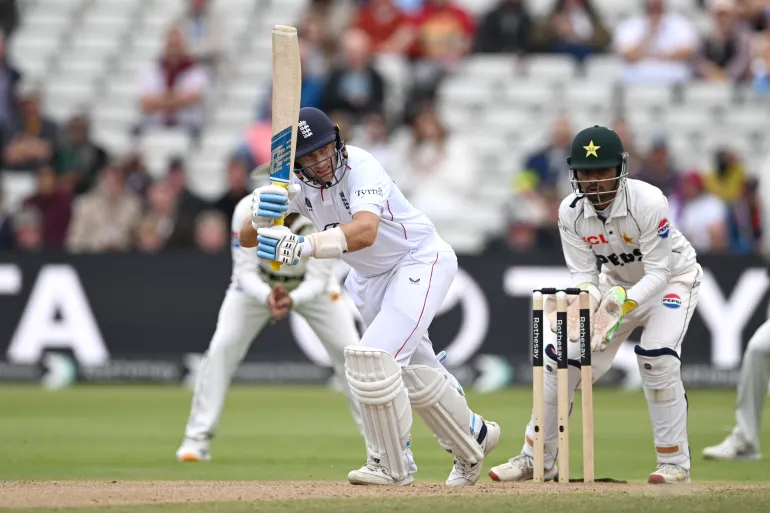
Joe Root led from the front as England survived a major wobble to beat Pakistan by eight wickets in the third Test at Edgbaston on Saturday, sealing a 3-0 series whitewash.
The home team, chasing just 130 to win, were in deep trouble when openers Ben Duckett and Emilio Gay were dismissed in the first over, bowled by Mohammad Abbas.
Recommended Stories
list of 4 itemsend of list
Root, England’s record runscorer, edged his first ball, bowled by Razaullah, through the slips for four in a nervy start but settled and scored quickly to take the sting out of the situation.
England captain Joe Root bats during day four of the third Test at Edgbaston [Gareth Copley/Getty Images]
The skipper was given a huge reprieve when he chopped onto the stumps off Mohammad Ali, only for the umpire to signal a no-ball, leaving the bowler distraught.
Root, with Jordan Cox at the other end, had another let-off when he edged an Abbas delivery between first and second slip, with neither fielder moving.
But he reached his half-century off 57 balls with a cut for four, and Cox matched him shortly afterwards.
England reached their target in the 25th over, with Root unbeaten on 62 and Cox 59 not out.
Jordan Cox (left) and Joe Root of England leave the field after winning the third Test [Gareth Copley/Getty Images
Root, in his second spell as England skipper after the departure of Ben Stokes, admitted his team were not the finished article but said he was delighted with their series win.
“The amount of uncertainty, noise and I guess chaos there was coming into the series, the way the guys have dealt with that – being so clinical with what we’ve had in front of us – and be stood here with a 3-0 win is really pleasing,” Root told Sky Sports.
“It sets us up nicely looking ahead to the start of a new era with (new head coach) Stephen Fleming coming in.”
Pakistan woes
It is England’s first Test series win since 2024, while Pakistan have now lost 16 of their last 21 games and are bottom of the World Test Championship table.
Root’s men had appeared set for a quickfire win inside three days on Friday before debutant fast bowler Razaullah launched an audacious assault with the bat, clubbing nine sixes as he raced to 81 off 63 balls.
The 21-year-old number nine, who also took four wickets in England’s first innings, put on 121 for the ninth wicket with fellow paceman Abbas (42) as England floundered.
Pakistan’s Razaullah laughs after surviving an LBW on day three [Darren Staples/AFP]
“We had a little bit of pushback yesterday which, in a strange way, was quite a good thing for the group,” said Root.
“Fair play to Razaullah; he made things difficult for us. He played some wonderful shots and made it very difficult to set fields to. He struck the ball nicely – I don’t know how he didn’t pull a muscle, swinging the bat that hard.”
The tourists sent seven players home after their crushing defeat in the second Test at Lord’s and brought in seven replacements, with Razaullah among them.
They also sacked head coach Sarfaraz Ahmed and assistant Umar Gul as their tour plunged into chaos.
The Pakistan team leave the field after bowling out England during the second day of the third Test [Philip Brown/Getty Images]
Pakistan made four changes to their side for the third Test, and they put up a fight despite being dismissed for a paltry 133 in their first innings.
Captain Babar Azam admitted his team would have to take stock after a one-sided series.
“Before we came here, we had to think about different things and to decide our team,” he said.
“We had a couple of changes after losing two matches. Playing in England is very difficult. We were trying to do our best in the third match.
“We need to sit down and look hard at our mistakes, decide our playing XI.”
The 3-0 whitewash is a huge tonic for England, who were in turmoil just weeks ago following a series loss to New Zealand and the exits of head coach Brendon McCullum and captain Stokes.
But tougher challenges lie ahead, starting with a Test series in South Africa in December and January, while a home Ashes looms next year.
Bettiah, India – Neyaz Miya was adjusting a kitchen handle. Mehadi Hassan was fixing a bracket for a bed.
They were at different construction sites – Miya in a half‑constructed home, a little higher up the hill, while Hassan was on the ground floor of Ganesh Hotel, closer to the Trishuli River that flowed through Syafrubesi, a bustling market town near the Nepal‑Tibet border, now wiped off the map by the August 26 flash floods.
More than 1,200 bodies have been recovered since then, at least 4,000 people remain missing, and more than 13,000 have been rescued.
“First came the terrifying loud sound. Then the ground trembled, and dark clouds descended upon us,” recalls 34‑year‑old Miya, who ran further up the hill with his phone and slippers that morning, five or six others running alongside him.
Hassan, lower on the slope, did not wait to reach for his slippers or his phone. He just ran, climbing a narrow, stair‑like path, up the hill, stopping only when he reached roughly 60 metres (200ft) above the road.
At some point, Miya and Hassan found each other. Around them were 60 to 70 other survivors who had also gathered high up on the hill.
A decade earlier, Miya had arrived in Syafrubesi as a carpenter. Three years later, he brought Hassan with him – both men from Bihar’s Bettiah district. Over the years, they built the town’s interiors – sofas, beds, almirahs, and kitchens for hotels and homes.
On that Wednesday morning, they watched all of that washed away. The multi‑storey hotels where they had worked – Red Panda, Garden Hotel, Buddha Hotel, Sunrise Hotel – were all swallowed by the flood.
“The town was gone in a blink,” Miya recounts, now sitting in his home in Turhapatti village of Bihar, India, just across the Nepal border. “There were only three kinds of people who survived that day: Those who were out of town, those who were at work and managed to run, and those who lived a little higher up the hill.”
Based on what he witnessed, Miya says only a few hundred people in Syafrubesi, a town that had a population of 2,271 in the 2011 census, likely survived.
Miya and Hasan are among them. Three of their close friends and colleagues, also migrant workers from Bihar, are not.
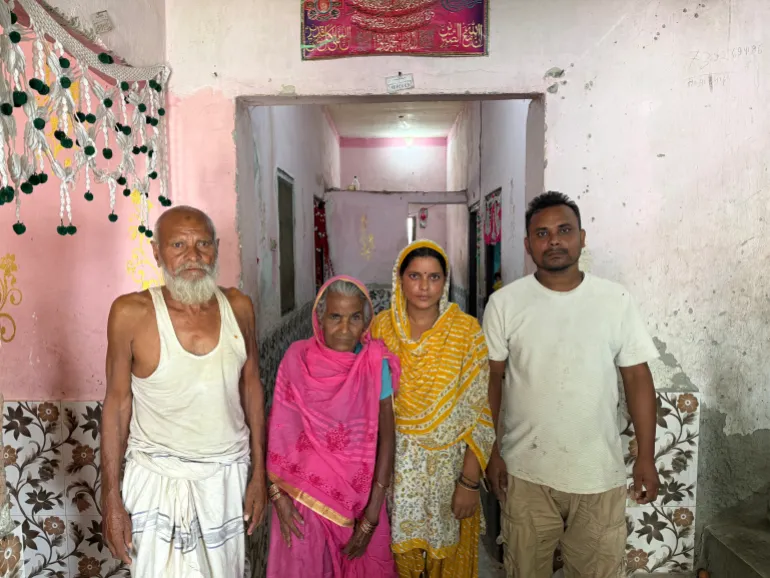
Neyaz Miya (far right), with his wife Rijwana Khatun, his mother Rubaida Khatun, and his father Doshahmad Miya. Neyaz survived the floods, but lost his masonry tools, worth almost $1000 [Jyoti Yadav/Al Jazeera]
A workday like no other
When the floods reached Syafrubesi, the men were already at work: Their shifts began at seven in the morning.
“To start at seven, we would wake up at four or five,” Miya recalls. They would leave with empty stomachs and were fed tea with doughnuts or biscuits at the construction site by building owners. Their first break came at 11am, when they returned to the rented one‑room space (3,500 Nepali rupees or $23 a month) that housed five to seven migrants at a time.
On the morning of August 26, they left for work alongside 34‑year‑old Arman Ansari, 20‑year‑old Samir Ansari, and 52‑year‑old Mukhtar Ansari, all migrants from Miya’s Turhapatti village.
In the rented room, two teenage boys, Arman’s 14‑year‑old son, Salman Alam, and his friend Shibu Alam, 17, remained asleep. They had come a month earlier to visit the hills.
“My father had cooked meat bhaat (rice with meat),” Salman recounts. He was waiting for his father to return at 11am so they could eat together.
Arman, his father, was working beside Hassan on the ground floor, pasting sunmica onto the same bed. Samir and Mukhtar were on the top floor of the Full Moon Hotel.
When Hassan ran out of the under-construction building and up the hill, he believed Arman was behind him. But by the time Hassan and Miya met higher up, there was no sign of the other three: Arman, Samir and Mukhtar.
Miya and Hassan found the boys, Salman and Shibu, terrified, on the hill. “Salman was crying, howling and searching for his father,” Hassan said.
The flood, which came with a high speed, took half an hour to recede. Soon, helicopters started hovering above them, airlifting the critically injured.
The four of them – Miya, Hassan and the boys – walked down the hill on foot to search for the three missing in the debris. They found nothing but sludge. Miya’s furniture-cutting tools and machines, worth 80,000 Nepali rupees ($530), were buried in the debris.
When they got back to their room, perched high on a slope, they found that it had survived.
But the army had taken charge, and soldiers herded survivors away from tenements near the river. “They said it [the flood] might come again,” Miya recalls.
They slept that night in a government school building in a village, he says. “At night, we were given daal bhat (rice and daal), and we wrapped ourselves in tarpaulin and slept.”
The next morning, a helicopter took them to another village. From there, another helicopter carried them to an army compound in a town. In the evening, they teamed up with five other migrants and hired an SUV to reach Nepal’s capital Kathmandu, each paying 3,500 rupees ($23).
The next morning, on August 28, they hired another SUV, which charged them 950 rupees ($6) each for a distance of 290km (180 miles) to Birgunj, a town on the India-Nepal border. They then crossed the border on foot before boarding buses for their villages.
It wasn’t the homecoming Indian migrants who work in Nepal usually plan.
A lane in Turhapatti village, Bihar, India, where the migrant workers are from. It is a village where almost every family has a story of migration [Jyoti Yadav/Al Jazeera]
‘No regular work’ back home
Turhapatti is among thousands of villages tucked along the 1,715km (1,066-mile) stretch of the India-Nepal border, where generations have crossed back and forth in search of work.
The two countries share an open border, and on both sides, especially in Bihar, the bond is known as a roti-beti ka rishta (a relationship of food and daughters), alluding to ties of livelihoods and matrimonial kinship. People live, work, and marry across the border.
Kathmandu is as close to Turhapatti as is Patna, the capital of Bihar. Per its 2021 Population and Housing Census, Nepal had 700,000 foreign-born residents, 97 percent of them from India.
Miya and Hassan say the wages for a carpenter or a mason on the Indian side are between 600-700 rupees, while for the same work in Nepal, wages are about 900 rupees. That drives migrant workers from India over the border into Nepal.
Nepal, for its part, is facing a major out-migration crisis — its per capita income is the lowest in South Asia, barring Afghanistan, and hundreds of thousands of young men and women leave each year to find work elsewhere. This creates a demand for migrant workers from Bihar, India’s poorest state that lies just across the border.
In Turhapatti, Miya owns only 0.03 hectares (0.06 acres), not enough to feed his family of six children, wife and parents. In recent years, he transitioned from being a carpenter to a contractor, which allowed him to bring in more workers from Bihar.
He had been sending 30,000 Indian rupees ($315) back to his family every month.
Hassan has even less back home: He inherited a 6×8-metre (20×25ft) room from his father and no agricultural land. “There is no regular daily work here,” he says. He would send 15,000 Indian rupees ($157) home from Nepal each month for his wife and four children.
Their story echoes in most homes in Turhapatti. The village had a population of 16,000 people in the 2011 census, India’s latest one. In nearly every household, men have left to work in other parts of India and abroad as carpenters, masons, or labourers mixing cement and sand into mortar.
The destinations are Kashmir, where close to 700 men from the village work; Nepal, with nearly 600; and thousands scattered across Indian cities: Chennai, Kolkata, Delhi, Mumbai. About 100 men have migrated to Dubai, Oman and Saudi Arabia.
The houses they built in Turhapatti stand in stark contrast to those of those who remain in India. The marble-fronted and iron-gated homes belong to men working in the Gulf, while semi-permanent dwellings belong to those who stayed behind.
Migrants in Nepal fall in between: Miya has been able to raise a brick house.
Sahrun Khatun, Arman’s wife, with her eldest son Salman (holding the youngest child) who survived, her mother-in-law, and two younger children, outside their home in Turhapatti, Bihar, India [Jyoti Yadav/Al Jazeera]
‘My body shivers at the thought’
This economic reality is what drove Arman Ansari to Syafrubesi. On July 26, Arman left for Nepal with Samir and Mukhtar. Arman’s son and his friend Shubu went with the three adults; the teenagers were on a trip to the hills.
Now, Arman’s brother-in-law. Jameel Miya, a carpenter in Kathmandu, scours the city’s hospitals for Arman’s body, telling authorities that his brother-in-law’s right hand and chest had deep scars, cut by shards of glass when he was young.
Arman’s wife, Sahrun Khatun, has only her last phone call with Arman to hold on to. They spoke two hours before the floods swept him away. “He was about to get his wages on September 1 and return home,” she says.
Salman, who had tagged along with his father to see the hills, hasn’t been able to sleep since the flood.
“The moment I close my eyes, I feel the flood is coming for me,” he says.
Mukhtar’s family lives a few lanes away.
Since the floods, Kasmun Khatun, Mukhtar’s wife, has been glued to the internet for any news of her missing husband. Joining her in that remote search are her daughter Asmana (18) and son Sadre Alam (14).
Her eldest son, Osama, 25, a tailor in Kathmandu, has been busy searching for his father in city hospitals.
“After waiting for a week and watching the videos, I submitted my DNA samples,” he says over a phone call. Osama manages to send home 6,000 rupees ($63), but that is no longer enough – his mother needs eye surgery that has already been delayed and cannot be put off much longer.
“The guardian has gone, all of a sudden,” he says, referring to his father.
At the far edge of Turhapatti stands the home of Samir Ansari, the youngest among the missing migrants and youngest of his five migrant brothers.
The Ganesh Hotel project he was working on was only three days from completion.
“He said he found another site to work on,” recalls his father, Hasmuddin Miya, remembering their last phone call on the evening of August 25.
Samir was a mason who specialised in marble tiles, a skill he had learned in Kashmir while working under his elder brothers at construction sites.
The three families are preparing to host a bhoj, the funeral feast – a custom of feeding hundreds of people – having given up on hope.
Meanwhile, the two survivors, Miya and Hassan, are already making calls to find work again. This time, their search turns towards Nepal’s plains. They pledge never to return to the hills.
“My whole body shivers at the thought of going there,” says Hassan.