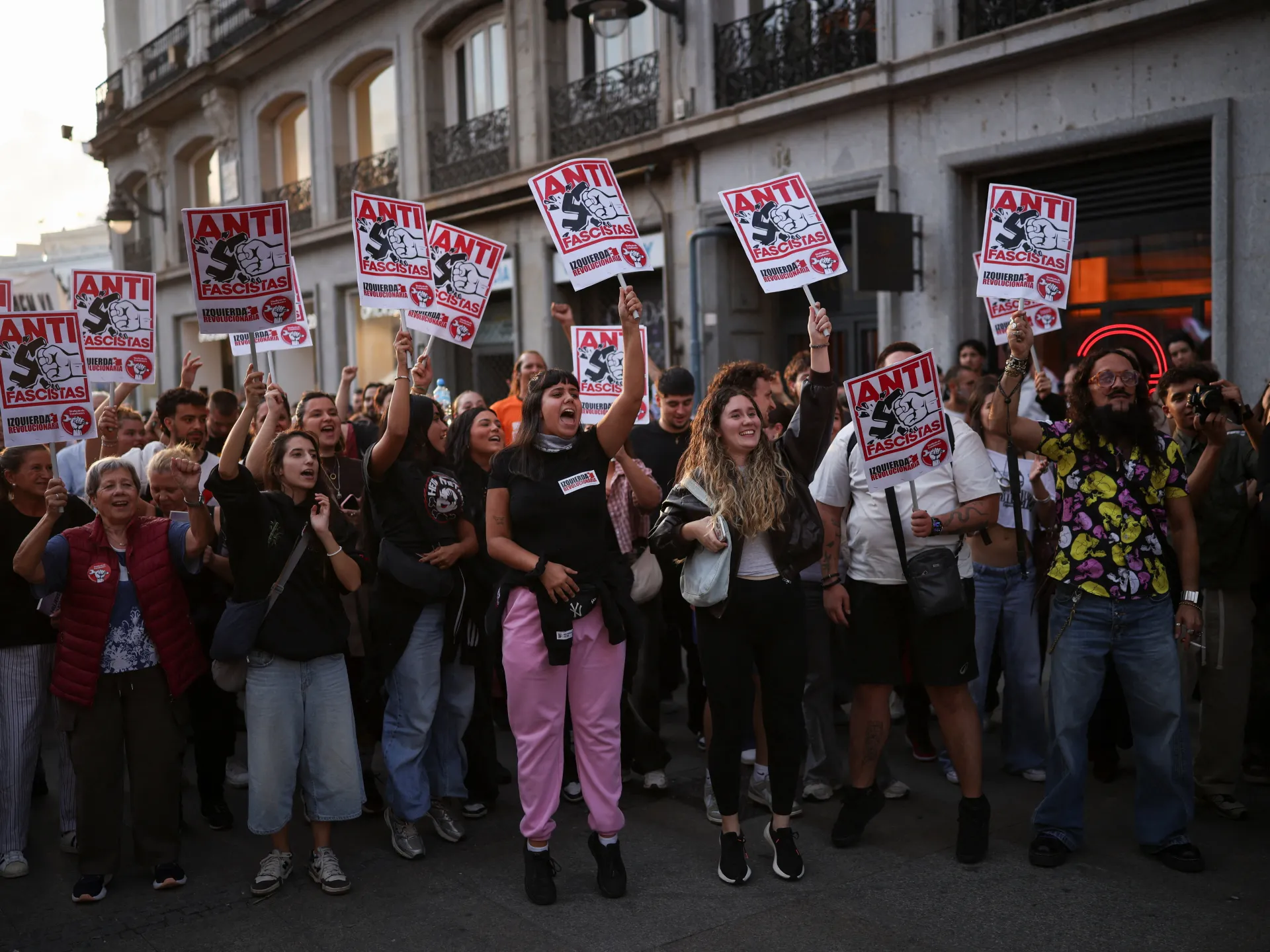
Tens of thousands of people have rallied across Spain as protests have spread since the conservative-dominated parliament rejected a bill proposing measures to tackle a housing crisis.
Parliament on Friday voted down two decrees proposed by Prime Minister Pedro Sanchez’s minority left-wing coalition government that were intended to address the housing crisis.
Recommended Stories
list of 3 itemsend of list
The protests erupted late last month after an 87-year-old woman was evicted from her home of 70 years in the capital, Madrid. Maria del Carmen Abascal’s eviction came after an international investment fund bought her building and hiked the rent.
Local media reports have suggested that Sanchez could call snap elections for as early as November after watching the strength of Saturday’s protests across the country. Spain’s current legislative term is set to end next summer.
Will the housing crisis trigger snap elections? Here’s what we know:
What happened on Friday in parliament?
The emergency measures proposed by Spain’s leftist government to tackle the country’s housing affordability crisis failed to pass on Friday.
The government had proposed two measures to protect renters in the country. The first decree was meant to stop evictions of vulnerable people, make real estate speculation harder, impose tighter restrictions on short-term leases and provide tax incentives to encourage renting and the construction of housing.
The second decree proposed making leases automatically renew when they are set to expire, essentially making them indefinite. A property owner would have to pay a tenant 12 months of rent to break the contract.
Sanchez, who leads a coalition government composed of his Socialist Party and the far-left Sumar, appealed to lawmakers in the run-up to the vote to put aside political calculations and pressure.
“Think about ordinary people, about those who most need the protection of public institutions. Think about the millions of young people who cannot afford to move out of their parents’ homes. Think about the families living with the constant anxiety of ever-rising rents,” he said before the voting.
But his government’s proposed measures were shot down by the majority of the 350-seat lower house of parliament.
The right-wing Catalan separatist party Junts refused to back the housing decrees, saying they would ultimately tighten the housing market. The centre-right Popular Party and far-right Vox also voted against the measures.
Miriam Nogueras of Junts argued the decrees would lead only to owners removing their properties from the rental market and thus driving up prices even further.
“If they really wanted to protect people, collar the vulture funds, and reactivate housing, they would have already done it. They’ve had eight years,” she added on X, referring to Sanchez’s government.
Health Minister Monica Garcia said on X that the right-wing parties “have voted for a feudal economy in which a minority extracts the salary from a majority that works for their luxuries. And they do it against their own voters, who also suffer increasingly high rents, live in fear that the contract will end and can even be evicted.”
“Today the right has given rent-seeking a parliamentary majority that it doesn’t have on the street, but it’s going to pay for it sooner rather than later,” she added.
Before the parliamentary vote, Marta Soler Gallart, head of the Department of Sociology at the University of Barcelona, explained that neither of the two decrees addressed the housing problem in the medium or long term.
“Models such as Vienna’s with its low rents are cited in support of these decrees, but it is overlooked that the Vienna model and others have low rents because of their long history of creating and maintaining public social housing,” Soler Gallart told Al Jazeera on September 30.
“In Spain, however, public funds are invested in social housing which, after a while, the recipients sell at market price.”
Soler Gallart also said the new measures disadvantage landlords with small or few properties by extending five-year tenancy agreements by a further two years and by providing an indefinite extension of their leases.
“However, these extensions are not compulsory if the landlord can prove that they need the property for their own use,” she said.
Why are people protesting across Spain?
Protests erupted across Spain in late September after 87-year-old Abascal was evicted from her home. The investment fund that bought her building hiked her rent by more than 200 percent to roughly $1,880 a month, a move aimed at pushing out the long-term tenant to make way for lucrative tourist apartments.
In recent years, Spain has seen protests against mass tourism, which has been linked to the housing crisis and soaring cost of living. Spain is the second most visited country in the world, attracting 97 million tourists last year.
While Abascal has returned to her home, according to her representatives, she has become the face of the country’s housing crisis, and people across Spain have been demanding the government address the issue.
Angered by parliament’s rejection of the government measures, tens of thousands of people took to the streets.
“It’s a shame,” Nando de Anguulo, 26, who joined Saturday’s protest in Madrid, told the Reuters news agency.
“It only proves that it is us, the people, who have to adapt to the political parties and not the politicians to what the people want, and this can’t go on like that.”
While the protests were mostly peaceful, in the southeastern city of Valencia, police fired rubber bullets and tear gas to break up demonstrations. About 30 protesters managed to get inside the City of Arts and Sciences, a landmark cultural building, before police removed them.
Meanwhile, in Madrid, Spanish police arrested three members of a far-right group and fired rubber bullets on Saturday night.
Far-right activists, some of whom performed Nazi salutes, tried to reach demonstrators camped out in the Puerta del Sol, a central square in the Spanish capital, the Spanish government said.
Valeria Racu, a spokesperson for the Tenants’ Union, said Saturday’s rallies revealed “a new energy that we haven’t seen in a long time and energy that is showing that eight days of people’s power can achieve more than eight years of progressive government”.
“Now begins real politics – politics which has always belonged to the people and which will return once and for all to the streets,” Racu added.
Could the housing crisis lead to snap elections?
Housing is a sensitive issue in Spain because it impacts how people vote. The average rent in the country has almost doubled in the past 10 years. The average price per square metre has risen from 8.20 euros (about $9.08 at the time) in 2016 to 15.1 euros ($17.15) this year, according to the real estate website Idealista.
In an October 1 article for Vanity Fair, Spanish journalist Jorge Dioni Lopez noted that after eight years in power, housing is what is causing Sanchez to lose support among educated young people, children of the middle classes.
“The government faces a difficult situation. Firstly, because most of the relevant powers lie with other levels of government. Secondly, because Spain is a nation of homeowners. Unlike in other European countries, almost all the public housing that has been built has ended up in private hands, and historically, homeownership has been more attractive than renting,” he wrote.
“Housing is our savings system and also the primary means of transmitting wealth between generations,” he added.
After Spain’s parliament rejected the government’s housing reform bills on Friday, the leader of the centre-right People’s Party, (PP) Alberto Nunez Feijoo, urged Sanchez to “call elections as soon as possible”, claiming he had the support of “neither the streets nor parliament”.
While Sanchez has not officially announced new elections, the Spanish online news site El Diario has reported that elections could take place as early as November 29. Spain’s general elections are currently scheduled for July 2027.