‘You’re going to Samobor? You must try kremšnita,” my Dubrovnik friends told me before I set off on my trip north. “But I’ve already had kremšnita in Zagreb,” I told them. They do it better in Samobor, they insisted. I wasn’t about to get embroiled in a battle of the cream cakes in a region where Croatians, Slovenes and Austrians all like to celebrate their own versions of this decadently thick, fat custard slice topped with puff pastry and icing sugar. But I was more than willing – happy, even – to follow everyone’s suggestions to try kremšnita in Hotel Livadić’s Kavana Livadić, in Samobor’s main King Tomislav Square, a mere half-hour drive west of Zagreb.
It lived up to the hype – delicately rich, creamy and with a light touch. After spending a few weeks in sun-bleached Venetian Dalmatia, amid the scrubby, limestone Dinaric Alps, I had swapped empires and was firmly in Habsburg Croatia. Here, in Zagreb County’s prettiest town, handsome baroque houses in pastel shades of buttery yellow, apricot and pistachio, festooned with stucco, line narrow King Tomislav Square, whose umbrella-shaded cafe terraces were filled with Croatians getting their morning fix of coffee and chatter.
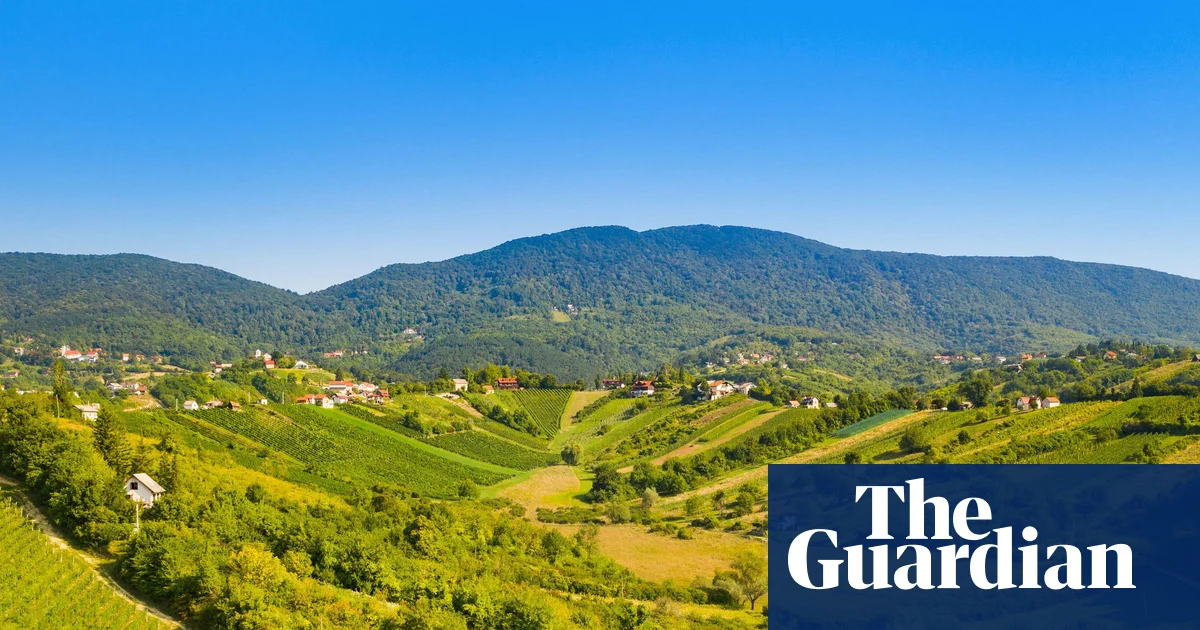
The lush green Samobor Hills overlook the medieval town, through which the Gradna – part river, part stream – flows and ripples under wooden bridges adorned with flowers. One of these bridges led to the onion-domed church of Saint Anastasia; another, with a fairytale wooden roof, took me to one of Samobor’s many green spaces, dotted with free red deckchairs, which had the slogan “Volim Samobor” (“I love Samobor”) written in white. In front of them, the stately former home (now the town’s museum) of one of Croatia’s foremost 19th-century composers, Ferdo Livadić, added to the air of gentle refinement, of culture worn lightly. It was easy to visualise Livadić entertaining his artistic friends, including Franz Liszt, in this august setting.
As well as the graceful architectural legacy of the Austro-Hungarian monarchy, this rolling green landscape is crisscrossed with forested trails, particularly within the Žumberak nature park, about 16 miles (26km) west of Samobor, where weekenders from Zagreb come to hike and bike in woods of hornbeam, oak and beech with bubbling waterfalls. Not having time for a full-on hike, I could still drive to Potočna dolina Slapnica, near the Vranjak waterfalls, and scramble up the path beside a series of cascades each more impressive than the last.
Closer to Samobor, the hilltop ruins of Okić castle rose to nearly 500m above sea level, one of the best-preserved romanesque fortifications in the country. The Mongols couldn’t defeat it, nor could the Ottoman Turks. Sadly, it defeated me when I attempted to hike to the top. Not realising there was a newer, easier path, I ended up on one that was little else but vertical tree roots. With a newly healed ankle and no phone signal, I thought it unwise to continue. But it’s on my list for next time.
A much easier path to take was along the Plešivica wine road, where more than three dozen wineries were scattered on a heart-shaped route between the village of Plešivica (10 miles south-west of Samobor) and the town of Jastrebarsko. In a harmonious landscape that could out-Tuscany Tuscany, vineyards clung to steep slopes between forested hills, many producing the sparkling wine Plešivica is renowned for. I met Martina and Krešimir Ivančić, whose ancestors were given a noble title and coat of arms by the Austrian empress Maria Theresa in 1759. The griffin on the family crest inspired the name of the Griffin Winery, which came about when a Hungarian count gave them a licence to plant a vineyard in 1773.
Martina took me to the covered patio of a wooden hut above the vineyards, a suitably bucolic place to taste an elegant and lightly fruity sparkling rose made from red portugieser grapes. We carried on in the extremely stylish tasting room, where plates of cured meats and cheeses accompanied glasses of full-bodied chardonnay.
I was also offered copanjek, a thin savoury pastry pie of cheese and greens. “They’re very portable, so workers would take them to the vineyard,” Martina told me. This looked like the winemaker’s version of rudarska greblica, which I had tasted that morning in the village of Rude, about a 10-minute drive west of Samobor, and liked so much I had to have two. Filled with cheese and walnuts, carrots or greens, these used to be made by the wives of Rude’s long-gone miners. They’re such an integral part of the region that they have their own festival every July and have been given EU protected status. At Pekarnica Nikl, in Rude, I met Jelena and Andrejas Nikl, the only authorised bakers of this much adored speciality. Jelena acknowledged the responsibility of keeping up this tradition of rudarska greblica, especially with the paperwork that came with legal protection – but, she said, it was worth it.
All around the Samobor Hills, people were holding fast to their heritage and infusing it with life. The Korak family is one of the most illustrious, with its Michelin-starred Korak winery and restaurant in Plešivica. Not a whiff of Michelin stuffiness or pretentiousness here, just the fourth and fifth generations of a family producing superb wine and making beautiful food in a serene setting facing the vineyards. Brother Bernard is chef (and has worked with Massimo Bottura of Italy’s Osteria Francescana and Ana Roš of Slovenia’s Hiša Franko); sister Vera is front of house; and parents Velimir and Mirjana tend the vines – even the siblings’ grandparents are still making cheese and pršut (prosciutto) for the restaurant.
Bernard grows as much as he can – the rest comes from local producers, including the farmer whose pigs are fed on scraps from Bernard’s kitchen. And if it’s not in season, it’s not on the plate. My June visit rewarded me with a truffle tagliatelle, and clams and green beans in a caviar sauce, among other delicious dishes in a five-course tasting menu at €118 (a very reasonable price, and in keeping with the region’s overall lower prices).
I could only imagine what delights autumn will bring, especially during the annual Wine Days festival in Jastrebarsko from 25-27 September. The Samobor Hills will be teeming with autumn truffles and mushrooms, and welcoming the change in season the best way they know – on the plate.