As the sun disappears behind the high tree line, our campfire spits and crackles. Four plump trout are sizzling on a flame-heated slab of rock, a cooking technique used by people in the Gurghiu mountains, part of Transylvania’s Eastern Carpathians, for centuries. Apart from gentle birdsong, it’s the only sound up here, 1,550 metres above sea level and far from any town or village.
“This area is very wild,” says Samir Teslovan, who drove us up through the densely forested peaks from his guesthouse in Toplița. “When I come here to the mountains, I charge my battery, charge my soul. I feel free, like the wind.”
Sitting on the edge of a fragrant forest of spruce, fir, beech and pine, our view stretches over the valley to misty mountains receding in layers to the horizon. Samir points to a far-off peak in the east, a pyramid on a ragged ridge. “That’s Ukraine, maybe 200km,” he tells us. Then, pointing west: “That way, 400km, is Hungary.” The forest is still home to bears, wolves and lynx, but it’s the solitude that brings him here. “I prefer wild zones, where no one goes,” he says. “There are places here that nobody knows.”
Across the vast forests and mountains of Harghita County in central Romania, there are many places that nobody knows. In fact, the whole region has flown under the radar of international travellers – 85% of visitors come from Romania itself, which feels bizarre when you discover the wonders here, as we did on a 12-day family road trip, staying at self-catering lodges and cabins along the way.
A holiday here costs a fraction of what it would in the Dolomites or the French or Swiss Alps. Even better, it’s remarkably uncrowded, which makes for a more authentic-feeling adventure.
The region previously belonged to the Austro-Hungarian empire, but Transylvania, including Harghita, was awarded to Romania after the first world war. The local population remains largely of Hungarian descent (about 85%), with most people identifying as Székelys (Szeklers), a distinct, Hungarian-speaking cultural group. And the Hungarian influence can be seen in the region’s food, from goulash to kürtőskalács (chimney cakes), and in the ornately carved székelykapu (wooden gates) outside houses.
We pick up a hire car in Brașov and drive north, in the opposite direction to Bran Castle and all the vampiric hoopla. Soon, we’re enjoying wide, open countryside, sharing the road with farmers on horse-drawn carts and passing churches with silvery spires and white storks nesting on top of electricity poles.
Our first base is Sâncrăieni, staying in Organicle Lodge, a lovely, quiet cabin with an upstairs spruce bedroom, spacious lounge and kitchen. While our four-year-old son races around the garden with the owners’ cats and French bulldog, we rest on our wooden deck, drinking Harghita beer, looking over a paddock, where a brown horse and white pony gambol and graze, and out towards the Harghita mountains. In the evenings, swifts flit about and white storks glide across pink skies.
We spend time at nearby Lacul Sfânta Ana (Saint Anne Lake), the only volcanic lake in Romania, wandering first through Mohoş Peat Bog, where the trees and curious plant life make it feel like stepping back into the ice age, then take a boat trip on the sparkling lake, surrounded on all sides by shades of forest green. In the evening, we head to Medveles Székelyföld observatory, where we watch four bears feeding on corn that’s laid out for them; Harghita has one of the highest bear population densities in Europe. The best sighting of our trip, though, comes during our drive to the lake, when we spot a mother and cub ambling through the forest and sniffing the air by the roadside.
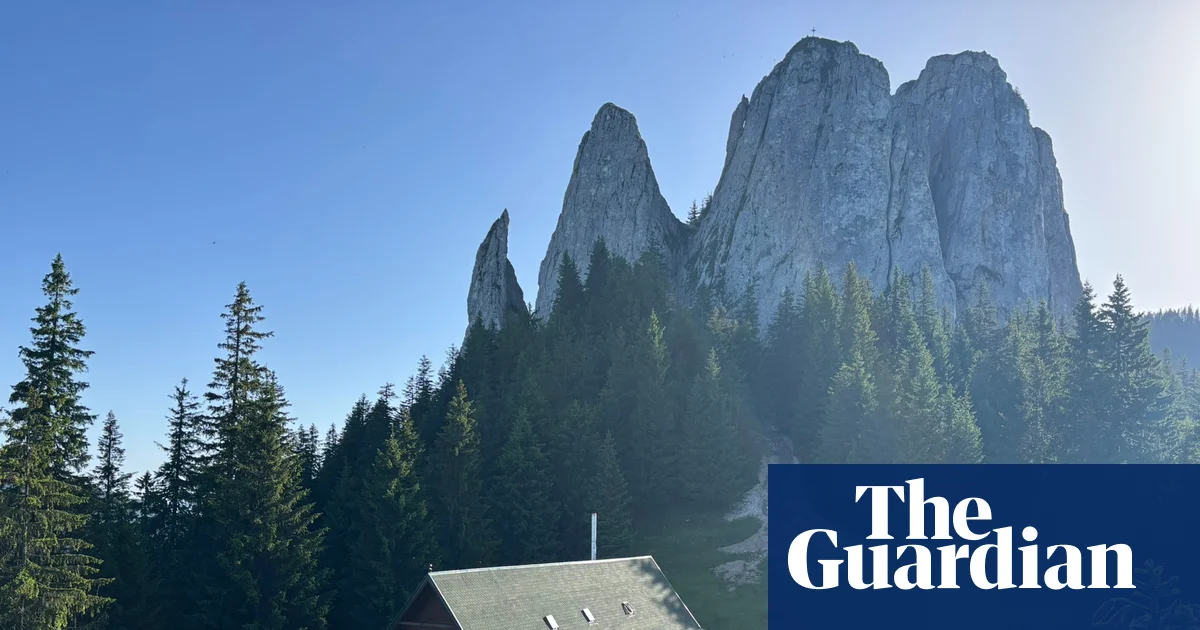
Heading farther north, we spend a couple of days at Vila Adela, near Lacu Roșu (Red Lake), an orange house decorated with red geraniums, with fairy houses, windmills, animal statues, see-saw and slide in the garden. Our bedroom looks out on to the majestic limestone massif Suhardul Mic.
Later, we drive through Bicaz Gorge, gazing up at massive rock walls and structures, dominated by Piatra Altarului (Altar Rock), the summit marked with a metal cross. Stopping to climb the tower of medieval manor house Lázár Castle en route, we reach Toplița at the far north of the county, staying at Casa Samir, where Samir and his son David run wildlife photography and nature tours.
After a steep and bumpy afternoon drive, we go hiking in the serene Gurghiu mountains. Golden sunlight winks through the trees as David points out the tracks of wild animals as we walk to where his father has parked and started a campfire. Along with trout, Samir serves a homemade salty sheep’s cheese, called burduf, and lamb sausage, both from his farm, and a bottle of palinka, a warming plum brandy. “I’ve been coming here all my life,” he tells us. “My grandfather and great-grandfather came here. I listen to the silence and the sounds of the forest, the birds and wild animals.”
Looping back around through the county, we make one final stop at Turul Guesthouse, a row of neat, two-storey, wooden lodges with hot tubs and a big trampoline. We wander among detailed models of Transylvanian castles, palaces, and churches, including Bran Castle, at Mini Transylvania Park and large-scale, moving models of ants, butterflies and the like at neighbouring Insect Park.
One morning, we hike up to the top of Harghita Mădăraș, at 1,801m (5,909ft) the highest peak in the Harghita mountains. Thunder rumbles and rain drenches us, as we reach the gold, white and blue Székely flag, the reportedly magnificent views blocked out by cloud that gives a sombre, funereal atmosphere to the cairns, flags, crosses and other memorials clustered around the summit.
We watch more bears at a tucked-away forest hide outside the Băile Homorod resort, including two mighty females who look as if they might clash over the feeding area, and spend one of our last afternoons at Zetea lake, where we take out a kayak. “It’s really a beautiful experience to be on the water,” Előd Tímár, co-owner of KayaKing, tells us. “Bears sometimes come to drink on the shore.”
Paddling south towards a forested peninsula, we’re surrounded on all sides by swaying trees. We pause in the vast expanse of open water and put down the paddles to float and drift for a while, and there it is again: a glorious, battery-charging feeling of peace, nature and being free, like the wind.
The trip was provided by Visit Harghita. Graeme stayed at Organicle Lodge (from £75 a night), Vila Adela (£50), Casa Samir (£43 B&B) which offers mountain adventures from £94 per person, and Turul Guesthouse (£87). Bear-watching at Medveles Székelyföld £35pp and at Băile Homorod £25pp. Kayaking with KayaKing from £6.50 per hour