“Cursed be you, State of Israel. Cursed be you,” Hugo Chávez said memorably on state television in 2010. Over his years in power, he floated the ancient antisemitic trope of the Christ-killing people, likened Israeli leaders to Hitler, called for them to be tried at The Hague, and in 2009 broke off relations entirely in response to the Gaza attacks, calling his own diplomats’ expulsion an “honor.” He had already withdrawn Venezuela’s envoy once before in 2006 over the IDF offensive in Lebanon, and three months after the 2009 break he recognized the Palestinian Authority.
Although Venezuela never stopped trading with Israel, Chávez’s firm anti-Israel rhetoric was central to how the Bolivarian Revolution defined itself abroad, even after his death. Now his heirs are thawing one of the coldest relationships in chavista foreign policy.
On Tuesday, the foreign ministries of Venezuela and Israel announced they would establish a “coordination mechanism” to provide consular services to their citizens, continuing the ongoing technical cooperation born out of Israel’s response to the June 24 earthquakes. Although the agreement falls short of full diplomatic restoration, with no mention yet of exchanging ambassadors or reopening embassies, it is the first formal coordination channel between the two countries since Chávez severed relations.
Chavista groups took to the streets in Caracas on July 25 to denounce the US-sponsored talks that began on August 1, burning Israeli and US flags.
In 2017, then-Foreign Minister Delcy Rodríguez said Venezuela wanted to restore ties, and the following year Maduro welcomed then-chief Sephardic rabbi of Israel, Shlomo Moshe Amara, to Miraflores, awarding him the Libertadoras y Libertadores order—the same honor given to the Palestinian Authority’s Abu Mazen by Chávez in 2009.
Although the government was quick to frame the collaboration as a humanitarian matter, it was also military from the jump. Six days after the quakes, a diplomatic and military mission departed to Venezuela from Israel, comprising more than 50 personnel from the Foreign Ministry, the IDF’s Home Front Command, and the National Emergency Management Authority, joined by ZAKA search-and-rescue volunteers. It was led by Brigadier General Elad Edri, chief of staff of the IDF Home Front Command, who in a July meeting presented a “Project for the Reconstruction of the Future” to Rodríguez. Delcy was then photographed alongside uniformed IDF officers, thanked the delegation on camera, and praised its members as “highly trained and professional,” ultimately asking Sa’ar to extend the mission. Prime Minister Benjamin Netanyahu personally approved the extension.
Newly-appointed canciller Félix Plasencia sealed the agreement with Israeli Foreign Minister Gideon Sa’ar after weeks of talks, and a day after holding a meeting with Isaac Cohen, chief rabbi of Venezuela’s Israelite Association. He delivered a letter addressed to Delcy Rodríguez, asking her to consider restoring diplomatic ties between the countries given “the needs of the Jewish community in our country.”
Plasencia thanked Israel for its earthquake assistance and praised the community’s historic contributions to Venezuela, warm words for a community that chavismo long conflated with the State it was cursing. In 2009, Chávez called on Venezuela’s Jews to answer for a foreign government’s war and linked Jews to the hoarding of the world’s wealth in his 2005 Christmas address. During the 2012 campaign, chavista media hammered Henrique Capriles over his Jewish ancestry, and state security raided the Hebraica Jewish school twice, in 2004 and 2007, as denounced by the Inter-American Commission on Human Rights.
Signaling a willingness to rebuild relations with Israel is one more entry on a long list of things that Washington wants and that Rodríguez is willing to concede.
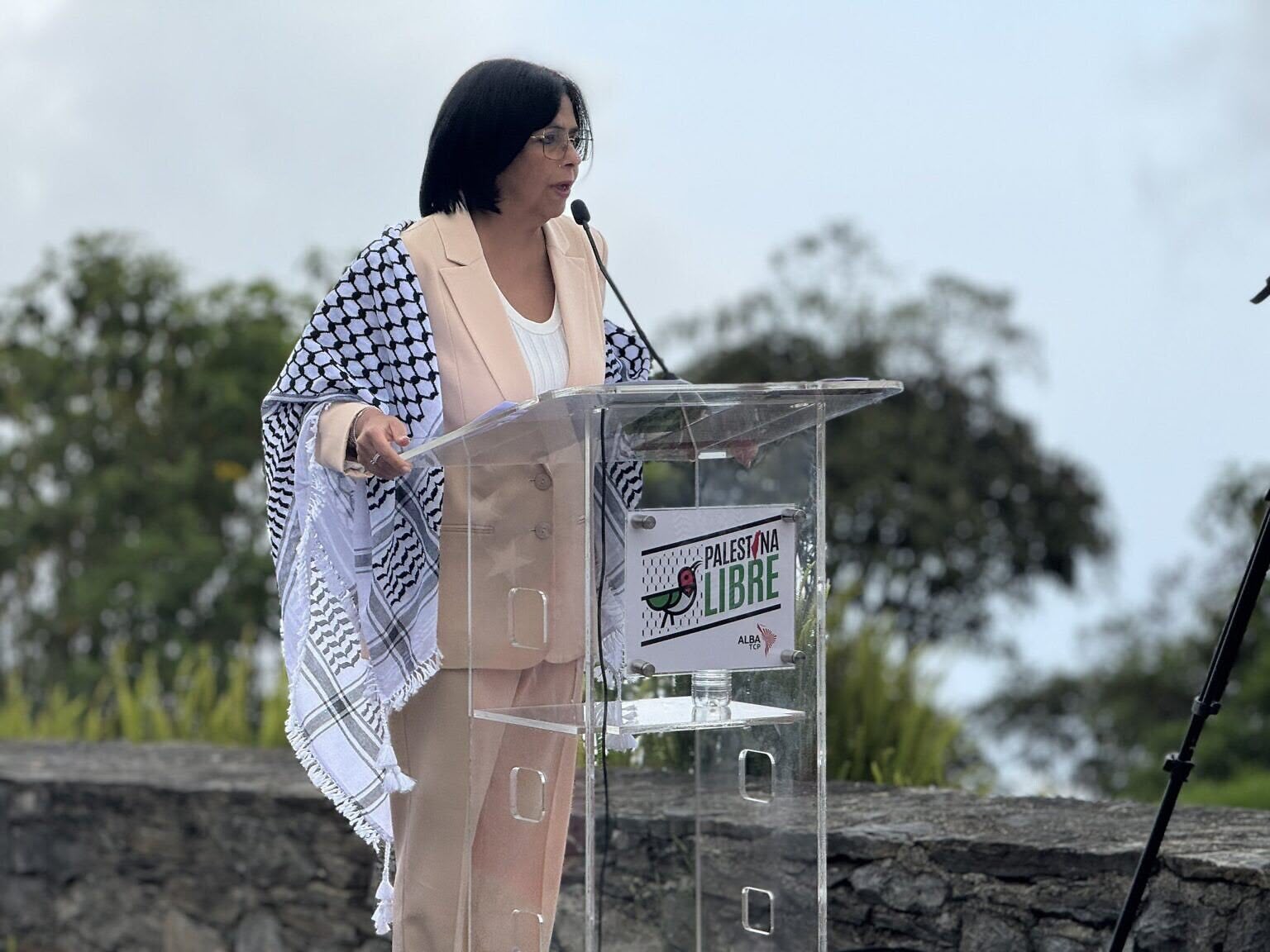
The government has reversed course, but some of its base has not. Chavista groups took to the streets in Caracas on July 25 to denounce the US-sponsored talks that began on August 1, burning Israeli and US flags. As the news of renewed consular relations broke, the Venezuelan Movement in Solidarity with Palestine, Al Awda, rejected “normalization with the genocidal state of Israel,” warning that “diplomacy cannot serve to whitewash crimes against humanity.”
But the base’s anger misreads the nature of the turn. After a quarter-century defining itself against empire, chavismo is not softening but practicing what former diplomat Imdat Oner calls authoritarian pragmatism: trading diplomatic goodwill for room to consolidate power at home and attract economic opportunities. Since taking the interim presidency, Delcy Rodríguez has reversed much of the confrontational diplomacy of the Chávez and Maduro years, moving closer to Washington, restoring ties with Chile, Perú, and the Dominican Republic, withdrawing from the International Criminal Court, and distancing Caracas from Iran.
Signaling a willingness to rebuild relations with Israel is one more entry on a long list of things that Washington wants and that Rodríguez is willing to concede. Chávez cursed the State of Israel “from the depths of his soul and his viscera”, but his successors have decided that the soul of their revolution is worth sacrificing for their own survival.