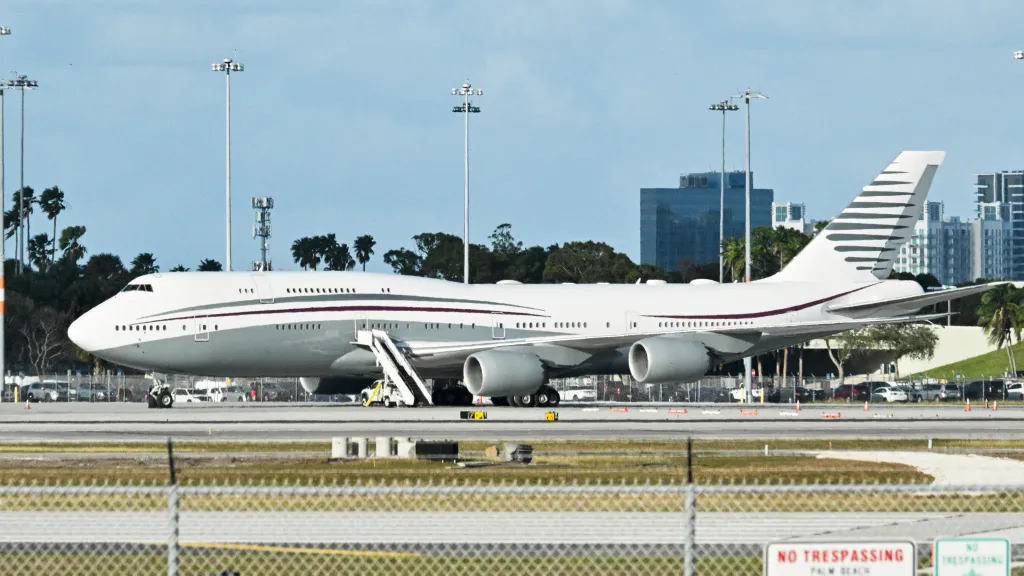
- Qatar’s 747-8i gifted for interim Air Force One use. The U.S. Air Force is testing a lavish 747-8i donated by Qatar to serve as a temporary Air Force One while awaiting delayed VC-25B deliveries.
- Test flights underway with expected delivery by 2026. The VC-25B Bridge Aircraft has begun test flights and is expected to be delivered to the Presidential Airlift Group by summer 2026.
- Limited modifications observed on the aircraft. Photos show few changes to the jet’s communication systems, though it includes new aerials and UHF satcom antennas.
- Defensive capabilities remain uncertain. The aircraft may lack comprehensive defensive systems like EMP hardening and defensive systems, raising questions about its operational use.
- High conversion costs and limited operational scope. With a conversion cost nearing $400 million, the jet may only be used domestically or in low-threat areas, prompting questions about its necessity.
Bottom line: The U.S. Air Force is testing a Qatari 747-8i as an interim Air Force One due to delays in Boeing’s VC-25B deliveries. While modifications are underway, the jet’s limited defensive capabilities and high conversion costs raise questions about its practicality and operational use.
The U.S. Air Force has begun test flights on an extremely lavish 747-8i Boeing Business Jet (BBJ) that Qatar donated to the U.S. last year for use by President Donald Trump. The jet, now dubbed VC-25B Bridge Aircraft, is set to serve in the Air Force One role while the White House awaits the extremely delayed delivery from Boeing of two fully-outfitted VC-25B Air Force One aircraft
“I can confirm that the VC-25B Bridge Aircraft has begun flight test,” an Air Force spokesperson told The War Zone Friday afternoon. “We expect the aircraft will be delivered to the Presidential Airlift Group no later than summer 2026.”
Aviation Week was the first to report the news of the test flight.
The Air Force declined to provide additional information about the testing program, including when it began or how many flights have taken place. It also remains unclear when the 747-8i will conduct real VIP missions or if it will receive a new official designation. With questions swirling about the legality and ethics of a president receiving a gift plane, the Pentagon last May took delivery of the aircraft and said it would rapidly undertake the required modifications.
The jet, using the call sign VADER01, was spotted by flight trackers over Texas yesterday. It took off from Majors Field in Greenville, Texas, flew over Tulsa, Oklahoma, Amarillo and Abilene, Texas, before landing back at Majors Field. The airport is home to L3 Technologies, which is modifying the jet. The facility at Greenville is a hub for this exact kind of modification work on the Pentagon’s larger aircraft.
Video and photos taken by aviation photographers show that the aircraft was in a white base livery, though it will reportedly get Trump’s red, dark blue and white paint scheme. The aircraft was delivered from Qatar in its maroon, white and gray striped scheme originally.

Aviation photographer TT-33 operator was kind enough to share some images with us. The photos were captured as the aircraft was landing at Majors Field yesterday. You can see more of his work here.


The photos show remarkably few modifications to the VC-25B Bridge Aircraft’s communications system, which already had an extensive broadband satellite communications suite when Qatar handed it over. These additions include a handfuls of new aerials and what appear to be two UHF satcom ‘platter’ antennas.
As TWZ has previously noted, converting any aircraft into one that is secure and safe enough to transport the president is a complex undertaking. The aircraft needs to provide constant, secure communications, including what is needed to order a nuclear strike. Historically, it also needs to be physically hardened both inside and out to withstand myriad threats, from the electromagnetic pulse of a nuclear weapon going off to incoming surface-to-air missiles to enemy intelligence-gathering efforts. To do this requires significant modifications right down to the aircraft’s outer structure.
In this case, it is likely impossible for the jet to receive EMP hardening and, at least based on the limited photos available, we cannot find any clear additions that would indicate the installation of an integrated self defense suite of any kind. The VC-25As are speckled with missile approach warning sensors and many laser countermeasures turrets (DIRCM). They also include the legacy Matador infrared countermeasure system above their jet engines and APU. This is in addition to other defensive features which are less visible and remain closely guarded secrets.

Common Infrared Countermeasures (CIRCM)
At the very least, this aircraft will have to feature some kind of DIRCM setup to repel shoulder-fired heat-seeking missiles, and modular units are available that can be attached in a canoe to the bottom of the aircraft. These systems, such as Elbit’s C-MUSIC or Northrop Grumman’s Guardian, are in service with foreign VVIP 747s, as well as commercial aircraft, including those flying for Israeli airline El Al. You can read all about these systems here. Still, while they offer far less defensive capacity compared to what is seen under the belly of a VC-25A, they would offer a significant layer of protection.

It’s also possible a more elaborate and fully integrated defensive system could be installed in the coming weeks, but it’s hard to imagine this would allow the jet to enter service this summer.
Adding a further layer of complexity to the procurement and fielding process of any new presidential airlift aircraft, there are tight controls around sourcing spares for aircraft with this mission, and specific rules about vetting individual parts to protect against espionage and sabotage. Clearly many practices and requirements had to be relaxed in order to rush this ‘bridge’ aircraft into service.

There are also questions about where this jet could actually fly operationally. Without a fully specialized design meeting all the requirements for the traditional Air Force One mission, it will likely be limited to domestic use or other very low threat areas. Given all that, and its reported conversion price tag approaching $400 million, there are legitimate questions about why it is needed at all.
As we noted earlier in this story, the flight test of this aircraft came as Boeing is far behind in the process of converting two other 747-8is originally built as commercial airliners into new fully customized VC-25B Air Force One aircraft. This led to the emergence of Trump’s idea of procuring an ‘interim’ Air Force One.
On Friday, the Air Force told us that it “is collaborating with Boeing to implement acceleration initiatives and expect the first delivery of the VC-25B in mid-2028.” If this is the case, then this ‘bridge’ aircraft will have served at most around two years until the first full-up VC-25B is delivered.
We have reached out to Boeing for additional details.

While it is not yet known when the ‘bridge’ VC-25B will actually transport the president, we know there is great pressure to get it doing exactly that from the White House. Judging by its configuration so far, whatever possible appears to have been done to make that happen.
Contact the author: howard@thewarzone.com