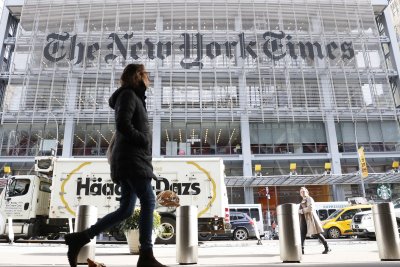

March 21 (UPI) — A federal judge struck down the Department of Defense’s policy that led to the ouster of most journalists from the Pentagon last fall and replaced them with those who agreed to the department’s new rules.
Judge Paul Friedman of the U.S. District Court for the District of Columbia ruled in favor of The New York Times, which sued the Department of Defense over the policy. Friedman ruled that the policy is unconstitutional and ordered the department to give back the credentials of the seven Times journalists who cover the Pentagon.
Though he didn’t order the restoration of other reporters’ credentials, he voided the policy that they refused to sign, allowing them to get credentialed again.
Pentagon spokesperson Sean Parnell wrote on X: “We disagree with the decision and are pursuing an immediate appeal.”
In October, the Defense Department required that all credentialed journalists sign the policy. Signing it gave the Pentagon the ability to label the journalists “security risks” and revoke their credentials if the department decided they had endangered national security. They had to pledge to only publish approved information.
Most news outlets refused to sign, losing their press passes and desks inside the Pentagon. They were replaced with news outlets and people friendly to the administration. The Times then sued the department over its First Amendment rights.
“A primary purpose of the First Amendment is to enable the press to publish what it will and the public to read what it chooses, free of any official proscription,” Friedman wrote in his opinion.
“Those who drafted the First Amendment believed that the nation’s security requires a free press and an informed people and that such security is endangered by governmental suppression of political speech,” Friedman added. “That principle has preserved the nation’s security for almost 250 years. It must not be abandoned now.”
First Amendment attorney Theodore Boutrous, who is representing The Times in the suit, told CNN: “The district court’s decision is a powerful rejection of the Pentagon’s effort to impede freedom of the press and the reporting of vital information to the American people during a time of war.”
“The district court’s opinion is not just a win for The Times, [Times reporter] Mr. [Julian E.] Barnes, and other journalists, but most importantly, for the American people who benefit from their coverage of the Pentagon,” Boutrous said.
Friedman also agreed with the Times that the policy violated its due process rights because it was vague and could be accidentally violated by reporters. Part of the policy prevented reporters from asking certain questions.
“A primary way in which journalists obtain information is by asking questions,” he wrote. “Under the policy’s terms, then, essential journalistic practices that the plaintiffs and others engage in every day — such as asking questions of department employees — could trigger a determination by the department that a journalist poses a security or safety risk.”
First Amendment advocates said they support the decision.
“The court affirmed that our security and liberty rely on the press’s freedom to publish and the public’s ability to access news about government affairs free from state control,” said Gabe Rottman, vice president of policy at the Reporters Committee for Freedom of the Press, in a statement.
Seth Stern, chief of advocacy at Freedom of the Press Foundation, said the ruling is especially important right now.
“It’s unfortunate that it took this long for the Pentagon’s ridiculous policy to be thrown in the trash. Especially now that we are spending money and blood on yet another war based on constantly shifting pretexts, journalists should double down on their commitment to finding out what the Pentagon does not want the public to know rather than parroting ‘authorized’ narratives,” Stern said in a statement.