Pentagon fires Stars and Stripes editor-in-chief, publisher, reporter

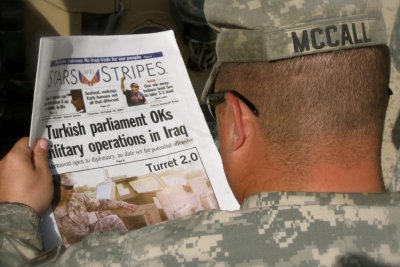
Stars and Stripes, the U.S. military newspaper founded in 1861, lost its editor-in-chief, publisher and Middle East reporter to firings Friday for what the Pentagon described as insubordination. File Photo by Sgt. Brendan Mackie/U.S. Army National Guard
Aug. 21 (UPI) — The Pentagon has fired the publisher, editor-in-chief and Middle East reporter of the venerable military newspaper Stars and Stripes, the publication reported Friday.
Editor-in-chief Erik Slavin, publisher Max Lederer Jr. and civilian reporter Lara Korte, who covers the Middle East, have all received termination notices, a Pentagon source confirmed to the newspaper.
Despite being part of the Department of Defense, Stars and Stripes has long maintained editorial independence from the top leaders but it has faced pressure under the administration of President Donald Trump, whose defense secretary, Pete Hegseth, has repeatedly clashed with media covering the Pentagon.
Slavin said he was fired for insubordination after telling CBS News last month that he would regard any attempt by the Pentagon to interfere with Stars and Stripes’ editorial independence as a “red line.”
Asked in an interview if he had any “red lines” in his mind when it came to censorship, Slavin answered, “Yes, I do,” and gave as an example, “Well, don’t run a perfectly accurate story. Run this instead. Here it is.”
On Friday, Slavin issued a statement to the newspaper saying, “I stand by the principle that Stars and Stripes must remain editorially independent, as required by law and by the department’s own policies.”
During the same interview, Korte said, “I’m working for Stars and Stripes, not for the Pentagon, not for any administration, not for any policy maker. I’m here to cover the military community.”
Korte said Friday she was informed that she, too, had been fired for insubordination due to her remarks in the interview.
“I consider it a great privilege to live alongside members of the military and share their stories. It’s a shame for the institution and service members, who swore to defend the Constitution and deserve the right to a free and independent press,” she said.
Lederer, who announced his retirement on Tuesday, was fired after more than 30 years of working for the paper.
Capt. William Urban, the military deputy to Lederer, didn’t directly address the terminations in an “open letter to stakeholders” published in Stars and Stripes on Friday, but rather spoke of increasing its readership through digital strategies.
“We may never be able to have the same impact for our service members digitally that our paper had during World War II in a vastly different media environment, but I also believe that we can do better — that we must do better for our most important constituency, the men and women who make up the U.S. Armed Forces,” he wrote.
“My vision for the future of Stars and Stripes is simple: More eyeballs on our content and more impact on our service members while maintaining the highest standard of professional journalism with the credibility that comes with editorial independence.”
Stars and Stripes’ independence first appeared to come into the administration’s crosshairs in January when Sean Parnell, chief Pentagon spokesman and a senior advisor to Hegseth, said the department was aiming to bring it “into the 21st century.
“We will modernize its operations, refocus its content away from woke distractions that syphon morale, and adapt it to serve a new generation of service members.”
The firing of its leadership elicited alarm from journalists.
National Press Club President Mark Schoeff Jr. called the moves “another brazen attempt by the Pentagon to dictate coverage of the military and should be immediately reversed.”
He cited the April firing of the the newspaper’s ombudsman, a role “established and charged by Congress to provide independent oversight and protect the paper’s editorial integrity,” and a March memo that imposed content restrictions and tightened the Pentagon’s oversight of the newsroom.
“Firing a newspaper editor after he publicly defended his newsroom’s editorial independence is deeply troubling, and it should concern every journalist and every member of the U.S. military who depends on independent reporting,” Schoeff added.
“This is an assault on the fundamental principle that journalists must be free to report the news without fear of retaliation from the government officials they cover,” he said. “The Pentagon must reaffirm that principle and make clear that Stars and Stripes journalists will not be punished for doing their jobs.”