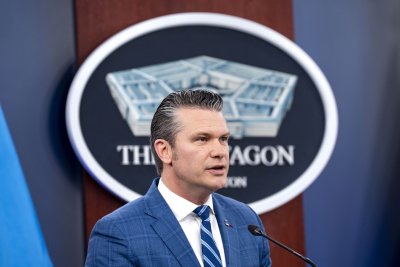
Judge blocks Pentagon from enforcing reporter escort policy

July 1 (UPI) — A federal judge has temporarily blocked the Defense Department from enforcing its escort policy, at least for reporters with The New York Times, dealing another blow to the Trump administration’s attempt to restrict media access at the Pentagon.
It was not entirely clear whether the order applied to all credentialed reporters or just those associated with The New York Times.
U.S. District Judge Paul Friedman in D.C. issued his preliminary injunction Tuesday, finding the plaintiffs were likely to succeed on their claims that the escort policy was retaliatory and infringed on their First Amendment rights.
“This Court has spoken at several points about the critical importance of protecting the freedoms enshrined in the First Amendment, and that evergreen principle bears repeating: ‘Those who drafted the First Amendment believed that the nation’s security requires a free press and an informed people and that such security is endangered by government suppression of political speech,'” Friedman said in his Tuesday opinion, quoting from one of his previous opinions in the case.
“‘That principle has preserved the nation’s security for almost 250 years.'”
The ruling comes in a protracted case that began when the Defense Department announced a new policy in October permitting the revocation of Pentagon credentials for collecting and reporting information it deemed unauthorized.
After Friedman ruled in March that the policy was unconstitutional, the Department of Defense came back with a new policy that, among other restrictions, mandated reporters be escorted by Defense Department personnel at all times within the Pentagon.
The Trump administration has argued that the new requirements are for national security purposes. By limiting access and requiring escorts, the Department of Defense said it could prevent the gathering and public disclosure of what it calls classified national security information and controlled unclassified information.
The Times then challenged the revised policy, with the court again siding against the Defense Department, which appealed, seeking only a limited stay pending appeal to allow the implementation of only the escort requirement.
In late April, a divided three-judge appeals panel granted the Trump administration’s emergency request, finding that it was likely to succeed in showing that the escort requirement was not within the scope of the lower court’s original order, without weighing the merits of the case. The Times then filed a new, second lawsuit challenging the Pentagon’s escort policy.
The Pentagon on Wednesday said it “strongly disagrees” with the court and will appeal the decision.
In a statement, Sean Parnell, chief Pentagon spokesperson, argued that the removal of the escort policy will make it easier for “sensitive and classified information to reach our adversaries.”
“Unescorted access to the Pentagon allowed journalists to observe activity patterns and develop relationships that contributed to repeated unauthorized disclosures of operational plans and intelligence,” Parnell said.
“The court’s order effectively restores that risky environment at a time when protecting our military’s secrets is more critical than ever.”
The Times argued that the policy was not only a restriction on its reporters’ First Amendment rights, but also retaliatory, an argument that Friedman said would likely succeed in court, pointing to numerous instances of Trump administration officials, including President Donald Trump and Defense Secretary Pete Hegseth, insulting the newspaper and other news organizations.
UPI has contacted The Times for comment.
The Freedom of the Press Foundation celebrated the ruling online, while calling for punishment if the Trump administration tries to find another workaround to enforce its media-restriction policies.
“The DoD can’t be allowed to punish journalism or evade court orders without consequences,” it said in an online statement.
“If the Pentagon keeps trying to avoid this ruling, the court should respond with sanctions or contempt.”