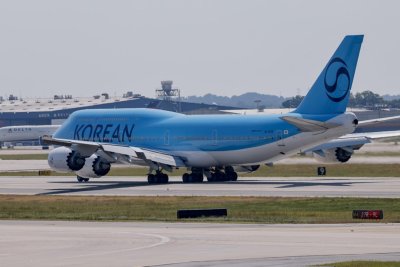

A Korean Air Lines Boeing 747-800 charter flight departs for Seoul, South Korea. File. Photo by ERIK S. LESSER / EPA
March 4 (Asia Today) — South Korea’s aviation industry is on alert as rising oil prices and a weakening Korean won threaten airline profitability following the recent escalation in Middle East tensions.
The surge in global crude prices and the won-dollar exchange rate comes after the United States and Israel launched airstrikes on Iran, raising fears of prolonged instability in the region.
According to the Korea Exchange on Tuesday, shares of Korean Air fell 7.94% to 23,200 won (about $16.10). The stock has dropped about 17% compared with its Feb. 27 closing price of 28,100 won (about $19.40), just before the strikes on Iran, reflecting investor concerns about rising operating costs.
Fuel expenses account for roughly 30% of airline operating costs, making the industry particularly vulnerable to oil price fluctuations. Korean Air estimates that a $1 change in oil prices per barrel can affect its operating profit by about $30.5 million.
Brent crude futures on the ICE Futures Exchange closed at $81.40 per barrel on Tuesday, up $3.66, or 4.71%, from the previous session. West Texas Intermediate crude rose $3.33, or 4.67%, to close at $74.56 per barrel on the New York Mercantile Exchange.
Oil prices have climbed for three consecutive trading days after tensions surrounding Iran intensified and shipping through the Strait of Hormuz – a key route for about 20% of global seaborne oil shipments – was disrupted.
Korean Air said it plans to protect profitability through hedging strategies. The airline uses fuel price option contracts under internal risk management policies, primarily employing a “zero-cost collar” hedging structure that sets upper and lower price limits for fuel purchases.
Under this system, the airline can buy jet fuel at a predetermined price even if oil prices rise, while it must purchase fuel at the agreed level if prices fall below a certain threshold.
Korean Air said it hedges up to 50% of its projected annual fuel consumption.
“Ongoing assessments of oil price risks are conducted regularly, and we apply appropriate hedging products depending on market conditions and price levels,” a Korean Air official said.
Industry analysts warn, however, that prolonged tensions in the Middle East could place additional pressure on airlines through a weaker Korean currency.
The won briefly surpassed the psychologically significant level of 1,500 per U.S. dollar early Tuesday. A weaker won typically increases overseas operating costs for airlines and can also dampen travel demand.
Low-cost carriers are expected to face greater difficulties. Jeju Air, Jin Air and T’way Air – South Korea’s major budget airlines – all reported operating losses last year amid the strong dollar and have been striving to return to profitability.
Recent signs of exchange rate stabilization had raised hopes for improved performance this year, but the Iran crisis has revived concerns across the industry.
A T’way Air official said the company is preparing contingency plans.
“When the won-dollar exchange rate rises, we respond by covering overseas operating costs with foreign currency revenues generated locally,” the official said. “We are reviewing additional measures depending on changes in the international situation.”
If you want, I can also create a short 60-90 second YouTube news script version of this story, which would fit well with your weekly global news roundup format.
— Reported by Asia Today; translated by UPI
© Asia Today. Unauthorized reproduction or redistribution prohibited.
Original Korean report: https://www.asiatoday.co.kr/kn/view.php?key=20260304010001116