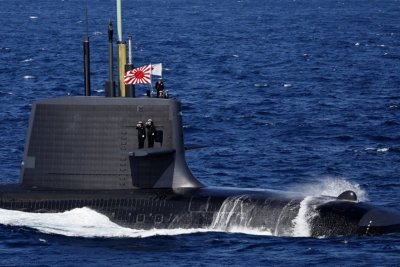

The Uzushio-class submarine of the Japan Maritime Self-Defense Force (JMSDF) sails during International Fleet Review to commemorate the 70th anniversary of the foundation of the JMSDF at Sagami Bay, off Yokosuka, south of Tokyo, Japan, 06 November 2022. File. Photo by ISSEI KATO / EPA
Feb. 20 (Asia Today) — Japan’s ruling Liberal Democratic Party has approved a draft proposal calling for a significant expansion of lethal weapons exports, including scrapping existing limits that restrict overseas transfers to non-combat equipment.
The draft, endorsed Wednesday by the party’s Security Affairs Committee, seeks to revise operational guidelines under Japan’s Three Principles on Defense Equipment Transfer.
At the center of the proposal is the abolition of the so-called “five categories” rule, which currently limits arms exports to non-combat purposes such as rescue, transport, surveillance and mine clearance.
Under the draft, exports of weapons with lethal capability would in principle be permitted.
Kojiro Onodera, head of the committee, told reporters after the meeting that Japan’s security environment is “growing increasingly severe” and said expanding defense exports is necessary to strengthen coordination with allies and like-minded countries.
The party plans to finalize its recommendations next week and submit them to the government in early March.
Exports would be limited to countries that have signed defense equipment and technology transfer agreements with Japan. Media reports have cited between 10 and 17 partner countries, including the United States and Australia.
Decisions on lethal weapons exports would be subject to review by the prime minister and relevant Cabinet ministers at the National Security Council. Non-lethal items such as body armor and helmets would be handled at the working level within the government, with possible post-reporting to the Diet rather than requiring formal Cabinet approval in each case.
The draft also calls for allowing finished products developed through international joint programs to be exported to third countries beyond the original partner nations. Current rules restrict such transfers largely to the next-generation fighter program jointly pursued by Japan, Britain and Italy.
Another sensitive issue is exports to countries involved in armed conflict. The existing principles prohibit transfers to parties engaged in conflict, allowing only limited non-lethal support to countries such as Ukraine.
The draft would maintain a general ban on exports to countries actively engaged in combat but allow exceptions in “special circumstances” when Japan’s security interests are at stake.
Japanese media outlets including Asahi, Mainichi and Sankei described the move as accelerating Japan’s shift toward a more active defense export policy.
The push reflects efforts to revitalize Japan’s defense industry and deepen security ties with partner nations. Critics, however, have raised concerns that easing restrictions could weaken parliamentary oversight and increase the risk of arms proliferation.
— Reported by Asia Today; translated by UPI
© Asia Today. Unauthorized reproduction or redistribution prohibited.
Original Korean report: https://www.asiatoday.co.kr/kn/view.php?key=20260220010005980