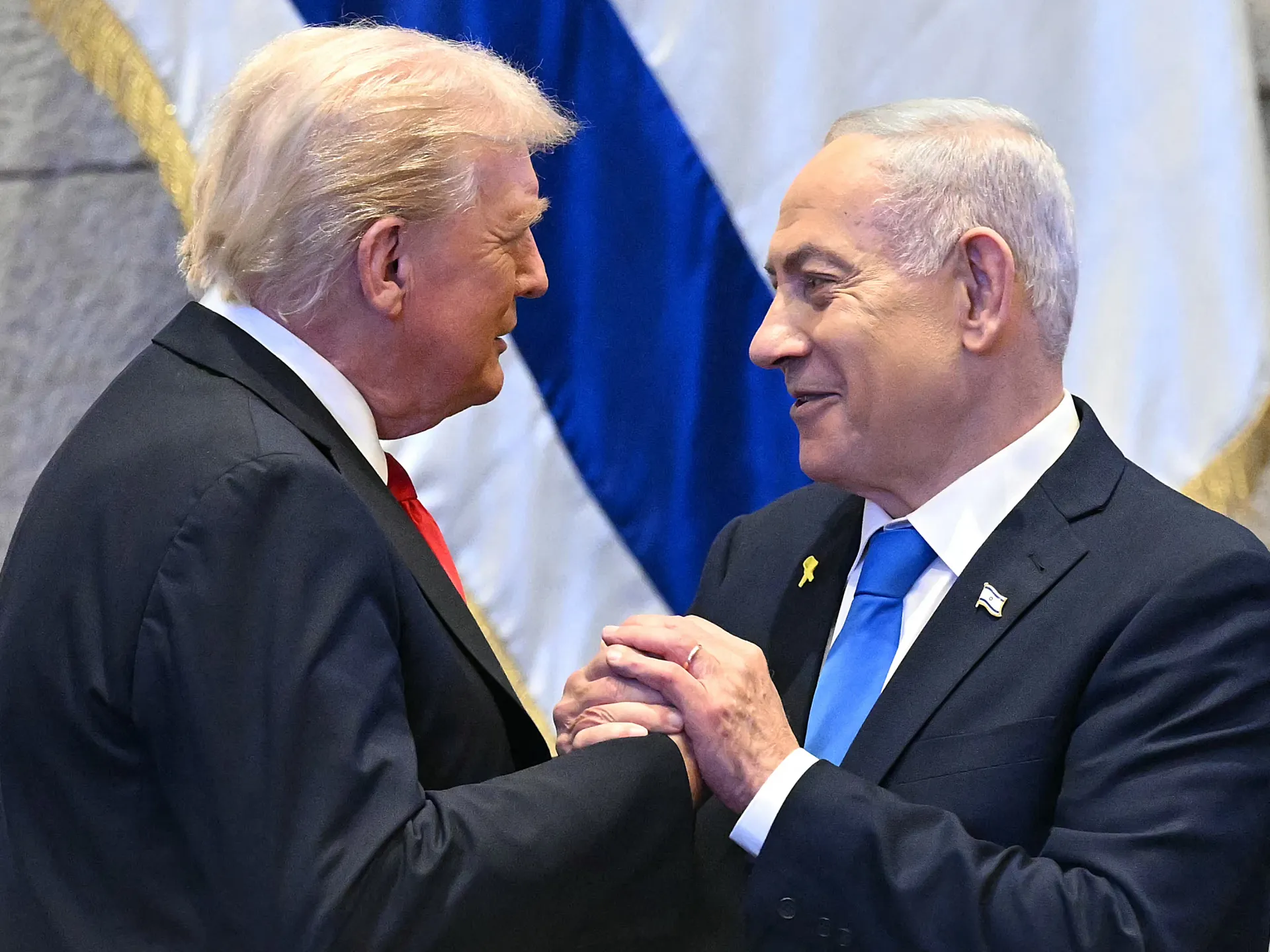
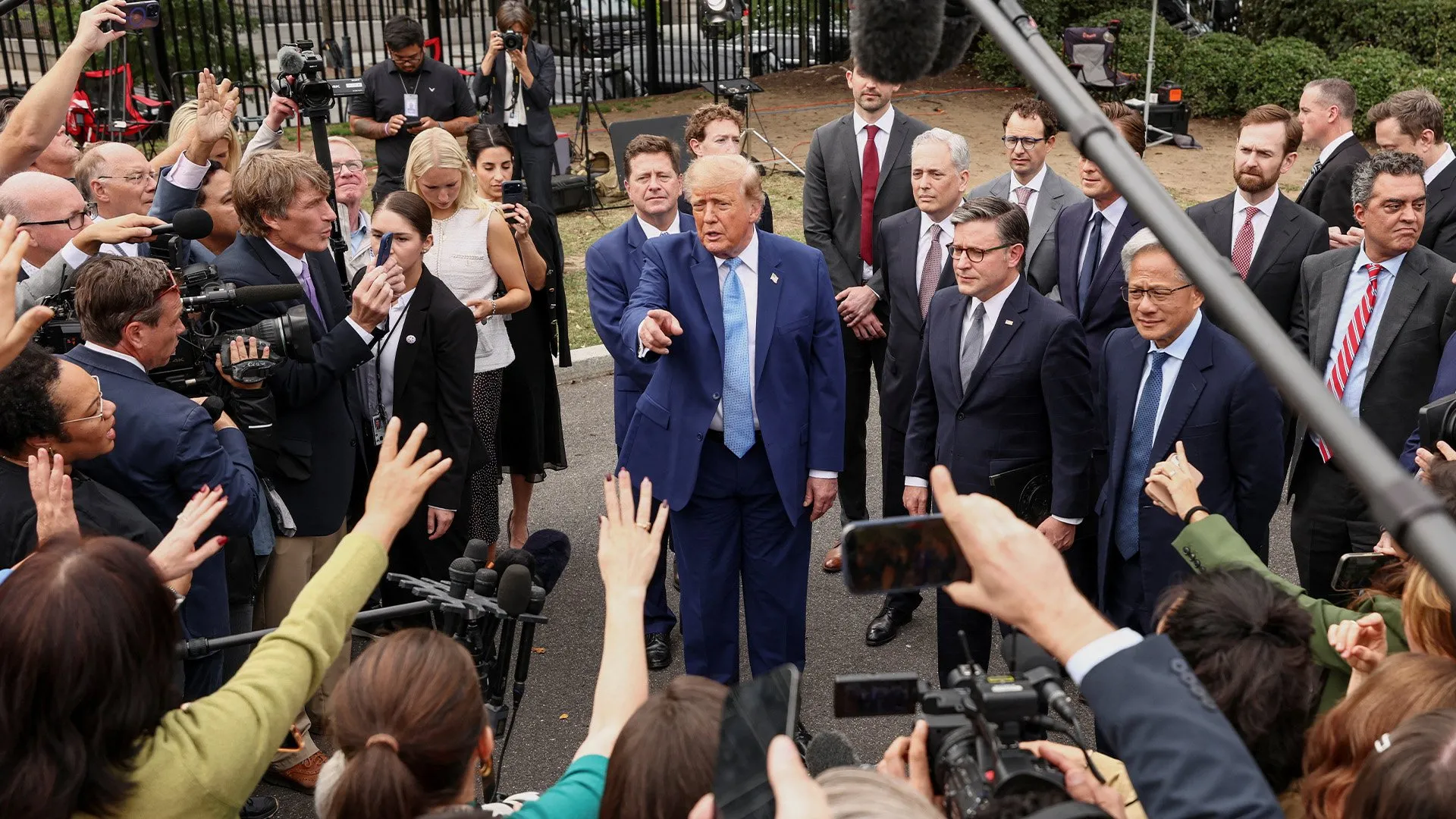
United States President Donald Trump has announced his official endorsement of Israel’s Prime Minister Benjamin Netanyahu’s election campaign after previously refusing to endorse anyone.
Trump posted on his Truth Social platform on Sunday that Netanyahu had been a “great warrior prime minister and an even greater partner for peace”, adding that Iran had been “systematically destroyed both militarily and financially, and unless they change their ways, rapidly, we will soon finish the job.”
Recommended Stories
list of 3 itemsend of list
“If Israel has the wrong Leader, which would be anyone other than Bibi, America will have to do this work ourselves, and I am not inclined to do so,” Trump wrote.
“Bibi Netanyahu has been Strong, Brave, and Brilliant in the face of tremendous opposition, including that coming from even Israel, itself. Despite all of that, he has endured and, in fact, he has thrived!”.
The president added that normal men and women would have “wilted” under the pressure that Netanyahu was under, but the Israeli prime minister “got stronger”.
“This is the kind of Partner that the United States of America is demanding of Israel, a Country for which it has done so much. Please let this Letter serve to represent my Complete and Total Endorsement of Bibi Netanyahu in his upcoming Race for Re-Election as Prime Minister of Israel. BIBI NETANYAHU WILL NEVER LET YOU DOWN!”, he added.
The Israeli election will be on October 27 . According to Israeli news outlet Haaretz’s tracker, as of Sunday, the opposition alliance led by the Yashar party of Gadi Eisenkot is expected to win the most seats, at 52, with Netanyahu’s Likud party-led coalition taking 51 of the 120 seats in the Knesset.
So far, no party is projected to secure an outright majority.
But Trump’s endorsement comes after he had previously shied away from fully backing Netanyahu’s election campaign.
Earlier this month, when asked twice by TIME magazine if Netanyahu should be given another term, Trump pivoted to his own popularity in Israel and Washington’s actions supporting Israel.
When asked on Thursday by the right-wing US news outlet, Newsmax, if he was planning to get involved in the Israeli elections, Trump said: “They’d like me to be. Yeah, they’d like me to be”.
When asked whether he trusted Netanyahu, Trump replied, “I don’t trust anybody, honestly”.
Still, Sanam Vakil, director of the Middle East North Africa programme at the British think tank Chatham House, explained that Trump’s endorsement of Netanyahu was “politically significant” because it comes after months of tension between the two leaders.
“It allows Netanyahu to reinforce his claim that he is indispensable to Israel’s relationship with Washington,” Vakil told Al Jazeera.
“However, its electoral impact should not be overstated. Israeli voters remain divided over Netanyahu’s leadership and the outcome of the Iran war. The endorsement may help consolidate his existing support, but it does not resolve the wider questions surrounding his record,” she added.
Andreas Krieg, senior lecturer at the school of security studies at King’s College London, said that Trump’s endorsement was a “political gift” to Netanyahu, whose electoral campaign is struggling.
But like Vakil, he cautioned against treating Trump’s endorsement as a game-changer.
“Netanyahu’s problems are structural, involving fragmented right-wing parties, disillusioned ultra-Orthodox voters and the legacy of October 7. Trump may mobilise reluctant Likud voters, potentially worth a seat or two in a close contest, but he cannot manufacture the coalition majority Netanyahu currently lacks,” Krieg told Al Jazeera.
What the endorsement means for the Iran war
Much of Trump’s endorsement has been heavily focused on the Iran war, at a time when many analysts suggest the US president might be looking to restart attacks, either before or after the midterm elections in early November.
The conflict, which began in February after the US and Israel launched attacks across Iran, is currently at a standstill.
The Strait of Hormuz, which once transported 20 percent of global crude, was effectively shut by Iran after the war started. A US naval blockade of Iranian vessels followed, as each country struck ships passing through the waterway that they accused of not complying with its orders. Oil traffic last month through the strait picked up to pre-war levels as the US Navy shepherded an increasing number of tankers. But a spate of Iranian attacks on vessels early this month has again hit crude exports through Hormuz.
On Monday morning, Brent crude futures stood at $107.57 a barrel, down slightly after reaching their highest since May 19 on Friday, when they briefly touched $110 a barrel.
Last month, Iran presented a proposal to Washington to reopen the waterway within seven days, but negotiations failed after the US did not address Tehran’s seven conditions, which included the lifting of sanctions and the ending of its naval blockade.
Foreign Minister Abbas Araghchi told Iranian media outlets on Sunday that the proposal remained on the table and, if Washington accepts Tehran’s conditions, the strait could reopen within six days, with talks resuming the following day.
At the same time, Araghchi, in a post on X on Sunday night, accused Netanyahu of wanting to restart attacks on Iran with the US to “stay out of jail”.
“Last time you wanted to ‘finish the job’, Iran emerged even stronger. Want to try your luck again? Be our guest. But be careful; we have unfinished jobs too,” he wrote.
“Netanyahu is driving America into another war to stay out of jail, whatever the consequences for Israel – let alone POTUS,” he added.
Krieg said Trump was prioritising the use of “coercive leverage” through his endorsement of Netanyahu but not necessarily “war over diplomacy”.
“The naval blockade is hurting Iran considerably and Washington believes time is working in its favour. Trump’s calculation is that Iran will eventually accept nuclear concessions and reopen Hormuz, without Washington having to offer significant concessions first,” he argued.
“His endorsement reinforces the military threat underpinning that strategy. But it does not mean diplomacy is finished. Trump still wants a deal he can present as a victory. The danger is that Tehran increasingly believes it must escalate to improve its bargaining position.”
What is next?
Vakil explained that, while Trump’s declaration of support for Netanyahu had signalled renewed political alignment with Israel and left the door open for future joint military action, it also makes it “harder for Trump to distance himself from the war or portray the US as having been reluctantly drawn into it”.
“He is explicitly taking ownership of the partnership and its military campaign against Iran. However, the endorsement does not necessarily mean that the two leaders have agreed on another operation, nor does it settle the question of who initially pushed hardest for war,” she said.
Vakil added that for Tehran, the statement will reinforce the belief of Iranian leaders that there is “little meaningful distinction between US and Israeli objectives.”
“At the same time, Trump’s suggestion that he is reluctant to confront Iran without Netanyahu could be interpreted as evidence of the limits of Washington’s appetite for another war.”
Meanwhile, while Trump has said that he would not attack Iran before the November midterms, several US media outlets have reported that the Pentagon has drawn up plans to relaunch attacks before voters head to the polls.
Last week, US news outlet Axios reported, citing both US and Israeli officials, that both Trump and Netanyahu had spoken about launching a major new operation against Iran ahead of the elections in both countries.
For Krieg, the likelihood that the US and Israel launch an attack on Iran remains low, assuming there is no Iranian strike that forces a response.
“The more dangerous window opens after November 3 [US midterms], when those electoral constraints disappear. Both militaries are preparing for that possibility. The greatest immediate risk is an uncontrolled escalation in Hormuz that forces Washington’s hand before either leader is politically ready,” he said.