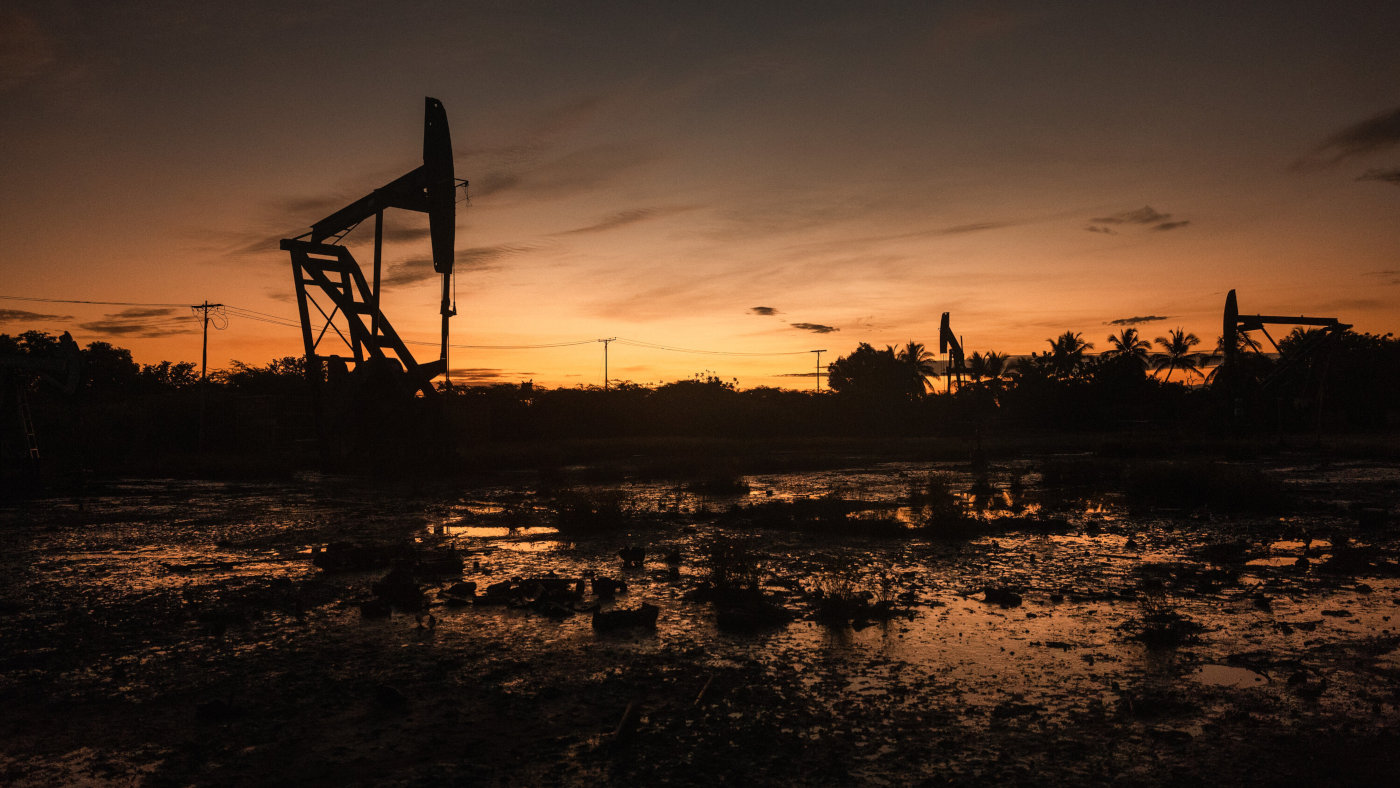
Oil exports remain Venezuela’s most important source of foreign revenue. (New York Times)
Caracas, February 20, 2026 (venezuelanalysis.com) – The Trump administration is forcing all royalty, tax, and dividend payments from Venezuelan oil production be paid into accounts managed by Washington.
The mandate reinforces the White House’s control over Venezuelan crude export revenues in the wake of the January 3 military strikes and kidnapping of President Nicolás Maduro, as well as a naval blockade imposed in December.
The US Treasury Department updated its FAQ section on February 18 to clarify conditions on recently issued sanctions waivers allowing expanded participation in Venezuela’s oil sector to Western corporations.
Under the licenses, only “routine payments of local taxes, permits, and fees” to Venezuelan authorities are permitted.
“Other payments, including royalties, fixed per-barrel production levies, or federal taxes to blocked persons, such as the Venezuelan government or (state oil company) PDVSA, must be made into the Foreign Government Deposit Fund,” the text read.
The acting Rodríguez administration has yet to comment on the new restrictions.
Since January, Washington has imposed control over Venezuelan crude exports, with proceeds deposited in a US-administered account in Qatar. US Energy Secretary Chris Wright announced recently that funds will now be deposited directly in a US Treasury account. Senior administration officials have stated that the arrangement gives the White House “leverage” to condition Venezuelan government policies, while Secretary of State Marco Rubio stated that Caracas must submit a “budget request” to access its own oil revenues.
At least US $500 million, out of an initial deal estimated at $2 billion, have been returned to Venezuela and offered by banks in foreign exchange auctions. Venezuelan authorities have also reported the import of medicines and medical equipment from US manufacturers using “unblocked funds.”
On Thursday, the Treasury’s Office of Foreign Assets Control (OFAC) issued General License 50A allowing select firms to conduct transactions and operations related to hydrocarbon projects with PDVSA or any other Venezuelan public entity. The document mirrors General License 50 issued on February 13 but added French firm Maurel & Prom to a list including BP, Chevron, Eni, Repsol, and Shell.
Maurel & Prom’s main project in the Caribbean nation is a minority stake in the Petroregional del Lago joint venture, which currently produces 21,000 barrels per day (bpd). The company’s executives recently held a meeting with Acting President Delcy Rodríguez as part of Caracas’ efforts to secure foreign investment.
In recent weeks, the Trump administration has issued several licenses to boost US and European involvement in the Venezuelan energy sector, with imports of diluents, inputs and technology now allowed. General License 49, issued on February 13, demands that companies apply for a special license before striking production and investment deals with Venezuela.
The US Treasury issued sanctions waivers while maintaining existing coercive measures against the Venezuelan oil industry in place, including financial sanctions against PDVSA. The licenses likewise block any transactions with companies from Cuba, China, Iran, North Korea, and Russia.
The selective flexibilization of sanctions followed the Venezuelan National Assembly’s approval of a pro-business overhaul of the country’s Hydrocarbon Law. The reform grants private corporations expanded control over operations and sales, while opening the possibility for disputes to be taken to external arbitration.
The reformed law also allows the Venezuelan executive to arbitrarily reduce royalties and a new “integrated tax,” capped at 30 and 15 percent, respectively. The executive is likewise entitled to grant reductions to the 50 percent income tax set for the oil industry if deemed necessary for projects to be “internationally competitive.”
According to US-set conditions and the reformed law, minority partners such as Repsol are authorized to sell crude from Venezuelan joint ventures before depositing the owed royalty and tax amounts, as well as dividends belonging to PDVSA, to US Treasury-designated accounts.
The initial crude sales as part of the Trump-imposed arrangement were conducted via commodity traders Vitol and Trafigura, which lifted cargoes at Venezuelan ports before re-selling them to final customers. However, according to Reuters, US-based refiners including Phillips66 and CITGO are looking to secure crude directly from Venezuela to maximize profits.
CITGO, a subsidiary of PDVSA, is close to being taken over by vulture fund Elliott Management following a court-mandated auction to satisfy creditor claims against the South American country. The company has been managed by boards appointed by the US-backed Venezuelan opposition since 2019.