The U.S. is continuing to build up its military presence in the Middle East ahead of a possible attack on Iran. The USS Abraham Lincoln and its Carrier Strike Group (CSG) is now in the Indian Ocean, a U.S. Navy official told The War Zone on Thursday. The CSG was in the South China Sea until U.S. President Donald Trump ordered it moved west. In addition, more cargo jets and aerial refueling tankers have arrived in the region. Trump on Thursday said a large naval presence is heading to the region.
These movements come as Trump has threatened to strike Iran over its brutal treatment of anti-government protesters, which has resulted in thousands of deaths.
“We have a big flotilla going in that direction, and we’ll see what happens,” Trump told reporters Thursday afternoon. “We have a big force going toward Iran. I’d rather not see anything happen, but we’re watching them very closely.”
“We have an armada,” Trump added after claiming he “stopped 837 hangings on Thursday…We have a massive fleet heading in that direction, and maybe we won’t have to use it. We’ll see.”
Aside from threatening to strike Iran, Trump on Jan. 13 also promised those taking to the streets that help was on its way.
However, he relented after being told the killings would stop and reportedly called off a strike against Iran last week. According to some accounts, Trump does not want to become involved in a protracted battle with Iran while still contemplating regime change. There are lingering concerns in Washington and Jerusalem about not having enough assets in the region to defend against an expected Iranian response, which in part led Israel to urge Trump to hold off any attack. This was also our analysis at the time.
The influx of additional assets to the region will give Trump a greater range of potential action, and allow for the ability to defend against an Iranian attack, whether in response to U.S. military actions or not.
“If Iranian leadership perceives that regime collapse is imminent, the expectation within this assessment is that Iran would escalate aggressively across multiple vectors,” the Times of Israel recently suggested in an opinion piece. “This would include attacks on American assets throughout the region, coordinated pressure against allies such as Israel, and actions designed to disrupt global energy flows. In particular, the Strait of Hormuz represents one of Iran’s most consequential pressure points. Energy agencies estimate that roughly 20 million barrels per day—about one-fifth of global petroleum liquids consumption—transit the strait.”
All this depends on the state of Iran’s command and control at the time of such an operation, as well as many other factors. While the specter of major retaliations in the Strait of Hormuz have persisted for years, it did not come to fruition during the war with Israel in June. Still, operations that seek regime change could change this calculus.
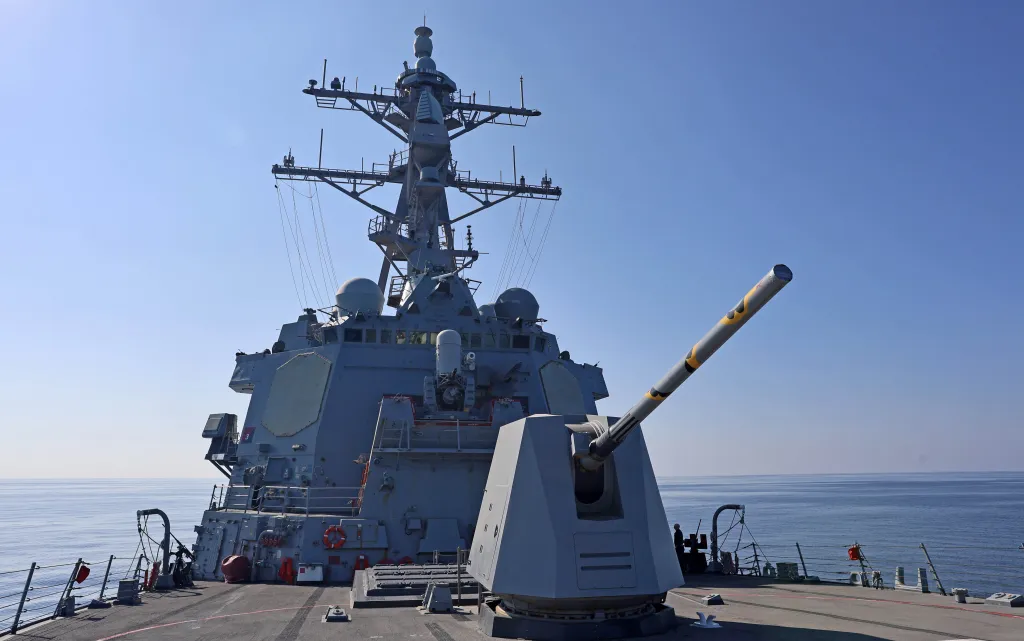
As for U.S. force posture in the region, there remains a large number of unknowns, including the exact composition of U.S. forces that are already there and what role, if any, will be played by Israel and other U.S. allies if Trump moves forward with an attack. We do know that the U.S. already had a limited number of fighter aircraft at several bases throughout the Middle East, as well as three Arleigh Burke class guided missile destroyers and perhaps a submarine plying its waters, among other capabilities, prior to the protests.

Many additional assets have poured in since then, but it remains unclear at the moment whether the current force can support in terms of a sustained conflict and what will be added in the coming days or even weeks leading up to an operation. At the same time, an operation could begin any time, so the current picture is quite murky. Even a limited decapitation operation aimed at the regime would require a huge number of contingencies.
The Lincoln CSG, which appears to be several days away from arriving in the Arabian Sea, would boost U.S. striking power in the region. Its embarked CVW-9 Carrier Air Wing consists of eight squadrons flying F-35C Lightning II, F/A-18E/F Super Hornets, EA-18G Growlers, E-2D Hawkeyes, CMV-22B Ospreys and MH-60R/S Sea Hawks. Its escorts, Ticonderoga class guided-missile cruiser USS Mobile Bay and the Arleigh Burke class guided-missile destroyers of Destroyer Squadron (DESRON) 21 bring a large number of missile tubes that could be used to strike Iran. These vessels could also be used in the defense of U.S. targets and those of its allies during a reprisal.
So far, there does not appear to have been a major influx of U.S. airpower. Low-resolution satellite imagery observed by The War Zone shows no large deployments to Diego Garcia, the Indian Ocean island where U.S. bombers have previously been staged amid rising tensions with Iran. However, online flight trackers are reporting that there have been flights of C-17 Globemaster III cargo jets to the region. These would be needed to move materiel and personnel. As we projected, the U.S. is sending additional Patriot and Terminal High Altitude Area Defense (THAAD) systems to the Middle East for increased protection from any Iranian attack, The Wall Street Journal reported.
As we previously mentioned, online flight trackers also noted that F-15E Strike Eagles, accompanied by KC-135 Stratotanker aerial refueling jets, headed east from RAF Lakenheath in England to the Middle East earlier this week.
The presence of Strike Eagles in the region, especially those coming from RAF Lakenheath, is in itself not new. These jets have maintained a steady presence at Muwaffaq Salti Air Base in Jordan for nearly a decade, and their recent arrival in the Middle East was largely expected due to the current instability and saber-rattling. F-15Es played a key role in defending against multiple Iranian drone and cruise missile barrages on Israel and they are now more capable of that mission than ever. Beyond its offensive capabilities, if Iran were to launch a major attack on Israel and/or U.S. assets in the region, preemptive or in retaliation, the F-15Es would play a key part in defending against those attacks.
While these are significant additions to the standing force posture in the region, more fighter aircraft would be expected for a major operation against Iran. We have not seen evidence of those kinds of movements just yet, although some movements are not identified via open sources.
Beyond tactical combat aircraft in the region, the U.S. can fly bombers there from the continental United States, as was the case when B-2 Spirits attacked Iran’s nuclear facilities during Operation Midnight Hammer last June.
The U.K. is also sending tactical combat jets to the region.
“The Royal Air Force’s joint Typhoon squadron with Qatar, 12 Squadron, has deployed to the Gulf for defensive purposes, noting regional tensions as part of the UK-Qatar Defence Assurance Agreement, demonstrating the strong and enduring defence relationship between the U.K. and Qatar,” the U.K. Defense Ministry (MoD) announced on Thursday.
“12 Squadron has regularly deployed to Qatar to conduct joint training and share experiences which enhance national and regional security,” MoD added. “Recently, the RAF deployed on exercises such as EPIC SKIES and SOARING FALCON – further reinforcing the operational capability between our two nations.”
Israel too remains at a high state of alert for an attack on or from its arch-enemy.
“It is my assessment that a strike will take place,” a high-ranking Israeli Defense Force (IDF) official told The War Zone. “The key variables – timing, method of execution, and the identity of participating forces, whether U.S. assets, the IDF, or additional coalition elements should they be involved, will be subject to strict and aggressive compartmentalization.”
“Likewise, the final decision to proceed with execution rests with a single individual alone,” the official added, referring to Trump.
As the U.S. and allies flow assets into the region and Israel stands at a heightened state of readiness, Iranian officials are ratcheting up their rhetoric.
On Thursday, Islamic Revolutionary Guard Corps (IRGC) commander General Mohammad Pakpour warned Israel and the United States “to avoid any miscalculations, by learning from historical experiences and what they learned in the 12-day imposed war, so that they do not face a more painful and regrettable fate.”
“The Islamic Revolutionary Guard Corps and dear Iran have their finger on the trigger, more prepared than ever, ready to carry out the orders and measures of the supreme commander-in-chief — a leader dearer than their own lives,” he added, referring to Iran’s Supreme Leader, Ayatollah Ali Khamenei.
The IRGC also released a video showing the location of U.S. bases in the region.
Khamenei’s government is also claiming it has suppressed the nationwide unrest that began Dec. 28 over rising prices, devalued currency that saw the rial crater now to basically nothing, a devastating drought, and brutal government crackdowns.
“The sedition is over now,” said Mohammad Movahedi, Iran’s prosecutor general, according to the judiciary’s Mizan News agency. “And we must be grateful, as always, to the people who extinguished this sedition by being in the field in a timely manner.”
However, getting verifiable information out of Iran remains incredibly challenging as the regime has cut off internet and phone service, and it is possible that at least some protests are ongoing.
While there is no indication of any imminent fighting, the regional players are increasingly preparing for conflict. This remains a volatile situation we will continue to monitor it closely.
Contact the author: howard@thewarzone.com