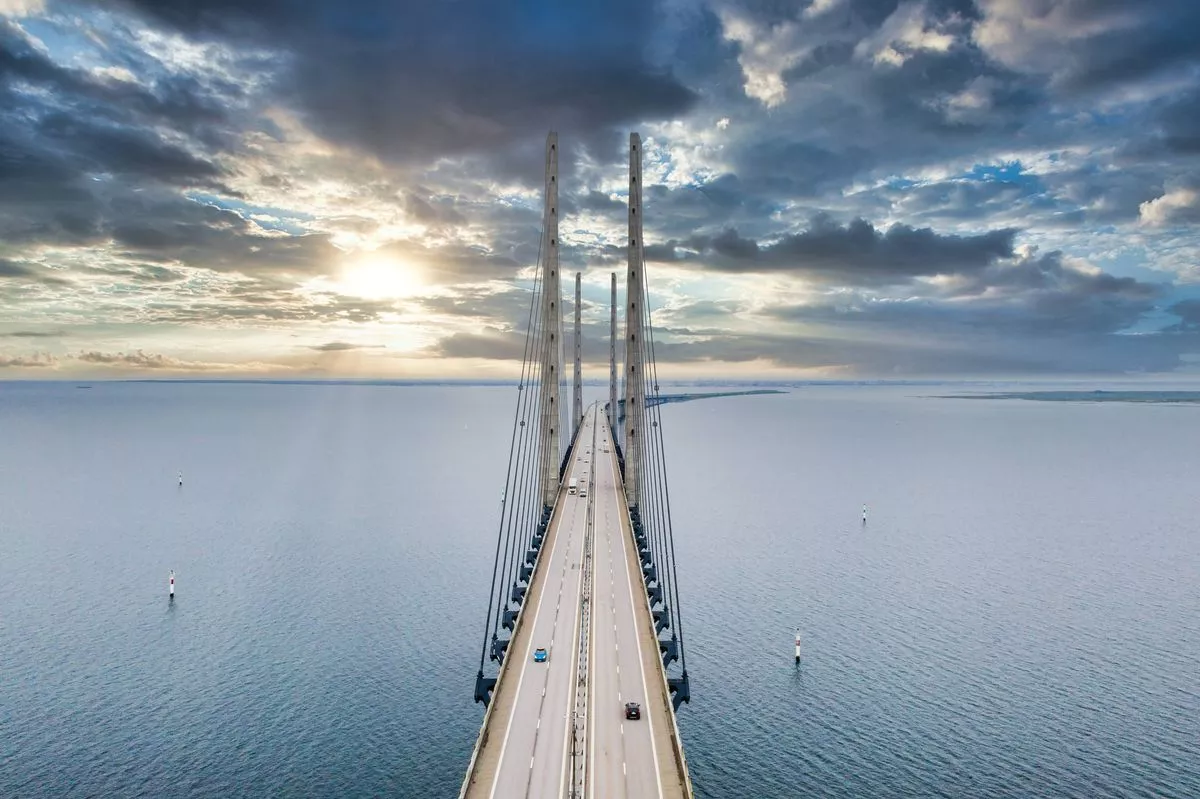
The 8-kilometre bridge is crossed by about 70,000 people each day

For more than 24 years, the 8-kilometre Øresund Bridge has served as a crucial link between Sweden and Denmark, providing a combined railway and motorway connection across the Øresund strait.
The bridge, a joint venture between Swedish firm Svedab and Danish company A/S Øresundsforbindelsen, makes up half of the journey from Sweden to the Danish Island of Amager.
Beginning near the city of Malmo on the Swedish coast, it extends to the man-made Danish Island of Peberholm, situated in the middle of the strait.
From Peberholm, a tunnel completes the remaining journey to the island of Amager, where Copenhagen airport is located, bringing the total distance travelled to around 16 km.
Construction on the bridge began in 1995, and it officially opened its lanes to traffic in July 2000. Just two years later, it was recognised with the IABSE Outstanding Structure Award, reports the Mirror.
Peberholm acts as a junction between the tunnel and the bridge.
It’s fitted with a motorway exit, restricted to authorised vehicles only, and a helicopter pad for use in emergencies.
The bridge, which sees an average daily footfall of 70,000 people, came with a hefty price tag of around £3.4 billion. The cost is expected to be recouped by 2037.
Crossing fees vary depending on the type of vehicle. Motorcyclists are charged £25.68, passenger cars £50.77, and vans, motorhomes or passenger cars with a trailer pay a staggering £178.55.
The Øresund Bridge claims the second spot as the longest bridge in Europe, only outdone by the 18.1km Kerch Bridge.
The latter spans the Kerch Strait, linking the Taman Peninsula of Krasnodar Krai in Russia and the Kerch Peninsula of Crimea.