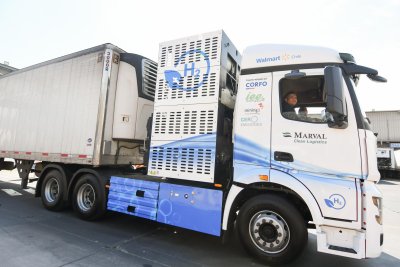

Walmart Chile’s vehicle, the first of its kind in Latin America, operates through a water-electrolysis process that uses renewable electricity to separate water into hydrogen and oxygen. Photo courtesy of Walmart Chile
SANTIAGO, Chile, Dec. 3 (UPI) — After a $15 million investment, Chile has built the first long-haul truck designed to run on green hydrogen, meaning it emits no carbon dioxide.
Walmart Chile’s vehicle, the first of its kind in Latin America, operates through a water-electrolysis process that uses renewable electricity to separate water into hydrogen and oxygen.
The truck has a range of about 465 miles, thanks to a storage capacity of 165 pounds of hydrogen. It can carry 54 tons of cargo, matching the performance of diesel-powered trucks.
It will be supplied directly by the green-hydrogen plant the retailer operates in Santiago, which produces up to 530 pounds a day.
Walmart Chile told UPI it decided to invest in this local development to advance its decarbonization plan for its logistics operations and to lead the adoption of cleaner technologies in the country.
“Green hydrogen allows us to operate with zero emissions, make use of the output from our plant in Quilicura and move toward our goal of having 40% of our routes be low-emission by 2029,” the company said.
The project was developed collaboratively as part of the HydroHaul Technology Program, which brought together several private companies with state financial support through Chile’s Economic Development Agency.
“That public-private coordination showed that advancing in green hydrogen requires coordinated efforts and pilot projects that generate real, on-the-ground evidence,” Walmart Chile said.
The truck was recently certified by the Ministry of Transport to operate on Chilean roads, and a hydrogen fueling station is being prepared at the Quilicura Distribution Center ahead of its launch.
“This is a technological innovation that is completely new for the country. Adding this type of technology helps trigger a range of local capabilities in knowledge, manufacturing and service and goods providers in general,” Ana María Ruz, executive director of the development agency’s Green Hydrogen Industry Development Committee, told UPI.
She added that it is good news that the vehicle can travel long distances. “This technology allows us to contribute to the development of products with added green value and move toward the long-awaited goal of carbon neutrality in a highly polluting sector such as transportation,” Ruz said.
It is expected to become a model that can be replicated nationwide.
“As this technology is tested in the country, not only from a technological standpoint but also an economic one, it is expected to serve as a success story that encourages other industries to evaluate adopting it where it is technically and financially viable,” Riz said.
Although significant cost gaps remain, she said favorable results should be highlighted.
“One example is the hydrogen-powered forklifts operating at Walmart’s Quilicura Distribution Center, which allowed the company to increase production by 5% because of shorter downtime for refueling,” Ruz said.
For that reason, other solutions are being funded, such as using hydrogen in trucks that carry refrigerated containers.
“This will help decarbonize the food industry through an application that does not yet exist in the country,” she said.
“It is very important to begin gaining experience now in transportation with green hydrogen. Pilot projects built around supply chains that allow vehicles to operate in real conditions and test range, charging times, maintenance, weather, altitude, dust and the coordination of the entire value chain are key for scaling up and making green hydrogen competitive in our country,” sustainability specialist Víctor Pérez, a professor at the Adolfo Ibáñez University’s School of Engineering and Sciences, told UPI.
Chile is advancing in the production of this fuel to reduce its dependence on fossil fuels and move toward the national goal of cutting greenhouse gas emissions by 25% by 2050.
“The country has a unique potential to produce green hydrogen thanks to its vast renewable resources, especially solar and wind energy. The Atacama Desert and the winds of Magallanes are inexhaustible sources for producing green hydrogen competitively, positioning Chile as a global leader,” Pérez said.